





3099
Of your peers have already watched this video.
48:30 Minutes
The most insightful time you'll spend today!
Responsible AI: From Theory to Practice
In less than 10 years, AI will be the number one driver of global GDP growth. And organizations that achieve AI absorption will be the leaders of the global economy.
But as fast as AI is progressing, it also requires more care and attention from a responsibility standpoint. A more accurate and powerful vision AI technology, for example, when used in a harmful way can lead to harmful and intentional misuse, unintentional failure modes, and loss of personal privacy contributing to severe, real-life consequences for individuals.
Listen to Tracy Frey, Director, Product Strategy & Operations, Cloud AI – Google Cloud discuss implementing AI Principles into well-known products. Hear approaches in place for applying AI Principles in the product development process, including user research, product design, product reviews, testing, documentation, and marketing.
3072
Of your peers have already watched this video.
26:00 Minutes
The most insightful time you'll spend today!
Measuring and Improving Speech-to-Text Accuracy
Google Cloud’s Speech-to-Text API has a large number of uses including making customer service teams more effective and increasing their ability to improve customer experience.
Google Cloud’s Speech-to-Text API provides incredible accuracy out of the box. What many might not know is that it also has new tools for enhancing accuracy and customizing the model for your industry, domain, or use case.
In this video, Calum Barnes, Product Manager, Google Cloud, offers an overview of Google Cloud’s Speech-to-Text abilities, then he talks about how you can measure the accuracy of speech to text on your own data. He also discusses what you can do using Google Cloud tools to improve your Speech-to-Text accuracy levels.
Come learn how Google measures accuracy and how you can use its tools to customize your model and improve accuracy. Barnes will walk you through the basic concepts and introduce a lab that you can complete later on your time.
Google Search Feature with Document AI Simplifies Document Extraction!

3018
Of your peers have already read this article.
1:30 Minutes
The most insightful time you'll spend today!
Google Cloud introduced Document AI to automate document processing and to streamline workflows with state-of-the-art machine learning models. With the deep neural networks, the models generalize the learning from seeing hundreds of thousands variations of the documents. But when information is missing or ambiguous on a document – like a missing address or entity name – a human may need to search for it…often on Google.
With Document AI, we are bringing the power of this “Google search” to help customers understand their documents. This means that the same Google knowledge graph technology that helps you find the name, address or phone number of your favorite restaurant can now enrich your document extraction with the right name, fully qualified address, and updated phone number.
Here is a sample payslip…

Imagine a bank employee entering this to capture a customer’s income to qualify them for a loan. When extracting information from this payslip, what employer name should she key in? She might take the time to go into Google and find the right correct legal entity name; or she might just guess and move on, potentially creating data reconciliation headaches down the line.
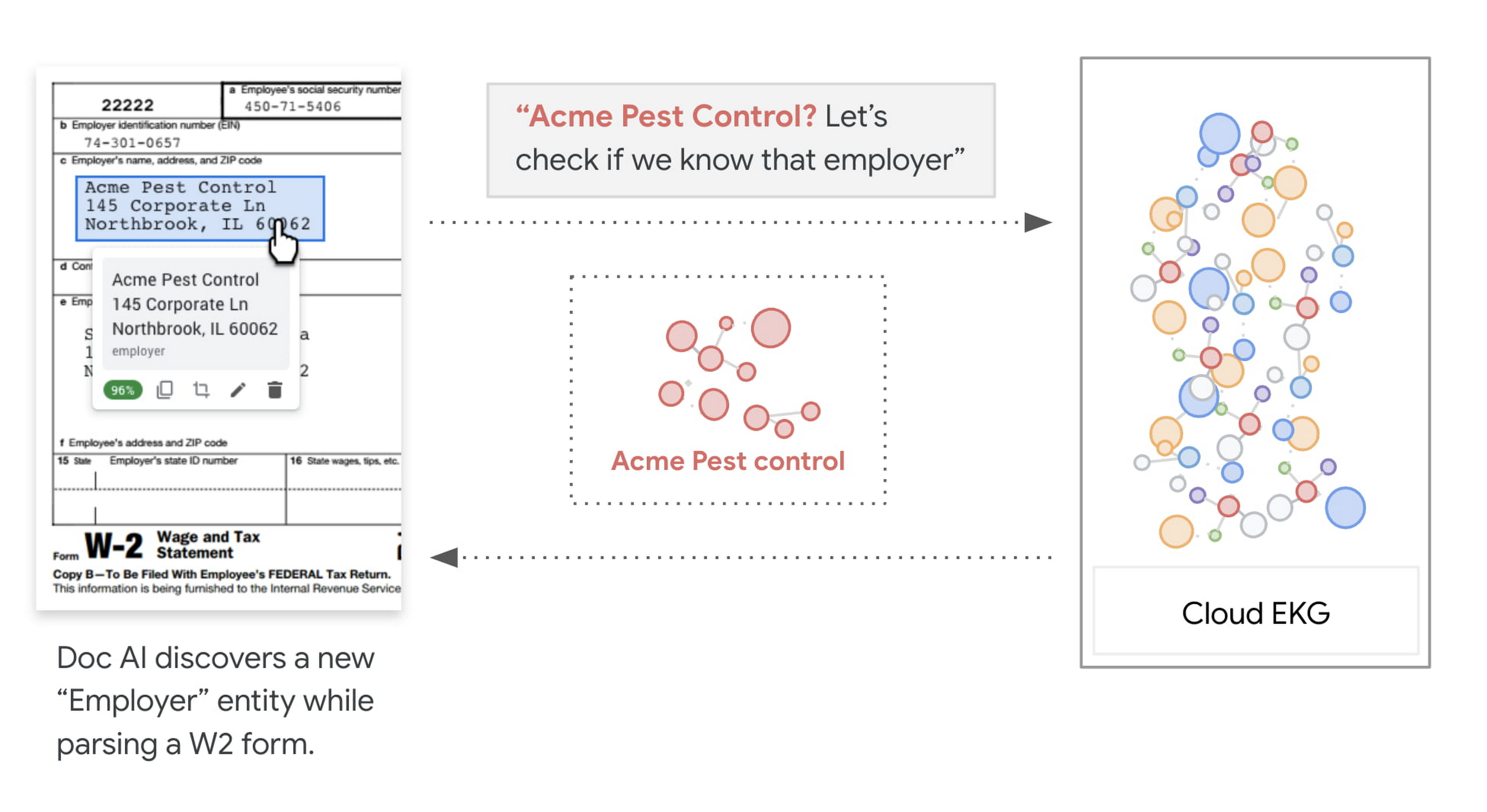
With Document AI, there is a better way. Our native integration with the knowledge graph means that we can deliver both the specific text from the payslip as well as Google’s best understanding of the actual name of the company that operates at this address. This is an important step to translate from “what has been said” on a document to “what does it mean”. By normalizing the value as you process millions of documents, you are improving accuracy and consistency at the beginning of the data processing workflow, making downstream integration, data analytics and business intelligence tasks at ease.
How EKG Enrichment Works
In a nutshell, Knowledge Graph is a knowledge base that uses a graph data model to integrate interlinked entities, including objects, events, processes or abstracted concepts. Google announced its Knowledge Graph in 2012 as a way to organize information from the Web and to enhance Search results. Different from Google Knowledge Graph, Cloud EKG (Enterprise Knowledge Graph) focuses on entities that are more relevant to enterprise customers, such as organization, product, people, locations, etc.
In EKG, every node is called an entity. Each entity in the graph represents an object, such as an organization. EKG aggregates all the information about a thing into a single entity, thus each entity represents a distinct and identifiable real world concept. The uniqueness of these entities in the graph is one of the reasons that make EKG useful. The edges between nodes are called relationships. When representing attributes, the relationships can be considered as properties, such as the name of a company, the price of a product, etc. When representing relationships, they connect entities in the graph, such as the CEO of a company, the seller of a product.

Entity linking, as its name suggests, is the task of assigning a unique identity to entities mentioned in text, images or videos. In the context of EKG, it connects the text mentions to entities in the graph. Under the hood, the recognition takes both the mention and its context information into consideration for linking to the best matching candidates in the graph.
Entity Enrichment, is essentially linking entities in EKG to documents, and using the attributes of linked entities to enrich the extracted information. The entity linking on documents is based on the understanding of both documents and the entities in the graph. First the document parser annotates entity mentions, which provides semantic meanings to the content of the document. Then Entity Linking selects a list of entities from EKG based on the types of these mentions, and matches to the best entity by comparing the attributes found in the document with the the relationships of the selected entities.
How to leverage the enrichment result
Knowledge graph enrichment is a built-in feature for Lending DocAI , Procurement DocAI and Contract DocAI today, and we are actively working on expanding it to cover more document types and parsers on the platform. To use the knowledge graph enriched values, look out for the entities fields under normalizedValue, returned by the API.
{entities: [{"textAnchor": {"content": "Google Singapore"},…."normalizedValue": {"text": "Google Asia Pacific, Singapore"}}]}
To learn more, check out the Document AI webpage, and EKG Enrichment page to see the list of supported parsers and fields.
3126
Of your peers have already watched this video.
21:30 Minutes
The most insightful time you'll spend today!
Interpreting ML Models with Explainable AI
We often trust our high-accuracy ML models to make decisions for our users, but it’s hard to know exactly why or how these models came to specific conclusions.
Explainable AI provides a suite of tools to help you interpret your ML model’s predictions.
Listen to this discussion regarding how to use Explainable AI to ensure our ML models are treating all users fairly and how to analyze image, text, and tabular models from a fairness perspective, using Explanations on AI Platform.
Sara Robinson, Developer Advocate, Google Cloud defines explainability, and what it looks like for different data types. She also demonstrates the different Explainable AI offerings on Google Cloud, runs a demo, and shows how to use the What-if Tool, an open source visualization tool for optimizing your ML model’s performance and fairness.
How Ather Energy is leveraging the Cloud to build and scale smart mobility solutions for India

8382
Of your peers have already read this article.
8:30 Minutes
The most insightful time you'll spend today!
In 2013, long before the world was discussing clean energy and sustainable practices, two IIT Madras graduates — Swapnil Jain and Tarun Mehta — had an idea to develop India’s first-ever electrical scooter.
This was at a time when auto manufacturers were still focusing on fossil-fuel-driven vehicles and ‘eco-friendly’ mobility solutions were more a trendy alternative catering to a niche market.
The duo founded Ather Energy in 2013 and launched their first fully-electric scooter, the Ather S340, in Bengaluru in 2016. Since then, the company has released several new models into the market and is planning to expand to eight more cities by the end of the year.
To support the smooth running of their vehicles, lower costs, improve time to market, and create great customer experience, Ather turned to Google Cloud.
Read the Full Story on YourStory
redBus: Mastering Big Data with Google BigQuery

5388
Of your peers have already read this article.
2:30 Minutes
The most insightful time you'll spend today!
In 2006, online travel agency redBus introduced internet bus ticketing in India, unifying tens of thousands of bus schedules into a single booking operation. (Think of it as Expedia for bus booking.) Using BigQuery, redBus crunches terabytes of booking and inventory data in mere seconds and at a fraction of the cost of other big data services. BigQuery also helps engineers fix glitches quickly, minimize lost sales, and improve customer service.
Challenge
Executives at the Bangalore-based redBus needed a powerful tool to analyze booking and inventory data across their system of hundreds of bus operators serving more than 10,000 routes. They considered using clusters of Hadoop servers to process the data but decided the system would take too much time to set up and would require a specialized staff to maintain it. It also would not provide the lightning-fast analysis they needed.
“It would have taken at least a couple of hours to analyze anything,” says Pradeep Kumar, a technical architect at redBus. “Crunching very large data sets would have been a day’s job. We needed something more powerful to get the real-time analysis we were looking for.”
Solution
Kumar and his colleagues learned about BigQuery and realized it was the right match for their data processing needs. The web-based service, which enables companies to analyze massive datasets using Google’s data processing infrastructure, is easy to set up and manage since its simple, SQL-like query language doesn’t require complex technology or specialized personnel. It also has low overhead costs.
The redBus team uses BigQuery as part of an intricate data collection and analysis process. Applications hosted on a range of servers continually pump information related to customer searches, seat inventory, and bookings into a centralized data collection system. Engineers upload the data to BigQuery, which provides answers to complex queries within seconds. For example, BigQuery helps redBus staff:
- Learn how many times customers searched for seats and found none or very few available, indicating more seats should be added to a route
- Investigate decreases in bookings and notify engineers if a technical problem is the cause
- Identify server problems by quickly analyzing data related to server activity
Results
BigQuery provides near real-time data analysis capabilities at 20% of the cost of maintaining a complex Hadoop infrastructure. Queries that would have required a day to analyze on a Hadoop framework take less than 30 seconds using Google’s web-based service.
“We explored several data analytics solutions. Nothing comes remotely close to the sheer power of Google BigQuery,” Kumar says. “It made large-scale data collection and crunching possible with little effort, which has translated to a significant business advantage.”
Google Cloud Platform results
- Analyzes data sets as large as 2 terabytes in less than 30 seconds using a simple, SQL-like language
- Saves time analyzing technical problems and customer booking trends
- Spends 80% less than they would have on a Hadoop infrastructure and avoids setting up and maintaining a complex infrastructure in-house
- Strengthens the company by improving customer service and engineering quality
The fast insights gained through BigQuery are also making redBus a stronger company. By minimizing the time it takes staff members to solve technical problems, BigQuery has helped improve customer service and reduce lost sales.
“Getting to the root of problems used to be really time-consuming,” Kumar says. “By the time we figured it out, customers might have given up. Now if there are booking problems, BigQuery helps us understand the reason right away. Choosing Google BigQuery was the right decision for our company.”
More Relevant Stories for Your Company


Value Realization with Google Cloud for Retail SAP Data
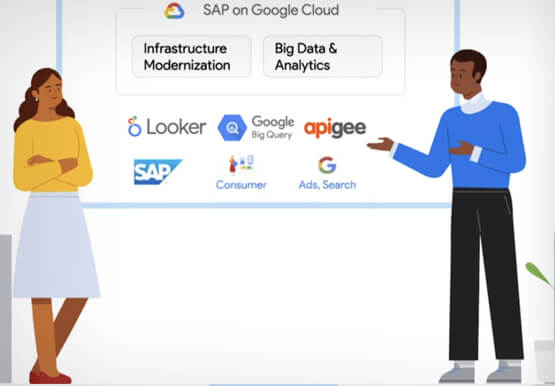
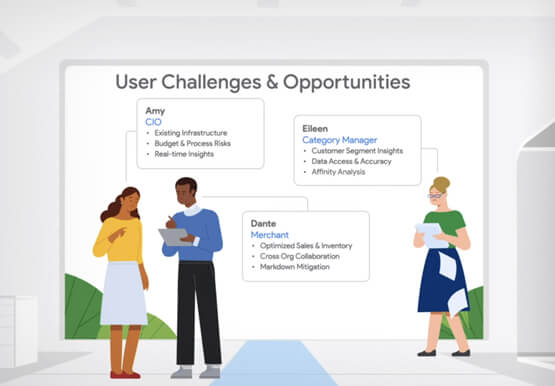
Retail engagements have changed drastically over the last few years, and by the virtue of COVID-19 pandemic, retail data and customers' expectations plummeted. To drive value and transformation across the entire value-chain retailers can make most of Google Cloud's secure, reliable IaaS by migrating their SAP systems and taking advantage

Combining IoT and Analytics to Warn Manufacturers of Line Break Downs and Increase Profitability
Oden Technologies is using the Internet of Things (IoT) to improve the factories of today. The giant network of “things” (including people) connected to each other via the Internet has the potential to reduce waste, increase efficiency, and improve safety across all walks of life. Oden is leading IoT innovation in

Datashare for Financial Services: Securing the Publishers and Consumers’ Access to Market Data
Access to the cloud has advanced the distribution and consumption of financial information on a global scale. In parallel, the global financial data landscape has been transformed by an influx of alternative data sources, including social media, meteorological data, satellite imagery, and other data. Exchanges and market data providers now

How Constellation Brands’ Direct-to-Customer Tech Delivers Economic Impact across Business Portfolio
Editor’s note: Today we’re hearing from Ryan Mason, Director, Head of DTC Growth & Strategy, at alcoholic beverage firm, Constellation Brands on the company’s shift to Direct-to-Consumer (DTC) sales and how Google Cloud’s powerful technology stack helped with this transformation. It’s no secret that consumer businesses have been up-ended in
