





6442
Of your peers have already watched this video.
1:30 Minutes
The most insightful time you'll spend today!
Value Realization with Google Cloud for Retail SAP Data
Retail engagements have changed drastically over the last few years, and by the virtue of COVID-19 pandemic, retail data and customers’ expectations plummeted. To drive value and transformation across the entire value-chain retailers can make most of Google Cloud’s secure, reliable IaaS by migrating their SAP systems and taking advantage of integrations, insights and innovations. In times of change retail companies can gain maximum visibility of SAP data unlocking Google Cloud’s infrastructure modernization and Big Data and analytics capabilities. Watch the video to understand how Google Cloud and SAP partnership is a golden handshake for retail businesses’ future.
US County, the Size of Mangalore, Uses AI to Offer Voice-Enabled Virtual Agent

3063
Of your peers have already read this article.
5:30 Minutes
The most insightful time you'll spend today!
From the historic Gold Country to the rugged heights of the Sierra Nevada, Placer County encompasses more than 1,500 square miles—and provides services to nearly 400,000 residents. Across the county, residents access resources in person, over the phone, and through the county website. In 2018, the county piloted a suite of eServices through its Community Development Resource Agency (CDRA) with the goal of helping its geographically dispersed population more easily apply for permits, make appointments, and get immediate answers to specific questions.
Now, with the help of Google Cloud Dialogflow and Speech-to-Text API, the county has created a virtual agent that enables anyone, anywhere, to simply start a conversation by saying “Ask Placer County” into a variety of voice assistant hardware. This virtual agent builds on the success of eServices and helps the public access information through their smartphones or smart home devices, which is especially helpful for individuals without immediate access to a computer—such as the traveling public or a contractor working on-site, for example.
The pilot program has been an opportunity to explore new technology and create another communication channel to our citizens. “Our ambitious and long-term goal is that ‘Ask Placer County’ will be like having a personal assistant to everything related to Placer County. While the virtual agent is currently limited to a few departments, we plan to expand it countywide,” says Ben Palacio, senior IT analyst for Placer County.
“Our ambitious and long-term goal is that ‘Ask Placer County’ will be like having a personal assistant to everything related to Placer County. While the virtual agent is currently limited to a few departments, we plan to expand it countywide.”
—Ben Palacio, Senior IT Analyst, Placer County
New eServices get a boost from AI virtual agent
The CDRA, one of many departments and agencies within Placer County, deployed interactive eServices for residents. As part of this initiative, the CDRA made a special request to the information technology (IT) department: Build an AI-based virtual agent that would spotlight the eServices on the website and make them easily available through a conversational interface.
“Having a specific technology requirement voiced by an agency was visionary and very welcome. It meant they were engaged and excited about the possibilities that these new technologies had to offer,” says Mike Spak, IT Manager for Placer County.
Today, the CDRA’s eServices help residents answer important questions, such as: “Is my land zoned for adding a garage?” “What historical engineering work has been done on my property?” And, “How can I make an appointment at a permitting office?”
“Having a specific technology requirement voiced by an agency was visionary and very welcome. It meant they were engaged and excited about the possibilities that these new technologies had to offer.”
—Mike Spak, IT Manager, Placer County
Google Cloud fit easily into Placer County’s multivendor environment
With the help of consultants from Dito, a Google Cloud Premier Partner, Placer County chose Google Cloud to help with “Ask Placer County.”
Placer County runs a multivendor IT environment. “Especially with the cloud, the easier it is to integrate a vendor’s capabilities with others, the better for everybody,” says Palacio. “Google Cloud was able to integrate with other vendors’ capabilities for this project.”
For example, Placer County uses the Google Cloud operations suite (formerly Stackdriver) to monitor, troubleshoot, and improve its cloud infrastructure and application performance. And it uses Dialogflow, which powers the natural language processing (NLP) interface of the “Ask Placer County” virtual agent. Both integrate easily with tools from other vendors.
“Especially with the cloud, the easier it is to integrate a vendor’s capabilities with others, the better for everybody. Google Cloud was able to integrate with other vendors’ capabilities for this project.”
—Ben Palacio, Senior IT Analyst, Placer County
Real-time conversations powered by “Ask Placer County”
Dito got “Ask Placer County” up and running using App Engine and Datastore. Today, the “Ask Placer County” virtual agent provides information ranging from how to adopt a pet to short-term-rental compliance.
Users can say “Ask Placer County” into their smartphones or their computer microphones and access targeted information from the pilot departments. IT staff reviews the asked questions and are constantly updating the virtual agent to provide more accurate and responsive information.
“You could be in your backyard with a contractor trying to get a project started, and if the contractor has a question about permitting or zoning, they can use their smartphone to get an answer right then and there, rather than having to interrupt the meeting, get back in their car, and drive to a county office,” says Palacio.
The county hopes “Ask Placer County” will improve the efficiency of in-person interactions between the public and county employees as well. Because the public can access common questions and information online or through the virtual agent, employees’ interactions with the public can be more focused and productive.
“We are providing more effective and efficient service to our customers through 24/7 access to information and by reducing the proportion of staff’s time in responding to emails and voicemails to answer our customer questions,” says Shawna Purvines, Principal Planner for Placer County.
According to Placer County, the virtual agent currently answers a monthly average of around 200 questions for the CDRA, and the county continues to develop more and more complete answers across participating departments.
“We are providing more effective and efficient service to our customers through 24/7 access to information and by reducing the proportion of staff’s time in responding to emails and voicemails to answer our customer questions.”
—Shawna Purvines, Principal Planner, Placer County
Constantly evolving based on users’ needs
To best serve the needs of the CDRA, and potentially other departments over time, “Ask Placer County” continues to evolve. The county can add and retire questions based on the needs of constituents. This technology can be tailored to address current needs, such as responding to COVID-19. “Our hope is that, in quickly evolving situations, the virtual agent can be a resource for the public to access real-time information about public services,” says Palacio.
As a component of the eServices group, “Ask Placer County” has kept construction and development in Placer County operational during the COVID-19 pandemic, and it continues to provide opportunities for the public to access county resources without coming in to the counters, reducing the need for in-person visits. In fact, according to Placer County data, permit applications have increased by 17%.
Placer County also performs analytics using the Google Cloud operations suite to gain insights into the most popular questions and, just as importantly, the questions that are not being answered. “We get insight into what we’re missing—for those times when the virtual agent can’t find a response in our database,” says Palacio. Placer County uses these insights to improve answers and ultimately improve the efficacy of the virtual agent over time.
“This continual, real-time learning is the exciting part of the application that lets us help constituents in entirely new ways. It’s really cool,” says Palacio.
County IT workers actively analyze CDRA webpages to determine which are the most visited and to craft questions and answers to add to “Ask Placer County.” According to Placer County, the number of questions the virtual agent can answer is now more than 600. But the CDRA pages are just a small subset of the 5,000 pages that make up the Placer County website. A future goal is to provide a backstop for customer questions that can’t be answered, transferring those customers to county staff for resolution.
“Looking ahead, this technology has the ability to provide answers to thousands and thousands of questions,” says Palacio.
“This continual, real-time learning is the exciting part of the application that lets us help constituents in entirely new ways. It’s really cool.”
—Ben Palacio, Senior IT Analyst, Placer County
Scaling “Ask Placer County” countywide
The limited rollout of the virtual agent technology allowed IT to monitor its effectiveness and make initial adjustments. As the virtual agent evolves, the Placer County chief information officer sees opportunities for it to engage the public countywide.
The “Ask Placer County” virtual agent can truly be a concierge, helping the public navigate county resources. It can help citizens become more engaged with their elected officials, it can provide information, and it can more efficiently connect the public with the services they seek.
Some of the future possibilities include providing current information on board meetings and individual elected officials, checking on permit status and burn days, and getting the latest county news. “There are so many ways we can use this solution to tackle issues within the county that we’re going to have to somehow prioritize them,” says Palacio.
Transform ‘Dark Data’ from Documents with Document AI, Cloud Functions and Workflows

8197
Of your peers have already read this article.
2:00 Minutes
The most insightful time you'll spend today!
At enterprises across industries, documents are at the center of core business processes. Documents store a treasure trove of valuable information whether it’s a company’s invoices, HR documents, tax forms and much more. However, the unstructured nature of documents make them difficult to work with as a data source. We call this “dark data” or unstructured data that businesses collect, process and store but do not utilize for purposes such as analytics, monetization, etc. These documents in pdf or image formats, often trigger complex processes that have historically relied on fragmented technology and manual steps. With compute solutions on Google Cloud and Document AI, you can create seamless integrations and easy to use applications for your users. Document AI is a platform and a family of solutions that help businesses to transform documents into structured data backed by machine learning. In this blog post we’ll walk you through how to use Serverless technology to process documents with Cloud Functions, and with workflows of business processes orchestrating microservices, API calls, and functions, thanks to Workflows.
At Cloud Next 2021, we presented how to build easy AI-powered applications with Google Cloud. We introduced a sample application for handling incoming expense reports, analyzing expense receipts with Procurement Document AI, a DocAI solution for automating procurement data capture from forms including invoices, utility statements and more. Then organizing the logic of a report approval process with Workflows, and used Cloud Functions as glue to invoke the workflow, and do analysis of the parsed document.
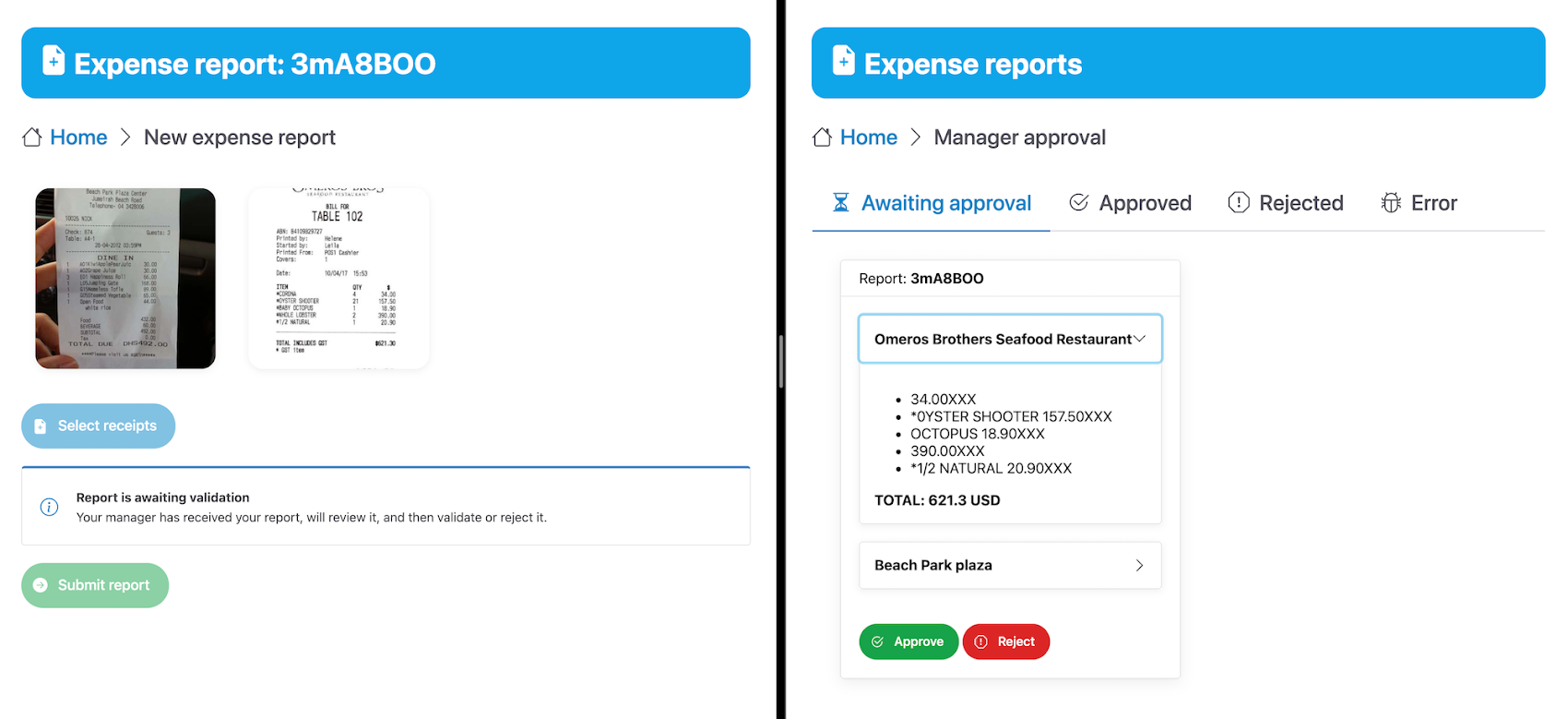
We also open sourced the code on this Github repository, if you’re interested in learning more about this application.
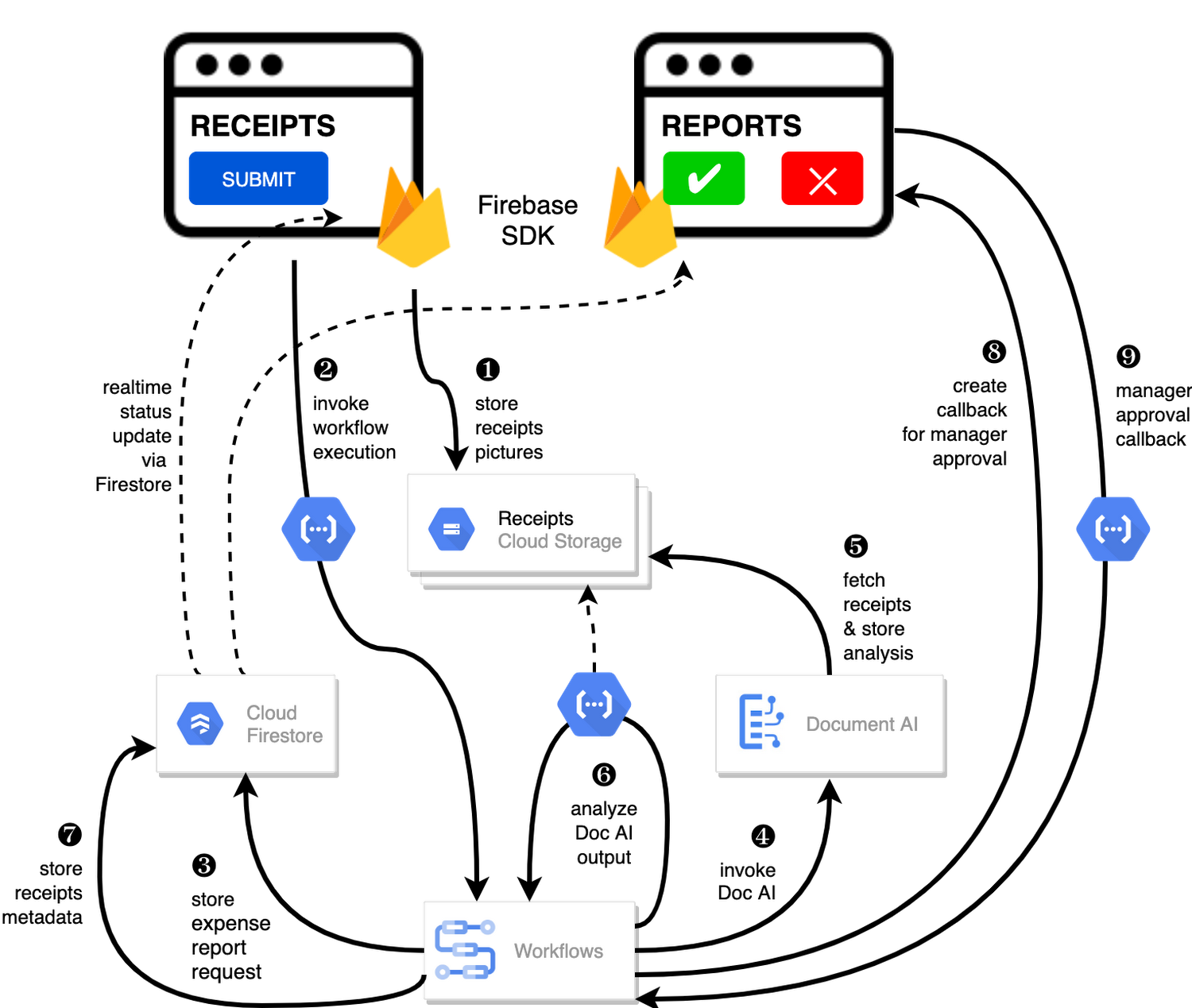
In the above diagram, there are two user journeys: the employee submitting an expense report where multiple receipts are processed at once, and the manager validating or rejecting the expense report.
First, the employee goes to the website, powered by Vue.js for the frontend progressive JavaScript framework and Shoelace for the library of web components. The website is hosted via Firebase Hosting. The frontend invokes an HTTP function that triggers the execution of our business workflow, defined using the Workflows YAML syntax.
Workflows is able to handle long-running operations without any additional code required, in our case we are asynchronously processing a set receipt files. Here, the Document AI connector directly calls the batch processing endpoint for service. This API returns a long-running operation: if you poll the API, the operation state will be “RUNNING” until it has reached a “SUCCEEDED” or “FAILED” state. You would have to wait for its completion. However, Workflows’ connectors handle such long-running operations, without you having to poll the API multiple times till the state changes. Here’s how we call the batch processing operation of the Document AI connector:
- invoke_document_ai:call: googleapis.documentai.v1.projects.locations.processors.batchProcessargs:name: ${"projects/" + project + "/locations/eu/processors/" + processorId}location: "eu"body:inputDocuments:gcsPrefix:gcsUriPrefix: ${bucket_input + report_id}documentOutputConfig:gcsOutputConfig:gcsUri: ${bucket_output + report_id}skipHumanReview: trueresult: document_ai_response
Machine learning uses state of the art Vision and Natural Language Processing models to intelligently extract schematized data from documents with Document AI. As a developer, you don’t have to figure out how to fine tune or reframe the receipt pictures, or how to find the relevant field and information in the receipt. It’s Document AI’s job to help you here: it will return a JSON document whose fields are: line_item, currency, supplier_name, total_amount, etc. Document AI is capable of understanding standardized papers and forms, including invoices, lending documents, pay slips, driver licenses, and more.
A cloud function retrieves all the relevant fields of the receipts, and makes its own tallies, before submitting the expense report for approval to the manager. Another useful feature of Workflows is put to good use: Callbacks, that we introduced last year. In the workflow definition we create a callback endpoint, and the workflow execution will wait for the callback to be called to continue its flow, thanks to those two instructions:
- create_callback:call: events.create_callback_endpointargs:http_callback_method: "POST"result: callback_details...- await_callback:try:call: events.await_callbackargs:callback: ${callback_details}timeout: 3600result: callback_requestexcept:as: esteps:- update_status_to_error:...
In this example application, we combined the intelligent capabilities of Document AI to transform complex image documents into usable structured data, with Cloud Functions for data transformation, process triggering, and callback handling logic, and Workflows enabled us to orchestrate the underlying business process and its service call logic.
Going further
If you’re looking to make sense of your documents, turning dark data into structured information, be sure to check out what Document AI offers. You can also get your hands on a codelab to get started quickly, in which you’ll get a chance at processing handwritten forms. If you want to explore Workflows, quickstarts are available to guide you through your first steps, and likewise, another codelab explores the basics of Workflows. As mentioned earlier, for a concrete example, the source code of our smart expense application is available on Github. Don’t hesitate to reach out to us at @glaforge and @asrivas_dev to discuss smart scalable apps with us.
4903
Of your peers have already watched this video.
5:00 Minutes
The most insightful time you'll spend today!
Video: How AI is Helping Biologists Protect Wildlife
According to the World Wildlife Fund, vertebrate populations have shrunk an average of 60 percent since the 1970s. And a recent UN global assessment found that we’re at risk of losing one million species to extinction, many of which may become extinct within the next decade.
To better protect wildlife, seven organizations, led by Conservation International, and Google have mapped more than 4.5 million animals in the wild using photos taken from motion-activated cameras known as camera traps. The photos are all part of Wildlife Insights, an AI-enabled, Google Cloud-based platform that streamlines conservation monitoring by speeding up camera trap photo analysis.
With photos and aggregated data available for the world to see, people can change the way protected areas are managed, empower local communities in conservation, and bring the best data closer to conservationists and decision-makers.
Camera traps help researchers assess the health of wildlife species, especially those that are reclusive and rare. Worldwide, biologists and land managers place motion-triggered cameras in forests and wilderness areas to monitor species, snapping millions of photos a year.
But what do you do when you have millions of wildlife selfies to sort through? On top of that, how do you quickly process photos where animals are difficult to find, like when an animal is in the dark or hiding behind a bush? And how do you quickly sort through up to 80 percent of photos that have no wildlife at all because the camera trap was triggered by the elements, like grass blowing in the wind?
Watch this video to find out.
4 Methods How AI/ML Boosts Innovation and Reduces Costs

2922
Of your peers have already read this article.
2:30 Minutes
The most insightful time you'll spend today!
“Cloud Wisdom Weekly: for tech companies and startups” is a new blog series we’re running this fall to answer common questions our tech and startup customers ask us about how to build apps faster, smarter, and cheaper. In this installment, we explore how to leverage artificial intelligence (AI) and machine learning (ML) for faster innovation and efficient operational growth.
Whether they’re trying to extract insights from data, create faster and more efficient workflows via intelligent automation, or build innovative customer experiences, leaders at today’s tech companies and startups know that proficiency in AI and ML is more important than ever.
AI and ML technologies are often expensive and time-consuming to develop, and the demand for AI and ML experts still largely outpaces the existing talent pool. These factors put pressure on tech companies and startups to allocate resources carefully when considering bringing AI/ML into their business strategy. In this article, we’ll explore four tips to help tech companies and startups accelerate innovation and reduce costs with AI and ML.
4 tips to accelerate innovation and reduces costs with AI and ML
Many of today’s most innovative companies are creating services or products that couldn’t exist without AI—but that doesn’t mean they’re building their AI and ML infrastructure and pipelines from scratch. Even for startups whose businesses don’t directly revolve around AI, injecting AI into operational processes can help manage costs as the company grows. By relying on a cloud provider for AI services, organizations can unlock opportunities to energize development, automate processes, and reduce costs.
1. Leverage pre-trained ML APIs to jumpstart product development
Tech companies and startups want their technical talent focused on proprietary projects that will make a difference to the business. This often involves the development of new applications for an AI technology, but not necessarily the development of the AI technology itself. In such scenarios, pre-trained APIs help organizations quickly and cost-effectively establish a foundation on which higher-value, more differentiated work can be layered.
For example, many companies building conversational AI into their products and services leverage Google Cloud APIs such as Speech-to-Text and Natural Language. With these APIs, developers can easily integrate capabilities like transcription, sentiment analysis, content classification, profanity filtering, speaker diarization, and more. These powerful technologies help organizations focus on creating products rather than having to build the base technologies.
See this article for examples of why tech companies and startups have chosen Google Cloud’s Speech APIs for use cases that range from deriving customer insights to giving robots empathetic personalities. For an even deeper dive, see
- our AI product page to explore other APIs, including Translation, Vision, and more;
- and the Google Cloud Skills Boost for ML APIs.
2. Use managed services to scale ML development and accelerate deployment of models to production
Pre-trained models are extremely useful, but in many cases, tech companies and startups need to create custom models to either derive insights from their own data or to apply new use cases to public data. Regardless of whether they’re building data-driven products or generating forecasting models from customer data, companies need ways to accelerate the building and deployment of models into their production environments.
A data scientist typically starts a new ML project in a notebook, experimenting with data stored on the local machine. Moving these efforts into a production environment requires additional tooling and resources, including more complicated infrastructure management. This is one reason many organizations struggle to bring models into production and burn through time and resources without moving the revenue needle.
Managed cloud platforms can help organizations transition from projects to automated experimentation at scale or the routine deployment and retraining of production models. Strong platforms offer flexible frameworks, fewer lines of code required for model training, unified environments across tools and datasets, and user-friendly infrastructure management and deployment pipelines.
At Google Cloud, we’ve seen customers with these needs embrace Vertex AI, our platform for accelerating ML development, in increasing numbers since it launched last year. Accelerating time to production by up to 80% compared to competing approaches, Vertex AI provides advanced end-to-end ML Ops capabilities so that data scientists, ML engineers, and developers can contribute to ML acceleration. It includes low-code features, like AutoML, that make it possible to train high performing models without ML expertise.
Over the first half of 2022, our performance tests found that the number of customers utilizing AI Workbench increased by 25x. It’s exciting to see the impact and value customers are gaining with Vertex AI Workbench, including seeing it help companies speed up large model training jobs by 10x and helping data science teams improve modeling precision from the 70-80% range to 98%.
If you are new to Vertex AI, check out this video series to learn how to take models from prototype to production. For deeper dives, see
- this article about Vertex AI’s role in an ambitious project to measure climate change with AI;
- BigQuery has built-in Machine Learning (ML) and Analytics that you can use to create no-code predictions using just SQL queries.
- this blog about how Vertex AI and BigQuery work together to make data analysis easier and more powerful;
- and this blog about Example-based explanations, one of our most recent updates to make model iteration more intuitive and efficient.
3. Harness the cloud to match hardware to use cases while minimizing costs and management overhead
ML infrastructure is generally expensive to build, and depending on the use case, specific hardware requirements and software integrations can make projects costly and complicated at scale. To solve for this, many tech companies and startups look to cloud services for compute and storage needs, attracted by the ability to pay only for resources they use while scaling up and down according to changing business needs.
At Google Cloud, customers share that they need the ability to optimize around a variety of infrastructure approaches for diverse ML workloads. Some use Central Processing Units (CPUs) for flexible prototyping. Others leverage our support for NVIDIA Graphics Processing Units (GPUs) for image-oriented projects and larger models, especially those with custom TensorFlow operations that must run partially on CPUs. Some choose to run on the same custom ML processors that power Google applications—Tensor Processing Units (TPUs). And many use different combinations of all of the preceding.
Beyond matching use cases to the right hardware and benefiting from the scale and operational simplicity of a managed service, tech companies and startups should explore configuration features that help further control costs. For example, Google Cloud features like time-sharing and multi-instance capabilities for GPUs — as well as features like Vertex AI Training Reduction Server — are built to optimize GPU costs and usage.
Vertex AI Workbench also integrates with the NVIDIA NGC catalog for deploying frameworks, software development kits and Jupyter Notebooks with a single click—another feature that, like Reduction Server, speaks to the ways organizations can make AI more efficient and less costly via managed services.
4. Implement AI for operations
Besides using pre-trained APIs and ML model development to develop and deliver products, startup and tech companies can improve operational efficiency, especially as they scale, by leveraging AI solutions built for specific business and operational needs, like contract processing or customer service.
Google Cloud’s DocumentAI products, for instance, apply ML to text for use cases ranging from contract lifecycle management to mortgage processing. For businesses whose customer support needs are growing, there’s Contact Center AI, which helps organizations build intelligent virtual agents, facilitate handoffs as appropriate between virtual agents and human agents, and generate insights from call center interactions. By leveraging AI to help manage operational processes, startups and tech companies can allocate more resources to innovation and growth.
Next steps toward an intelligent future
The tips in this article can help any tech company or startup find ways to save money and boost efficiency with AI and ML. You can learn more about these topics by registering for Google Cloud Next, kicking off October 11, where you’ll hear Google Cloud’s latest AI news, discussions, and perspectives—in the meantime, you can also dive into our Vertex AI quickstarts and BigQuery ML tutorials. And for the latest on our work with tech companies and startups, be sure to visit our Startups page.
How Google Cloud’s Scalable Data Storage and High Compute Resources Fuel Investment Research

6293
Of your peers have already read this article.
1:30 Minutes
The most insightful time you'll spend today!
Investment management is a heavily data-driven industry—portfolio managers and investment researchers require a large number of data sources to guide them in shaping their investment strategies.
New cloud capabilities and technologies enable investment managers to process data faster than ever before and iterate on ideas quickly to fuel innovation in the signal generation process and gain a competitive edge.
Using the cloud for investment research workflows makes it easier to onboard data from data providers, spin up large compute workloads in the midst of market volatility or during heavy research cycles, and manage complex machine learning or natural language workflows to gain market insights.
We hear from industry leaders that they’re exploring new ways to run investment research. “Differentiated investment strategies require new types of information sources, and new ways to process that information,” David Easthope, senior analyst, Market Structure and Technology, Greenwich Associates. “And that, of course, relies heavily on having access to reliable and scalable storage, computational, and AI / ML resources. More specifically, quantitative strategies can benefit from the computational platforms and embedded AI/ML capabilities the cloud can offer.”
Google Cloud gives investment managers essential components to work and operate faster as they bring their investment research workflows to the cloud. Here are the key highlights:
1. Simplify, speed up your data acquisition, discovery, and analytics
The foundation of any investment strategy starts with data—acquiring it, detecting patterns, and analyzing it for insights. Enabling data providers to easily share large datasets such as tick history within a high-performance analytics engine can greatly reduce the data engineering overhead when possible.
Once data is onboarded, you can tag business and technical metadata related to your datasets and provide portfolio managers the ability to discover these datasets via a search interface.
We further review analytics options for various scenarios, including aggregating massive datasets, creating dashboards, and incorporating streaming analytics workloads.
2. Take advantage of burst compute workloads
Data engineers and researchers require ready access to burst compute capabilities to perform backtesting, portfolio simulations and run risk calculations. Cloud works well for these workloads due to its elasticity, consumption-based models, and hardware evolution.
Many investment managers are shifting to a container-based strategy along with a Kubernetes-based scheduler for greater consistency, scaling and efficiency in environments with a large number of researchers. Cloud managed services and a rich suite of CI/CD tools can make this vision a reality while improving security and developer productivity.
3. Tackle machine learning (ML) and model deployment with the help from cloud
Quantitative researchers scour vast amounts of market and alternative data sources searching for signals and correlations, while ML engineers have the challenge of taking these signals and moving them to production.
Google Cloud empowers users to create and operationalize their models without wasting valuable time with a comprehensive set of MLOps tools.
In this paper, we explore multiple solutions for ML and model deployment. Those capabilities reduce the amount of time operationalizing ML models, so quants and data scientists have more time to devote to differentiating activities.
4. Get the data you need in less time with Natural Language and Document AI
Thousands of financial filings, news articles, and sell-side research reports are generated every day, and it’s difficult for humans alone to process this volume of information. These documents are often generated in many languages and the ability to do entity recognition, sentiment or syntactical analysis in those languages, or perhaps translate them into the language of the portfolio manager is of critical importance. Google Cloud provides these capabilities through pre-trained models, or allows you to train high-quality models with your own datasets.
Getting started
There are plenty of emerging technologies, tools, and approaches available to help investment managers today. At Google Cloud, we can help you access, organize, and utilize these essential components to make your research faster, reliable, and more valuable.
To learn more about these four keys to better investment research, check out our whitepaper for more.
More Relevant Stories for Your Company

Improving Patient Outcomes with SAVI and Google Cloud’s Innovative Surgical Instrument Tracking
Powered by Vertex AI (Google Cloud’s platform for accelerating development and deployment of machine learning models into production), SAVI (Semi Automated Vision Inspection)1 is transforming surgical instrument identification and cataloging, leading to fewer canceled surgeries and easing pressure on surgery waitlists. Max Kelsen, an analytics and software agency that specializes

Speak Now to Book a Flight: easyJet’s Uses AI to Improve Customer Experience
With a growing fleet of 325 aircraft that cover more than 1,000 routes across 158 airports, easyJet is one of Europe’s most popular airlines. And easyJet serves an average of 90 million passengers each year, so a helpful mobile experience for its customers is a top priority. Travellers today are

Elevating Voice Solutions: Google Cloud Introduces Speech-to-Text v2 API and Chirp for Businesses
As one of the most innate and ubiquitous forms of expression, speech is a fundamental pillar of human interaction. It comes as no surprise, then, that Google Cloud’s Speech API has become a crucial tool for enterprise customers, launched to general availability (GA) over six years ago and, now, processing over 1

Google Cloud Next ’22 to Commence in October: Block Your Calendar!
We’re excited to announce that Google Cloud Next returns on October 11–13, 2022. Join us for keynotes from industry luminaries and engage live with Google developers. Explore dynamic content across various learning levels, and dive deep into technologies and solutions spanning the Google Cloud and Google Workspace portfolios. Participate in breakout sessions,
