





Strategic Consulting, Training & Implementation Guidelines with Public Sector PSO Helps Governments Stay Compliant

4713
Of your peers have already read this article.
3:00 Minutes
The most insightful time you'll spend today!
Did you know that by 2025, enterprise IT spending on public cloud computing will overtake traditional IT spending? In fact, 51% of IT spend in application software, infrastructure software, business process services, and system infrastructure will transition to the public cloud, compared to 41% in 20221.. As enterprises continue to rapidly shift to the cloud, government agencies must prioritize and accelerate security and compliance implementation.
In May 2021, the White House issued an Executive Order requiring US Federal agencies to accelerate cloud adoption, embrace security best practices, develop plans to implement Zero Trust architectures, and map implementation frameworks to FedRAMP. The Administration’s focus on secure cloud adoption marks a critical shift to prioritizing cybersecurity at scale. Google Cloud’s Public Sector Professional Services Organization (PSO) has committed to helping customers meet security and compliance requirements in the cloud through specialized consulting engagements.
Accelerating Authority to Operate (ATO)
The Federal Risk and Authorization Management Program (FedRAMP) was established in 2011 as a government-wide program that promotes the adoption of secure cloud services across the federal government. FedRAMP provides a standardized approach to security and risk assessment for cloud technologies and federal agencies. US Federal agencies are required to utilize and implement FedRAMP cloud service offerings as part of the “Cloud First” federal cloud computing strategy.
While Google Cloud provides a FedRAMP-authorized cloud services platform and a robust catalog of FedRAMP-approved products and services (92 services and counting), customers are still tasked with achieving Agency ATO for the products and services they use, and Google Cloud provides many resources to assist customers with this journey. Google Cloud’s FedRAMP package can be accessed by completing the FedRAMP Package Access Request Form and submitting it to info@fedramp.gov. Additionally, customers can use Google’s NIST 800-53 ATO Accelerator as a starting point for documenting control implementation. Finally, Google Cloud’s Public Sector PSO offers the following strategic consulting engagements to help customers streamline the Agency ATO process.
- Cloud Discover: FedRAMP is a six-week interactive workshop to support customers that are just getting started with the ATO process on Google Cloud. Customers are educated on FedRAMP fundamentals, Google’s security and compliance posture, and how to approach ATO on Google Cloud. Through deep-dive interviews and design sessions, PSO helps customers craft an actionable ATO plan, assess FedRAMP readiness, and develop a conceptual ATO boundary. This engagement helps organizations establish a clear understanding and roadmap for FedRAMP ATO on Google Cloud.
- FedRAMP Security Review is a ten to twelve week engagement that aids customers in FedRAMP operational readiness. PSO consultants perform detailed FedRAMP architecture reviews to identify potential gaps in NIST 800-53 security control implementation and Google Cloud secure architecture best practices. Findings from the security reviews are shared with the customer along with configuration guidance and recommendations. This engagement helps organizations prepare for the third-party or independent security assessment that is required for FedRAMP ATO.
- Cloud Deploy: FedRAMP is a multi-month engagement designed to help customers document the details of their FedRAMP System Security Plan (SSP) and corresponding NIST 800-53 security controls, in preparation for Agency ATO on Google Cloud at FedRAMP Low, Moderate, or High. PSO collaborates with customers to develop a detailed technical infrastructure design document and security control matrix capturing evidence of the FedRAMP system architecture, security control implementation, data flows and system components. PSO can also partner with a third-party assessment organization (3PAO) or an independent assessor (IA) to support customer efforts for FedRAMP security assessment. This engagement helps customer system owners prepare for Agency ATO assessment and package submission.
Developing a Zero Trust Strategy
In addition to providing FedRAMP enablement, Public Sector PSO has partnered with the Google Cloud Chief Information Security Officer (CISO) team to assist organizations with developing a zero trust architecture and strategy.
Zero Trust Foundations is a seven-week engagement co-delivered by Google Cloud’s CISO and PSO teams. CISO and PSO educate customers on zero trust fundamentals, Google’s journey to zero trust through BeyondCorp, and defense in depth best practices. The CISO team walks customers through a Zero Trust Assessment (ZTA) to understand the organization’s current security posture and maturity. Insights from the ZTA enable the CISO team to work with the customer to identify an ideal first-mover workload for zero trust adoption. Following the CISO ZTA, PSO facilitates a deep-dive Zero Trust Workshop (ZTW), collaborating with key customer stakeholders to develop a NIST 800-207 aligned, cloud-agnostic zero trust architecture for the identified first-mover workload. The zero trust architecture is part of a comprehensive zero trust strategy deliverable that is based on focus areas called out in the Office of Management and Budget (OMB) Federal Zero Trust Strategy released January 2022.
Scaling Secure Cloud Adoption with PSO
Public Sector PSO enables customer success by sharing our technical expertise, providing cloud strategy, implementation guidance, training and enablement using our proven methodology. As enterprise IT, operations, and organizational models continue to evolve, our goal is to help government agencies accelerate their security and compliance journeys in the cloud. To learn more about the work we are doing with the federal government, visit cloud.google.com/solutions/federal-government.

1115
Of your peers have already downloaded this article
1:30 Minutes
The most insightful time you'll spend today!
A common perception is that migrating existing workloads to the public cloud—especially those with a lot of data—is complex, time consuming, and risky. But with the right planning, organizations can rapidly establish the right practices to accelerate migrations, lower risk, and succeed in the cloud.
Google Cloud Launches Digital Assets Team to Power the Emerging Blockchain Space

3105
Of your peers have already read this article.
1:30 Minutes
The most insightful time you'll spend today!
Blockchain technology is yielding tremendous innovation and value creation for consumers and businesses around the world. As the technology becomes more mainstream, companies need scalable, secure, and sustainable infrastructure on which to grow their businesses and support their networks. We believe Google Cloud can play an important role in this evolution.
Building on our existing work with blockchain developers, exchanges, and other companies in this space, we are announcing today a new, dedicated Digital Assets Team within Google Cloud to support our customers’ needs in building, transacting, storing value, and deploying new products on blockchain-based platforms. This new team will enable our customers to accelerate their efforts in this emerging space and help underpin the blockchain ecosystems of tomorrow.
What We’re Doing Today (and Into the Future)
Blockchain and distributed-ledger-based companies like Hedera, Theta Labs, and Dapper Labs have already chosen to build on top of Google Cloud for scalability, flexibility, and security. Moving forward, Google Cloud’s Digital Assets Team will undertake a number of short- and long-term initiatives to support companies in the digital assets/blockchain ecosystem, including:
- Providing dedicated node hosting/remote procedure call (RPC) nodes for developers, allowing users to deploy blockchain validators on Google Cloud via a single click (“click to deploy”).
- Participating in node validation and on-chain governance with select partners.
- Helping developers and users host their nodes on the cleanest cloud in the industry, supporting their environmental, social, and governance initiatives.
- Supporting on-chain governance via participation from Google Cloud executives and senior engineers.
- Hosting several public BigQuery datasets on our Marketplace, including full blockchain transaction history for Bitcoin, Ethereum, Bitcoin Cash, Dash, Litecoin, Zcash, Theta, Hedera Hashgraph, Band Protocol, Polygon, XRP, and Dogecoin.
- Driving co-development and integration into Google’s robust partner ecosystem, including participating in the Google Cloud Marketplace.
- Embracing joint go-to-market initiatives with our ecosystem partners where Google Cloud can be the connective tissue between traditional enterprise and blockchain technologies.
As we build out our team, we’re also exploring opportunities in the future to enable Google Cloud customers to make and receive payments using cryptocurrencies.
Why Partner with Google Cloud
Our customers in this space—both traditional firms seeking to implement blockchain strategies and blockchain-native companies, such as exchanges, app providers, and decentralized platforms—are choosing Google Cloud for three key reasons:
- First, their businesses and their developer ecosystems can build on the industry’s cleanest cloud. Growing in a sustainable manner is top-of-mind for many businesses, but is particularly relevant in the blockchain space, where the ability to run and scale sustainably is critical. Google is carbon neutral today, and we’ve announced our goal to run on carbon-free energy, 24/7 at all of our data centers by 2030. We’ve also rolled out the ability for customers to choose a Google Cloud region in which to run based on carbon footprint data.
- Second, developers building on blockchain-based platforms can benefit from Google’s world-class developer platform. Google Cloud infrastructure ensures that developers can speed up the delivery of software and data on the blockchain, delivering fast access to applications for users.
- Third, Google Cloud technologies and services will ensure that blockchain-based companies can scale securely and reliably. Google can ensure that data, applications, games, or digital assets like NFTs will be delivered on a stable, secure, and trusted global network.
Google Cloud’s Approach to Blockchain and Digital Assets
Blockchains and digital assets are changing the way the world stores and moves its information —as well as value. As an infrastructure provider, Google Cloud views the evolution of blockchain technology and decentralized networks today as analogous to the rise of open source and the internet 10-15 years ago. Just as open source developments were integral to the early days of the internet, blockchain is yielding innovation and value creation for consumers and businesses. As the technology becomes more mainstream, companies will need scalable, secure infrastructure on which to grow their businesses and support their networks.
As such, we’re applying Google Cloud technology to the blockchain market with the following principles:
- Consistent with Google Cloud’s core business: We are specialists in data-powered innovation with leading infrastructure, industry solutions, and other cutting-edge technology. We pursue blockchain projects and partnerships that align with our mission and our expertise.
- User trust and governance: Blockchain networks raise novel questions concerning legal compliance and user privacy. We will maintain our commitment to our users through a robust focus on privacy and user trust, as well as an uncompromising focus on compliance with applicable laws.
- Network-agnostic: Google’s infrastructure will seek to preserve optionality of networks for the benefit of users.
We’re inspired by the work already done in the digital assets space by our customers, and we look forward to providing the infrastructure and technologies to support what’s possible with blockchain technologies in the future. If you’re eager to learn more about Google Cloud’s new Digital Assets Team, please reach out to your Google Cloud sales representative or partner manager.
Google Cloud Introduces Enterprise-grade Scheduler across All GCP Regions

3416
Of your peers have already read this article.
1:30 Minutes
The most insightful time you'll spend today!
Reliably executing tasks on a schedule is critical for everything from data engineering, to infrastructure management, and application maintenance. Today, we are thrilled to announce that Google Cloud Scheduler, our enterprise-grade scheduling service, is now available in more GCP regions and multiple regions can now be used from a single project removing the prior limit of a single region per project.
With many enterprise customers deploying complex distributed cloud systems, Cloud Scheduler has helped solve the problem of single-server cron scheduling being a single point of failure. With this update you are now able to create Scheduler jobs across distinct cloud regions that can help satisfy cross-regional availability and fail-over scenarios.
Furthermore, you are no longer required to create an AppEngine application in order to use Cloud Scheduler. For existing Cloud Scheduler jobs, it is safe to disable the AppEngine application within the project. Jobs will continue to function without an AppEngine application.
Creating jobs in different regions is easy. You simply pick the location where you would like your job to run. For example you can specify a location when creating a job through the gcloud command line :
HTTP Targets
gcloud scheduler jobs create http <job-name>--location <cloud-region>--schedule <cron-schedule>--uri <target-uri>
Pub/Sub Topics
gcloud scheduler jobs create pubsub <job-name>--location <cloud-region>--schedule <cron-schedule>--topic <topic-name>(--message-body <message-body> | --message-body-from-file <file-path>)
AppEngine Services
gcloud scheduler jobs create app-engine <job-name>--location <cloud-region>--schedule <cron-schedule>
Or you can pick a location when creating a job through the Cloud Console:
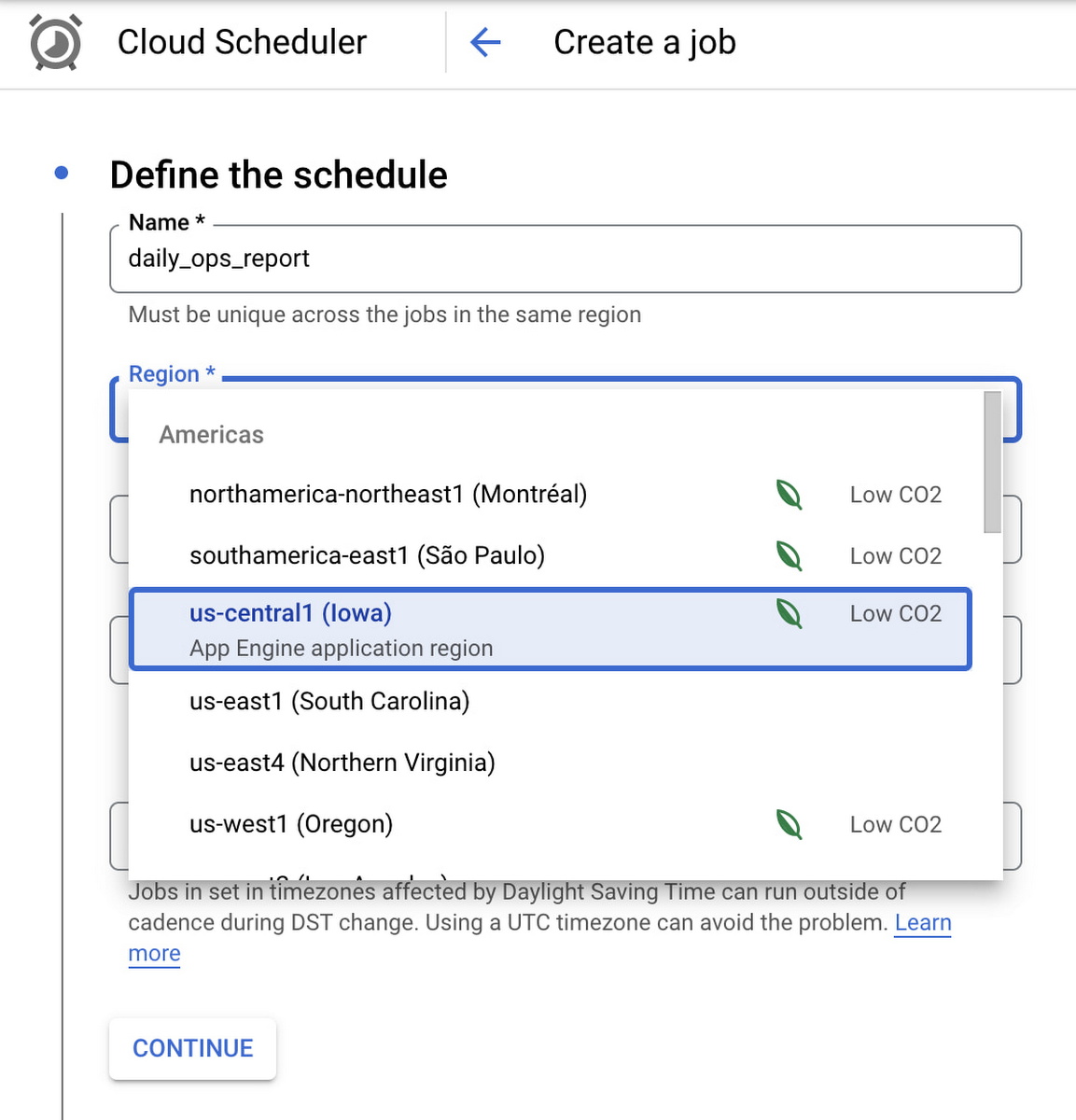
Google Cloud Scheduler is now available in 23 GCP Regions, and this number is expected to grow in the future. You can always find an up-to-date list of available regions by running:
gcloud scheduler locations list
We hope you are as excited about this launch as we are. Please reach out to us with any suggestions or questions in our public issue tracker.
What Swiggy and You Can Learn From This Company’s Use of ML to Engage Customers

9660
Of your peers have already read this article.
1:45 Minutes
The most insightful time you'll spend today!
The app economy has enabled a huge range of unique business models to flourish. One such model is online food ordering and delivery services, in which apps leverage geo-location data to aggregate local food choices and offer personalized options to consumers.
A leading company in this space is Just Eat. Launched in the UK in 2001 with a vision of ‘serving the world’s greatest menu. Brilliantly.’ The company has capitalized on the popularity of online food delivery and grown its presence across 12 markets.
Just Eat acts as an intermediary between take-out food outlets and hungry customers, giving local restaurants access to a broader base of potential diners, while providing consumers with an easy and secure way to order and pay for food from their favourite restaurants.
Today the company helps 27 million customers find food from more than 112,000 restaurants—everything from homemade Italian pasta, to Chinese noodle bowls, to fish-and-chips.
Data is the fuel of Just Eat’s rapid growth, but it wasn’t always looked at that way. In its early days, Just Eat struggled with the deluge of information and faced fragmentation across its systems. In fact, the company realized its legacy data vendor wasn’t capable of ingesting 90 percent of the data produced by its food platform. This was incredibly frustrating for Just Eat’s analysts and data scientists, who had to waste time cleaning up sources instead of leveraging the data to create a better user experience.
Just Eat turned to Google Cloud, and now uses machine learning (ML) to power sophisticated consumer recommendations on both its app and website. It also makes heavy use of features offered by Google Cloud Platform, including BigQuery for running analytics on its customer data set and Cloud Pub/Sub for messaging app users with relevant offers in real-time.
Having all of Just Eat’s data in one platform has translated into real value for its customers. With Google Cloud tools, Just Eat has created its own proprietary Customer Ontology framework, which today contains 5.5 billion features that better understand consumers’ behavior and food habits, and provides insights into previous visits.
Just Eat recently created an “Adventurous Index” to map its customers according to their ordering habits, enabling them to tailor their marketing and user experiences. For example, mid-adventurous customers are shown a choice of restaurants that serve their most ordered cuisine, while adventurous customers can choose from restaurants that serve a wider variety. This not only has prompted consumers to be more adventurous with their choices, but also has led to more business at a more diverse set of restaurants.
Matt Cresswell, Director of Customer Platforms at Just Eat said that Google Cloud has become integral to its product delivery: “Consumer food choice is a hugely nuanced topic. We know that individuals have their own unique journeys when they use Just Eat. We’ve sought to create a truly one-to-one relationship with every customer. The changes we’ve made to the platform mean they can access the dishes they enjoy at the touch of a fingertip, and find inspiration to discover new dishes they’ll love. We’re grateful to Google Cloud for helping us support our customers on their culinary explorations.”
Indonesia moves towards advanced education with Cloud, ML & Mobile Development

3211
Of your peers have already read this article.
2:30 Minutes
The most insightful time you'll spend today!
Indonesia is leading the way for digital transformation in Southeast Asia. According to Google’s e-Conomy South East Asia report, the country’s 2030 Gross Merchandise Value – the value of online retailing to consumers – could be twice the value of the whole of Southeast Asia today.
This growth means that many companies need more qualified IT graduates and employees with digital skills than they have today. Fast-growing tech companies need more qualified IT graduates, and employees with digital skills. According to the World Bank, Indonesia needs an additional nine million people with digital skills by 2030. The shortage of technical talent reiterates the need to invest in a reliable skills pipeline.
Following years of digital talent developments in Indonesia, Google has become a supporter of Bangkit, an academy designed to produce high-caliber technical talent for Indonesian technology companies and startups. Bangkit has facilitated a multi-stakeholder collaboration between Google, government, industry, and universities across Indonesia.
Last year, the President of Indonesia and the Ministry of Education and Culture, Research, and Technology, acknowledged Bangkit’s significant impact, with 3,000 students completing nearly 15,000 courses and specialisations.
Building on last year’s success, Bangkit started its 2022 program in February, offering three learning paths to students:
- Cloud computing with Google Cloud, preparing students for the Google Associate Cloud Engineer certification. Some of the course components are also available online
- Mobile development with Android, preparing students for the Google Associate Android Developer exam. An online version is available here.
- Machine learning with Tensorflow, getting students ready to take the Tensorflow Developer certification. Some of the online courses are available here for others.
Bangkit 2022 has enrolled 3,100 university students who will take a five month study course, obtaining university study credit, as well as industry certifications. The program accepts diverse cohorts of people who are passionate about preparing for a tech career in the near future, with support and encouragement for women, people with disabilities, and students from across Indonesia to apply.
Since its pilot in 2019, Bangkit has been guided by three principles:
- Industry-led: provides curriculum and instructors from industry experts, including Google, GoTo and Traveloka. Instructors include key figures such as Laurence Moroney (Google, Lead AI Advocate), Google Developer Experts, and other committed professionals.
- Immersive: combines online learning methods conducted in both individual and group settings.
- Interdisciplinary: contains knowledge and best practices in tech, soft skills, and English to provide complete career readiness.
The program runs from February to July 2022, and has a 900-hour curriculum throughout the 18-week learning experience.
Benefits for students participating in Bangkit include:
- Study credit conversion
- Job opportunities at our career fair
- Google Cloud, TensorFlow and AAD exam vouchers
- Incubation funds and mentorship support from industry
Towards the end of Bangkit 2022, students will team up for the Capstone Project challenge to propose solutions to some of the nation’s most pressing problems, such as environmentalism, accessibility, and more. The top 15 teams will be selected to receive funding to incubate their capstone projects. These education and career-preparedness offerings are provided at no cost.
Google is partnering with industry, governments, universities, and employers to help meet the skill demands of today. From supporting the State of Ohio to offer tech skills to residents, to working with the University of Minnesota-Rochester to create a customized health sciences degree program, Google is here to help our partners prepare those they serve for a cloud-first world.
More Relevant Stories for Your Company

Expanding Google Cloud Ready – Sustainability Program with 12 New Partners
We introduced the Google Cloud Ready – Sustainability designation earlier this year to showcase those partners committed to help global businesses and governments accelerate their sustainability programs. These partners build solutions that enhance the capabilities and ease the adoption of powerful Google Cloud technologies, such as Google Earth Engine and

Forrester Report on Indian Healthcare: Why this Sector’s Seeing Greater Cloud Investments than BFSI or Retail
The healthcare industry in India is experiencing a rapid change, becoming one of India’s largest sectors in terms of both revenue and employment. But healthcare firms are under immense pressure to improve clinical outcomes and reduce the cost of care. Healthcare firms must recognize that their patients are customers who

How Vertex Vizier’s Automated Hyperparameter Tuning Improves ML Models
We recently launched Vertex AI to help you move machine learning (ML) from experimentation into production faster and manage your models with confidence—speeding up your ability to improve outcomes at your organization. But we know many of you are just getting started with ML and there’s a lot to learn! In tandem

Kohl’s Leverages Google Cloud Platform for Omnichannel Retail
Kohl’s is an omnichannel retailer focused on driving traffic, operational efficiency and delivering seamless omnichannel customer experiences. Ratnakar Lavu is Kohl’s Senior Executive Vice President and Chief Technology Officer. He, and Kohl’s, are at the forefront of retail technology innovation, focusing on a frictionless customer journey across digital, mobile and
