





Expanding Google Cloud Ready – Sustainability Program with 12 New Partners

2822
Of your peers have already read this article.
2:00 Minutes
The most insightful time you'll spend today!
We introduced the Google Cloud Ready – Sustainability designation earlier this year to showcase those partners committed to help global businesses and governments accelerate their sustainability programs. These partners build solutions that enhance the capabilities and ease the adoption of powerful Google Cloud technologies, such as Google Earth Engine and BigQuery, allowing customers to leverage data-rich solutions that help reduce their carbon footprints.
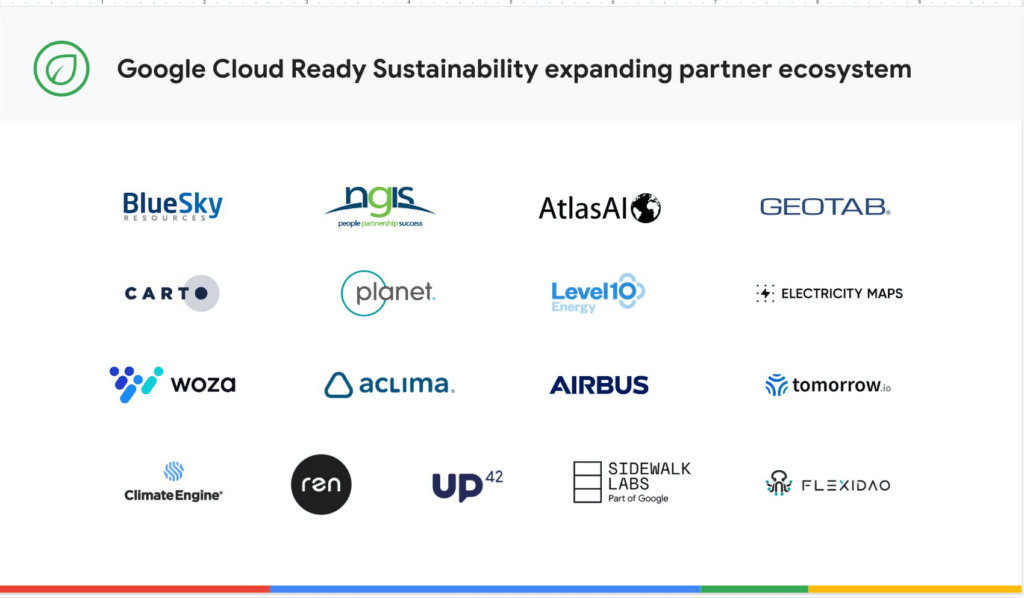
Today, we’re pleased to announce growth of the Google Cloud Ready – Sustainability program, with 12 new partners joining the initiative and bringing their climate, ESG, and sustainability platforms to Google Cloud. These partners include:
Aclima is pioneering an entirely new way to diagnose the health of our air and track climate-changing pollution. Powered by its network of roving and stationary sensors, Aclima measures air pollution and greenhouse gasses at unprecedented scales and with block-by-block resolution.
Sustainability at Airbus means uniting and safeguarding the world in a safe, ethical, and socially and environmentally responsible way. Airbus has a comprehensive sustainability strategy built on four core commitments, which guide the company’s approach to the way it does business and how it designs its products and services: Lead the journey toward clean aerospace, respect human rights and foster inclusion, build the business on the foundation of safety and quality, and exemplify business integrity.
Atlas AI is a predictive analytics platform that analyzes, monitors, and forecasts regions of growth, vulnerability, and opportunity around the world to offer insight into where organizations can grow most successfully, and where investment can boost historically underserved communities. Atlas AI’s platform has been used to expand water and sanitation infrastructure, promote new electrification, target community health services, and broaden internet access in countries across Sub-Saharan Africa and South Asia.
BlueSky Resources makes sense of sensors from both public and private sources by harmonizing inputs from ground, aerial and space based inputs. Expertise in atmospheric science and cloud technology allows BlueSky to provide understanding and insights related to the correlation of emissions insights to assets and activities. This powerful combination of data, climate science and delivery of insights is enabling focused sustainability impact across clients in various industries including energy, waste management, industry and natural resource management.
Electricity Maps provides companies with actionable data quantifying the carbon intensity and origin of electricity. This data is available on an hourly basis across 50+ countries and more than 160 regions. Electricity Maps’ mission is to organize the world’s electricity data to drive the transition toward a truly decarbonized electricity system.
FlexiDAO is a global climate tech company based in the Netherlands and Spain. The company works closely with other critical stakeholders to co-create the international standard around energy-related emissions compliance. Thanks to FlexiDAO’s end-to-end 24/7 Carbon-free Energy platform, companies can quantify and confidently showcase their contribution to society’s decarbonization.
LevelTen Energy helps organizations achieve carbon-free energy usage targets (on an annual and 24/7 basis) by delivering access to the world’s largest clean energy marketplace, and the software, data, analytics, and expertise required for efficient transactions. The LevelTen Platform connects energy buyers and over 40 sustainability advisors with more than 1,800 carbon-free energy projects in 24 countries across North America and Europe.
Ren is a SaaS platform built on Google Cloud that enables companies with global supply chains to source the cleanest energy possible. Despite using country-sized amounts of energy, most companies have no idea how to transition to renewables due to complex financial, technical, and logistical challenges. Ren unlocks cost savings, provides the cleanest energy possible, and ensures companies meet their carbon commitments on time.
Sidewalk Labs, an urban innovation unit in Google, builds products to radically improve quality of life in cities for all. Delve is a product that helps real estate teams design more sustainable buildings and neighborhood blocks, faster. Mesa automates building controls to deliver savings and comfort to commercial building owners and tenants. With these products and others, Sidewalk Labs helps commercial real estate developers, building owners and city planners make more sustainable choices for the built environment that are better for communities and the planet.
Tomorrow.io is The World’s Weather and Climate Security Platform, helping countries, businesses, and individuals manage their weather and climate security challenges. The platform is fully customizable to any industry impacted by the weather. Customers around the world use Tomorrow.io to dramatically improve operational efficiency. Tomorrow.io was built from the ground up to help teams prepare for the business impact of weather by automating decision-making and enabling climate adaptation at scale.
UP42 is a geospatial developer platform and marketplace bringing together industry-leading data and ready-to-use processing algorithms. The platform enables organizations to build, run, and scale geospatial products. With the ability to choose from a wide range of high-resolution commercial and open satellite data, aerial, weather, and others, solution providers can apply best-in-class machine learning and/or processing modules to gain valuable geospatial insights and streamline their processes.
Woza is a sustainable innovation platform that leverages deep geospatial knowledge and existing best-in-class technologies to develop a new generation of streamlined analytics workflows focused on sustainability. Companies in agri-food, energy, and public sector are partnering with Woza to accelerate their journey to Industry 4.0.
Adding expertise to accelerate sustainability use cases
New partners in the initiative join our existing Google Cloud Ready – Sustainability partners like Carto, Climate Engine, Geotab, NGIS, and Planet Labs PBC bringing a wealth of industry knowledge, offering solutions for sustainability challenges ranging from first-mile sustainable sourcing and spatial finance to fleet electrification and rich geospatial visualizations.
CARTO is the world’s leading Location Intelligence platform, enabling organizations to use spatial data and analysis for more efficient delivery routes, better behavioral marketing, strategic store placements, and much more. The company’s solutions extend the geospatial capabilities available in BigQuery, while leveraging the near limitless scalability that Google Cloud provides. When it comes to sustainability, CARTO’s platform is trusted by a wide range of organizations, including Greenpeace, Vizzuality, Litterati, Indigo, WWF, the Marine Conservation Institute, The World Bank, and the Institute for Sustainable Cities.
Climate Engine leverages data from Google Earth Engine and other ecosystem partners to help organizations improve their climate change-related risk planning in areas such as water use, agriculture, storm risk, and wildfire spread. By linking the economy and the environment, organizations can understand how environmental risks are affecting their markets and discover opportunities to reduce their emissions and potential supply chain or operational disruptions from climate-related events.
Geotab is advancing security, connecting commercial vehicles to the cloud, and providing data-driven analytics to help customers better manage their fleets. Processing billions of data points daily, Geotab helps businesses improve and optimize fleet productivity, enhance safety, and achieve sustainability goals and stronger compliance.
Geospatial solutions provider NGIS built a SaaS-based first-mile sustainable sourcing solution called TraceMark using Google Cloud’s geospatial platform and technologies from other ecosystem partners. Several global CPG firms have already used TraceMark to modernize their geospatial workflows and help facilitate the use of space-based data for supply chain sustainability transformation.
Planet Labs PBC operates the largest fleet of Earth imaging satellites in history, with approximately 200 satellites in orbit. Planet’s mission is to image the whole earth’s landmass every day to make global change visible, accessible, and actionable. As a Public Benefit Corporation, Planet’s Public Benefit Purpose is to accelerate humanity toward a more sustainable, secure, and prosperous world by illuminating environmental and social change.
How the Google Cloud Ready – Sustainability program works
If you are a Google Cloud partner with sustainability solutions and expertise to share, the Google Cloud Ready – Sustainability program is open for applications. Entry into the program requires that the partner solution delivers quantifiable results for climate mitigation, adaptation, or reporting needs. To apply for the Google Cloud Ready – Sustainability designation, the solution must:
- Be available on Google Cloud
- Address ESG risk, and assist customers in achieving ESG targets and/or support typical ESG goal frameworks, such as the United Nations’ SDGs
- Demonstrate repeatability
- Meet minimum Google Cloud application development best practices, including security, performance, scalability, availability, and carbon footprint reporting for available services
- Have Google Cloud Carbon Footprint Reporting enabled
- Have at least one public customer case study available.
The selection process begins with an evaluation of the solution. If a partner meets the above criteria, Google Cloud provides a suggested roadmap for tier progression within the program and then issues a formal acknowledgement of participation in the Google Cloud Ready – Sustainability program. Together, Google Cloud sustainability partners can deliver platforms that are helping businesses and governments accelerate progress aligned to their environmental goals.
Google Cloud will showcase the validated solutions on the Google Cloud Partner Directory Listing, Google Cloud Ready Sustainability Partner Advantage page, and — if applicable — via the Google Cloud Marketplace. We hope to help customers better understand how these technologies can help them meet their ESG goals, find the right solution for their particular challenge, and implement a solution faster.
Prospective partners can visit the Partner Portal to learn more about the Google Cloud Ready – Sustainability program or complete an application.
Southwire Completes SAP Migration to Google Cloud as a First Step of its Tech Evolution

4950
Of your peers have already read this article.
1:30 Minutes
The most insightful time you'll spend today!
“Talk about tough times, right?”
That’s how Dan Stuart, Senior Vice President of IT Services at Southwire Company, refers to the months following a December 2019 ransomware event, and the COVID crisis that began in spring of 2020. Those events hit just as the company was preparing for an overhaul of their SAP environment. This comprehensive plan included three key elements. First, the company wanted to upgrade their SAP ECC environment to take advantage of the latest functionality available for this critical ERP system. Second, Southwire aimed to deploy SAP Business Warehouse on SAP HANA to accelerate vital reporting for all business users. Third, the company wanted to upgrade to the latest version of SAP Process Orchestration—an essential component that touches key manufacturing interfaces in all Southwire facilities.
Southwire had looked at multiple options for the upgrades, including remaining entirely on-premises, colocation, and full cloud migration. “Going to the cloud seemed a lot more compelling,” says Joe Schleupner, Southwire’s Senior Director of PMO & ITS planning and implementation. “We were going to the cloud eventually, so why take these intermediary steps? Let’s just get it done.”
After looking at several options, Southwire decided to migrate to Google Cloud. “We wanted to be on a platform for SAP that was flexible, scalable, and secure; that we could count on to get up and running quickly,” says Stuart. “We chose Google Cloud not only for those reasons, but also because we recognize that Google has other assets that we may be able to take advantage of down the line, such as technologies like artificial intelligence (AI).”
More stability, less worry
As one of the leading manufacturers of wire and cable used in the transmission and distribution of electricity, Southwire aids the delivery of power to millions of people worldwide. They have more than 30 manufacturing facilities across the United States running 24/7. Any downtime directly affects productivity and revenue. With help from Google Cloud and their implementation partner NIMBL, Southwire completed the SAP migration to Google Cloud over a planned maintenance weekend on July 4th.
The migration itself, while complex, went quickly and smoothly. “Just moving to the cloud was quite a feat because we were dealing with so much data, but in total the SAP system was down for only ~16 hours,” says Schleupner.
“As a project manager, I always felt that Google Cloud had my back” Schleupner says. The Process Orchestration (PO) migration was of particular concern, considering that it controlled all of Southwire’s manufacturing interfaces across the entire company. “Every critical piece of information that goes from SAP down to the manufacturing system goes through that system,” says Schleupner.
Even after migrating, Southwire discovered that making changes to the system was fast, easy, and resulted in no downtime. Normally, certain types of changes would have involved taking down SAP for at least an hour.
The Southwire team also appreciates the fact that the modern cloud architecture means spending less time on routine infrastructure maintenance. “It’s one less thing for me to worry about,” Stuart says, “I can focus on the business side of the house and move the technology and responsibilities to what we do within the Google Cloud Platform.”
What comes next?
While the cloud migration will increase stability, uptime, performance, and security, there is much more to come. Southwire is currently working on a disaster recovery implementation for their SAP environment on Google Cloud. Stuart and Schleupner are excited about where Google Cloud can further take Southwire. They are considering an SAP Hybris e-commerce implementation as well as connected factory and/or factory automation initiatives that can take advantage of artificial intelligence and machine learning.
To Stuart and Schleupner, the migration of Southwire’s SAP environment to Google Cloud, as important as it was, really represents the first step in the company’s tech evolution. Now that much of the heavy lifting is complete, Southwire’s digital transformation can begin in earnest. “There’s no shortage of areas where I think Google Cloud will come into play,” Stuart says, “and we intend to look at these things with an open mind to understand how we can leverage current investments to take our organization where we want to go.”
Learn more about Southwire’s SAP on Google Cloud deployment and how Google Cloud can transform the way you work with your SAP enterprise applications. Visit cloud.google.com/solutions/sap.
Manhattan Associates and Google Cloud: How the Partnership Accelerates Future of Digital Retail

4975
Of your peers have already read this article.
1:30 Minutes
The most insightful time you'll spend today!
While the shift to digital business and the cloud has been well under way for some years now, organizations today have a new sense of urgency due to COVID-19. Delivering digital transformation is no longer a ‘nice to have’ option, rather, it is an operational imperative. Taking advantage of the infrastructure, platform and solution gains that cloud and microservices architecture provide is a must for brands today.
At Google Cloud, we understand the pressures and challenges organizations of all sizes, across all industries are facing. The pandemic has dramatically impacted global commerce at-large, exposing (for many organizations across multiple sectors) gaps in omnichannel capabilities, business continuity and forecasting plans, not to mention spots in supply chain agility, resilience and responsiveness.
A rapidly evolving consumer-driven commerce landscape has put innovation squarely in the spotlight for supply chain teams all over the world, with the effects of the global pandemic making it increasingly difficult for manufacturers, wholesalers, third party logistics providers and retailers (in particular) to weather the perfect storm of fast-moving consumer trends and a need for ‘always on’ digital innovation.
These same effects have driven increasing interest and uptake of technology like the Manhattan Active® suite of solutions, as well as our own cloud platform; both of which afford organizations the levels of agility, flexibility and scalability needed to insulate their people, processes and long-term business strategies against unforeseen future obstacles such as global pandemics or international trade disputes.
An excellent example of this agility, flexibility and scalability in action is PVH’s response to the global pandemic. One of the most admired fashion and lifestyle companies with such iconic brands as Calvin Klein, TOMMY HILFIGER, Van Heusen, and IZOD, PVH was forced to temporarily close its physical stores and, as a result, experienced a sudden massive increase in online sales. The retailer was able to quickly pivot by adjusting its business rules in Manhattan Distributed Order Management (part of Manhattan Active Omni) to expose store inventory to online consumers and reroute its fulfillment processes. Thanks to Manhattan’s solution delivered through Google Cloud, in a matter of days, PVH was able to leverage both its distribution centers and vast store network to fulfill its online orders.
“The events of 2020 have accelerated retail and ecommerce operations forward,” said David Herridge, executive vice president of Global Value Chain Technologies for PVH. “With quick, creative thinking and the right partner, we were able to pivot operations, satisfy our customers and prepare for the future.”
Manhattan’s products have been recognized for their ability to solve real-world challenges through innovation, and used by many of the world’s top brands to solve some of their most complex commerce and supply chain challenges: the latest recognition is Manhattan’s position as sole leader in the 2021 Forrester Wave™ for Order Management Solutions.
Since December 2018, Google Cloud has been collaborating closely with the team at Manhattan and its ‘always on’, versionless approach to innovation. And, during the last two and a half years, Manhattan has significantly accelerated its cloud-first solutions and market adoption, resulting in tremendous growth in its overall cloud business efforts.
By building cloud native solutions on Google Cloud, the teams at Manhattan continue to deliver the high-performance, elastic, high-redundancy, secure solutions their customers rely on. Moreover, it means both Google Cloud and Manhattan continue to innovate and push the boundaries of what is possible in terms of the supply chain and omnichannel innovations that underpin global commerce – innovation that is needed more now than maybe ever before.
Our commitment to distributed cloud solutions and ongoing innovation, not to mention the fact Google Cloud operates a net carbon-neutral cloud, means that the working partnership between both industry leading teams continues to be a perfect match of brand values; not just from a technology perspective, but also a long-term sustainability and environmental one too.
More information on the partnership can be found here.
11253
Of your peers have already watched this video.
1:30 Minutes
The most insightful time you'll spend today!
Indian Retailer Figures Optimizes Hyperlocal Delivery to Increase Customer Experience
Anyone who follows the Indian e-commerce scene knows that one of the largest challenges these companies face is hyperlocal delivery.
That was a problem facing Wellness Forever, a retail chain of pharmacies with 150-plus stores across India.
“Exactly a year ago, we started our journey of hyperlocal deliveries. This optimization was a big time challenge for us to understand how to optimize this,” Palani Subbiah, CTO, Wellness Forever.
The problem in front of Wellness Forever was to identify which customer could can be sold from which store, so that a delivery could be made within 90 minutes.
“We handle a large amount of customer data and we wanted to use insights to help and improve the customer satisfaction index,” says Subbiah.
To do that Wellness Forever leveraged Google Big Query to run massive amount of data to come up with the operational insights. They also used Firebase and Google Maps.
“By 2021, we are going to have about 450 stores. Those stores are going to be not only a physical store, which is a digital store.
30 Guides to Ease Your Cloud Migration Journey
4397
Of your peers have already read this article.
1:30 Minutes
The most insightful time you'll spend today!
Getting started with your migration
One of the challenges with cloud migration is that you’re solving a puzzle with multiple pieces. In addition to a number of workloads you could migrate, you’re also solving for challenges you’re facing, the use cases driving you to migrate, and the benefits you’re looking to gain. Each organization’s puzzle will likely get solved in their own unique way, but thankfully there is plenty of guidance on how you can migrate common workloads in successful ways.
In addition to working directly with our Rapid Assessment and Migration Program (RAMP), we also offer a plethora of self-service guides to help you succeed! Some of these guides, which we’ll cover below, are designed to help you identify the best ways to migrate, which include meeting common organizational goals like minimizing time and risk during your migration, identifying the most enterprise-grade infrastructure for your workloads, picking a cloud that aligns with your organization’s sustainability goals, and more:
- Get started with this cloud migration guide and checklist
- Key considerations for building a migration factory to Google Cloud
- Understanding the cloud migration strategies at your disposal
- Understanding how to migrate key enterprise workloads to Google Cloud
Which workloads are you moving?
In addition to the guides above which help you through your end-to-end migration, it’s also important to understand the specific workloads you’ve got on-premises (or in other clouds). Each workload has their own unique nuances — what works for one might not work perfectly for another. This is where leveraging the expertise of our RAMP team is crucial, and why we have lots of migration guides for specific workloads and end-states. For each workload, we’re highlighting a few guides that we think could be most helpful, but you can also click each topic to learn more or find more guides.
- Modernization path for .NET applications on Google Cloud
- Managed Service for Microsoft Active Directory is GA
- Migrating Microsoft workloads to Google Cloud yields results
- Migrate, scale, and innovate at speed
- Boost Retail Intelligence and Agility in the Cloud
- Retire your tech debt: Move vSphere 5.5+ to Google Cloud VMware Engine
- Financial Services Spotlight: Elevating agility and security in the cloud
- Curious about Google Cloud Bare Metal Solution? Start here
- Getting Started with Google Cloud’s Bare Metal Solution
- Guide – Bring new life to your databases with an Oracle migration
- SAP on Google Cloud: Migration strategies
- Run your SAP workloads on Google Cloud Bare Metal Solution
- eBook – Google Cloud for SAP: The enterprise cloud for business agility, insights, and innovation
- How to transfer your data to Google Cloud
- An Overview of the Transfer Appliance
- Migration to Google Cloud: Transferring your large datasets
- Transferring data from Amazon S3 to Cloud Storage using VPC Service Controls and Storage Transfer Service
- Overview of Database Migration Service
- Database migration: Concepts and principles (Part 1)
- Database migration: Concepts and principles (Part 2)
- Database cloud migrations made easy for PostgreSQL, MySQL
- Migrating data warehouses to BigQuery: Introduction and overview
- Oracle to BigQuery migration
- Amazon Redshift to BigQuery migration guide
- IBM Netezza to BigQuery migration guide
- Teradata to BigQuery migration guide
Take the next step
When it comes to migration, we’re committed to meet every organization where they are. We fully understand the nuances and challenges of cloud migration, and at Google Cloud we have one singular goal: to help you realize true business value through your cloud migrations.
Visit our Migration Architecture Center to find even more guides to use during your migration, or if you’re looking to dive a little deeper into planning, sign up for a free discovery and assessment of your existing IT landscape.
4905
Of your peers have already watched this video.
11:30 Minutes
The most insightful time you'll spend today!
Driving Business Transformation in Manufacturing, Industrial, and Transportation Using Google Cloud and AI/ML
Google Cloud partners closely with manufacturing, industrial, and transportation organizations to drive business transformation.
In this video, Mandeep Waraich, Head of Product – Industrial AI, Google Cloud, shares customer stories as well as Google Cloud’s differentiated AI products and solutions.
Waraich covers the current state of automation and industrial efficiency and how artificial intelligence is revealing an entirely new universe of possibilities.
He also speaks about Google Cloud’s approach to bringing these AI technologies to the market, and Google Cloud’s “deploy anywhere” methodology that helps achieve the impact of AI at a global enterprise scale.
More Relevant Stories for Your Company

IBM Spectrum LSF and Google Collab: Leverage Google Cloud’s Scalability and Compute Engine Infrastructure
High Performance Computing (HPC) is prevalent today across many industries, including financial services, life sciences, higher education research, manufacturing, and energy. More and more businesses are deploying HPC workloads in the cloud to take advantage of its elasticity, scalability, and availability. Job schedulers are critical for HPC applications given the nature of
Google Cloud Migration Speeds Up The New York Times’ Journey to New Normal
Like virtually every business across the globe, The New York Times had to quickly adapt to the challenges of the coronavirus pandemic last year. Fortunately, our data system with Google Cloud positioned us to perform quickly and efficiently in the new normal. How we use data We have an end-to-end type of

Vodafone Leverages Google Cloud to Aid COVID-19 Frontline with Anonymized Insights on Population Mobility
Editor’s note: When Europe’s largest mobile communications company, Vodafone, was asked by the European Commission to help understand population movement across the European Union and the UK to help fight COVID-19, it was able to provide anonymized mobile network-based insights to answer the call. Here’s how Vodafone, with the support

Google Cloud Announces Improvements in Private Catalog to Drive Terraform Deployments
As an enterprise admin, when you choose to use Google Cloud Private Catalog to enable curated, self-serve Google Cloud infrastructure provisioning, you need the ability to manage your organization’s deployments. Today, we’re pleased to announce support for several improvements to Terraform driven deployments through Private Catalog. With this new release, you can
