





Linking the Middle East with Southern Europe and Asia: Google’s New Subsea Cables to Be Ready by 2024!
3364
Of your peers have already read this article.
1:30 Minutes
The most insightful time you'll spend today!
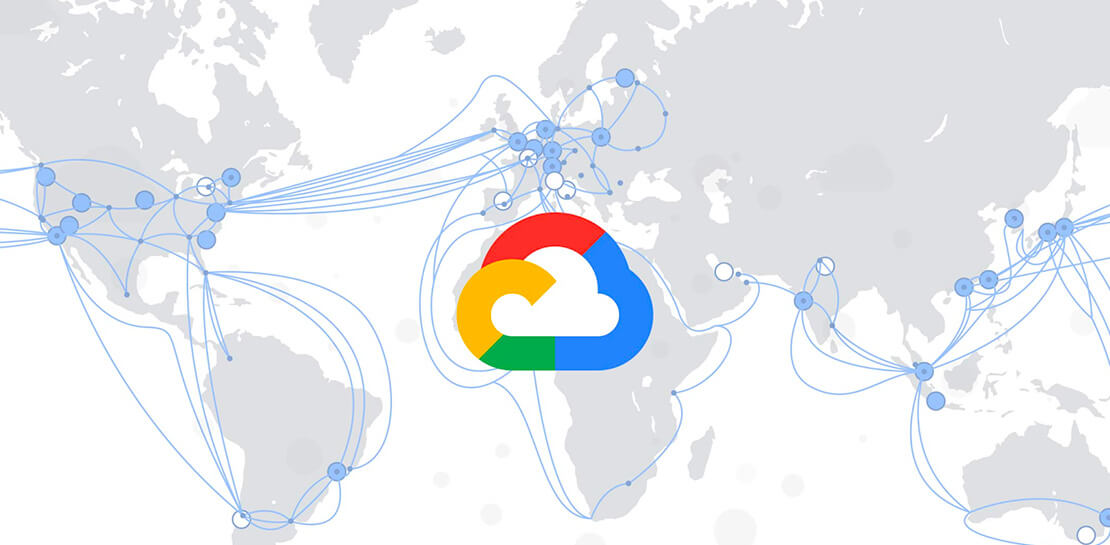
Today, we’re announcing that we are collaborating with Sparkle and others to build and operate two submarine cable systems linking the Middle East with southern Europe and Asia: the Blue Submarine Cable System connecting Italy, France, Greece, and Israel; and the Raman Submarine Cable System connecting Jordan, Saudi Arabia, Djibouti, Oman and India.
Developing additional network capacity and routes is critical to Google users and customers around the globe, who depend on robust connectivity to power their online lives, and communicate with friends, family and business partners. Google users and Google Cloud customers will benefit from increased capacity and decreased latency to regions in the area.
Each equipped with 16 fiber optic pairs, the Blue and Raman Submarine Cable Systems are expected to be ready for service in 2024. In time, consortium members hope to make additional landings and connect the two systems through terrestrial network assets.
Like with other infrastructure projects, building a subsea cable is an opportunity to pay tribute to a regional luminary who has advanced human understanding. The Raman cable is named for Sir Chandrasekhara Venkata Raman, an Indian physicist who won the 1930 Nobel Prize in Physics—the first Asian to receive that honor in science. C.V. Raman’s work centered on light scattering, which finds that when light traverses a transparent material, some of the deflected light changes wavelength and amplitude. This so-called Raman effect is a foundational principle in the field of optics that enables any underwater network cable. A trip across the Mediterranean also prompted him to ask why the sea is blue, when water itself is clear? Thanks to C.V. Raman, we now know that the sea isn’t simply reflecting the sky, but because the water itself causes blue light to scatter.
With Blue and Raman, we now have 18 investments in subsea cables around the world, including Google-funded cables like Curie, Dunant, Equiano, Firmina and Grace Hopper, and consortium cables like Echo, JGA, INDIGO and Havfrue. You can learn more about Google Cloud’s network and infrastructure here.
3486
Of your peers have already downloaded this article
1:30 Minutes
The most insightful time you'll spend today!
Reduce risks, increase uptime, and free up working capital with Google Cloud’s SAP Business Continuity Program. Working closely with our experienced partner community, we will ease the lift and shift of your on premises or hosted SAP environments with simple, no-cost migrations.
Gain a future-proof digital business platform with integrated artificial intelligence, machine learning, and advanced analytics that deliver deep insights for all who need them.
Get the performance, compute power, flexibility, scalability, availability, and security you need for your current and future business needs with SAP on Google Cloud. Download this factsheet to learn more.
Dual Run: A Proven Solution for Secure Mainframe Modernization

954
Of your peers have already read this article.
4:30 Minutes
The most insightful time you'll spend today!
CIOs are again evaluating their mainframe investments, balancing rising operational costs and difficulty finding talent with the perceived costs and risks of moving critical applications to the cloud. Increased business agility, technical innovation, computing elasticity, customer insights, and a growing talent pool all encourage CIOs to migrate and modernize from “Big Iron” onto public cloud platforms.
Google Cloud recently announced Dual Run, a new mainframe modernization solution, to help customers mitigate the risk involved in mainframe migrations and accelerate their migration to the cloud. Leaders can leverage Dual Run in their quest to ensure their mainframe modernization projects will succeed and pay off so let’s dive a little deeper into what Dual Run is, how it works, and how it can help you.
Mainframe modernization with a proven technology
Since so many businesses still run mainframes, we decided to partner with Banco Santander—one of the largest banks in the world—to bring Dual Run to our enterprise customers, since they had already built a solution. In fact, Dual Run was built on top of Banco Santander’s unique technology which has already demonstrated proven results in the regulated financial services industry. Now that Dual Run is available, Banco Santander has been using it to bring their data and workloads onto Google Cloud’s trusted infrastructure.
The concept is not new, but the solution is unique
Dual Run enables you to run a parallel production system, allowing you to simultaneously run workloads on your mainframes and on Google Cloud. While many enterprises running mainframes have thought about parallel production concept and a few even tried before, Google Cloud is unique among the hyperscalers to provide such a solution as an offering to its customers.
With a parallel production run, you can perform real-time testing of your applications on Google Cloud and quickly gather data on performance and stability with no disruption to your business. Once you’re satisfied with the functional and performance equivalence of the two systems, you can make the new Google Cloud environment your system of record, while existing mainframe systems can be used as a backup or decommissioned.
In addition to the transformative benefits you get from moving to Google Cloud–such as AI-based scalability, speed, and security–migrating mainframes with Dual Run offers you even more benefits:
Mitigate migration risk: Dual Run reduces risk during the migration by running your business critical systems in parallel with powerful reporting to track the difference between your current and target systems. This ensures there is no impact or risk to your existing mainframes while migrating to Google Cloud.
Secure migration investments: Avoid costly migration mistakes by basing your decisions and actions on empirical data acquired from your production system.
Reduce business testing effort: Compare the functional equivalence of outcomes in the current and target system with production data and drastically reduce the testing cycles of your migrated workload.
Accelerate migration: Speed up the entire mainframe migration process with a well-defined framework, automation components, predefined dashboards, and a tested approach. Empirical reporting available in Dual Run also enables customers in regulated industries to more readily respond to regulator reviews and requests for information.
Your migration journey with Dual Run
Dual Run is packaged with several automation components to aid your migration journey, from assessment all the way through to production.
This chart shows how Dual Run plays a key role throughout your mainframe modernization journey:
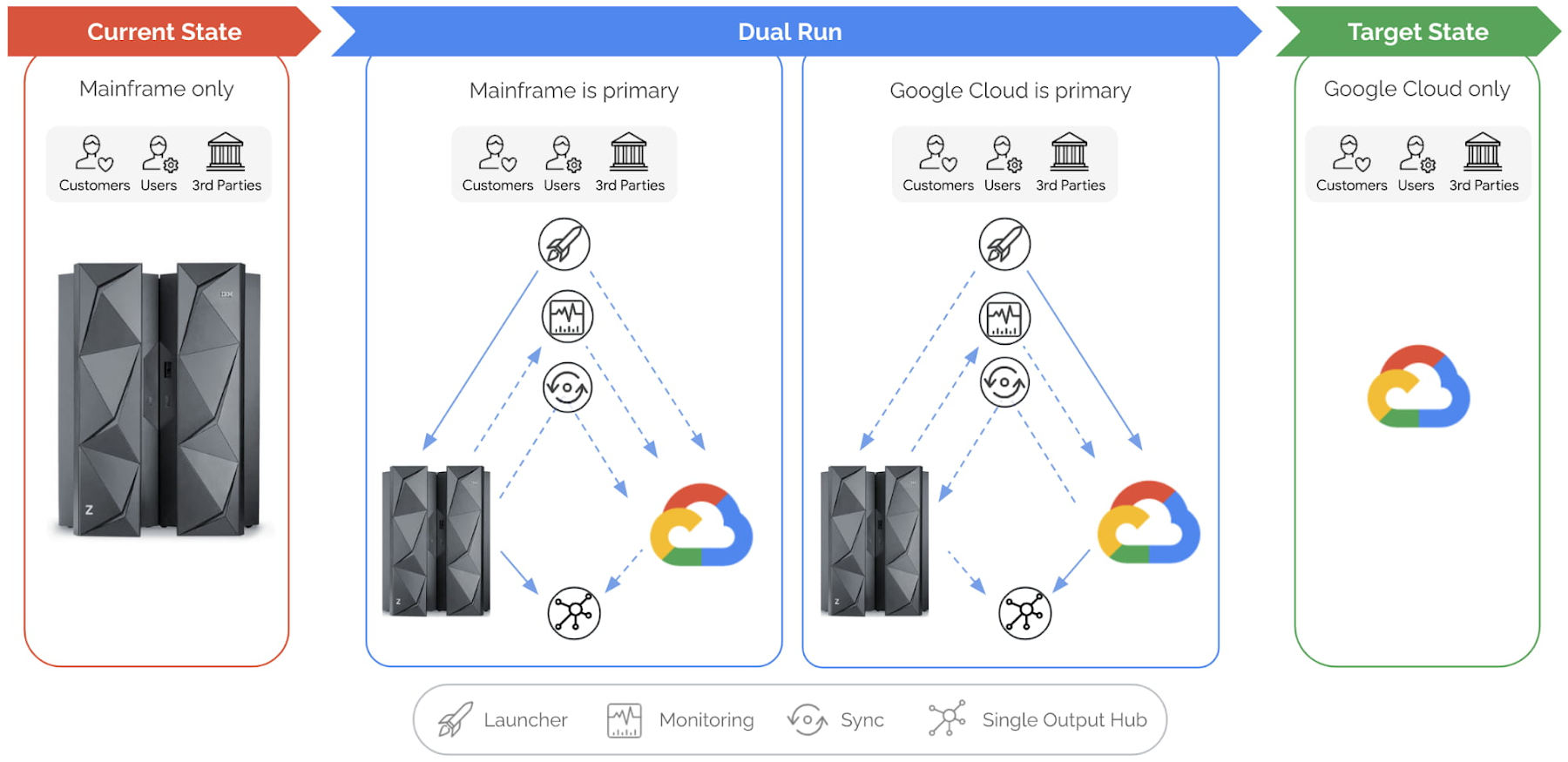
Let’s explore this illustration in a bit more detail, phase by phase:
Current state: This is your starting point, when your production workloads are still running in your mainframe. Dual Run helps you assess your mainframe workload for compatibility on Google Cloud.
After this assessment, Dual Run’s conversion engine helps address the incompatibilities in your current application and then migrates the application and data to Google Cloud. At this stage, you have your current application executing on the mainframe and your migrated application is ready to be executed or tested on Google Cloud.
Dual Run state: In this state, the migrated workload will be executed in two stages.
Dual Run stage 1:
In the first stage of Dual Run, your mainframe will remain as the “primary” system — meaning the response and outputs to other systems are sent from your mainframe — while the migrated workload will be executed in parallel in Google Cloud as “secondary.”
Dual Run performs the following actions as a cyclical process, repeated until you reach your desired migrated application quality is achieved:
- All workloads — batch & transactions — executed in the mainframe are replicated in Google Cloud
- The outcomes from both systems are validated to report any differences, enabling you to take corrective actions in migrated applications
- The functional and performance differences between the two systems will be observed, and the mainframe and Google Cloud data are periodically synchronized to bring both the systems in sync
Typically, most of your migration time will be spent in the first stage of Dual Run until you are satisfied with the results. The key goal for this stage is that your primary, business-critical mainframe workload is not disturbed while your migrated application is tuned to provide the exact same results as your current application.
Dual Run stage 2:
When the Dual Run reporting and results confirm that the migrated application matches your mainframe system, Google Cloud then becomes the “primary” system, while your mainframe will still be executed in parallel as “secondary.” Dual Run will enable you to do a smooth switch between primary and secondary systems through a configuration management system.
Target state: In this final state, the mainframe can be decommissioned while the Dual Run components are removed, enabling an optimal and efficient business execution with Google Cloud.
Summary
For any business or organization that has to migrate or modernize their mainframes, Dual Run offers a unique solution to achieve this with reduced risk and time. In fact, what we’re seeing from our customers is that Dual Run offers the right combination of proven experience, engineering, and strategic partnership that is essential for mainframe migration success. If you would like to learn more, check out our mainframe modernization website.
Titanium: A Robust Foundation for Workload-optimized Cloud Computing

937
Of your peers have already read this article.
3:30 Minutes
The most insightful time you'll spend today!
Google Cloud is built on world-class technical infrastructure that supports services that are loved and relied on by billions of people across the globe: Google Search, YouTube, Gmail, Google Maps and more. A core tenet at Google Cloud is to leverage Google’s experience building and operating highly available and highly reliable planetary-scale compute, storage and networking systems and data centers.
Google takes a workload-optimized approach to building its infrastructure, employing a combination of dedicated hardware and software components to meet its workloads’ ever-growing demands. Underpinning this infrastructure is Titanium, a system of purpose-built, custom silicon and multiple tiers of scale-out offloads that together power improvements in the performance, reliability, and security of our customers’ workloads (for example, 25% faster block storage IOPS/instance compared to the other two leading hyperscalers). Unveiled today at Google Cloud Next, you’ll find Titanium technology in many of Google Cloud’s recent infrastructure offerings.
10x demands of tomorrow
Meeting the growing performance, reliability, and security demands of both legacy and emerging workloads is a constant challenge for cloud infrastructure providers. And now, these demands are multiplying with the heightened adoption of generative AI across almost every industry. Meanwhile, the benefits of Moore’s law have been declining in recent years. We can’t rely on silicon advances alone to meet tomorrow’s needs.
As just one example, this chart shows the exponential computing demands of large language models.
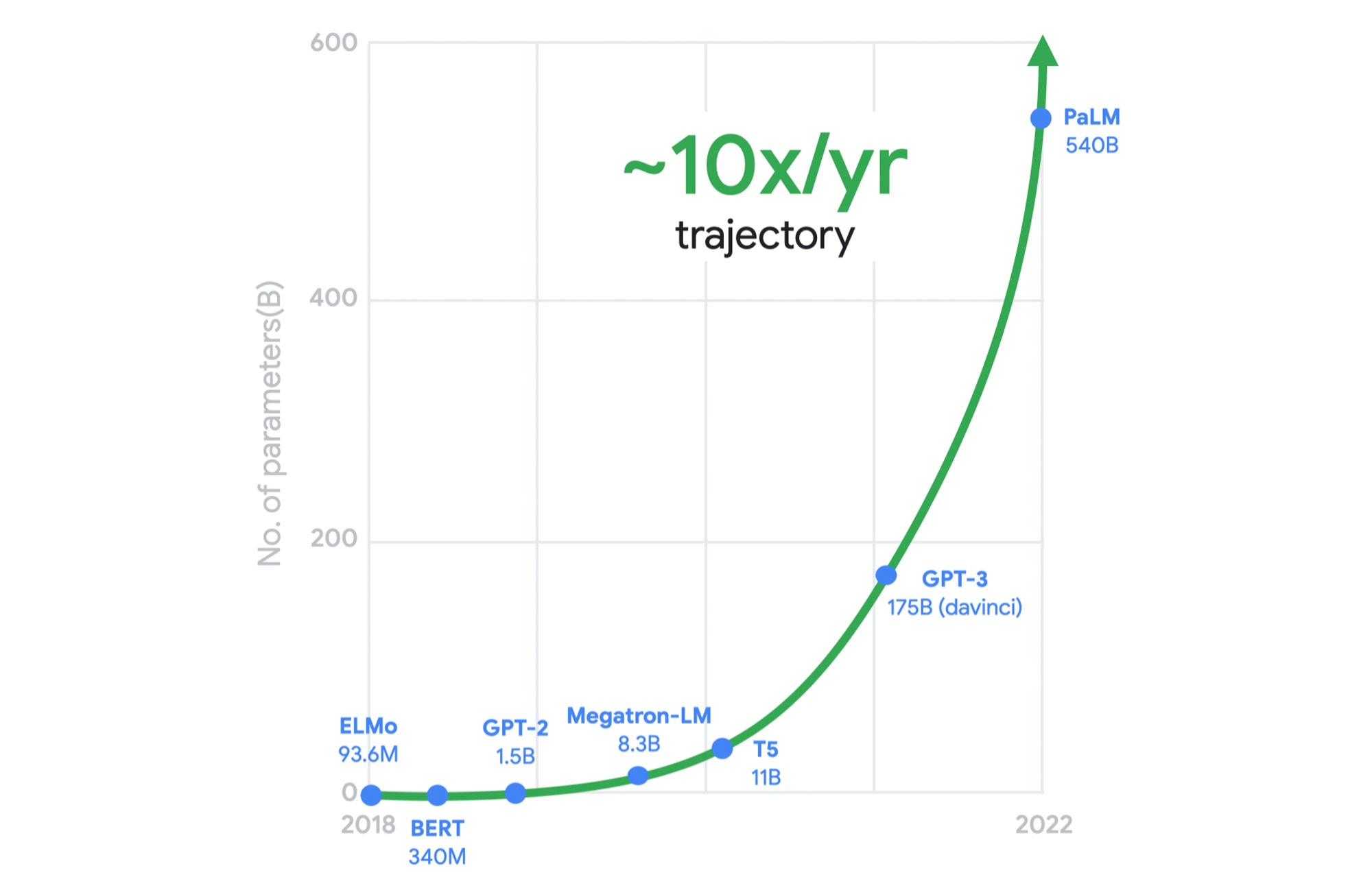
It was clear to us a long time ago that we needed to rethink our infrastructure designs to meet these demands. This is why, for several years, we’ve adopted workload-optimization and intentional design as central principles for our infrastructure platform. We engineer golden paths from silicon to the customer workload, using a combination of purpose-built infrastructure, prescriptive architectures, and an open ecosystem to deliver workload-optimized infrastructure.
Offloads play a pivotal role
Central to this strategy are offload technologies. Traditionally, the CPU wears many hats: It runs the hypervisor, the virtualization stack to enable your workloads, and manages storage and networking I/O; it’s responsible for security isolation for virtual interfaces and physical hardware, etc. In this model, customer workloads running on the CPU contend for resources with these platform tasks.
Offloads on dedicated hardware perform behind-the-scenes security, networking, and storage functions that were previously performed by the host CPU, allowing the CPU to focus on maximizing performance for customer workloads.

A recent example of an on-host offload or accelerator is the Infrastructure Processing Unit (IPU), a system-on-chip that we co-designed with Intel to enable better security isolation and performance on our 3rd gen compute instances. The IPU enables:
- Predictable and efficient compute
- Programmable packet processing for low latency, 200 Gbps networking with 3x the packets per second compared to our previous-generation compute instances
- In-transit encryption with the PSP protocol
Another important example of Google’s on-host hardware is Titan, a secure, low-power microcontroller that helps ensure that every machine in Google Cloud boots from a trusted state.
But we did not stop there. To meet tomorrow’s demands, we knew we needed to go past the performance that could be achieved using the host’s dedicated offload hardware.
A tiered system of offloads
A key component of Titanium is its modern offload architecture, which combines capabilities whose scale and performance are well-established within Google, as well as new capabilities tailored for cloud use cases.
Just as modern workloads scale out horizontally in the cloud, with Titanium, we’ve extended the architecture to augment on-host offloads with an additional tier of scale-out offloads that run outside the host. This system of offloads is deployed fleet-wide and dynamically adjusts to changing workload needs to continually deliver the best performance.

Example 1: Block storage
Titanium scale-out offload enables Hyperdisk block storage to deliver stellar I/O performance. Hyperdisk’s Titanium offload on the host IPU works in tandem with the Titanium scale-out offload tier that distributes I/O across Google’s massive cluster-level filesystem, Colossus.

With traditional offload architectures, higher block storage IOPS requires purchasing larger compute instances. For example, you may need to deploy a data-intensive workload on a compute instance with many more vCPUs than the workload needs just to get sufficient storage performance. This tight coupling results in wasted resources and higher costs for customers. Further, even with large instances, storage performance in the cloud may be inadequate relative to what customers are used to with on-prem storage systems.
With our new block storage, Hyperdisk powered by Titanium, we have decoupled compute-instance size from storage performance. Hyperdisk uses a tier of offloads in our cloud fabric to offload storage I/O from the customer hosts to achieve higher storage performance even with a general-purpose VM.
In fact, today we are announcing that Titanium-powered C3 VMs with Hyperdisk Extreme now support 500K IOPS per compute instance in preview to meet the needs of the most demanding workloads. This is 25% faster IOPS/instance compared to the other two leading hyperscalers, courtesy of the Titanium system.
Example 2: Network routing
Virtual network routing is another example of using a second tier of scale-out offloads (“hoverboards”). With Titanium, Google’s Andromeda virtual networking stack on the IPU offload device sends all packets for which it does not have a route to Hoverboard gateways, which have forwarding information for all virtual networks. Hoverboards are standalone software switches that act as default routers for some flows.

Unlike the traditional gateway model, the control plane dynamically detects flows that exceed a specified usage threshold and programs them to be direct host-to-host flows, bypassing the hoverboards allowing hoverboards to focus on the long tail of less frequent flows. Typically, only a small subset of possible VM pairs in a network communicate with one another, so the VMs only have to store and process a small fraction of the usual network configuration on an individual VM host, improving per-server memory utilization and control-plane CPU scalability.
Titanium already powers your workloads
The Titanium journey began years ago with the component technologies described above. Many of our products already benefit from this architecture, and the newest elements of this architecture are now available with our 3rd gen Compute Engine instances such as C3 and the new Hyperdisk block storage.
Going forward, look for the Titanium architecture to underpin all future generations of our infrastructure offerings, in the process enabling new classes of infrastructure capabilities that move well beyond the confines of a single server.
Google Cloud’s Autism Career Program to Nurture Neurodiverse Talent
3561
Of your peers have already read this article.
1:30 Minutes
The most insightful time you'll spend today!
My passion for neurodiversity began 10 years ago, when I became involved with Els for Autism, an organization that works with children and adults who have autism, as well as their families. At the time, I had a friend who was struggling to find resources for his son with autism. The foundation promotes acceptance and inclusion for people on the spectrum, helping them live independently and find jobs that harness their talents and skills. The organization’s focus on autism in the workplace resonated deeply with me, due to the rich experiences I had working with individuals with autism over the course of my career.
Approximately two percent of the population has autism, but it’s estimated this number is actually quite low as many individuals go undiagnosed. Of those that have been diagnosed, only 29% have had any sort of paid work in their lives. Personally, I find this tragic, because individuals with autism can be highly-functioning and contributing professionals in any organization. Too often, though, the interview process can pose challenges due to unconscious bias from a hiring manager or interviewer, for example, if the candidate doesn’t look an interviewer in the eyes or asks for additional time to complete a test. This bias often unintentionally marginalizes great candidates and means businesses miss out on valuable talent who can contribute and enrich the workplace.
Introducing Google Cloud’s Autism Career Program
It is in that spirit that I am excited to announce the launch of Google Cloud’s Autism Career Program, designed to hire and support more talented people with autism in the rapidly growing cloud industry.
We are working with experts from the Stanford Neurodiversity Project (part of the Stanford University School of Medicine), which provides consultation services to employers to advise on opportunities and success metrics for neurodiverse individuals in the workplace.
One key pillar of our program is to train up to 500 Google Cloud managers and others who are involved in hiring processes. Our goal is to empower these Googlers to work effectively and empathetically with autistic candidates and ensure Google’s onboarding processes are accessible and equitable. Stanford will also provide coaching to applicants, as well as ongoing support for them, their teammates and managers once they join the Google Cloud team.
We’re taking this approach to break down the barriers that candidates with autism most often face. In addition to bias, there may be challenges with how interviews are structured or conducted without the right tools. For these reasons, we will offer candidates in this program reasonable accommodations like extended interview time, providing questions in advance, or conducting the interview in writing in a Google Doc rather than verbally on a call. These accommodations don’t give those candidates an unfair advantage. It’s just the opposite: They remove an unfair disadvantage so candidates have a fair and equitable chance to compete for the job.
This program is just one example of Google Cloud’s commitment to inclusion, and it is an important step forward to building a more representative team and creating value for customers and stakeholders.
New Google Cloud regions are coming to Asia Pacific

2906
Of your peers have already read this article.
1:30 Minutes
The most insightful time you'll spend today!
Digital tools offered by cloud computing are fueling transformation around the world, including in Asia Pacific. In fact, IDC expects that total spending on cloud services in Asia Pacific (excluding Japan) will reach 282 billion USD by 2025.1 To meet growing demand for cloud services in Asia Pacific, we are excited to announce our plans to bring three new Google Cloud regions to Malaysia, Thailand, and New Zealand — on top of six other regions that we previously announced are coming to Berlin, Dammam, Doha, Mexico, Tel Aviv, and Turin.
When they launch, these new regions will join our 34 cloud regions currently in operation around the world — 11 of which are located in Asia Pacific — delivering high-performance services running on the cleanest cloud in the industry. Enterprises across industries, startups, and public sector organizations across Asia Pacific will benefit from key controls that enable them to maintain low latency and the highest security, data residency, and compliance standards, including specific data storage requirements.
“The new Google Cloud regions will help to address organizations’ increasing needs in the area of digital sovereignty and enable more opportunities for digital transformation and innovation in Asia Pacific. With this announcement, Google Cloud is providing customers with more choices in accessing capabilities from local cloud regions while aiding their journeys to hybrid and multi-cloud environments,” said Daphne Chung, Research Director, Cloud Services and Software Research, IDC Asia/Pacific.
What customers and partners are saying
From retail and media & entertainment to financial services and public sector, leading organizations come to Google Cloud as their trusted innovation partner. The new Google Cloud regions in Malaysia, Thailand, and New Zealand will help our customers continue to enable growth and solve their most critical business problems. We will work with our customers to ensure the cloud region fits their evolving needs.
“Kami was born out of the digital native era, where in order to scale globally we needed a partner like Google Cloud who could support us on our ongoing innovation journey. We have since delivered an engaging and dependable experience for millions of teachers and students around the world, so it’s incredibly exciting to hear about the new region coming to New Zealand. This investment from Google Cloud will enable us to deliver services with lower latency to our Kiwi users, which will further elevate and optimize our free premium offering to all New Zealand schools.” – Jordan Thoms, Chief Technology Officer, Kami
“Our customers are at the heart of our business, and helping Kiwis find what they are looking for, faster than ever before, is our key priority. Our collaboration with Google Cloud has been pivotal in ensuring the stability and resilience of our infrastructure, allowing us to deliver world-class experiences to the 650,000 Kiwis that visit our site every day. We welcome Google Cloud’s investment in New Zealand, and are looking forward to more opportunities to partner closely on our technology transformation journey.” – Anders Skoe, CEO, Trade Me
“Digital transformation plays a key role in helping Vodafone deliver better customer experiences and connect all Kiwis. We welcome Google Cloud’s investment in New Zealand and look forward to working together to offer more enriched experiences for local businesses, and the communities we serve,” said Jason Paris, CEO, Vodafone New Zealand
“Our journey with Google Cloud spans almost half a decade, with our most recent partnership and co-innovation initiatives paving the way for AirAsia and Capital A to disrupt the digital platform arena in the same vein as we did airlines. The announcement of a new cloud region that’s coming to Malaysia – and Thailand too if I may add – showcases Google Cloud’s continuous desire to expand its in-region capabilities to complement and support our aspiration of establishing the airasia Super App at the center of our e-commerce, logistics and fintech ecosystem, while enriching the local community and giving all 700 million people in Asean inclusivity, accessibility, and value. I couldn’t be more excited about this massive milestone and the new possibilities that Google Cloud’s growing network of cloud regions will create for us, our peers, and the common man.” – Tony Fernandes, CEO, Capital A
“Google Cloud’s world-class cloud-based analytics and artificial intelligence (AI) tools have enabled Media Prima to embed a digital DNA across our organization, deliver trusted and real-time news updates during peak periods when people need them the most, and implement whole new engagement models like content commerce, thereby allowing us to diversify our revenue streams and remain at the forefront of an industry in transition. By allowing us to place our digital infrastructure and applications even closer to our audiences, this cloud region will supercharge data-driven content production and distribution, and our ability to enrich the lives of Malaysians by informing, entertaining, and engaging them through new and innovative mediums.” – Rafiq Razali, Group Managing Director, Media Prima
“Google Cloud’s global network has been playing an integral role in Krungthai Bank’s adoption of advanced data analytics, cybersecurity, AI, and open banking capabilities to earn and retain the trust of the 40 million Thais who use our digital services to meet their daily financing needs. This new cloud region is a fundamentally important milestone that will help accelerate our continuous digital reinvention and sustainable growth strategy within the local regulatory framework, thereby allowing us to reach and serve Thais at all levels, including unbanked consumers and small business owners, no matter where they may be.” – Payong Srivanich, CEO, Krungthai Bank
“Having migrated our operations and applications onto Google Cloud’s superior data cloud infrastructure, we are already delivering more personalized services and experiences to small business owners, delivery riders, and consumers than ever before – and in a more cost efficient and sustainable way. With the new cloud region, we will be physically closer to the computing resources that Google Cloud has to offer, and able to access cloud technologies in a faster and even more complete way. This will help strengthen our mission: to build a homegrown ‘super app’ that assists smaller players and revitalizes the grassroots economy.” – Thana Thienachariya, Chairman of the Board, Purple Ventures Co., Ltd. (Robinhood)
Delivering a global network
These new cloud regions represent our ongoing commitment to supporting digital transformation across Asia Pacific. We continue to invest in expanding connectivity throughout the region by working with partners in the telecommunications industry to establish subsea cables — including Apricot, Echo, JGA South, INDIGO, and Topaz — and points of presence in major cities.
Learn more about our global cloud infrastructure, including new and upcoming regions.
- Source: Asia/Pacific (Excluding Japan) Whole Cloud Forecast, 2020—2025, Doc # AP47756122, February 2022
More Relevant Stories for Your Company

8 Must-Have Google Cloud Products for Startups
Startups worldwide turn to Google Cloud tools to build fast on a strong and easy to use platform that helps them get to market and launch products faster, all while building on the cleanest cloud in the industry. Startups leverage Google Cloud and our Google for Startups Cloud Program to

Analyze and Evaluate Migration Strategies with Google
In this whitepaper, we outline migration frameworks that we built based on conversations we’ve had with CIOs, CTOs, and their technical staff. The goal of these frameworks is to help you devise a migration strategy that empowers both IT and the business. Learn how to analyze migration strategies for your




FFF Enterprises See 80% Improvements in Speed at Lower Cost by Moving SAP Data to Google Cloud
FFF Enterprises, a pharmaceutical distributor of lifesaving biopharma products, vaccines and plasma products deployed SAP on Google Cloud to leverage its ability to scale server demands, reduce costs and improve speed and performance. Learn how the migration helps FFF empower healthcare to care!

What Swiggy and You Can Learn From This Company’s Use of ML to Engage Customers
The app economy has enabled a huge range of unique business models to flourish. One such model is online food ordering and delivery services, in which apps leverage geo-location data to aggregate local food choices and offer personalized options to consumers. A leading company in this space is Just Eat.
