






1101
Of your peers have already downloaded this article
5:30 Minutes
The most insightful time you'll spend today!
How Rustomjee Increased speed, agility, and worker mobility with Google Cloud Platform

4220
Of your peers have already read this article.
6:30 Minutes
The most insightful time you'll spend today!
Operating for 23 years, Rustomjee has carved a niche for itself in the ever-growing real estate sector. Rustomjee’s portfolio includes 14.32 million square feet of completed projects; 12 million square feet of ongoing development; and another 28 million square feet of planned development. These projects span the best locations of the Mumbai Metropolitan Region. Rustomjee adds value to the lives of its homeowners through its core business, its corporate social responsibility initiatives, and its philanthropy. The business strives to ensure that every blueprint includes child-friendly spaces for parks, playgrounds, and learning rooms, encouraging families to spend quality time with each other.
In the 17 years Rustomjee’s Corporate Head of Information Systems, V M Samir, has worked with the business, it has grown from 100 employees to more than 800 employees – primarily professionals such as engineers, architects, lawyers, accountants, and regulatory consultants. The remainder work in marketing, sales, administration, security, human resources, and other associated areas.
Historically, Samir says, the real estate industry globally has lagged in embracing new workplace technologies, making building business cases, securing sponsorship, completing implementations, and encouraging adoption a difficult task.
G Suite powers cloud journey
Rustomjee started operations running an on-premises email service. However, the business wanted to upgrade its anti-spam capabilities and, in 2007, turned to G Suite. “There was no practical way I could build an anti-spam engine within that service that could match the power of the G Suite anti-spam engine and the intelligence held within its databases,” says Samir. “Our second key reason for moving was the lower cost of G Suite relative to an on-premises service that required us to spend on compute, backup, storage, and administration resources. Running G Suite would also help ensure users could still access their emails if their machines experienced an outage.”
Finally, G Suite enabled Rustomjee to access and compose emails from any location – a luxury for a real estate organization whose workers often attended construction projects with poor connectivity. “Finally, G Suite was the only service in those days that integrated calendar, meeting, and storage repositories through single sign-on. Google was so far ahead of the curve at that time and we saw the potential of G Suite to transform our communications and ultimately our business.”
“We did not have to shut down the business operations during the migration because Google Cloud Platform complemented every idea we had. And when my business users came to work on the Monday morning [after the final migration], everything was stable and the performance had improved. We told them our infrastructure had changed and they should start thanking Google Cloud!”
—V M Samir, Corporate Head, Information Systems, Rustomjee
The business started its cloud and IT modernization journey by decommissioning its on-premises email servers and using G Suite for Business. It began testing in March 2007 and went live with all production email services for 500 users in June 2008.
The intuitive nature and ease of use of G Suite made the transition seamless. “I did not have to undertake a large-scale change management exercise,” says Samir. “Users bought into the program and acquired the necessary knowledge quickly, meaning our adoption rate was extremely fast.”
With G Suite, email became the new norm to complete a range of tasks at Rustomjee. “We started exchanging CAD drawings, videos, high-resolution images, and other large files with our consultants,” says Samir. “These files had been difficult to store in on-premises environments.”
Rustomjee has improved collaboration and performance with G Suite, primarily due to four services. Gmail enables workers to communicate seamlessly externally and with each other, while Calendar enables them to set up and synchronize meetings. These meetings can be conducted through Hangouts Meet. “If a group of people internally need to discuss a work order or contract, they can coordinate calendars, sit at different locations within our organization, and collaborate using audio and video on a common service,” says Samir. “They can also work from and update a single document in Drive.”
With email and other collaboration applications running smoothly, Rustomjee saw an opportunity to enhance its technology infrastructure. The business had started operations running workplace applications on servers in small air-conditioned rooms. These servers ran databases and applications that sent data across a network to endpoints including desktops and laptops.
Expansion and the changing demands of workplace technology prompted Rustomjee to upgrade its capabilities, and the business commissioned a data center. However, Rustomjee’s continuously fast-growing compute and storage requirements, as well as the need to access new technologies to innovate and compete, quickly strained its technology model. “We required eight weeks each time we needed to add new compute and storage to our environment,” says Samir. “In addition, the heavy investments in our captive data center meant we were unable to easily leverage new technologies and decommission old technologies.”
Public cloud supports growth
Rustomjee reviewed its options and decided public cloud services could best meet its ongoing needs. “The rising cost of maintaining old hardware would force us to refresh data center technologies every five to seven years,” says Samir. “More broadly, a hardware-defined data center could not adapt quickly in the cloud-computing world, making it difficult to align compute with growth.”
The business started by moving its corporate website and microsites to a public cloud service to accommodate increased traffic delivered from a change in business strategy. “We saw an opportunity to shift our marketing and advertising from print advertising to digital platforms,” says Samir. “We wanted to be available to buyers from the point at which they start looking at properties online.”
However, Rustomjee’s digital marketing teams found it difficult to scale instances in line with demand, and work with complex user administration screens and control panels.
“With Google Cloud Platform, we’ve achieved a considerable reduction in timelines and simplified technology management and administration. All of our business users are delighted.”
—V M Samir, Corporate Head, Information Systems, Rustomjee
Google Cloud Platform presented an opportunity for Rustomjee to run its websites and microsites in a reliable, scalable, and responsive infrastructure. “Our evaluation confirmed Google Cloud Platform could support our growing demand for compute and storage,” says Samir. ‘In addition, because we undertake projects that are geographically distributed, networking – not only within the data center, but that could be accessed from any location – was very important. Only Google Cloud Platform had its own networking infrastructure.”
“More broadly, in a cloud environment, we could select any database we needed and start consuming operating systems as a service,” he adds. “In addition, we did not have to invest capital in licenses and hardware and we could always resize network bandwidth. Further, we could take advantage of pay-as-we-use cloud services, and link this to business growth.”
Google Cloud Platform also allowed Rustomjee to reduce the size of the teams needed to manage and operate its infrastructure. “When you have infrastructure running in the data center and in disaster recovery locations, you need to have a large pool of resources working around the clock to ensure constant uptime, sound backup, and good replication measures in place,” says Samir. “With the cloud, everything is simplified and we do not have to consider issues like how many hard drives have failed in on a particular morning.”
The business started testing and created its first virtual machine instance to Google Cloud Platform in April 2017. Because the Mumbai data center was not yet operating Rustomjee initially hosted its instances in the Google Cloud Platform Singapore Region. This initial move enabled the business to reduce the number of required virtual machine instances from six to one. After a year of running the website on Google Cloud Platform, the business found the simplicity of scaling compute resources meant its digital marketing teams were running more campaigns and servicing more leads, while compute spend had fallen by 56 percent. Furthermore, Rustomjee was not experiencing latency that impacted the user experience.
The opening of the Google Cloud Platform Region in Mumbai in late 2017 gave Rustomjee an opportunity to use compute, storage, and networking services located domestically. The business decided to go all-in on Google Cloud Platform and migrated a range of applications to the service.
These included an SAP enterprise resource planning system, running initially on Oracle but moved to the SAP HANA in-memory computing platform, with the assistance of advisory consultants from a leading firm. This system is integral to Rustomjee’s successful operations, meaning it has to be highly available and responsive. “All our financials are captured and stored in this system, as well as projects, materials management, order management, financial systems, and sales ordering systems, both procurement and supply-side,” says Samir. “In short, we cannot live without SAP ERP!”
Rustomjee turned to SAP specialist partner InfraBeat Technologies, a leading network implementation provider, and Google engineers to complete the migration successfully. “We were all in this together and collaborated closely to deliver the project successfully,” says Samir. “We were very impressed by the expertise and skills of everyone involved.”
A nine-day migration
With assistance from Google Cloud and the partners, Rustomjee moved all its SAP workloads, from sandbox to development, development to quality, and quality to production, in just nine calendar days, without impacting the business. “We did not have to shut down the business operations during the migration because Google Cloud Platform complemented every idea we had,” says Samir. “And when my business users came to work on the Monday morning [after the final migration], everything was stable and performance had improved. We told them our infrastructure had changed and they should start thanking Google Cloud!”
Moving to Google Cloud Platform enabled the business to complete certain customer invoicing workloads in just two hours, down from 13 hours previously. Backups of the SAP enterprise resource planning system that had taken up to six hours, were now being completed in six minutes.
“We have now fully embraced a cloud-first approach and have moved 100 percent of our workloads to the cloud. We depend totally on Google Cloud Platform to run our business.”
—V M Samir, Corporate Head, Information Systems, Rustomjee
Eight weeks down to 20 minutes
Rustomjee has also cut the eight-week cycles needed to set up the infrastructure and applications for a new real estate project, and integrate it into the SAP system, to just 20 minutes. “With Google Cloud Platform, we’ve achieved a considerable reduction in timelines and simplified management and administration,” says Samir. “All of our business users are delighted.”
With its website and enterprise resource planning system running successfully on Google Cloud Platform, the business decided to move its virtual application delivery environment into the service. “We decided to move all 800 of our employees into the cloud, so they could access applications through any endpoint, be it a mobile phone, tablet, thin client, desktop, or laptop,” says Samir.
The business decided to replace an existing application virtualization product with public images available on Compute Engine, with testing of Android, iOS and Windows operating systems across a range of devices proving highly successful. “Running the remote desktop service in Compute Engine and using public images enabled us to operate a leaner, simplified desktop as a service environment,” says Samir. “We have been able to deploy business function-specific virtual machine instances on the cloud and compartmentalize data to the business functions that need them. The business completed the move – including 8.1TB of data – in just six weeks. “The only workloads we did not move during that period were intensive workloads for visualization,” says Samir.
However, the four teams that did not use the remote desktop as a service environment – and that created visualization-intensive workloads – were working in traditional ways, compromising productivity and increasing risk. “They used to be given a desk in their respective offices and their workstations loaded with the applications,” says Samir. “There was no way of taking hourly backups of these devices and there was no recovery mechanism for the applications, because they were not in the data center.
“The other challenge was what happens to the data, because we operate out of multiple locations. The users in these four teams always had to come back to pre-assigned desks and continue working from there. This was counterproductive.”
The business subsequently implemented virtual machine instances with GPU access for visualization-intensive workloads. “We started evaluating Nvidia T4 (Tesla) GPUs in the Mumbai Region on 13 February and went live on 11 March in Mumbai,” says Samir. “By moving these 40 team members to Google Cloud Platform, we have enabled them to work with visualization workloads from any location, improving productivity and flexibility.”
Focus on core business
With Google Cloud Platform, Rustomjee can focus on running real estate projects and using technology to enable them. “I don’t have to refresh my technology every five to seven years, and I can leverage new technologies as they come on stream,” says Samir.
Reliable application access
With the flexibility and scalability of Google Cloud Platform, Rustomjee is now well-positioned to support further growth and operate in accordance with the time-limited nature of the real estate industry in India. “If we have promised to hand over the keys to a customer by a certain deadline and we fail to do so, we face a penalty of 10 percent of the cost of the project,” explains Samir. “The Indian Government introduced this regime in 2017 and business and technology have to align with its requirements.
“Google Cloud Platform is the right service to move us forward and enable us to overcome these challenges,” he adds. “We have now fully embraced a cloud-first approach and have moved 100 percent of our workloads to the cloud. We depend totally on Google Cloud Platform to run our business.”
Why the C-suite Can No Longer Ignore Cloud Computing

3552
Of your peers have already read this article.
2:30 Minutes
The most insightful time you'll spend today!
Gone are the days when technology was relegated to the sidelines of a business, only considered essential for industries and professionals directly dealing with it. Today, it is not just a value-add, but an integral part of every enterprise’s operations and ultimately, its success. This has wrought many changes in the way we work, the most noteworthy of which is creating the necessity for every executive – not just the CIO & CTO – to familiarise themselves with the technologies of the future.
Among these is cloud computing, which is essential to doing business in the 21st century. As the IT infrastructure needs of enterprises grow, and we inch closer to true mobility, it’s no surprise that cloud adoption is increasing by leaps and bounds. Unfortunately, too many C-suite executives dismiss cloud computing as being outside of their area of expertise. And while ignoring the technology aspect may have been possible for CEOs and CFOs in the past, it has now infiltrated every aspect of work, and arguably life itself. This makes it essential for executives across different functions and departments to familiarise themselves with at least the very basics of up-and-coming innovations.
One myth that has followed cloud computing is that it is a one-size-fits-all solution that businesses can merely install and use for storage. And while cookie-cutter solutions do exist, they end up doing more harm than good in the long term. To avoid this pitfall, it’s important for enterprises to understand the range of offerings at their disposal, and pick the one that most closely aligns with their needs.
Most people associate cloud deployment with subscribing to a third-party cloud service provider, which owns and manages all the resources that a firm might require. Known as the public cloud, this is the most popular option, especially for small and medium businesses that cannot bear the cost of IT infrastructure. Cost-effectiveness isn’t the only upside of this technology, though, since public clouds offer the added benefits of increased security, greater scalability, maximum uptime and ease of setting up.
Though the public cloud is the most widely used, it’s far from the only option that a business has. Enterprises seeking an added degree of customisation might find private cloud solutions to their liking. These offer an added layer of privacy, which may be mandated by the industry or jurisdiction that they operate in. Moreover, private clouds can allow access even in cases where geography or connectivity is unreliable. One of the factors that has held people back from switching to the private cloud has been the fact that they might need to buy and maintain the requisite infrastructure. In such cases, the Virtual Private Cloud (VPC) lets businesses tap into resources stored on a public cloud, within an isolated environment, with more granular control over virtual networks.
A fourth solution, known as the hybrid cloud, also offers the best of two worlds by utilising resources that are on-prem as well as on the public cloud. It is ideal for companies that already have money invested in IT infrastructure, but still want to make the most of the emerging technology. It can also serve as a stepping stone for ventures that are looking to make the switch, but have their reservations about the public cloud.
Each of these offerings comes with its own set of advantages and disadvantages. The key lies in evaluating your needs against the options at your
Mambu’s Journey: Modernizing Core Banking with Google Cloud

937
Of your peers have already read this article.
3:30 Minutes
The most insightful time you'll spend today!
When our founders began Mambu in 2011, their goal was to bring the latest digital technologies to the banking and finance world. Banking, in particular, is an industry built on decades of deep legacy technology. So initially, Mambu was embraced by microfinance — 100 organizations in 26 countries in just the first two years.
Since then, acceptance of modernizing core banking services by using composable, cloud technologies has grown across financial services institutions (FSIs). We now service top-tier banks, fintech startups, and other finance organizations across six continents, helping them deliver flexible, personalized, customer-centric banking products and services that their customers can depend upon.
One of the main reasons we’ve been able to scale the Mambu composable banking platform across the globe and at our current pace is our partnership with Google Cloud. The decision to move forward with Google Cloud happened for several reasons.
1. Flexibility and openness. Many FSIs are on hybrid and multicloud technology stacks, as they may still be transitioning from legacy systems, or have data residency requirements that have led them to use different clouds in different regions. Mambu meets customers wherever they are in their cloud journeys. We support interoperability without vendor lock-in. This need for openness, as well as the scalability benefits, led Mambu to evolve our platform on Google Kubernetes Engine (GKE). Many customers use open-source Kubernetes because, this common foundation can help streamline integration, speed up time to market, and reduce development. Just as important, the Google Cloud open cloud approach matches our company values.
2. Security and data residency. For customers in highly regulated finance industries, security isn’t just top of mind, it’s the No. 1 requirement. In addition to Google Cloud’s secure infrastructure, external audit certifications, and encryption, its wide array of regions has allowed us to expand into more countries, where we serve banks that must meet local data residency requirements. For example, Google Cloud’s Jakarta Cloud Region, has allowed us to support Bank Jago in Indonesia as it brings more financial inclusion to the unbanked in that country.
3. Availability. It’s critical for banks to maintain basic financial functionality, like accepting deposits and serving cash, even amid a service disruption. We needed a cloud partner with impeccable redundancy, failover, and disaster recovery capabilities.
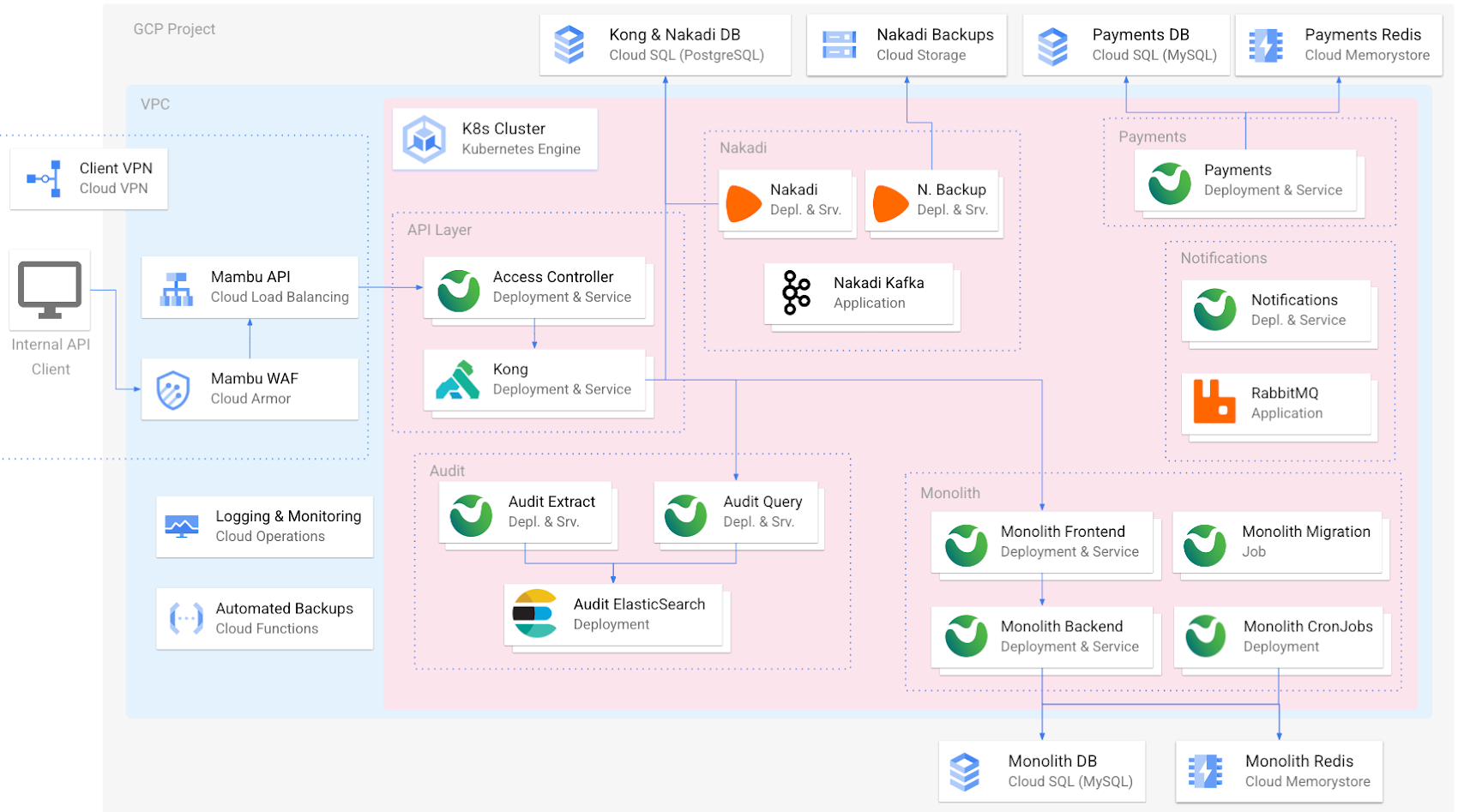
In addition to GKE, the Mambu platform uses several other Google Cloud services for specific functions, including Cloud Armor, Cloud Load Balancing, Cloud VPN, Cloud Memorystore, and Google Cloud Operations.
Another important reason we chose to partner with Google Cloud was its expansive ecosystem and commitment to innovation. We are midway into a three-year journey to modernize our own technology stack to meet customer needs.
Building a roadmap with Google Cloud
Our customers need a core banking technology platform that will grow with them as they bring to market innovative services built on the latest technology advances. For Mambu to be that platform, we need a cloud partner that supports and scales with our growth. While we originally built our cloud architecture on GKE and Compute Engine (among a few other Google Cloud services), we’re now looking to a serverless future where we can scale more easily and leverage managed services within Google Cloud and its partner ecosystem to focus on our core offerings.
These are just some of the modernization and customer-led innovations that we’re cooking up:
- More workloads in GKE: Like many companies, our cloud transformation is a work in progress. While much of our codebase is in GKE, we’re continuing to break up some larger pieces of code into microservices to increase agility and velocity, enabling us to make consistent updates to discrete areas of our platform without affecting the whole. GKE is the leader for orchestrating microservices at scale and continues to be a natural fit.
- Native BigQuery integration: Mambu customers collect a tremendous amount of data within the platform that can be used for analytics, personalization, and other use cases. We’re planning to create a seamless integration for feeding core banking data from Mambu into BigQuery so that customers can better leverage their valuable data.
- CloudSQL vs. self-managed MySQL: We have almost completed migrating from our own MySQL instances to managed Cloud SQL databases, which will open up new opportunities to implement customer-centric solutions such as BigQuery integration.
- A serverless future with Cloud Run: Compute Engine is working well for Mambu, providing the flexibility to choose the virtual machines that best balance performance and cost needs. As we seek even more time and cost efficiencies, we believe the elastic scalability of a serverless architecture built on Cloud Run will get us there, and we’re considering going serverless in the future. Doing so would abstract infrastructure for simpler management, while allowing us to fire up containers to meet our customers’ high transactions-per-second needs, spin them down when not needed, and pay only when they run. It would also boost security: Without long-running compute, there are no patches or fixes, and each new instance is isolated and fresh by default.
These are just a handful of examples of the ways we want to best leverage Google Cloud services to simplify how we manage our tech stack, as well as continue to bolster security, scalability, and performance. There are many other ideas we’re exploring: using Dataproc and Datastream to support the specific data needs of Islamic banking, Cloud Functions so that customers can run their own queries against Mambu, and AI-enabled features.
At Mambu, our mission is to empower our customers to deliver great modern financial experiences easily to everyone around the world. Every time Google Cloud opens a new data center, we can enter a new market. Every time we move to a new-to-us managed service via the Google Cloud Marketplace, we free up time to build new ways to deliver customer-centric banking solutions. And so, we look forward to continuing this partnership with Google Cloud well into the future.
How Companies can Improve Scalability, Flexibility, and Reliability While Reducing Costs: Tips from Route4Me

3985
Of your peers have already read this article.
3:30 Minutes
The most insightful time you'll spend today!
Google Cloud Results
- Improves application performance by 8x to 12x; customers can create increasingly complex optimized driving routes in single-digit seconds
- Improves customer satisfaction via increased reliability and greater application performance
- Focuses on adding value to customers by improving software and algorithms, not infrastructure management
- Saves 5x in infrastructure costs
In 2009, Dan Khasis needed to rent an apartment. His search had him driving around the greater New York City area in unfamiliar areas, scattershot-style, often ending up where he started. The frustrating experience led the serial entrepreneur to launch Route4Me, a smartphone navigation app to help consumers create driving routes optimized for multiple stops.
Soon, business users recognized Route4Me’s value and requested enhancements specifically for them. While route optimization apps for big businesses already existed, they were almost exclusively offline desktop programs that were expensive to purchase, deploy, and get trained on. Recognizing the opportunity, Route4Me developed an affordable route optimization solution across various devices, such as smartphones, smartwatches, and telematics devices. The software was tailored to logistics-intensive businesses such as last-mile delivery services and business units conducting field sales, field service, and field marketing functions.
As Route4Me grew its user base, it became clear that its infrastructure of rented, dedicated servers from various providers wasn’t sustainable. “The hardware costs seemed low, but there were many risks and hidden costs,” says Dan Khasis, Co-founder and CEO at Route4Me. For example, “Multi-zone disaster recovery, high availability, automated failover, and on-demand surging of many nodes was simply impossible,“ he adds.
Because under the hood Route4Me’s routing optimization platform requires complex computations, the company needed a globally scalable infrastructure capable of delivering low latency and high throughput. Route4Me also needed to stay competitive by developing and delivering new services as quickly and efficiently as possible.
For these and other reasons, Route4Me moved 100% into the cloud. “Like many entrepreneurial software companies, we test all the latest technologies we can find before upgrading. Typically we go with the fastest technology, with a strong bias towards open source and open standards,” Khasis says. Based on extensive testing, Route4Me selected Google Cloud Platform (GCP). Along with the scalability, flexibility, reliability, and low-cost structure of GCP, Route4Me had already migrated its entire platform to containerized microservices, which Khasis says “are extremely stable and reliable” on Google Kubernetes Engine. While Route4Me has proprietary routing and route optimization engines, it uses Google Maps for high-precision geocoding and as the frontend.
With GCP, Route4Me has reduced its IT infrastructure costs while delivering faster route optimizations and more reliable service to customers. Because of GCP, the company is also planning to add services that will deliver the fastest possible routing simulations and calculations to customers at a price that Khasis says is “impossible without a mature cloud-based platform like GCP.”
Unexpected savings, pleasant surprises
The migration to GCP and Kubernetes Engine required Route4Me to revamp its Service-Oriented Architecture (SOA) and convert millions of lines of code into containerized microservices running on Kubernetes Engine. With more than 150 microservices and thousands of add-on modules and features offered on the Route4Me platform, the migration took several months. But the transition, which began in May 2017 and concluded toward year’s end, went smoothly. “Thanks to the reliability and open source portability of Google Kubernetes Engine, Route4Me experienced one-tenth of the problems that we’ve had when onboarding to other cloud providers,” says Khasis.
Halfway into the migration, Route4Me engineers discovered an unexpected cost savings. The ability to run preemptible virtual machine (VM) instances with Kubernetes Engine resulted in a 90% savings in infrastructure costs, according to Khasis.
The engineering team was also pleasantly surprised by the improved intra-system latency and performance between the Google network and those of third-party systems and other data centers that Route4Me connects to. Overall latency dropped from 8x to 12x. “Where it used to take 8 to 14 seconds to plan a complicated route, now it takes as little as 2 seconds,” Khasis says. Route4Me is also running most of its transactional and operational data through Google BigQuery for a variety of business use cases, including complex machine learning tasks such as geospatial analytics, geospatial pattern detection, and synthetic density.
Scaling while delivering great performance
Route4Me algorithms take into account such data as driving distance, driving time, who’s driving, the day of the week, the vehicle being used, weather conditions, and dozens of other attributes. “All those scenarios and data have to be run in near real time,” Khasis explains. The Route4Me system must access multiple internal and external databases, aggregate all the information in parallel, and deliver it using a high-speed infrastructure platform.
“Our core services and algorithms work much faster on a Google architecture, bringing the total time to solve a complex route problem down to single-digit seconds.” “Many of those steps are resource-intensive,” Khasis adds. “With Kubernetes Engine clusters, we can do much more, scaling up and down as needed, and still deliver great performance to customers around the world.”
Because of its scale, Route4Me built its own automation system for marketing, support, and communications with its customers. “Since we moved our proprietary marketing automation system to GCP, we began delivering our omni-channel marketing communications more reliably, and the correct message reached customers faster and at just the right moment,” says Khasis. “That’s translated to happier customers and increased revenue.”
Customer satisfaction has increased, too, because Route4Me’s users experience far fewer slowdowns than before due to the reliability of GCP. The reliability also means the company spends less time worrying about certain clusters or servers going down for extended periods of time. “We have zero sysadmins, which was the Achilles heel of some of my previous startups,” says Khasis. “So we can focus on software development rather than infrastructure management.”
In order to scale as needed and develop new features, Khasis had expected the company would need to hire more SysAdmin, DevOps, and SecOps staff. “But once we migrated to the modern GCP environment, we didn’t have to make those hires. We saved a lot of money by not having to hire, train, and manage more people,” explains Khasis.
Flexible GCP pricing, in which customers only pay for what they use, has saved Route4Me money on its IT infrastructure. “Preemptible server pricing on GCP is so aggressive,” Khasis says. “If servers are automatically shut off for a certain time period, we don’t pay for them for that period. And if servers are on for a certain amount of time, we get an automatic 30% discount. We’re saving money on the platform with fixed and dynamic workloads.”
Per-second billing with GCP also helps Route4Me cut costs. “If it only takes 25 seconds to do something, we only pay for those 25 seconds,” Khasis says. For the same 25 seconds, other cloud providers might charge for 10 minutes usage or even an hour.”
Road map for the future
In the coming year, Route4Me plans to offer additional add-ons as part of its self-service marketplace, providing customers with transparent pricing on highly complex route optimizations. The service will be extremely valuable to heavy users. For instance, if an organization has to visit 50,000 locations by a certain time, it might wonder if it needs to add 20 people to make that happen and how much it’s going to cost. “Because we’re on GCP, our customer can run a variety of complicated routing scenarios to see which one is the most efficient in seconds instead of minutes,” says Khasis. “As far as I know, none of our competitors can offer that kind of service, giving us an edge as well as a new revenue stream.”
Going forward, Route4Me will begin migrating a huge portion of its core routing optimization platform to Google Google Cloud Spanner. “We want to take further advantage of Cloud Spanner, which comes closest to the CAP theorem and permits us to operate an infinitely scalable and nearly indestructible platform,” Khasis says.
As one example, Route4Me receives telematics data, such as GPS coordinates, from Internet of Things (IoT) devices in smartphones and vehicles, and performs complex algorithmic analysis running on Cloud Spanner. This provides real-time return on investment (ROI) information, so customers can see how much money they’re saving by using Route4Me routing optimization services.
“In order to help as many logistics-intensive businesses as possible, we intend to migrate our proprietary mapping, routing, and route optimization services to Cloud Spanner to take advantage of its extreme reliability and redundancy, and the multi-availability zones of Google Cloud Platform,” says Khasis.
Route4Me also plans to leverage Google machine learning technology, in part to make its routing solution available for use in autonomous and drone vehicles, as well as decentralized edge computing deployments. In addition, Google security and encryption technology will help the company expand its offerings to the heavily regulated medical industry.
Over 60 Route4Me team members use G Suite for almost everything. ”We’re interested in using everything possible with G Suite. We get inspiration from G Suite, too. A lot of thinking and effort went into improving G Suite, and we use that as inspiration to improve own products.”
How to Pick a Database that is Suitable for Your Application

7039
Of your peers have already read this article.
2:30 Minutes
The most insightful time you'll spend today!
Picking the right database for your application is not easy. The choice depends heavily on your use case—transactional processing, analytical processing, in-memory database, and so on—but it also depends on other factors. This post covers the different database options available within Google Cloud across relational (SQL) and non-relational (NoSQL) databases and explains which use cases are best suited for each database option.

Relational databases
In relational databases information is stored in tables, rows and columns, which typically works best for structured data. As a result they are used for applications in which the structure of the data does not change often. SQL (Structured Query Language) is used when interacting with most relational databases. They offer ACID consistency mode for the data, which means:
- Atomic: All operations in a transaction succeed or the operation is rolled back.
- Consistent: On the completion of a transaction, the database is structurally sound.
- Isolated: Transactions do not contend with one another. Contentious access to data is moderated by the database so that transactions appear to run sequentially.
- Durable: The results of applying a transaction are permanent, even in the presence of failures.
Because of these properties, relational databases are used in applications that require high accuracy and for transactional queries such as financial and retail transactions. For example: In banking when a customer makes a funds transfer request, you want to make sure the transaction is possible and it actually happens on the most up-to-date account balance, in this case an error or resubmit request is likely fine.
There are three relational database options in Google Cloud: Cloud SQL, Cloud Spanner, and Bare Metal Solution.
Cloud SQL: Provides managed MySQL, PostgreSQL and SQL Server databases on Google Cloud. It reduces maintenance cost and automates database provisioning, storage capacity management, back ups, and out-of-the-box high availability and disaster recovery/failover. For these reasons it is best for general-purpose web frameworks, CRM, ERP, SaaS and e-commerce applications.
Cloud Spanner: Cloud Spanner is an enterprise-grade, globally-distributed, and strongly-consistent database that offers up to 99.999% availability, built specifically to combine the benefits of relational database structure with non-relational horizontal scale. It is a unique database that combines ACID transactions, SQL queries, and relational structure with the scalability that you typically associate with non-relational or NoSQL databases. As a result, Spanner is best used for applications such as gaming, payment solutions, global financial ledgers, retail banking and inventory management that require ability to scale limitlessly with strong-consistency and high-availability.
Bare Metal Solution: Provides hardware to run specialized workloads with low latency on Google Cloud. This is specifically useful if there is an Oracle database that you want to lift and shift into Google Cloud. This enables data center retirements and paves a path to modernize legacy applications.
Non-relational databases
Non-relational databases (or NoSQL databases) store compex, unstructured data in a non-tabular form such as documents. Non-relational databases are often used when large quantities of complex and diverse data need to be organized. Unlike relational databases, they perform faster because a query doesn’t have to access several tables to deliver an answer, making them ideal for storing data that may change frequently or for applications that handle many different kinds of data.
For example, an apparel store might have a database in which shirts have their own document containing all of their information, including size, brand, and color with room for adding more parameters later such as sleeve size, collars, and so on.
Qualities that make NoSQL databases fast:
- Eventual consistency: stores usually exhibit consistency at some later point (e.g., lazily at read time)
- Horizontal scaling, usually using hashed distributions
- Typically, they are optimized for a specific workload pattern (i.e., key-value, graph, wide-column)
- Typically, they don’t support cross shard transactions or flexible isolation modes.
Because of these properties, non-relational databases are used in applications that require large scale, reliability, availability, and frequent data changes.They can easily scale horizontally by adding more servers, unlike some relational databases, which scale vertically by increasing the machine size as the data grows. Although, some relations databases such as Cloud Spanner support scale-out and strict consistency.
Non-relational databases can store a variety of unstructured data such as documents, key-value, graphs, wide columns, and more. Here are your non-relational database options in Google Cloud:
- Document databases: Store information as documents (in formats such as JSON and XML). For example: Firestore
- Key-value stores: Group associated data in collections with records that are identified with unique keys for easy retrieval. Key-value stores have just enough structure to mirror the value of relational databases while still preserving the benefits of NoSQL. For example: Datastore, Bigtable, Memorystore
- In-memory database: Purpose-built database that relies primarily on memory for data storage. These are designed to attain minimal response time by eliminating the need to access disks. They are ideal for applications that require microsecond response times and can have large spikes in traffic. For example: Memorystore
- Wide-column databases: Use the tabular format but allow a wide variance in how data is named and formatted in each row, even in the same table. They have some basic structure while preserving a lot of flexibility. For example: Bigtable
- Graph databases: Use graph structures to define the relationships between stored data points; useful for identifying patterns in unstructured and semi-structured information. For example: JanusGraph
There are three non-relational databases in Google Cloud:
- Firestore: Is a serverless document database which scales on demand and acts as a backend-as-a-service. It is DBaaS that increases the speed of building applications. It is perfect for all general purpose uses cases such as ecommerce, gaming, IoT and real time dashboards. With Firestore users can interact with and collaborate on live and offline data making it great for real-time application and mobile apps.
- Cloud Bigtable: Cloud Bigtable is a sparsely populated table that can scale to billions of rows and thousands of columns, enabling you to store terabytes or even petabytes of data. It is ideal for storing very large amounts of single-keyed data with very low latency. It supports high read and write throughput at sub-millisecond latency, and it is an ideal data source for MapReduce operations. It also supports the open-source HBase API standard to easily integrate with the Apache ecosystem including HBase, Beam, Hadoop and Spark along with Google Cloud ecosystem.
- Memorystore: Memorystore is a fully managed in-memory data store service for Redis and Memcached at Google Cloud. It is best for in-memory and transient data stores and automates the complex tasks of provisioning, replication, failover, and patching so you can spend more time coding. Because it offers extremely low latency and high performance, Memorystore is great for web and mobile, gaming, leaderboard, social, chat, and news feed applications.
Conclusion
Choosing a relational or a non-relational database largely depends on the use case. Broadly, if your application requires ACID transactions and your data structure is not going to change much, select a relational database.
In Google Cloud use Cloud SQL for any general-purpose SQL database and Cloud Spanner for large-scale globally scalable, strongly consistent use cases. In general, if your data structure may change later and if scale and availability is a bigger requirement than consistency then a non-relational database is a preferable choice. Google Cloud offers Firestore, Memorystore, and Cloud Bigtable to support a variety of use cases across the document, key-value, and wide column database spectrum.
For more comparison resources on each database check out the overview. For more hands-on experience with Bigtable, check out our on-demand training here and learn about migrating databases to managed services check out this whitepaper.
https://youtube.com/watch?v=2TZXSnCTd7E%3Fenablejsapi%3D1%26
For more #GCPSketchnote, follow the GitHub repo. For similar cloud content follow me on Twitter @pvergadia and keep an eye out on thecloudgirl.dev.
More Relevant Stories for Your Company

How to Get Your Cloud Migration Journey Started Off on the Right Foot
When moving to the cloud, many organizations concentrate their focus on the change in technology, and overlook an area just as complex: cultural change. At Google, we’ve spent years nurturing our culture and workforce to best operate in the cloud, and the Google Cloud Professional Services team leverages the lessons we’ve learned

Demystifying FinOps on Google Cloud: Whitepaper
FinOps is a concept similar to DevOps, but with a different set of goals. Cloud FinOps is an operational framework and cultural shift that brings together technology, finance and business to drive financial accountability and accelerate business value realization. In layman terms, FinOps aims to help companies achieve most out

Pacemaker’s Automated Alerts and Alert Reporting: No More Outages for SAP Systems on Google Cloud!
When critical services fail, businesses risk losing revenue, productivity, and trust. That’s why Google Cloud customers running SAP applications choose to deploy high availability (HA) systems on Google Cloud. In these deployments Linux operating system clustering provides application and guest awareness for the application state and automates recovery actions in

Dassana: Choosing Google Workspace and Google Cloud to accelerate growth and reach goals
When Dassana co-founders Gaurav Kumar and Parth Shah, formerly founder and founding engineer at RedLock (now Prisma Cloud by Palo Alto Networks), set out on a new startup journey in 2020, they knew exactly where to start: sign up for Google Workspace. “Every startup I’ve been at, we used Google
