





5881
Of your peers have already watched this video.
1:30 Minutes
The most insightful time you'll spend today!
FFF Enterprises See 80% Improvements in Speed at Lower Cost by Moving SAP Data to Google Cloud
FFF Enterprises, a pharmaceutical distributor of lifesaving biopharma products, vaccines and plasma products deployed SAP on Google Cloud to leverage its ability to scale server demands, reduce costs and improve speed and performance. Learn how the migration helps FFF empower healthcare to care!
6511
Of your peers have already watched this video.
46:30 Minutes
The most insightful time you'll spend today!
The Inside Story of How Home Depot Migrated to Google BigQuery From an On-prem DW Solution
In the media, you will often hear story of how born-in-the-cloud companies manage with massive infrastructure.
But it is one thing is to be a startup, and build infrastructure with bespoke requirements. And quite another to have a complex, multinational organization with online, with mobile, with brick-and-mortar presence, and hundreds of thousands of SKUs and professional services, and many, many years of technology, innovation, and really smart engineers.
This is the second story. The story of how The Home Depot, the number-one home improvement retailer in the US pulled of that feat.
The Home Depot has over 2,200 stores, over 4 lakh associates, and 2017 revenues of over a $100 billion.
In this video, Rick Ramaker, technology director, data analytics at The Home Depot, and Kevin Scholz, distinguished engineer, The Home Depot, talk about how the company transformed and modernised its data warehousing, the challenges they faced and the benefits they accrued from the project.
It’s a fascinating watch!
Taking Partnership forward: Google Cloud VMware Engine Now in VMware Cloud Universal

3475
Of your peers have already read this article.
1:30 Minutes
The most insightful time you'll spend today!
As the pace of digital transformation accelerates, our partnership with VMware continues to focus on helping customers successfully navigate their cloud journey and achieve their business objectives through seamless and rapid migration of business critical VMware workloads.
We announced the general availability of Google Cloud VMware Engine in May 2020. Since then we have worked closely with VMware to make it easier for customers to quickly migrate and run business-critical, VMware-based workloads on Google Cloud. Customers are already leveraging the service across a variety of use cases including application migration, datacenter exit, virtual desktop infrastructure, disaster recovery, and spinning up new capacity quickly to meet business needs.
For example, retailer Carrefour migrated its on-premises VMware workloads to Google Cloud without disruption to shoppers or employees while reducing operating costs by 40% and energy consumption by 45%. Once in the cloud, Carrefour was able to leverage its data and AI to deliver innovative customer experiences across online and in-store channels. Similarly, telecommunications provider Mitel migrated thousands of VMware instances across 30 data centers to Google Cloud in less than 90 days, quickly achieving increased stability, scale, and security.
Today, we announced the continued growth of the Google Cloud and VMware partnership with the addition of Google Cloud VMware Engine within VMware Cloud Universal. Google Cloud VMware Engine delivers a cloud-native VMware experience and enables you to rapidly migrate to the cloud without changes to your apps, policies, or tools. Once you migrate your VMware workloads to Google Cloud, you can accelerate digital transformation through seamless access to services such as BigQuery for real-time data analytics and cloud-native container-based architectures on Kubernetes.
With VMware Cloud Universal, you will be able to accelerate migrations of your workloads and applications to Google Cloud through purchase of Google Cloud VMware Engine from VMware and its partners, allowing you to flexibly purchase credits, and leverage existing spend and unused VMware Cloud Universal credits. The program will offer the following benefits:
- Financial flexibility by letting you redeem VMware Cloud Universal credits for Google Cloud VMware Engine
- Streamlined consumption by enabling you to burn down your Google Cloud commits while purchasing from VMware
- Use of existing VMware licensing investments through the VMware Cloud Universal program for Google Cloud VMware Engine
With Google Cloud VMware Engine, you can take advantage of Google Cloud’s highly performant, scalable infrastructure with fully redundant and dedicated 100 Gbps networking, providing 99.99% availability to meet the needs of the most demanding workloads at very low costs. By providing a consistent VMware environment natively in Google Cloud, you can quickly migrate your VMware workloads to Google Cloud without changes. Deep and unique networking integrations and capabilities such as multi-region and multi-VPC connectivity, further ease the migration of complex enterprise networking topologies to Google Cloud. With rapid provisioning of private clouds across 13 global regions, you can also take advantage of on-demand capacity to serve your infrastructure needs with a cloud-native VMware environment in Google Cloud.Once in the cloud, you can take advantage of other Google Cloud services such as BigQuery and Cloud Operations to gain data-driven insights and unify operations.
Getting started
With Google Cloud VMware Engine as part of VMware Cloud Universal, Google Cloud is a compelling cloud destination for your VMware workloads. You can learn more about how to get started with the service and get additional detail around use cases and pricing on our website.
5566
Of your peers have already downloaded this article
1:30 Minutes
The most insightful time you'll spend today!
Protecting a global network against persistent and constantly evolving cyber threats is one of the most important challenges faced by Google Cloud. So, how does Google’s global network protects seven different global businesses, each with over 1 billion customers, including popular Google services such as Google Search, YouTube, Maps, and Gmail?
The answer is a multi-step process, which is constantly changing and evolving to stay one step ahead of the malicious hackers and attackers. For instance, it’s network communications protocols—the rules that enable communications between systems—change multiple times per second to make malicious intrusions much harder.
Data in Google Cloud is encrypted both in transit and at rest. Google’s network capacity far exceeds any traffic load it hosts to thwart and DDoS attack. In addition, it has numerous other products, tools, and processes at work to provide defense in depth.
Download this e-book to get a detailed overview of Google Cloud’s approach to security and privacy.
Strategic Consulting, Training & Implementation Guidelines with Public Sector PSO Helps Governments Stay Compliant

4707
Of your peers have already read this article.
3:00 Minutes
The most insightful time you'll spend today!
Did you know that by 2025, enterprise IT spending on public cloud computing will overtake traditional IT spending? In fact, 51% of IT spend in application software, infrastructure software, business process services, and system infrastructure will transition to the public cloud, compared to 41% in 20221.. As enterprises continue to rapidly shift to the cloud, government agencies must prioritize and accelerate security and compliance implementation.
In May 2021, the White House issued an Executive Order requiring US Federal agencies to accelerate cloud adoption, embrace security best practices, develop plans to implement Zero Trust architectures, and map implementation frameworks to FedRAMP. The Administration’s focus on secure cloud adoption marks a critical shift to prioritizing cybersecurity at scale. Google Cloud’s Public Sector Professional Services Organization (PSO) has committed to helping customers meet security and compliance requirements in the cloud through specialized consulting engagements.
Accelerating Authority to Operate (ATO)
The Federal Risk and Authorization Management Program (FedRAMP) was established in 2011 as a government-wide program that promotes the adoption of secure cloud services across the federal government. FedRAMP provides a standardized approach to security and risk assessment for cloud technologies and federal agencies. US Federal agencies are required to utilize and implement FedRAMP cloud service offerings as part of the “Cloud First” federal cloud computing strategy.
While Google Cloud provides a FedRAMP-authorized cloud services platform and a robust catalog of FedRAMP-approved products and services (92 services and counting), customers are still tasked with achieving Agency ATO for the products and services they use, and Google Cloud provides many resources to assist customers with this journey. Google Cloud’s FedRAMP package can be accessed by completing the FedRAMP Package Access Request Form and submitting it to info@fedramp.gov. Additionally, customers can use Google’s NIST 800-53 ATO Accelerator as a starting point for documenting control implementation. Finally, Google Cloud’s Public Sector PSO offers the following strategic consulting engagements to help customers streamline the Agency ATO process.
- Cloud Discover: FedRAMP is a six-week interactive workshop to support customers that are just getting started with the ATO process on Google Cloud. Customers are educated on FedRAMP fundamentals, Google’s security and compliance posture, and how to approach ATO on Google Cloud. Through deep-dive interviews and design sessions, PSO helps customers craft an actionable ATO plan, assess FedRAMP readiness, and develop a conceptual ATO boundary. This engagement helps organizations establish a clear understanding and roadmap for FedRAMP ATO on Google Cloud.
- FedRAMP Security Review is a ten to twelve week engagement that aids customers in FedRAMP operational readiness. PSO consultants perform detailed FedRAMP architecture reviews to identify potential gaps in NIST 800-53 security control implementation and Google Cloud secure architecture best practices. Findings from the security reviews are shared with the customer along with configuration guidance and recommendations. This engagement helps organizations prepare for the third-party or independent security assessment that is required for FedRAMP ATO.
- Cloud Deploy: FedRAMP is a multi-month engagement designed to help customers document the details of their FedRAMP System Security Plan (SSP) and corresponding NIST 800-53 security controls, in preparation for Agency ATO on Google Cloud at FedRAMP Low, Moderate, or High. PSO collaborates with customers to develop a detailed technical infrastructure design document and security control matrix capturing evidence of the FedRAMP system architecture, security control implementation, data flows and system components. PSO can also partner with a third-party assessment organization (3PAO) or an independent assessor (IA) to support customer efforts for FedRAMP security assessment. This engagement helps customer system owners prepare for Agency ATO assessment and package submission.
Developing a Zero Trust Strategy
In addition to providing FedRAMP enablement, Public Sector PSO has partnered with the Google Cloud Chief Information Security Officer (CISO) team to assist organizations with developing a zero trust architecture and strategy.
Zero Trust Foundations is a seven-week engagement co-delivered by Google Cloud’s CISO and PSO teams. CISO and PSO educate customers on zero trust fundamentals, Google’s journey to zero trust through BeyondCorp, and defense in depth best practices. The CISO team walks customers through a Zero Trust Assessment (ZTA) to understand the organization’s current security posture and maturity. Insights from the ZTA enable the CISO team to work with the customer to identify an ideal first-mover workload for zero trust adoption. Following the CISO ZTA, PSO facilitates a deep-dive Zero Trust Workshop (ZTW), collaborating with key customer stakeholders to develop a NIST 800-207 aligned, cloud-agnostic zero trust architecture for the identified first-mover workload. The zero trust architecture is part of a comprehensive zero trust strategy deliverable that is based on focus areas called out in the Office of Management and Budget (OMB) Federal Zero Trust Strategy released January 2022.
Scaling Secure Cloud Adoption with PSO
Public Sector PSO enables customer success by sharing our technical expertise, providing cloud strategy, implementation guidance, training and enablement using our proven methodology. As enterprise IT, operations, and organizational models continue to evolve, our goal is to help government agencies accelerate their security and compliance journeys in the cloud. To learn more about the work we are doing with the federal government, visit cloud.google.com/solutions/federal-government.
Datashare for Financial Services: Securing the Publishers and Consumers’ Access to Market Data

8563
Of your peers have already read this article.
4:30 Minutes
The most insightful time you'll spend today!
Access to the cloud has advanced the distribution and consumption of financial information on a global scale. In parallel, the global financial data landscape has been transformed by an influx of alternative data sources, including social media, meteorological data, satellite imagery, and other data. Exchanges and market data providers now find they need to include these new datasets to enrich their products and compete, which has meant they now must consider cloud-based models to keep up with the demands of their customers who expect easy, quick, flexible and cost-efficient ways to consume market data.
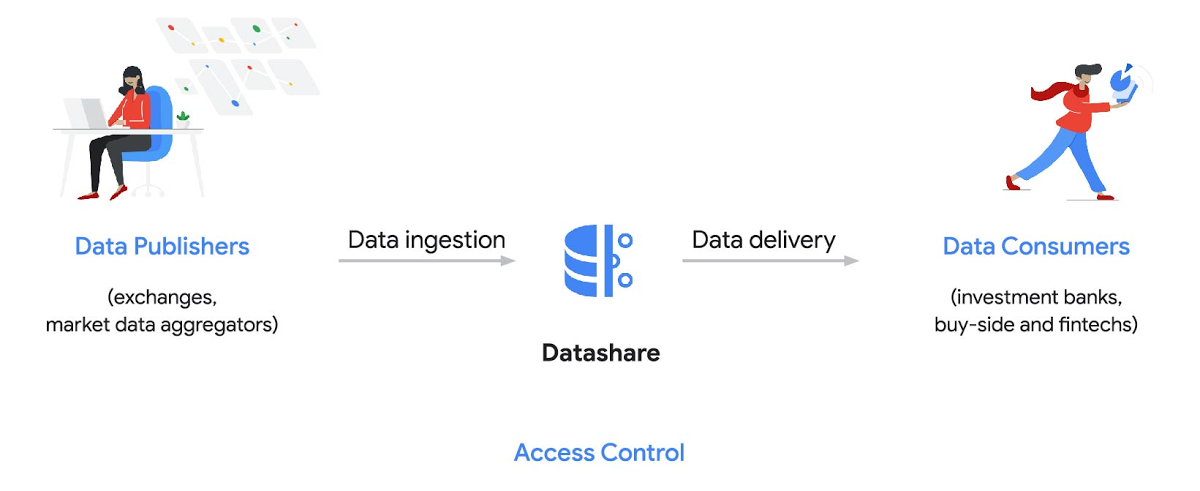
To address these needs, today we’re announcing the general availability of Datashare for financial services, a new Google Cloud solution that brings together the entire capital markets ecosystem—data publishers, and data consumers—to exchange market data securely and easily.
Datashare helps organize third-party financial information, making it accessible and useful to market data publishers and data consumers. We open-sourced the entire Datashare solution so market data publishers can now onboard their licensed datasets to Google Cloud securely, quickly and easily, while data consumers can consume that data as a service in tools of their preference, such as BigQuery.
Three ways to distribute and consume your data
Batch data delivery
Datashare provides a batch data delivery mechanism for data publishers to deliver their reference data, historical tick data, alternative market data sources and more via BigQuery, reducing the administrative burden on data consumers to extract insights from data.
Real-time data streaming delivery
By using this event-based data delivery channel for rapidly changing instrument prices, tick data, orders, news and others via Pub/Sub, data consumers can reliably process individual messages or rewind to a point in time to replay a prior market scenario and test model changes.
Monetizing licensed datasets
Market data publishers can onboard their licensed datasets to Google Cloud and make them available via a one-stop-shop on Google Cloud Marketplace, enabling a new sales channel to expand market reach.
Reference architecture
Check out the diagram below to see how you can share your batch and real-time data directly to your Google Cloud customers with BigQuery and Pub/Sub.

As you can see in the above reference architecture, both publishers and consumers can derive several benefits from the solution:
Benefits for data publishers
- You no longer have to maintain your own delivery and licensing infrastructure.
- You can easily package and deliver granular data products and experiments with SQL.
- You can have a solution that scales with your business as data volumes and number of customers grow.
Benefits for data consumers
- Your data is ready for analysis and machine learning (ML)— you no longer have to maintain extract, transform, and load (ETL) pipelines to load files and transform data.
- You can avoid the expense and burden of maintaining multiple copies of large data files.
- You can be more targeted with consumption of data using BigQuery queries, improving performance, and compliance, and reducing cost.
Accessing the datasets
Google Cloud has been working with multiple industry firms on innovating in the market data space. By using Datashare for publishing, data publishers can make their entire datasets available on Google Cloud. Early adopters of Datashare include firms such as OneTick and Accern. OneTick’s datasets include reference and historical futures data (that can be accessed in our console with your login). Accern’s datasets include alternative data such as market sentiment and credit analysis data (that can be accessed in our console with your login).
To make it more helpful, we partnered with Accern to create a hypothetical scenario to describe the data acquisition and analytics process step-by-step.
Accern use case
As a sustainability analyst, you require an economic, social and governance (ESG) dataset to determine which sector is the most widely covered ESG sector by analysts, and to also identify the sector with the lowest ESG sentiment score. Now, you can discover and acquire an ESG dataset in Google Cloud.
Step 1. Navigate to the Financial Services solutions page in the Google Cloud console:

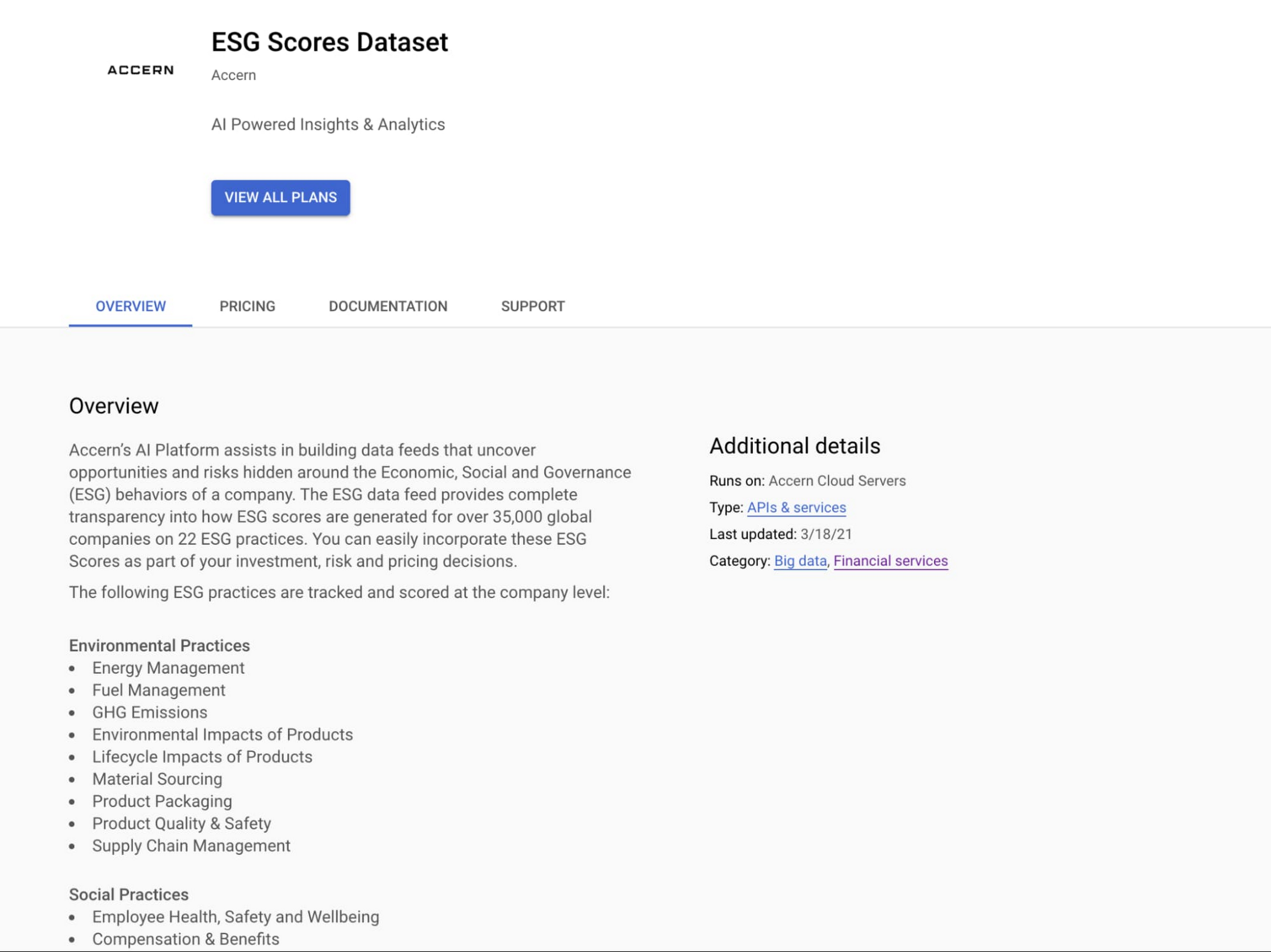
Step 2. Click a dataset, for example Accern AI-Generated ESG Insights, then review the overview details, plans and pricing, documentation and support information. To view the available pricing tiers, click ‘View All Plans’. Once you’ve decided on a tier that you would like to subscribe to, click ‘Select’, choose a billing account and review and accept the terms of service to complete the subscription. Once the steps are complete, click ‘Subscribe’ at the bottom. An overlay window will appear, click ‘Register with Accern’ to activate and complete the subscription.

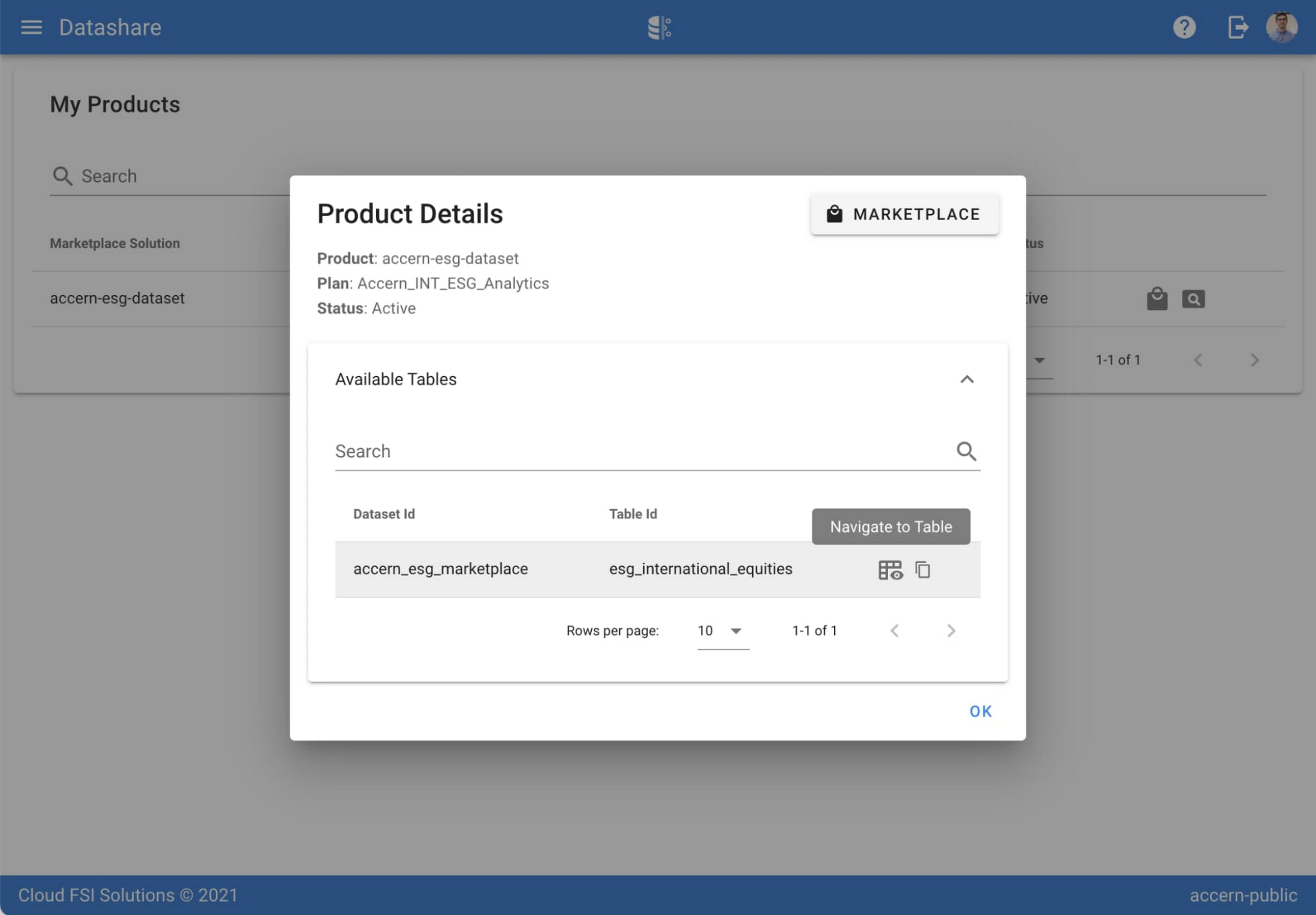
Step 3. Once activation is complete, you’ll be directed to the Datashare ‘My Products’ screen. Voila! You are now subscribed to Accern’s ESG Scores dataset and can access it in your Google Cloud instance using BigQuery. To access the data, click the hour glass icon on the corresponding ‘My Products’ record that you just purchased. An overlay will present you with the details on the dataset and/or table. Click the ‘Navigate to Table’ button to navigate through to the BigQuery console.


Step 4. Now that you have access and are in the BigQuery console, it’s time to generate data insights.
For this example, we’ve eliminated the company identifying information that is included as part of the subscription and aggregated company ESG in a view where each row represents a day, an industry sector, a specific identified ‘ESG Issues’ (event_group and event) and the respective ‘ESG Sentiment’ per issue.

For example, row 1 indicates that within the ‘Healthcare’ sector, there was a ‘Social – Civil Society’ issue identified and it had a negative ESG sentiment score of -15.35.
Step 5. Generate a report by exporting it to Data Studio to build visualizations and conduct additional analysis on the ESG data.
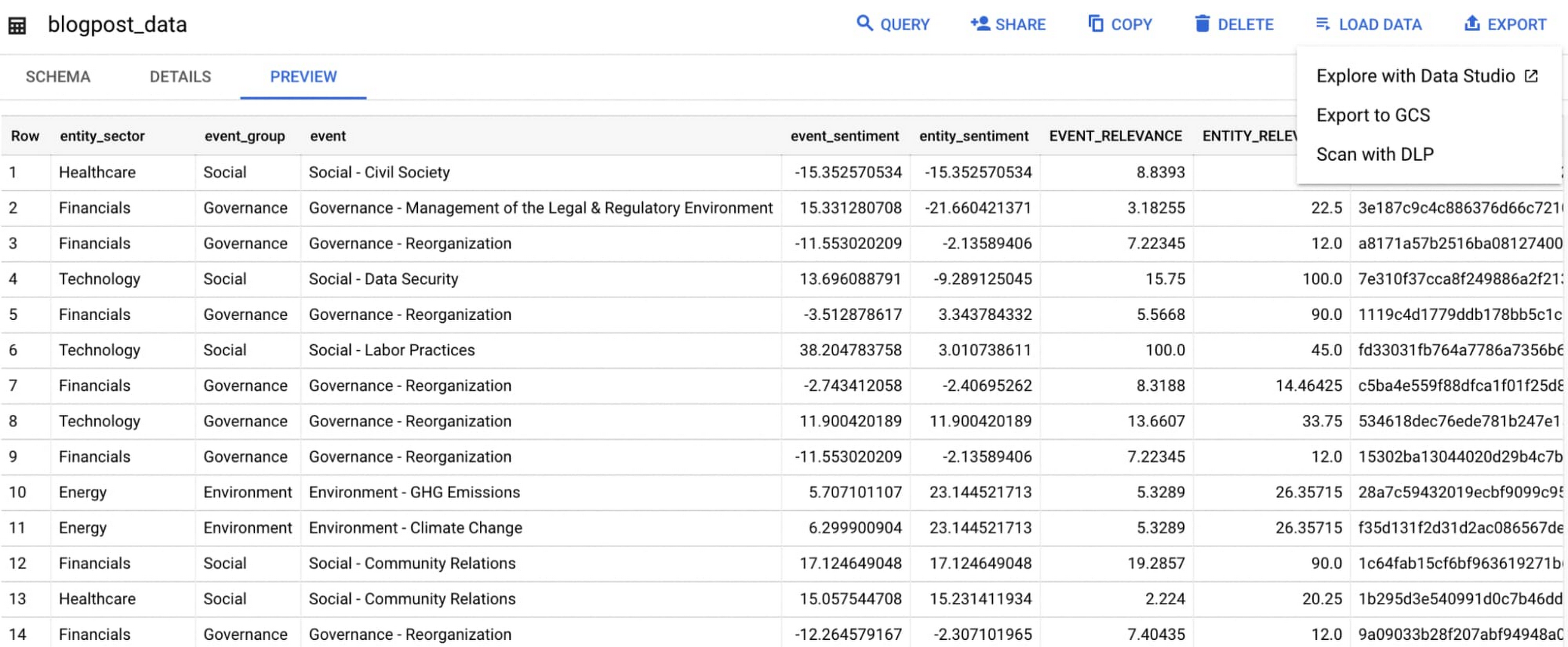
Select ‘Export’ and ‘Explore with Data Studio’.
Step 6. Build a simple/basic report.
Now that the ESG data appears in Data Studio, you can start by building a simple chart to help you understand which industry sectors have the highest volume of discussions around ESG and the overall ESG Sentiment per industry sector.
To build the chart:
- Select the chart type ‘Table’.
- Include
Entity_Sectoras your dimension to aggregate results by ‘Industry Sector.’ - Include
Signal_IDas a measure to count the number of ESG passages identified per ‘Industry Sector.’ - Include
AVG(Event_Sentiment)as a measure to display the overall ESG Sentiment per ‘Industry Sector’ across ESG Issues.

You can see sectors that are most discussed when it comes to ESG related topics and their corresponding ‘ESG Sentiment’ scores.
Step 7. Build your final report in Data Studio.
As a next step you can further drill into the data to understand ESG data specific to each ‘Industry Sector’ and identify positive and negative ESG practices.
Accern has built a more complex sample dashboard and made it available publicly here. You can interact with this report and play around with the data. The dashboard can help to identify material ESG insights for each sector to inform your investment and risk processes. If you have additional questions, you can reach out to Accern directly.

Discovering, accessing and analyzing licensed datasets is quick and easy. Stay tuned for more updates on new licensed datasets.
Publishing your data via Datashare
If you are a publisher of market data, alternative, or exotic data, you can use Datashare to get it published on Google Cloud Marketplace.
Start by joining the Partner Advantage program by registering for the Partner Advantage Portal and applying for the Partner Advantage Build Model engagement. Visit our getting started guide for information to get started on publishing licensed datasets in the Marketplace. Stay tuned for a future blog post about using Datashare to publish datasets in the Marketplace.
More solutions for capital markets
Check out other Google Cloud solutions for capital markets.
More Relevant Stories for Your Company
Delivering 10X Improvement to Risk and Regulatory Reporting Through Cloud and AI
Enterprise agility and the ability to innovate, adapt and respond quickly to the ever-changing risk and regulatory landscape is no longer a choice, but the cornerstone of successful digital transformation and commercial growth. Traditional access to and ways of managing data invariably create challenges in dealing with multiple data repositories,

Cloud Bigtable brings database stability and performance to Precognitive
At Precognitive, we were able to start with a blank technology slate to support our fraud detection software products. When we started building the initial version of our platform in 2017, we had some decisions to make: What coding language to use? What cloud infrastructure provider to choose? What database




Strategies for Migrating to the Cloud
What are the technologies that are helping enterprises scale, adapt, and modernize? Are there any strategies that enterprises can adopt for moving to the cloud? What this webinar to find out the different migration patterns to the cloud and learn how enterprises can choose the right strategies based on their

Confidential Computing: Google Cloud Security, Project Zero and AMD Come Together to Secure Sensitive Workloads
At Google Cloud, we believe that the protection of our customers’ sensitive data is paramount, and encryption is a powerful mechanism to help achieve this goal. For years, we have supported encryption in transit when our customers ingest their data to bring it to the cloud. We’ve also long supported
