





Google Cloud’s No-Cost Skill Badge: Up Your Generative AI Game

1195
Of your peers have already read this article.
1:30 Minutes
The most insightful time you'll spend today!
Generative AI is a rapidly expanding technology with a wide range of potential applications. Google Cloud Learning is thrilled to offer a new, no-cost Generative AI Fundamentals skill badge. This skill badge is designed for anyone eager to learn about the power of generative AI. No technical skills or prior knowledge required!
For those new to digital credentials, Google Cloud skill badges are digital credentials issued by Google Cloud in recognition of your knowledge of Google Cloud products and services. Individuals can earn skill badges on Google Cloud Skills Boost, and can share their skill badge to their social media profile and resume.
Watch the short videos in the generative AI courses and complete the final quiz to earn the Generative AI Fundamentals skill badge pictured below. In as little as 120 minutes, you will learn the basics of how generative AI works, how Google Cloud AI technology can be used by businesses and individuals, and how the principles of responsible AI lead to ethical decisions about the use of generative AI.
By earning the skill badge, you will demonstrate your understanding of foundational concepts in generative AI.
The topics covered in the courses include:
1. Introduction to Generative AI
- Explain how generative AI works
- Describe generative AI model types
- Describe generative AI applications
2. Introduction to Large Language Models
- Define large language models (LLMs)
- Describe LLM use cases
- Explain prompt tuning
- Describe Google’s generative AI development tools
3. Introduction to Responsible AI
- Identify the need for a responsible AI practice within an organization
- Recognize that decisions made at all stages of a project make an impact in Responsible AI
- Recognize that organizations can design an AI infrastructure to fit their own business needs and values
Earn the skill badge and show off your generative AI knowledge today! And for more content to help you stay up to date with generative AI, check out “The Prompt” and our generative AI primer for executives on Transform with Google Cloud.
How Vertex AI NAS is Suitable for Most Advanced ML Workloads

4480
Of your peers have already read this article.
3:00 Minutes
The most insightful time you'll spend today!
Vertex AI launched with the premise “one AI platform, every ML tool you need.” Let’s talk about how Vertex AI streamlines modeling universally for a broad range of use cases.
The overall purpose of Vertex AI is to simplify modeling so that enterprises can fast track their innovation, accelerate time to market, and ultimately increase return on ML investments. Vertex AI facilitates this in several ways. Features like Vertex AI Workbench, for example, speed up training and deployment of models by five times compared to traditional notebooks. Vertex AI Workbench’s native integration with BigQuery and Spark means that users without data science expertise can more easily perform machine learning work. Tools integrated into the unified Vertex AI platform, such as state of the art pre-trained APIs and AutoML, make it easier for data scientists to build models in less time. And for modeling work that lends itself best to custom modeling, Vertex AI’s custom model tooling supports advanced ML coding, with nearly 80% fewer lines of code required (compared to competitive platforms) to train a model with custom libraries. Vertex AI delivers all this while maintaining a strong focus on Explainable AI.
Yet organizations with the largest investments in AI and machine learning, with teams of ML experts, require extremely advanced toolsets to deliver on their most complex problems. Simplified ML modeling isn’t relegated to simple use cases only.
Let’s look at Vertex AI Neural Architecture Search (NAS), for instance.
Vertex AI NAS enables ML experts at the highest level to perform their most complex tasks with higher accuracy, lower latency, and low power requirements. Vertex AI NAS originates from the deep experience Alphabet has with building advanced AI at scale. In 2017, the Google Brain team recognized we need a better way to scale AI modeling, so they developed Neural Architecture Search technology to create an AI that generates other neural networks, trained to optimize their performance in a specific task the user provides. To the astonishment of many in the field, these AI-optimized models were able to beat a number of state of the art benchmarks, such as ImageNet and SOTA mobilenets, setting a new standard for many of the applications we see in use today, including many Google-internal products. Google Cloud saw the potential of such a technology and shipped in less than a year a productized version of the technique (under the brand AutoML). Vertex AI NAS is the newest and most powerful version of this idea, using the most sophisticated innovation that has emerged since the initial research.
Customer organizations are already implementing Vertex AI NAS for their most advanced workloads. Autonomous vehicle company Nuro is using Vertex AI NAS, and Jack Guo, Head of Autonomy Platform at the company, states, “Nuro’s perception team has accelerated their AI model development with Vertex AI NAS. Vertex AI NAS have enabled us to innovate AI models to achieve good accuracy and optimize memory and latency for the target hardware. Overall, this has increased our team’s productivity for developing and deploying perception AI models.”
And our partner ecosystem is growing for Vertex AI NAS. Google Cloud and Qualcomm Technologies have collaborated to bring Vertex AI NAS to the Qualcomm Technologies Neural Processing SDK, optimized for Snapdragon 8. This will bring AI to different device types and use cases, such as those involving IoT, mixed reality, automobiles, and mobile.
Google Cloud’s commitments to making machine learning more accessible and useful for data users, from the novice to the expert, and to increasing the efficacy of machine learning for enterprises are at the core of everything we do. With the suite of unified machine learning tools within Vertex AI, organizations can take advantage of every ML tool they need on one AI platform.
Ready to start ML modeling with Vertex AI? Start building for free. Want to know how Vertex AI Platform can help your enterprise increase return on ML investments? Contact us.
AI Booster: how Vodafone is supercharging AI & ML at scale

3230
Of your peers have already read this article.
3:30 Minutes
The most insightful time you'll spend today!
One of the largest telecommunications companies in the world, Vodafone is at the forefront of building next-generation connectivity and a sustainable digital future.
Creating this digital future requires going beyond what’s possible today and unlocking significant investment in new technology and change. For Vodafone, a key driver is the use of artificial intelligence (AI) and machine learning (ML), enabling predictive capabilities in enhancing the customer experience, improving network performance, accelerating advances in research, and much more.
Following 18 months of hard work, Vodafone has made a huge leap forward in advancing its AI capabilities at scale with the launch of its “AI Booster” AI / ML platform. Led by the Global Big Data & AI organization under Vodafone Commercial, the platform will use the latest Google technology to enable the next generation of AI use cases, such as optimizing customer experiences, customer loyalty, and product recommendations.
Vodafone’s Commercial team has long focused on advancing its AI and ML capabilities to drive business results. Yet as demand grows, it is easier said than done to embed AI and ML into the fabric of the organization and rapidly build and deploy ML use cases at scale in a highly regulated industry. Accomplishing this task means not only having the right platform infrastructure, but also developing new skills, ways of working, and processes.
Having made meaningful strides in extracting value from data by moving it into a single source of truth on Google Cloud, Vodafone had already significantly increased efficiency, reduced data costs, and improved data quality. This enabled a plethora of use cases that generate business value using analytics and data science. The next step was building industrial scale ML capability, capable of handling thousands of ML models a day across 18+ countries, while streamlining data science processes and keeping up with technological growth.
Knowing they had to do something drastically different to scale successfully, along came the idea for AI Booster.
“To maximize business value at pace and scale, our vision was to enable fast creation and horizontal / vertical scaling of use cases in an automated, standardized manner. To do this, 18 months ago we set out to build a next-generation AI / ML platform based on new Google technology, some of which hadn’t even been announced yet.
“We knew it wouldn’t be easy. People said, ‘Shoot for the stars and you might get off the ground…’ Today, we’re really proud that AI Booster is truly taking off, and went live in almost double the markets we had originally planned. Together, we’ve used the best possible ML Ops tools and created Vodafone’s “AI Booster Platform” to make data scientists’ lives easier, maximise value and take co-creation and scaling of use cases globally to another level,” says Cornelia Schaurecker, Global Group Director for Big Data & AI at Vodafone.
AI Booster: a scalable, unified ML platform built entirely on Google Cloud
Google’s Vertex AI lets customers build, deploy, and scale ML models faster, with pre-trained and custom tooling within a unified platform. Built upon Vertex AI, Vodafone’s AI Booster is a fully managed cloud-native platform that integrates seamlessly with Vodafone’s Neuron platform, a data ocean built on Google Cloud.
“As a technology platform, we’re incredibly proud of building a cutting-edge MLOps platform based on best-in-class Google Cloud architecture with in-built automation, scalability and security. The result is we’re delivering more value from data science, while embedding reliability engineering principles throughout,” comments Ashish Vijayvargia, Analytics Product Lead at Vodafone
Indeed, while Vertex AI is at the core of the platform, it’s much more than that. With tools like Cloud Build and Artifact Registry for CI/CD, and Cloud Functions for automatically triggering Vertex Pipelines, automation is at the heart of driving efficiency and reducing operational overhead and deployment times. Today, users simply complete an online form, and then, within minutes, receive a fully functional AI Booster environment with all the right guardrails, controls, and approvals.
Not long ago it could take months to move a model from a proof of concept (PoC) to launching live in production. By focusing on ML operations (MLOps), the entire ML journey is now more cost-effective, faster, and flexible, all without compromising security. PoC-to-production can now be as little as four weeks, an 80% reduction.
Diving a bit deeper, Vodafone’s AI Booster Product Manager, Sebastian Mathalikunnel, summarizes key features of the platform: “Our overarching vision was a single ML platform-as-a-service that scales horizontally (business use cases across markets) and vertically (from PoC to Production). For this, we needed innovative solutions to make it both technically and commercially feasible. Selecting a few highlights, we:
- completely automated ML lifecycle compliance activities (drift / skew detection, explainability, auditability, etc.) via reusable pipelines, containers, and managed services;
- embedded security by design into the heart of the platform;
- capitalized on Google-native ML tooling using BQML, AutoML, Vertex AI and others;
- accelerated adoption through standardized and embedded ML templates.”
For the last point, Datatonic, a Google Cloud data and AI partner, was instrumental in building reusable MLOps Turbo Templates, a reference implementation of Vertex Pipelines, to accelerate building a production-ready MLOps solution on Google Cloud.
“Our team is devoted to solving complex challenges with data and AI, in a scalable way. From the start, we knew the extent of change Vodafone was embarking on with AI Booster. Through this open-source codebase, we’ve created a common standard for deploying ML models at scale on Google Cloud. The benefit to one data scientist alone is significant, so scaling this across hundreds of data scientists can really change the business,” says Jamie Curtis, Datatonic’s Practice Lead for MLOps.
Reimagining the data scientist & machine learning engineer experience
With the new technology platform in place, driving adoption across geographies and markets is the next challenge. The technology and process changes have a considerable impact on people’s roles, learning, and ways of working. For data scientists, non-core work now is supported by machines in the background—literally at the click of a button. They can spend time doing what they do best and discovering new tools to help them do the job.
With AI Booster, data scientists and ML engineers have already started to drive greater value and collaborate on innovative solutions. Supported by instructor-led and on-demand learning paths with Google Cloud, AI Booster is also shaping a culture of experimentation and learning.
Together We Can
Eighteen months in the making, AI Booster would not have happened without the dedication of teams across Vodafone, Datatonic, and Google Cloud. Googlers from across the globe were engaged in supporting Vodafone’s journey and continue to help build the next evolution of the platform.
Cornelia highlights that “all of this was only possible due to the incredible technology and teams at Vodafone and Google Cloud, who were flexible in listening to our requirements and even tweaking their products as a result. Alongside our ‘Spirit of Vodafone,’ which encourages experimenting and adapting fast, we’re able to optimize value for our customers and business. A huge thank you also to Datatonic, who were a critical partner throughout this journey and to Intel for their valuable funding contribution.”
The Google & Vodafone partnership continues to go from strength to strength, and together, we are accelerating the digital future and finding new ways to keep people connected.
“Vodafone’s flourishing relationship with Google Cloud is a vital aspect of our evolution toward becoming a world-leading tech communications company. It accelerates our ability to create faster, more scalable solutions to business challenges like improving customer loyalty and enhancing customer experience, whilst keeping Vodafone at the forefront of AI and data science,” says Cengiz Ucbenli, Global Head of Big Data and AI, Innovation, Governance at Vodafone.
Find out more about the work Google Cloud is doing to help Vodafone here, and to learn more about how Vertex AI capabilities continue to evolve, read about our recent Applied ML Summit.
UKG Ready: Meeting the Needs of Complex Machine Learning Models and Distributed Data Sets

3990
Of your peers have already read this article.
2:30 Minutes
The most insightful time you'll spend today!
Business Problem
UKG Ready primarily operates in the Small and Medium Business (SMB) space, so inherently many customers are forced to operate and make key business decisions with less Workforce Management (WFM) / Human Capital Management (HCM) data. In addition to volume, SMB lacks the variety of data needed to create a dynamic and agile organization. This puts SMB at a major disadvantage compared to larger segments.
Project Goals
People Insights module is committed to surfacing insights to customers in the context of their day-to-day duties and aid in decision making. With the SMB customer data limitations mentioned above, the goal of this project was to create a global dataset that augments individual customer data to bring light to less obvious, yet important information.
Challenges
UKG Ready is a highly configurable application that gives customers the opportunity to build solutions on a platform that meets their specific business needs. High configurability gives high flexibility to customers in their usage of the software. However, it becomes nearly impossible to create a global dataset for machine learning and data insights. UKG Ready manages just under 4 million of the US workforce and some 30,000+ customers. Despite the large employee dataset size, machine learning models that are specific to customers are starved for data because the individual customers have a relatively small employee population. Does that mean we cannot support our SMB customers’ decision making with ML?
Result
Partnering with Google, we were able to develop an approach that allowed us to standardize various domain entities (pay categories, time off codes, job titles, etc.) so that we could build a global dataset to augment SMB customer data. Using machine learning we were able to build a common vocabulary across our customer base. This common vocabulary encapsulates the nuances of how our customers manage their business and yet is generalized and standardized such that the data can be aggregated over the variety of customer configurations. This allows us to serve up practical insights to customers through various use cases. Our partnership allowed us to leverage Google Cloud Services to meet the needs of our complex machine learning models, distributed data sets and CI/CD processes.
How
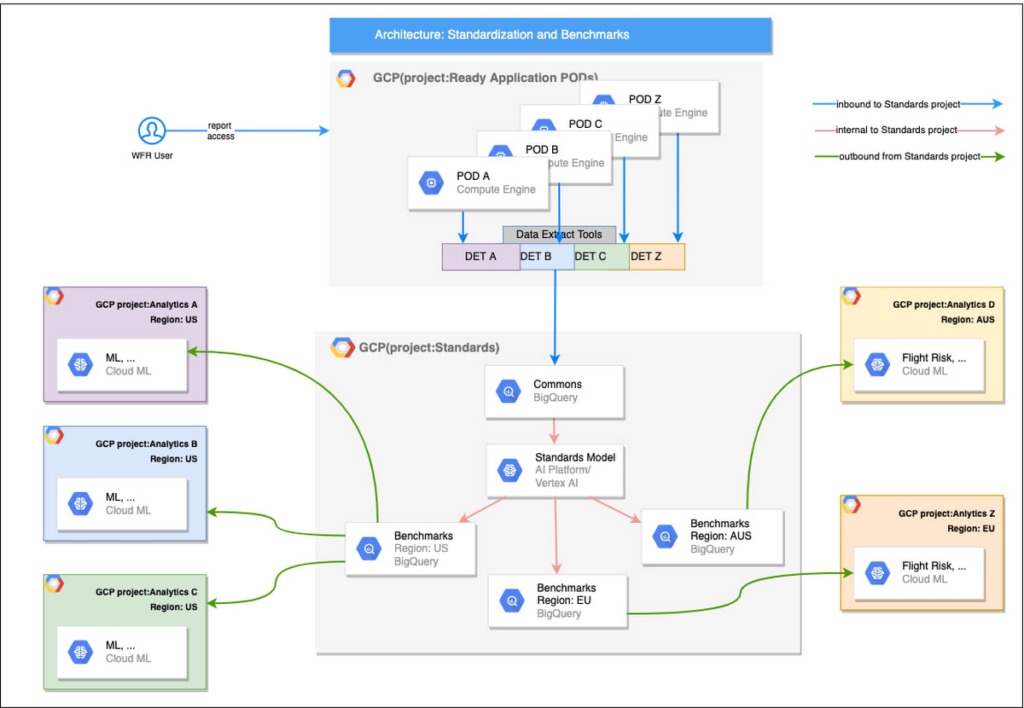
UKG Ready decided to partner with Google for an end-to-end solution for the analytics offering. This allowed us to focus on our core business logic without having to worry about the platform, environment configurations, performance and scalability of the entire solution. We make use of various Google Cloud services such as Cloud Triggers, Cloud Storage, Cloud Functions, Cloud Composer, Cloud Dataflow, Big Query, Vertex AI, Cloud Pub/Sub… to host our analytics solution. Jenkins manages the entire CI/CD pipelines and cloud environments are configured and deployed using Terraform.
The standardization of business entities problem was solved in three distinct steps:
Step 1: Collecting aggregated data
We needed an approach to collect aggregated data from our highly distributed, sharded, multi-tenant data sources. We developed a custom solution that allows us to extract data aggregated at source for PII and GDPR considerations and transfer to Google Cloud Storage in the fastest manner possible. Data is then transformed and stored in Big Query. Services used: GCS, Cloud Functions, DataFlow, Cloud Composer and Big Query. All processes are orchestrated using Cloud Composer and detailed logging is available in Cloud Logging (Stackdriver).
Step 2: Applying NLP (Natural Language Processing)
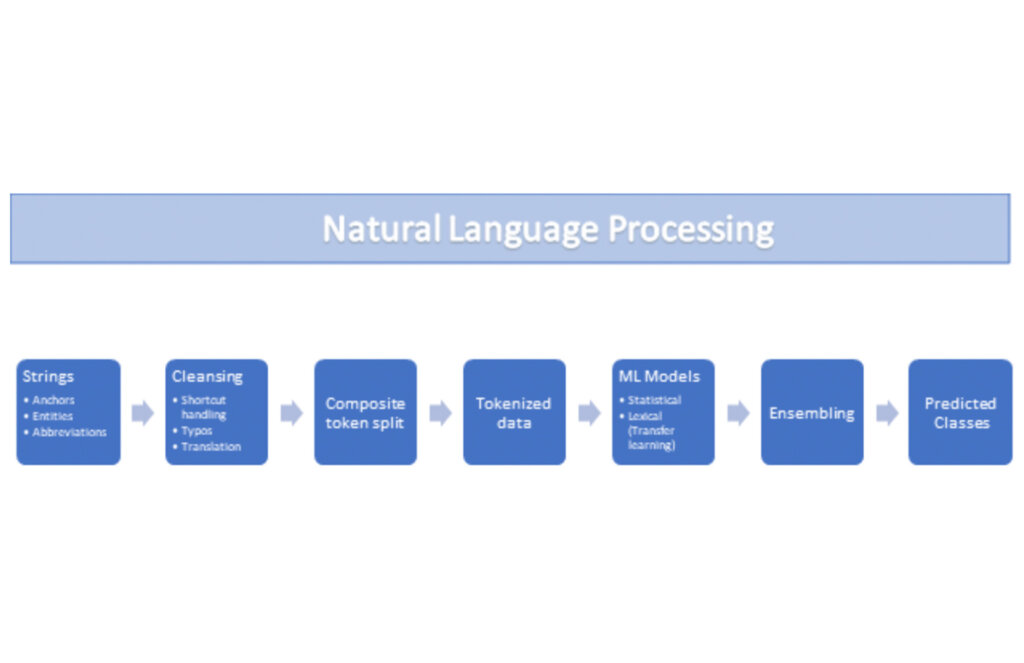
Once we had the variety of customer configurations or the business entities available, we then applied NLP algorithms to categorize and standardize these in buckets. This approach assumes that customers use natural language for configurations like job titles, pay codes etc.
String Preparation
The input data for string preparation process is an entity string or several strings, that describe one entity object (like name-description pair or code-name pair). The output represents set of tokens that may be used to run a classification/clustering model. The process of string preparation tokenizes strings, replaces shortcuts, handles abbreviations, translates tokens, handles grammatical errors and mistypes
ML Models
Statistical
The idea of the model is to use defined target classes (clusters) and assign several tokens (anchors) to each of them an entity that has any of those tokens would be “attracted” to appropriate class. All other tokens are weighted according to frequencies of usage of theses tokens in the entities with anchor tokens:
Using anchor tokens, we are building kind-of Word2Vec - dimensionality of vector is equal to number of target classes. The higher the specific dimension (cluster) value, the higher the probability of entity to be included in appropriate cluster. Final prediction for entity tokens list for specific class is sum of weights of all the tokens included. Predicted cluster is a cluster that has maximal prediction score.
Lexical Model
We managed to generate reasonable amount of labeled data during statistical model implementation and testing. That opens a possibility to build “classical” NLP model that uses labeled data to train classification neural network using pretrained layers to produce token embeddings or even string embeddings. We started experimentation with pre-trained models like GloVe and got good results with single words and bi-grams but started getting issues in handling of n-grams. Our Google account team came to our rescue and recommended some white papers that helped formulate our strategy. We now use Tensorflow nnlm-en-dim128 model to produce string embeddings – it was trained on 200B records English Google News corpus and produces for each input string 128-dimensional vector. After that we use several Dense and Dropout layers to build a classification model.
Ensembling
To perform ensembling all the model results for each class are cast to probabilities using softmax transformation with scale normalization. Final predicted probability is maximal average score of both models among all the classes scores – appropriate class is predicted class.
The machine learning models are deployed on Vertex AI and are used in batch predictions. Model performance is captured at every prediction boundary and monitored for quality in production.
Step 3: Making available common vocabulary
Having the standardized vocabulary, we then needed a mechanism to have the results be available in UKG Ready reports and customer specific models like Flight Risk and Fatigue. For this we again used Google Services for orchestration, data transformation and data storage.
Once the modeling is complete, we made the customer specific models leveraging the above architecture be available in Reports. We utilized our proven existing technology choices in GCP for orchestration, data transformation and data storage
Results
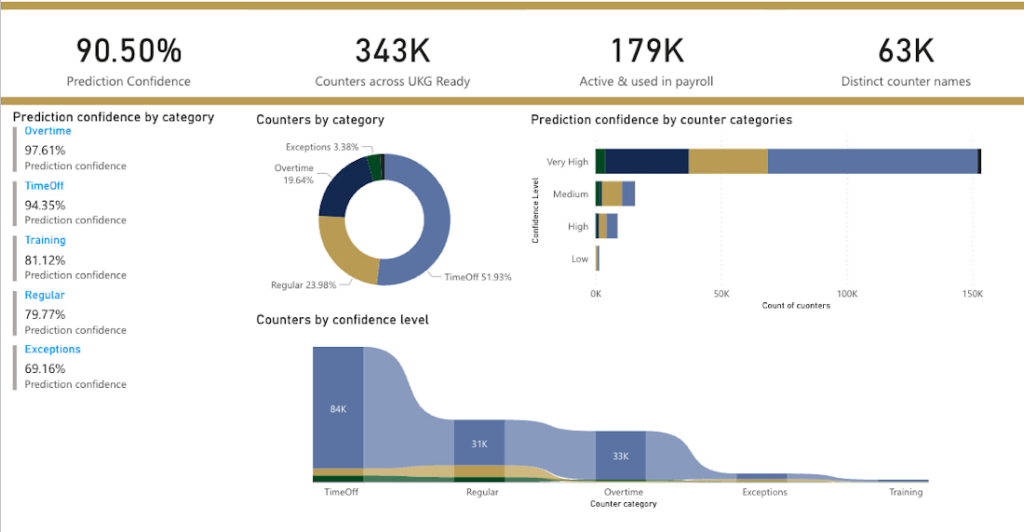
We are able to build a common vocabulary of our customers’ business entities with good confidence. And be an expert advisor to our SMB customers in their decision-making using machine learning. With the advice of our Google account team and using Google services we can add value to our product in a relatively short amount of time. And we are not done! We continue to use this platform for new use cases, complex business problems and innovative machine learning solutions.
Sample result:
Special thanks to Kanchana Patlolla , AI Specialist, Google for the collaboration in bringing this to light

TPUs Can Cut Deep Learning Costs by upto 80%—and Other Things You Didn’t Know About TPUs
DOWNLOAD E-BOOK3528
Of your peers have already downloaded this article
6:15 Minutes
The most insightful time you'll spend today!
The Tensor Processing Unit (TPU) is a custom ASIC chip—designed from the ground up by Google for machine learning workloads—that powers several of Google’s major products including Translate, Photos, Search Assistant and Gmail.
Cloud TPU provides the benefit of the TPU as a scalable and easy-to-use cloud computing resource to all developers and data scientists running cutting-edge ML models on Google Cloud.
But what is a TPU, how is it different from CPUs and GPUs, and how much does it lower cost by?
Download the whitepaper, What Makes TPUs Fine-tuned for Deep Learning?, to find out:
- Back to the basics: How CPUs and GPUs work
- The difference between CPUs, GPUs and TPUs
- Why TPUs are best-suited for deep-learning workloads
- Cost-benefit analysis: How much you can save by leveraging TPU-architecture
Google Cloud and Climate Engine Collaborate to Support Climate Action in Public Sector

4832
Of your peers have already read this article.
1:30 Minutes
The most insightful time you'll spend today!
While there is uncertainty about how much the climate will change in the future, we know it won’t look like the past. Extreme weather events will increase in frequency and severity; the world will continue to warm, and the cost of climate change will increase.
Government plays a vital role in understanding and responding to these changes quickly. Achieving this improved response time will require data insights to ensure informed decision-making—from local to global scales. The challenge is not only urgent; it’s one of the world’s biggest “big data” problems.
Fortunately, new technologies to help us monitor the Earth are proliferating. Thousands of satellites take millions of images of the planet every day. Sensors generate data about temperature, precipitation, wind, soil conditions, and more—as frequently as every second. We have more information about the planet’s systems than at any other time in history. And the data will only continue to grow. The problem is not the lack of data–it is harnessing this data to drive insights for decision makers to tackle climate change. That’s why Google Cloud has partnered with Climate Engine.
How Climate Engine and Google Cloud enable greater climate resilience
Climate Engine is a scientist-led company that works with Google to accelerate and scale the use of Google Earth Engine’s world-class geospatial capacities (in addition to those of Google Cloud Storage and BigQuery, among other tools) in support of climate action in the public sector. Powered by Google Cloud’s infrastructure, Google Earth Engine (GEE) combines a multi-petabyte catalog of satellite imagery and geospatial datasets with planetary-scale analysis capabilities, enabling scientists, researchers, and developers to detect changes, map trends, and quantify differences on the Earth’s surface.
With cloud-based technologies, we can leverage massive computing at a scale that generates actionable insights from Earth-based data. These insights help us better manage resources, understand risks, predict changes, and respond to disasters as we meet the challenge of climate change. Geospatial AI combines the power of artificial intelligence (AI) and machine learning (ML) with geospatial analysis. Google Cloud’s Geospatial AI solutions provide departments and agencies with a centralized system to collect, process, and deliver Earth-based data into decision-making contexts.
Climate Engine and Google Cloud provide specialists with the opportunity to go back in time and see how our landscapes have changed due to changes in climate and other human activities over the past few decades. Years of data can now be quantitatively analyzed and visualized in a matter of a few seconds, enabling government agencies to fulfill their mandates by drawing invaluable insights into how landscapes are changing, what physical and natural assets are at risk, and where the opportunities are for reducing emissions and increasing carbon sequestration.
“This is game changing for natural resource managers and scientists at public institutions at all levels of government,” says Dr. Daniel McEvoy, regional climatologist, at the Desert Research Institute & Western Regional Climate Center, Nevada System of Higher Education.https://www.youtube.com/embed/aPGsi8bd_Zk?enablejsapi=1&
Use cases for geospatial climate information systems
The use cases for this technology are as varied as the climate challenges themselves. These include monitoring, predicting, and analyzing the risks of extreme weather events like floods, wildfire, drought, extreme heat, wind, and other climate hazards. Use cases also include tracking changes in ecosystems, disease vectors, water availability and quality, soil health, growing seasons, air pollution, and more. These use cases are some of the ways that Google Cloud and Climate Engine can help the public sector deliver on government mandates. These provide insights that are helpful for a wide range of departments, and that can be applied in spatial and temporal scales that are meaningful for governments to take action.
“Our planet is changing at a rate that we have never experienced,” says Forrest Melton of the NASA Western Water Applications Office. To respond to these changes, we must understand what is happening across a wide range of environmental variables and at geospatial scales that range from local to global. We now have access to more data about the planet than ever before. The big challenge is converting data into actionable insights and then rapidly integrating these insights into decision-making systems. Climate Engine and Google Cloud help resolve this problem through innovative analytical tools and effective use of cloud computing.”
Climate change carries an existential risk to our current and future stability and security. Together, we are working to provide transformational technologies that help meet that risk and build a safer, more resilient future for all of us.
Learn more about Google Cloud’s environmental initiatives here and here.
More Relevant Stories for Your Company

AI in Manufacturing Already A Mainstream: Google Cloud Study
While the promise of artificial intelligence transforming the manufacturing industry is not new, long-ongoing experimentation hasn’t yet led to widespread business benefits. Manufacturers remain in “pilot purgatory,” as Gartner reports that only 21% of companies in the industry have active AI initiatives in production. However, new research from Google Cloud reveals that the

Custom AI Solutions, Global Delivery Centers and More Resources Dedicated for Customer Success
At Google Cloud, our customers are at the forefront of digital transformation—launching entirely new businesses and products built in the cloud, redefining entire industries with data and artificial intelligence, delivering innovative new consumer experiences, or committing to sustainable new ways of doing business. We’re committed to our customers’ success, and

ML Workflow Made Simple: How to Automate ML Experiment Tracking with Vertex AI Experiments Autologging
Practical machine learning (ML) is a trial and error process. ML practitioners compare different performance metrics by running ML experiments till you find the best model with a given set of parameters. Because of the experimental nature of ML, there are many reasons for tracking ML experiments and making them


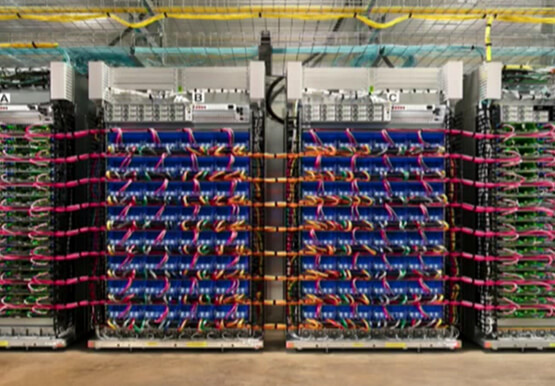

What are TPUs and Why Should Data Scientists Care?
When it comes to machine learning, more data means better results. But processing more data also requires more computing power. CPUs are great for sequential arithmetic calculations. They offer low latency with this type of workload. But to speed up machine learning, models have to perform multiple calculations in parallel.
