





AI in Manufacturing Already A Mainstream: Google Cloud Study

5684
Of your peers have already read this article.
3:00 Minutes
The most insightful time you'll spend today!
While the promise of artificial intelligence transforming the manufacturing industry is not new, long-ongoing experimentation hasn’t yet led to widespread business benefits. Manufacturers remain in “pilot purgatory,” as Gartner reports that only 21% of companies in the industry have active AI initiatives in production.
However, new research from Google Cloud reveals that the COVID-19 pandemic may have spurred a significant increase in the use of AI and other digital enablers among manufacturers. According to our data—which polled more than 1,000 senior manufacturing executives across seven countries—76% have turned to digital enablers and disruptive technologies due to the pandemic such as data and analytics, cloud, and artificial intelligence (AI). And 66% of manufacturers who use AI in their day-to-day operations report that their reliance on AI is increasing.

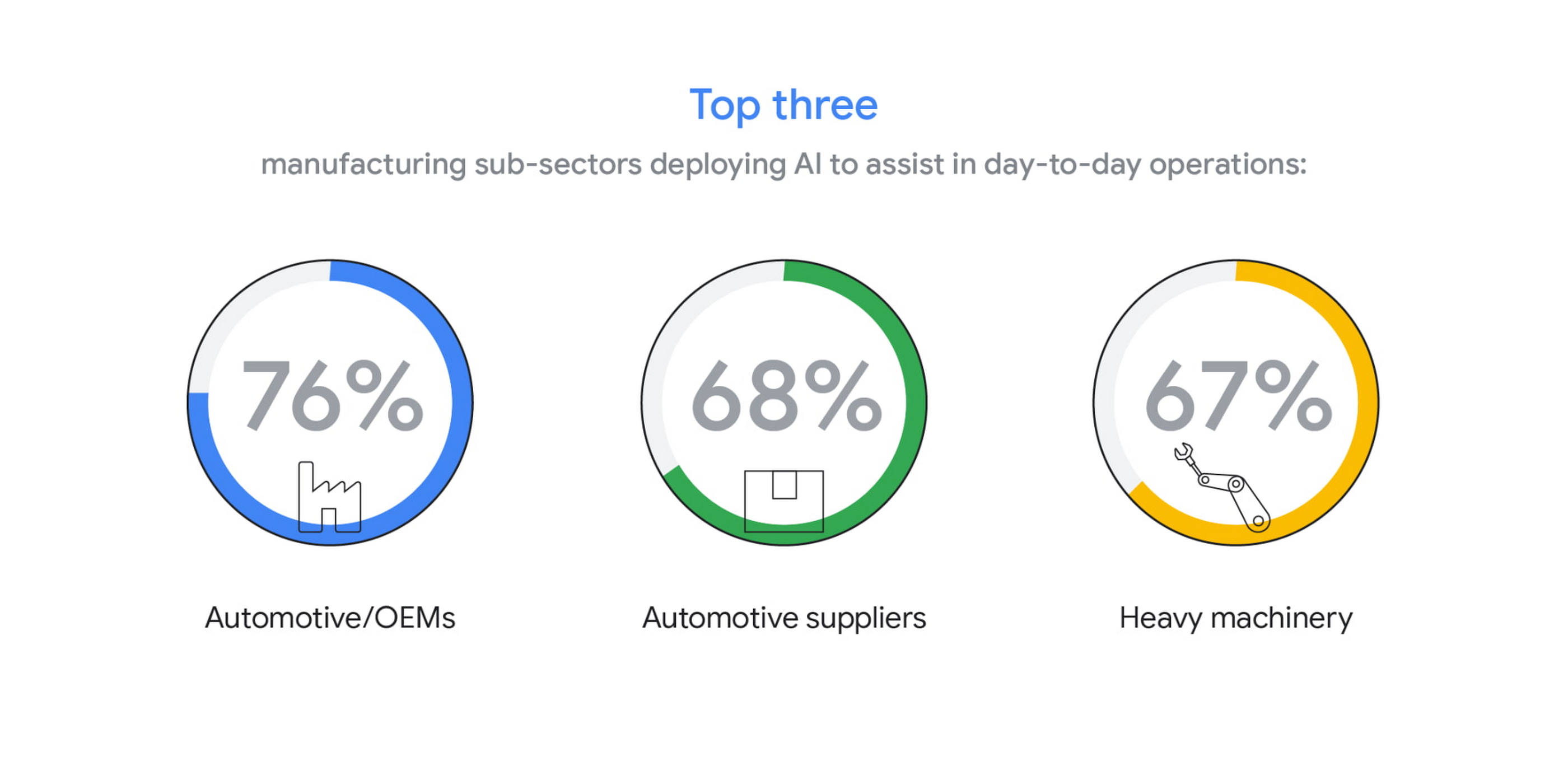
The top three sub-sectors deploying AI to assist in day-to-day operations are automotive/OEMs (76%), automotive suppliers (68%), and heavy machinery (67%).
In fact, Bryan Goodman, Director of Artificial Intelligence and Cloud, Ford Global Data & Insight and Analytics shares, “Our new relationship with Google will supercharge our efforts to democratize AI across our business, from the plant floor to vehicles to dealerships. We used to count the number of AI and machine learning projects at Ford. Now it’s so commonplace that it’s like asking how many people are using math. This includes an AI ecosystem that is fueled by data, and that powers a ‘digital network flywheel.’”
Moving from edge cases to mainstream business needs
Why are manufacturers now turning to AI in increasing numbers? Our research shows that companies who currently use AI in day-to-day operations are looking for assistance with business continuity (38%), helping make employees more efficient (38%), and to be helpful for employees overall (34%). It’s clear that AI/ML technology can augment manufacturing employees’ efforts, whether by providing prescriptive analytics like real-time guidance and training, flagging safety hazards, or detecting potential defects on the assembly line.

In terms of specific AI use cases called out by the research, two main areas emerged: quality control and supply chain optimization. In the quality control category, 39% of surveyed manufacturers who use AI in their day-to-day operations use it for quality inspection and 35% for product and/or production line quality checks. At Google Cloud, we often speak with manufacturers about AI for visual inspection of finished products. Using AI vision, production line workers can spend less time on repetitive product inspections and can instead focus on more complex tasks, such as root cause analysis.
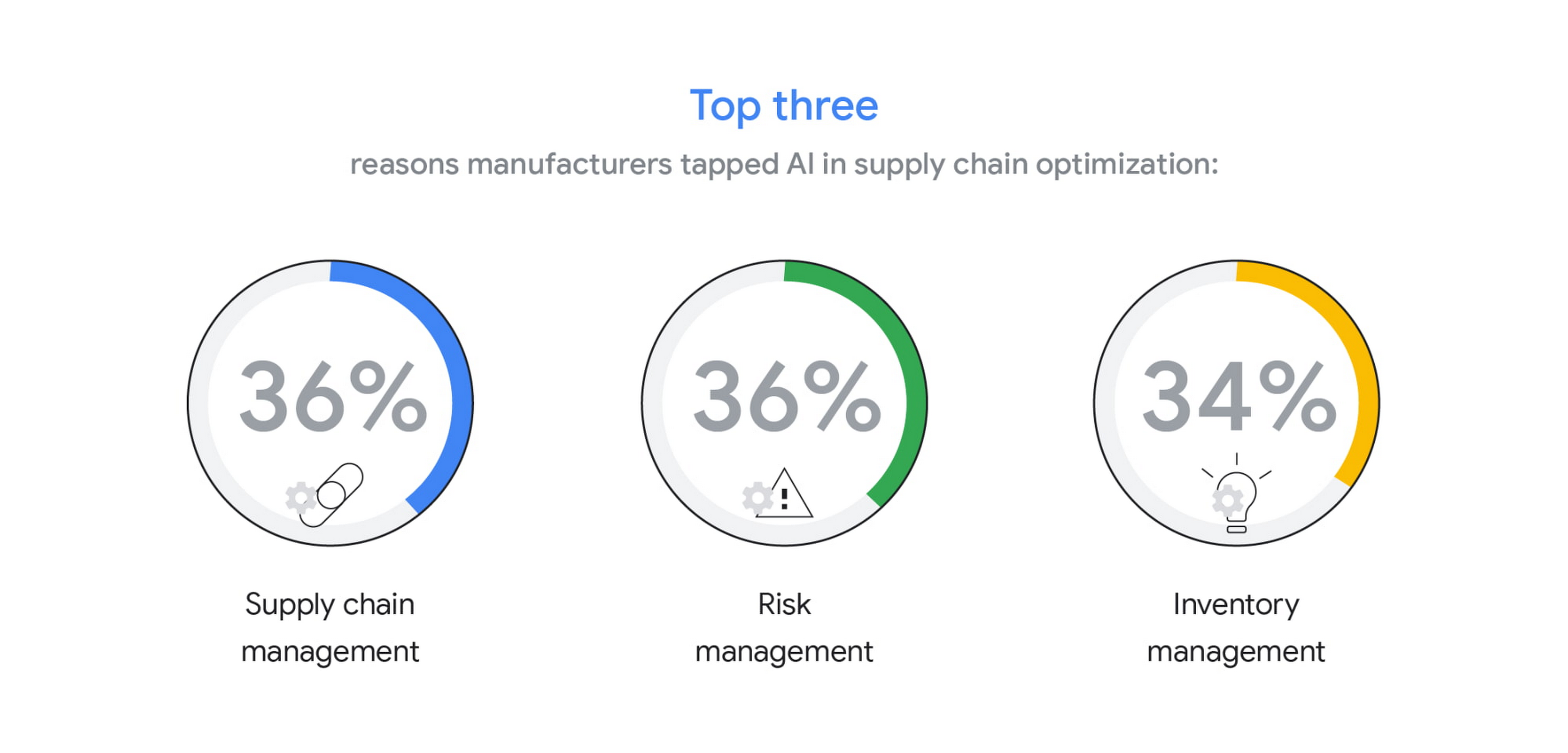
In the supply chain optimization category, manufacturers said they tapped AI for supply chain management (36%), risk management (36%), and inventory management (34%).
In our day-to-day work, we’re seeing many manufacturers rethink their supply chains and operating models to better accommodate for the increased volatility that has been brought about by the pandemic and support the secular trend of consumers asking for increasingly individualized products. We’ll share more on deglobalization in the third installment of our manufacturing insights series.
AI use differs by geography, but not for the reasons you may think
The extent to which AI is already being used today varies quite strongly between geographies, according to our research. While 80% and 79% of manufacturers in Italy and Germany respectively report using AI in day-to-day operations, that percentage plummets in the United States (64%), Japan (50%) and Korea (39%).

It’s tempting to state this disparity is due to an “AI talent gap.” Although the most common barrier, just a quarter (23%) of manufacturers surveyed believe they don’t have the talent to properly leverage AI. Cost, too, does not appear to be a roadblock (21% of those surveyed). Rather, from our observations, the missing link appears to be having the right technology platform and tools to manage a production-grade AI pipeline. This is obviously the focus of our efforts and others in the space, as we believe the cloud can truly help the industry make a step change.
Looking ahead: The Golden Age of AI for manufacturing
The key to widespread adoption of AI lies in its ease of deployment and use. As AI becomes more pervasive in solving real-world problems for manufacturers, we see the industry moving away from “pilot purgatory” to the “golden age of AI.” The manufacturing industry is no stranger to innovation, from the days of mass production, to lean manufacturing, six sigma and, more recently, enterprise resource planning. AI promises to bring even more innovation to the forefront.
To learn more about these findings and more, download our infographic here and our full report here.
Research methodology
The survey was conducted online by The Harris Poll on behalf of Google Cloud, from October 15 – November 4, 2020, among 1,154 senior manufacturing executives in France (n=150), Germany (n=200), Italy (n=154), Japan (n=150), South Korea (n=150), the UK (n=150), and the U.S. (n=200) who are employed full-time at a company with more than 500 employees, and who work in the manufacturing industry with a title of director level or higher. The data in each country were weighted by number of employees to bring them into line with actual company size proportions in the population. A global post-weight was applied to ensure equal weight of each country in the global total.

4907
Of your peers have already downloaded this article
1:30 Minutes
The most insightful time you'll spend today!
Artificial intelligence and machine learning are already transforming the technological landscape. From digital assistants to image-recognition software to self-driving cars, what was once the stuff of science fiction is now becoming a reality. But what exactly does it mean for marketing and advertising executives?
It could get us closer to one of advertising’s most-sought goals: relevance at scale. Before then, we’re going to see changes to the way we do business.
Technological advances have always created new opportunities for storytelling and marketing. Just as the advent of TV brought an era of truly mass advertising and reach, and the internet and mobile brought a new level of targeting and context, AI will change how people interact with information, technology, brands, and services.
A big part of the opportunity for marketers is how AI will help us fully realize personalization—and relevance—at scale. With platforms like Search and YouTube reaching billions of people everyday, digital ad platforms finally can achieve communication at scale. This scale, combined with customization possible through AI, means we’ll soon be able to tailor campaigns to consumer intent in the moment. It will be like having a million planners in your pocket.
Find out how you can achieve relevance at scale. Download now!
3261
Of your peers have already watched this video.
24:00 Minutes
The most insightful time you'll spend today!
An Introduction to MLOps on Google Cloud
The enterprise machine learning life cycle is expanding as firms increasingly look to automate their production ML systems.
MLOps is an ML engineering culture and practice that aims at unifying ML system development and ML system operation enabling shorter development cycles, increased deployment velocity, and more dependable releases in close alignment with business objectives.
In this video, Nate Keating, Product Manager, Google Cloud, will define and give an overview of MLOps and the discuss the challenges at play. He then shares where data science teams are today and where Google Cloud sees them going. Finally he will demonstrate a simple framework for MLOps based on real processes that he has seen in practice.
Learn how to construct your systems to standardize and manage the life cycle of machine learning in production with MLOps on Google Cloud.
How Public Sectors Leverage Google Cloud to Push the Envelop in Human Services and Labor

3114
Of your peers have already read this article.
2: 30 Minutes
The most insightful time you'll spend today!
The COVID-19 pandemic tested our nation’s public benefits system in unimaginable ways. With an unprecedented 60 million individuals turning to unemployment and social services to satisfy their basic needs, state and local governments were stretched to meet the demand.
But state and local government leaders have risen to the challenge of providing their constituents with critical services. They created and administered innovative solutions, complete with wholly original processes, and brought desperately needed employment, cash, food, and healthcare support to families in crisis. These public sector heroes raised the bar during this critical time and facilitated economic recovery for our local communities, making the impossible possible for its people.
When state and local government agencies partner with Google Cloud, they can reimagine how they deliver human services and labor services for their communities. All in a matter of weeks, instead of months or years.
Tools that solve for remote work and service delivery hurdles
Never before was there such a need for modern and accessible tools to allow a workforce to secure new jobs and operate remotely. The Virtual Career Center (VCC), built on Google Cloud, was designed with these needs in mind.
Google Workspace, including Google Meet, allows job seekers to schedule video meetings with career coaches, job recruiters, and potential employers. The Google Job Search API will enable them to explore career opportunities best suited to their skills and interests.
A thousand miles away, the Rhode Island Virtual Career Center was helping its job seekers by offering virtual meetings with career coaches, the ability to schedule meetings with prospective employers, and help on building effective resumes. Skipper, the CareerCompass RI Bot, an intelligent agent for careers, uses data and machine learning to facilitate potential new career paths and reskilling opportunities for Rhode Islanders.
In addition to enabling remote work, Google Workspace can support remote service delivery, a critical need for those involved in health and human services programs. Engaging with individuals and families is an essential component for more of these programs, including eligibility determination, assessment, and service delivery. The ability to engage directly with the public through virtual interviews, counseling sessions, telehealth, etc. improves access for those on both sides of the screen. Further, through Google Classroom, a component of Google Workspace for Education, foster and adoptive parents can obtain virtual training required for licensing.
Tools to expedite relief funds and employment assistance
As the number of people applying for unemployment assistance skyrocketed, so did the backlog of claims requiring review. The pandemic also saw a rise in fraudulent claims, which caused delays for families waiting on legitimate payments and resulted in unnecessary spending for government agencies. Realizing the magnitude of the challenge was beyond the agencies’ current resources, and they shifted their focus to machine learning.
To address the massive backlog of claims, SpringML partnered with Google Cloud to develop the Improper Payment Analytics solution that successfully leverages AI to help agencies identify fraudulent claims and avoid improper payments so aid can be prioritized for those who need it. Though such a tool would typically take months to develop, the team was able to launch it in just weeks, to the benefit of all stakeholders involved. Families awaiting legitimate payments received checks more quickly, and state and local governments saved millions in spending.
For instance, to address erroneous payments totaling $330 million to fraudulent applicants, the State of Ohio partnered with Google Cloud to utilize artificial intelligence and machine learning solutions to proactively identify and decline improper payment risks. As a result, the State avoided paying fraudulent claims and accelerated the payment of legitimate benefits to families facing financial hardship.
The New York State Department of Labor launched a streamlined unemployment application to allow residents to apply for pandemic unemployment assistance without the added burden of applying for unemployment insurance. Success was immediate, and the application backlog plummeted as New Yorkers got the financial aid they desperately needed. Illinois took a different approach, deploying Contact Center Artificial Intelligence (CCAI) to create virtual agents who assist with specialized calls 24/7, in multiple languages, providing turn-by-turn guidance in real-time. Conversations can be turned into insights through analytics and reporting tools that uncover key call drivers and customer sentiment. By solving for spikes in call volume, CCAI has helped process more than 1 million unemployment claims.
Automated data solutions bring immediate food and cash assistance resources
With millions out of work and out of school during the pandemic, food and cash assistance became a critical need. Applying for all of these benefits requires significant documentation that, in most cases, has historically been manually processed. Given the volume of people in need, this took a massive amount of human resources and time.
Using Document AI (DocAI), agencies can automate this highly manual process and speed up the delivery of critical benefits to individuals and families. DocAI extracts the key data, provides a confidence score in a single review pane for staff review, and automatically uploads that data to the case management system–significantly reducing manual processing. Today, these state and local government organizations turn to DocAI to eliminate the difficult paperwork application process to help meet the benefit needs of their residents now and tomorrow, as illustrated by both the Wisconsin Department of Workforce Development (DWD) and the State of Hawaii.
The Wisconsin DWD streamlined their paper unemployment insurance claims using DocAI by enabling DWD staff to receive critical data extracted from submitted applications and make decisions rapidly, saving time for both applicants and staff. The State of Hawaii also used DocAI to extract, interpret, and transport COVID-19 test result data of incoming travelers to Google Cloud instantly. As a result, Hawaii was able to welcome travelers and reopen its economy in the midst of the pandemic.
Partner with us
After making it through this very difficult period, agencies have emerged from the pandemic with stronger labor and health and human service delivery for their residents. State and local governments recognized the necessity of virtual engagement and expanded access to services to meet this critical moment, solving for work, cash, food and healthcare needs.
To learn more about Google Cloud for human services and labor, watch our video on the power of customer innovation or contact your Google Cloud sales representative. Let’s get solving together.

8004
Of your peers have already downloaded this article
20:30 Minutes
The most insightful time you'll spend today!
These business and technology innovators are leveraging cloud computing, machine learning, APIs, collaborative platforms, among others to advance healthcare, financial services, retail, media and entertainment, manufacturing, and government.
They include some of the biggest brands in the world, as well as some you’ve probably never heard of. But they all have one thing in common: They are astounding in their idea, scope and execution.
Every story has a short–and a longer–version. Scan through them and choose to dive deeper into stories that reflect challenges that your company or your industry is facing. You’ll find solutions to problems you previously thought impossible to solve.
5693
Of your peers have already watched this video.
22:00 Minutes
The most insightful time you'll spend today!
Chronicle Security Analytics: Key to Address Security Data Overload
Google Cloud’s Chronicle is a security analytics platform built for modern use cases to combat modern threats. In today’s world, enterprises have undergone significant changes in all aspects, and must adapt to their security needs to counter threats and attacks. Watch the video to learn Google Cloud’s initiative to help businesses improve their security by 10x to catch up with the way the world is changing and how Chronicle Security Analytics is poised to help address data security challenges.
More Relevant Stories for Your Company

AI Solutions for Government Organizations: How to Get Started
Cloud-native features are helping public sector teams innovate faster than ever. Ideas discussed in a morning meeting can be a working proof of concept later that day. Managed services can remove administrative burden and reduce the steps needed to design and provision cloud infrastructure. Security can be built-in from the

Master AI Prompt Engineering with 6 Proven Tips
As AI-powered tools become increasingly prevalent, prompt engineering is becoming a skill that developers need to master. Large language models (LLMs) and other generative foundation models require contextual, specific, and tailored natural language instructions to generate the desired output. This means that developers need to write prompts that are clear,

Japanese Used Car Operator Uses Machine Learning to Improve Marketing
Since 1994, IDOM, Japan’s leading buyer and retailer of used cars, has enjoyed success in the auto industry with a simple yet traditional business model: buy pre-owned vehicles directly from car owners and auction them to third-party dealers, or sell them to other consumers at retail stores. In an increasingly

Transform Your Marketing Strategy with Tinyclues and Google Cloud CDP
Editor’s note: The post is part of a series highlighting our awesome partners, and their solutions, that are Built with BigQuery. What are Customer Data Platforms (CDPs) and why do we need them? Today, customers utilize a wide array of devices when interacting with a brand. As an example, think
