





3309
Of your peers have already watched this video.
21:26 Minutes
The most insightful time you'll spend today!
What are TPUs and Why Should Data Scientists Care?
When it comes to machine learning, more data means better results.
But processing more data also requires more computing power. CPUs are great for sequential arithmetic calculations. They offer low latency with this type of workload. But to speed up machine learning, models have to perform multiple calculations in parallel. And that’s where GPUs perform better.
TensorFlow Processing Units, or TPUs, represent the most advanced hardware accelerators that has been architected ground up for TensorFlow by Google Cloud. Cloud TPUs deliver accelerated performance to help businesses train deep learning models in a matter of hours instead of weeks.
This allows enterprises to be more productive with their scarcest resource, the ML scientist, and drive more innovations, thanks to the advanced computing capability.
Watch John Barrus, Senior Product Manager, Google Cloud; and Zak Stone, Product Manager, Google Brain, show you benefits of using TPUs and how to get started.
Google Unveils New Cloud Region in Delhi NCR to Power India’s Digitization

8338
Of your peers have already read this article.
2:00 Minutes
The most insightful time you'll spend today!
In the past year, Google has worked to surface timely and reliable health information, amplify public health campaigns, and help nonprofits get urgent support to Indians in need. Now, we are continuing to focus on helping India’s businesses accelerate their digital transformation, deepening our commitment to India’s digitization and economic recovery. To support customers and the public sector in India and across Asia Pacific, we’re excited to announce that our new Google Cloud region in Delhi National Capital Region (NCR) is now open.
Designed to help both Indian and global companies alike build highly available applications for their customers, the Delhi NCR region is our second Google Cloud region in India and 10th to open in Asia Pacific.
What customers and partners are saying
Navigating this past year has been a challenge for companies as they grapple with changing customers demands and economic uncertainty. Technology has played a critical role, and we’ve been fortunate to partner with and serve people, companies, and government institutions around the world to help them adapt. The Google Cloud region in Delhi NCR will help our customers adapt to new requirements, new opportunities and new ways of working, like we’ve helped so many companies do in the region:
- InMobi scaled a personalized AI platform to support 120+ million active users. “With the arrival of the Google Cloud Delhi NCR, InMobi Group sees the opportunity to continue closing the gap between our users and products,” says Mohit Saxena, Co-founder and Group CTO of Inmobi. “Glance, especially, has been serving AI-powered personalised content to over 120 million active users. We can’t wait to continue giving them truly meaningful experiences that are speedy, scale well, and are relevant to them, by expanding the use of our current tools working on Google Cloud with the opening of a new region.”
- Groww now supports a sizable user base. “Google Cloud provides great technology that enables us to build and scale infrastructure to millions of users, and the new Google Cloud region in Delhi NCR will continue to help more businesses and startups in India access powerful cloud-based infrastructure, products and services,” says Neeraj Singh, Co-founder and Chief Technology Officer, Groww.
- HDFC Bank is positioned for the future. “At HDFC Bank, we are harnessing technology platforms to both run and build the bank. As we progress to be future ready, the objective is to invest in future technologies that give us scale, efficiency and resiliency. Towards this the Google Cloud region in Delhi NCR will enable us to enhance our resiliency and help us in building an active-active design framework for our new generation applications on cloud,” says Ramesh Lakshminarayanan, CIO, HDFC Bank.
- Dr. Reddy’s Lab built a modern data platform with Google Cloud. “At Dr Reddy’s, we pride ourselves in helping patients regain good health, acting quickly to provide innovative solutions to address patients’ unmet needs and in accelerating access to medicines to people worldwide. Our Google Cloud-powered data platform is helping us realize these objectives and we welcome Google’s investment in the new Delhi NCR region as helping us and other businesses in India make further contributions to our social and economic future,” says Mukesh Rathi, Senior Vice President & CIO, Dr. Reddy’s Laboratories.
- “To survive the disruption caused by the pandemic and to succeed in the long term, organizations need to become digital natives, so they can be more agile, explore new business models and build new capabilities that boost resilience. A cloud-first strategy plays a key role in enabling businesses to do this,” said Piyush N. Singh, Lead – India market unit & lead – Growth and Strategic Client Relationships, Asia Pacific and Latin America, Accenture. “Harnessing the potential of cloud requires the right data infrastructure and this expansion by Google Cloud will undoubtedly help Indian enterprises in their digital transformation journeys.”
A global network of regions
Delhi NCR joins 25 existing Google Cloud regions connected via our high-performance network, helping customers better serve their users and customers throughout the globe. As the second region in India, customers benefit from improved business continuity planning with distributed, secure infrastructure needed to meet IT and business requirements for disaster recovery, while maintaining data sovereignty.
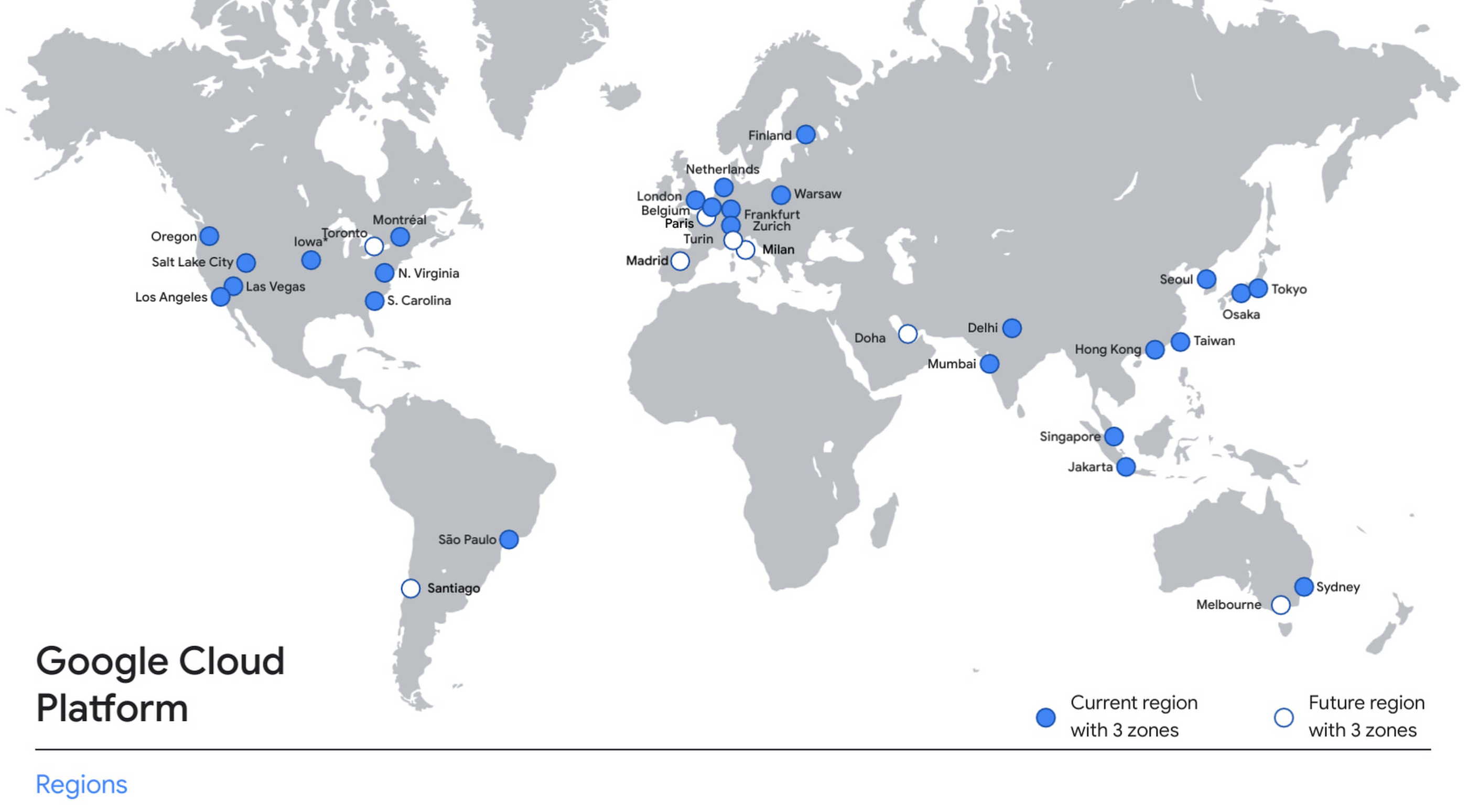
With this new region, Google Cloud customers operating in India also benefit from low latency and high performance of their cloud-based workloads and data. Designed for high availability, the region opens with three availability zones to protect against service disruptions, and offers a portfolio of key products, including Compute Engine, App Engine, Google Kubernetes Engine, Cloud Bigtable, Cloud Spanner, and BigQuery.
Supporting India’s recovery with training and education
Google and Google Cloud will also continue to support our customers with people and education programs. We’re investing in local talent and the local developer community to help enterprises digitally transform and support economic recovery.
Through the India Digitization Fund, we expanded our efforts to support India’s recovery from COVID-19—in particular, through programs to support education and small businesses. In addition to expanding internet access, and investments to help start-ups accelerate India’s digital transformation, we’ve grown our Grow with Google efforts. Businesses can access digital tools to maintain business continuity, find resources like quick help videos, and learn digital skills—in both English and in Hindi.
Helping customers build their transformation clouds
Google Cloud is here to support businesses, helping them get smarter with data, deploy faster, connect more easily with people and customers throughout the globe, and protect everything that matters to their businesses. The cloud region in Delhi NCR offers new technology and tools that can be a catalyst for this change. To learn more, visit the Google Cloud locations page, and be sure to watch the region launch event here.
3246
Of your peers have already watched this video.
38:09 Minutes
The most insightful time you'll spend today!
TensorFlow: The Show-and-Tell Data Scientists Have Been Asking For
TensorFlow is among the most popular, if not, the most popular deep learning libraries today. According to one ranking, “TensorFlow is at least two standard deviations above the mean on all calculated metrics.”
Watch as Lak Lakshmanan, Technical Lead, Machine Learning and Big Data, Google Cloud, walks through a development workflow that will make operationalization easier to execute, including the process of building a complete machine learning pipeline covering ingest, exploration, training, evaluation, deployment, and prediction.
He also talks about the need for distributed training. But what’s the benefit of distributed TensorFlow? Many machine learning frameworks can only handle “toy problems”, or problems that can be solved by input data that fits into memory. These are small data sets.
But to build effective machine learning you need big data, feature engineering, and model architectures. With large amounts of data batching and distribution are very important. That’s where distributed training comes in.
Thinking of a Multicloud Journey? Here’s What Our Experts Want You to Consider

4802
Of your peers have already read this article.
3:00 Minutes
The most insightful time you'll spend today!
Do you want to fire up a bunch of techies? Talk about multicloud! There is no shortage of opinions. I figured we should tackle this hot topic head-on, so I recently talked to four smart folks—Corey Quinn of Duckbill Group, Armon Dadgar of Hashicorp, Tammy Bryant Butow of Gremlin, and James Watters of VMware—about what multicloud is all about, key considerations, and why you should (or shouldn’t!) do it.
Five important insights came out of these discussions. If you’re on a multicloud journey or considering one, keep reading.
Do: Choose to do multicloud for the right reasons
Don’t do multicloud because Gartner says so, implores Corey Quinn. Before embarking on a multicloud, define a “why” focused on business value journey, says Armon Dadger. For example, you might want to use services from each public cloud because of their differentiated services, according to Tammy Bryant Butow. Armon also calls out regulatory reasons, existing business relationships, and accommodating mergers and acquisitions. On the topic of M&A, Corey points out that if you acquire a company that uses another cloud, it’s usually expensive and difficult to consolidate. It can be smarter to stay put.
https://youtube.com/watch?v=xFSDexQhCUY%3Fenablejsapi%3D1%26
Don’t: Over-engineer for workload or data portability
Thinking that you’ll build a system that moves seamlessly among the various cloud providers? Hold up, says our group of experts. Armon points out that aspects of your toolchain or architecture may be multicloud—think of some of your workflows or global network routing—but that shifting workloads or data is far from simple. Corey says that trying to engineer for “write once, run anywhere” can slow you down, and ignores the inherent uniqueness that’s part of each platform. Specifically, Corey calls out the per-cloud stickiness of identity management, security features, and even network functionality. And data gravity is still a thing, says James, that causes some to dismiss multicloud outright.
If you’re using multiple public clouds, you take advantage of the distinct value each offers, Armon says. Use native cloud services where possible so that you see the benefits from useful innovations, built-in resilience, and baked-in best practices. The value from that cloud-infused workload may outweigh the benefits of seamless portability.
https://youtube.com/watch?v=B1VH56_L8f8%3Fenablejsapi%3D1%26
Do: Recognize different stakeholder interests and needs
James smartly points out that many multicloud debates happen because people are arguing from different perspectives. Context matters. If you’re an infrastructure engineer who invests heavily in a given cloud’s identity and access management model, multicloud looks tricky. Or if you’re a data engineer with petabytes of data homed in a particular cloud, multicloud may look unrealistic. James highlights that many developers default to multicloud because their local tools—where all the work happens—are multicloud. A developer’s IDE and preferred code framework(s) aren’t tied to any given cloud. Be aware that groups within your organization will come at multicloud from distinct directions. And this may impact your approach!
https://youtube.com/watch?v=I9sqXDqkKBM%3Fenablejsapi%3D1%26
Don’t: Go it alone
Corey talks about the importance of asking others what worked, and what didn’t. Tammy offers her best practices around sharing results from experiments. It’s about sharing knowledge and tapping into it for community benefit. Others have probably tried what you’re trying, and can help you avoid common pitfalls. If you’ve just made an architectural choice that didn’t work out, share it, and help others avoid the pain.
Read research from analysts, go to conferences or watch videos to observe case studies, and join online communities that offer a safe place to share mistakes and learn from others.
https://youtube.com/watch?v=mrSb5vqOfuI%3Fenablejsapi%3D1%26
Do: Experiment first using techniques like multi-region deployments
If you think you can operate systems across clouds, how about you first try doing it across regions in a specific cloud, suggests Corey. Getting a system to properly work across cloud regions isn’t trivial, he says, and that experience can help you uncover where you have architectural or operational constraints that will be even worse across cloud providers.
This is great guidance if your multicloud aspirations involve using multiple clouds to power one application—versus the more standard definition of multicloud where you use different clouds for different applications—but can also surface issues in your support process or toolchain that fail when faced with distributed systems. Start with muti-region deployments and chaos engineering experiments before aggressively jumping into multicloud architectures.
The Google Cloud take
Do the things above. It’s great advice. I’ll add three more things that we’ve learned from our customers.
- Don’t fear multicloud. You’re already doing it. You don’t single-source everything. As Corey mentioned, you probably already have one cloud for productivity tools, another for source code, another for cloud infrastructure. You’ll use software and application services from a mix of providers for a single app. You have that experience in your team and have been doing that for decades. What people do rightly worry about is using more than one infrastructure service beneath an application, as that can introduce latency, security, and logistical hurdles. Make sure you know which model your team is considering.
- Embrace the right foundational components, including Kubernetes. Will everything run on Kubernetes? Of course not. Don’t try to do that. But it also represents the closest thing we have to a multicloud API. Companies are using Kubernetes to stripe a consistent experience across clouds. And this isn’t just to orchestrate containers, but also to manage infrastructure and cloud-native services. Also, consider where you need other fundamental consistency across clouds, including areas like provisioning and identity federation.
- Use Google Cloud as your anchor. Here’s a fundamental question you have to decide for yourself: Are you going to bring your on-premises technology and practices to the cloud, or bring cloud technology and practices on-prem? We sincerely believe in the latter. Anchor to where you’re trying to get to. We offer Anthos as a way to build and run distributed Kubernetes fleets in Google Cloud and across clouds. By using a cloud-based backplane instead of an on-prem one, you’re offloading toil, leveraging managed services for scale and security, and introducing modern practices to the rest of your team.
We learned a lot about multicloud through these discussions, and it seems like others did too. That’s why we’re going to do a second round of interviews with a new crop of experts so that we can keep digging deeper into this topic. Stay tuned!
Collateral IT: Leveraging Google Cloud for Enhanced Asset Allocation at HSBC

2594
Of your peers have already read this article.
2:30 Minutes
The most insightful time you'll spend today!
Have you ever heard of an optimization problem? Imagine you have a million marbles, all of different sizes, colors, patterns, and weights. You need to fill up 1,000 jars of different sizes with them, but each jar has restrictions as to which colors, patterns, and how many marbles of each type it can hold. After filling all the jars, you may keep any leftover marbles, so you want to ensure that these are the shiniest ones in the bunch. How do you go about solving this puzzle? There are many possibilities, but what would be the most efficient way to guarantee you’ll reach the best possible outcome every time?
At HSBC, our Collateral Treasury desk and Collateral Management team have been solving a similar problem, but instead of marbles and jars, we work with around 50,000 assets that can be used as collateral, and 1,000s of collateral accounts.
Our Collateral Treasury Trading desk helps finance our Markets business by providing the required collateral, such as certain debt or equities, to cover its obligations to a client. The collateral could be used by HSBC for its margin requirements, CCPs (Central Counterparty Clearing Houses), or for securities financing transactions. Each obligation can have different eligibility criteria about what assets can be used as collateral for each client. These rules and restrictions revolve around the type of asset allowed or daily liquidity factors.
The process of matching collateral to obligations is known as an allocation, and it can get complicated the more diverse the collateral pool and the more customers you have. It is important to allocate collateral in the most efficient way and, traditionally, this business problem has been managed manually or by a third party against a set of simple rules.
But by collaborating with Google Cloud, we can improve collateral allocation through automation. Even small efficiency gains have the potential to make a significant difference when the amount of collateral inventory managed is tens of billions of dollars. It means the Collateral Treasury desk is much more efficient when managing its own funding costs or regulatory ratios such as the Liquidity Coverage Ratio (a key financial resource measure for banks that ensures sufficient high quality assets are readily available to survive periods of liquidity stress).
Leveraging AI to tackle a complex business problem
Our solution is OPTIC, a HSBC platform utilizing Google Operation Research Tools, or OR-Tools, an open-source optimization library provided by Google AI. Its main goal is to allow the Collateral Treasury desk to automate the collateral allocation process in the most optimal way on any given day. OPTIC’s architecture is based on microservices and provides the ability to handle large volumes of data, for which a scalable and self-managed infrastructure is needed. OPTIC runs on Google Kubernetes Engine, which provides it with workload rebalancing, auto-scaling capabilities, and high availability.
Additionally, we collaborated with Google Operations Research, which gave us access to the experience of Google AI engineers who were able to advise us on the best way to implement their optimization libraries to solve our business problem.
We’ve found that using linear programming solvers such as Google OR-Tools is the best way to achieve the optimization capability that fundamentally changes how we manage our inventory. It enables us to optimize for multiple outcomes and be certain that we are doing this in the most efficient way possible.
Finding the optimal way forward with automation
OPTIC works by consuming data feeds from a multitude of systems, then it standardizes the data, and combines with decision-making parameters and weightings Google OR-Tools can use, to understand and arrive at an optimal outcome. OPTIC can also provide insights and metrics that help optimize business decisions such as which assets can be added or removed in the future to make collateral allocation even more efficient.
Looking forward, this project makes us optimistic about using Google Kubernetes Engine to manage more of our microservices in other platforms. This will mean that we can scale without worrying about hardware or making big changes to our environment. With this solution, we’ll be able to mobilize and optimize our collateral according to our own view of the value and quality of the collateral, as well as the best fit for our exposures at any given time.
Over time, the project can bring visible long-term benefits to HSBC’s Markets business, including decreased operational risks and potential to save significant funding costs. Next, we will continue to add new capabilities and data sources to our solution to continue solving some of the most complex business challenges in our industry.
Gyfted: Finding the Right Man for the Job Using Google Cloud AI/ML Tools

2562
Of your peers have already read this article.
2:00 Minutes
The most insightful time you'll spend today!
It’s no secret that many organizations and job seekers find the hiring process exhausting. It can be time consuming, costly, and somewhat risky for both parties. Those are just some of the experiences we wanted to change when we started Gyfted, a pre-vetted talent marketplace for people who complete tech training or degree programs and are looking for the right career move. At the same time, we’re helping businesses save time and improve recruiting outcomes with our automated candidate screening and sourcing tools.
Our vision is clear: To take a candidate through one structured hiring process, and then put them in front of thousands of companies. It’s similar to the common app system in higher education. Sounds simple, but it is a herculean technical and UX task. To succeed we had to combine advanced psychometric testing, machine learning, the latest in behavioral design, and develop the highest quality structured, relational dataset to represent candidate and manager profiles and preferences on our network. Fortunately, we were cofounded by world-leading experts in these areas including Dr. Michal Kosinski, one of the world’s top computational psychologists, and Adam Szefer, a gifted young technologist. We’ve been joined by a group of equally talented employees, most of whom work remotely in Poland, US, Switzerland, UK, Israel, and Ukraine.
The influence of dating platforms and matching
When seeking inspiration, we were influenced by the success of dating platforms, especially Bumble with its focus on commitment. These platforms have done a great job using design to match people together.
We like to think we’re doing the same for recruiters and candidates in terms of not only role and culture fit matching, but also through a fundamental feature of Gyfted, which is that our job-seekers are anonymous. This helps recruiters meet one of their goals today, which is to minimize bias in the hiring process and enable objective, diversity-oriented recruiting.
Another of our unique selling points is that we conduct candidate screening that is gamified and automated, with a structured interview, where the interview remains with the candidate’s profile. We roughly estimate that just for the 15 million open jobs on LinkedIn, if companies fill in 50% of those via external recruiting, and conduct a screening interview with 10 candidates per job filled at $50/hour paid to an employee to do the screening, that’s $3.75 billion and 75 million hours in direct costs. This is on top of applying for jobs, selecting CVs, and coordinating the process, which takes an even bigger financial and time toll on both applicants and recruiters. Instead, it would be better to take one interview for 1000 companies. The impact of what we want to achieve with our vision is enormous.
We also offer career discovery and career search tools for job candidates. This includes free, personalized feedback for every job-seeker. Right now, we’re aiming the service at students, bootcamp graduates and juniors, helping them to land jobs in tech and the creative industry at large. Next, we’ll expand into mid and senior roles. In the long run we want to reshape how recruiting happens through a common app that saves everyone in the market significant time and resources, helping people find jobs not only faster, but jobs that truly fit them.
Developing advanced AI applications with Google Cloud
We obtained our original funding from angel and institutional investors, and we were selected into the Fall 2021 batch of StartX, the non-profit start-up accelerator and founder community associated with Stanford University. But like most startups our budgets are tight, and we need to find ways to operate as efficiently as possible, especially when building out our technology stack and developer environment.
That’s where Google Cloud comes in. It’s a lot more affordable and flexible than competing solutions, and our developers love it. We use Google App Engine for the hosting and development of our applications giving us enormous flexibility. Vertex AI enables us to build, deploy, and scale machine learning models faster, within a unified artificial intelligence platform. On top of that we use Google Vertex AI Workbench as the development environment for the data science workflow, which allows us to have everything that we need to host and develop innovative AI-based applications.
BigQuery, Google Cloud’s serverless data warehouse, is another stand-out solution for us. We use it to crunch big data from all our systems and the UX is very intuitive and easy to use, allowing us to use it across the business and get insights from a wide range of employees, not just technical experts.
Above all, Google Cloud helps us solve the main platform challenges facing Gyfted including scalability and identity management, so we are perfectly positioned for growth. Right now, we handle about 2 million candidate interactions, a volume we expect to grow exponentially. As that number grows, we rely on Google Cloud to help us scale securely and with reliability.
Eliminating bias from the hiring process
Our technology partners have also been integral to helping us get to an advanced stage of our beta program. MongoDB on Google Cloud takes the data burden off our teams and reduces time to value of our applications. We can stay nimble and can scale database capacity at the push of a button.
Our collaboration with the Google team has been fantastic. Our Startup Success Manager is an expert when it comes to Google Cloud solutions, and he also understands our business from his own experience as an entrepreneur and an investor. It’s great to have an internal point of contact who can help us navigate all of Google’s resources.
I’d also stress the extent to which Google Cloud values align with ours. For example, a key benefit for our customers is the ability to strip unconscious bias out of the hiring process. Google Cloud tools support this commitment to diversity, especially when we are building out our AI models.
On a team level, we also appreciate the support that Google Cloud has shown through its Google Support Fund for Start-ups in Ukraine. This has helped many Ukrainian businesses to continue to operate at a very challenging time, including startups with remote, distributed teams in Poland where most of us stem from.
If I had to sum up Google Cloud and our collaboration with Google for Startups in a phrase, I’d say that it adds enormous value to our business while removing much of the risk when scaling up a start-up. We’ve seen the addition of many new tools and features in the past two years and our Google mentors are always looking at the best way these can be integrated with Gyfted’s own roadmap. That means that we can continue to transform recruiting and hiring processes with the support of one of the world’s most advanced tech companies as a strategic growth partner.

If you want to learn more about how Google Cloud can help your startup, visit our page here to get more information about our program, and sign up for our communications to get a look at our community activities, digital events, special offers, and more.
More Relevant Stories for Your Company

How the Telegraph is Reimagining Media with Google Cloud
Whether they’re reading the newspaper on the way to work, or catching up on the latest headlines on their smartphones, readers expect up-to-the-minute news wherever and whenever makes the most sense for them. As a result, media companies are increasingly looking for ways to improve, expand, and simplify their offerings,

How TapClicks’ Google Cloud Migration Makes Life Easy for Marketers
Editor’s note: In this blog post we learn how TapClicks migrated to Google Cloud to offer their marketing customers a unified platform for data management, operations, insights, and analysis. TapClicks is a smart marketing cloud, powered by data, that unifies our customer’s marketing. By choosing to migrate our core applications last

Google Cloud Helps Northwell Health to Boost Caregiver Productivity and Access to Right Care Using AI
Lung cancer is the leading cause of cancer death in the United States and like any cancer, early detection is crucial to survival. Screening at-risk populations is an important part of reducing mortality, and if concerning nodules are found on imaging, further testing may be required. Today, we’ll share how

Google Submits Two Large Language Model Benchmarks into the Open Division
Recently, models with billions or trillions of parameters have shown significant advances in machine learning capabilities and accuracy. For example, Google’s LaMDA model is able to engage in a free-flowing conversation with users about a large variety of topics. There is enormous interest within the machine learning research and product communities in
