





7 Common Myths About Cloud Computing That Must Be Banished

4266
Of your peers have already read this article.
3:15 Minutes
The most insightful time you'll spend today!
No discussion about the emerging technologies that are shaping our future is complete without a mention of cloud computing. Unfortunately, too many of these discussions are filled with misinformation and fear-mongering. And while it’s always advisable to approach new technologies with a degree of healthy skepticism, this should always be backed by facts.
Here are seven of the most common myths about cloud computing that you shouldn’t take at face value:
An On-Premises Data Centre is More Secure Than the Cloud
One of the first concerns cloud skeptics cite as the case against it is the possibility of a data breach or cyber attack. However, the overwhelming majority of professionals agree that cloud computing offers much more security than an on-premises data centre. Not only do cloud solutions come with the requisite infrastructure, but they’re also maintained by some of the finest security personnel in the world, who work for cloud service providers.
Cloud Computing is Too Expensive
The concerns surrounding the cost of cloud computing have been blown vastly out of proportion. While the cost of implementation varies from one business to another, cloud computing’s ‘pay-as-you-go’ model helps prevent unnecessary spending on infrastructure. In fact, some providers offer users their service without any up-front costs or termination fees. However, it is up to an enterprise to evaluate whether this model will be more cost-effective for their requirements, as opposed to building a data centre.
Migration to the Cloud Will Result in Extended Downtime
There’s a reason that the old adage ‘Time is money’ is as popular as it is. Irrespective of its industry, geography, size or nature, no organisation can afford more than the bare minimum downtime. However, cloud migration doesn’t have to be synonymous with lost time and money. In fact, most popular cloud service providers offer seamless, live migration, and may only result in negligible downtime where the existing servers are extremely outdated.
My Business is Too Small for Cloud Computing
Cloud computing was once thought of as the prerogative of big companies that have massive computing power and infrastructure needs. However, a quick glance through the pros and cons of the technology shows that this isn’t the case. In fact, small and medium organisations might just find it to be more useful. Not only does cloud adoption save the cost of building a data centre, but also the human resource expenditure that comes with having to maintain it. Moreover, offerings like Google Apps for Business consolidate a multitude of services into one platform, making them easier to implement and maintain.
Cloud Computing is Only Good for Storage and Analytics
Data storage and analytics are among the cloud’s most popular uses. However, this doesn’t mean that the technology is only of use to technology and data science departments. Figures from 2011 showed that the bulk of cloud spending in the Asia Pacific region is concentrated in the functions of customer service, marketing, sales, manufacturing and human resource management. Seamless flow of accurate and up-to-date information is department-agnostic, and if leveraged in the right way, can be a game-changer for every organisation.
I Won’t Have Enough Control on the Cloud
Cloud solutions aren’t as rigid as most people assume. Between the public, private and hybrid cloud, there are a host of options that businesses can choose from when it comes to cloud migration. Each of these offers a different degree of customisation and flexibility, which companies can pick from, on the basis of their requirements and skill level.
Cloud Computing is Digital Transformation
Deploying cloud solutions can put organisations on the fast track to success in the digital age. However, it is far from the only component that is needed to make the big transition. It’s not unheard of for vendors and IT professionals to make cloud computing seem like the be-all and end-all solution to all of a business’ digital woes. This is why, senior management should have a clearly defined purpose and realistic expectations in mind before migrating to the cloud.
3596
Of your peers have already watched this video.
10:42 Minutes
The most insightful time you'll spend today!
The Inside Story of How PayPal Became an Innovator in a Competitive Market
PayPal is an American company operating a worldwide online payment system that supports online money transfers and serves as an electronic alternative to traditional paper methods like checks and money orders. The company enables over 29 million payments or transactions on a peak day. in over 200 markets around the world.
PayPal wanted to scale its business. It had achieved a 25% payment growth across the world. It wanted to ensure it’s available wherever its customers are and enable seamless transactions. PayPal also wanted to ensure flexibility. “There are huge variations in the amounts of payment that happen every day of the week or every week of the year. We wanted to ensure our systems are capable of keeping up with these variations,” says Sri Shivananda, SVP and CTO, PayPal.
The company also had to meet regulatory compliance needs across its 200 markets and increase its efficiency. It wanted to get rid of hardware on-premises which it wasn’t using on a regular basis. And above all, the company wanted to innovate quickly to beat the competition.
This is why PayPal turned to Google Cloud. Watch how it made the transition and reaped the benefits.
A Step-by-Step Guide to Lift-and-Shift a Line of Business Application onto Google Cloud
DOWNLOAD WHITEPAPER3795
Of your peers have already downloaded this article
1:30 Minutes
The most insightful time you'll spend today!
Want to move an existing business application to the Cloud? Want to make sure that the process is painless, easy, reliable, and provides the necessary cost benefits?
Well, it’s not as complex as many technology professionals think. On the contrary, by understanding the various steps involved in the process, identifying the right set of tools, listing the various phases of the migration process and the tasks involved under each phase, the whole lifting-and-shifting of the business application on to the Cloud can be pretty easy.
Still not convinced? Google Cloud has the answer.
Read the whitepaper and understand how you can:
- Lift-and-shift an existing line of business application onto Google Cloud.
- Identify the steps involved in this migration process.
- Identify and list the various phases involved in the migration process.
- Understand the sub-tasks involved under each of the phases.
- Get the required documentation and support.
- Achieve the migration without changing or adding any code.
Download the Whitepaper to Find Out
Google Cloud Introduces Enterprise-grade Scheduler across All GCP Regions

3407
Of your peers have already read this article.
1:30 Minutes
The most insightful time you'll spend today!
Reliably executing tasks on a schedule is critical for everything from data engineering, to infrastructure management, and application maintenance. Today, we are thrilled to announce that Google Cloud Scheduler, our enterprise-grade scheduling service, is now available in more GCP regions and multiple regions can now be used from a single project removing the prior limit of a single region per project.
With many enterprise customers deploying complex distributed cloud systems, Cloud Scheduler has helped solve the problem of single-server cron scheduling being a single point of failure. With this update you are now able to create Scheduler jobs across distinct cloud regions that can help satisfy cross-regional availability and fail-over scenarios.
Furthermore, you are no longer required to create an AppEngine application in order to use Cloud Scheduler. For existing Cloud Scheduler jobs, it is safe to disable the AppEngine application within the project. Jobs will continue to function without an AppEngine application.
Creating jobs in different regions is easy. You simply pick the location where you would like your job to run. For example you can specify a location when creating a job through the gcloud command line :
HTTP Targets
gcloud scheduler jobs create http <job-name>--location <cloud-region>--schedule <cron-schedule>--uri <target-uri>
Pub/Sub Topics
gcloud scheduler jobs create pubsub <job-name>--location <cloud-region>--schedule <cron-schedule>--topic <topic-name>(--message-body <message-body> | --message-body-from-file <file-path>)
AppEngine Services
gcloud scheduler jobs create app-engine <job-name>--location <cloud-region>--schedule <cron-schedule>
Or you can pick a location when creating a job through the Cloud Console:
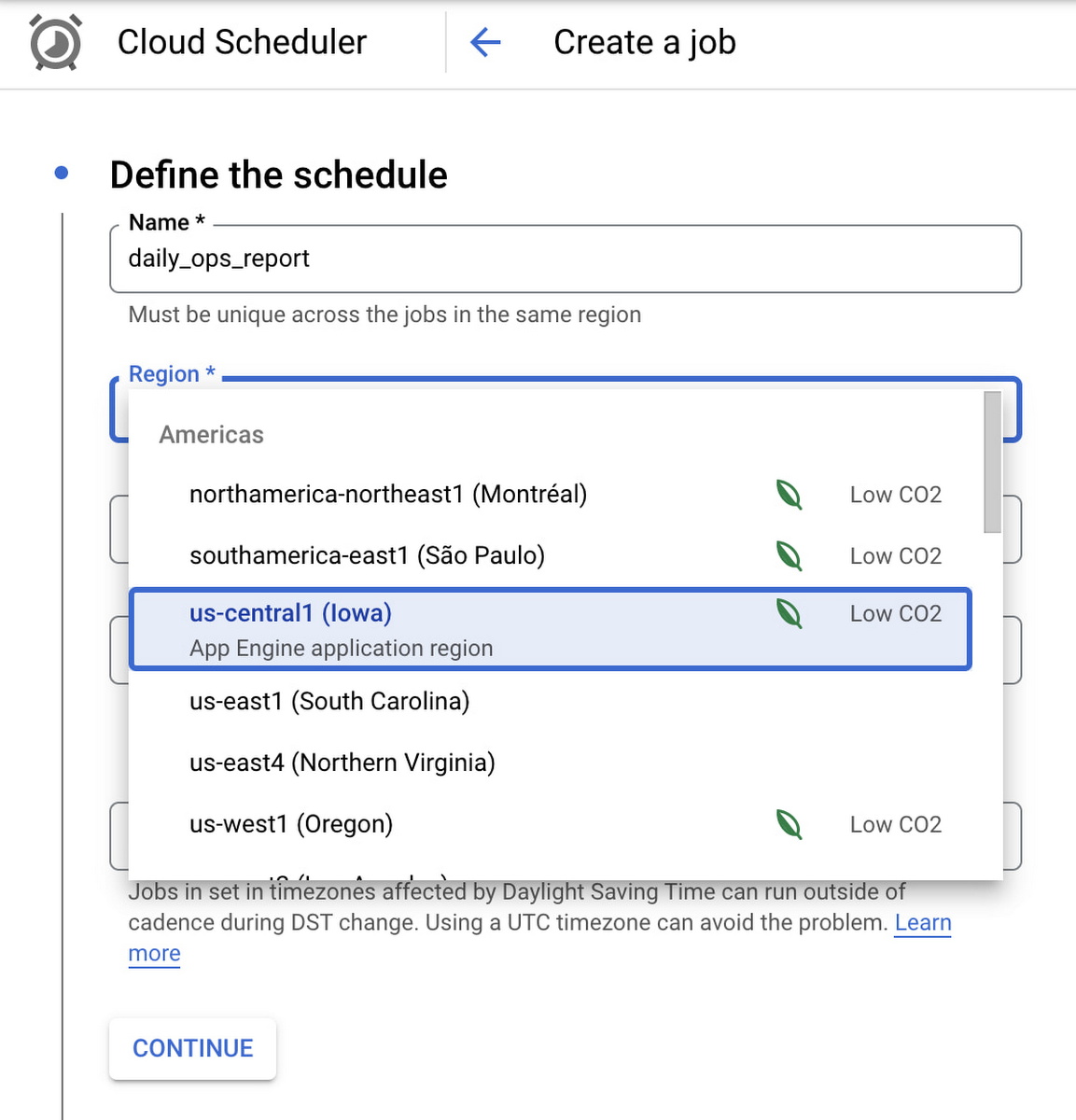
Google Cloud Scheduler is now available in 23 GCP Regions, and this number is expected to grow in the future. You can always find an up-to-date list of available regions by running:
gcloud scheduler locations list
We hope you are as excited about this launch as we are. Please reach out to us with any suggestions or questions in our public issue tracker.
Google Cloud Leads the Landscape for Unstructured Data Security Platform: Forrester

7035
Of your peers have already read this article.
1:30 Minutes
The most insightful time you'll spend today!
As organizations expand their use of cloud computing services, more of their sensitive data inevitably moves to and lives in the cloud. Much of this sensitive data is unstructured and can be challenging to secure. Despite this potential challenge, the usefulness of cloud for data storage and processing is too big for most organizations to ignore and has in turn led to data sprawl, where their sensitive data is spread over many resources, both in the cloud and on-premise. Addressing data sprawl requires solutions that can discover, manage, and secure sensitive data, especially unstructured data, as it spreads.
To help organizations confidently move their sensitive data to the cloud, Google Cloud works diligently to earn and maintain customer trust. Control and transparency are pillars of our approach to offering a trusted cloud. Therefore, we’ve been expanding our capabilities to act on unstructured data as sprawl increases.
Given the importance of these capabilities to our strategy, we are happy to announce today that Forrester Research has named Google Cloud a Leader in The Forrester Wave™: Unstructured Data Security Platforms, Q2 2021 report, and rated Google Cloud highest in the current offering category among the providers evaluated.

The report evaluates the 11 most significant providers with platform solutions to secure and protect unstructured data, spanning from cloud providers to data security-focused vendors. The report notes that “Google offers breadth and depth with built-in data security in the cloud. Google Cloud Platform, Google Workspace, and BeyondCorp Enterprise have underlying data security products and features for protecting customer data.”
Google Cloud tools focused on protecting unstructured data were developed and battle-tested internally at Google to alleviate some of our own data security challenges. This brings the best of Google security to the organizations utilizing Google Cloud and our security tools. The report highlights that “Google productizes capabilities originally developed to secure its own business, and brings a disciplined approach to product enhancements for enterprise requirements. It serves a wide range of enterprise and mid-market, with a focus on emphasizing data protection needs by industry. ”
Google Cloud’s data security strategy focuses on meeting customers wherever they are in their cloud migration journey. The report highlights that “Google further enables a Zero Trust approach with third-party integrations through its BeyondCorp Alliance of partners in device management, endpoint security and gateways.”
Google Cloud received the highest possible score in sixteen criteria, in total receiving the most 5 out of 5 ratings among all vendors assessed. These criteria include: Data Intelligence, Access Control, Deletion, Obfuscation-Scope, Obfuscation-Key Management, Deployment, Security and Risk, APIs and Integration, Data Security Platform Vision, Data Security Execution Roadmap, Performance, Planned Enhancements, Zero Trust Enabling Partner Ecosystem, Diversity, Equity and Inclusion, Installed Base, and Revenue.
Notably, Google Cloud received the highest possible score in the Obfuscation criteria. Obfuscation can help protect sensitive data, like personally identifiable information (PII), which is critical to many enterprise workflows. Cloud DLP helps customers inspect and mask this sensitive data with techniques like redaction, bucketing, and tokenization, which help strike the balance between risk and utility. This is especially crucial when dealing with unstructured or free-text workloads, in which it can be challenging to know what data to redact. More than 150 detectors combine to power Cloud DLP’s masking, which can be deployed in data migrations and business workloads like real-time data collection and processing. For Obfuscation specifically, the report mentioned that Google “takes a broad view of DLP, which includes in-line redaction of sensitive elements in unstructured data and DLP APIs that extend support to additional data types like images or other media.”
We are honored to be a Leader in The Forrester Wave™ Unstructured Data Security Platforms Q2 2021 report, and look forward to continuing to innovate and partner with you on ways to make your digital transformation journey safer as we work to become your most trusted Cloud.
A copy of the full report can be viewed here.

3940
Of your peers have already downloaded this article
3:30 Minutes
The most insightful time you'll spend today!
Cloud data warehouse solutions are changing the way firms build and support data platforms for insights. From provisioning a cloud data warehouse in minutes without requiring any technical expertise to allowing business analysts and other nontechnical users to access, store, and process large amounts of data for insights, they allow users to focus on business issues rather than deal with technical complexity.
No wonder, technology leaders rate cloud data warehouses as critical for their data management strategy. As a result, cloud data warehouse deployments are on the rise as firms across industries look at lowering costs, supporting new accelerated insights, and simplifying data management.
Analyst firm Forrester Research in its recent report on the Cloud Data Warehouse market has named Google Cloud a leader in this space as it offers large and complex cloud deployments, supports a broader set of use cases, and delivers high performance, scale, and automation.
Download this Forrester Research report to understand why enterprises are turning to cloud data warehouses and why Google Cloud is a leader in this space.
More Relevant Stories for Your Company

Google Introduces Cloud Career Jump Start Certification for the U.S. Underrepresented Communities
It’s no question that the cloud computing industry is booming and cloud experts are in high demand. In 2020, 67 percent of organizations surveyed in the IDG Cloud Computing Report added new cloud roles and functions (source). So there are plenty of cloud jobs out there, but if you don’t

This Chart, from Home Depot, Dramatically Demonstrates the Power of a Cloud Data Warehouse
The Home Depot (THD) is the world’s largest home-improvement chain, growing to more than 2,200 stores and 700,000 products in four decades. Much of that success was driven through the analysis of data. This included developing sales forecasts, replenishing inventory through the supply chain network, and providing timely performance scorecards. However,

Expect 40 Percent Higher Price-performance than General Purpose VM with Google TAU VMs!
In November 2021, we announced the general availability of Tau VMs. Since then, Google Cloud’s Tau VMs with Google Kubernetes Engine (GKE) have unlocked value for many customers who are now using Tau VMs for their production workloads, such as: Ascend, who achieved over 125% higher performance; Nylas, who gained

Building Unique Customer Experiences with Speed & Scale: Sprinklr & Google Cloud
Enterprises are increasingly seeking out technologies that help them create unique experiences for customers with speed and at scale. At the same time, customers want flexibility when deciding where to manage their enterprise data, particularly when it comes to business-critical applications. That’s why I’m thrilled that Sprinklr, the unified customer
