





Building Unique Customer Experiences with Speed & Scale: Sprinklr & Google Cloud

8242
Of your peers have already read this article.
2:00 Minutes
The most insightful time you'll spend today!
Enterprises are increasingly seeking out technologies that help them create unique experiences for customers with speed and at scale. At the same time, customers want flexibility when deciding where to manage their enterprise data, particularly when it comes to business-critical applications.
That’s why I’m thrilled that Sprinklr, the unified customer experience management (Unified-CXM) platform for modern enterprises, has partnered with Google Cloud to accelerate its go-to-market strategy and grow awareness among our joint customers. Sprinklr will work closely with our global salesforce, benefitting from our deep relationships with enterprises that have chosen to build on Google Cloud.
Akin to Google Cloud’s mission to accelerate every organization’s ability to digitally transform their business through data-powered innovation, Sprinklr’s primary objective is to empower the world’s largest and most loved brands to make their customers happier by listening, learning, and taking action through insights. With this strategic partnership now in place, Sprinklr and Google Cloud will go-to-market together with the end-customer as our sole focus.
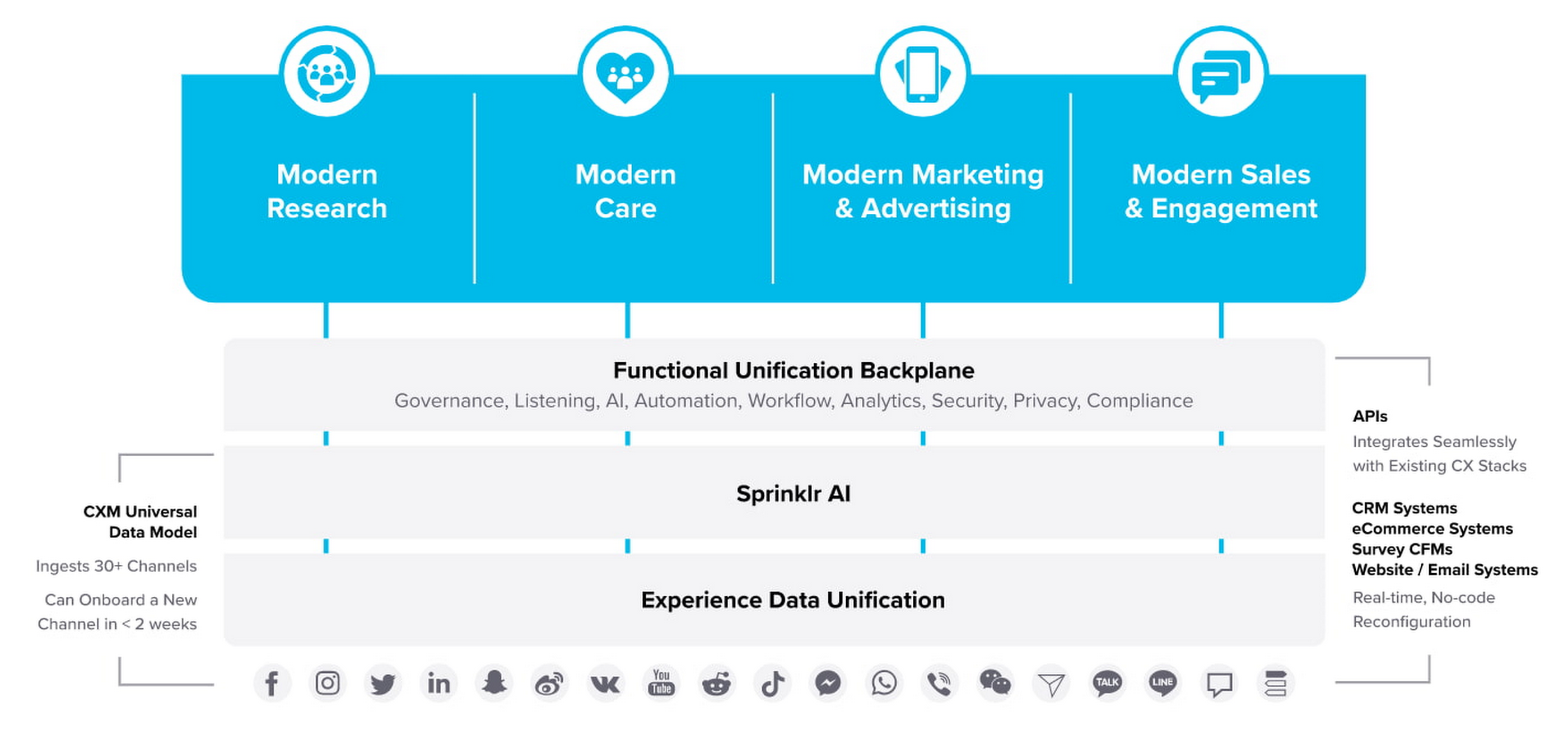
Traditionally, brands have adopted point solutions to manage segments of the customer journey. In isolation, these may work — but they rarely work collaboratively, even when vendors build “Frankenstacks” of disconnected products. These solutions can’t deliver a 360° view of the customer, and often reinforce departmental silos. All of which creates point-solution chaos.
Sprinklr’s approach is fundamentally different and is the way out of the aforementioned point-solution chaos. As the first platform purpose-built for unified customer experience management (Unified-CXM) and trusted by the enterprise, Sprinklr’s industry-leading AI and powerful Care, Marketing, Research, and Engagement solutions enable the world’s top brands to learn about their customers, understand the marketplace, and reach, engage, and serve customers on all channels to drive business growth.
Sprinklr was built from the ground up as a platform-first solution, designed to evolve and grow with the rapid expansion of digital channels and applications. The results? Faster innovation. Stronger performance. And a future-proof strategy for customer engagement on an enterprise scale.
“Sprinklr works with large, global companies that want flexibility when deciding where to manage their enterprise data and consider our platform a business-critical application,” said Doug Balut, Senior Vice President of Global Alliances, Sprinklr. “Giving our customers the opportunity to manage Sprinklr on Google Cloud empowers them to create engaging customer experiences while maintaining the high security, scalability, and performance they need to run their business.”
To learn more about this exciting partnership and the challenges we jointly solve for customers, check out the recent conversation between Google Cloud’s VP of Marketing, Sarah Kennedy, and Sprinklr’s Chief Experience Officer, Grad Conn. Or read the press release on the partnership.
How Rustomjee Increased speed, agility, and worker mobility with Google Cloud Platform

4230
Of your peers have already read this article.
6:30 Minutes
The most insightful time you'll spend today!
Operating for 23 years, Rustomjee has carved a niche for itself in the ever-growing real estate sector. Rustomjee’s portfolio includes 14.32 million square feet of completed projects; 12 million square feet of ongoing development; and another 28 million square feet of planned development. These projects span the best locations of the Mumbai Metropolitan Region. Rustomjee adds value to the lives of its homeowners through its core business, its corporate social responsibility initiatives, and its philanthropy. The business strives to ensure that every blueprint includes child-friendly spaces for parks, playgrounds, and learning rooms, encouraging families to spend quality time with each other.
In the 17 years Rustomjee’s Corporate Head of Information Systems, V M Samir, has worked with the business, it has grown from 100 employees to more than 800 employees – primarily professionals such as engineers, architects, lawyers, accountants, and regulatory consultants. The remainder work in marketing, sales, administration, security, human resources, and other associated areas.
Historically, Samir says, the real estate industry globally has lagged in embracing new workplace technologies, making building business cases, securing sponsorship, completing implementations, and encouraging adoption a difficult task.
G Suite powers cloud journey
Rustomjee started operations running an on-premises email service. However, the business wanted to upgrade its anti-spam capabilities and, in 2007, turned to G Suite. “There was no practical way I could build an anti-spam engine within that service that could match the power of the G Suite anti-spam engine and the intelligence held within its databases,” says Samir. “Our second key reason for moving was the lower cost of G Suite relative to an on-premises service that required us to spend on compute, backup, storage, and administration resources. Running G Suite would also help ensure users could still access their emails if their machines experienced an outage.”
Finally, G Suite enabled Rustomjee to access and compose emails from any location – a luxury for a real estate organization whose workers often attended construction projects with poor connectivity. “Finally, G Suite was the only service in those days that integrated calendar, meeting, and storage repositories through single sign-on. Google was so far ahead of the curve at that time and we saw the potential of G Suite to transform our communications and ultimately our business.”
“We did not have to shut down the business operations during the migration because Google Cloud Platform complemented every idea we had. And when my business users came to work on the Monday morning [after the final migration], everything was stable and the performance had improved. We told them our infrastructure had changed and they should start thanking Google Cloud!”
—V M Samir, Corporate Head, Information Systems, Rustomjee
The business started its cloud and IT modernization journey by decommissioning its on-premises email servers and using G Suite for Business. It began testing in March 2007 and went live with all production email services for 500 users in June 2008.
The intuitive nature and ease of use of G Suite made the transition seamless. “I did not have to undertake a large-scale change management exercise,” says Samir. “Users bought into the program and acquired the necessary knowledge quickly, meaning our adoption rate was extremely fast.”
With G Suite, email became the new norm to complete a range of tasks at Rustomjee. “We started exchanging CAD drawings, videos, high-resolution images, and other large files with our consultants,” says Samir. “These files had been difficult to store in on-premises environments.”
Rustomjee has improved collaboration and performance with G Suite, primarily due to four services. Gmail enables workers to communicate seamlessly externally and with each other, while Calendar enables them to set up and synchronize meetings. These meetings can be conducted through Hangouts Meet. “If a group of people internally need to discuss a work order or contract, they can coordinate calendars, sit at different locations within our organization, and collaborate using audio and video on a common service,” says Samir. “They can also work from and update a single document in Drive.”
With email and other collaboration applications running smoothly, Rustomjee saw an opportunity to enhance its technology infrastructure. The business had started operations running workplace applications on servers in small air-conditioned rooms. These servers ran databases and applications that sent data across a network to endpoints including desktops and laptops.
Expansion and the changing demands of workplace technology prompted Rustomjee to upgrade its capabilities, and the business commissioned a data center. However, Rustomjee’s continuously fast-growing compute and storage requirements, as well as the need to access new technologies to innovate and compete, quickly strained its technology model. “We required eight weeks each time we needed to add new compute and storage to our environment,” says Samir. “In addition, the heavy investments in our captive data center meant we were unable to easily leverage new technologies and decommission old technologies.”
Public cloud supports growth
Rustomjee reviewed its options and decided public cloud services could best meet its ongoing needs. “The rising cost of maintaining old hardware would force us to refresh data center technologies every five to seven years,” says Samir. “More broadly, a hardware-defined data center could not adapt quickly in the cloud-computing world, making it difficult to align compute with growth.”
The business started by moving its corporate website and microsites to a public cloud service to accommodate increased traffic delivered from a change in business strategy. “We saw an opportunity to shift our marketing and advertising from print advertising to digital platforms,” says Samir. “We wanted to be available to buyers from the point at which they start looking at properties online.”
However, Rustomjee’s digital marketing teams found it difficult to scale instances in line with demand, and work with complex user administration screens and control panels.
“With Google Cloud Platform, we’ve achieved a considerable reduction in timelines and simplified technology management and administration. All of our business users are delighted.”
—V M Samir, Corporate Head, Information Systems, Rustomjee
Google Cloud Platform presented an opportunity for Rustomjee to run its websites and microsites in a reliable, scalable, and responsive infrastructure. “Our evaluation confirmed Google Cloud Platform could support our growing demand for compute and storage,” says Samir. ‘In addition, because we undertake projects that are geographically distributed, networking – not only within the data center, but that could be accessed from any location – was very important. Only Google Cloud Platform had its own networking infrastructure.”
“More broadly, in a cloud environment, we could select any database we needed and start consuming operating systems as a service,” he adds. “In addition, we did not have to invest capital in licenses and hardware and we could always resize network bandwidth. Further, we could take advantage of pay-as-we-use cloud services, and link this to business growth.”
Google Cloud Platform also allowed Rustomjee to reduce the size of the teams needed to manage and operate its infrastructure. “When you have infrastructure running in the data center and in disaster recovery locations, you need to have a large pool of resources working around the clock to ensure constant uptime, sound backup, and good replication measures in place,” says Samir. “With the cloud, everything is simplified and we do not have to consider issues like how many hard drives have failed in on a particular morning.”
The business started testing and created its first virtual machine instance to Google Cloud Platform in April 2017. Because the Mumbai data center was not yet operating Rustomjee initially hosted its instances in the Google Cloud Platform Singapore Region. This initial move enabled the business to reduce the number of required virtual machine instances from six to one. After a year of running the website on Google Cloud Platform, the business found the simplicity of scaling compute resources meant its digital marketing teams were running more campaigns and servicing more leads, while compute spend had fallen by 56 percent. Furthermore, Rustomjee was not experiencing latency that impacted the user experience.
The opening of the Google Cloud Platform Region in Mumbai in late 2017 gave Rustomjee an opportunity to use compute, storage, and networking services located domestically. The business decided to go all-in on Google Cloud Platform and migrated a range of applications to the service.
These included an SAP enterprise resource planning system, running initially on Oracle but moved to the SAP HANA in-memory computing platform, with the assistance of advisory consultants from a leading firm. This system is integral to Rustomjee’s successful operations, meaning it has to be highly available and responsive. “All our financials are captured and stored in this system, as well as projects, materials management, order management, financial systems, and sales ordering systems, both procurement and supply-side,” says Samir. “In short, we cannot live without SAP ERP!”
Rustomjee turned to SAP specialist partner InfraBeat Technologies, a leading network implementation provider, and Google engineers to complete the migration successfully. “We were all in this together and collaborated closely to deliver the project successfully,” says Samir. “We were very impressed by the expertise and skills of everyone involved.”
A nine-day migration
With assistance from Google Cloud and the partners, Rustomjee moved all its SAP workloads, from sandbox to development, development to quality, and quality to production, in just nine calendar days, without impacting the business. “We did not have to shut down the business operations during the migration because Google Cloud Platform complemented every idea we had,” says Samir. “And when my business users came to work on the Monday morning [after the final migration], everything was stable and performance had improved. We told them our infrastructure had changed and they should start thanking Google Cloud!”
Moving to Google Cloud Platform enabled the business to complete certain customer invoicing workloads in just two hours, down from 13 hours previously. Backups of the SAP enterprise resource planning system that had taken up to six hours, were now being completed in six minutes.
“We have now fully embraced a cloud-first approach and have moved 100 percent of our workloads to the cloud. We depend totally on Google Cloud Platform to run our business.”
—V M Samir, Corporate Head, Information Systems, Rustomjee
Eight weeks down to 20 minutes
Rustomjee has also cut the eight-week cycles needed to set up the infrastructure and applications for a new real estate project, and integrate it into the SAP system, to just 20 minutes. “With Google Cloud Platform, we’ve achieved a considerable reduction in timelines and simplified management and administration,” says Samir. “All of our business users are delighted.”
With its website and enterprise resource planning system running successfully on Google Cloud Platform, the business decided to move its virtual application delivery environment into the service. “We decided to move all 800 of our employees into the cloud, so they could access applications through any endpoint, be it a mobile phone, tablet, thin client, desktop, or laptop,” says Samir.
The business decided to replace an existing application virtualization product with public images available on Compute Engine, with testing of Android, iOS and Windows operating systems across a range of devices proving highly successful. “Running the remote desktop service in Compute Engine and using public images enabled us to operate a leaner, simplified desktop as a service environment,” says Samir. “We have been able to deploy business function-specific virtual machine instances on the cloud and compartmentalize data to the business functions that need them. The business completed the move – including 8.1TB of data – in just six weeks. “The only workloads we did not move during that period were intensive workloads for visualization,” says Samir.
However, the four teams that did not use the remote desktop as a service environment – and that created visualization-intensive workloads – were working in traditional ways, compromising productivity and increasing risk. “They used to be given a desk in their respective offices and their workstations loaded with the applications,” says Samir. “There was no way of taking hourly backups of these devices and there was no recovery mechanism for the applications, because they were not in the data center.
“The other challenge was what happens to the data, because we operate out of multiple locations. The users in these four teams always had to come back to pre-assigned desks and continue working from there. This was counterproductive.”
The business subsequently implemented virtual machine instances with GPU access for visualization-intensive workloads. “We started evaluating Nvidia T4 (Tesla) GPUs in the Mumbai Region on 13 February and went live on 11 March in Mumbai,” says Samir. “By moving these 40 team members to Google Cloud Platform, we have enabled them to work with visualization workloads from any location, improving productivity and flexibility.”
Focus on core business
With Google Cloud Platform, Rustomjee can focus on running real estate projects and using technology to enable them. “I don’t have to refresh my technology every five to seven years, and I can leverage new technologies as they come on stream,” says Samir.
Reliable application access
With the flexibility and scalability of Google Cloud Platform, Rustomjee is now well-positioned to support further growth and operate in accordance with the time-limited nature of the real estate industry in India. “If we have promised to hand over the keys to a customer by a certain deadline and we fail to do so, we face a penalty of 10 percent of the cost of the project,” explains Samir. “The Indian Government introduced this regime in 2017 and business and technology have to align with its requirements.
“Google Cloud Platform is the right service to move us forward and enable us to overcome these challenges,” he adds. “We have now fully embraced a cloud-first approach and have moved 100 percent of our workloads to the cloud. We depend totally on Google Cloud Platform to run our business.”

4467
Of your peers have already downloaded this article
1:30 Minutes
The most insightful time you'll spend today!
Increasingly, technology, data, and human interactions will follow a new model of real-time inputs, enabling change without interruption and positive iteration. Cloud computing powers an important shift for information technology, and it will usher in new and better ways to serve customers, make discoveries, and build great products and services.
As part of this transformation, technology models will become more flexible, interoperable, and open; office cultures will shift toward transparency, collaboration, and constant learning. That means innovation and team building – the best parts of work – can happen more frequently and efficiently. Customer focus can sharpen and become more responsive. Corporate knowledge gained over decades of competing and innovating can be brought to bear more easily and meaningfully.
To compete effectively in this changing landscape, business and technology leaders must find ways to embrace the potential of cloud computing – whether in the tools and systems they choose, the institutional cultures they create, or the business strategies they prioritize. Today’s enterprises can set the stage for future success by infusing their unique assets – such as customer relationships, excellent service capabilities, strong partnerships, market knowhow, and technology investment – with the power of innovative IT.
Dassana: Choosing Google Workspace and Google Cloud to accelerate growth and reach goals

3043
Of your peers have already read this article.
2:30 Minutes
The most insightful time you'll spend today!
When Dassana co-founders Gaurav Kumar and Parth Shah, formerly founder and founding engineer at RedLock (now Prisma Cloud by Palo Alto Networks), set out on a new startup journey in 2020, they knew exactly where to start: sign up for Google Workspace.
“Every startup I’ve been at, we used Google Workspace,” said Kumar. “We’ve been using it for so long, and we’re all used to it. It’s like drinking water—you don’t think about it.”
“We’re big on user experience,” explained Shah. “Google is one of the few companies out there that is all about building the right kind of user experience that’s easy to follow. The sharing capabilities are amazing and, of course, easy to use. Docs, Sheets, Slides—we use all of it.”
Dassana, which emerged from stealth with $5 million in seed funding earlier this year, is a next-generation security data lake. It provides a holistic picture of security risk across an organization and its business units by ingesting large volumes of structured data in a schema-less fashion. Their success is a great testament to why startups are choosing not only Google Workspace, but a range of Google Cloud products.
Though the Dassana team was comfortable with Workspace from the start, not all their early technology choices were the best fit for the company, and Google Cloud services became more crucial as the startup evolved. For example, the team opted to use Amazon Web Services (AWS) to start their cloud journey, but ultimately started to explore other cloud options when they decided to run their technology platform on Kubernetes.
“We started looking into which cloud platforms provide the best Kubernetes experience,” said Kumar. “Hands-down, Google Kubernetes Engine (GKE) had the best experience. If you look at product velocity and how GKE has evolved over time, from its early days to GKE Autopilot and all the features and other native integrations—nothing even comes close.”
In particular, Kumar noted that the native integration between Google Workspace and GKE was particularly unique and useful. “When I go to Google Workspace and then go to GKE, my identity is already there,” he said. “I don’t have to integrate or manage anything. If I disable an account in Workspace, it’s also disabled on GKE.”
Another advantage is that GKE allows you to set up Google Groups to work with Kubernetes role-based access control (RBAC) for GKE clusters. This lets administrators maintain users and groups outside of GKE and assign RBAC permissions directly to Groups in Workspace without any extra engineering work or overhead management.
“I can actually use my Workspace identity to give granular controls to my GKE workloads. The integration of Google Groups in GKE and Kubernetes is a lifesaver. It’s saved us a lot of hassles,” said Kumar. Kumar also noted that the platform delivers better performance compared to other solutions thanks to the low latency of Google Cloud’s global network.
Like many startups, Dassana has found a powerful combination in Google Workspace and GKE on Google Cloud that lets them connect technologies, easily collaborate with their teams, and rapidly build their product. The team also recognizes the necessity of continued innovation, and is exploring additional Google Cloud products to help them accelerate their momentum. For example, Dassana plans to use the performance and scale of Cloud Storage buckets to store the company’s data. The team is also investigating how to save time by using Pub/Sub to integrate data directly from Google Workspace and other sources for security analytics.
To learn more about why startups like Dassana are choosing Google Workspace and Google Cloud to accelerate their growth and reach their goals, visit our startup solutions pages for Google Workspace and Google Cloud.
Earth Week: Google Cloud at the Heart of Sustainability

3486
Of your peers have already read this article.
1:30 Minutes
The most insightful time you'll spend today!
Today’s Google Doodle reminds us of the enormous changes our planet is experiencing due to climate change. Everyone, from businesses to governments to technologists, has the opportunity to meet this challenge — transforming themselves and their organizations to be more sustainable. For this Earth Day 2022, and indeed Earth Week, Google Cloud celebrates the organizations and individuals who are fighting climate change with innovative technology. We don’t want you to miss a thing, so here’s a recap of all our news in one handy location.
We asked global CEOs: what is it going to take to make progress on sustainability in your org?
In a survey of 1,500 CXOs across 16 countries, many executives say they are willing to do what it takes to have more sustainable practices. But despite their ambition, real measures of impact are lacking. To see what will change that, check out the blog.
We announced a new innovation challenge supporting climate science and research…
Our blog on Monday announced the Climate Innovation Challenge Research Credits program, to support researchers as they work to better understand climate change, increase climate resilience and develop new, promising solutions to urgent climate challenges. You can apply for research credits here.
…and shared stories of researchers making a difference
We interviewed Dr. Richard Fernandes from Natural Resources Canada, who built the LEAF toolbox that maps and assesses vegetation with satellite data from Google Earth Engine. You can read our Q&A here.
Canada has approximately 10 million square kilometers of land and the annual data volume of these maps is equivalent to streaming HD movies for over 750 hours non-stop. Cloud computing allows us to manage all this data in a useful and accessible way.Dr. Fernandes, Research Scientist
We also published a story about the U.S. Department of Agriculture’s Forest Service, and how they use Google Cloud processing and analysis tools to help sustainably manage 193 million acres of land.
We turned the lights on at new clean energy projects in four countries…
We shared details of our battery project in Belgium, solar projects in Denmark, and wind projects in Chile and Finland. Our battery project in Belgium is the first of its kind, enabling us to switch from diesel generators to a cleaner backup solution that will keep the internet up and running in the event of a power disruption. These will all help us continue to operate the cleanest cloud in the industry.

…and made it easier to learn how to build applications more sustainably
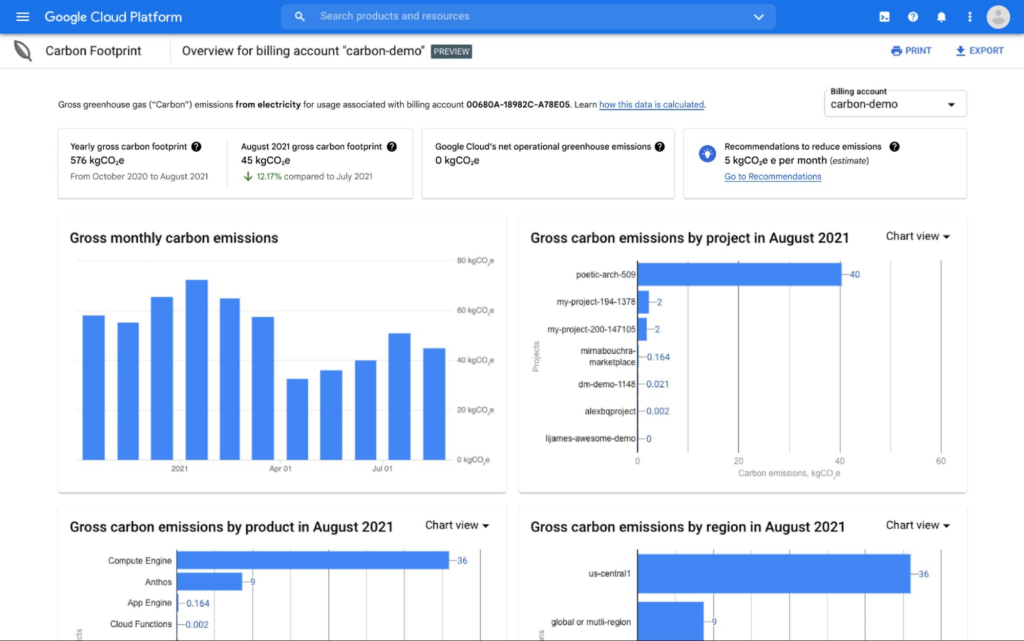
We launched a new lab that walks users through our Carbon Sense suite of products. From using our region picker app to make low-carbon architecture decisions, to analyzing the carbon footprint of your Google Cloud app with Carbon Footprint, we’re building sustainability into the tools you use every day. You can also find Carbon Footprint training in the new Data Warehouse Cloud On-Board.
We formed an ecosystem of partners to help accelerate sustainability projects…
The Google Cloud partner ecosystem is critical to helping our customers act sustainably today. A new whitepaper produced in partnership with Enterprise Strategy Group shares real-world solutions that could make an immediate impact — not in the next decade, but right now.
…and shared stories of innovative startups changing the game with Google Cloud.
Take Enexor and its partners, who are producing clean and sustainable energy from discarded plastics and agro-waste. The blog from Lee Jestings, Enexor Founder & CEO, shares how Google for Startups got them started, and which Google Cloud tools help them build predictive models. Check out their story.
Or Nuuly, the rental and resale business created by the URBN portfolio, which also includes Urban Outfitters, Anthropologie, and Free People. In the blog you can read how Nuuly is using technology to provide a sustainable experience to employees and customers — from upcycling clothing, to recyclable and reusable packaging.
Whether you’re a startup, scientist, executive or developer, at Google Cloud we’ll continue to work hard to help make your digital transformation a sustainable one.
Learn more about our sustainability work here, and don’t miss the inaugural Cloud Sustainability Summit this June. Register now.
How AI-powered ML Models Helps Run Unemployment Claims Verification at Scale

8413
Of your peers have already read this article.
2:00 Minutes
The most insightful time you'll spend today!
With unemployment application submissions reaching record numbers over the past year, state and local agencies in the United States have faced the challenge of processing unprecedented numbers of claims per week. The digital infrastructure most agencies have in place is unable to handle this volume, resulting in constituents waiting longer, and bad actors taking advantage of vulnerable systems. The Department of Labor Inspector General estimates that $63 billion in claims distributed is either an improper payment or fraud.
Validating claims also requires secure data sharing with other agencies for document and identity verification. Government leaders need a way to allow case adjudicators to quickly and confidently release backlogged claims, integrate with existing systems, and segment legitimate claims from potentially fraudulent ones — all within limited government budgets — securely and at scale.
Implementing a fraud detection solution on Google Cloud
States were under pressure to release payments, while also filtering out potentially fraudulent claims. SpringML and Google Cloud developed a framework to give adjudicators a reliable verification process that quickly filters potentially fraudulent claims, while processing the remaining claims so benefits reach citizens in a timely manner. SpringML and Google Cloud, applied AI-powered machine learning models to detect anomalous patterns in large datasets. Using Google Cloud tools, SpringML implemented a solution to streamline workflows, improve efficiencies, automate processes and identify potentially fraudulent claims.
SpringML used a variety of Google Cloud products to deliver a fraud detection solution, including:
- Google Cloud Storage to store and manage data
- BigQuery to store tabular data and BigQuery Machine Learning (BQML) to conduct machine learning on that data
- AutoML solutions to build predictive models and risk scoring
- Visualization tools such as Looker and Data Studio to present data and help government leaders make informed decisions.
Implementing machine learning to detect improper payments allows agencies to classify claims as “fraud” or “not fraud” based on the number of flags, as well as prioritize the most urgent claims. Deploying intelligent virtual agents to handle frequently asked questions meant that live agents could focus their time on more challenging cases.
Even once the pandemic is behind us, there will be bad actors trying to take advantage of overwhelmed or legacy systems. We’ve identified a few best practices for agencies managing enormous case loads and looking to improve improper payment analytics:
- Move your systems to the cloud. Many on-premises legacy systems can’t update their applications and scale to meet the volume of claims. Moving to a cloud environment enables rapid solution deployment and ingestion of large amounts of data without fear of overloading the system. The cloud scales with you–cost-effectively and securely.
- Understand patterns in the data. The answer is always in the data — we used deep analysis to help uncover suspicious patterns in large data sets. We implemented unsupervised machine learning to learn behaviors and create configurable rules that adjust to new information that comes into the system. We can uncover patterns that are likely associated with fraud – ones that a human might have missed.
- Use AI/ML tools to automate your existing systems and teams. These tools enable humans to work smarter and more efficiently. We automate anomaly detection and create dashboards for adjudicators to rapidly process claims. We are enabling the Wisconsin Department of Workforce Development by implementing automatic calculations and processing of recharge amounts, resulting in faster processing times and fewer human errors. Proactive fraud detection and timely calculation of recharge payment allowed DWD to ensure the benefits reached the right individuals.
- Build flexibility into your systems. We discovered that fraud patterns change over time. For instance,flags for fraud during March-May 2020 were vastly different from those we found in June-July 2020. Google Cloud tools make it easy to continually update algorithms to detect patterns and integrate external data sources.
Using Google Cloud tools, we can update digital infrastructure and incorporate machine learning best practices to help organizations efficiently process large volumes of claims and identify high probability fraudulent ones. SpringML provides consulting and implementation services and industry-specific analytics solutions that deliver high-impact business value to accelerate data-driven digital transformation. Learn more about fraud detection and how to improve improper payments analytics by watching our webinar.
More Relevant Stories for Your Company

Connected Data is the Lifeblood of Today’s Retailers: IDC’s 2022 Research
For a look ahead at the trends that will animate the retail industry this year, let’s take a look back at the 2022 National Retail Federation (NRF) "Big Show" in NYC. Attendees at January’s event were treated to tangible examples of how retail challenges are being solved today, including new

Lending DocAI Shortens Borrowers’ Journey on Roostify
The home lending journey entails processing an immense number of documents daily from hundreds of thousands of borrowers. Currently, home lending document processing relies on some outdated digital models and a high dependency on manual labor, resulting in slow processing times and higher origination costs. Scaling a business that sorts

AI in Manufacturing Already A Mainstream: Google Cloud Study
While the promise of artificial intelligence transforming the manufacturing industry is not new, long-ongoing experimentation hasn’t yet led to widespread business benefits. Manufacturers remain in “pilot purgatory,” as Gartner reports that only 21% of companies in the industry have active AI initiatives in production. However, new research from Google Cloud reveals that the

How Do You Cut Costs and Improve Staff Productivity, and Business Visibility? Ascend Money Has an Answer
Hundreds of millions of residents of South East Asia have only limited access to banking and finance services. However, help is at hand. One of South East Asia's largest fintech businesses, Ascend Money is using digital technologies to realize its mission of enabling as many people as possible to access
