





5451
Of your peers have already watched this video.
1:30 Minutes
The most insightful time you'll spend today!
Skincare Firm Scales 4X in Minutes with SAP on Google Cloud
As the number one skincare brand in the United States, Rodan + Fields must support its team of over 300,000 of independent contractors as well as work to ensure a really personalized experience for customers. To keep pace with the company’s growth, Rodan + Fields realized it needed a more modern, scalable platform for its SAP environment.
After implementing both SAP ERP and SAP Hybris on Google Cloud, Rodan + Fields can focus on its business instead of infrastructure. It can scale four times its size in less than five minutes. Also, BigQuery is now used for data analysis to support critical business decisions.
With SAP on Google Cloud consultants can have 100% confidence that Rodan + Fields systems will provide them the insight, data and tools to succeed.
Google Unveils New Cloud Region in Delhi NCR to Power India’s Digitization

8318
Of your peers have already read this article.
2:00 Minutes
The most insightful time you'll spend today!
In the past year, Google has worked to surface timely and reliable health information, amplify public health campaigns, and help nonprofits get urgent support to Indians in need. Now, we are continuing to focus on helping India’s businesses accelerate their digital transformation, deepening our commitment to India’s digitization and economic recovery. To support customers and the public sector in India and across Asia Pacific, we’re excited to announce that our new Google Cloud region in Delhi National Capital Region (NCR) is now open.
Designed to help both Indian and global companies alike build highly available applications for their customers, the Delhi NCR region is our second Google Cloud region in India and 10th to open in Asia Pacific.
What customers and partners are saying
Navigating this past year has been a challenge for companies as they grapple with changing customers demands and economic uncertainty. Technology has played a critical role, and we’ve been fortunate to partner with and serve people, companies, and government institutions around the world to help them adapt. The Google Cloud region in Delhi NCR will help our customers adapt to new requirements, new opportunities and new ways of working, like we’ve helped so many companies do in the region:
- InMobi scaled a personalized AI platform to support 120+ million active users. “With the arrival of the Google Cloud Delhi NCR, InMobi Group sees the opportunity to continue closing the gap between our users and products,” says Mohit Saxena, Co-founder and Group CTO of Inmobi. “Glance, especially, has been serving AI-powered personalised content to over 120 million active users. We can’t wait to continue giving them truly meaningful experiences that are speedy, scale well, and are relevant to them, by expanding the use of our current tools working on Google Cloud with the opening of a new region.”
- Groww now supports a sizable user base. “Google Cloud provides great technology that enables us to build and scale infrastructure to millions of users, and the new Google Cloud region in Delhi NCR will continue to help more businesses and startups in India access powerful cloud-based infrastructure, products and services,” says Neeraj Singh, Co-founder and Chief Technology Officer, Groww.
- HDFC Bank is positioned for the future. “At HDFC Bank, we are harnessing technology platforms to both run and build the bank. As we progress to be future ready, the objective is to invest in future technologies that give us scale, efficiency and resiliency. Towards this the Google Cloud region in Delhi NCR will enable us to enhance our resiliency and help us in building an active-active design framework for our new generation applications on cloud,” says Ramesh Lakshminarayanan, CIO, HDFC Bank.
- Dr. Reddy’s Lab built a modern data platform with Google Cloud. “At Dr Reddy’s, we pride ourselves in helping patients regain good health, acting quickly to provide innovative solutions to address patients’ unmet needs and in accelerating access to medicines to people worldwide. Our Google Cloud-powered data platform is helping us realize these objectives and we welcome Google’s investment in the new Delhi NCR region as helping us and other businesses in India make further contributions to our social and economic future,” says Mukesh Rathi, Senior Vice President & CIO, Dr. Reddy’s Laboratories.
- “To survive the disruption caused by the pandemic and to succeed in the long term, organizations need to become digital natives, so they can be more agile, explore new business models and build new capabilities that boost resilience. A cloud-first strategy plays a key role in enabling businesses to do this,” said Piyush N. Singh, Lead – India market unit & lead – Growth and Strategic Client Relationships, Asia Pacific and Latin America, Accenture. “Harnessing the potential of cloud requires the right data infrastructure and this expansion by Google Cloud will undoubtedly help Indian enterprises in their digital transformation journeys.”
A global network of regions
Delhi NCR joins 25 existing Google Cloud regions connected via our high-performance network, helping customers better serve their users and customers throughout the globe. As the second region in India, customers benefit from improved business continuity planning with distributed, secure infrastructure needed to meet IT and business requirements for disaster recovery, while maintaining data sovereignty.
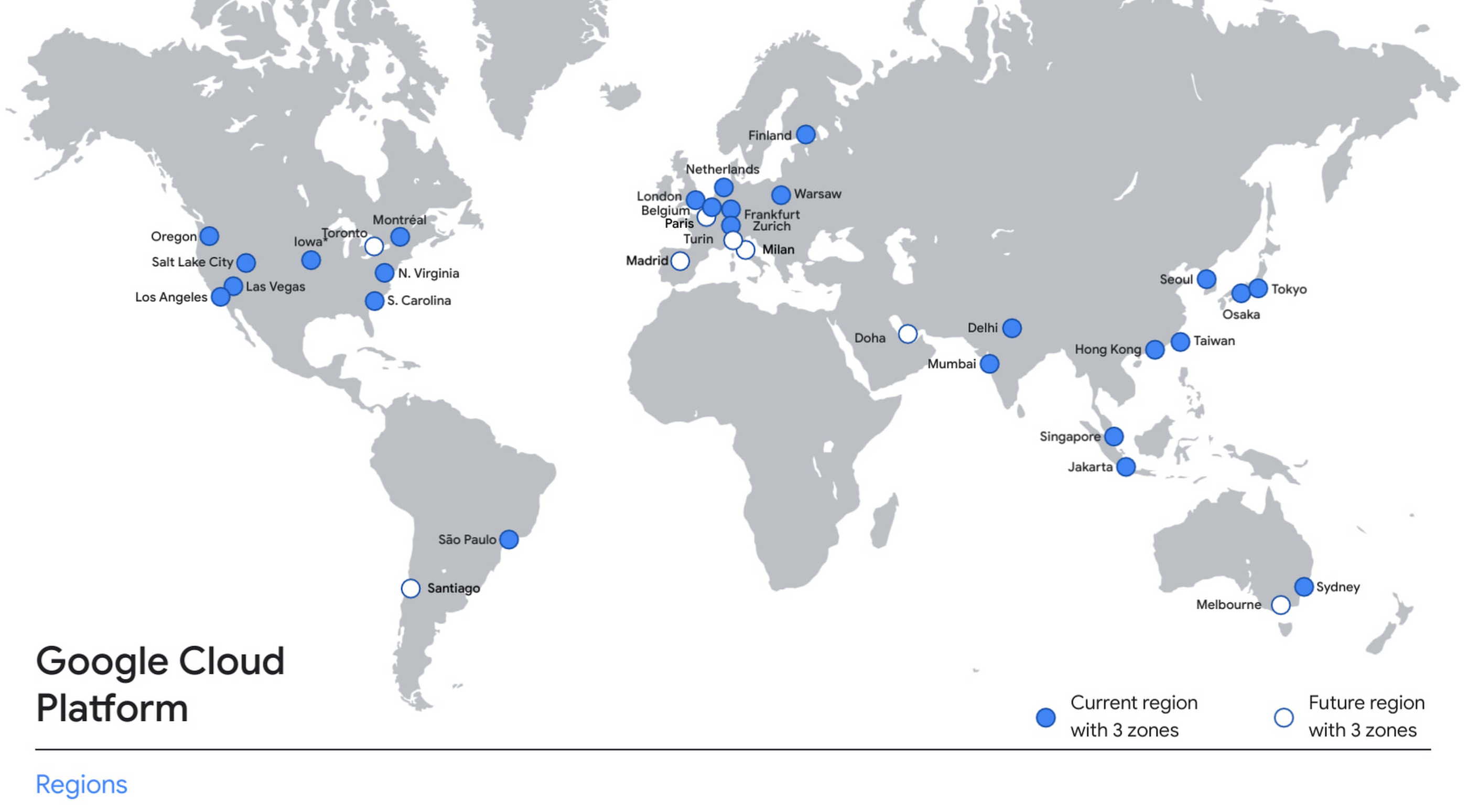
With this new region, Google Cloud customers operating in India also benefit from low latency and high performance of their cloud-based workloads and data. Designed for high availability, the region opens with three availability zones to protect against service disruptions, and offers a portfolio of key products, including Compute Engine, App Engine, Google Kubernetes Engine, Cloud Bigtable, Cloud Spanner, and BigQuery.
Supporting India’s recovery with training and education
Google and Google Cloud will also continue to support our customers with people and education programs. We’re investing in local talent and the local developer community to help enterprises digitally transform and support economic recovery.
Through the India Digitization Fund, we expanded our efforts to support India’s recovery from COVID-19—in particular, through programs to support education and small businesses. In addition to expanding internet access, and investments to help start-ups accelerate India’s digital transformation, we’ve grown our Grow with Google efforts. Businesses can access digital tools to maintain business continuity, find resources like quick help videos, and learn digital skills—in both English and in Hindi.
Helping customers build their transformation clouds
Google Cloud is here to support businesses, helping them get smarter with data, deploy faster, connect more easily with people and customers throughout the globe, and protect everything that matters to their businesses. The cloud region in Delhi NCR offers new technology and tools that can be a catalyst for this change. To learn more, visit the Google Cloud locations page, and be sure to watch the region launch event here.
Takeaways from the Google Cloud Public Sector Summit on Prioritizing Tech Investments

4773
Of your peers have already read this article.
3:00 Minutes
The most insightful time you'll spend today!
Editor’s note: Today’s post highlights five takeaways from our session at the first ever Google Cloud Public Sector Summit. To watch the full session, check out All the Right Moves: Prioritizing Investments in Technology.
Now more than ever, government agencies need to invest in digital services to fulfill their missions and better serve communities. Yet modernization isn’t a one-and-done approach; it’s a sustained effort, with multi-year implications, and requires careful consideration of how to integrate existing investments to optimize costs. Digital transformation requires coordination between different programs and agencies, including all of their many competing considerations. In short, maximizing technology investments requires careful planning, strategic thinking, and industry partners that can provide flexibility and security and meet agencies where they are.
I sat down with Suzette Kent, former U.S. federal chief information officer, and Dominic Sale, assistant commissioner for Technology Transformation Services at the General Services Administration (GSA) for a conversation to unpack this important topic and discuss industry best practices.
The panelists had five tips for government employees who are making technology purchasing decisions for their agency.
1. Put the agency’s mission first.Avoid getting distracted by exciting new trends and focus on long-term goals that can impact which procurement strategies or funds could be used. The discussion started with how government agencies could cut through the noise about technology and prioritize which technology is best for their needs. Sale and Kent agreed that an agency should focus on its core mission outcomes and let its technology needs flow from that. Sale also emphasized the importance of having technology design respond to humans’ needs, which has historically been a challenge for government agencies.
For agencies to stay focused on their mission, final decisions about technology need to be made by the program manager who best understands each program’s mission. The government CIO’s role is to be the enabler for the technology and leverage it at the enterprise level, particularly when it comes to sharing infrastructure. The takeaway: enable mission programs by empowering your teams and providing access to authorized, compliant, innovative data platforms that programs can move confidently and quickly with.
2. Invest in interoperability. Agency employees often struggle to balance the need for a positive return on investment (ROI) with requirements for meeting mission objectives. While the panelists agreed that the total cost of ownership was important, they also emphasized taking an expanded view of ROI, including future-proofing and investing in functionality that may not realize its return for many years based on the initiative. Saving money isn’t particularly valuable if the solution doesn’t meet an agency’s needs. When choosing a technology partner, government employees should understand its long-term vision to ensure that the partner fits agency priorities. Partners’ technologies should also integrate seamlessly with existing systems so agencies don’t duplicate investment costs.
For example, Google Anthos extends Google Cloud services and engineering practices into an organization’s existing environment, establishing operational consistency across apps and modernization. With Anthos, agencies can simply and securely build and deploy applications anywhere, integrating cloud services across platforms. This allows them to enjoy a consistent DevOps experience for hybrid and multi-cloud environments and enables new innovation. Most importantly, this enables an enterprise data platform, one of the largest catalysts for mission transformation and applied AI.
3. Take advantage of artificial intelligence (AI) benefits. Over the course of the pandemic, the rapid application of AI has improved government productivity, efficiency, and the ability to deliver critical new services to the public at scale. This has further cemented AI’s role as an essential government technology for the present and future. In fact, Nextgov reports that “46% of government IT specialists plan to use AI and machine learning (ML) for embedded systems in the near future.”
As we’ve seen over the course of the pandemic, government programs can start small with AI pilots before moving into broad deployment. This can help agencies understand AI’s potential before moving to full production. People always supervise AI technologies, and the possibilities are endless. Google Cloud’s Contact Center AI (CCAI) has helped government agencies improve the customer experience, by allowing citizens to schedule vaccine appointments via a platform of their choice with up to 28 languages and dialects, and manage vaccine deployment. The U.S. Navy spends billions annually to fight rust and corrosion on its ships. Inspections of ships, aircraft and vehicles are a time-consuming and critical part of keeping the U.S. Navy at top performance so Google Cloud and Simple Technology Solutions (STS) rapidly built an AI-based corrosion-detection and analysis system. The system detected and analyzed corrosion on vessels with 90% accuracy and will eventually be used to automate inspections of vessels, aircraft, and vehicles—saving billions of dollars. Document AI helps a variety of government agencies scale their document processing, reducing the time it typically takes to process enormous amounts of data and related citizen claims.
Successful adoption of AI also depends on the quality of the data. Ultimately, agencies need high-quality enterprise data pipes so that employees and the community trust the system and public sector agencies. Sale described a GSA project that used AI bots to read legal contracts and look for particular phrases that would indicate a specific use case. Previously, an employee would have had to read through the contracts and search for the information. In this way, AI is saving the government both money and time.
4. Creating better experiences for the public. Sale observed that, “trust is the government’s currency and profit motive.” And trust comes when the public can be served with the same modern tools and technology they’re used to – in real-time and with transparency in mind. For example, agencies can provide transparency in public-facing dashboards for programs and supply services that deliver information in real-time through solutions like CCAI.
Trust also requires that constituents feel that government agencies will keep their data safe and secure. The need for a globally secure infrastructure with systems that are up-to-date and designed with security at every level, underpinned by zero-trust enterprise-wide remains paramount – particularly after the series of recent cyberattacks targeting government IT infrastructure.
5. Finding the right technology partner. Government leaders need technology partners who provide a flexible and interoperable platform to integrate existing investments and maximize technical value. Historically, public sector agencies have largely been forced to adopt private clouds, which has reduced their access to richer features, and hindered their ability to adopt a full range of security and product capabilities. The right partner won’t require government leaders to compromise on functionality or service availability to achieve compliance. The right partner can harness the power of emerging technology to make it Government-ready and the true promise of cloud– the access and integration of open data– to make missions more powerful and impactful for the constituencies they serve.

5690
Of your peers have already downloaded this article
5:30 Minutes
The most insightful time you'll spend today!
Modernizing apps on the cloud isn’t an “all or nothing” decision. Businesses want the option to modernize on-premises or choose multi-cloud solutions that meet their needs. That’s why we created a new solution for running apps anywhere – simply, flexibly, and securely. Embracing open standards, Anthos lets you run your applications, unmodified, on existing on-prem hardware investments or in the public cloud. So that you write once and deploy anywhere.
Download this report and find out how to:
- Decouple infrastructure and applications with containers and Kubernetes
- Decouple cloud teams from one another so they can work independently
- Meet the challenges of microservice management using service mesh
- Implement a zero-trust security model to enforce more granular controls while maintaining a consistent user experience
Google and NetApp Partnership Expansion to Ease Customers’ Cloud Migration

3665
Of your peers have already read this article.
3:00 Minutes
The most insightful time you'll spend today!
As organizations continue to evolve to meet the needs of their stakeholders, they are increasingly looking to adopt the cloud and digitally transform their business. Since our partnership with NetApp began in 2018, we’ve been focused on delivering the infrastructure, tools, and services to help customers on their cloud migration journey and benefit from their data to better serve their customers.
“Customers are looking to adopt flexible and scalable solutions that meet the needs of their business,” said Ronen Schwartz, SVP & GM, Cloud Volumes, NetApp. “Our long-standing partnership with Google Cloud continues to deliver innovative solutions for customers as they look to migrate and run their business critical applications in the cloud while unlocking the power of their data with industry-leading cloud services.”
Innovative, industry-first solutions have become the standard for our partnership. From the general availability of NetApp Cloud Volumes Service (CVS) for Google Cloud in 2019, to our collaboration on new architectures in 2020 with the release of the software-defined CVS powered by Google Kubernetes Engine (GKE), we continue to deliver first-of-its-kind enterprise file storage services together. In 2021, the pace of innovation has only increased—together, we delivered volume replication powered by SnapMirror, which efficiently copies volume data from one Google Cloud region to another for data consistency, development, testing, or disaster recovery.
We’ve also made our services available globally—you can now run Cloud Volumes ONTAP in all 28 Google Cloud regions, and CVS is now available in 19 regions, allowing you to access our services wherever you are around the globe. All of this is backed up by a 99.99% SLA for CVS, enabling high availability for your enterprise workloads.
Hundreds of customers including MailerLite, a leader in marketing automation, have benefitted from our joint services. MailerLite was looking to move millions of files to the cloud without disruption as they were facing availability, management, and maintenance challenges as their business scaled. By leveraging NetApp CVS on Google Cloud, MailerLite was able to migrate over 100 million files to Google Cloud in about an hour, removing their ongoing infrastructure overhead, saving developer hours, and eliminating the scalability limitations they previously experienced.
Expanding our partnership
Last week at Google Cloud Next ‘21, we announced we are expanding our strategic partnership in two ways to make it even easier for customers to migrate and run business critical applications on Google Cloud. First, NetApp will provide storage infrastructure for the newly announced Google Distributed Cloud Hosted, where data resides in customer-owned data centers and colocation facilities. This enables a safe and secure way to modernize an on-premises deployment while still meeting data security and privacy requirements.
Additionally, for customers looking to migrate their VMware workloads to Google Cloud, we announced preview access for NetApp Cloud Volumes as datastores for Google Cloud VMware Engine. By providing customers with the choice to scale compute and storage independently, customers can now reduce costs and complexity when migrating and running storage-bound workloads. This also allows customers to address regional disaster recovery use cases, making it easier and more cost-effective to move on-premises workloads into Google Cloud. To get started, you can sign up for preview access using the Registration for Preview Access form.
Looking forward
We’re excited for what’s to come with our partnership and committed to delivering value to customers across industries. Google Cloud is a Gold sponsor at this week’s NetApp Insight, and we invite you to join our spotlight session featuring Google Cloud and NetApp leaders. Additionally, we are leading multiple breakout sessions where you will hear from our product team on how you can accelerate cloud adoption with Google Cloud and NetApp. You can also learn more and get started today by visiting our NetApp on Google Cloud website.

3547
Of your peers have already downloaded this article
1:30 Minutes
The most insightful time you'll spend today!
In a study of 360 business and technology decision makers and influencers from Indian enterprises, conducted by Forrester Consulting, it is revealed that public cloud adoption in India is on the rise with 2 in 3 organizations planning to increase their cloud spending by 5% or more in the next 12 months.
According to the study, public cloud platforms help organizations to:
- Enable digital customer experience
- Improve digital operational excellence
- Power digital ecosystem expansion
- Accelerate digital innovation
Download this infographic to understand why Indian companies are adopting a cloud-first approach to accelerate digital transformation.
More Relevant Stories for Your Company

Google Cloud Featured at TechCrunch Disrupt 2021
Startups need to move quickly and focus their limited resources on areas where they can differentiate. If infrastructure isn’t your differentiator, don’t put a lot of energy into your infrastructure when someone else can do it for you. What’s more, time-to-market matters to startups more now than ever. Successful early

Accelerating Success: Tips and Techniques for Optimizing and Scaling Your Startup
At Google Cloud, we want to provide you with the access to all the tools you need to grow your business. Through the Google Cloud Technical Guides for Startups, leverage industry leading solutions with how-to video guides and resources curated for startups. This multi-series contains 3 chapters: Start, Build and

Largest Beauty Retailer in the US Powers Digital Transformation with Google Cloud Smart Analytics
Digital technology offers increasing flexibility and choice to consumers. As a result, the retail industry is dramatically shifting toward more tailored and personalized experiences for shoppers, and businesses are rethinking how they deliver value to customers. This couldn’t be more true for the beauty retailing industry where leading companies are

IDC Retail Insights: The Digital Pulse of Retail
Google partnered with IDC Retail Insights to conduct a survey of retailers across the globe to assess the state of transformation and develop an index of digital maturity. Learn more about the changes in digital resilience over the last year and the areas of innovation over the next 12 months.
