





4890
Of your peers have already watched this video.
1:30 Minutes
The most insightful time you'll spend today!
Accelerate Your Digital Transformation Through a Modern Infrastructure
Learn about the latest advancements to Google Cloud Platform’s unique infrastructure to accelerate enterprise workloads and build planet scalable solutions. Hear how Google Cloud’s infrastructure enables you to solve problems faster, more securely, and at greater scale.
See how Google Cloud is accelerating the support for enterprise workloads like SAP, VMware, and Windows and augmenting new capabilities to better protect and secure your workloads. Discover how Google Cloud enables businesses to build high-scale applications with global scale and reach.
4041
Of your peers have already watched this video.
15:00 Minutes
The most insightful time you'll spend today!
Modernize your Windows Workloads by Migrating them to Google Cloud
Google has plenty to offer when it comes to migrating and modernizing traditional enterprise Windows workloads to the cloud. Explore different approaches for re-hosting, modernizing, and transforming Windows applications, and the benefits of moving to Google Cloud.
Learn from demos on some of the cutting-edge technologies that can offload some of the operational IT burden into optimized managed services.
Marxent Leverages Google Cloud to Elevate Customer Journeys on Retail Apps with 3D Shopping Experiences

3333
Of your peers have already read this article.
3:00 Minutes
The most insightful time you'll spend today!
As ecommerce for home goods exploded in popularity during COVID, furniture and DIY retailers looked to find new ways to grow online transaction sizes to in-store levels. Shopping for furniture and home improvement projects has always been challenging online. Furniture, kitchen cabinets, fixtures, and appliances become a part of daily life, are challenging to return, and have a low purchase frequency. Once a shopper makes a decision, they tend to live with it for many years. These are visual, tactile, decisions that require measurements, style choices, budgeting, an understanding of available products, and an involved consideration processes. During the pandemic, retailers turned to 3D to enhance these virtual shopping experiences.
Inspiration and visualization cultivate confidence
Our 3D Room Commerce company, Marxent offers 3D visualization and configuration solutions that help retailers sell complex, configurable products online through consumer-facing 3D design and visualization apps. The Marxent 3D Room Planner with HD Renders helps shoppers to visualize how furniture or kitchen cabinet configurations will look in the specific floorplan of their home. Founded in 2011, Marxent envisions a world where buying a dining table or remodeling an entire kitchen is as easy as buying a car from Carvana or ordering dinner through Bite Squad. Our 3D apps create a streamlined inspiration to transaction to advocacy model that cultivates shopper confidence and allows retailers to sell the whole room, not just individual items.
Using Google Cloud as a foundation, we help some of the largest retail and home goods companies in the world provide exceptional customer journeys. We trust Google Cloud because our clients trust us to make it faster and easier for shoppers to buy semi-custom, configurable projects.
Embracing the power of 3D to super-charge ecommerce
It’s inarguable: e-commerce is on the rise. More people than ever before are shopping online for furniture, kitchen cabinets, decking, and other large-scale configurable products.
Customers who design with a retailer, usually buy from them. When shoppers visit stores and showrooms, they find inspiration in merchandised scenes that illustrate how products like sofas, chairs, rugs and lamps work together to accomplish a look. Skilled sales people make suggestions and offer advice on how to put pieces together. They may even work up a quick floor plan to show how multiple items work together in a room. In store, the inspiration phase is intimately tied to consideration and, ultimately, to driving transactions.
By contrast, online shoppers typically start home projects by seeking inspiration and ideas from Pinterest, Instagram and unbranded online image searches. Once they have formed their style preferences, shoppers keep searching to compare products across multiple retailers, plan their project, and put together a final budget.
To own the whole project sale, retailers need to own the entire inspiration to transaction to advocacy journey. With both online and in-store applications, Retailers leverage Marxent’s 3D Room Planner app to build shopper confidence, capture the whole room sale and win the customer over.
https://youtube.com/watch?v=_svOdVvX5LA%3Fenablejsapi%3D1%26
PRE-RENDERED MID-POLY 3D SCENE

POST-RENDERED MID-POLY 3D SCENE – This is a slightly different angle of the same room that has been rendered into a “Raw Render” (rendered in under 2 minutes).

Through Marxent’s 3D Room Commerce solution, users experience a cyclical inspiration to transaction to advocacy journey. It starts with shoppers viewing inspirational images and media online. Using Marxent’s applications, they can design directly from inspirational images to create a custom, configured space without any product catalog knowledge. Shoppers can visualize the products they love together and in the context of their own floor plan instead of navigating product pages and wondering if items will work together.
Then, they can add the whole room to a shopping cart with a single click. While this virtual experience does lead to a transaction, it also allows users to save, collaborate on, and share the spaces they’ve created. They become advocates by sharing their projects on social media, starting the inspirational content cycle again.
Putting an end to manual operations
To deliver renders at scale, Marxent needed to update their cloud render solution. Initially, our 3D Art team operated a manual on-premise render fleet. However, this required many hours of manual setup, configuration, and operation. We also had to manage expensive graphics servers—bare metal, CPUs, GPUs, RAM, HDD, and more. The only solution was to automate the 3D rendering process and empower end-users to rapidly create their own 3D room renders.
When we were evaluating new solutions, we saw distinct advantages in the Google Cloud Platform that would help them safely and securely scale their business, while strengthening their partnerships with end customers. For example, in moving to Google Cloud, we could automate and scale our rendering process without having to manage fleets of physical servers. We also viewed the platform as an asset due to Google’s secure-by-design infrastructure, agility, data analytics capabilities, and potential for joining the Marketplace.
Creating magical customer experiences that inspire purchase
To provide our customers and shoppers with contextual experiences, Marxent’s applications use mid-poly 3D models that balance speed and realism. These models provide a latency-free, real-time design experience that can be rendered into scenes that are realistic enough to be perceived as photos on social media.
The complex process of rendering these images requires a combination of efficiency, speed, analytics, and consistent performance that Google Cloud provides. When configured with powerful and speedy gaming GPUs, Marxent can provide fast rendering that meets customers and shopper demands. Here’s a look at our HD Renders application.

Before a user can request an HD Render, they must create a room in the Marxent 3D Room Planner. Once requested, Marxent pulls the saved project from the database and kicks off the process with Cloud Pub/Sub. The project loads into a gaming GPU, using the same platform code running when the user first creates the room in the application. It boots up the app in the cloud to load the room.
The code then scours the space and prepares it for rendering, adjusting texture formats, and adding in lighting. After going through the render engine, the project automatically uploads to Cloud Storage. Finally, the user receives a link to the final product. Throughout, Cloud Pub/Sub handles messages ensuring the right event processes are happening, such as rendering success or failure.
Using this process, it’s possible to create dozens of images out of a single scene, trading products in and out of a floor plan by leveraging a complete catalog of content geometries and covers, textures, and finishes.
Utilizing Google Cloud throughout the buying journey
Today, Marxent’s applications power world-class retailers with AR, VR, and 3D commerce experiences. We use cutting-edge graphics hardware to create renderings in less than 2 minutes per screenshot, often much faster. We’re also saving money as we no longer have to manage expensive servers or purchase expensive hardware upfront. Our clients are happier because we have passed on the cost savings to them while now having limitless scaling capabilities to meet demand.
By partnering with Google Cloud, Marxent can confidently offer our customers secure applications built on infrastructure with advanced security tools that support compliance and data confidentiality. Backed by a globally consistent platform, we can also help brands build reliable purchasing experiences across customer touchpoints—without fear of downtime during peak sales periods. This strategic partnership has allowed us to provide a best-in-breed, customer-first experience that our customers demand while providing the reliability that our partners expect.
With customers demanding seamless shopping experiences, Marxent’s 3D technologies open doors to new, easier, more convenient, and more satisfying shopping experiences that empower consumers to buy the right products the first time.
If you want to learn more about how Google Cloud can help your startup, visit our Startup Program application page here and sign up for our monthly startup newsletter to get a peek at our community activities, digital events, special offers, and more.
How Google Cloud’s PSO Supports Customers’ Migration Goals

5039
Of your peers have already read this article.
2:00 Minutes
The most insightful time you'll spend today!
Google Cloud’s Professional Services Organization (PSO) engages with customers to ensure effective and efficient operations in the cloud, from the time they begin considering how cloud can help them overcome their operational, business or technical challenges, to the time they’re looking to optimize their cloud workloads.
We know that all parts of the cloud journey are important and can be complex. In this blog post, we want to focus specifically on the migration process and how PSO engages in a myriad of activities to ensure a successful migration.
As a team of trusted technical advisors, PSO will approach migrations in three phases:
- Pre-Migration Planning
- Cutover Activities
- Post-Migration Operations
While this post will not cover in detail all of the steps required for a migration, it will focus on how PSO engages in specific activities to meet customer objectives, manage risk, and deliver value. We will discuss the assets, processes and tools that we leverage to ensure success.
Pre-Migration Planning
Assess Scope
Before the migration happens, you will need to understand and clarify the future state that you’re working towards. From a logistical perspective, PSO will be helping you with capacity planning to ensure sufficient resources are available for your envisioned future state.
While migration into the cloud does allow you to eliminate many of the considerations for the physical, logistical, and financial concerns of traditional data centers and co-locations, it does not remove the need for active management of quotas, preparation for large migrations, and forecasting. PSO will help you forecast your needs in advance and work with the capacity team to adjust quotas, manage resources, and ensure availability.
Once the future state has been determined, PSO will also work with the product teams to determine any gaps in functionality. PSO captures feature requests across Google Cloud services and makes sure they are understood, logged, tracked, and prioritized appropriately with the relevant product teams. From there, they work closely with the customer to determine any interim workarounds that can be leveraged while waiting for the feature to land, as well as providing updates on the upcoming roadmap.
Develop Migration Approach and Tooling
Within Google Cloud, we have a library of assets and tools we use to assist in the migration process. We have seen these assets help us successfully complete migrations for other customers efficiently and effectively.
Based on the scoping requirements and tooling available to assist in the migration, PSO will help recommend a migration approach. We understand that enterprises have specific needs; differing levels of complexity and scale; regulatory, operational, or organization challenges that will need to be factored into the migration. PSO will help customers think through the different migration options and how all of the considerations will play out.
PSO will work with the customer team to determine the best migration approach for moving servers from on-prem to Google Cloud. PSO will walk customers through different migration approaches, such as refactoring, lift-shift, or new installs. From there, the customer can determine the best fit for their migration. PSO will provide guidance on best practices and use cases from other customers with similar use cases.
Google offers a variety of cloud native tools that can assist with asset discovery, the migration itself, and post-migration optimization. PSO, as one example, will help work with project managers to determine the best tooling that accommodates the customer’s requirements for migrating servers. PSO will also engage Google product team to ensure the customer fully understands the capabilities of each tool and the best fit for the use case. Google understands from a tooling perspective, one size does not fit all, thus PSO will work with the customer on determining the best migration approach and tooling for different requirements.
Cutover Activities
Once all of the planning activities have been completed, PSO will assist in making sure the cutover is successful.
During and leading up to critical customer events, PSO can provide proactive event management services which deliver increased support and readiness for key workloads. Beyond having a solid architecture and infrastructure on the platform, support for this infrastructure is essential and TAMs will help ensure that there are additional resources to support and unblock the customer where challenges arise.
As part of event management activities, PSO liaises with the Google Cloud Support Organization to ensure quick remediation and high resilience for situations where challenges arise. A war room is usually created to facilitate quick communication about the critical activities and roadblocks that arise. These war rooms can give customers a direct line to the support and engineering teams that will triage and resolve their issues.
Post-Migration Activities
Once cutover is complete, PSO will continue to provide support in areas such incident management, capacity planning, continuous operational support, and optimization to ensure the customer is successful from start to finish.
PSO will serve as the liaison between the customer and Google engineers. If support cases need to be escalated, PSO will ensure the appropriate parties are involved and work to get the case resolved in a timely manner. Through operational rigor, PSO will work with the customer in determining if certain Google Cloud services will be beneficial to the customer objectives. If services will add value to the customer, PSO will help enable the services so it aligns with the customer’s goal and current cloud architecture. In cases where there are missing gaps in services, PSO will proactively work with the customer and Google engineering teams to close the gaps by enabling additional functionality in the services.
PSO will continue to work with the engineering teams to consistently review and provide recommendations on the customer’s cloud architecture in ensuring the most optimal and cost efficient design along with adhering to Google’s best practices guidelines.
Aside from migrations, PSO is also responsible for providing continuous training of Google Cloud to customers. To ensure consistent development of Google Cloud, PSO will work with the customer to jointly develop a learning roadmap to ensure the customer has the necessary skills to succeed in delivering successful projects in Google Cloud.
Conclusion
Google PSO will be actively engaged throughout the customer’s cloud journey to ensure the necessary guidance, methodology, and tools are presented to the customer. PSO will engage in a series of activities from pre-migration planning to post migration in key areas such as capacity planning to ensure sufficient resources are allocated for future workloads to providing support on technical cases for troubleshooting. PSO will serve as a long-term trusted advisor who will be the voice of the customer and provide the reliability and stability of the customer’s Google Cloud environment.
Click here if you’d like to engage with our PSO team on your migration. Or, you can also get started with a free discovery and assessment of your current IT landscape.
Datashare for Financial Services: Securing the Publishers and Consumers’ Access to Market Data

8574
Of your peers have already read this article.
4:30 Minutes
The most insightful time you'll spend today!
Access to the cloud has advanced the distribution and consumption of financial information on a global scale. In parallel, the global financial data landscape has been transformed by an influx of alternative data sources, including social media, meteorological data, satellite imagery, and other data. Exchanges and market data providers now find they need to include these new datasets to enrich their products and compete, which has meant they now must consider cloud-based models to keep up with the demands of their customers who expect easy, quick, flexible and cost-efficient ways to consume market data.
To address these needs, today we’re announcing the general availability of Datashare for financial services, a new Google Cloud solution that brings together the entire capital markets ecosystem—data publishers, and data consumers—to exchange market data securely and easily.
Datashare helps organize third-party financial information, making it accessible and useful to market data publishers and data consumers. We open-sourced the entire Datashare solution so market data publishers can now onboard their licensed datasets to Google Cloud securely, quickly and easily, while data consumers can consume that data as a service in tools of their preference, such as BigQuery.
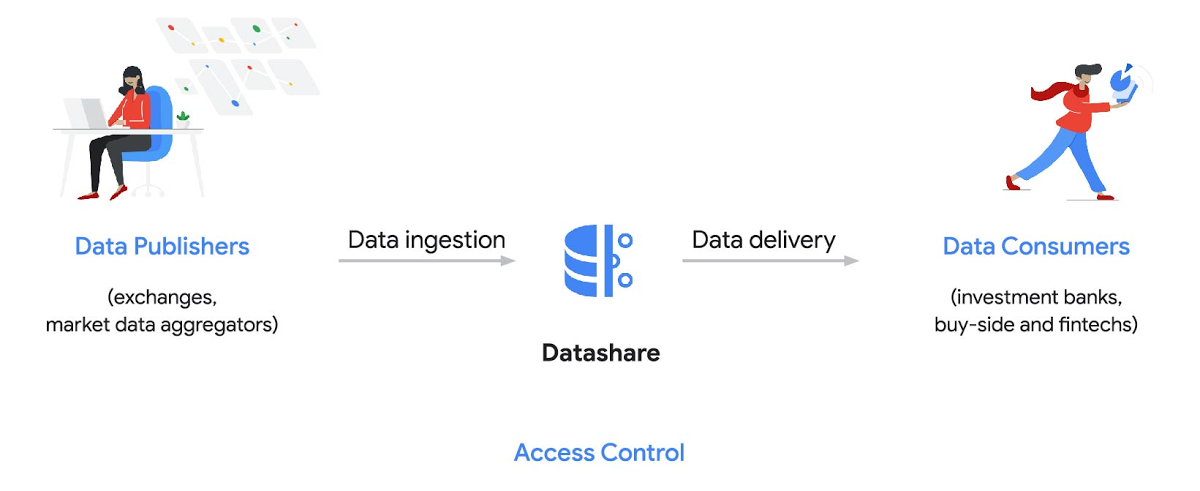
Three ways to distribute and consume your data
Batch data delivery
Datashare provides a batch data delivery mechanism for data publishers to deliver their reference data, historical tick data, alternative market data sources and more via BigQuery, reducing the administrative burden on data consumers to extract insights from data.
Real-time data streaming delivery
By using this event-based data delivery channel for rapidly changing instrument prices, tick data, orders, news and others via Pub/Sub, data consumers can reliably process individual messages or rewind to a point in time to replay a prior market scenario and test model changes.
Monetizing licensed datasets
Market data publishers can onboard their licensed datasets to Google Cloud and make them available via a one-stop-shop on Google Cloud Marketplace, enabling a new sales channel to expand market reach.
Reference architecture
Check out the diagram below to see how you can share your batch and real-time data directly to your Google Cloud customers with BigQuery and Pub/Sub.

As you can see in the above reference architecture, both publishers and consumers can derive several benefits from the solution:
Benefits for data publishers
- You no longer have to maintain your own delivery and licensing infrastructure.
- You can easily package and deliver granular data products and experiments with SQL.
- You can have a solution that scales with your business as data volumes and number of customers grow.
Benefits for data consumers
- Your data is ready for analysis and machine learning (ML)— you no longer have to maintain extract, transform, and load (ETL) pipelines to load files and transform data.
- You can avoid the expense and burden of maintaining multiple copies of large data files.
- You can be more targeted with consumption of data using BigQuery queries, improving performance, and compliance, and reducing cost.
Accessing the datasets
Google Cloud has been working with multiple industry firms on innovating in the market data space. By using Datashare for publishing, data publishers can make their entire datasets available on Google Cloud. Early adopters of Datashare include firms such as OneTick and Accern. OneTick’s datasets include reference and historical futures data (that can be accessed in our console with your login). Accern’s datasets include alternative data such as market sentiment and credit analysis data (that can be accessed in our console with your login).
To make it more helpful, we partnered with Accern to create a hypothetical scenario to describe the data acquisition and analytics process step-by-step.
Accern use case
As a sustainability analyst, you require an economic, social and governance (ESG) dataset to determine which sector is the most widely covered ESG sector by analysts, and to also identify the sector with the lowest ESG sentiment score. Now, you can discover and acquire an ESG dataset in Google Cloud.
Step 1. Navigate to the Financial Services solutions page in the Google Cloud console:

Step 2. Click a dataset, for example Accern AI-Generated ESG Insights, then review the overview details, plans and pricing, documentation and support information. To view the available pricing tiers, click ‘View All Plans’. Once you’ve decided on a tier that you would like to subscribe to, click ‘Select’, choose a billing account and review and accept the terms of service to complete the subscription. Once the steps are complete, click ‘Subscribe’ at the bottom. An overlay window will appear, click ‘Register with Accern’ to activate and complete the subscription.
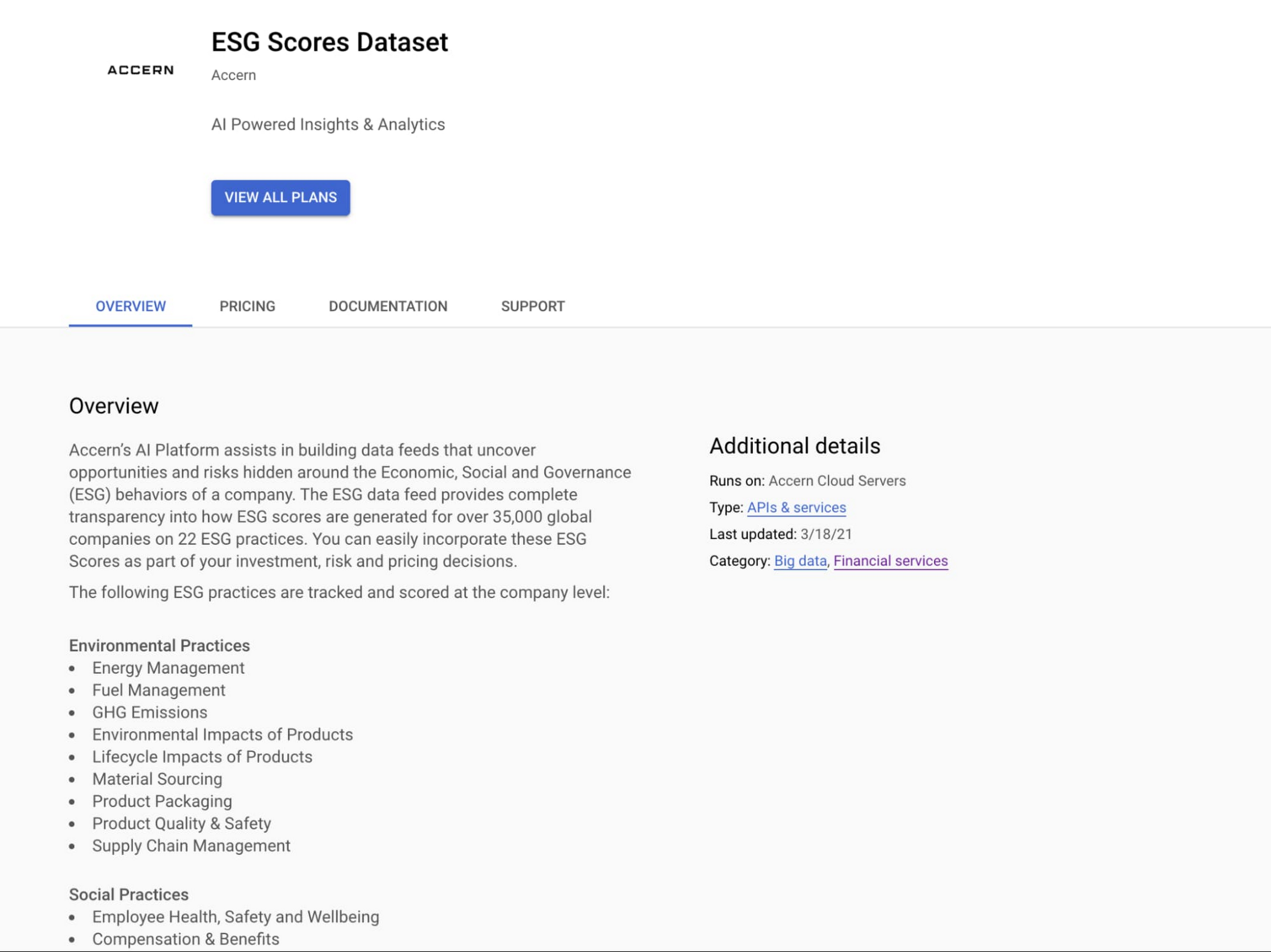

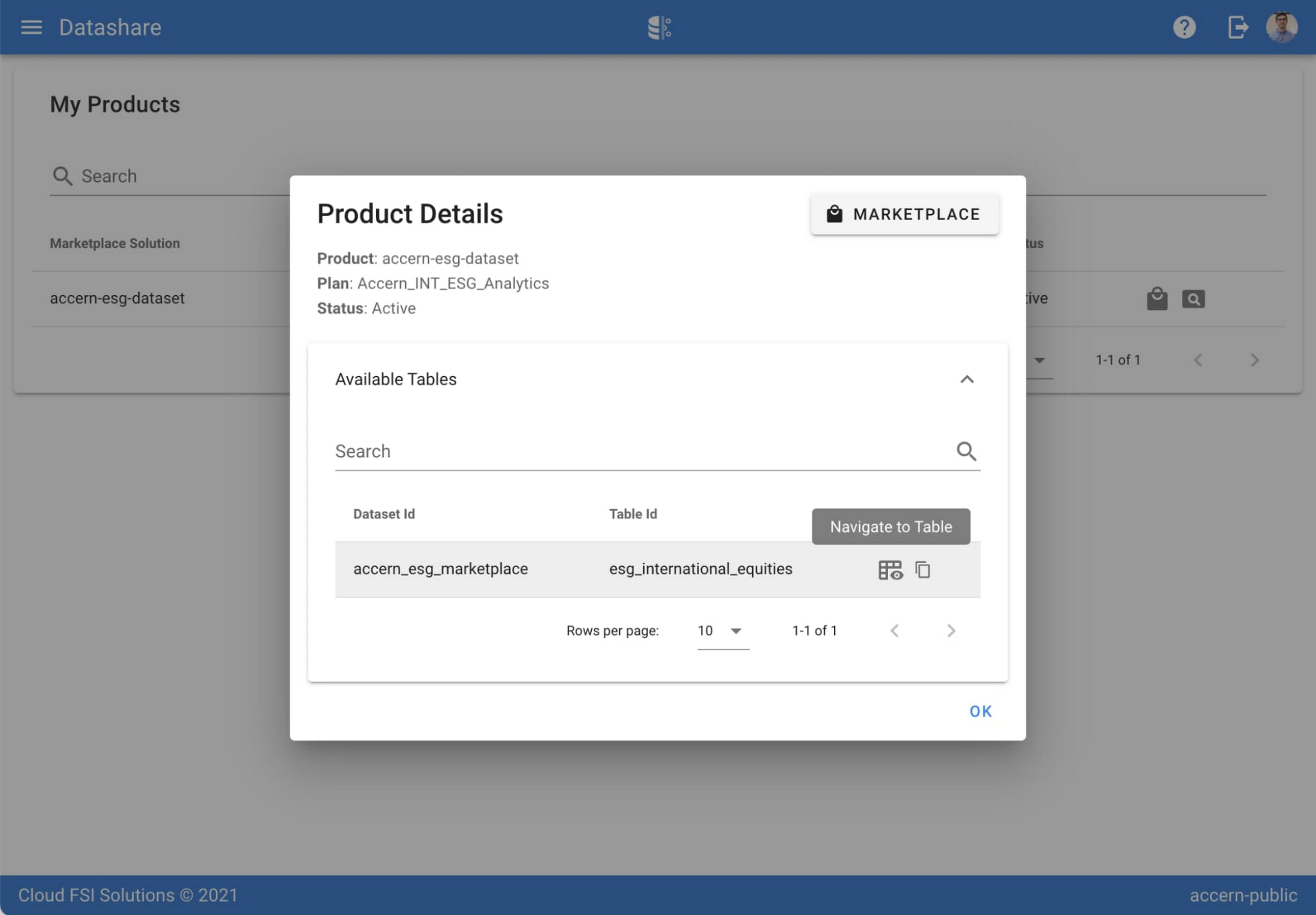
Step 3. Once activation is complete, you’ll be directed to the Datashare ‘My Products’ screen. Voila! You are now subscribed to Accern’s ESG Scores dataset and can access it in your Google Cloud instance using BigQuery. To access the data, click the hour glass icon on the corresponding ‘My Products’ record that you just purchased. An overlay will present you with the details on the dataset and/or table. Click the ‘Navigate to Table’ button to navigate through to the BigQuery console.


Step 4. Now that you have access and are in the BigQuery console, it’s time to generate data insights.
For this example, we’ve eliminated the company identifying information that is included as part of the subscription and aggregated company ESG in a view where each row represents a day, an industry sector, a specific identified ‘ESG Issues’ (event_group and event) and the respective ‘ESG Sentiment’ per issue.

For example, row 1 indicates that within the ‘Healthcare’ sector, there was a ‘Social – Civil Society’ issue identified and it had a negative ESG sentiment score of -15.35.
Step 5. Generate a report by exporting it to Data Studio to build visualizations and conduct additional analysis on the ESG data.
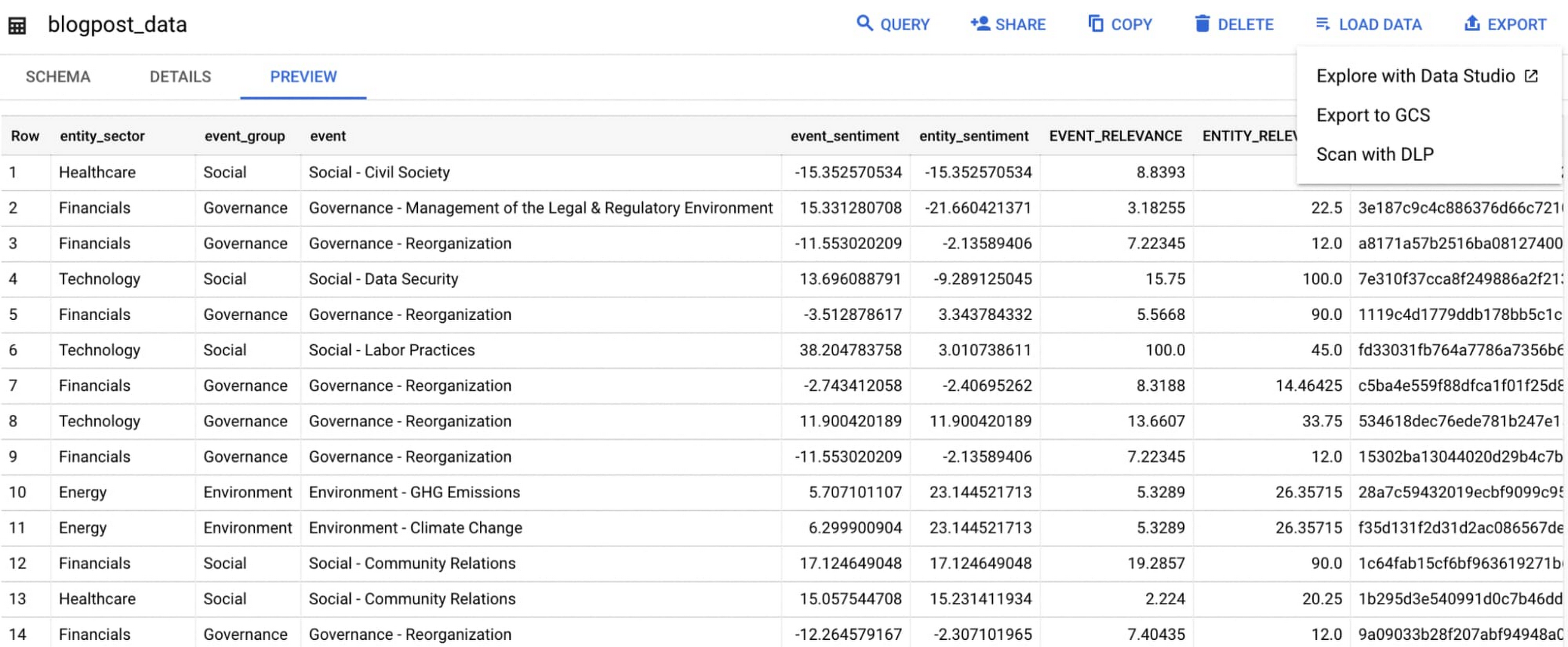
Select ‘Export’ and ‘Explore with Data Studio’.
Step 6. Build a simple/basic report.
Now that the ESG data appears in Data Studio, you can start by building a simple chart to help you understand which industry sectors have the highest volume of discussions around ESG and the overall ESG Sentiment per industry sector.
To build the chart:
- Select the chart type ‘Table’.
- Include
Entity_Sectoras your dimension to aggregate results by ‘Industry Sector.’ - Include
Signal_IDas a measure to count the number of ESG passages identified per ‘Industry Sector.’ - Include
AVG(Event_Sentiment)as a measure to display the overall ESG Sentiment per ‘Industry Sector’ across ESG Issues.

You can see sectors that are most discussed when it comes to ESG related topics and their corresponding ‘ESG Sentiment’ scores.
Step 7. Build your final report in Data Studio.
As a next step you can further drill into the data to understand ESG data specific to each ‘Industry Sector’ and identify positive and negative ESG practices.
Accern has built a more complex sample dashboard and made it available publicly here. You can interact with this report and play around with the data. The dashboard can help to identify material ESG insights for each sector to inform your investment and risk processes. If you have additional questions, you can reach out to Accern directly.

Discovering, accessing and analyzing licensed datasets is quick and easy. Stay tuned for more updates on new licensed datasets.
Publishing your data via Datashare
If you are a publisher of market data, alternative, or exotic data, you can use Datashare to get it published on Google Cloud Marketplace.
Start by joining the Partner Advantage program by registering for the Partner Advantage Portal and applying for the Partner Advantage Build Model engagement. Visit our getting started guide for information to get started on publishing licensed datasets in the Marketplace. Stay tuned for a future blog post about using Datashare to publish datasets in the Marketplace.
More solutions for capital markets
Check out other Google Cloud solutions for capital markets.
Tencent Africa Cuts Cost and Improves Stability with Google Cloud

3427
Of your peers have already read this article.
3:00 Minutes
The most insightful time you'll spend today!
About Tencent Africa
Tencent Africa is dedicated to making every day easier for customers and brands. Opening its doors in 2013 as WeChat Africa, the company is responsible for WeChat operations on the continent.

About Siatik Systems
Founded in 2008, South Africa-based Siatik Systems is a leading Google Cloud Platform solutions provider with a focus on cloud integration services, information technology consulting services, and bespoke software engineering solutions.

Google Cloud Results
- Reduced latency in its service from 180 to 35 milliseconds with powerful hardware and a fast, global network from Google Cloud Platform
- Cut costs with per-minute billing and sustained use discounts
- Increased the speed of provisioning new servers with easy-to-use interface of Google Compute Engine
As one of Africa’s leading technology companies, Tencent Africa is responsible for WeChat operations on the continent. WeChat Africa has successfully launched a number of features including the WeChat Wallet, a mobile payment service for smartphones, which enables seamless and secure transactions for friends to send money to one another, cash money out at Standard Bank ATMs, use at accredited retailers, and make purchases from any SnapScan merchant in South Africa. Under the new name, Tencent Africa recently launched two new mobile products, JOOX, a mobile music streaming application, and VOOV, a social live streaming application.
When China’s Tencent brought its hugely popular instant messaging service WeChat to South Africa, it faced a near saturated market. To gain traction, Tencent Africa had to showcase WeChat’s versatility as a platform that goes far beyond just instant messaging. Engaging with local financial partners helped WeChat launch a WeChat Wallet to facilitate electronic payments, while providing exclusive content from South African cultural figures helped bring the platform extra publicity.
As WeChat started to grow its customer base, its on-premises infrastructure was stretched beyond its limits and the company looked for a cloud-based solution. After evaluating all its options, Tencent Africa found Google Cloud Platform best suited its needs.
“We’re a growing business and constantly upgrading our infrastructure. Getting new servers was becoming quite expensive so we wanted a cloud-based solution to reduce costs,” says Christoff Albertyn, Head of Technology at Tencent Africa. “When we did some latency testing, Google came out on top, so it made sense to go with them. Everybody loves Google, it’s a great brand. Just knowing a company like Google is behind it gives you peace of mind.”
Building a platform to scale
Instant messaging services need a stable infrastructure, the ability to scale at speed, and lightning fast performance. When Tencent Africa built an Official Accounts API to run a number of services on WeChat, to help companies engage with users on the platform, latency was its main concern. The Official Accounts services had to deliver replies over WeChat in under five seconds or the connection would drop.
Between the API on-premises servers in South Africa and WeChat’s main servers in China, Tencent Africa’s services regularly hit the limits of the permissible response time. In addition, by 2015, WeChat was starting to garner more customers across South Africa and Tencent Africa had to provision more servers. The on-premises servers were simply being asked to do too much, and expansion was proving expensive, so the company looked for a cloud-based solution.
Before committing to anything, Tencent Services did a thorough latency test of several cloud-based solutions. Google Cloud Platform came top. Tencent also engaged the help of Siatik, a Google Partner, to gauge what solutions best fit the company’s needs and help implement them. Siatik customers span both the public and private sectors and its consultants are regularly engaged in the health care, education, financial and technology industries. In order to provide leading technology solutions, it partners with industry leaders, such as Google, to provide best-of-breed infrastructure and cloud platform solutions to its customers.
“Siatik was a great partner to work with,” says Christoff. “Any questions I had, I could just pick up the phone and whatever it was they’d help me out. They were also able to get some of the team from Google to come to our offices and see how we worked, which was really good.”
With a simple, clean interface in Google Compute Engine, the company was able to spin up virtual instances very quickly and begin migrating its stack to Google. When it became more comfortable with Google Cloud Platform features, Tencent used Google Cloud SQL and Google BigQuery to manage its data streams, and Google Cloud Storage to store them safely.
From day one, it was very smooth. The interface was amazing—Google must have spent a long time perfecting it because it was so easy to use says Christoff. “I set up the first virtual machine in no time without any struggles.”
In addition to powerful hardware from Google Compute Engine, the fast, global network from Google helped to speed up performance. With the infrastructure ported over to Google, Tencent also brought in G Suite as an office productivity solution, which eased the pressure on its servers even more. Throughout the process, Siatik were on hand to advise and provide technical guidance whenever any issues came up.
What I really like is how quickly you can spin servers up. There’s no messing about and the interface is really easy to use, says Christoff. “You can have a virtual machine running in just a few minutes. It’s very impressive.”
Cutting costs, raising expectations
Google Cloud Platform helped Tencent Africa to slash its latency. Before the migration, pings to the Chinese servers and back would regularly take 180 milliseconds. Afterwards, this fell to around 35 milliseconds, helping to ensure smooth service to Tencent’s South African customers. Google offers innovative pricing, such as per-minute billing and sustained use discounts, which helped significantly cut server costs compared to an equivalent on-premises solution.
As its customer base grew, and Tencent Africa began to release new products, the ease of use of Google Compute Engine meant that spinning up new servers took minutes instead of hours and allowed the company to scale up and down at speed. Exploring products such as Kubernetes for rapid deployment or TensorFlow for machine learning, Tencent Africa continues to evolve and experiment with new products to keep WeChat a growing success in South Africa.
“Initially, we just used per-minute billing, but when I saw how much work we were doing with Google BigQuery and Google Cloud SQL, we started to generate sustained-use discounts, which helped save us a lot of money,” says Christoff. “The other great thing is, Google Cloud Platform monitors how you’re using it and tells you what else you can do to reduce costs.”
More Relevant Stories for Your Company

AI in Manufacturing Already A Mainstream: Google Cloud Study
While the promise of artificial intelligence transforming the manufacturing industry is not new, long-ongoing experimentation hasn’t yet led to widespread business benefits. Manufacturers remain in “pilot purgatory,” as Gartner reports that only 21% of companies in the industry have active AI initiatives in production. However, new research from Google Cloud reveals that the

Google Cloud Announces Improvements in Private Catalog to Drive Terraform Deployments
As an enterprise admin, when you choose to use Google Cloud Private Catalog to enable curated, self-serve Google Cloud infrastructure provisioning, you need the ability to manage your organization’s deployments. Today, we’re pleased to announce support for several improvements to Terraform driven deployments through Private Catalog. With this new release, you can

Hybrid Work with Google Workspace: What Customers can Expect
In June, we shared our vision for navigating the future of hybrid work with a single connected experience in Google Workspace. Now, as many of our customers begin to embark on their own hybrid journeys, I wanted to share how we’re helping them bridge the gaps in this new way of


A Quick Guide to Cloud Monitoring
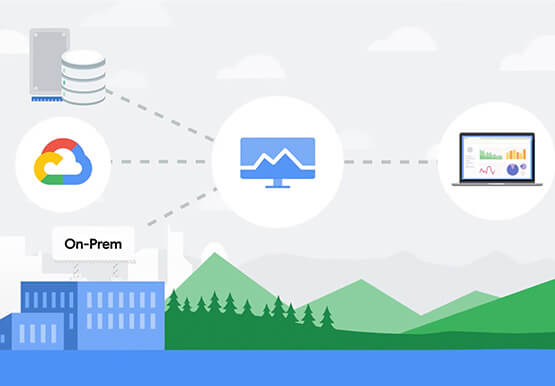
Cloud Monitoring is a tool that allows you to gain visibility into the performance, availability, and health of your applications and infrastructure. In this video, we show you what Cloud Monitoring is and how you can use it to custom define service-level objectives (SLOs), monitor application metrics, and the overall
