





3339
Of your peers have already watched this video.
4:56 Minutes
The most insightful time you'll spend today!
API Management with Istio
Kubernetes can be a great orchestration platform for your microservices but these services can grow complex and difficult to manage. Istio simplifies the life of organizations contemplating a “microservices” approach, or who are simply deploying many services that communicate with each other. Istio creates a “service mesh” that routes traffic between interrelated services in a secure and robust way so that the developers of each individual service can focus on what a service does rather than the details of how it communicates. Both Istio and Apigee provide complementary capabilities to teams building APIs and services in today’s world.
Join us as we walk you through Istio and several ways it can help you wrangle your applications. In this video, we’ll be working with Apigee to manage a full API.
How the Telegraph is Reimagining Media with Google Cloud

10179
Of your peers have already read this article.
3:30 Minutes
The most insightful time you'll spend today!
Whether they’re reading the newspaper on the way to work, or catching up on the latest headlines on their smartphones, readers expect up-to-the-minute news wherever and whenever makes the most sense for them. As a result, media companies are increasingly looking for ways to improve, expand, and simplify their offerings, and they’re increasingly looking to the cloud to do it.
For more than 160 years The Telegraph has been counted on by readers across the United Kingdom and globally for award-winning news and journalism. An early adopter of cloud technology, it’s been a G Suite customer since 2008 and has already been using Google Cloud Platform to analyze digital behaviors to improve engagement and advertising performance since 2016.
Recently, The Telegraph announced it’s migrating fully to Google Cloud. By migrating all their production and pre-production services, they aim to deliver content faster, provide compelling experiences to readers, and reduce environmental impact.
“We are delighted to announce our newest collaboration with Google Cloud,” said Chris Taylor, Chief Information Officer, The Telegraph. “We have always worked closely with Google as they help us to provide our readers with great experiences on our digital products, collaboration software and internet scale through search. Their continued leadership in projects such as Kubernetes are enabling us to build flexible development environments that truly support DevOps.”
Powering the Digital Publishing Ecosystem
The Telegraph produces large volumes of digital content every day. It was imperative for them to find a cloud provider they could trust to support this ecosystem. By working with Google Cloud they have changed the way they see and engage with data: they can collect new information about their products every second and use that to continually hone their strategy. The Telegraph are placing more confidence and trust in the data captured about their content and now have one of the best available pieces of technology for capturing and analyzing the stories they publish in real-time.
Leveraging AI to support journalists
Time is critical when journalists are on a story, and The Telegraph wants to put important data in the hands of its journalists right when they need it. To do this, it will be using AutoML to classify content for journalists and make it more discoverable. For example, a reporter will be able to bring up relevant assets that link to their stories. It will also apply AutoML to classify Telegraph stock photos to help journalists attach compelling visual content to their stories faster.
Building compelling reader experiences with the help of APIs
Readers have an ever-increasing expectation of personalization. To meet this need, The Telegraph launched My Telegraph, currently live in beta, to offer registered readers personalized news experiences based on their interests or the particular journalists they want to follow. My Telegraph was developed on an API management platform provided by Google Cloud’s Apigee. You can learn more about how it’s applying API management to My Telegraph, in this blog post.
Working for environmental good
The Telegraph is the biggest selling quality newspaper in the UK, an accolade which requires it to print and distribute hundreds of thousands of copies each day. Optimal management of print production is important, and by using a combination of the cloud and machine learning, The Telegraph is better able to predict demand for physical newspapers, maximizing sales and minimizing waste. This makes great business sense for The Telegraph but also has great environmental benefit.

3691
Of your peers have already downloaded this article
2:30 Minutes
The most insightful time you'll spend today!
In today’s connected digital world, people expect their various applications to work together seamlessly. The key to making this happen is APIs. A robust library of APIs allows developers to connect applications and deliver new services quickly and easily. But to get the most out of APIs, companies need an API management platform that will deliver manageability and security.
However, as the Citrix team looked to quickly expand its API library, it realized that the company needed a leading API platform. “We researched every API platform and the clear leader was Apigee Edge,” says Adam Brancato, Senior Manager of Customer Applications at Citrix. “With Apigee Edge, we expanded our API support from 10 APIs to more than 50 APIs in a year.”
As a result, Citrix now supports a wide range of APIs for both internal and external use, including email, support cases, single sign- on, licensing, accounts, assets management, contacts, Salesforce integration, order validation, and more.
Download this case study to understand how the Citrix team leveraged Apigee to save time and boost productivity.
Rhode Island’s VCC Platform Built on GCP Helps Jobseekers Get Back to Work!

3257
Of your peers have already read this article.
5:00 Minutes
The most insightful time you'll spend today!
2020 brought many challenges, especially as in-person operations were shut down, and many were left vulnerable to unemployment.
The State of Rhode Island responded to these challenges, by modernizing their workforce development operations and moving completely to a custom online platform called the Virtual Career Center, also nicknamed “the VCC.”
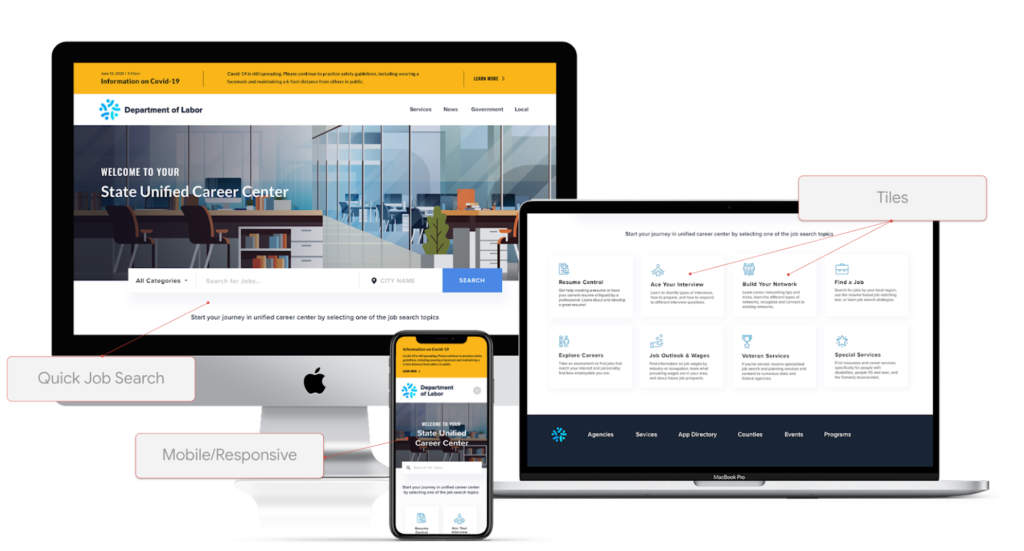
It was developed in partnership with Google Cloud and a nonprofit called “Research Improving People’s Lives” (RIPL), and was fully built by Google Cloud partner Maven Wave, which helps a wide array of organizations, including public sector customers, with many types of cloud initiatives.
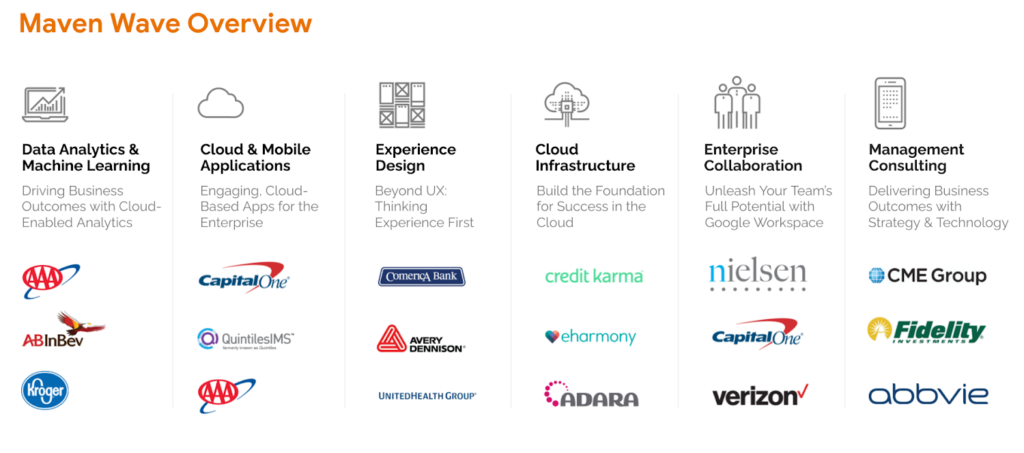
In this episode of Architecting with Google Cloud, we interviewed Joel Osman, head of Digital Experience & Custom Applications at MavenWave who shared a lot of insights such as:
“We looked at how we can apply leading edge emerging technologies to help people get back to work and use them as tools in such a way that we can augment the personal one to one interactions that agencies had been using with job seekers, to help them get back to work.”
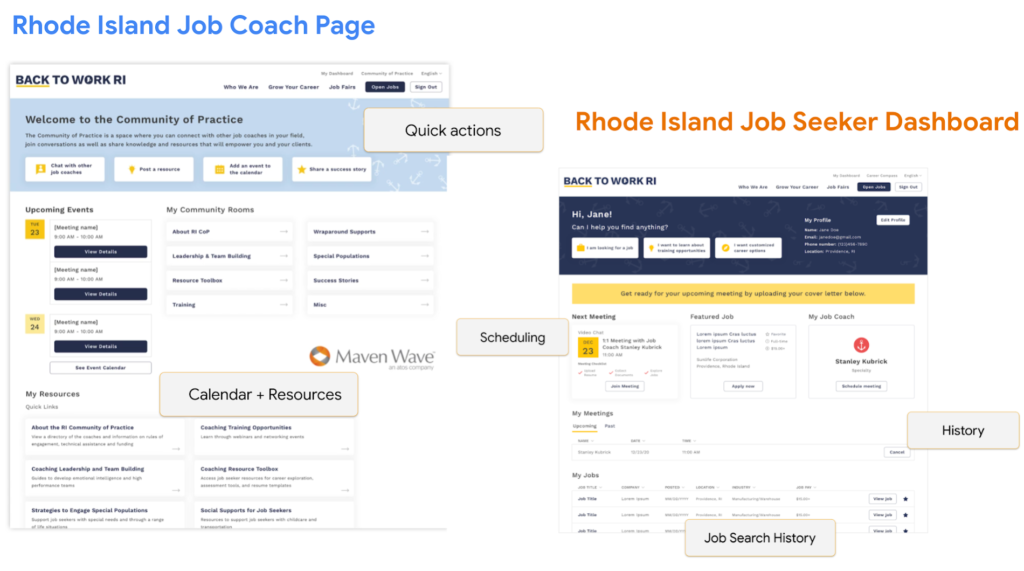
One of those key benefits is enabling job seekers to find coaches that are specialized in their respective community. During the in-person walk-in model, applicants were paired on a first come first serve basis with any available coach on site. Meanwhile online scheduling has enabled a greater opportunity to match veterans, college graduates, non-English speakers, etc with coaches with prior experience in that specific area.
How the VCC was built
This VCC web app was built on Angular. It has a custom frontend built on top of 2 key Google Cloud products. The first is Workspace, which includes functionality such as video conferencing, documents, slides, chat, file storage, etc. And the other is Google Cloud computing resources. Here’s a view of the architecture:
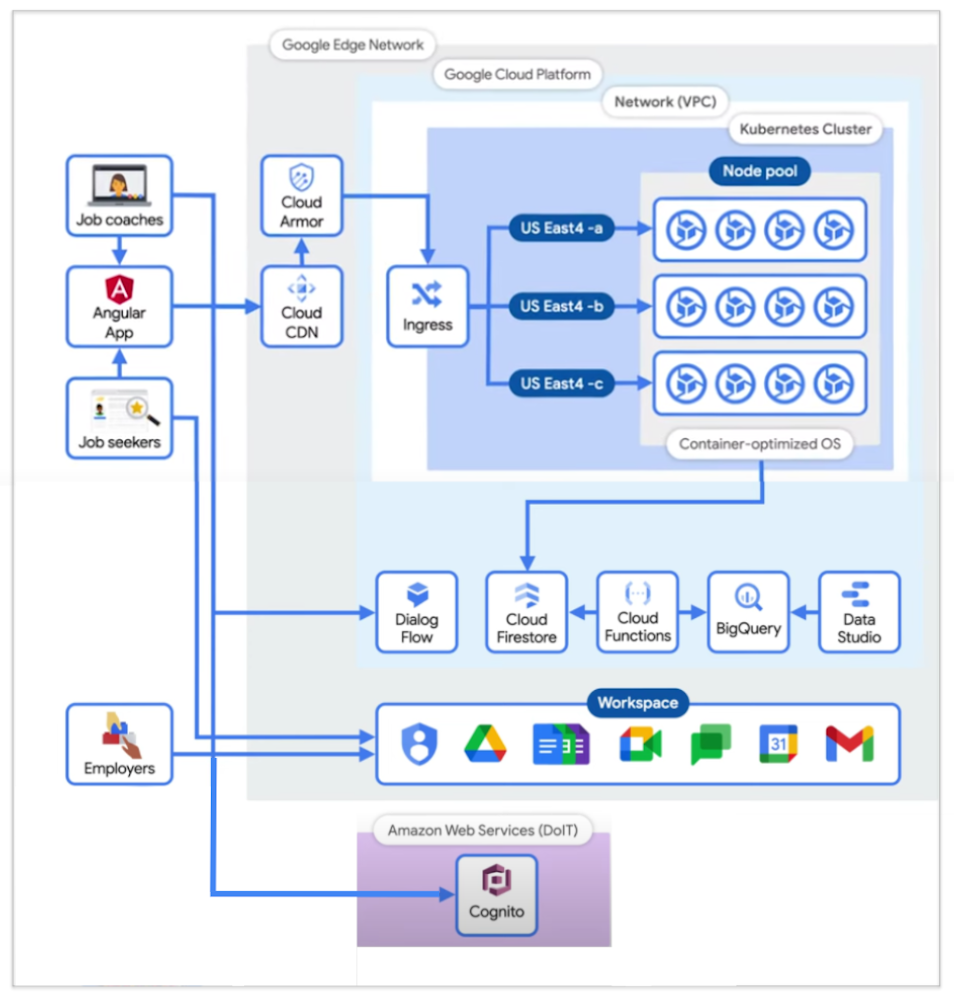
There are 3 main types of users at this time, and that’s job coaches, job seekers, and employers.
- 👩🔧 Job Coaches all have Google IDs in the Google Workspace domain, and therefore authenticate against the Google identity repository.
- 🕵️♂️ Job Seekers are authenticated through a Cognito-based process maintained by the nonprofit I mentioned earlier (RIPL), the Rhode Island infrastructure team, and the Department of Information Technology (DoIT). Cognito was an identity repository setup prior to this project for users interacting with the State, and remained as their form of authentication.
- 🧭 Employers participate directly with Google Meet, and, to an extent, Google Calendar; but not the Angular app. There’s also a focus on building a future dashboard to see how the center has helped employers with applicants.
The specific Google Cloud components used are the following:
- Firestore: realtime Database that keeps data in sync across client apps.
- BigQuery: serverless warehouse for data.
- Data Studio: is used to build filterable dashboards over BigQuery
- Cloud Functions: which serve as triggers to keep scheduling and data workflows in sync.
- Kubernetes cluster: runs & autoscales the server-side code in a single-region deployment, with a minimum of four nodes per zone across three zones of the US East region.
- Cloud Armor: protects applications and websites from attacks, and sets NIST-compliant policies.
- Google’s Content Distribution Network (CDN): content is accessed and cached.
To manage the lifecycle of the infrastructure, a Terraform script is used, which is an open source tool, and is structured into 5 folder environments:
- Admin
- Dev
- QA & UAT
- Networks
- Prod
- Shared Services (for CI/CD pipelines between Dev & Prod).
Adoption outcomes
A universal fear we technical practitioners may have is:
“Will our tool be loved and adopted by our intended audiences?”
Joel mentioned Job Coaches at the time were not used to working from home, and the team was concerned that they would potentially feel overwhelmed with a lot of new technology.
As a rewarding surprise, when Job Coaches were presented the proof of concept, it was received with positivity.
“95% of Job Coaches rated the VCC as a valuable solution and 87% reported to find it very or extremely effective.”
This alignment was thanks to designing the tool with the users in mind, and performing user research since the beginning of the journey, which helped address their day to day needs.
Additional innovation for the future
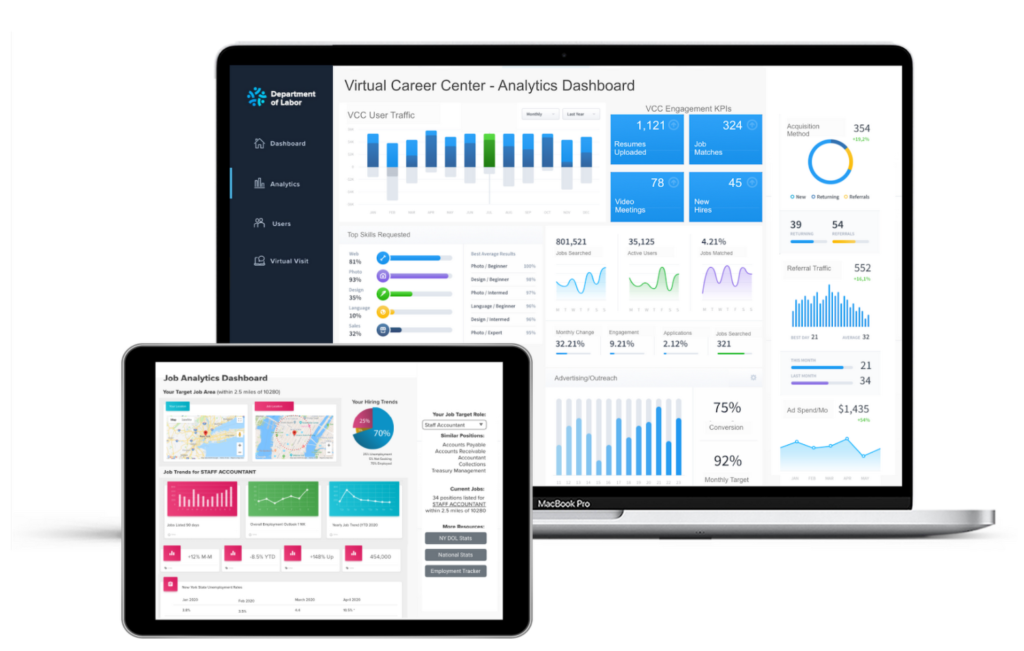
After creating a centralized hub and moving operations to a digital format, many more benefits also arise. For example, there can now be an integrated data analytics view which enables meaningful dashboards that can be customized for different audiences such as job applicants, coaches, program stakeholders, or state agencies.
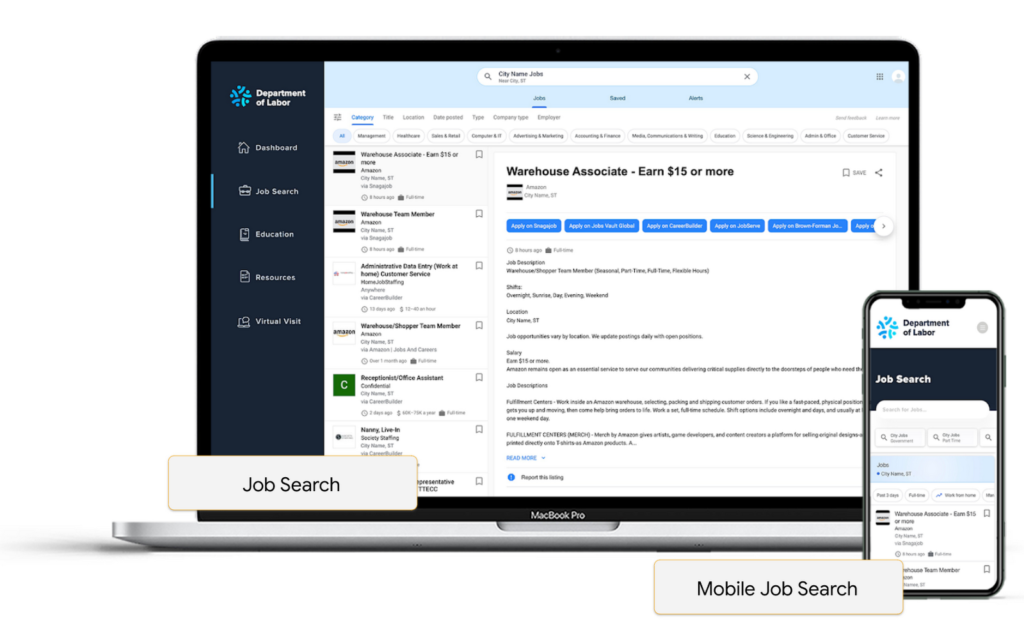
There can be improved job searchability by integrating machine learning, helping with resume building and parsing that take keywords out of a resume and match them to a variety of relevant job clusters, rather than just performing raw keyword searches.
Embedding chat bots can also help reduce the load of call centers in states, as they utilize natural language processing as well to help guide job seekers with prompt answers.

Conclusion
The State of Rhode Island’s Virtual Career Center is an amazing success story. By having worked with an experienced partner to move their operations to a digital format, they were able to respond to their citizen’s needs in a time where in-person operations were not possible. They also unlocked opportunities such as better matching and reporting along that journey.
For any organization whether they are in the public sector, university, private sector, etc; anyone can take advantage of this platform and customize it to their needs as Maven Wave shared that they offer a menu of options, where you can pick and choose functionality based on your requirements, IT resources, and budget.
Khan Academy’s Shortcut to Growth: The Trick Behind the Scenes

3586
Of your peers have already read this article.
4:15 Minutes
The most insightful time you'll spend today!
Based in Mountain View, California, Khan Academy is a not-for-profit that produces and posts a vast collection of free educational online videos about math and science topics ranging from algebra and trigonometry to biology and economics.
Millions of students, educators, and self-learners around the world watch the videos, both on the Khan Academy’s YouTube channel and on its hugely popular website (www.khanacademy.org), where students answer some 1.5 million practice questions per school day. The Khan Academy development team continually tweaks the site based on how visitors choose to learn.
Challenge
Khan Academy’s beginnings date back to 2004, when Sal Khan’s cousin asked him to remotely tutor her daughter in math. Khan was happy to help and more than qualified, given his three MIT degrees and his Harvard MBA.
As more relatives and friends asked Khan for tutoring assistance, he began videotaping short lessons and posting them to YouTube. His knack for distilling complex concepts into easy-to-follow tutorials helped the videos go viral.
Sal knew he needed to offload the technical and maintenance concerns so he could work on what was important. To grow, it was important for him to be able to stop worrying about things like deployment issues and running his own server.
Ben Kamens, lead developer for Khan Academy
Khan maintained a website for his growing video library for several years, but the platform experienced limitations as traffic increased.
At the same time, media attention was growing, and technology industry leaders, including Microsoft founder Bill Gates and Silicon Valley venture capitalist John Doerr, began lending their support and evangelizing Khan’s mission and work. It was at this point that Khan quit his job as a hedge fund analyst to devote his full-time attention to the site’s growing potential.
“With Google App Engine, we don’t need a system administrator or anyone dedicated to deploying our app, so 99 percent of our time is spent working on our application,” says Ben Kamens, lead developer, Khan Academy.
“Sal knew he needed to offload the technical and maintenance concerns so he could work on what was important, which was to make more videos for the Khan Academy library,” explains Ben Kamens, lead developer for Khan Academy. “To grow, it was important for him to be able to stop worrying about things like deployment issues and running his own server.”
Solution
Khan Academy chose App Engine as its hosting and application development platform because App Engine could easily house its growing collection of 2,000-plus videos, resolving the organization’s overall server and maintenance issues with a single solution.
Using App Engine freed the team to focus on the user experience and the array of content that makes the academy such a powerhouse.
“A lot of what the Khan Academy is about is collecting data on student behavior so we can teach them better,” Kamens says. “Did they use a hint? Have they watched the video before? That data is being stored on Google App Engine so we can figure out what the most effective videos are, or where students struggle the most.”
Khan Academy provides individual profiles to students so they can analyze their learning progress, which means the organization needs systems running in the background to collect and track of all this data. Because App Engine takes care of server support, Khan Academy’s five developers can spend almost all of their time improving site functionality.
“If we didn’t have Google App Engine, we’d be spending a lot more time figuring out server setup and working on routers,” Kamens says. “Our ability to focus on the actual product is the benefit of Google App Engine.”
With the App Engine dashboard, which provides information like response time, uptime, and error rates, the development team also has an easy way to watch over site performance. “It lets us see what the average response time is, so we can keep it really low,” Kamens explains.
Results
During the US school year, Khan Academy receives more than 3.8 million unique visits a month — all served through App Engine. To support this much traffic, a typical company would need an internal system administration staff.
“With Google App Engine, we don’t need a system administrator or anyone dedicated to deploying our app, so 99 percent of our time is spent working on our application,” explains Kamens. “Our application lives on Google App Engine, and we bank all of our scalability and traffic concerns on Google App Engine. Even huge traffic spikes from Sal’s media appearances don’t worry us since we know that Google App Engine will handle the spike.”
Kamens also likes the fact that he and his team can turn to the Google App Engine support team for assistance when they need it. He also finds helpful tips on the Google App Engine blog.
The Khan Academy staff has come to completely rely on App Engine. “We are constantly using more of Google App Engine’s capabilities and have been happy with the performance,” Kamens says. “It’s nice to have an easy deployment process since we deploy the site on average at least once a day, [and] sometimes up to nine or 10 times [a day].”

5692
Of your peers have already downloaded this article
5:30 Minutes
The most insightful time you'll spend today!
Modernizing apps on the cloud isn’t an “all or nothing” decision. Businesses want the option to modernize on-premises or choose multi-cloud solutions that meet their needs. That’s why we created a new solution for running apps anywhere – simply, flexibly, and securely. Embracing open standards, Anthos lets you run your applications, unmodified, on existing on-prem hardware investments or in the public cloud. So that you write once and deploy anywhere.
Download this report and find out how to:
- Decouple infrastructure and applications with containers and Kubernetes
- Decouple cloud teams from one another so they can work independently
- Meet the challenges of microservice management using service mesh
- Implement a zero-trust security model to enforce more granular controls while maintaining a consistent user experience
More Relevant Stories for Your Company

Apigee and Vision API: ICICI Prudential Life Insurance’s Journey of Speeding Document Processing
Google Cloud results Helps enable instant document approval with optical character recognition by Vision APIProcesses 100,000 documents in 20 minutes with automated document processing product Recognic, powered by Vision API and ApigeeHelps increase the number of applications processed by 30% within the same timeframe The insurance landscape in India has seen

PaGaLGuY Turns to Google Cloud Platform to Power Leading India Education Network
Founded in 2006, PaGaLGuY started as a forum that enabled students, typically aged between 20 and 30 to discuss and seek advice on academic issues. By 2011, PaGaLGuY had increased its traffic to about 250,000 page views per month. The business is now one of India’s largest education networks and

Deploying Ray on GKE: Distributed Computing Made Easy
The rapidly evolving landscape of distributed computing demands efficient and scalable frameworks. Ray.io is an open-source framework to easily scale up Python applications across multiple nodes in a cluster. Ray provides a simple API for building distributed, parallelized applications, especially for deep learning applications. Google Kubernetes Engine (GKE) is a managed container orchestration

How PLAID’S Multi-cloud Approach with Anthos Clusters on AWS Drives Higher Business Growth
Editor’s note: Today’s post comes from Naohiko Takemura, Head of Engineering, and Kosukex Oya, Engineer, both from Japanese customer experience platform PLAID. The company runs its platform in a multicloud environment through Anthos clusters on AWS and shares more on its experiences and best practices. At PLAID, our mission is to maximize the value
