





Goal for Google: AI for everyone

2947
Of your peers have already read this article.
3:30 Minutes
The most insightful time you'll spend today!
Alphabet CEO Sundar Pichai has compared the potential impact of artificial intelligence (AI) to the impact of electricity—so it may be no surprise that at Google Cloud, we expect to see increased AI and machine learning (ML) momentum across the spectrum of users and use cases.
Some of the momentum is more foundational, such as the hundreds of academic citations that Google AI researchers earn each year, or products like Google Cloud Vertex AI accelerating ML development and experimentation by 5x, with 80% fewer lines of code required. Some are more concrete, like mortgage servicer Mr. Cooper using Google Cloud Document AI to process documents 75% faster with 40% cost savings; Ford leveraging Google Cloud AI services for predictive maintenance and other manufacturing modernizations; and customers across a wide range of industries deploying ML platforms atop Google Cloud.
Together, these proof points reflect our belief that AI is for everyone, and that it should be easy to harness in workflows of all kinds and for people of all levels of technical expertise. We see our customers’ accomplishments as validation of this philosophy and a sign that we are taking away the right things from our conversations with business leaders. Likewise, we see validation in recognition from analysts, which recently includes Google being named a Leader by
Gartner® in the 2022 Magic Quadrant™ for Cloud AI Developer Services report
Forrester in the Forrester Wave™: AI Infrastructure, Q4 2021 report, the Forrester Wave™: Document-Oriented Text Analytics Platforms, Q2 2022 report, and The Forrester Wave™: People-Oriented Text Analytics Platforms, Q2 2022 report
In June, we talked about four pillars that guide our approach to creating products for MLOps and to accelerate development of ML models and their deployment into product. In this article, we’ll look more broadly at our AI and ML philosophy, and what it means to create “AI for everyone.”
AI should be for everyone
One of the pillars we discussed in June was “meeting users where they are,” and this idea extends far beyond products for data scientists. Technical expertise should not be a barrier to implementing AI—otherwise, use cases where AI can help will languish without modernization, and enterprises without well-developed AI practices will risk falling behind their competitors.
To this end, we focus on creating AI and ML services for all kinds of users, e.g.:
- DocumentAI, Contact Center AI, and other solutions that inject AI and ML into business workflows without imposing heavy technical requirements or retraining on users;
- Pre-trained APIs, ranging from Speech to Fleet Optimization, that let developers leverage pre-trained ML models and free them from having to develop core AI technologies from scratch;
- BigQuery ML to unite data analysis tasks with ML;
- AutoML for abstracted and low-code ML production without requiring ML expertise;
- Vertex AI to speed up ML experimentation and deployment, with every tool you need to build deploy and the lifecycle of ML projects
- AI Infrastructure options for training deep learning and machine learning models cost effectively. Including Deep Learning VMs optimized for data science and machine learning tasks and AI accelerators for every use case, from low-cost inference to high-performance training.
It’s important to provide not only leading tools for advanced AI practitioners, but also leading AI services for users of all kinds. Some of this involves abstracting or automating parts of the ML workflow to meet the needs of the job and technical aptitude of the user. Some of it involves integrating our AI and ML services with our broader range of enterprise products, whether that means smarter language models invisibly integrated into Google Docs or BigQuery making ML easily accessible to data analysts. Regardless of any particular angle, AI is turning into a multi-faceted, pervasive technology for businesses and users the world over, so we feel technology providers should reflect this by building platforms that help users harness the power of AI by meeting them wherever they are.
How we’re powering the next generation of AI
Creating products that help bring AI to everyone requires large research investments, including in areas where the path to productization may not be clear for years. We feel a foundation in research combines with our focus on business needs and users to inform sustainable AI products that are in keeping with our AI principles and encourages responsible use of AI.
Many of our recent updates to our AI and ML platforms began as Google research projects. Just consider how DeepMind’s breakthrough AlphaFold project has led to the ability to run protein prediction models in Vertex AI. Or how research into neural networks helped create Vertex AI NAS, which lets data science teams train models more accurately with lower latency and power requirements.
Research is crucial, but also only one way of validating an AI strategy. Products have to speak for themselves when they reach customers, and customers need to see their feedback reflected as products are iterated and updated. This reinforces the importance of seeing customer adoption and success across a range of industries, use cases, and user types. In this regard, we feel very fortunate to work with so many great customers, and very proud of the work we help them accomplish.
I’ve already mentioned Ford and Mr. Cooper, but those are just a small sampling. For example, Vodafone Commercial’s “AI Booster” platform uses the latest Google technology to enable cutting-edge AI use cases such as optimizing customer experiences, customer loyalty, and product recommendations. Our conversational AI technologies are used by companies ranging from Embodied, whose Moxie robot helps children overcome developmental challenges, to HubSpot connecting meeting notes to CRM data. Across our products and across industries around the world, customer stories grow by the day.
We also see validation in our partner network. As we noted in the pillars discussed in June, partners like Nvidia help us to ensure customers have freedom of choice when building their AI stacks, and partners like Neo4j help our customers to expand our services into areas like graph structures. Partners support our mission to bring AI to everyone, helping more customers use our services for new and expanded use cases.
Accelerating the momentum
Overall, to create products that reflect AI’s potential and likely future ubiquity, we have to take all of the preceding factors, from research to customer and analyst conversations to working with partners, and turn them into products and product updates. We’ve been very active over the last year, from the launch of Call Center AI Platform in March, to the new Speech model we released in May, to a range of announcements at the Google Cloud Applied ML Summit in June. We have much more planned in coming months, and we’re excited to work with customers not just to maintain the pace of AI momentum, but to accelerate it. To learn more about Google Cloud’s AI and ML services, visit this link or browse recent AI and ML articles on the Google Cloud Blog.
GARTNER and MAGIC QUADRANT are registered trademarks and service marks of Gartner, Inc. and/or its affiliates in the U.S. and internationally and are used herein with permission. All rights reserved. Gartner does not endorse any vendor, product or service depicted in its research publications and does not advise technology users to select only those vendors with the highest ratings or other designation. Gartner research publications consist of the opinions of Gartner’s Research & Advisory organization and should not be construed as statements of fact. Gartner disclaims all warranties, expressed or implied, with respect to this research, including any warranties of merchantability or fitness for a particular purpose.
6360
Of your peers have already watched this video.
2:00 Minutes
The most insightful time you'll spend today!
Google Cloud’s ML-based Image Classification App: A Key to Global Wildlife Conservation
Wildlife provides critical benefits to support nature and people. Unfortunately, wildlife is slowly but surely disappearing from our planet and we lack reliable and up-to-date information to understand and prevent this loss. By harnessing the power of technology and science, we can unite millions of photos from [motion sensored cameras] around the world and reveal how wildlife is faring, in near real-time…and make better decisions
wildlifeinsights.org/about
Google Cloud expands availability of enterprise-ready generative AI

1085
Of your peers have already read this article.
1:30 Minutes
The most insightful time you'll spend today!
Generative AI continues to develop at a blistering pace, making it more important than ever that organizations have access to enterprise-ready capabilities to help them leverage this disruptive technology.
Harnessing the power of decades of Google’s research, innovation, and investment in AI, Google Cloud continues to make generative AI available with baked-in security, data governance, and scalability across the board.
To this end, last month, we announced the general availability of Generative AI support on Vertex AI, giving our customers the ability to access powerful foundation models from Google Research and tools for customizing and applying them.
Today we are announcing the general availability (GA) of four important foundation models for Vertex AI. These include Imagen, PaLM 2 for Chat, Codey, and Chirp. For each of these models, organizations can access APIs on Model Garden and do prompt design and tuning on Generative AI Studio.
- Imagen includes four key features:
- Image generation for creating studio-grade images at scale
- Image editing to edit generated or existing images via text prompts
- Image captioning for creating captions of images at scale
- Visual Question & Answering (VQA) for interacting with, analyzing, and explaining images
- PaLM 2 for Chat follows the general availability of PaLM 2 for Text in June
- Codey supports code generation, completion, and code chat
- Chirp supports multilingual Speech AI
We’re also announcing Multimodal Embeddings API in preview, which lets customers combine the power of Vertex AI’s generative AI models with their proprietary data, to generate embeddings, or interchangeable vector representations, of their text and image data. These capabilities can enable data science teams to deliver a variety of downstream tasks such as image classification, content recommendations, and visual search.
In this blog post, we’ll explore what your organization can do with these powerful models and how Vertex AI provides the enterprise-ready capabilities you can use to get up and running with generative AI.
Helping to drive enterprise value from Generative AI models
Powerful models are the foundation of generative AI, but the software, tools, and infrastructure that surround these models are equally important for enterprise adoption. Organizations face challenges not only accessing these models, but also integrating AI while maintaining protection over intellectual property, adhering to regulations around data security and privacy, and ensuring models and applications are safe to use. Many organizations also want to use generative AI without incurring large costs or managing huge clusters.
We help address these challenges head-on with Vertex AI’s platform capabilities for scalable application integration, purpose-built AI infrastructure, secure and private data customization, and responsible use of this technology.
Let’s see how each of these pillars can help your organization.
Access models to build production-ready generative applications
Vertex AI can make it easy to access foundation models, as today’s model announcements attest. While models are an inextricable part of generative AI, the software that helps enterprises use this technology is equally important—which is why Vertex AI also offers a range of tools for tuning, deploying, monitoring, and maintaining models, so you can build differentiated applications using your own data.
Turning to today’s announcements, in May we announced Imagen, our foundation model for image generation. Now, we are excited to announce Imagen is generally available with an allowlist (i.e., approved access via your sales representative), letting onboarded customers start using image generation and editing capabilities. Visual Q&A and Captioning for production workloads are also generally available for all customers. Visual Q&A provides new ways to engage with image-based data like retail products or image libraries. This new capability can give you answers to questions about an image, helping you analyze large amounts of data quickly, and it can even help the visually impaired understand images or graphs that they wouldn’t be able to otherwise. Captioning, meanwhile, can make it easy to generate relevant descriptions for your images. Captions can help with indexing and searching, as well as assigning image descriptions to product listings on eCommerce websites.
“Imagen is beginning to power key capabilities within Omni, Omnicom’s open operating system, that will enable 17,000+ trained and certified users to create audience-driven customized images in minutes. Imagen has been instrumental in offering a scalable platform for image generation and customization. Integrating it into our platform allows us to expand the scope of audience-powered creative inspiration, at a scale that wasn’t previously possible,” said Art Schram, Annalect Chief Product Officer at Omnicom. “We’re starting to adopt the latest features like styles and fine tuning, and engineering data-driven prompts. We look forward to continuing to provide our users relevant visual inspiration in a responsible way.”
“The latest improvements in Imagen’s product preservation capabilities are a perfect match for Typeface’s focus on personalized AI for brands,” explained Vishal Sood, Head of Product at Typeface. “By combining Google Vertex AI’s Imagen with Typeface’s brand-personalized AI, we are able to help enterprises to create 10x personalized content in a fraction of time.”
Google Shopping recently built an application called Product Studio using Imagen on Vertex AI. Product Studio can enable merchants to create rich product images quickly and easily, at a fraction of the time it takes to do professional product photo shoots. “We’re excited about the feedback we’re getting from merchants in our early pilots, who say that Product Studio, which leverages Imagen on Vertex AI, helps them generate and publish lifestyle product photos directly to their product catalogs,” says Jeff Harrell, Google’s Senior Director of Product Management for Merchant Shopping.
Announced in May, PaLM 2 is a family of models that power dozens of Google products, including Bard and Duet AI in Google Cloud. With the PaLM 2 for Chat model, now generally available, you can leverage Google’s PaLM’s variety of abilities for multi-turn chat applications, such as shopping assistants, customer support agents, and more.
ThoughtSpot, provider of a widely-adopted business intelligence platform, is using PaLM 2 to build a new feature in ThoughtSpot for Google Sheets called “AI Explain,” which can instantly generate explanations of charts, visuals, and anomalies, and will launch new conversational AI and ML-enabled predictive forecasting capabilities into its analytics platform.
With Codey, your organization’s developers can accelerate a wide variety of coding tasks, helping to empower them to work efficiently and close skills gaps. The model enables not only code completion and code generation capabilities, but also chat to help with debugging, documentation, learning new concepts, and more. Since launching in preview in May, we’ve added additional programming languages including Go, Google Standard SQL, Java, Javascript, Python, and Typescript. We’ve also improved the quality of code responses and increased serving capacity, enabling your developers with the right tools to enter the era of generative engineering.
“Security and privacy are key to incorporating AI into the software development lifecycle,” said David DeSanto, Chief Product Officer at GitLab. “GitLab leverages Vertex AI to deliver new, AI-powered features with a privacy-first approach, including the ability to run our own models and leverage Codey foundation models built on top of PaLM 2. The GitLab DevSecOps platform empowers organizations to harness the benefits of AI for faster software delivery, while ensuring their data, intellectual property, and source code are protected.”
Originally released in May in preview, Chirp is a version of our 2 billion-parameter speech model, which was trained on millions of hours of audio and supports over 100 languages. Chirp achieves 98% accuracy on English and relative improvement of up to 300% in languages with less than 10 million speakers. Whether the use case involves customer support, transcriptions, or voice control, Chirp can help your organization communicate with customers and constituents inclusively, by engaging audiences in their native languages.
Last but not least, our Multimodal Embeddings API, now in preview, can unlock an array of new applications, such as image and text-based recommendations, by enabling the processing of text and images interchangeably. This capability complements our Text Embeddings API, which became generally available in June, and remains a recommended choice for those with fully text-based use cases. Multimodal Embeddings API makes it possible to categorize images and text together and can be crucial for use cases like retail recommendation systems that can provide relevant outputs from both images of products and text descriptions.
Match generative AI with infrastructure
Beyond access to models and tools for building generative AI apps, you need infrastructure to make sure your apps can scale and reliably perform — ideally without running into daunting compute costs or management overhead that distracts your technical talent from building innovative products. Google Cloud offers the choice and power to run smaller models running finite tasks at the lowest latency levels, as well as to run large models capable of cutting-edge experiments.
As our large language model customers are looking to scale up their projects and applications using our models, they often need assurances that their requests will be serviced with acceptable performance. This is especially critical for delivering real-time applications where customer service is paramount. Starting in August, Vertex AI will support provisioned, dedicated generative AI capacity that can deliver guaranteed throughput. This feature can be especially beneficial to customers who have a high volume of sustained workloads.
Leverage generative AI while protecting data and privacy
One capability enabled by Google Cloud is the ability to customize models using your own data. Vertex AI can help customers keep their data protected, secure, and private. When a company tunes a foundation model in Vertex AI, private data, model outputs, and prompts can be kept private, and they are never used in the foundation model training corpus. We recently published a whitepaper, “Adaptation of Large Foundation Models,” which outlines how we help protect customer data.
Auditability and compliance are essential to helping ensure the security and privacy of customer data. We also engage in comprehensive GDPR privacy efforts, including our transparency commitments for customer data usage and the support for our customer’s Data Protection Impact Assessments (DPIAs). Now, we’re excited to support HIPAA compliance for many of our generally available models on Vertex AI, so that healthcare and life science customers with whom we have a Business Associate Agreement can run workloads with Protected Health Information (PHI) data on Google Cloud.
Innovate responsibly
Our AI Principles put beneficial use, user safety, and avoidance of harms above business outcomes and are embedded in how we develop our AI products. We’ve conducted extensive reviews on our generative AI products to identify potential risks and have developed guardrails to mitigate these impacts. For example, to address concerns around safety, we’ve implemented safety filters for bias, toxicity, and other harmful content. We also equip our customers with the tools they need to help reduce risk within their applications and provide recommendations to help navigate responsible AI.
Bring the power of generative AI to your organization
With both a wide selection of foundation models and extensive, enterprise-grade platform capabilities, Vertex AI continues to unlock ways for your business or organization to access foundation models, tune them on your proprietary data, and leverage them for differentiated apps and digital experiences. To take the next step, visit our product page or reach out to our sales representatives to gain access to our latest capabilities.
6191
Of your peers have already watched this video.
16:00 Minutes
The most insightful time you'll spend today!
Easy Access to Stream Analytics with Google Cloud
By 2025, more than a quarter of the data created in the global datasphere will be real-time in nature.
“This is important because in the real-time world, “the window of opportunity diminishes and goes away really fast. You want to be able to respond to your customer needs, their asks, and be able to do prediction or maybe detect some problem and really respond to it really fast,” says Evren Eryurek, Director of Product Management for Stream Analytics at Google Cloud.
Today, streaming analysis of application and user events only continue to become more central to how every business operates. With this development comes an accompanying rise in customer expectations for businesses to be aware, prepared, and delivering real-time solutions. Is your business ready?
In this session, Eryurek will showcase Google Cloud’s latest developments to enable easy access to creation and management of real-time data driven experiences.
Learn the latest about the products powering Google’s streaming capabilities and hear directly from the team bringing them to life.
Geospatial Data for Business Apps Drive Sustainable and Accurate Decision-making

4362
Of your peers have already read this article.
1:30 Minutes
The most insightful time you'll spend today!
Organizations that collect geospatial data can use that information to understand their operations, help make better business decisions, and power innovation. Traditionally, organizations have required deep GIS expertise and tooling in order to deliver geospatial insights. In this post, we outline some ways that geospatial data can be used in various business applications.
Assessing environmental risk
Governments and businesses involved in insurance underwriting, property management, agriculture technology, and related areas are increasingly concerned with risks posed by environmental conditions. Historical models that predict natural disasters like pollution, flooding, and wildfires are becoming less accurate as real-world conditions change. Therefore, organizations are incorporating real-time and historical data into a geospatial analytics platform and using predictive modeling to more effectively plan for risk and to forecast weather.
Selecting sites and planning expansion
Businesses that have storefronts, such as retailers and restaurants, can find the best locations for their stores by using geospatial data like population density to simulate new locations and to predict financial outcomes. Telecom providers can use geospatial data in a similar way to determine the optimal locations for cell towers. A site selection solution can combine proprietary site metrics with publicly-available data like traffic patterns and geographic mobility to help organizations make better decisions about site selection, site rationalization, and expansion strategy.
Planning logistics and transport
For freight companies, courier services, ride-hailing services, and other companies that manage fleets, it’s critical to incorporate geospatial context into business decision-making. Fleet management operations include optimizing last-mile logistics, analyzing telematics data from vehicles for self-driving cars, managing precision railroading, and improving mobility planning. Managing all of these operations relies extensively on geospatial context. Organizations can create a digital twin of their supply chain that includes geospatial data to mitigate supply chain risk, design for sustainability, and minimize their carbon footprint.
Understanding and improving soil health and yield
AgTech companies and other organizations that practice precision agriculture can use a scalable analytics platform to analyze millions of acres of land. These insights help organizations understand soil characteristics and help them analyze the interactions among variables that affect crop production. Companies can load topography data, climate data, soil biomass data, and other contextual data from public data sources. They can then combine this information with data about local conditions to make better planting and land-management decisions. Mapping this information using geospatial analytics not only lets organizations actively monitor crop health and manage crops, but it can help farmers determine the most suitable land for a given crop and to assess risk from weather conditions.
Managing sustainable development
Geospatial data can help organizations map economic, environmental, and social conditions to better understand the geographies in which they conduct business. By taking into account environmental and socio-economic phenomena like poverty, pollution, and vulnerable populations, organizations can determine focus areas for protecting and preserving the environment, such as reducing deforestation and soil erosion. Similarly, geospatial data can help organizations design data-driven health and safety interventions. Geospatial analytics can also help an organization meet its commitments to sustainability standards through sustainable and ethical sourcing. Using geospatial analytics, organizations can track, monitor, and optimize the end-to-end supply chain from the source of raw materials to the destination of the final product.
What’s next
Google Cloud provides a full suite of geospatial analytics and machine learning capabilities that can help you make more accurate and sustainable business decisions without the complexity and expense of managing traditional GIS infrastructure. Get started today by learning how you can use Google Cloud features to get insights from your geospatial data, see Geospatial analytics architecture.
Acknowledgements: We’d like to thank Chad Jennings, Lak Lakshmanan, Kannappan Sirchabesan, Mike Pope, and Michael Hao for their contributions to this blog post and the Geospatial Analytics architecture.
A Look Back on Google Cloud’s Data Analytics Development Efforts from June

5975
Of your peers have already read this article.
4:00 Minutes
The most insightful time you'll spend today!
June is the month that holds the summer solstice, and some of us in the northern hemisphere get to enjoy the longest days of sunshine out of the entire year. We used all the hours we could in June to deliver a flurry of new features across BigQuery, Dataflow, Data Fusion, and more. Let’s take a look!
Simple, Sophisticated, and Secure
Usability is a key tenant of our data analytics development efforts. Our new user-friendly BigQuery improvements this month include:
- Flexible data type casting
- Formatting to change column descriptions
- GRANT/REVOKE access control commands using SQL
We hope this will delight data analysts, data scientists, DBAs, and SQL-enthusiasts who can find out more details in our blog here.
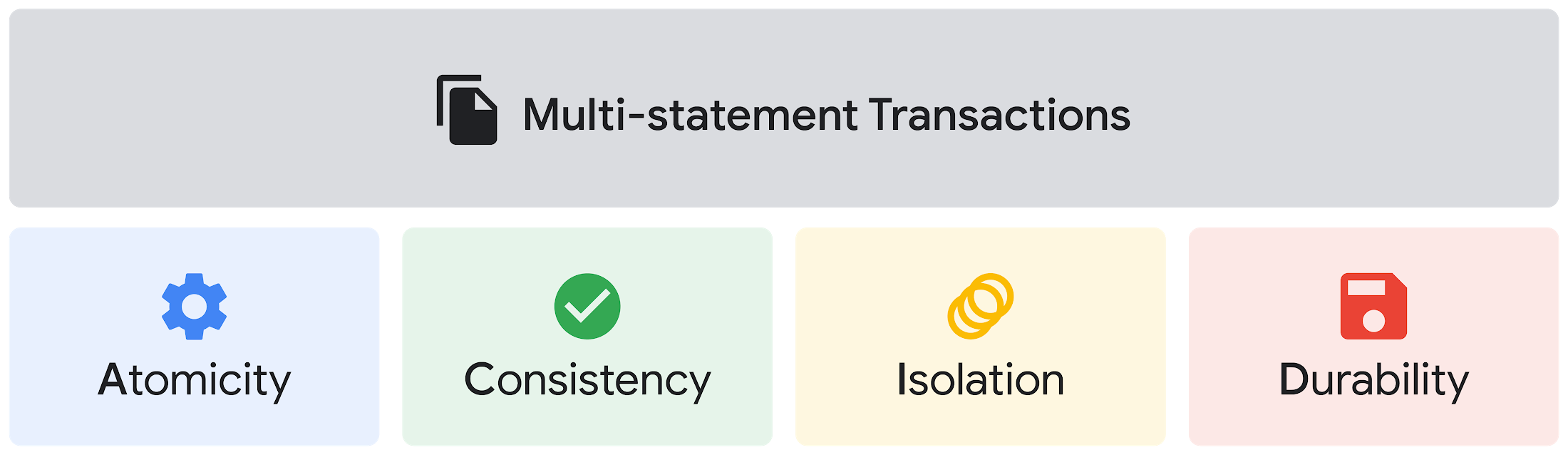
Beyond simplifying commands, we also recognize that it’s equally important to have more sophistication when dealing with transactions. That’s why we introduced multi-statement transactions in BigQuery.
As you probably know, BigQuery has long supported single-statement transactions through DML statements, such as INSERT, UPDATE, DELETE, MERGE and TRUNCATE, applied to one table per transaction. With multi-statement transactions, you can now use multiple SQL statements, including DML, spanning multiple tables in a single transaction.
This means that any data changes across multiple tables associated with all statements in a given transaction are committed atomically (all at once) if successful—or all rolled back atomically in the event of a failure.
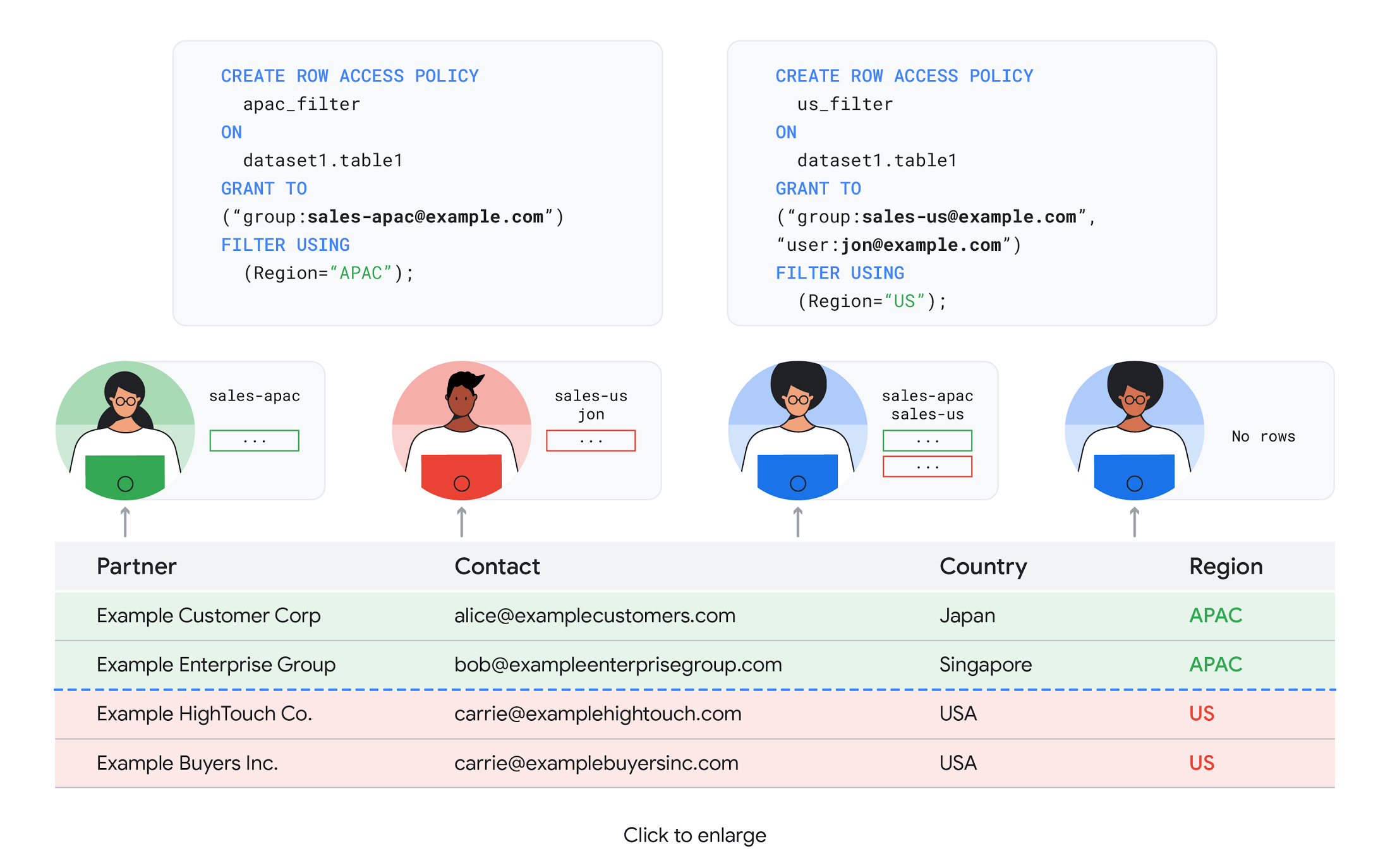
We also know that organizations need to control access to data, down to the granular level and that, with the complexity of data platforms increasing day by day, it’s become even more critical to identify and monitor who has access to sensitive data.
To help address these needs, we announced the general availability of BigQuery row-level security. This capability gives customers a way to control access to subsets of data in the same table for different groups of users. Row-level security in BigQuery enables different user personas access to subsets of data in the same table and can easily be created, updated, and dropped using DDL statements. To learn more, check out the documentation and best practices.
Simple, Safe, and Smart
Beyond building a simpler, more sophisticated and more secure data platform for customers, our team has been focused on providing solutions powered by built-in intelligence. One of our core beliefs is that for machine learning to be adopted and useful at scale, it must be easy to use and deploy.
BigQuery ML, our embedded machine learning capabilities, have been adopted by 80% of our top customers around the globe and it has become a cornerstone of their data to value journey.
As part of our efforts, we announced the general availability of AutoML tables in BigQuery ML. This no-code solution lets customers automatically build and deploy state-of-the-art machine learning models on structured data. With easy integration with Vertex AI, AutoML in BQML makes it simple to achieve machine learning magic in the background. From preprocessing data to feature engineering and model tuning all the way to cross validation, AutoML will “automagically” select and ensemble models so everyone—even non-data scientists—can use it.
Want to take this feature for a test drive? Try it today on BigQuery’s NYC Taxi public dataset following the instructions in this blog!
Speaking of public datasets, we also introduced the availability of Google Trends data in BigQuery to enable customers to measure interest in a topic or search term across Google Search. This new dataset will soon be available in Analytics Hub and will be anonymized, indexed, normalized, and aggregated prior to publication.
Want to ensure your end-cap displays are relevant to your local audience? You can take signals from what people are looking for in your market area to inform what items to place. Want to understand what new features could be incorporated into an existing product based on what people are searching for? Terms that appear in these datasets could be an indicator of what you should be paying attention to.
All this data and technology can be put to use to deploy critical solutions to grow and protect your business. For example, it can be difficult to know how to define anomalies during detection. If you have labeled data with known anomalies, then you can choose from a variety of supervised machine learning model types that are already supported in BigQuery ML.
But what if you don’t know what kind of anomaly to expect, and you don’t have labeled data? Unlike typical predictive techniques that leverage supervised learning, organizations may need to be able to detect anomalies in the absence of labeled data.
That’s why, we were particularly excited to announce the public preview of new anomaly detection capabilities in BigQuery ML that leverage unsupervised machine learning to help you detect anomalies without needing labeled data.
Our team has been working with a large number of enterprises who leverage machine learning for better anomaly detection. In financial services for example, customers have used our technology to detect machine-learned anomalies in real-time foreign exchange data.
To make it easier for you to take advantage of their best practices, we teamed up with Kasna to develop sample code, architecture guidance, and a data synthesizer that generates data so you can test these innovations right away.
Simple, Scalable, and Speedy
Capturing, processing and analyzing data in motion has become an important component of our customer architecture choices. Along with batch processing, many of you need the flexibility to stream records into BigQuery so they can become available for query as they are written.
Our new BigQuery Storage Write API combines the functionality of streaming ingestion and batch loading into a single API. You can use it to stream records into BigQuery or even batch process an arbitrarily large number of records and commit them in a single atomic operation.
Flexible systems that can do batch and real-time in the same environment is in our DNA: Dataflow, our serverless, data processing service for streaming and batch data was built with flexibility in mind.
This principle applies not just to what Dataflow does but also how you can leverage it—whether you prefer using Dataflow SQL right from the BigQuery web UI, Vertex AI notebooks from the Dataflow interface, or the vast collection of pre-built templates to develop streaming pipelines.
Dataflow has been in the news quite a bit recently. You might have noted the recent introduction of Dataflow Prime, a new no-ops, auto-tuning functionality that optimizes resource utilization and further simplifies big data processing. You might have also read that Google Dataflow is a Leader in The 2021 Forrester Wave™: Streaming Analytics, giving Dataflow a score of 5 out of 5 across 12 different criteria.
We couldn’t be more excited about the support the community has provided to this platform. The scalability of Dataflow is unparalleled and as you set your company up for more scale, more speed, and “streaming that screams”, we suggest you take a look at what leaders at Sky, RVU or Palo Alto Networks have already accomplished.
If you’re new to Dataflow, you’re in for a treat: this past month, Priyanka Vergadia (AKA CloudGirl) released a great set of resources to get you started. Read her blog here and watch her introduction video below!
https://youtube.com/watch?v=WRspZRG9e90%3Fenablejsapi%3D1%26
Simple structure that sticks together
We thrive to be the partner of choice for your transformation journey, regardless where your data comes from and how you choose to unify your data stack.
Our partners at Tata Consultancy Services (TCS) recently released research that highlights the importance of a unifying digital fabric and how data integration services like Google Cloud Data Fusion can enable their clients to achieve this vision.
We also announced SAP Integration with Cloud Data Fusion, Google Cloud’s native data integration platform, to seamlessly move data out of SAP Business Suite, SAP ERP and S4/HANA. To date, we provide more than 50 pipelines in Cloud Data Fusion to rapidly onboard SAP data.
This past month, we introduced our SAP Accelerator for Order to Cash. This accelerator is a sample implementation of the SAP Table Batch Source feature in Cloud Data Fusion and will help you get started with your end-to-end order to cash process and analytics.
It includes sample Cloud Data Fusion pipelines that you can configure to connect to your SAP data source, perform transformations, store data in BigQuery, and set up analytics in Looker. It also comes with LookML dashboards which you can access on Github.
Countless great organizations have chosen to work with Google for their SAP data. In June, we wrote about ATB Financial’s journey and how the company uses data to better serve over 800,000 customers, save over CA$2.24 million in productivity, and realize more than CA$4 million in operating revenue through “D.E.E.P”, a data exposure enablement platform built around BigQuery.
Finally, if you are an application developer looking for a unified platform that brings together data from Firebase Crashlytics, Google Analytics, Cloud Firestore, and third party datasets, we have good news!
This past month, we released a unified analytics platform that combines Firebase, BigQuery, Google Looker and FiveTran to easily integrate disparate data sources, and infuse data into operational workflows for greater product development insights and increased customer experience. This resource comes with sample code, a reference guide and a great blog! We hope you enjoy it. See you all next month!
https://youtube.com/watch?v=L25Vfzr2Ciw%3Fenablejsapi%3D1%26
More Relevant Stories for Your Company

Google Search Feature with Document AI Simplifies Document Extraction!
Google Cloud introduced Document AI to automate document processing and to streamline workflows with state-of-the-art machine learning models. With the deep neural networks, the models generalize the learning from seeing hundreds of thousands variations of the documents. But when information is missing or ambiguous on a document - like a missing address

BigQuery Explainable AI for Demystifying the Inner Workings of ML Models. Now GA!
Explainable AI (XAI) helps you understand and interpret how your machine learning models make decisions. We're excited to announce that BigQuery Explainable AI is now generally available (GA). BigQuery is the data warehouse that supports explainable AI in a most comprehensive way w.r.t both XAI methodology and model types. It does this at

Poor Product Discovery Causes Shoppers’ Abandonment, Time to Augment ‘Search Experience’ with Google’s Retail Search!
How many times has a shopper searched for a product on a store’s website only to get results that aren’t relevant—or worse, provided no search results at all? While most ecommerce sites have search capabilities, few accomplish their ultimate goal: making it easy for customers to discover the products they

Measuring Deforestation in Extractive Supply Chains With ML
Introduction In my experience, I have observed that it’s common in machine learning to surrender to the process of experimenting with many different algorithms in a trial and error fashion, until you get the desired result. My peers and I at Google have a People and Planet AI YouTube series
