





2917
Of your peers have already watched this video.
14:00 Minutes
The most insightful time you'll spend today!
Productionizing TensorFlow on Google Cloud with TensorFlow Enterprise
Machine learning is transforming every aspect of our lives and developers and enterprises are using ML to build impactful solutions that drive business value.
TensorFlow is one of the most widely used production-ready frameworks for machine learning and it’s open-sourced by Google so that everyone can take advantage of these powerful tools.
But if you are an enterprise trying to use ML there are some challenges you may face.
To address the needs of AI-enabled businesses, Google recently introduced TensorFlow Enterprise. It incorporates enterprise-grade support, cloud scale performance, and Google Cloud-managed services.
Watch Sandeep Gupta, Product Manager, TensorFlow, to learn how to get started and why the best way for businesses to experience TensorFlow is with TensorFlow Enterprise.
Companies Can Speed-up AI Developments with NVIDIA’s One Stop Catalog for AI Software

3142
Of your peers have already read this article.
2:00 Minutes
The most insightful time you'll spend today!
NVIDIA GPU-powered instances on Google Cloud provide an optimal platform for organizations to develop their AI applications on the latest hardware and software stack, then seamlessly deploy those applications at scale in production.
Simplifying Workflows to Speedup AI Developments
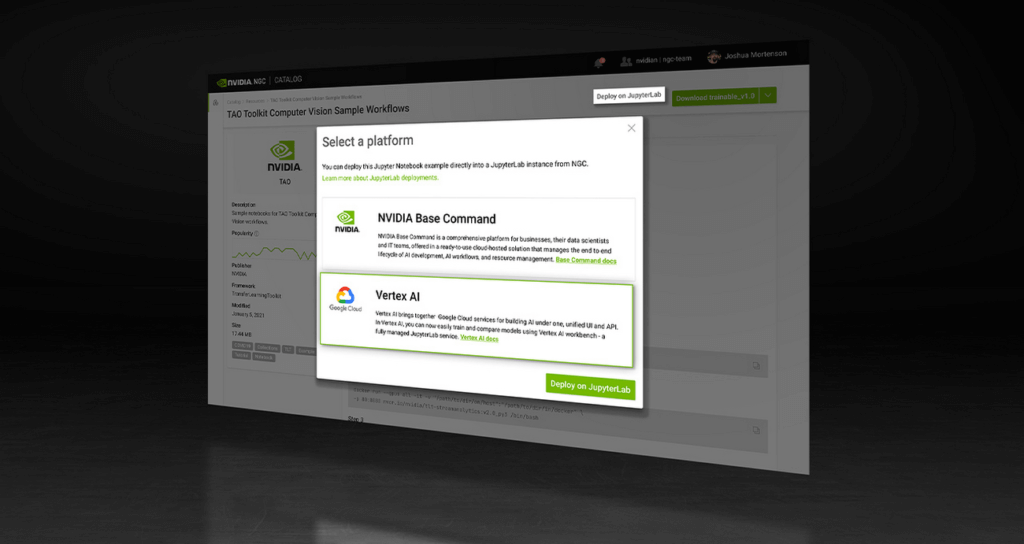
NVIDIA recently announced the One Click Deploy feature on the NVIDIA NGC catalog, the hub for GPU-optimized AI software. Developed in collaboration with Google Cloud, this feature simplifies the deployment of AI software, to a single click from the NGC catalog.
This allows data scientists to deploy frameworks, software development kits and Jupyter Notebooks directly to Google Cloud’s Vertex AI Workbench, a new managed Jupyter Notebook service on top of Vertex AI, Google’s service for machine learning operations.
Under the hood, this feature launches the JupyterLab instance on Google Cloud Vertex AI Workbench with optimal instance configuration, preloads the software dependencies, and downloads the NGC notebook in one go.
NGC Catalog – One Stop for AI Software
NVIDIA is expanding the rich trove of NVIDIA AI software in the catalog to ensure AI practitioners have everything they need to get started — from frameworks to models.
All of the AI models in the catalog come with credentials. They’re like resumes that show the model’s skills, the dataset that trained it, how to use the model and how it’s expected to perform.
These model credentials provide transparency, which gives developers the confidence in picking the right model for their use case.
The NGC catalog also hosts Jupyter Notebooks tailored for the most popular AI/ML applications. Examples include:
Computer Vision – A collection of models for detecting human actions, gestures and more.
Automatic Speech Recognition – An end-to-end workflow for text-to-speech training.
Recommendation – A collection of example notebooks to help build end-to-end recommendation services.
Serve Robotics uses Vertex AI and the simple easy-to-use interface that the NGC One Click Deploy delivers.
“NGC catalog allows our ML research engineers to launch environments for experiments on Vertex AI with a single click. This saves us the efforts on ML infra setup and lets researchers focus on the ML problem in the computer vision and robotics space more efficiently.”—Kaiwen Yuan, Director of ML/Head of Perceptions & Predictions at Serve Robotics
Accelerate ML Deployments
Explore hundreds of Jupyter notebook examples for speech, computer vision and recommenders and, if you’re just getting started with AI, browse NVIDIA’s collection of Jupyter notebook examples and run it using the One Click Deploy feature on Google Cloud Vertex AI.
NLP in Healthcare Can Unlock Clinical Insights beyond Typical Data Format Barriers

2894
Of your peers have already read this article.
1:30 Minutes
The most insightful time you'll spend today!
Aches and pains. What, if anything, is the difference between those? And do you know a “myocardial infarction” from a “heart attack”? What about an “MI”? Is that shorthand, or part of the address of a hospital in Michigan?
For people, it can be easy to understand the distinctions and nuances between similar words, phrases, and concepts, even technical ones, like those found throughout the medical field. Yet even for the most advanced AI, the contextual clues that give humans accurate comprehension of words and images remain an elusive challenge. It’s a challenge well worth solving, though: As much as 80% of all healthcare data is said to be unstructured.
It’s the kind of complicated data management challenge that natural language processing was built to solve.
Healthcare and life sciences organizations are generating vast amounts of unstructured data as part of clinical and operational workflows, which presents an enormous opportunity to derive meaningful insights for medical research, population health, and patient care. For example, clinical notes and lab reports have useful, actionable information that, when unlocked, can help improve the overall quality of patient care, accelerate the discovery of new treatments, and increase the efficiency of healthcare delivery.
This approach is at the heart of Google Cloud’s Healthcare Natural Language API, in enabling healthcare organizations to build open, intelligent systems that unlock value from healthcare data. The open cloud approach enables our partners to innovate more easily, and scale more efficiently. We believe this approach will further advance interoperability—and ultimately lead to healthier and fuller lives.
Unlockinging value from clinical documents and research materials
Over the past two years, we have seen just how powerful AI can be in expediting drug discovery efforts for COVID-19, forecasting and modeling COVID-19 cases, and building better models for a host of public health measures. The opportunities extend well beyond battling the pandemic, too, to helping combat cancers, diabetes, and disabilities, and accelerating drug discovery.
As healthcare and life sciences organizations look to incorporate new data sources in their analytics and AI workflows, Google Cloud has been investing in providing open, flexible, and easy to use API services that customers and partners can integrate into their solutions, to accelerate their development with the power of Google’s AI technology.
The Cloud Healthcare Natural Language API is one such example, and aims to provide fully managed services that deliver the latest advances in natural language processing in an easy to use and easy to integrate manner. Healthcare organizations can then build intelligent systems to improve care and reduce cost while not having to worry about the complexities of the underlying and fast-changing technology, thus enabling more open innovation in the development of healthcare applications.
A number of healthcare innovators are exploring the potential for natural language processing.
“Patients come to Mayo Clinic with a history, and that history is well-documented, but often buried in clinical notes. Extracting information from unstructured healthcare data across thousands of patients is a complex problem,” says Vish Anantraman, M.D., Chief Technology Officer at Mayo Clinic. “Custom natural language processing solutions have a great potential to extract higher quality insights from these notes and to deliver more timely, and holistic patient care.”
The best insights can often be the unexpected ones, and that is precisely what Hackensack Meridian Health, in northern New Jersey, is looking for.
“Doctor’s notes are a rich space to create structured information from their natural workflow,” says Michael Draugelis, vice president for predictive health at Hackensack Meridian Health. “We are designing new AI-powered solutions to connect clinical teams, patients, and the community automatically from these insights—without creating cumbersome screen clicks and prompts. This automation allows our clinical teams to focus on connecting with the patient.”
Hospital leaders there are testing Google’s NLP API to gather information such as social determinants of health and behavioral health signals from large amounts of clinical notes, with approximately 35 million processed. Seeking to achieve the greatest value from natural language processing, the team at Hackensack Meridian Health have specifically focused on extracting information that is inherently not easy to capture in more traditional electronic health records.
“The extracted insights from the Google NLP API creates a foundational component to map clinical protocols, pathways, and outcomes, to better understand and improve patient care,” Draugelis says.
And at the National Institutes of Health and elsewhere, researchers are exploring how natural-language-derived variables could offer an additional predictive value over and above the Veteran Health Administrations’s structured EMR-based suicide prediction model.
To help healthcare organizations achieve goals like the ones above, we at Google draw on the expertise of tens of thousands of data scientists across the company who work every day on building better AI and decades of AI research in language understanding to power the development of services such as the Cloud Healthcare Natural Language API.
According to independent benchmarking of Cloud providers offering fully managed healthcare natural language service by tech analysts GigaOm, the Google Cloud Healthcare Natural Language API was among the most accurate in the industry, outperforming other service providers in terms of correctly classified medical entities and relationships, and with very few misclassifications.
Using AI to connect systems and enhance healthcare interoperability
As an industry, healthcare and life sciences organizations have been talking about the importance of data and data interoperability for a while. But our experiences from the past couple years have demonstrated that we cannot be fully prepared for the next global health crisis without greater connections within and between organizations.
Starting with the Healthcare Data Engine, organizations have been integrating and harmonizing data securely across many of their sources—patients, members, operations, research, and public databases—so they can quickly analyze it to get insights, and then make smarter, faster decisions.
This is the start of a broader vision for a new kind of healthcare and life sciences connected world where enterprises, institutions, and startups will securely collaborate to deliver on the next generation of care. Such a future relies on cloud-based solutions that are as open and flexible as they are user-friendly, compliance-ready, and secure.
We envision a future where healthcare organizations can seamlessly connect data from various systems, unlock the value from data regardless of source or format, and break down barriers in healthcare interoperability and AI to improve healthcare and save lives.
With these goals in mind, we continue to enhance the hybrid data clouds that customers are building to organize and analyze their information, and we and our partners continue to build on our data capabilities. Given the complexities both within the field and within each organization, we believe the greatest value comes from having partners and tools available to build the AI and NLP technologies most relevant to your unique needs.
3305
Of your peers have already watched this video.
16:30 Minutes
The most insightful time you'll spend today!
Engage and Translate: Text and Audio Chat in 100+ Languages
As users worldwide connect to the internet and work remotely, it’s more important than ever to make interactive applications chat in many languages.
But when users speak 100s of languages, this quickly can get challenging. Where to start? If you are new to translation, Sarah Weldon, the Product Manager for Cloud Translation, and Dale Markowitz, an Applied AI Engineer and Developer Advocate touch on a couple of simple starters, then provide examples of how you could advance your translations once you have gone further along the learning curve.
They also share how the Translation API can quickly globalize an app, with no multilingual expertise required. Increasing language coverage can drastically increase engagement, even for internal applications. For example, when Mercy Corps integrated Translation API in their internal hub, traffic volume increased 70%. Learn about integrating the Google Cloud Translation API Advanced with a chatbot client, using the machine translation glossary feature to control a set of terms for more relevant translation.
2969
Of your peers have already watched this video.
9:00 Minutes
The most insightful time you'll spend today!
Satellites Can Help Map Carbon Emissions By Looking at Images of Power Plants!
Did you know that Satellites can now help track power plants and determine if they are on or off? And did also know that compute processing that classifies over 59 trillion bytes of data from over 11,000 sensors from 300 satellites is done on on Google Cloud?
Google Cloud’s sustainability initiatives along with its cutting-edge, powerful technology and products are leveraged worldwide by organizations, non-profits and governments to keep a check on greenhouse gas emissions and build self-reporting, power monitoring platforms. Climate TRACE, a collaborative data sharing project with 50+ organizations is dedicated towards this cause by building a visual and meaningful way on a web app. In this video you can learn how generate geo-spatial model that can view the images of power plants gathered from satellite called Sentinel-2 to assess emissions from power plants. Watch the video to learn Google Cloud’s vehement role in funding and staffing special initiatives with Googlers who are experts in AI/ML, UX, data analytics and more!
Google Products Helps HMH’s Healthcare Staff Work from Anywhere Efficiently and Securely!

10225
Of your peers have already read this article.
3:00 Minutes
The most insightful time you'll spend today!
Hackensack Meridian Health (HMH) executive Mark Eimer explains how an ambitiously-timed rollout of a comprehensive suite of Google products helped the entire organization—from doctors to IT staff—achieve better security, cultivate a more equitable work environment, and ultimately, improve patient outcomes.
How does a recently merged, 17-hospital healthcare system fast-track a platform migration and hardware rollout securely and in a way that improves work for everyone, regardless of location or role? These are the questions that kept me up at night in early 2020, when the pandemic demanded a “big bang”—something our legacy laptops and operating systems couldn’t handle.
We began our work with Google in 2020 with the adoption of Chrome as our default browser. As we migrated platforms, keeping patient data safe was of the utmost importance to us, along with providing every staff member with the tools they needed to work virtually. Our staff often experienced issues accessing our web-based applications using Internet Explorer or Edge Browser, a problem that went away when we switched to Chrome. Chrome’s versatile compatibility also made it easier for my team to migrate all of our web-based operations, and Chrome’s security and manageability were key components to making this switch a huge win for the organization.
The success of this migration led us to extend our Google partnership to patient care applications—where Google’s expertise in AI and ML helps scale the use of diagnostics tools and improve other aspects of the patient journey.

Achieving security at every step
Like so many other healthcare organizations, we’ve been concerned about ransomware attacks. This is part of why we moved to Google Workspace and distributed over 3,000 Chrome OS devices in kiosk mode in March of 2020, when many of us went remote due to the pandemic. We were very concerned about team members accessing corporate applications through home devices that were running EOL operating systems (WIN7), as well as a general lack of antivirus and encryption measures.
We were protected by the fact that Google’s software and hardware both had built-in security features that we needed to stave off sophisticated attackers. For example, Chrome OS automatically updates to the latest security update and encrypts data living outside the cloud on the hardware. These features protected us from security-related disruptions, letting us securely move a huge library of file shares and emails across thousands of accounts to Google Chrome OS in just four months.
A year later, in March 2021, we migrated the enterprise over to Google Workspace and saw an immediate reduction in spam by 30% from the inherent built-in AI/ML. This meant staff were less likely to receive (and click through) phishing attempts. My team could connect, create, and collaborate easily and securely—even as more of us were working from home and needed to access sensitive data remotely.
Leveling the playing field
As an organization, we were surprised by how many team members didn’t have personal computers at home. We quickly decided that if we needed team members to work from home, the health network would have to supply hardware. Chromebooks’ lower price tag compared to PCs—on top of their built-in security controls—allowed us to purchase, deploy, and support that initial distribution of 3,000 Chromebooks to team members in less than three weeks, providing devices to every eligible remote employee instead of just a select few. This was vital to reaching our equitable technology goal as part of our diversity and inclusion initiative: everybody has the same tools to do good work.
When all employees have what they need to do their jobs well, we get better patient outcomes. Before we began this cloud adoption journey, patient and staff experiences were different within the hospitals and outside of them.
Now it’s the same wherever our staff is, and we’ve seen efficiency and accessibility benefits extend to the patient side. For example, we built a web-based contact center that supports 80 locations that use Workspace and Chrome OS devices. Since customer service, admin, and providers are all on the same system, it has become a one-stop shop for patients.
Furthermore, through the Grow with Google program, we were able to provide another benefit to employees that drove our equity goals. Google trained 50 non-IT staff members—from environmental services, food and nutrition, and other non-tech areas who were interested in making a career change to IT—on the Google products we were using. They may not have thought about switching to a career in IT before the Grow with Google program came to our organization, but through this partnership, they now have that opportunity.
A strategic, long-term partner
With any large-scale rollout, the work doesn’t end once laptops are in employee hands. Google has shown their commitment to long-term collaboration as they continuously optimize their products for the unique needs of healthcare providers and go the extra mile in tailoring tools to our staff’s workflows.
For example, on the Chrome OS side, the Google team has helped our registration desks and document centers with device integration for hardware like credit card readers and e-signature pads. They’ve also helped us meet security and privacy requirements mandated by state and federal governments around HIPAA, Medicaid, and Medicare reimbursements. Over this next year, we’ll look at a feature roadmap with Google Cloud to deliver further enhancements, iterating on the product itself to meet our needs for the present and the future.
Delivering the future of healthcare
The benefits we’ve seen around security and usability—and the ability to provide all staff with equal access to Google’s technology—are why we’re expanding our partnership with Google to both the administrative and clinical sides of HMH. In addition to further Google rollouts with corporate, next year we’re distributing Chromebooks to all 350 of our ambulatory clinics.
We’re also working with the Google professional services team to create a custom AI model that analyzes 3D mammogram images. This AI model will enable two providers to read mammograms—which adheres to international best practices but is currently rare in the US—without requiring additional time. Conducting double readings of mammograms will yield better health outcomes for our patients, such as a lower patient recall rate and an increased accuracy in detecting breast cancer.
We’re currently building the model using a variety of Google Cloud products, including Cloud Healthcare API. Once complete, this model is expected to be trained, deployed, and maintained in Google’s Vertex AI, allowing our providers to be more productive as they make clinical decisions with AI support. As the model is proven over time, we plan to make the predictive services accessible to other healthcare organizations.
With Google, we’re able to achieve a unified architecture for storing data as well as training and deploying AI models, which enable our staff to work more efficiently and securely from anywhere. While I may not be able to predict the future as accurately as AI can, I foresee our continued partnership with Google as a key part of HMH’s improved provider and patient outcomes.
More Relevant Stories for Your Company




Conversational AI in Search, Maps and Online Shopping!
Did you know about 77 percent of customers are likely to make a purchase from a brand they can message with? Direct interaction with the brand to gather product information shortens buyers' journey and personalizes it with appropriate messages. To helps businesses add speed, simplicity and convenience in brand-customers interaction,

Tackling Real-Time Bidding Challenges: Arpeely’s Fresh Approach with Google Cloud
At Arpeely, we’ve developed some of the world’s most advanced advertising technology. Our machine learning (ML) media acquisition platform and “win-win” business model enables customers to bring highly intentful users to their offerings with precision, peace of mind and minimal overhead. Real-time bidding is a dynamic and intricate process that involves

Everything You Want to Know About Google Cloud’s AI-Enabled Talent Solution: From What It Is to How to Use it
First, What is Google Cloud Talent Solution? Cloud Talent Solution is a service that brings machine learning to the job search experience, returning high quality results to job seekers far beyond the limitations of typical keyword-based methods. Once integrated with your job content, Cloud Talent Solution automatically detects and infers
New Research Shows Top Marketers Use Machine Learning to Drive Growth
Automation and machine learning technologies are changing the way marketers drive results for their customers and brands. But there’s still a significant gap between those who are just talking about machine learning and those who are taking action. For marketers looking to become leaders in their field, this is an
