





3789
Of your peers have already watched this video.
2:30 Minutes
The most insightful time you'll spend today!
How e-Com Firm Bukalapak Achieved 5X ROAS With Machine Learning
In 2018, Indonesia accounted for 94% of SEA’s $23 billion e-commerce industry. Today, the country’s massive e-commerce sector continues to grow, along with the number of brands looking for innovative ways to compete for a piece of the pie.
As one of the largest e-commerce companies in the region, Bukalapak receives a high volume of website visitors via direct traffic, Shopping ads, Google Display Network ads, and YouTube ads.
But when the brand noticed too many potential customers were browsing its website without converting, it knew it had to reconsider its marketing strategy. In an effort to reach consumers who were more likely to buy its products, Bukalapak turned to Smart Shopping campaigns.
Experimenting with Automation
By combining standard shopping and dynamic remarketing campaigns, Smart Shopping campaigns use automated bidding and ad placement to promote products to users across Search, Display, and YouTube. The automated solution also allows brands to reach high-value users who have already seen its ads or visited its site directly but left without converting.
Always open to trying new strategies, Bukalapak launched a three-month Smart Shopping campaign focused on 5% of its Shopping ads traffic using a maximize conversion value bidding strategy. The rest of the brand’s traffic (95%) was assigned standard shopping and dynamic remarketing campaigns, and the results of these were measured against the automated alternative.
The team was able to launch the Smart Shopping campaign with little manual effort by:
- creating a separate campaign with a determined traffic split and a recommended daily budget.
- uploading the Bukalapak logo and image banner for responsive display ads.
- designating Indonesia as the country of sale.
The campaign combined the brand’s existing product feed with Google’s machine learning algorithm to serve more than 40 million products to potential customers across multiple channels — all while automating ad placement and bidding for maximum conversion value.
Smart Shopping Campaign Saves Time, Boosts ROAS
The Smart Shopping campaign achieved 5X higher ROAS than the standard shopping effort while also driving 4X more conversions and 300% growth in conversion value, leading to 2.5X more new customers.
“The automation not only allowed the team to focus less on manual campaign optimization but also helped them boost relevance among high-value users,” said Tushar Bhatia, associate vice president of growth at Bukalapak.

The impressive results encouraged Bukalapak to increase its investment in Smart Shopping campaigns by 27X over the past year. The brand plans to remain at the forefront of innovation by continually testing new products and further optimizing its campaign strategies.
Lufthansa: Wind Forecasting with Google Cloud ML Helps Increase On-time Flights

2502
Of your peers have already read this article.
3:30 Minutes
The most insightful time you'll spend today!
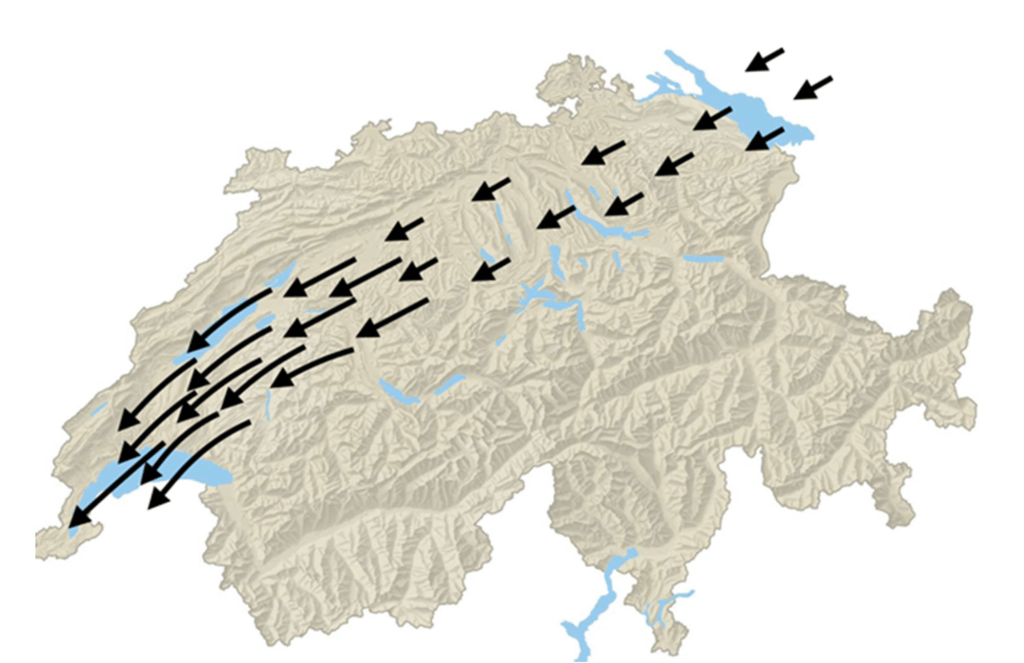
The magnitude and direction of wind significantly impacts airport operations, and Lufthansa Group Airlines are no exception. A particularly troublesome kind is called BISE: it is a cold, dry wind that blows from the northeast to southwest in Switzerland, through the Swiss Plateau. Its effects on flight schedules can be severe, such as forcing planes to change runways, which can create a chain reaction of flight delays and possible cancellations. In Zurich Airport, in particular, BISE can potentially reduce capacity by up to 30%, leading to further flight delays and cancellations, and to millions in lost revenue for Lufthansa (as well as dissatisfaction among their passengers).
Being able to predict this kind of wind well in advance lets the Network Operations Control team schedule flight operations optimally across runways and timeslots, to minimize disruptions to the schedule. However, predicting speed and magnitude can be incredibly difficult to model and thus to predict— which is why Lufthansa reached out to Google Cloud.
Machine learning (ML) can help airports and airlines to better anticipate and manage these types of disruptive weather events. In this blog post, we’ll explore an experiment Lufthansa did together with Google Cloud and its Vertex AI Forecast service, accurately predicting BISE hours in advance, with more than 40% relative improvement in accuracy over internal heuristics, all within days instead of the months it often takes to do ML projects of this magnitude and performance.
“Being impressed with Google’s technology and prowess in the field of AI and machine learning, we were certain that my working together with their expert, to combine our technology with their domain expertise, we would achieve the best results possible,“ said Christian Most, Senior Director, Digital Operations Optimization at Lufthansa Group.
Collecting and preparing the dataset
The goal of Lufthansa and Google Cloud’s project was to forecast the BISE wind for Zurich’s Kloten Airport using deep learning-based ML approaches, then to see if the prediction surpasses internal heuristics-driven solutions and gauge the ease of use and practicality of the deep learning approach in production.
Since deep learning-based techniques require large datasets, the project relies on Meteoswiss simulation data, a dataset consisting of multiple meteorological sensor measurements collected from several weather stations across Switzerland over the past five years. By using this dataset, we obtained data on factors like wind direction, speed, pressure, temperature, humidity and more, at a 10 min resolution, along with some information about the location of the weather stations, such as altitude. These factors, which we hypothesized to be predictive of the BISE, ended up carrying valuable signals, as we would see later.
This collected data was next subjected to an extensive cleaning and feature engineering process using Vertex AI Workbench, in order to prepare the final dataset for training. The cleaning phase included steps to drop the features, or rows, that contained too many missing values, or failed statistical tests for entropy, etc. Since the direction of wind is a circular feature (between 0 and 360 degrees), this column/feature was replaced with two features: the corresponding sine and cosine embedding. The dataset was then flattened such that the columns contained all the relevant features and sensor measurements from all the weather stations at a particular 10-minute interval.
Since the target variable — i.e,. BISE — was not directly available, we engineered a proxy target variable for BISE called “tailwind speed around runway,” which above a certain threshold indicates the presence of BISE along the runway.
Forecasting wind in the Cloud
Once the dataset was ready, Lufthansa and Google Cloud evaluated several options before deciding to experiment and tune Vertex AI Forecast, Google’s AutoML-powered forecasting service, in order to achieve optimum results. Vertex Forecast is capable of the required feature engineering, neural architecture search, and hyper parameter tuning, and it is managed by Google Cloud to score in the top 2.5% in the M5 Forecasting Competition on Kaggle, in a completely automated fashion. These qualities made it an excellent choice for Lufthansa, to reduce the manual overhead of creating, deploying, and maintaining top performing deep learning models.
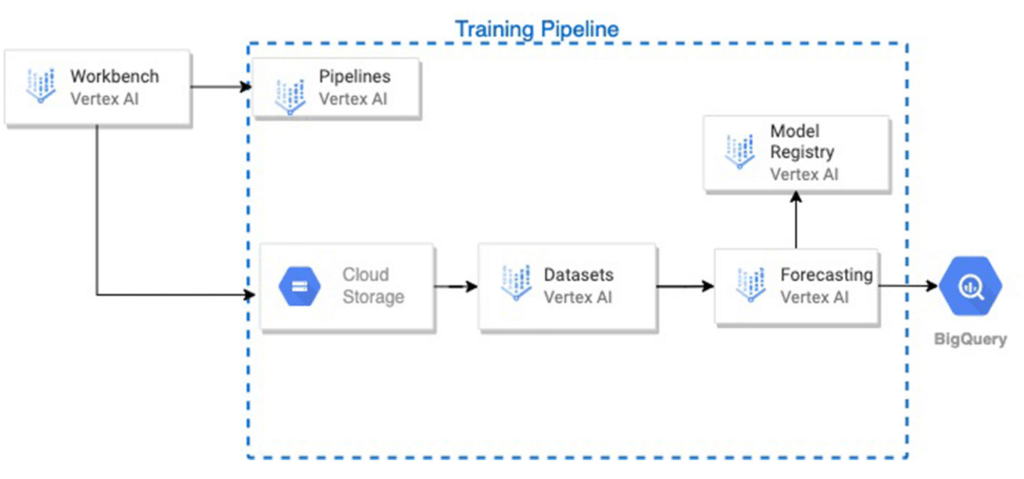
The raw data files were loaded from cloud storage, preprocessed on Vertex AI Workbench. Then, a training pipeline was initiated on Vertex AI Pipelines, which performed the following steps in sequence:
The .csv data file was loaded from Cloud Storage into a Vertex AI managed dataset.
A Vertex AI forecasting training job was initiated with the dataset, and it was also registered as a model in the Vertex AI Model Registry.
Upon completion, the model was evaluated on the test set, and the model’s predictions and the input features and ground truth of the test set, were stored in a user-defined table in BigQuery. Several test metrics were also available on the service and model dashboards.
One of the biggest challenges was the severe imbalance in the dataset, as measurements with BISE were very far and few in between. In order to account for this, instances where BISE occurred, as well the occurrences temporally close to them, were upweighted using weights calculated with methods including Inverse of Square Root of Number of Samples (ISNS), Effective Number of Samples (ENS), and Gaussian reweighting. The formulas for the methods are given below. These weights were supplied as separate columns in the dataset, and were iteratively used thereafter by the service as the “weight” column.
ISNS

ENS

Weighted gaussian

Results and next steps
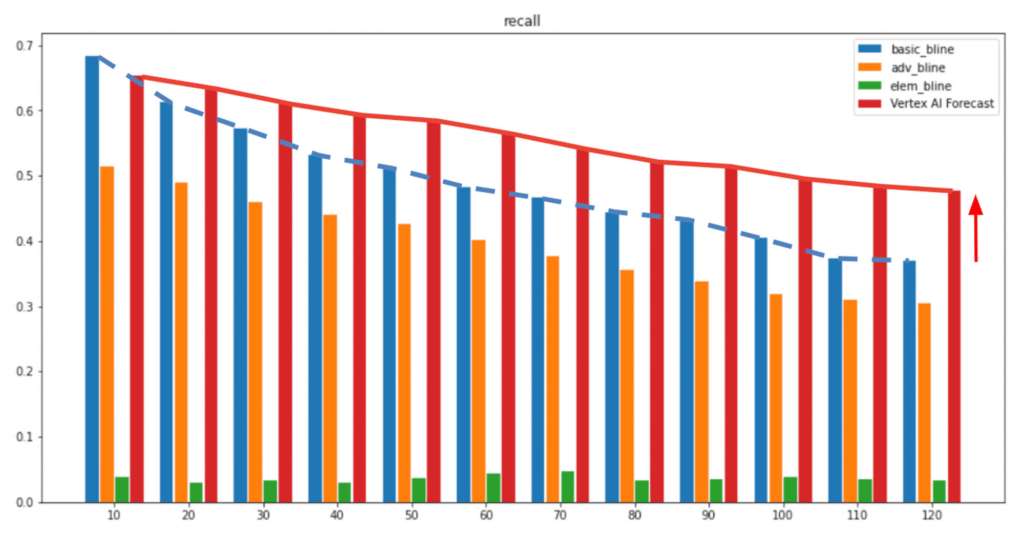
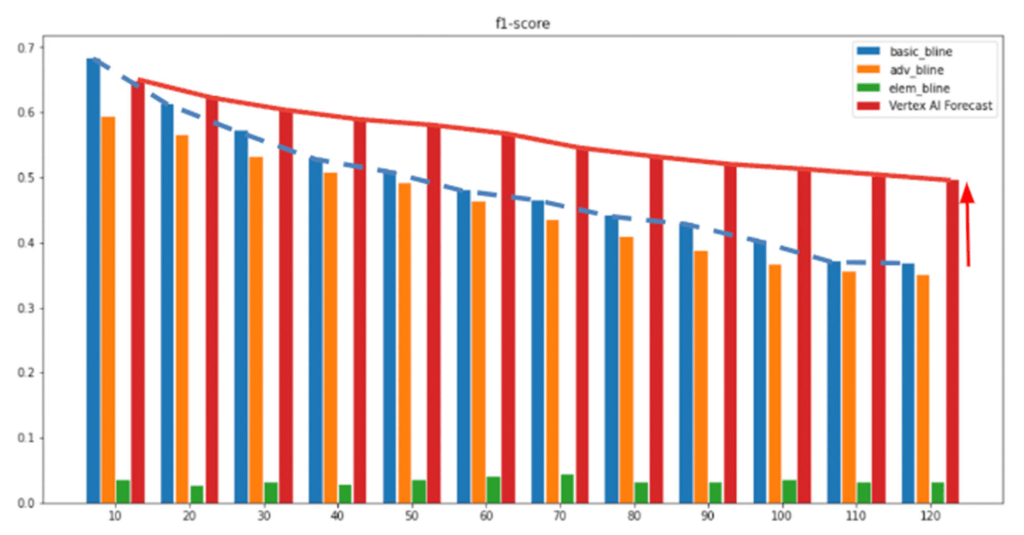
In the above figures, the x-axis represents the forecast horizon and the Y-axis shows the respective metrics (Recall/F1-score). As shown after multiple experiments, we can see Vertex AI Forecast achieved higher recall and precision t (red bar), outperforming Lufthansa’s internal baseline heuristics, with the performance gap widening steadily as the forecast horizon extends further into the future. At the two-hour mark, our custom-configured Vertex AI Forecast model improved by 40% relative to the internal heuristics and 1700% compared to the random guess baseline. As we saw with other experiments, at a six-hour forecast horizon, the performance gap widens even more, with Vertex AI Forecast in the lead. Since forecasting BISE a few hours in advance is very beneficial to prevent flight delays for Lufthansa, this was a great solution for them.
“We are very excited to be able to not only do accurate long term forecasts for the BISE, but also that Vertex AI Forecasting makes training and deploying such models much easier and faster, allowing us to innovate rapidly to serve our customers and stakeholders in the best possible manner,” said Swiss Oliver Rueegg, Product Owner, Swiss International Airlines.
Lufthansa plans to explore productionizing this solution by integrating it into their Operations Decision Support Suite, which is used by the network controllers in the Operations Control Center in Kloten, as well as to work closely with Google’s specialists to integrate both Vertex AI Forecast and other of Google’s AI/ML offerings for their use cases.
2991
Of your peers have already watched this video.
26:30 Minutes
The most insightful time you'll spend today!
What’s Next for Personalization on Google Cloud
Customer shopping behavior has changed for good. With fewer in-store shopping visits retailers have had to shore up their digital storefronts and explore new ways to meaningfully engage with their customers.
Delivering a superior customer experience has become even more of a differentiator for the early movers and personalized recommendations have emerged as one of the strongest potential drivers of revenue lift.
But as many retailers have discovered delivering recommendations at scale can actually be quite complex and time consuming.
Learn how to deliver highly-personalized product recommendations with Google Cloud Recommendations AI.
Recommendations AI is now fully open access and self-serve, with more built-in integrations with Google Shopping Merchant Center and Google Analytics, as well as more controls over how you create recommendation pipelines and manage your costs.
You will also hear how Google Cloud partners like Qubit and BigCommerce have successfully deployed Recommendations AI for their customers and made us an integral part of their solution offerings.
901
Of your peers have already watched this video.
9:30 Minutes
The most insightful time you'll spend today!
Building Ethical AI: Why Organizations Need to Define Their Own Principles
In this video, learn about the importance of responsible AI, and how Google implements responsible AI in their products. You will also get an introduction to Google’s 7 AI principles.
Want to learn more about the importance of responsible AI? Enroll on Google Cloud Skills Boost → https://goo.gle/3CGhlXo
View the Generative AI Learning path playlist → https://goo.gle/LearnGenAI
Subscribe to Google Cloud Tech → https://goo.gle/GoogleCloudTech
Custom Voice Feature Can Help Brands Tweak IVR for Better Customer Experiences

5132
Of your peers have already read this article.
1:30 Minutes
The most insightful time you'll spend today!
With the rise of digital assistants and conversational interfaces, people have grown accustomed to hearing and speaking to synthetic voices. But what do those voices sound like? Often, pretty repetitive. We’re all familiar with the Google Assistant voice, for example.
That’s why we are excited to announce the general availability of Custom Voice in our Cloud Text-to-Speech (TTS) API, a new feature that lets you train custom voice models with your own audio recordings to create unique experiences.
For businesses looking to build a strong brand identity, establishing a unique voice can help turn mobile app interactions or customer service based on interactive voice responses (IVR) into differentiated customer experiences. Our TTS API has included a speech synthesis service with a static list of voices for some time, but now, with Custom Voice, moving beyond these predefined options is easier than ever.
Custom Voice lets you simply submit your audio recordings to get access to the new voice directly in the TTS API. Custom Voice TTS includes guidance on the audio requirements to help make sure you generate a high quality custom TTS voice model. Once this new model is trained, all you have to do to start using the newly trained voice is reference the model ID in your calls to the Cloud TTS API.
At Google, we are committed to building safe and accountable AI products, not only because it’s the right thing to do, but because it is a critical step in ensuring successful use in production. As part of Google Cloud’s Responsible AI governance process, we conducted a deep ethical evaluation of Custom Voice TTS, and its relation to synthetic media, in order to surface and mitigate potential harms that it may create. If you are interested in Custom Voice TTS, there is a review process to help ensure each use case is aligned with our AI Principles and adequate voice actor consent is given.
Additionally, to verify that voice actors are actually the ones producing the audio, you will need to submit an audio file producing a sentence that Google Cloud chooses (for example: “I agree that my voice will be used to create a synthetic custom Text-to-Speech voice).
We’re looking forward to seeing this API help businesses solve problems in an easy, fast, and scalable way. TTS Custom Voice is now GA in these languages:
English (US)
English (AU)
English (UK)
Spanish (US)
Spanish (Spain)
French (France)
French (Canada)
Italian (Italy)
German (Germany)
Portugues (Brazil)
Japanese (Japan)
We plan to continue expanding this lineup in order to meet your needs. Ready to try for yourself? Contact your seller to get started on your use case evaluation today!
Transforming Media Industry: Three Strategies for Media Leaders to Leverage Generative AI
1535
Of your peers have already read this article.
3:30 Minutes
The most insightful time you'll spend today!
The digital era turned the traditional formula for media and entertainment success on its head, ushering in new technologies that have changed how content is produced, distributed, experienced, and monetized. Audiences have more choice, flexibility, and power over what they consume, and today’s media companies have to embrace ongoing transformation or risk falling behind – or becoming irrelevant.
A new wave of transformation is arriving with generative AI, a type of artificial intelligence that can interact with users in natural language and create novel data, ranging from story outlines, reports, and other text outputs to multimodal content like images, videos, and audio. Media and entertainment are inherently about content creation and creativity—so what does this new technology mean for the industry?
At Google Cloud, we see tremendous opportunity for creative industries, from more efficient creation methods to improved user experiences. Let’s explore.
AI for media with Google Cloud
Google Cloud has a long history with large language models (LLMs) and other generative AI technologies—from their influence over the years on products like Document AI, to recent announcements like Generative AI support in Vertex AI, which lets businesses access and tune generative AI foundation models, and Generative AI App Builder, which lets developers build chatbots and other generative apps in minutes.
We’ve helped our global media and entertainment customers with AI for personalization, search and recommendations, predictive analytics, and much more — and with generative AI now on the rise, we have some ideas to help media leaders, technologists, and creators think about and prepare to utilize powerful AI in their work.
Three lenses on innovation in media
The media and entertainment industry is increasingly diverse and complex, with companies spanning over-the-top (OTT) subscription streaming services, 24-hour linear channels, live broadcasts of sporting events, digital journalism, traditional publishing, short-form user-generated social video, and more. More and more, the boundaries between these segments of the media industry are blurring — but common to them all is the focus on providing compelling content in an engaging audience experience that can be directly or indirectly monetized.
With this in mind, we suggest media and entertainment companies look at the application of innovative technologies like generative AI through the following three lenses:
- Improving content creation, production, and management
- Enhancing and personalizing audience experiences
- Improving monetization
Improving content creation, production, and management
Generative AI democratizes many aspects of content creation, opening new ways to create written material, illustrations, sound effects, special effects, and more. Its recent maturation has been so rapid, some in the media industry have expressed concern that generative AI implies the end of creative professions. We think the opposite is more likely: just as photography, audio recordings, and computer generated images have enabled new modes of creativity, rather than making old ones obsolete, generative AI has the potential to both enable new forms of expression and enhance familiar ones.
For example, journalists could use generative AI to speed up research by helping them synthesize and analyze large volumes of information, or to help them create initial drafts or summaries of editorial content. Film and television producers could leverage the technology to accelerate the post-production editing process, with new AI-enabled interfaces for rapidly adjusting or enhancing scene details such as lighting and color. Broadcasters could use generative AI to make vast libraries of video footage searchable and accessible for use in telling more compelling stories. The potential use cases go on and on.
Far from undermining incredible creative professions, generative AI is poised to free writers, artists, editors, and many others from the tedious and mundane aspects of their work, empowering them to focus more of their time on creativity.
Enhancing and personalizing audience experiences
Every media organization in the world today faces the reality that for most consumers, switching costs are extremely low. This puts incredible pressure on these companies to invest in delivering low-friction and compelling audience experiences that help mitigate subscribers from churning and viewers from abandoning content experiences for competitive platforms.
Generative AI can help media companies engage and retain viewers, such as by enabling more powerful search and recommendations on their digital content platforms. With its increasingly multimodal capabilities extending from natural language to both audio and video content, generative AI is well-positioned to power more personalized audience experiences.
Consumers often complain about “the paradox of choice” or their inability to find something interesting to watch on streaming platforms that have incredibly vast libraries of content available on demand. Imagine a not-too-distant future wherein a consumer can simply ask the content platform they’re using to help them find a specific show to watch based on mood, specific types of scenes, combinations of actors, award nominations, or practically anything they can think to ask. And that’s just the tip of the iceberg — imagine generative AI’s potential to curate, assemble, and even create personalized content for a viewer to consume!
Improving monetization
As consumers’ content consumption further expands from traditional theatrical and linear television programming to include digital offerings across an array of platforms, devices, and content types, media companies face the challenge of maintaining and improving monetization. The conventional economics and approaches to advertising and subscription models are proving, in many cases, not to deliver sufficient ROI.
Generative AI has the potential to help media companies improve their monetization of audience experiences. As mentioned previously, enhanced personalization can play a role in mitigating churn, which in turn can help sustain and grow subscription and advertising revenues. Going beyond this, generative AI can be leveraged to drive even greater advertising revenues via more targeted, contextual, and personalized advertisements. Imagine both display and video advertisements that are generated on the fly to personalize product specifics, messaging, style, colors, and innumerable other characteristics to drive greater engagement and higher click-through rates (CTR), and thus higher advertising CPMs (cost per thousand impressions).
Coming up next
Generative AI presents a significant opportunity for media companies to fundamentally transform content creation, engagement, and monetization. Compelling services are already on the market — but there is far more to come.
Google Cloud continues to build on its deep experience and expertise with AI, and we are committed to working with the industry to develop compelling, accessible, trusted, and responsible AI solutions that will drive meaningful business outcomes. We are excited to create the future together with our global media customers and partners across the ecosystem. To learn more about this disruptive topic, read “Debunking five generative AI misconceptions” from Google Cloud vice president of AI & Business Solutions Phil Moyer, or explore our Trusted Tester Program for generative AI.
More Relevant Stories for Your Company

Geospatial Data for Business Apps Drive Sustainable and Accurate Decision-making
Organizations that collect geospatial data can use that information to understand their operations, help make better business decisions, and power innovation. Traditionally, organizations have required deep GIS expertise and tooling in order to deliver geospatial insights. In this post, we outline some ways that geospatial data can be used in

AI Features in Apigee X Helps Build and Manage APIs at Scale
APIs are the backbone of digital transformation. Via APIs, you can securely share data and functionality with developers both inside and outside of your organizational boundaries, letting you build applications faster, seamlessly connect and interact with partners, and drive new business revenue. Because APIs encompass business-critical information, any downtime or

Google Cloud Next 21 for Data Analytics Unplugged
October 23rd (this past Saturday!) was my 4th Googlevarsery and we are wrapping an incredible Google Next 2021! When I started in 2017, we had a dream of making BigQuery Intelligent Data Warehouse that would power every organization’s data driven digital transformation. This year at Next, It was amazing to



How Good Are Google’s Vision, Speech, Translation and Natural Language ML APIs?
Many companies want to be able to adopt machine learning and artificial intelligence quickly into their businesses. But it isn't always straight-forward and easy. Custom building the models and setting up and maintaining the infrastructure required for an AI project is time-consuming. That is where Google’s machine learning APIs come
