






4668
Of your peers have already listened to this podcast
30:30 Minutes
The most insightful time you'll spend today!
Why it’s Easier Than Ever for Developers to Break Into Machine Learning and Data Science
This week we talk about machine learning, its best use cases, and how developers can break into machine learning and data science.
Dale Markowitz, Google Developer Advocate, talks about natural language processing as well, explaining that it’s basically the intersection of machine learning and text processing. It can be used for anything from aggregating and sorting Twitter posts about your company to sentiment analysis.
For developers looking to enter the machine learning space, Dale suggests starting with non life-threatening applications, such as labeling pictures.
Next, consider the possible mistakes the application can make ahead of time to help mitigate issues. To help prevent the introduction of bias into the model, Dale suggests introducing it to as many different types of project-appropriate data sets as possible. It’s also important to continually monitor your model.
Later in the show, we talk Google shop, learning about all the new features in Google Translate and AutoML.
Tyson Foods’ Story of Unlocking Opportunities by Integrating Real-time Analytics with AI and BI

6494
Of your peers have already read this article.
3:00 Minutes
The most insightful time you'll spend today!
As data environments become more complex, companies are turning to streaming analytics solutions that analyze data as it’s ingested and deliver immediate, high-value insights into what is happening now. These insights enable decision makers to act in real time to take advantage of opportunities or respond to issues as they occur.
While understanding what is happening now has great business value, forward-thinking companies are taking things a step further, using real-time analytics integrated with artificial intelligence (AI) and business intelligence (BI) to answer the question, “what might happen in the future?” Arkansas-based Tyson Foods has embraced AI/BI analytics to enable predictive insights that unlock new opportunities and drive future growth.
Creating a digital twin for connected intelligence company wide
Before using AI/BI, Tyson’s analytics capabilities consisted of traditional BI solutions focused on KPIs and simplifying data so that humans could understand it. Tyson wanted to leverage its data to uncover ways to improve current processes and grow its business. But with BI alone, Tyson struggled to use data to run the simulations and scenarios essential to make educated decisions. To keep growing, it had to embrace the complexity of its data, building ways to analyze it and use it to inform decision making.
Tyson’s on-premises analytics solutions limited its ability to be aggressive and make intelligent, timely, prescriptive decisions. The solution was to create a digital twin to scale optimizations within business processes, moving from local optimizations to system-wide connected optimizations. Doing so meant shifting entirely to cloud computing, with an initial focus on building the ingestion component of the digital twin platform.
Investing in a digital twin enabled Tyson to accelerate new capabilities like supply chain simulation “what-if” scenarios, prescriptive price elasticity recommendations, and improvement of customer intimacy.
Solving the ingestion problem for faster time to insights
Before its migration to Google Cloud, analytics projects that Tyson suffered from uncertainty over how to obtain the data. This problem was prolific and caused project times to be extended for weeks or even months due to the need to write and support one-off data ingestion processes at the front end. This problem also prevented the IT team from delivering analytics solutions fast enough for the business to take full advantage of them.
To solve this analytics problem, the team created Data Ingestion Compute Engine (DICE). DICE is a Google Cloud-hosted, open-source, cloud-native ingestion platform developed to provide configuration-based, no-ops, code-free ingestion from disparate enterprise data systems, both internal and external. It is centered on three high-level goals:
- Accelerate the speed of delivery of IT analytics solutions
- Enable growth of IT capabilities to produce meaningful insight
- Reduce long-term total cost of ownership for ingestion solutions
Creating DICE ingestion platform with Google Cloud services
Teams use DICE to set up secure data ingestion jobs in minutes without having to manage complex connections or write, deploy, and support their own code. DICE enables unbound scale, highly parallel processing, DevSecOps, open source, and the implementation of Lambda Data Architecture.
A DICE job is the logical unit of work in the DICE platform, consisting of immutable and mutable configurations persisted as JSON documents stored in Firestore. The job exists as an instruction set for the DICE data engine, which is Apache Beam running Dataflow to instruct which data to pull, how to pull it, how often to pull it, how to process it, when it changes, and where to direct it.
Two of DICE’s primary layers include the metadata engine and the data engine. The metadata engine is responsible for the creation and management of DICE job configuration and orchestration. It is made up of many microservices that interact with multiple Google Cloud services, including the job configuration creation API, job build configuration helper API, and job execution scheduler API.
The data engine is responsible for the physical ingestion of data, the change detection processing of that data, and the delivery of that data to specified targets. The data engine is Java code that uses the Apache Beam unified programming model and runs in Dataflow. It is comprised of streaming, jobs, and Dataflow flex template batch jobs. Logically, the data engine is segmented across three layers: the inbound processing layer, the DICE file system layer, and the target processing layer, which takes the data from the DICE file system and moves it to targets.
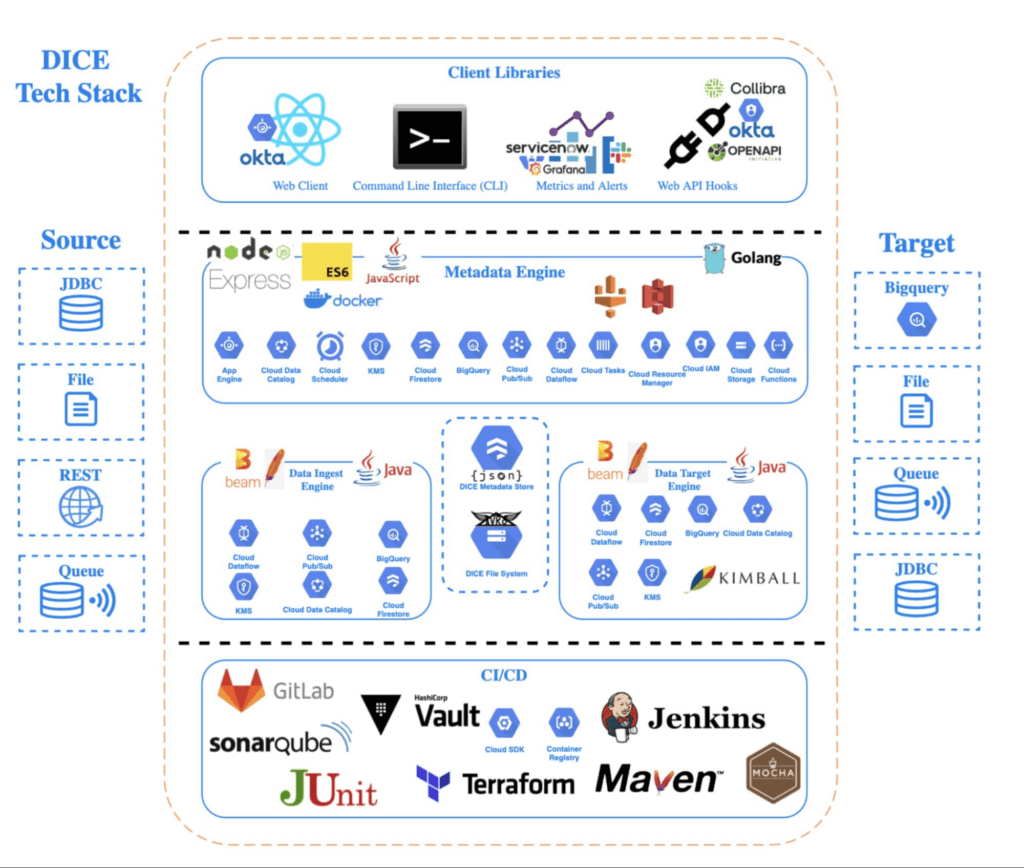
Rolling DICE for thousands of ingestion jobs each day
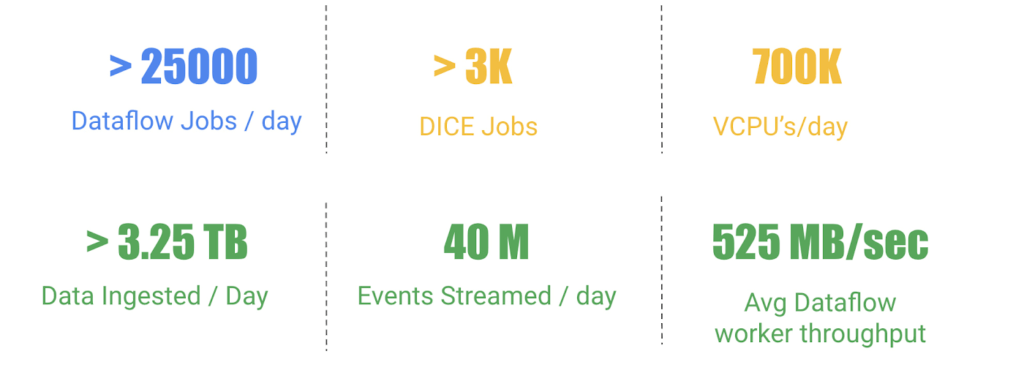
DICE was first deployed to a production environment in November 2019, and just two years later, it has more than 3,000 data ingestion jobs from more than a hundred disparate data systems, both internal and external to Tyson Foods. Most of these jobs run multiple times a day. On a daily basis the DICE environment sees more than 25,000 Dataflow jobs running and an average of 3.25 terabytes of new data being ingested.
DICE supports ingestion from many different types of technologies, including BigQuery, SQL Server, SAP HANA, Postgres, Oracle, MySQL, Db2, various types of file systems, and FTP servers. Additionally, DICE supports target platform technologies for ingestion jobs that include multiple JDBC targets, multiple file system targets, and BigQuery and queue-based store and forward technologies.
The platform continues to see linear growth of DICE jobs, all while keeping platform costs relatively flat. With increasing demand for the platform, Tyson’s IT team is constantly enhancing DICE to support new sources and targets.
This intelligent platform keeps adding new value and makes it simple for Tyson to take advantage of its data. This innovation is a necessity in this fast-changing world of digital business in which companies must transform a high volume of complex data into actionable insight.
Cloud and AI Paves the Future of Finance: Excerpts from FIA Boca 2022

6621
Of your peers have already read this article.
4:00 Minutes
The most insightful time you'll spend today!
Financial markets were among the first to adopt new technologies, and that has certainly been true of the derivatives markets, which were early adopters of electronic trading. Going forward, new capabilities will transform the way industry participants communicate, analyze, and trade.
I sat down with Google Cloud’s Phil Moyer and former SEC Commissioner, Troy Paredes, for a fireside chat at FIA Boca 2022 to discuss the future of markets and policy, the new technologies that are already paving the way for greater speed and transparency, and how cloud can help promote greater resiliency, performance, and security to enable the long-term vision for the market. The following is a summary of our discussion.
The current state of cloud technology
When it comes to technology adoption, we’re seeing the market and participants adopt cloud technologies, and increasingly, machine learning (ML) on a wider scale. Cloud technology allows for easier, faster, and much more secure experimentation with large datasets and ML.
A recent Google sponsored study by Coalition Greenwich (September, 2021) showed that more than 93% of trading systems, exchanges, and data providers are in some way providing services on the cloud. The same study, revealed that about 72% of the financial industry across the buy side and sell side, intend to consume public cloud-data based market data within the next 12 months.
Data-driven decision-making and risk management have always been, and continue to remain, the cornerstones of the financial markets. Over time, technology innovation has facilitated access to better insights from data, and therefore, better decision-making and the ability to manage risk. That expectation is now mainstream, and will continue to grow in sophistication.
The multi-phased technology trajectory
The movement of exchanges to the cloud will occur in a “crawl-walk-run” fashion, with low-hanging fruits the first to be picked in the near term while bigger, paradigmatic changes will occur over the medium and long term. Some organizations are starting all three stages simultaneously, understanding that each will move at an independent cadence.
The “crawl” phase is one in which foundations are built, starting with organizations moving data to the cloud and experimenting with some degree of analytics. It’s one of the most important phases because it’s where the opportunity to increase transparency and risk management takes shape.
In moving to the cloud, the infrastructure – which in the past relied on a combination of people, processes, and some technology – becomes the code that runs applications. This early phase is key to empowering organizations to shift to a cloud-based, agile-first operating model that makes it easier and more seamless to launch new products in the future, including by freeing up people and resources from IT management to more mission-focused work.
Establishing the cloud operating model simplifies the “walk” and “run” phases where compliance is more automated, latency-sensitive applications are more readily available, and the next generation of exchanges, market participants, and regulators is better prepared to meet future challenges.
The “walk” phase is where much of the innovation happens. Exchanges are making significant progress in leveraging foundational data decisions in the “crawl” phase and innovations in the cloud to improve settlement, clearing, risk management, collateral management, and compliance, and launch new products.
And finally, the “run” phase is where organizations will start to move the latency-sensitive markets to the cloud, as the markets increasingly will demand low-latency and high performance along with transparency and analytics to solve historical obstacles to market access.
Opportunities for both regulators and market participants
Any time significant technological change takes place, regulators explore its implications, particularly with respect to their ability to meet their regulatory objectives.
Increasingly, we are seeing technological change driving more opportunities for regulators and market participants alike. Such changes may also allow better protection of the marketplace, with greater integrity and transparency.
Over time, regulatory regimes – rules, regulations, statutes, interpretations, and guidance – will also adjust to new technologies, both benefiting the marketplace and advancing regulatory goals.
As one example, the cloud is increasing the ability to meet compliance obligations by allowing compliance to be built into transactions. Moreover, predicated on the vision of real-time regulatory reporting, and given the pace of technological change in the marketplace over the last several years, various regulators have been using more advanced analytics. This trend will continue to help them more effectively and efficiently meet their objectives, and monitor and meet the expectations they have for the entire market.
Machine learning’s role in the financial markets
Google Cloud’s head of AI and Industry Solutions, Andrew Moore, said that ML will be doing three key things for us in the next 10 years: giving us meaning, providing concierge services, and serving as a guardian. Extracting information that is critical to investor decision-making can be extremely important. With more data than ever, ML can increase the ability to process it while also becoming more accessible in the cloud and better supporting regulatory objectives.
The technology will likely manifest in trading and anti-money laundering activities as they relate market functions, as well as managing a wide variety of risks – supporting the interests of both investors and regulators in terms of decision-making, surveillance, and protections.
Rather than taking individuals out of the equation, the digitization of markets, assets, and guard rails combined with ML will allow people to focus their expertise in different ways to achieve key objectives.
Building the market foundation for the future
The goals of operational resiliency, security, and privacy will continue to be critical for building the market foundation for both participants and regulators. While technology promises to create advantages in concrete, tangible ways, it will be important to scrutinize potential risks and concerns.
Priority one for technology providers is to build an environment of trustless security, including encryption at motion and encryption at rest, ensuring that markets are operationally resilient while instilling confidence for any exchange that runs on top of that infrastructure. Multicloud architectures and approaches are likely also to be part of the solution for operational resilience.
Throughout time, liquidity has been the outcome of improved access, transparency, and security. Technology providers are responding by sharing both the responsibility for, and fate of, the markets of the future to build an efficient, faster, and more transparent and secure financial industry.
You can learn more about our approach in our newest white paper, Building the financial markets foundation for the future.
How TapClicks’ Google Cloud Migration Makes Life Easy for Marketers

8555
Of your peers have already read this article.
2:00 Minutes
The most insightful time you'll spend today!
Editor’s note: In this blog post we learn how TapClicks migrated to Google Cloud to offer their marketing customers a unified platform for data management, operations, insights, and analysis.
TapClicks is a smart marketing cloud, powered by data, that unifies our customer’s marketing. By choosing to migrate our core applications last year to Google Cloud, we cut costs, solved data-sharing concerns for our customers, and opened our stack up to a new ecosystem of possibilities.
The core problem that we’re solving for our customers is how to manage their marketing infrastructures data and operations. Life isn’t easy for marketers now. There are 7,000 different vendors servicing this space today – creating much complexity between digital agencies, media, and brands. Marketers face challenges in navigating all of these systems, logging in and out, understanding pacing goals, and managing the flow of marketing data so they can analyze and report internally as well as to their clients at scale.
We unify omnichannel campaign data (250 API connectors and 6000 Smart Connectors ™ ) from a plethora of marketing sources on an automated data warehousing solution, creating simplicity for organizations. Over 4,000 agencies, media companies, and brands use our Marketing Operations and Data Management Platform, which imports data at scale and creates an automatic data warehouse on Google Cloud. Teams can also leverage TapClicks, like our world class Facebook connector, to import data directly into Google Data Studios. Beyond importing and storing, we also provide data exporting to other Google solutions like Google Data Studio and Google Sheets. We also create interactive dashboards that let stakeholders and clients analyze their data, as well as automated, multi-channel reports that go out to clients at specified times. So channel comparisons, optimizations, attribution, and calculations are easily performed. Some of our customers are able to generate hundreds of thousands of individual reports and dashboards for their clients.
Although we may be best known for our reporting and analytics, we also empower teams managing the marketing operations workflow from customers and internal stakeholders, especially at scale. Our user-friendly, configurable system helps manage their orders and campaigns. Through automation of this process, we deliver tremendous amounts of efficiency, time saving, cost savings, and reduction of errors. The combination of these solutions makes up our unified platform, with additional capabilities like marketing intelligence that offers competitive and brand-level analysis. This is a disruptive solution in use by all leading media companies, agencies and many brands.
Partnering for possibilities
We faced a few challenges with our original tech stack, which included a mix of the leader in web services revenue, leaders in high performance data warehousing, as well as vendors on bare metal servers.
- One challenge was around costs, which were growing.
- Second, many of our customers work with multiple brands, and are very hesitant to share their data with the leader in web services, who’s often viewed as their competitor.
- Third, these vendors are more focused on their own revenue rather than a true long term partnership that would enable their customers to enjoy similar success as they have experienced.
When looking at other cloud providers, Google Cloud emerged for us as the front runner. They were competitive on costs, and their native Kubernetes support was superior— a big selling point for our DevOps team. There’s also a movement in the marketing and advertising industry away from AWS toward Google Cloud because of the data-sharing concern. Finally, most of our customers are already using Google Cloud tools, so there’s brand recognition and familiarity there, and easier integrations with their own systems.
Migrating to Google Cloud
Our migration, which took about five months, involved moving a significant chunk of our infrastructure, including our core applications, using Google Kubernetes Engine (GKE). In our legacy architecture, each of our clients was assigned to one of our virtual machines (VMs), and there was a lot of unused capacity because we had to provision for the max usage. We appreciated GKE’s cloud native capabilities, especially autoscaling, a huge benefit for our web application. We have varying usage patterns during the day, and though our application is mostly used during business hours, there are also days in the month of higher usage, and autoscaling saves us time and costs. GKE also makes deployments much easier, and we anticipate a lot of benefits there for our developer environments. We’ve moved some of our microservices into GKE and plan to move more in the future. All in all, we were able to migrate our core products and the bulk of our AWS spend successfully to Google Cloud.
We also moved from our other vendors Relational Database Service (RDS) to running MySQL on our own VMs on Google Cloud, which gives us more flexibility in terms of settings and fine tuning. We’re still trying to find the best mix as we’re modernizing our infrastructure, and we took this opportunity to migrate from MySQL 5.7 to 8.0.
Our next stage is exploring more of the capabilities and services of Google Cloud, including BigQuery, which we’re considering for our own data warehouse. The fact that we could also run Snowflake on Google Cloud, if needed, was another selling point for our migration.
We’re especially interested in BigQuery ML’s machine learning and natural language processing capabilities, which enabled better predictive insights. Our customers want insights from their campaigns— which are working, which are paying off, where should they invest next? Using our platform, they’re looking not only to generate reporting, but also identify opportunities to improve campaign performance. We plan to use AI and ML to improve those capabilities, so that our customers can seamlessly unlock insight and intelligence from their marketing data and campaigns.
Double-clicking on Google Cloud
For us, being able to deeply leverage and partner with Google Cloud to deliver those solutions on a single stack is critical, and we think our customers will love it. We see TapClicks and Google Cloud partnering at a level beyond what you typically see in a cloud provider relationship. Already, fifty percent of our company is working with various Google Cloud solutions, and we envision TapClicks and Google Cloud as extensions of each other, providing a single, powerful platform solution.
Google Cloud understands the partnership concept, and their team was able to shine a light on their services and what they could bring to the table. Compared to our previous experiences, dealing with the Google Cloud team has been a true pleasure. Now that we’ve migrated, we’re ready to take our next steps into the services available to us in the Google Cloud ecosystem, and the problems we’ll continue to solve for our customers. Learn more about TapClicks and BigQuery ML.
3310
Of your peers have already watched this video.
21:26 Minutes
The most insightful time you'll spend today!
What are TPUs and Why Should Data Scientists Care?
When it comes to machine learning, more data means better results.
But processing more data also requires more computing power. CPUs are great for sequential arithmetic calculations. They offer low latency with this type of workload. But to speed up machine learning, models have to perform multiple calculations in parallel. And that’s where GPUs perform better.
TensorFlow Processing Units, or TPUs, represent the most advanced hardware accelerators that has been architected ground up for TensorFlow by Google Cloud. Cloud TPUs deliver accelerated performance to help businesses train deep learning models in a matter of hours instead of weeks.
This allows enterprises to be more productive with their scarcest resource, the ML scientist, and drive more innovations, thanks to the advanced computing capability.
Watch John Barrus, Senior Product Manager, Google Cloud; and Zak Stone, Product Manager, Google Brain, show you benefits of using TPUs and how to get started.
Improved TabNet on Vertex AI: High-performance, scalable Tabular Deep Learning

2514
Of your peers have already read this article.
2:30 Minutes
The most insightful time you'll spend today!
Data scientists choose models based on various tradeoffs when solving machine learning (ML) problems that involve tabular (i.e., structured) data, the most common data type within enterprises. Among such models, decision trees are popular because they are easy to interpret, fast to train, and can obtain high accuracy quickly from small-scale datasets. On the other hand, deep neural networks offer superior accuracy on larger datasets, as well as the benefits of end-to-end learning, but are black-box and difficult to interpret. TabNet, an interpretable deep learning architecture developed by Google AI, combines the best of both worlds: it is explainable, like simpler tree-based models, and can achieve the high accuracy of complex black-box models and ensembles.
We’re excited to announce that TabNet is now available in Vertex AI Tabular Workflows! Tabular Workflows provides fully managed, optimized, and scalable pipelines, making it easier to use TabNet without worrying about implementation details, and to deploy TabNet with the MLOps capabilities of Vertex. TabNet on Vertex AI Tabular Workflows is optimized for efficient scaling to massive tabular datasets. Moreover, TabNet on Vertex AI Tabular Workflows come with machine learning improvements on top of the original TabNet, yielding better accuracy for real-world data challenges.
TabNet on Vertex AI is well-suited for a wide range of tabular data tasks where model explainability is just as important as accuracy, such as financial asset price prediction, fraud/cyberattack/crime detection, retail demand forecasting, user modeling, credit/risk scoring, diagnosis from healthcare records, and product recommendations.
Overview of Tabnet
TabNet has a specially-designed architecture (overviewed in Fig. 1), based on sequential attention, that selects which model features to reason from at each step. This mechanism makes it possible to explain how the model arrives at its predictions and the thoughtful design helps with superior accuracy. TabNet not only outperforms alternative models (including neural networks and decision trees) but also provides interpretable feature attributions. More details, including results on academic benchmarks, can be found in our AAAI 2021 paper.
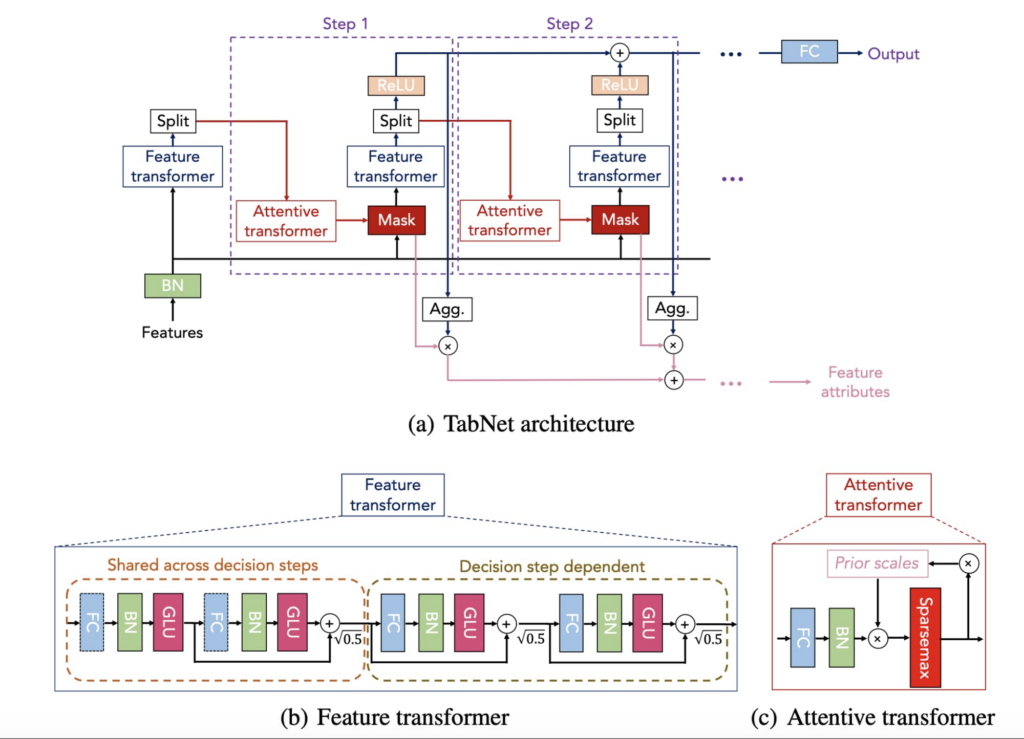
Since its publication, TabNet has received significant traction from various enterprises across different industries and a variety of high-value tabular data applications (most of which include the ones for which deep learning was not even used a priori). It has been used by numerous enterprises like Microsoft, Ludwig, Ravelin, and Determined. Given high customer interest on TabNet, we’ve worked on making it available on Vertex given the real-world deep learning development and productionization needs, as well as improving its performance and efficiency.
Highlights of TabNet on Vertex AI Tabular Workflows
Scaling to Very Large Datasets
Fueled by the advances in cloud technologies like BigQuery, enterprises are increasingly collecting more tabular data, and datasets with billions of samples and hundreds/thousands of features are becoming the norm. In general, deep learning models get better learning from more data samples, and more features, with the optimal methods as they can better learn the complex patterns that drive the predictions. The computational challenges become significant though when model development on massive datasets is considered. This results in high cost or very long model development times, constituting a bottleneck for most customers to fully take advantage of their large datasets. With TabNet on Tabular Workflows, we’re making it more efficient to scale to very large tabular datasets.
Key Implementation Aspects: The TabNet architecture has unique advantages for scaling: it is composed mainly of tensor algebra operations, it utilizes very large batch sizes, and it has high compute intensity (i.e., the architecture employs a high number of operations for each data byte transmitted). These open a path to efficient distributed training on many GPUs, utilized to scale TabNet training in our improved implementation.
In TabNet on Vertex AI Tabular Workflows, we have carefully engineered the data and training pipelines to maximize hardware utilization so that users can get the best return for their Vertex AI spending. The following features enable scale with TabNet on Tabular workflows:
- Parallel data reading with multiple CPUs in a pipeline optimized to maximize GPU utilization for distributed training, reflecting best practices from Tensorflow.
- Training on multiple GPUs that can provide significant speedups on large datasets with high compute requirements. Users can specify any available machine on GCP with multiple GPUs, and the model will automatically run on them with distributed training.
- For efficient data parallelism with distributed learning, we use Tensorflow mirrored distribution strategy to support data parallelism across many GPUs. Our results demonstrate >80% utilization with several GPUs on billion-scale datasets with 100s-1000s of features.
Standard implementations of deep learning models could yield a low GPU utilization, and thus inefficient use of resources. With our implementation, TabNet on Vertex, users can get the maximal return on their compute spend on large-scale datasets.
Examples on real-world customer data: We have benchmarked the training time specifically for enterprise use cases where large datasets are being used and fast training is crucial. In one representative example, we used 1 NVIDIA_TESLA_V100 GPU to achieve state-of-the-art performance in ~1 hour on a dataset with ~5 million samples. In another example, we used 4 NVIDIA_TESLA_V100 GPUs to achieve state-of-the-art performance in ~14 hours on a dataset with ~1.4 billion samples.
Improving Accuracy given Real-World Data Challenges
Compared to its original version, TabNet on Vertex AI Tabular Workflows has improved machine learning capabilities. We have specifically focused on the common real-world tabular data challenges. One common challenge for real-world tabular data is numerical columns having skewed distributions, for which we productionized learnable preprocessing layers (e.g. including parametrized power transform families and quantile transformations) that improve the TabNet learning. Another common challenge is the high number of categories for categorical data, for which we adopted tunable high-dimensional embeddings. Another one is imbalance of label distribution, for which we added various loss function families (e.g. focal loss and differentiable AUC variants). We have observed that such additions can provide a noticeable performance boost in some cases.
Case studies with real-world customer data: We have worked with large customers to replace legacy algorithms with TabNet for a wide range of use cases, including recommendation, rankings, fraud detection, and estimated arrival time predictions. In one representative example, TabNet was stacked against a sophisticated model ensemble for a large customer. It outperformed the ensemble in most cases, leading to a nearly 10% error reduction on some of the key tasks. This is an impressive result, given that each percentage improvement on this model resulted in multi-million savings for the customer!
Out-of-the-box Explainability
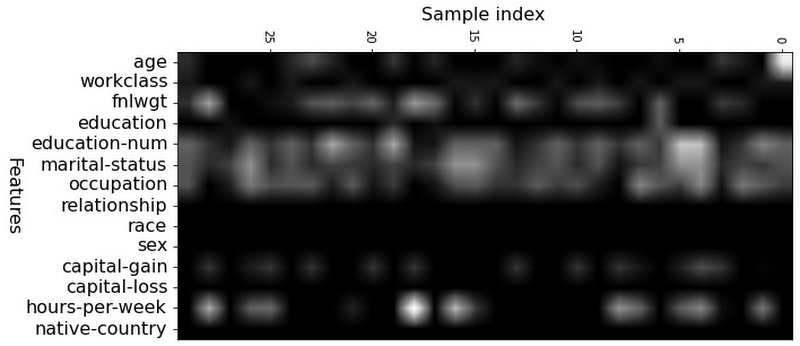
In addition to high accuracy, another core benefit of TabNet is that, unlike conventional deep neural network (DNN) models such as multi-layer perceptrons, its architecture includes explainability out of the box. This new launch on Vertex Tabular Workflows makes it very convenient to visualize explanations of the trained TabNet models, so that the users can quickly gain insights on how the TabNet models arrive at its decisions. TabNet provides feature importance output via its learned masks, which indicate whether a feature is selected at a given decision step in the model. Below is the visualization of the local and global feature importance based on the mask values. The higher the value of the mask for a particular sample, the more important the corresponding feature is for that sample. Explainability of TabNet has fundamental benefits over post-hoc methods like Shapley values that are computationally-expensive to estimate, while TabNet’s explanations are readily available from the model’s intermediate layers. Furthermore, post-hoc explanations are based on approximations to nonlinear black-box functions while TabNet’s explanations are based on what the actual decision making is based on.
Explainability example: To illustrate what is achievable with this kind of explainability, Figure 2 below shows the feature importance for the Census dataset. The figure indicates that education, occupation, and number of hours per week are the most important features to predict whether a person can earn more than $50K/year (the color of corresponding columns are lighter). The explainability capability is sample-wise, which means that we can get the feature importance for each sample separately.
Benefits as a Fully-Managed Vertex Pipeline
TabNet on Vertex Tabular Workflows makes the model development and deployments tasks much simpler – without writing any code, one can obtain the trained TabNet model, deploy it in their application, and use the MLOps capabilities enabled by Vertex Managed Pipelines! Some of these benefits are highlighted as:
- Compatibility with Vertex AI ML Ops for implementing automated ML at scale including products like Vertex AI Pipelines and Vertex AI Experiments.
- Deployment convenience: Vertex AI prediction services, both in batch and online mode, are supported out-of-the-box.
- Customizable feature engineering to enable the best utilization of the domain knowledge of users.
- Using Google’s state-of-the-art search algorithms, automatic tuning to identify the best-performing hyperparameters, with automatic selection of the appropriate hyper-parameter search space based on dataset size, prediction type, and training budget.
- Tracking the deployed model and convenient evaluation tools.
- Easiness in comparative benchmarking with other models (such as AutoML and Wide & Deep Networks) as the user journey would be unified.
- Multi-region availability to better address international workloads.
More details
If you’re interested in trying TabNet on Vertex AI on your tabular datasets, please check out Tabular Workflow on Vertex AI and fill out this form.
Acknowledgements: We’d like to thank Nate Yoder, Yihe Dong, Dawei Jia, Alex Martin, Helin Wang, Henry Tappen and Tomas Pfister for their contributions to this blog.
More Relevant Stories for Your Company

Contact Center AI Platform Brings Together the Merits of AI, Cloud Scalability, CRM Integration and Multi-experiences!
Providing best-in-class customer service is crucial for the success of your business. Contact centers are a critical touch point, as they have to balance between representing your brand and prioritizing customer care. When your customers seek help and support, they expect efficient service that is accessible through modern voice and

Vector Search: The Tech Powering Billions of Search Results for Google Users
Recently, Google Cloud partner Groovenauts, Inc. published a live demo of MatchIt Fast. As the demo shows, you can find images and text similar to a selected sample from a collection of millions in a matter of milliseconds: Image similarity search with MatchIt Fast Give it a try — and either select a preset

Discover Gen App Builder: Transform Search and Conversational Experiences Through Generative AI
If you’ve been exploring recently-launched consumer generative AI tools like Bard and thinking about how to build similar experiences for your business, Generative AI App Builder, or Gen App Builder for short, is here to get you started.Gen App Builder is part of Google Cloud’s recently announced generative AI offerings and lets developers,

Thinking of a Multicloud Journey? Here’s What Our Experts Want You to Consider
Do you want to fire up a bunch of techies? Talk about multicloud! There is no shortage of opinions. I figured we should tackle this hot topic head-on, so I recently talked to four smart folks—Corey Quinn of Duckbill Group, Armon Dadgar of Hashicorp, Tammy Bryant Butow of Gremlin, and James Watters of VMware—about what multicloud is
