






Upgrade Your Contact Center with Knowlarity’s AI-powered Speech Analytics for Higher CX
READ FULL INTRODOWNLOAD AGAIN6214
Of your peers have already downloaded this article
7:00 Minutes
The most insightful time you'll spend today!
Empowering AI Startups: Google Cloud’s Game-Changing Benefits

1140
Of your peers have already read this article.
3:30 Minutes
The most insightful time you'll spend today!
New AI startup program benefits and Accelerator introduced at the Google Cloud Startup Summit
Google Cloud is committed to supporting the growth and advancement of startups, with particular focus on helping startups looking to build and scale. We’re seeing tremendous innovation from startups choosing Google Cloud to advance their generative AI development, thanks to our fully-managed and serverless data, AI, and infrastructure solutions. That’s why today’s Startup Summit, and announcements, are focused on AI.
Following our March 14th announcement that we were expanding the Google for Startups Cloud Program with exclusive benefits for AI startups, we’re excited to announce that the program is now live. Starting today, eligible seed to series A startups that use AI as their core technology to develop their primary products or solutions can apply here. This gives them access to all the Google for Startups Cloud Program benefits, including:
Up to $350,000 USD over two years in Google Cloud credits
For Google Cloud and Firebase usage covered in:
- Year 1: 100% up to $250,000 USD in Google Cloud credits [1] (includes standard program credits plus an additional $150,000 USD for the AI startup program)
- Year 2: 20% up to an additional $100,000 USD in Google Cloud credits
Technical & collaboration support
We’re providing credits to allow AI startups access to fast, high-quality Customer Care Enhanced Support, access to Google Cloud Startup Customer Engineers, and a dedicated Startup Success Manager to accelerate onboarding with Google Cloud. We’re also offering 12 months of free Google Workspace Business Plus for new sign-ups.
Additional AI benefits, such as access to AI experts, training, and resources include:
Webinars & live Q&A sessions
Exclusive access to join webinars and live Q&As with our Google Cloud AI product managers, engineers, and developers.
Insight into AI innovation
Direct visibility into Google Cloud’s latest AI advances and product roadmap.
Hands-on AI learning labs
Free access to advanced hands-on learning labs focused on AI/ML and the latest Google Cloud technology.
Exclusive AI ISV/Saas startup access to Built with Google Cloud AI
Access to the AI Center of Excellence, tools and training, co-marketing, and amplification on Google Cloud Marketplace. These resources have historically been available only to AI enterprise ISV/SaaS companies, but will now also be offered to ISV/SaaS startups in our program.
Dedicated AI technical guidance, workshops, and best practices
Architectural guidance and best practices to get started and build with Google Cloud AI solutions, including technical deep dives and hands-on workshops.
We’re also excited to announce an inaugural North American Google for Startups Accelerator: Cloud. This 10-week virtual Accelerator is equity-free and best suited for cloud-native startups leveraging AI and ML in their operations. Designed to help prepare for the next phase of the growth journey, participating startups will work with the best of Google’s programs, products, people, and technology. Applications are open now until May 30th and the program kicks off in July. Find out more here.
Our goal is to enable more AI-first startups and give them the technology, community, and resources they need to build and grow their startup faster, smarter, and cheaper. Furthermore, partnering with Google Cloud lets startups seamlessly integrate with other Google solutions and leverage our global infrastructure. Google Cloud’s AI platform, Vertex AI, gives startups the intelligence they need to make smart business decisions and allows them to easily build, deploy, and scale machine learning (ML) models faster. They can also quickly build with Google Cloud’s advanced generative AI technologies or use our best-in-class speech, vision, translation, and language APIs. To learn more about Google Cloud’s recently-announced Generative AI Support in Vertex AI, check out this deep dive, and to keep up with Google Cloud’s latest generative AI news and thought leadership, read The Prompt on Transform with Google Cloud.
Startups around the world are choosing Google Cloud. Join us and let’s build the future, together.
Google Cloud expands availability of enterprise-ready generative AI

1075
Of your peers have already read this article.
1:30 Minutes
The most insightful time you'll spend today!
Generative AI continues to develop at a blistering pace, making it more important than ever that organizations have access to enterprise-ready capabilities to help them leverage this disruptive technology.
Harnessing the power of decades of Google’s research, innovation, and investment in AI, Google Cloud continues to make generative AI available with baked-in security, data governance, and scalability across the board.
To this end, last month, we announced the general availability of Generative AI support on Vertex AI, giving our customers the ability to access powerful foundation models from Google Research and tools for customizing and applying them.
Today we are announcing the general availability (GA) of four important foundation models for Vertex AI. These include Imagen, PaLM 2 for Chat, Codey, and Chirp. For each of these models, organizations can access APIs on Model Garden and do prompt design and tuning on Generative AI Studio.
- Imagen includes four key features:
- Image generation for creating studio-grade images at scale
- Image editing to edit generated or existing images via text prompts
- Image captioning for creating captions of images at scale
- Visual Question & Answering (VQA) for interacting with, analyzing, and explaining images
- PaLM 2 for Chat follows the general availability of PaLM 2 for Text in June
- Codey supports code generation, completion, and code chat
- Chirp supports multilingual Speech AI
We’re also announcing Multimodal Embeddings API in preview, which lets customers combine the power of Vertex AI’s generative AI models with their proprietary data, to generate embeddings, or interchangeable vector representations, of their text and image data. These capabilities can enable data science teams to deliver a variety of downstream tasks such as image classification, content recommendations, and visual search.
In this blog post, we’ll explore what your organization can do with these powerful models and how Vertex AI provides the enterprise-ready capabilities you can use to get up and running with generative AI.
Helping to drive enterprise value from Generative AI models
Powerful models are the foundation of generative AI, but the software, tools, and infrastructure that surround these models are equally important for enterprise adoption. Organizations face challenges not only accessing these models, but also integrating AI while maintaining protection over intellectual property, adhering to regulations around data security and privacy, and ensuring models and applications are safe to use. Many organizations also want to use generative AI without incurring large costs or managing huge clusters.
We help address these challenges head-on with Vertex AI’s platform capabilities for scalable application integration, purpose-built AI infrastructure, secure and private data customization, and responsible use of this technology.
Let’s see how each of these pillars can help your organization.
Access models to build production-ready generative applications
Vertex AI can make it easy to access foundation models, as today’s model announcements attest. While models are an inextricable part of generative AI, the software that helps enterprises use this technology is equally important—which is why Vertex AI also offers a range of tools for tuning, deploying, monitoring, and maintaining models, so you can build differentiated applications using your own data.
Turning to today’s announcements, in May we announced Imagen, our foundation model for image generation. Now, we are excited to announce Imagen is generally available with an allowlist (i.e., approved access via your sales representative), letting onboarded customers start using image generation and editing capabilities. Visual Q&A and Captioning for production workloads are also generally available for all customers. Visual Q&A provides new ways to engage with image-based data like retail products or image libraries. This new capability can give you answers to questions about an image, helping you analyze large amounts of data quickly, and it can even help the visually impaired understand images or graphs that they wouldn’t be able to otherwise. Captioning, meanwhile, can make it easy to generate relevant descriptions for your images. Captions can help with indexing and searching, as well as assigning image descriptions to product listings on eCommerce websites.
“Imagen is beginning to power key capabilities within Omni, Omnicom’s open operating system, that will enable 17,000+ trained and certified users to create audience-driven customized images in minutes. Imagen has been instrumental in offering a scalable platform for image generation and customization. Integrating it into our platform allows us to expand the scope of audience-powered creative inspiration, at a scale that wasn’t previously possible,” said Art Schram, Annalect Chief Product Officer at Omnicom. “We’re starting to adopt the latest features like styles and fine tuning, and engineering data-driven prompts. We look forward to continuing to provide our users relevant visual inspiration in a responsible way.”
“The latest improvements in Imagen’s product preservation capabilities are a perfect match for Typeface’s focus on personalized AI for brands,” explained Vishal Sood, Head of Product at Typeface. “By combining Google Vertex AI’s Imagen with Typeface’s brand-personalized AI, we are able to help enterprises to create 10x personalized content in a fraction of time.”
Google Shopping recently built an application called Product Studio using Imagen on Vertex AI. Product Studio can enable merchants to create rich product images quickly and easily, at a fraction of the time it takes to do professional product photo shoots. “We’re excited about the feedback we’re getting from merchants in our early pilots, who say that Product Studio, which leverages Imagen on Vertex AI, helps them generate and publish lifestyle product photos directly to their product catalogs,” says Jeff Harrell, Google’s Senior Director of Product Management for Merchant Shopping.
Announced in May, PaLM 2 is a family of models that power dozens of Google products, including Bard and Duet AI in Google Cloud. With the PaLM 2 for Chat model, now generally available, you can leverage Google’s PaLM’s variety of abilities for multi-turn chat applications, such as shopping assistants, customer support agents, and more.
ThoughtSpot, provider of a widely-adopted business intelligence platform, is using PaLM 2 to build a new feature in ThoughtSpot for Google Sheets called “AI Explain,” which can instantly generate explanations of charts, visuals, and anomalies, and will launch new conversational AI and ML-enabled predictive forecasting capabilities into its analytics platform.
With Codey, your organization’s developers can accelerate a wide variety of coding tasks, helping to empower them to work efficiently and close skills gaps. The model enables not only code completion and code generation capabilities, but also chat to help with debugging, documentation, learning new concepts, and more. Since launching in preview in May, we’ve added additional programming languages including Go, Google Standard SQL, Java, Javascript, Python, and Typescript. We’ve also improved the quality of code responses and increased serving capacity, enabling your developers with the right tools to enter the era of generative engineering.
“Security and privacy are key to incorporating AI into the software development lifecycle,” said David DeSanto, Chief Product Officer at GitLab. “GitLab leverages Vertex AI to deliver new, AI-powered features with a privacy-first approach, including the ability to run our own models and leverage Codey foundation models built on top of PaLM 2. The GitLab DevSecOps platform empowers organizations to harness the benefits of AI for faster software delivery, while ensuring their data, intellectual property, and source code are protected.”
Originally released in May in preview, Chirp is a version of our 2 billion-parameter speech model, which was trained on millions of hours of audio and supports over 100 languages. Chirp achieves 98% accuracy on English and relative improvement of up to 300% in languages with less than 10 million speakers. Whether the use case involves customer support, transcriptions, or voice control, Chirp can help your organization communicate with customers and constituents inclusively, by engaging audiences in their native languages.
Last but not least, our Multimodal Embeddings API, now in preview, can unlock an array of new applications, such as image and text-based recommendations, by enabling the processing of text and images interchangeably. This capability complements our Text Embeddings API, which became generally available in June, and remains a recommended choice for those with fully text-based use cases. Multimodal Embeddings API makes it possible to categorize images and text together and can be crucial for use cases like retail recommendation systems that can provide relevant outputs from both images of products and text descriptions.
Match generative AI with infrastructure
Beyond access to models and tools for building generative AI apps, you need infrastructure to make sure your apps can scale and reliably perform — ideally without running into daunting compute costs or management overhead that distracts your technical talent from building innovative products. Google Cloud offers the choice and power to run smaller models running finite tasks at the lowest latency levels, as well as to run large models capable of cutting-edge experiments.
As our large language model customers are looking to scale up their projects and applications using our models, they often need assurances that their requests will be serviced with acceptable performance. This is especially critical for delivering real-time applications where customer service is paramount. Starting in August, Vertex AI will support provisioned, dedicated generative AI capacity that can deliver guaranteed throughput. This feature can be especially beneficial to customers who have a high volume of sustained workloads.
Leverage generative AI while protecting data and privacy
One capability enabled by Google Cloud is the ability to customize models using your own data. Vertex AI can help customers keep their data protected, secure, and private. When a company tunes a foundation model in Vertex AI, private data, model outputs, and prompts can be kept private, and they are never used in the foundation model training corpus. We recently published a whitepaper, “Adaptation of Large Foundation Models,” which outlines how we help protect customer data.
Auditability and compliance are essential to helping ensure the security and privacy of customer data. We also engage in comprehensive GDPR privacy efforts, including our transparency commitments for customer data usage and the support for our customer’s Data Protection Impact Assessments (DPIAs). Now, we’re excited to support HIPAA compliance for many of our generally available models on Vertex AI, so that healthcare and life science customers with whom we have a Business Associate Agreement can run workloads with Protected Health Information (PHI) data on Google Cloud.
Innovate responsibly
Our AI Principles put beneficial use, user safety, and avoidance of harms above business outcomes and are embedded in how we develop our AI products. We’ve conducted extensive reviews on our generative AI products to identify potential risks and have developed guardrails to mitigate these impacts. For example, to address concerns around safety, we’ve implemented safety filters for bias, toxicity, and other harmful content. We also equip our customers with the tools they need to help reduce risk within their applications and provide recommendations to help navigate responsible AI.
Bring the power of generative AI to your organization
With both a wide selection of foundation models and extensive, enterprise-grade platform capabilities, Vertex AI continues to unlock ways for your business or organization to access foundation models, tune them on your proprietary data, and leverage them for differentiated apps and digital experiences. To take the next step, visit our product page or reach out to our sales representatives to gain access to our latest capabilities.
Taking Maps Further: New Website Experience for Product Discovery, Budgeting and Access to Dev Documentation

6633
Of your peers have already read this article.
1:30 Minutes
The most insightful time you'll spend today!
For more than 15 years, developers have used Google Maps Platform to deliver location-based experiences to their end users and used location intelligence to optimize their businesses. Along this journey, we’ve made a variety of changes to better support our community as needs have changed and new industries and technologies have emerged. We started rolling out a new website experience, at https://mapsplatform.google.com, to help you better understand the products and solutions best suited to address your objectives. Plus, now you can directly connect to the developer documentation for each product to get started quickly, and you can visualize usage and associated costs to have a better idea of what to expect before getting started.
Getting to your solution faster
Maps, Routes, Places are building blocks that let you develop implementations for any use case. Building for specific use cases, however, typically requires using a combination of APIs and SDKs. To help you quickly understand what’s possible and what you need to build for your use case, you can now visit the solutions tab to select from a list of popular use cases or industries. Once you’ve selected a use case or industry, you’re taken to a page where you can explore relevant products, read helpful blog posts, see how other customers have deployed for similar use cases, and more.
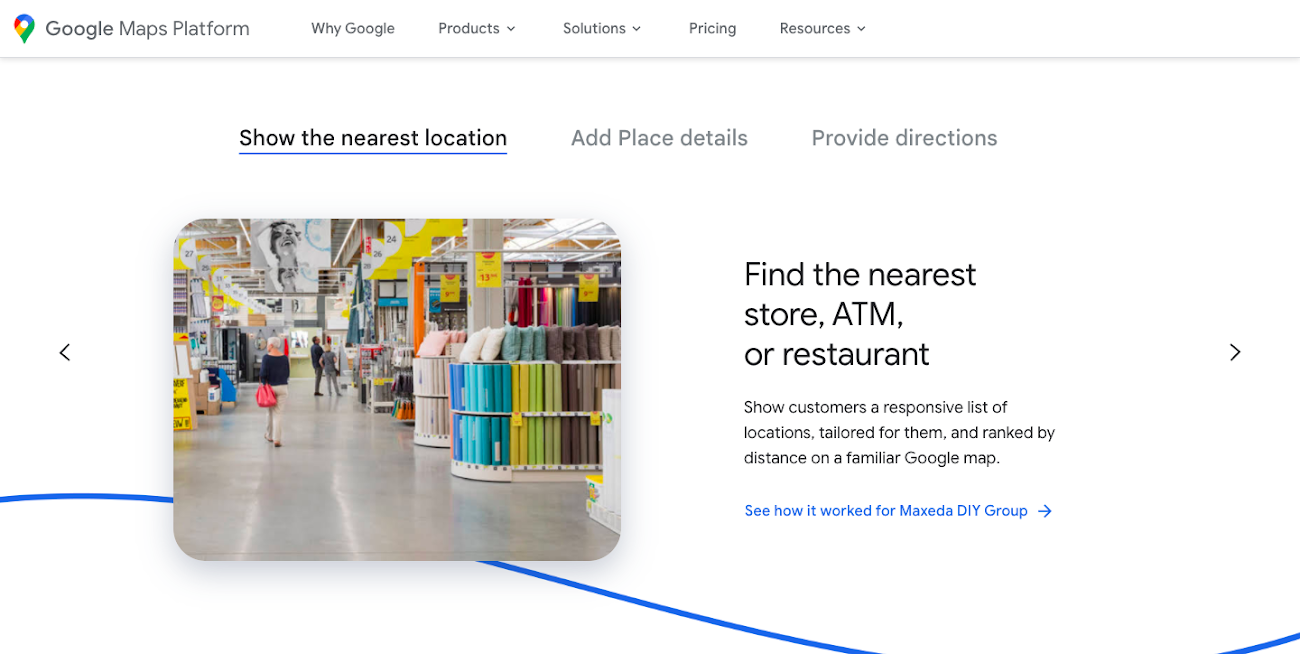
Direct access to developer documentation
Did you know there are more than a thousand pages of developer documentation created to help you get started, unblock you when you’re stuck, and share best practices? Now when you explore a product or solution from the Google Maps Platform website, you can easily navigate back and forth between our website and documentation. Just tap on JS, iOS, Android or API under the product name to get to the documentation you need.
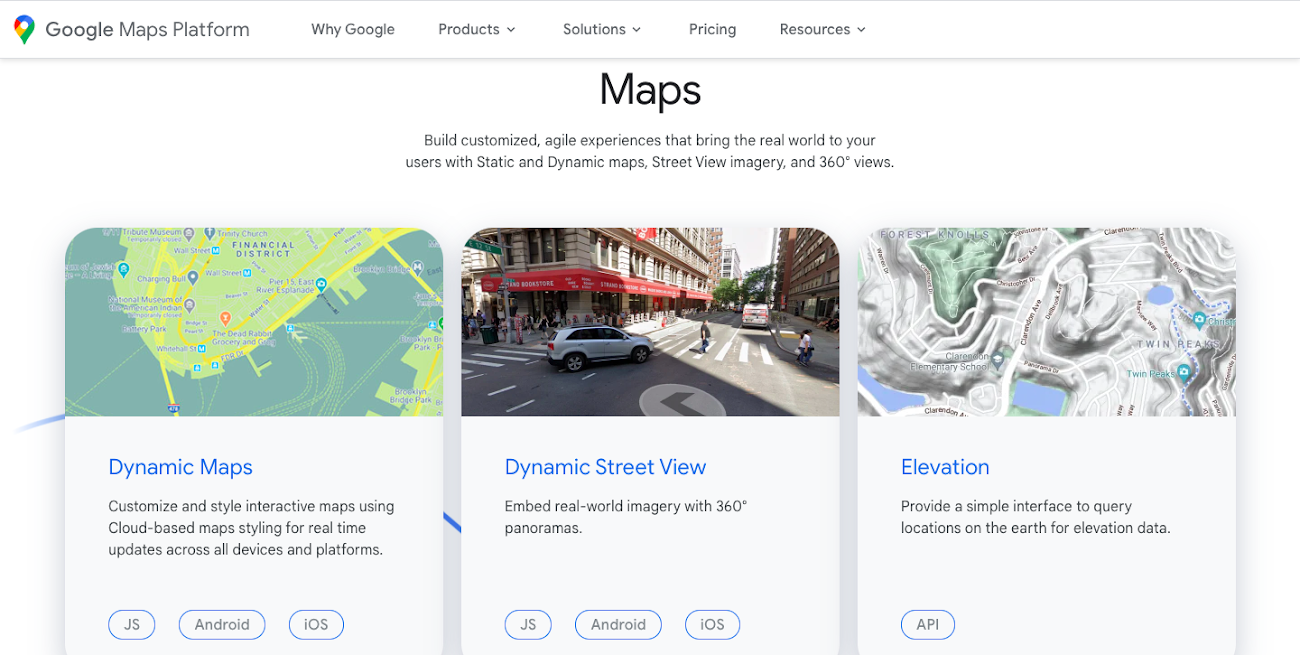
Budgeting for your project
To help you calculate pricing for your project, we’ve introduced a new pricing calculator. Once you find the product and API or SDK you plan to use, pull the slider to reflect your estimated number of monthly requests. This will automatically update the “monthly cost” column for each product and API or SDK you plan to use. If your estimated monthly requests exceed the slider limit, contact our sales team to learn about volume discounts that start at 20% off.
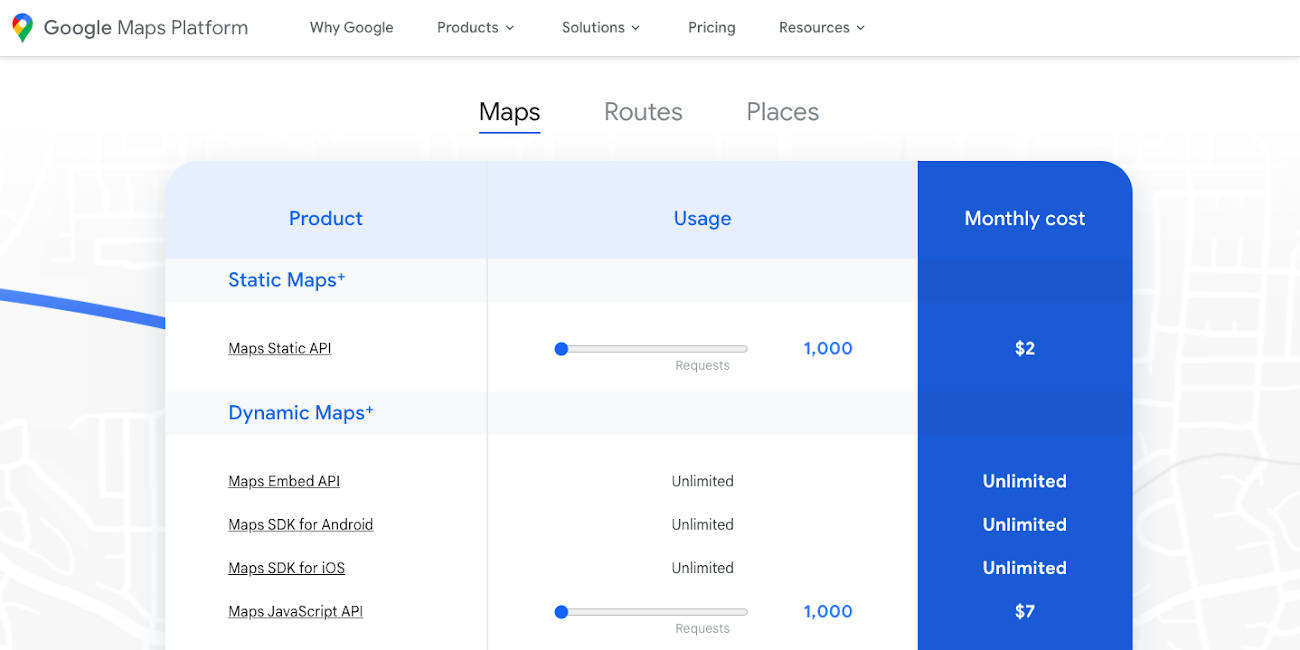
We hope our new website makes it easier to discover our products and solutions, estimate your budget, and start building with our documentation so you can deliver helpful experiences to your users and optimize your business.
For more information on Google Maps Platform, visit https://mapsplatform.google.com.

ESG Did the Math: It’s Cheaper and Smarter to Migrate Enterprise Data Warehouses to Google BigQuery. Way Smarter
DOWNLOAD WHITEPAPER6481
Of your peers have already downloaded this article
11:30 Minutes
The most insightful time you'll spend today!
Enterprise data warehouses (EDWs) are often deemed the most valuable asset in the data center, serving as the backbone of the business. The ongoing insight gained from these solutions has justified the significant up-front capital investments and ongoing operational costs, but the rigidity of the traditional EDW is forcing organizations to reevaluate their approach to analytics and business intelligence.
While legacy EDW solutions were all about throwing as much computational power as possible at a relatively static data set, with the inflow of new and valuable sources of data and the emergence of all-encompassing analytics initiatives, the success of today’s EDW solutions depends more on operational and resource agility than raw horsepower.
Being able to dynamically adjust to the needs of the business, integrate into operational processes, and quickly react to emerging opportunities can place an organization at a distinct competitive advantage.
Today’s EDW solutions must act as a global repository of information, provide the agility to scale up or down on demand, and seamlessly integrate with other analytics tools and services used throughout a data-driven organization.
Over the last two years, ESG has conducted detailed studies quantifying the economic value of Google data analytics services. The first evaluated Google BigQuery compared to on-premises Hadoop and AWS redshift. The second focused on Google DataProc compared to DIY Spark and Hadoop approaches. Here’s the next iteration of our economic analysis, extending the BigQuery study to incorporate a comparison to legacy enterprise data warehouses, both on-premises and in the cloud.
Through publicly available pricing and in-depth qualitative customer interviews, ESG was able to assert a base set of assumptions that power a dynamic model, incorporating up-front capital investments, deployment and migration costs, expected monthly cloud costs, administrative costs, and operational costs associated with legacy on-premises EDWs, cloud-based EDWs, and Google BigQuery.
The crux of the results show organizations can save up to 52% by using BigQuery over on-premises EDWs and up to 41% over cloud-based EDWs. Unlike legacy on-premises EDWs, BigQuery provides organizations with the key abilities that are essential to delivering a modern EDW solution, most notably the ability to integrate across other Google Cloud Platform services, including its market leading AI-based solutions and services.
Although not called t out directly in the published report, ESG’s models indicate that the savings achieved by migrating an on-premises EDW solution to Google BigQuery may actually be more cost effective than simply continuing to operate an existing on-premises EDW solution.
Startup Success Blueprint: Insights on Cloud Provider Selection from One AI

909
Of your peers have already read this article.
4:30 Minutes
The most insightful time you'll spend today!
From the newsroom to the boardroom, everywhere we turn these days the topic of conversation is artificial intelligence (AI). From the smallest startups to the largest enterprises, every business is looking for ways to incorporate generative AI technology into their products or services.
Generative AI is a new breed, able to not only discern patterns in data but generalize from them and create new data—and it’s moving fast. With new technologies rapidly emerging, there’s a lot to consider when choosing a tech stack that’s right for your startup.
Our mission is to empower startups to build generative AI applications quickly, efficiently, and responsibly. In addition to our technology, we offer a variety of fresh educational and consulting initiatives, as well as comprehensive plans tailored to specific industry applications.
At the recent Google Cloud Startup Summit, leaders from One AI and MongoDB weighed in on various decisions startups face when choosing a development platform to integrate AI into their products. (You can watch the full conversation here.) They shared key insights into the challenges startups face when applying AI technology to real-world business and product use cases.
In this blog, we’ll explore why One AI – a platform that empowers businesses to deploy tailored AI solutions – relies on MongoDB on Google Cloud for performance, scale, functionality, and TCO. We will also cover the things that startups should keep in mind when building their generative AI stack.
Fine-tuning generative AI for startups
First, let’s start with a little background.
AI-based capabilities have been around for decades now, but generative AI is distinct. It’s a more mature version of AI, powered by models pre-trained on very large datasets composed of massive quantities of images, text, and data. These models are known as foundation models, and they include large language models (LLMs), text-to-image models, multimodal models, and more. Foundation models let intelligent applications generate new images, text, and data based on queries or prompts. This in turn allows companies to deploy those capabilities in their products and services faster since they don’t have to retrain the whole AI from scratch.
Over the course of their diverse startup careers, Amit Ben, CEO at One AI and his team have built AI-based capabilities from the ground up for various products in various fields.
“And each time, we had to rebuild the tech stack over again,” Amit explains. “With the advent of generative AI, startups now have the ability to deploy much faster — with a lower TCO and higher confidence — and deliver the capabilities they need into their products and services. It finally makes sense for every company to have AI in its product portfolio.”
“For us to be able to focus on that,” Amit adds, “we need to make sure we have a rock-solid foundation that we can build on.”
That foundation is MongoDB on Google Cloud.
Helping startups build fast and with flexibility
Startups can scale from ideation to growth with Google Cloud’s global availability, market-leading sustainability, and the same zero-trust security model that Google itself depends on.
With MongoDB, startups can take advantage of iteration cycles that are 3-5X faster, reduce sprawl and complexity, and benefit from the scalable infrastructure and advanced analytics tools on Google Cloud.
With MongoDB on Google Cloud, Amit and his team are confident they can adapt to new schemas, to new data, and to the scale they need for both writing and reading, all while operating on a scalable platform and infrastructure they can rely on for the long haul.
A common mistake for startups is turning to niche, single-point solutions. But this can backfire when they realize their solution doesn’t provide the security, scalability, and performance they need to grow.
Additionally, startups tend to have tight iteration cycles as they find their ideal product market fit. The ability to build fast and with improved flexibility is a key differentiator in a startup environment.
From cutting-edge automation to rock-solid redundancy and performance, there are many reasons why startups choose MongoDB on Google Cloud. And now, a dedicated partnership helps startups like One AI scale more quickly, more securely, and more successfully.
Google Cloud and MongoDB for startups
Choosing the right technology to accelerate time to market is critical to a startup’s success. Not only is it easy to get started, but Google Cloud and MongoDB also provide the foundation for users to scale without limits — so startups can focus on innovating and growing their businesses.
Learn more about the powerful startup programs available from Google Cloud and MongoDB.
More Relevant Stories for Your Company

Advance Your Cloud Career: Seven New No-Cost Generative AI Training Courses
Editor's note: This blog has been updated since it originally published to reflect the total number of generative AI courses that have become available since the publish date. An AI/ML (artificial intelligence/machine learning) career path can be a great specialty area within the cloud—and one of the most accessible! Because this

Innovate Faster & More Flexibly: How Our Commitment to Open Source Unlocks AI and ML Innovation
At Google, we believe anyone should be able to quickly and easily turn their artificial intelligence (AI) idea into reality. Open source software (OSS) has become increasingly important to this goal, heavily influencing the pace of innovation in AI and machine learning (ML) ecosystems. Over the last two decades, ML
Google Cloud VMware Engine Achieves HIPAA Compliance
We are excited to announce that as of April 1, 2021, Google Cloud VMware Engine is covered under the Google Cloud Business Associate Agreement (BAA), meaning it has achieved HIPAA compliance. Healthcare organizations can now migrate and run their HIPAA-compliant VMware workloads in a fully compatible VMware Cloud Verified stack running natively

Making Your Pictures Worth a Thousand Labels! (with Cloud Vision API)
In this post, I'll be showing some amazing ways the Vision API can extract meaning from your images - keep reading, or jump directly into a tutorial using Python, Node.js, Go, or Java! This tutorial can be completed at no cost within the Google Cloud Free Tier. They say a picture is worth a
