






Telegraph Media Group Creates More Marketing Opportunities With Google Cloud Platform
READ FULL INTRODOWNLOAD AGAIN3798
Of your peers have already downloaded this article
2:01 Minutes
The most insightful time you'll spend today!
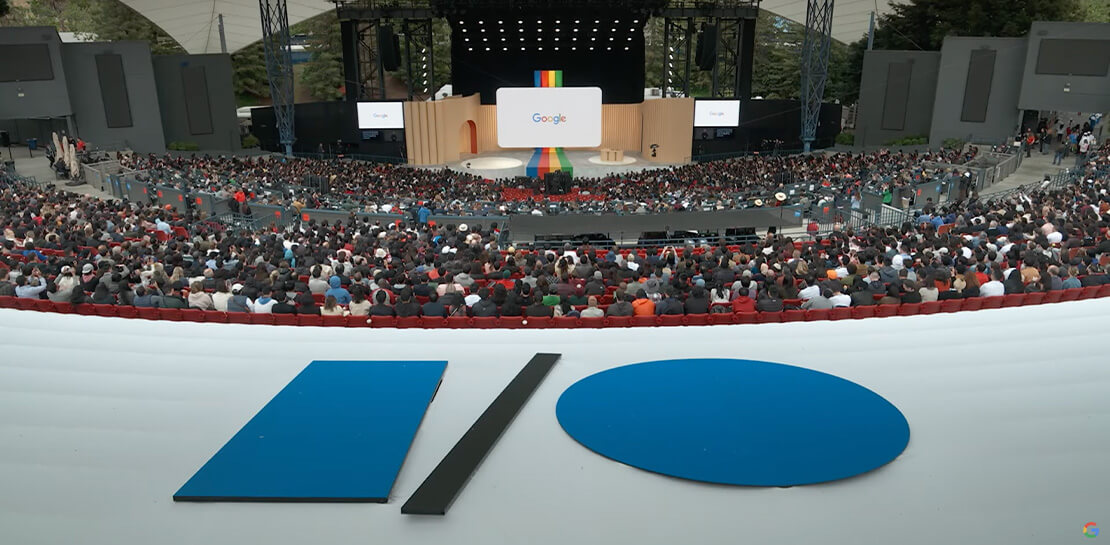
Generative AI Takes Center Stage at Google I/O Conference 2023
1191
Of your peers have already read this article.
7:00 Minutes
The most insightful time you'll spend today!
Over the past decade, artificial intelligence has evolved from experimental prototypes and early successes to mainstream enterprise use. And the recent advancements in generative AI have begun to change the way we create, connect, and collaborate. As Google CEO Sundar Pichai said in his keynote, every business and organization is thinking about how to drive transformation. That’s why we’re focused on making it easy and scalable for others to innovate with AI.
In March, we announced exciting new products that infuse generative AI into our Google Cloud offerings, empowering developers to responsibly build with enterprise-level safety, security, and privacy. They include Gen App Builder, which lets developers quickly and easily create generative chat and enterprise search applications, and Generative AI support in Vertex AI, which expands our machine learning development platform with access to foundation models from Google and others to quickly build, customize and deploy models. We also introduced our vision for Google Workspace, and delivered generative AI features to trusted testers in Gmail and Google Docs that help people write.
Last month we introduced Security AI Workbench, an industry-first extensible platform powered by our new LLM security model Sec-PaLM, which incorporates Google’s unique visibility into the evolving threat landscape and is fine-tuned for cybersecurity operations.
Today at Google I/O, we are excited to share the next steps not only in our own AI journey, but also those of our customers and partners as well. We’ve already seen a number of organizations begin to develop with and deploy our generative AI offerings. These organizations have been able to move their ideas from experimentation to enterprise-ready applications with the training models, security, compute infrastructure, and cost controls needed to provide their customers with transformative experiences. Our open ecosystem, which provides opportunities for every kind of partner, continues to grow as well. And we are also pleased to share new services and capabilities across Google Cloud and Workspace, including Duet AI—our AI-powered collaborator—to enable more users and developers to start seeing the impact AI can have on their organization.
Customers bringing ideas to life with generative AI
Leading companies in a variety of industries like eDreams ODIGEO, GitLab, Oxbotica, and more, are using our generative AI technologies to create engaging content, synthesize and organize information, automate business processes, and build amazing customer experiences. A few examples we showcased today include:
- Adore Me, a New York-based intimate apparel brand, is creating production-worthy copy with generative AI features in Docs and Gmail. This is accelerating projects and processes in ways that even surprised the company.
- Canva, the visual communication platform, uses Google Cloud’s rich generative AI capabilities in language translation to better support its non-English speaking users. Users can now easily translate presentations, posters, social media posts, and more into over a hundred languages. The company is also testing ways that Google’s PaLM technology can turn short video clips into longer, more compelling stories. The result will be a more seamless design experience while growing the Canva brand.
- Character.AI, a leading conversational AI platform, selected Google Cloud as its preferred cloud infrastructure provider because we offer the speed, security and flexibility required to meet the needs of its rapidly growing community of creators. We are enabling Character.AI to train and infer LLMs faster and more efficiently, and enhancing the customer experience by inspiring imagination, discovery, and understanding.
- Deutsche Bank is testing Google’s generative AI and large language models (LLMs) at scale to provide new insights to financial analysts, driving operational efficiencies and execution velocity. There is an opportunity to significantly reduce the time it takes to perform banking operations and financial analysts’ tasks, empowering employees by increasing their productivity while helping to safeguard customer data privacy, data integrity, and system security.
- Instacart is always looking for opportunities to adopt the latest technological innovations, and by joining the Workspace Labs program, they have access to the new features and can discover how generative AI will make an impact for their teams.
- Orange is exploring a next-generation contact center with Google Cloud. With customers in 26 countries, the global telecommunications firm is testing generative AI to transcribe the call, summarize the exchange between the customer and service representatives, and suggest possible follow up actions to the agent based on the discussion. This experiment has the potential to dramatically improve both the efficiency and quality of customer interactions. Orange is working closely with Google to help ensure data protection and make sure that systematic employee review of Generative AI output and transparency can be implemented.
- Replit is developing a collaborative software development platform powered by AI. Developers using Replit’s Ghostwriter coding AI already have 30% of their code written by generative AI today. With real-time debugging of the code output and context awareness of the program’s files, Ghostwriter frees up developers’ time for more challenging and creative aspects of programming.
- Uber is creating generative AI for customer-service chatbots and agent assist capabilities, which handle a range of common service issues with human-like interactions with the aim of achieving greater customer satisfaction and cost efficiency. Additionally, Uber is working on using our synthetic data systems (a technique for improving the quality of LLMs) in areas like product development, fraud detection, and employee productivity.
Wendy’s is working with Google Cloud on a groundbreaking AI solution, Wendy’s FreshAI, designed to revolutionize the quick service restaurant industry. The technology is transforming Wendy’s drive-thru food ordering experience with Google Cloud’s generative AI and LLMs—with the ability to discern the billions of possible order combinations on the Wendy’s menu. In June, Wendy’s plans to launch its first pilot of the technology in a Columbus, Ohio-area restaurant, before expanding to more drive-thru locations.
Partnering creates a strong ecosystem of real-world options for customers
At Google Cloud, we are dedicated to being the most open hyperscale cloud provider, and that includes our AI ecosystem. Today, we are excited to expand upon the partnerships announced earlier this year for every layer of the AI stack—chipmakers, companies building foundation models and AI platforms, technology partners enabling companies to develop and deploy machine learning (ML) models, app-builders solving customer use cases with generative AI, and global services and consulting firms that help enterprise customers implement all of this technology at scale.
We announced new or expanded partnerships with SaaS companies like Box, Dialpad, Jasper, Salesforce, and UKG; and consultancies including Accenture, BCG, Cognizant, Deloitte, and KPMG. Together with our previous announcements with companies like AI21 Labs, Aible, Anthropic, Anyscale, Bending Spoons, Cohere, Faraday, Glean, Gretel, Labelbox, Midjourney, Osmo, Replit, Snorkel AI, Tabnine, Weights & Biases, and many more, they provide the a wide range of options for businesses and governments looking to bring generative AI into their organizations.
Introducing new generative AI capabilities for Google Cloud
To help cloud users of all skill levels solve their everyday work challenges, we’re excited to announce Duet AI for Google Cloud, a new generative AI-powered collaborator. Duet AI serves as your expert pair programmer and assists cloud users with contextual code completion, offering suggestions tuned to your code base, generating entire functions in real-time, and assisting you with code reviews and inspections. It can fundamentally transform the way cloud users of all skill sets build new experiences and is embedded across Google Cloud interfaces—within the integrated development environment (IDE), Google Cloud Console, and even chat.
For developers looking to create generative AI applications more simply and efficiently, we are also introducing new foundation models and capabilities across our Google Cloud AI products. And to continue to enable and inspire more customers and partners, we are opening up generative AI support in Vertex AI and expanding access to many of these new innovations to more organizations.
- New foundation models are now available in Vertex AI. Codey, our code generation foundation model, helps accelerate software development with code generation, code completion, and code chat. Imagen, our text-to-image foundation model, lets customers generate and customize studio-grade images. And Chirp, our state-of-the-art speech model, allows customers to more deeply engage with their customers and constituents inclusively in their native languages with captioning and voice assistance. They can each be accessed via APIs, tuned through our intuitive Generative AI Studio, and feature enterprise-grade security and reliability, including encryption, access control, content moderation, and recitation capabilities that let organizations see the sources behind model outputs.
- Text Embeddings API is a new API endpoint that lets developers build recommendation engines, classifiers, question-answering systems, similarity matching, and other sophisticated applications based on semantic understanding of text or images.
- Reinforcement Learning from Human Feedback (RLHF) allows organizations to incorporate human feedback to deeply customize and improve model performance.
Underpinning all of these innovations is our AI-optimized infrastructure. We provide the widest choice of compute options among leading cloud providers and are excited to continue to build them out with the introduction of new A3 Virtual Machines based on NVIDIA’s H100 GPU. These VMs, alongside the recently announced G2 VMs, offer a comprehensive range of GPU power for training and serving AI models.
Extending generative AI across Google Workspace
Earlier this year, we shared our vision for bringing generative AI to Workspace, and gave many users early access to features that helped them write in Gmail and Google Docs. Today, we are excited to announce Duet AI for Google Workspace, which brings together our powerful generative AI features and lets users collaborate with AI so they can get more done every day. We’re delivering the following features to trusted testers via Workspace Labs:
- In Gmail, we’re adding the ability to draft responses that consider the context of your existing email thread—and making the experience available on mobile.
- In Google Slides and Meet, we’re enabling you to easily generate images from text descriptions. Custom images in slides can help bring your story to life, and in Meet they can be used to create custom backgrounds.
- In Google Sheets, we’re automating data classification and the creation of custom plans—helping you analyze and organize data faster than ever.
Moving the industry forward, responsibly
Customers continue to amaze us with their ideas and creativity, and we look forward to continuing to help them discover their own paths forward with generative AI. While the potential for impact on business is great, we remain committed to taking a responsible approach, guided by our AI Principles. As we gather more feedback from our customers and users, we will continue to bring new innovations to market, with a goal to enable organizations of every size and industry to increase efficiency, connect with customers in new ways, and unlock entirely new revenue streams.
Making Your Pictures Worth a Thousand Labels! (with Cloud Vision API)

1212
Of your peers have already read this article.
2:30 Minutes
The most insightful time you'll spend today!
In this post, I’ll be showing some amazing ways the Vision API can extract meaning from your images – keep reading, or jump directly into a tutorial using Python, Node.js, Go, or Java! This tutorial can be completed at no cost within the Google Cloud Free Tier.
They say a picture is worth a thousand words. But how do you make those words available and useful? Around the world, we are generating more images than ever before, and it’s no surprise that businesses are turning to image recognition technology to help meet the immense opportunities created with this growing set of data.
Cloud Vision API is a powerful tool that enables you to perform a variety of tasks including label detection, text recognition, and object tracking on your image data. Whether it’s identifying products in a retail store, analyzing social media posts for brand mentions, or scanning through millions of images to find a specific object, the Cloud Vision API can help businesses automate their image analysis workflows and gain valuable insights from their visual data. To protect privacy, and help you build responsibly, the Cloud Vision API offers features to limit personal identification, such as person blur, which hides identifiable features.
Let’s explore a few of the key features of the Cloud Vision API.
Detect famous landmarks
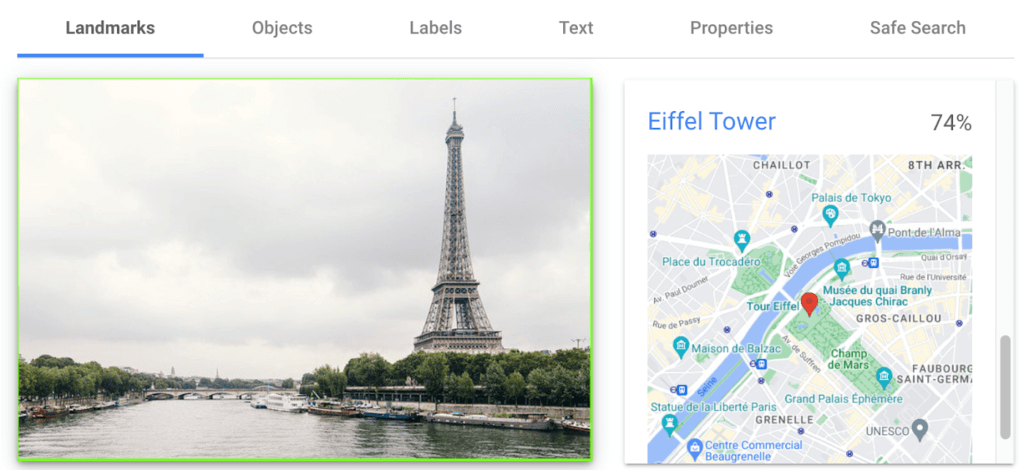
Landmark detection allows you to analyze images to identify specific landmarks such as buildings, natural features, and other recognizable locations. Cloud Vision API recognizes landmarks and provides information about them, including their name, location, and other relevant details. Perhaps you are trying to identify the landmarks in images shared by customers as part of social campaigns, or want to build a mobile app that provides information to tourists on famous landmarks.
In the below left-hand side image, Cloud Vision API has detected the Eiffel Tower, shown in the visualized response. Not shown in this visualization here, but also detected, were Pont de Bir-Hakeim (the bridge) and Champs de Mars (the park in front of the Eiffel Tower).
Detect objects and label images
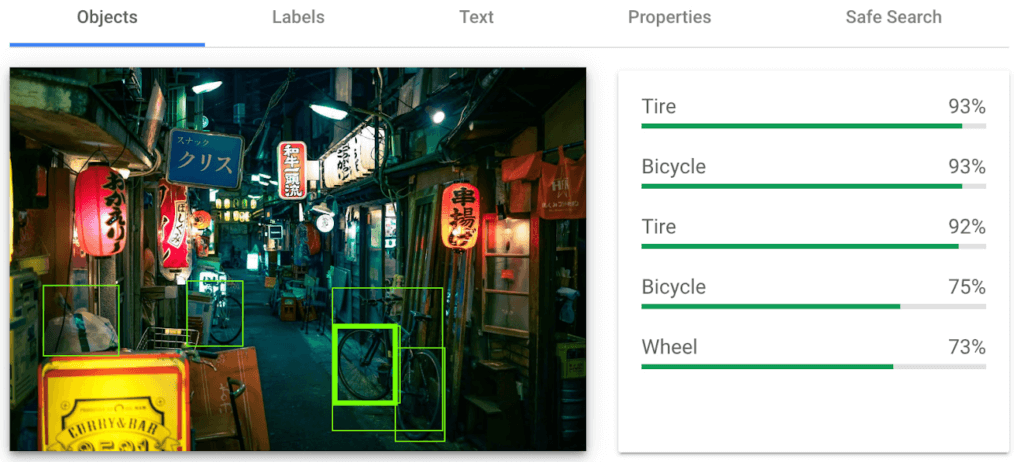
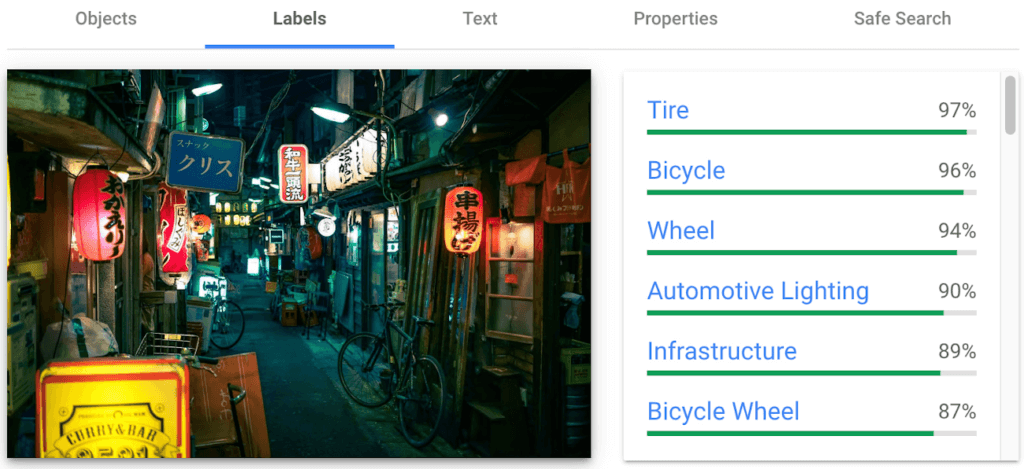
Object detection and labels are two related features that enable you to identify and classify objects within an image. Object detection detects and locates objects within an image, and provides information such as the position, size, and orientation of each object. Labels, on the other hand, provide a general classification of the content within an image.
Object detection has practical applications in many industries such as self-driving vehicles (where it’s critical), retail, manufacturing and more, while labels can be used to help classify and organize large collections of images, or to categorize and filter content.
You can see the similarities and differences in the responses provided by the object detection and labeling features in this image taken in Setagaya.
Detect text
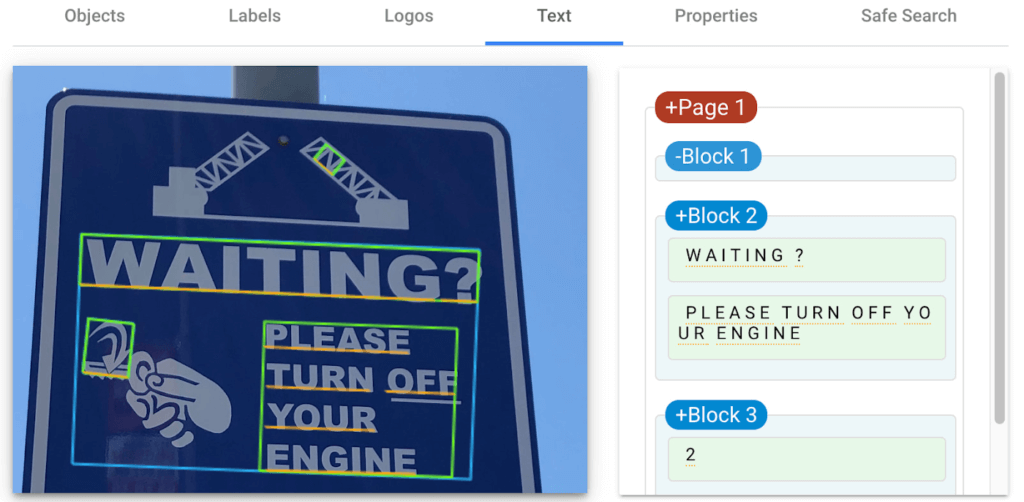
Cloud Vision API detects and extracts text from any image, even if it’s handwritten or in different languages. Once it detects text, the API can provide information about the position, orientation, and size of each text element, as well as individual words, and their bounding boxes.
In this image of a traffic sign, Cloud Vision API has detected the text and provided it in the response.
Detect explicit content
Cloud Vision API can automatically identify and flag explicit or inappropriate content within an image using five categories: adult, spoof, medical, violence, and racy. The API provides a score that indicates the likelihood for each category in the image, which you can use to set thresholds in your application and decide how to handle those that exceed them. This feature is particularly useful for filtering or moderating user-generated content.
Luckily for the images I shared here, each category has been deemed “very unlikely” to be present. Phew!



Next Steps
These are just a few features of the Cloud Vision API and how it can help your business with automating image analysis workflows and gaining valuable insights from your visual data.
Head to the interactive walkthrough tutorials in Python, Node.js, Go, and Java to see step-by-step how to access the API and learn more about all the features that you can integrate into your own applications! Again, this tutorial can be completed at no cost within the Google Cloud Free Tier.
An Out-of-the-box, End-to-end Solution for Contact Centers!

3585
Of your peers have already read this article.
3:00 Minutes
The most insightful time you'll spend today!
Providing best-in-class customer service is crucial for the success of your business. Contact centers are a critical touch point, as they have to balance between representing your brand and prioritizing customer care. When your customers seek help and support, they expect efficient service that is accessible through modern voice and digital channels. In short, customer expectations are increasing—and that’s a problem if your contact center infrastructure and solutions are becoming outdated.
All of these factors are why today, we’re announcing Google Cloud Contact Center AI Platform, an expansion to Contact Center AI that offers an out-of-box, end-to-end solution for the contact center. It brings together the advantages of AI, cloud scalability, multi-experience capabilities, and tight integration with customer relationship management (CRM) platforms to unify sales, marketing, and support teams around data across the customer journey.
Improving customer experiences from all angles
Google Cloud’s Contact Center AI helps you leverage AI to scale your contact center interactions while maintaining a high level of customer satisfaction. Over the last two years, we have built a large group of partners, including the largest contact center and customer experience ISVs and our system integrator ecosystem, to bring Contact Center AI to customers. Today, we are helping enterprises across industries and geographies to cost-effectively reimagine contact center experiences. For example, Marks & Spencer reduced in-store call volume by 50%, and similarly, The Home Depot improved call containment by 185%, all while significantly increasing customer self-service engagement.
Adding to our Contact Center AI capabilities, Contact Center AI Platform is purpose-built for customer relationship management, extending your ability to offer personalized customer experiences that are consistent across your brand, whether delivered through a virtual agent, a human agent, or a combination of both. It eliminates many long-running pain points, from managing data fragmentation to replacing rigid customer experience flows with more engaging, personalized, and flexible support. With this addition, Contact Center AI now lets you:
- Orchestrate the customer journey by creating modern experiences that can be embedded in their chosen channels with mobile/web software developer kits (SDKs), compatible with iOS and Android;
- Leverage CRM as a single source of insight into the customer experience, to unify content, increase personalization, and automate processing with CRM data unification;
- Manage multiple channels without pivoting across voice, SMS, and chat support;
- Predict customer needs and route calls appropriately with AI-driven routing, based on both historical CRM data and real-time interactions;
- Automate scheduling, schedule adherence monitoring, and manage employee scheduling preferences with Workforce Optimization (WFO) integration;
- Provide customers with self-service via web or mobile interfaces using Visual Interactive Voice Response (IVR).
Helping you do more with contact centers
The addition of Contact Center AI Platform provides your partners the ability to integrate with Contact Center AI, so you can enjoy a more seamless experience operating your customer service center, with a complete view of the customer in a single workspace that includes real-time AI intelligence, native agent call controls, and real-time call transcription. For example, we are expanding our partnership with Salesforce to integrate Contact Center AI with Service Cloud Voice to deliver a unified Service Cloud agent console and Customer 360.
“Customers are continually raising their service expectations, and our research tells us 79% of consumers believe the experience a company provides is as important as its products and services,” said Ryan Nichols, SVP & GM, Contact Center, for Salesforce Service Cloud. “Through intelligence, workflows, and a deeper understanding of the customer, Salesforce’s Service Cloud Voice paired with Google’s Contact Center AI will empower agents with a seamless experience to help them wow customers.”
We are also excited to partner with UJET, an innovative and experienced Contact Center as a Service (CCaaS) provider. UJET offers secure user-centric design, scalability, and mobile-focused solution, with turnkey implementation, strong omnichannel capabilities, and best-in-class user experience, making their product a natural fit into Google’s contact center vision. To learn more about the partnership, see here.
Delivering impact for customers
Contact Center AI is already making a difference for our customers such as OneUnited Bank, the largest Black-owned bank in the U.S. “OneUnited Bank has been in partnership with Google Cloud and UJET, as well as a long-standing customer of Salesforce. The expansion and enhancements of Google Cloud’s Contact Center AI, along with its deeper integration with Salesforce, means better return on investment as we drive towards evolving our contact center to deliver exceptional client experiences,” said Teri Williams, President and Chief Operating Officer at OneUnited Bank.
Fitbit, which boasts more than 29 million active users, is also reaping the benefits. “Fitbit relies on Google Cloud and UJET to provide support to our customers with a mobile-first approach. This collaboration, in combination with a strong Salesforce integration, has helped us modernize our entire customer support experience,” stated Cassandra Johnson, VP, Devices & Services Customer Care & Vendor Management Office, at Google.
According to industry analyst Sheila McGee-Smith of McGee-Smith Analytics, “Google Cloud’s Contact Center AI is already a force in the contact center industry thanks to its early focus on AI for customer experience.” She continued, “Through their partnerships with UJET and Salesforce, as well as these expanded capabilities, Google Cloud’s Contact Center AI Platform will help define the future of customer service by powering more secure, engaging, and personalized customer experiences.”
Contact Center AI Platform is supported by a host of integration partners, including Accenture, CDW, Cognizant, Deloitte, HCL, IBM, Infosys, Quantiphi, Tata Consultancy Services, and Wipro. We will also continue to partner closely with the contact center and customer experience (CX) ISVs that our customers already rely on. If you already have a contact center solution provider, you can still integrate Google Cloud’s Contact Center AI into your existing environment.
To learn more about how you can leverage the power of AI to reimagine your contact center experience, visit our Contact Center AI page.

5449
Of your peers have already downloaded this article
14:30 Minutes
The most insightful time you'll spend today!
To make great products: do machine learning like the great engineer you are, not like the great machine learning expert you aren’t.
Most of the problems you will face are, in fact, engineering problems. Even with all the resources of a great machine learning expert, most of the gains come from great features, not great machine learning algorithms. So, the basic approach is:
- Make sure your pipeline is solid end to end.
- Start with a reasonable objective.
- Add common-sense features in a simple way.
- Make sure that your pipeline stays solid.
This approach will work well for a long period of time. Diverge from this approach only when there are no more simple tricks to get you any farther. Adding complexity slows future releases.
Once you’ve exhausted the simple tricks, cutting-edge machine learning might indeed be in your future. See the section on Phase III machine learning projects.
This document is arranged as follows:
- The first part should help you understand whether the time is right for building a machine learning system.
- The second part is about deploying your first pipeline.
- The third part is about launching and iterating while adding new features to your pipeline, how to evaluate models and training-serving skew.
- The final part is about what to do when you reach a plateau.
- Afterwards, there is a list of related work and an appendix with some background on the systems commonly used as examples in this document.
How Connected-Stories Uses BigQuery and AI/ML to Craft Personalized Ad Experiences

4021
Of your peers have already read this article.
4:00 Minutes
The most insightful time you'll spend today!
Editor’s note: The post is part of a series highlighting our awesome partners, and their solutions, that are Built with BigQuery
In the field of producing engaging video content such as ads, many marketers ignore the power of data to improve their creative efforts to meet the consumers’ need for personalized messages. The demand for creative tech to efficiently personalize is real as marketers need personalized video Ads to reach their audience with the right message at the right time. Data, Insights and Technology are the main ingredients to deliver this value while ensuring security and privacy requirements are met. The Connected-Stories team partnered with Google Cloud to build a platform for Ad personalization. Google Data Cloud and BigQuery are at the forefront to assimilate data, leverage ML models, create personalized ads, and capitalize on real-time intelligence as the core features of the Connected-Stories NEXT platform.
Connected-Stories NEXT is an end-to-end creative management platform to develop, serve, and optimize interactive video and display ads that scale across any channel. The platform ingests first-party data to create custom ML models, measure numerous third-party data points to help brands develop unique customer journeys and create videos that their data signals can drive. An intelligent feedback loop passes real-time data back, enabling brands to make data-driven and actionable video ads that take the brand’s campaigns to the next level.
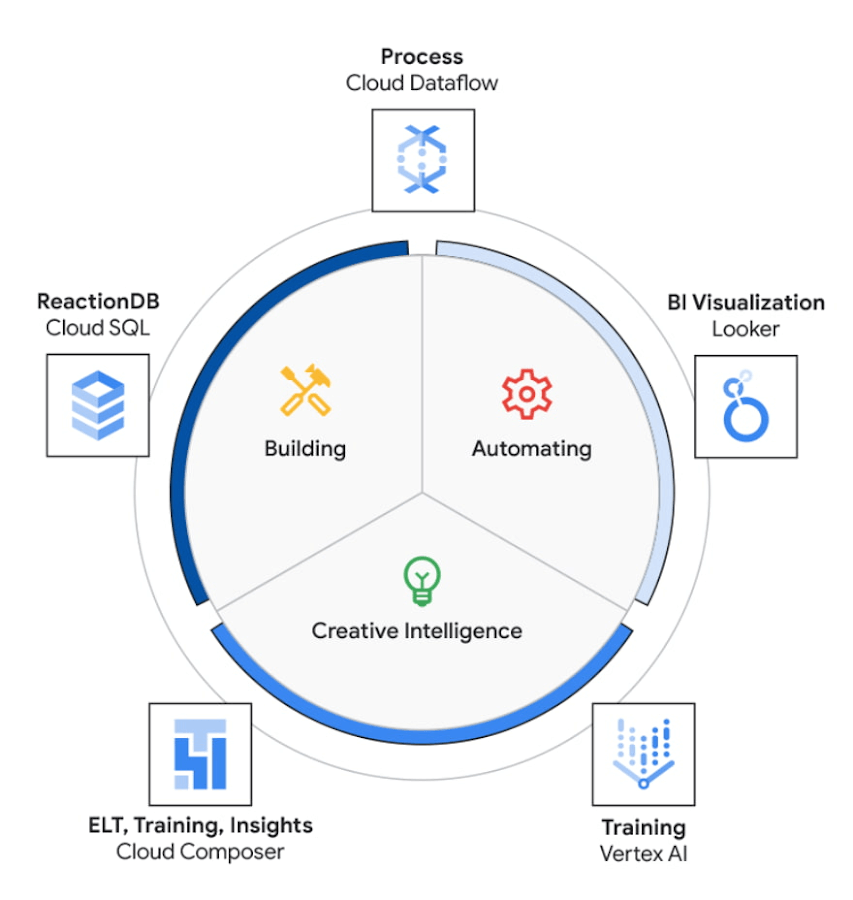
The core use case of the NEXT platform revolves around collecting user’s interaction data and optimizing for precision and speed to create an actionable Ad experience that is personalized for each user. The platform processes complex data points to create interactive data visualizations that allow for accurate analysis. The platform uses Vertex AI to access managed tools, workflows, and infrastructure to build, deploy, and scale ML models that have improved the accuracy to identify segments for further analysis.
The platform ingests 200M data events with peaks and valleys of activity. These events are processed to generate dashboards that enable users to visualize metrics based on filters in real-time. These dashboards have high performance requirements in terms of a responsive user interface under constantly changing data dimensions.
Google Cloud’s serverless stack coupled with limitless data cloud infrastructure has been the core to the NEXT platform’s data-driven innovation. The growing volume of data ingested, streamed and processed were scaled uniformly across the compute, storage and analytical layers of solution. A lean development team at Connected-Stories were able to focus all-in on the solution, while the serverless stack scaled, lowered attack service in terms of security and optimized the cost footprint through pay-as-you-go features.
BigQuery has been the backbone to support the vast amounts of data spreading over multiple geos resulting in workloads running at petabyte scale. BigQuery’s fully managed serverless architecture, real-time streaming, built-in machine learning and rich business intelligence capabilities distinguishes itself from a cloud data warehouse. It is the foundation needed to approach data and serve users in an unlimited number of ways. For an application with zero tolerance for failure, given its fully managed nature, BigQuery handles replication, recovery, data distributed optimization and management.
The platform’s requirements include the need for low maintenance, constantly ingesting and refreshing data and smart-tuning of aggregated data. These capabilities can be implemented by BigQuery’s materialized views feature. Materialized views are useful for precomputed views that regularly cache query results for better performance. These views possess the innate feature to read only the delta change from base tables and calculate the up-to-date aggregations. Materialized views impart faster outputs and consume fewer resources while reducing the cost footprint.
Some key considerations in using Google cloud and focusing on the Serverless stack include: quick onboarding to development, prototyping in short sprints and ease of preparing data in a rapidly changing environment. Typical considerations around low code / no code include data transformation, aggregation and reduced deployment time. These considerations are fulfilled through using serverless capabilities within Google Cloud such as PubSub, Cloud Storage, Cloud Run, Cloud Composer, Dataflow and BigQuery as described in the Architecture diagram below. The use of each of these components and services are described below.
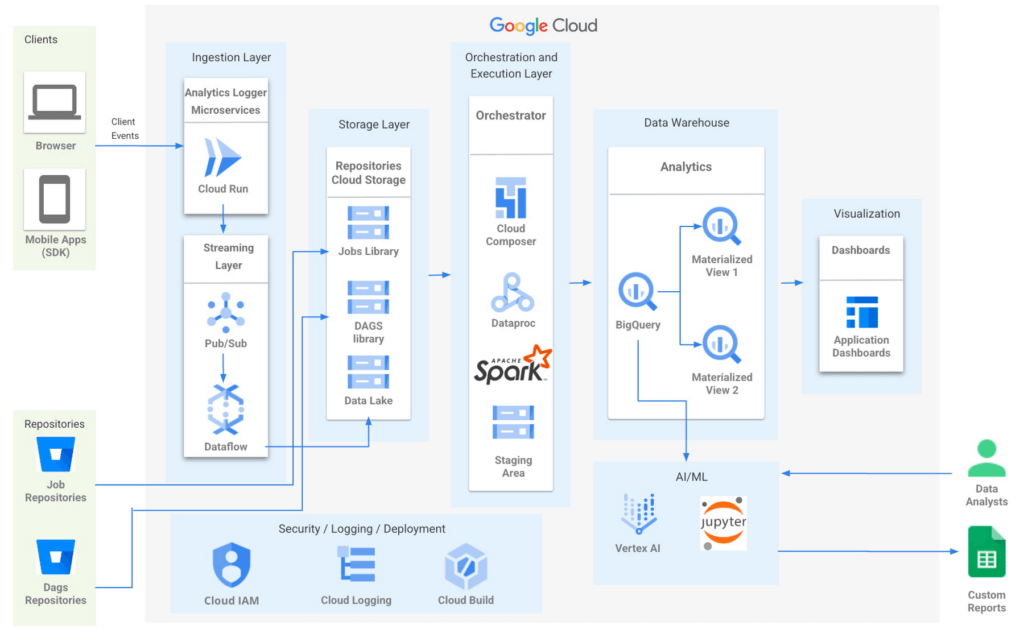
- Input/Ingest: At a high-level, microservices hosted in Cloud Run collect and aggregate incoming Ads events.
- Enrichment: The output of this stage is a Pub-Sub message enriched with more attributes based on a pre-configured campaign.
- Store: a Cloud Dataflow streaming job to create text files in Cloud Storage buckets.
- Trigger: Cloud Composer triggers the spark jobs based on text files to process and group them to produce desired output as one record per impression, a logical group of events.
- Deploy: Cloud Build is then used to automate all deployments.
Thus far, all Google cloud managed services work together to ingest, store and trigger the orchestration, all of which are scalable based on configurations including autoscaling capabilities.
- Visualization: A visualization tool reads data from BigQuery to compute pre-aggregations required for each dashboard.
- Data Model Evolution considerations: Though the solution served the purpose of creating pre-aggregations, as the data model evolved by adding a column or creating a new table, it led to recreating pre-aggregations and querying the data again. Alternatively, creating aggregate tables as an extra output of current ETLs seemed like a viable option. However, this would increase the cost and complexity of jobs. A similar situation to reprocess or update aggregated tables would occur as data is updated.
Precomputed views of data that is periodically cached are critical to reach the audience with the right message at the right time.
- Performance: In order to increase the performance of the platform, we need to have regularly precomputed views of the data, cached .
- Materialized Views: Consumers of these views needed faster response times, to consume fewer resources and output only the changes in comparison to a base table. BigQuery Materialized views were used to solve this very requirement. Materialized views have been highly leveraged to optimize the design resulting in lesser maintenance and access to fresh data with high performance with a relatively low technical investment in creating and maintaining SQL code.
- Dashboards: Application dashboards pointing to the Materialized views are highly performant and provide a view into fresh data.
- Custom Reports with Vertex AI Notebooks: Vertex AI notebooks directly read data from BigQuery to produce custom reports for a subset of customers. Vertex AI has been hugely beneficial to data analysts, where an environment with pre-installed libraries simplifies the readiness to use. Vertex AI Workbench notebooks are used to share these reports within the team allowing them to work always on the cloud without having the need to download data at any time. Besides, it increases the velocity to develop and test ML models faster.
The NEXT platform has yielded benefits such as customers having the ability to create unique consumer journeys powered by AI / ML personalization triggers, using first-party data and business intelligence tools to capitalize on real-time creative intelligence, which is a dashboard to measure campaign performance for cross-functional teams to analyze the impact of Ad content experience at a granular level. All of these while ensuring controlled access to data to enrich data without moving across clouds. The NEXT platform can keep up with increased demands for agility, scalability and reliability through the underlying usage of Google Cloud.
Partnering with Google, in the context of the Google Built with BigQuery program has surfaced the differentiated value in areas of creating interactive personalized Ads by using real-time data. In addition, by sharing this data across organizations as assets, ML models have fueled higher levels of innovation. Connected-Stories plan to deepen the penetration into the entire spectrum of services offered in the AI/ML area to enhance core functionality and provide newer capabilities to the platform.
Click here to learn more about Connected-Stories NEXT Platform capabilities.
The Built with BigQuery Advantage for ISVs
Through Built with BigQuery, launched in April ‘22 as part of Google Data Cloud Summit, Google is helping tech companies like Connected-Stories co-innovate in building applications that leverage Google’s data cloud with simplified access to technology, helpful and dedicated engineering support, and joint go-to-market programs. Participating companies can:
- Get started fast with a Google-funded, pre-configured sandbox.
- Accelerate product design and architecture through access to designated technical experts from the ISV Center of Excellence who can share insights from key use cases, architectural patterns, and best practices encountered in the field.
- Amplify success with joint marketing programs to drive awareness, generate demand, and increase adoption.
The Google Data Cloud spectrum of products and specifically BigQuery give ISVs the advantage of a powerful, highly scalable data warehouse that’s integrated with Google Cloud’s open, secure, sustainable platform. And with a huge and expanding partner ecosystem and support for multi-cloud, open source tools and APIs, Google provides technology companies the portability and extensibility they need to avoid data lock-in and exercise choice.
We thank the Google Cloud and Connected-Stories team members who co-authored the blog: Connected-Stories: Luna Catini, Marketing Director, Google: Sujit Khasnis, Cloud Partner Engineering
More Relevant Stories for Your Company

Dataplex: Google Cloud’s Intelligent Data Fabric to Manage Data and Analytics at Scale
Enterprises are struggling to make high quality data easily discoverable and accessible for analytics, across multiple silos, to a growing number of people and tools within their organization. They are often forced to make tradeoffs—to move and duplicate data across silos to enable diverse analytics use cases or leave their

Revolutionizing Cloud Computing: Introducing G2 VMs with NVIDIA L4 GPUs
Organizations across industries are looking to AI to turn troves of data into intelligence, powered by the latest advances in generative AI. Yet for many organizations, there is a barrier to adopting the latest models because they can be costly to train or serve. A new class of cloud GPUs


Chronicle Security Analytics: Key to Address Security Data Overload
Google Cloud's Chronicle is a security analytics platform built for modern use cases to combat modern threats. In today's world, enterprises have undergone significant changes in all aspects, and must adapt to their security needs to counter threats and attacks. Watch the video to learn Google Cloud's initiative to help

Built on Google Cloud, Enexor’s Bio-CHP Unit Powers 100 Homes with Renewable Energy!
Editor’s note: Earth Day reminds us that we all can contribute to creating a cleaner, healthier, and more sustainable future. Google Cloud is excited to celebrate innovative startup companies developing new technology and driving sustainable change. On this year’s Earth Day we’re highlighting Enexor BioEnergy and their initiative to produce
