






No More Migration Challenges: How Nine Clients of Google Cloud Achieved Success
READ FULL INTRODOWNLOAD AGAIN3302
Of your peers have already downloaded this article
15:00 Minutes
The most insightful time you'll spend today!
Google Announces New Cloud Region in Toronto

3420
Of your peers have already read this article.
1:30 Minutes
The most insightful time you'll spend today!
For over a decade, we’ve been investing in Canada to become a go-to cloud partner for organizations across the country. Whether they’re in financial services, media and entertainment, retail, telecommunications or the public sector, a rapidly growing number of organizations located or operating in Canada are choosing Google Cloud to help them build applications better and faster, store data, and deliver awesome experiences to their users, all on the cleanest cloud in the industry. To support this growing customer base, we’re excited to announce that the new Google Cloud region in Toronto is now open.
As you’d expect, we’re thrilled about this news, but we aren’t the only ones that have been looking forward to this launch. We asked some of our customers operating in Canada for their take on the upcoming cloud region. Here’s what they had to say:
“Our alliance with Google is truly distinctive in the Canadian market as we are working together to co-innovate and create new services for key industries, including communications technology, healthcare, agriculture, security, and the connected home. The new cloud region in Toronto marks another key milestone that will propel TELUS’ digital leadership by further leveraging the scalability, reliability and cost effectiveness of Google Cloud to support improved customer experience and build stronger, healthier and more sustainable communities.”—Hesham Fahmy, Chief Development Officer, TELUS
“We’re simplifying, modernizing and digitizing Scotiabank to enhance the customer experience for our 25 million customers across the globe. By leveraging powerful cloud-based services including Google Cloud, we’re able to put the most advanced software engineering, data analytics and machine learning tools in the hands of our talented employees. We welcome Google Cloud’s investment in Toronto and look forward to the opportunities the Toronto Cloud Region will present to our Technology team.”
—Michael Zerbs, Group Head Technology & Operations, Scotiabank
“Cloud technologies—and the access to scalable compute, rich geospatial datasets and smart analytics tools—will be critical contributors to support climate action and sustainable policy decisions. At Natural Resources Canada, scientists and researchers are applying innovative digital solutions to support Canada’s natural resource sector. The new Google Cloud region in Toronto will provide our scientists, technologists and researchers with the products and services necessary to turn Earth data into actionable insights.”
—Vik Pant, PhD, Chief Scientist and Chief Science Advisor, Natural Resources Canada
“At Accenture, we bring together technology and human ingenuity to create and respond to change. We’re thrilled to join forces with Google Cloud and their newest region in Toronto with an important mutual goal: to accelerate cloud innovation in Canada. Our clients already know us for our deep industry intelligence, cloud-first expertise and market-renowned delivery. We’re now combining that with Google’s human-centric design to bring even more opportunities to our clients across all industries.”
—Jeffrey Russell, President of Accenture in Canada.
“We are thrilled to see Google’s commitment to Canada. We look forward to helping our joint customers transform their operations, leveraging Google Cloud’s latest data center in Toronto. At Deloitte, we believe cloud is THE opportunity to reimagine everything.”
—Terry Stuart, Deloitte Chief Digital Officer, Canada.
“As Canadian organizations increasingly leverage cloud to transform their businesses, we are excited about the new opportunities that the Toronto Google Cloud region brings to the market. We look forward to continuing our strong partnership with Google Cloud to bring customized and innovative solutions that help Canadian companies fully realize the value of cloud technology, so that they can compete and win on the global stage.”
—Andrew Caprara, Chief Operating Officer, Softchoice
Toronto joins 27 existing Google Cloud regions connected via our high-performance network, helping customers better serve their users and customers throughout the globe. In combination with our Montreal region, customers now benefit from improved business continuity planning with distributed, secure infrastructure needed to meet IT and business requirements for disaster recovery, while maintaining data sovereignty.
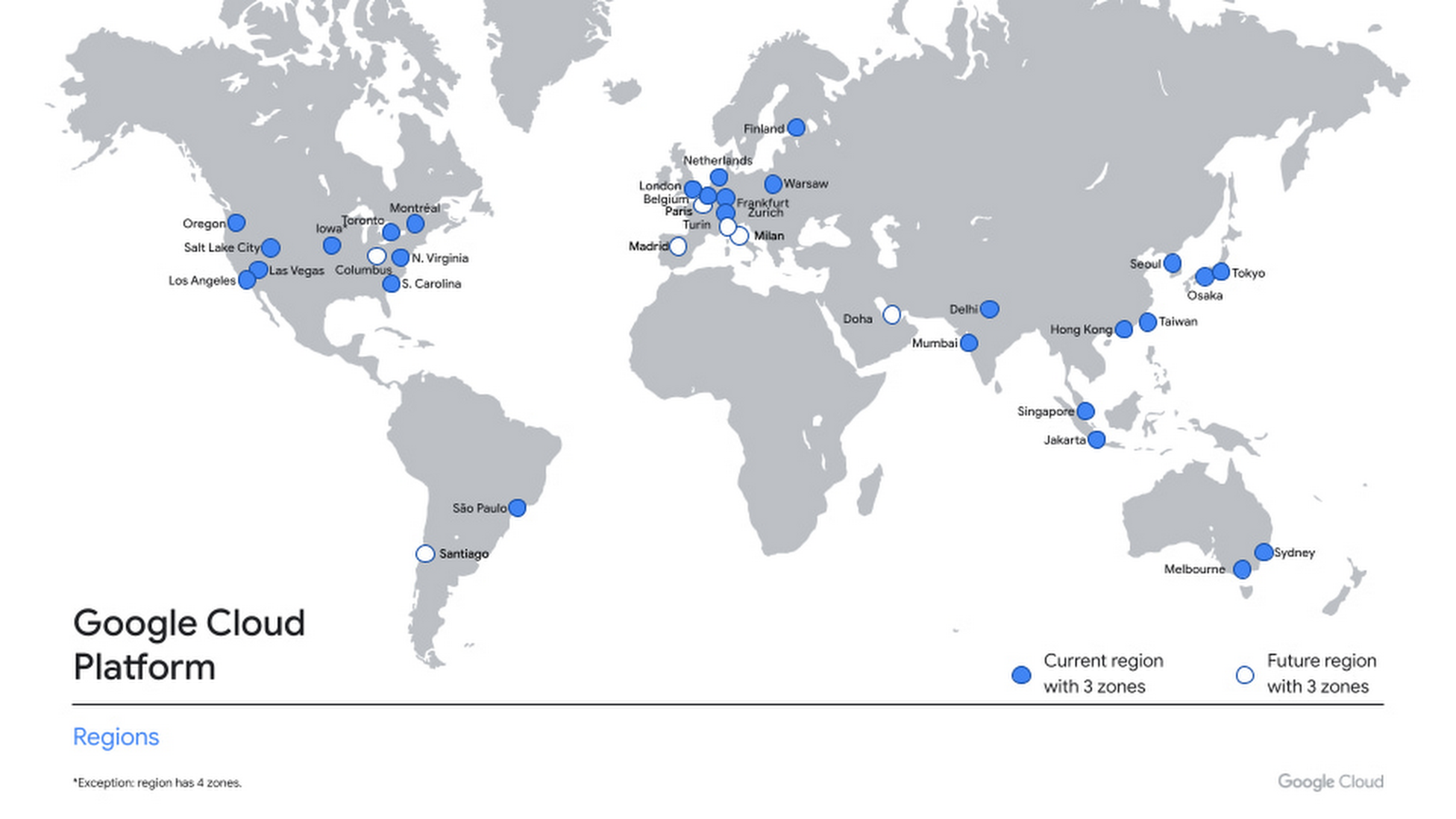
The new region launches with three zones, allowing organizations of all sizes and industries to distribute apps and storage to protect against service disruptions, and with our core portfolio of Google Cloud Platform products, including Compute Engine, App Engine, Google Kubernetes Engine, Bigtable, Spanner, and BigQuery.
We’re working to bring you new cloud products and capabilities in Canada, and our goal is to allow you to access those services quickly and easily—wherever you might be in the country. The past year has proved how important easy access to digital infrastructure, technical education, training and support are to helping businesses respond to the pandemic. We’re particularly proud of the teams who faced the unique challenges of building a cloud region during this time to help our customers and community accelerate their digital transformation.
To support all of our users, customers and government organizations in Canada, we’ll continue to invest in new infrastructure, engineering support and solutions. We’re currently hosting our first ever Google Cloud Accelerator Canada to bring the best of Google’s programs, products, people and technology to startups doing interesting work in the cloud. We’ve recently received Protected B accreditation with Canadian Centre for Cyber Security, which is crucial for healthcare, education, and regulated industries adopting cloud services. We’re also pleased to announce the preview of Assured Workloads for Canada—a capability which allows you to secure and configure sensitive workloads in accordance with your specific regulatory or policy requirements.
For help migrating to Google Cloud, please contact our local partners. For additional details on Google Cloud regions, please visit our locations page, where you’ll find updates on the availability of additional services and regions. You can always contact us to help you get started or access our many educational resources. We’re excited to see what you build next with Google Cloud.
Vodafone Leverages Google Cloud to Aid COVID-19 Frontline with Anonymized Insights on Population Mobility

11225
Of your peers have already read this article.
1:30 Minutes
The most insightful time you'll spend today!
Editor’s note: When Europe’s largest mobile communications company, Vodafone, was asked by the European Commission to help understand population movement across the European Union and the UK to help fight COVID-19, it was able to provide anonymized mobile network-based insights to answer the call. Here’s how Vodafone, with the support of Google Cloud, rapidly mobilized the COVID-19 frontline, while respecting its customers’ privacy.
With the emergence of COVID-19 in early 2020, the European Commission—the executive branch of the European Union (EU)—knew that technology would be instrumental in its fight to control the pandemic. With various lockdowns imposed across its member states, the Commission was keen to predict and prevent the spread of COVID-19 and to manage the related social, political and financial impacts.
Mobile network data helps track COVID-19 across the EU
Mobile networks produce location data, which can be turned into useful anonymous insights to understand population movement within a geographic area. The European Commission, working with mobile industry association GSMA (Groupe Speciale Mobile Association), asked Europe’s major mobile phone operators for help in producing insights to support the fight against COVID-19. As the largest mobile network operator within the EU, Vodafone saw this as a critical opportunity to participate.
Vodafone had previous experience of using mobile network data to support pandemic research. For example, in 2019, Vodafone provided mobility pattern analysis to help track the spread of Malaria in Mozambique. And, during the early stages of the COVID-19 pandemic (prior to working with the European Commission), Vodafone assisted the Italian and Spanish governments in understanding their citizens’ mobility patterns. Vodafone had also previously offered anonymized and aggregated population mobility insights to support public transport and tourism authorities and retail organizations in a number of countries. Consequently, Vodafone was perfectly placed to play a greater role in supporting the European Commission’s response to the pandemic.
When asked to assist the European Commission, Vodafone first considered how it could safely share its data with the governing body without providing details on the individual movements of its customers. It realized it could achieve this through an elaborate set of anonymization and aggregation techniques. Insights are aggregated from a minimum of 50 users and Vodafone only shared these anonymous insights and never the actual raw data with the Commission. As specified by the EU, these insights are then presented onto a large geographical region, typically a city or a county with thousands of people living in that area.
These insights illustrate how people move, helping to determine how lockdowns and self-isolation measures were impacting behaviors.
Using Google Cloud to collate and store population mobility data
In April 2020, Vodafone began migrating its operations, including its mobile data, to Google Cloud on servers in Europe and the UK with elaborate security safeguards, including encryption, building on a previous partnership.
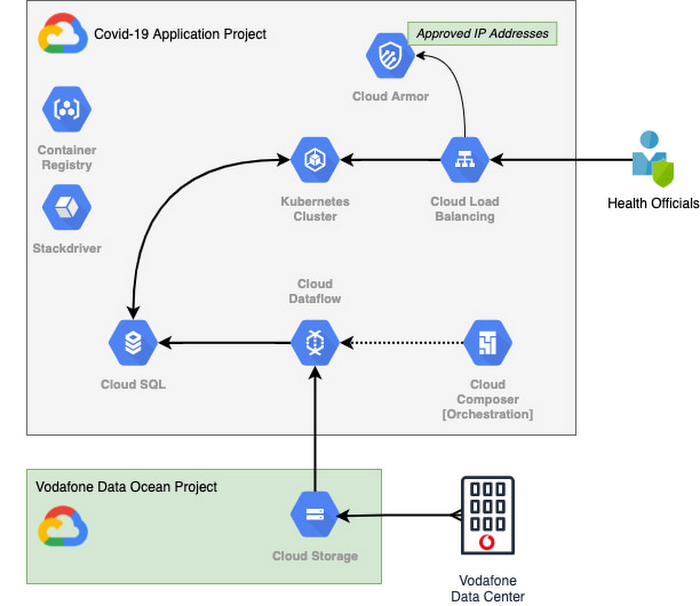
With the data residing in EU and UK data centers and not the United States, Vodafone could then retrieve anonymous insights from Google Cloud Storage instantaneously. Before supplying any information to the European Commission, however, Vodafone used Dataflow to validate the data and run a series of tests to ensure the database had accurate data, before ingesting and archiving the relevant metrics. For instant access, the data was then made available to the European Commission using a Redis database on Google Kubernetes Engine.
To ensure aggregate Vodafone customer data was always safe, secure, and anonymous, all entry points to the front-end were protected behind Google Cloud Armor, where only specific IP addresses were allowed. Using these tools, seamless data pipelines fed in predefined key performance indicators from each specified European market. While data quality measures ensured the definitions for metrics across markets were consistent and could be accurately compared.
The architecture (pictured below) shows how Vodafone integrated and anonymized its data on Google Cloud.
Live interactive dashboard shows population mobility in real-time
With its data integrated on Google Cloud, Vodafone created a live, interactive dashboard to track mobility patterns and share relevant information with the European Commission in real-time.
The European Commission Joint Research Center (JRC) was able to gather valuable information from these insights, which enabled them to see where population mobility was aiding the spread of the disease, when cross-referenced with health data. It could also assess the implications of lockdowns on different populations and forecast cross-country spreading.
Mobile data aids disease modeling for multiple stakeholders
The Vodafone data became instrumental in modeling the likely course of the disease too. For example, the University of Southampton in the UK used it to predict the outcome of different coordinated COVID-19 exit strategies across Europe. This research was published in Science Magazine in September 2020.
The Vodafone data dashboard continues to be used by individual governments, NGOs and organizations to further investigate the impacts of the pandemic and to measure the effectiveness of response strategies alongside the rollout of vaccination programs. The project also helped Vodafone win a DataIQ award for most effective stakeholder engagement.
Using the learnings from this project, Vodafone has been able to adapt its own B2B solution, called Vodafone Analytics, by adaptIng and migrating the code to work in Google Cloud Platform. This solution has been rolled out across Germany, Greece, Portugal and South Africa, and new countries are being onboarded every day. Vodafone Analytics already has more than 100 customers leveraging it for a variety of use cases—Italian fashion retailer OVS, uses it for its smart retail operation, while global real estate company, JLL, uses it to understand the footfall passing through its properties.
Working together, Vodafone and Google Cloud continue to help a range of organizations, governments, and NGOs navigate through the ongoing pandemic, optimize their operations, and help the greater good, without infringing individuals’ fundamental rights to privacy.
To learn more about Google Cloud and Vodafone, watch our full interview here.
Autonom8: Achieving growth and profits for businesses with Google Cloud

3036
Of your peers have already read this article.
3:30 Minutes
The most insightful time you'll spend today!
With Google Cloud, Autonom8 can run a platform that accelerates and streamlines customer journeys in a scalable, reliable, cost-effective infrastructure, while using advanced optical character recognition to enable intelligent document processing.
About Autonom8
Headquartered in the United States and India, Autonom8 has built a low-code SaaS platform that allows businesses to digitize customer-facing workflows. The business aims to help clients reduce costs and improve interactions with their customers through automation and enablement of customer journeys.

Google Cloud results:
- Increased margins by up to 30% by switching from a home-grown OCR system to Cloud Vision AI
- Enables one DevOps team member to manage up to 30 customers
- Provides real-time information about customer journeys to enable businesses to respond quickly and accurately
- Ensures use of its platform with containerization in customers’ private data centers
- Reduced operating costs by up to 20% with localized scalability and architecture through GKE
Just as cars are evolving to become autonomous, smart and self-driving, enterprises can gain self-awareness, an ability to learn and an ability to adapt. This is the value proposition put forward by Autonom8, an India- and United States-based enterprise workflow management software business. “We provide a low-code, high-intelligence customer journey automation SaaS platform,” explains Ranjit Padmanabhan, Co-founder and Chief Technology Officer (CTO), Autonom8.
The Autonom8 platform includes components, such as A8Studio, a drag and drop location from which clients can create customer journeys, a chat platform that enables clients to create chatbots, and an analytics module. “With our platform and services, businesses can reduce costs and improve interactions with their customers by applying automation to accelerate and provide better customer journeys,” adds Padmanabhan.
Demand for Autonom8 is being driven by the changing customer demands of enterprises, including the expectation to interact with them over multiple channels, and the rising cost of building software with experienced developers. These trends place enterprises under growing pressure to increase the productivity of the people they do have, particularly those who are less technically inclined. In addition, changing consumer habits, regulations and the emergence of new technologies mean customer journeys cannot remain static and need to evolve.
Developing a microservices-based SaaS platform
From the start, Autonom8 planned to deliver a SaaS platform and initially deployed on a multinational cloud service, chosen due to the team’s familiarity with its products and the availability of credits. However, the company’s decision to opt for a microservices architecture that enables individual services to scale independently while running in a containerized environment, demanded high-quality container orchestration. To optimize cost, scalability and performance, Autonom8 began evaluating Google Kubernetes Engine (GKE).
The business then completed a side-by-side comparison between Google Cloud and its incumbent provider of compute, storage and other services. Google Cloud fared favorably, with Vision AI in particular providing powerful machine learning and optical character recognition (OCR) functionality, supporting a key use case for Autonom8.
In addition, many of Autonom8’s clients at the time are financial institutions in India, and legally required to retain data within the country’s borders. Google Cloud’s global network and local presence means the business could fulfill this requirement easily.
“We decided to evaluate Google Cloud, particularly GKE, from two perspectives. One, from a security perspective, as we sell to banks that audit our platform, and two, as a failover between regions because downtime costs money. We found it a compelling solution.”
— Ranjit Padmanabhan, Co-founder and Chief Technology Officer (CTO), Autonom8
A seamless move to Google Cloud
Autonom8 began deploying on Google Cloud in 2018, with its architecture comprising storage, compute, serverless, container management and orchestration, and Vision AI. “We looked at our scripting with the previous provider, and using the Google Cloud documentation available online, educated ourselves over a few weeks before moving pieces of our architecture step by step to Google Cloud,” says Padmanabhan. “We did not run into any major issues. It was pretty simple, with our experienced engineers training others in the product.”
According to the CTO, the business had two options when moving to Google Cloud. Autonom8 could either install raw virtual machines and effectively create its own virtualized data center, or rely on managed services for functions such as memory store, registration and authentication to save time and resources over the long term. Autonom8 opted for the latter and has transitioned fully to Google Cloud, with the number of cloud products and services in its architecture rising from five to about 15. While each product and service performs a key role in the delivery of Autonom8’s products and services, Padmanabhan nominates GKE, Vision AI and Cloud SQL as providing the greatest value to the business.
Scalability, real-time monitoring and intelligent document processing at low cost
With GKE, the business can now scale the nodes or containers specific to each microservice in the event traffic to a particular client surges, due to a rebate or promotion. “Through the combination of the architecture and localized scalability we achieve with GKE, we are reducing our operating costs by up to 20%,” says Padmanabhan.
Running an open source TimescaleDB on Postgres in Cloud SQL enables Autonom8 to give its clients the ability to monitor customer journey information in real time. An example of a journey is applying for a bank loan. The customer must take steps including providing income, tax and other financial details that the bank then appraises to help make a decision on the application. “The moment someone applies for a loan, for example, a bank knows about it and can monitor for fraud, bottlenecks, or other abnormalities, and immediately route to a remediation workflow,” explains Padmanabhan. “Cloud SQL enables us to maintain transactional logging and provide real-time data to our dashboards.”
After evaluating alternative services, including developing a home-grown OCR engine, the business turned to Cloud Vision AI to manage the intelligent document processing that comprises much of its transactional volume. “Vision AI is significantly better than the alternatives and the cost of maintaining our version did not make sense, because Google Cloud continues to make improvements over time that enable us to deliver more and more accurate results to our customers,” says Padmanabhan. “Switching from our home-grown service to Vision AI has enabled us to increase our profit margins by up to 30%.”
“Through the combination of the architecture and localized scalability we achieve with Google Kubernetes Engine, we are reducing our operating costs by up to 20%.”
—Ranjit Padmanabhan, Co-founder and Chief Technology Officer (CTO), Autonom8
Supporting client demands and improving developer efficiency
Google Cloud also enables Autonom8 to meet the demands of businesses that want to run its platform within their own private data centers. “We can undertake the build within Google Cloud and ship our containers to compatible hosts within those clients’ data centers,” explains Padmanabhan. “With our previous provider, we could create containers, but these would not run properly within those data centers.”
Furthermore, Google Cloud documentation and online resources help Autonom8 reduce the training needed for new developers to become productive, with the Google Cloud learning curve taking up just 10% of the overall onboarding cycle.
The organization spends the equivalent of just 3% of its overall annual revenue on DevOps, measured as DevOps Utility Ratio, while the cloud cost of revenue is about USD 1 for every USD 6 in annual recurring revenue, measured as Cloud Utility Ratio. “These two metrics are about what we can do with the people we have,” explains Padmanabhan. “Our current ratio implies that one DevOps person can handle approximately 30 customers. This is made possible by the tools we have, and the comprehensive support from Google Cloud in terms of security patches, intelligent alerts, resource overloading, and more.”
Google Cloud also provides the flexibility for Autonom8 to accommodate the varying service levels required by individual customers based on factors, such as the impact of downtime, as the business can failover seamlessly between regions to mitigate the impact of any issues that may occur.
“Our current ratio implies that one DevOps person can handle approximately 30 customers. This is made possible by the tools we have, and the comprehensive support from Google Cloud in terms of security patches, intelligent alerts, resource overloading, and more.”
—Ranjit Padmanabhan, Co-founder and Chief Technology Officer (CTO), Autonom8
Integrating Google Workspace with Autonom8 to deliver new capabilities
Autonom8 relies on Google Workspace for communication, collaboration and other workplace productivity requirements, growing its footprint from Gmail when the employee population was four or five, to a range of products including Sheets and Drive as the business grew. “It became natural to use the capabilities in Google Workspace as we matured,” says Padmanabhan. “One of the most interesting capabilities was our ability to integrate Google Workspace into our platform. For example, when someone is running a workflow, they can add data from a Sheet. We’ve added Google Workspace authentication capabilities into our products as well.”
“Everyone is using shared links to Drive and I really like the granular permissions structure,” he adds. “I can open up folders to clients while keeping an internal space within the business to ensure security and privacy.”
With Google Cloud, Autonom8 is now poised to continue growing its business and adding new features and capabilities for clients. “We are extremely excited at the opportunity to step up our offering to clients with Google Cloud,” concludes Padmanabhan.
11258
Of your peers have already watched this video.
1:30 Minutes
The most insightful time you'll spend today!
Indian Retailer Figures Optimizes Hyperlocal Delivery to Increase Customer Experience
Anyone who follows the Indian e-commerce scene knows that one of the largest challenges these companies face is hyperlocal delivery.
That was a problem facing Wellness Forever, a retail chain of pharmacies with 150-plus stores across India.
“Exactly a year ago, we started our journey of hyperlocal deliveries. This optimization was a big time challenge for us to understand how to optimize this,” Palani Subbiah, CTO, Wellness Forever.
The problem in front of Wellness Forever was to identify which customer could can be sold from which store, so that a delivery could be made within 90 minutes.
“We handle a large amount of customer data and we wanted to use insights to help and improve the customer satisfaction index,” says Subbiah.
To do that Wellness Forever leveraged Google Big Query to run massive amount of data to come up with the operational insights. They also used Firebase and Google Maps.
“By 2021, we are going to have about 450 stores. Those stores are going to be not only a physical store, which is a digital store.
How Google Classroom Helps State of Iowa Employees Serve the Public Better

5598
Of your peers have already read this article.
1:30 Minutes
The most insightful time you'll spend today!
Organizations are pressed with the need to engage, retain, and upskill employees with many positions staying fully or partially remote as the pandemic continues. The Center for Digital Government (CDG) reports that 74% of state and local governments believe they will continue hybrid operations for the long-term. This transition is the latest in a long list of reasons agencies are looking for solutions to help train their workforce digitally. Some have found Google Classroom to be the perfect solution.
The State of Iowa knew about the advantages of digital classrooms even before the pandemic. They were already successfully using Google Classroom for in-person training, making the transition to digital seamless when the state closed down. Jessica Van Heuveln, a Google support specialist for the State of Iowa CIO’s Office, says the switch to digital doesn’t deprive workers of hands-on training. “You can use Google Classroom for many different environments, so if you’re doing self-taught, in-person or virtual training, it’s going to work with all those approaches.”
The logistics of a digital classroom
Iowa uses Google Classroom to onboard and upskill employees as well as train volunteers. When the pandemic shifted the state’s workforce to 70% working from home, they needed a platform that could not only handle a vast range of topics and teaching styles to support remote workers but also scale to meet their demand. Van Heuveln notes that Google Classroom was particularly helpful for handling compliance training, especially with its integration with Google Meet. These trainings often require an entire sector of the workforce to attend a single class with more than 100 attendees, according to Van Heuveln. The logistics of these larger sessions cuts down on the number of total sessions the state needs to host. Iowa also found that employees were less apprehensive about learning when they could do it from the comfort of their own homes.
Iowa follows a train-the-trainer model to train employees expected to instruct using Google Classroom. Trainers working in departments across the state learn to use Google Classroom to create and host virtual learning experiences specific to their own departments.
Collaborative classrooms made simple
Google Classroom meets many needs for Iowa, such as setting up training, managing attendance, reviewing uploaded coursework, and communicating with attendees. Both course attendees and trainers have everything they need in one place, and robust engagement tools help attendees stay focused while giving trainers the feedback they need from their lessons. Built-in survey options let trainers gauge attendee knowledge, and the chat function ensures no one ever misses a question. The reporting dashboard gives trainers access to analytics to track engagement and attendance, providing insights that can improve future training sessions.
Google Classroom also makes it easier to ensure attendees stay on board throughout the training program. Coursework can be uploaded directly into Google Classroom, and training sessions can be recorded and archived. This feature allows employees to work at their own pace or lets them catch up when a scheduling conflict means they might miss a session.
The enterprise version of Google Classroom Iowa uses interfaces with other Google Workspace tools such as Google Meet, Google Calendar, Google Drive, and Gmail, which streamlines training and leads to more collaboration between employees and trainers. It can also interface with applications from other providers, further boosting its utility as an effective virtual classroom. Google Drive stores training materials securely. Lastly, Google Classroom enterprise comes with 24/7 support to make sure agencies always have everything they need for success.
Helping employees be better prepared to serve
Google Classroom can be a powerful part of any training program, whether it be digital or in-person. Building virtual connections empowers organizations to deliver better experiences. Google Classroom is helping the State of Iowa accomplish this for their constituents. Designed to scale and be accessible from anywhere, the platform helps public employees better serve the public. Virtual training strategies are essential for agencies that are looking to grow their workforce and build employee skill levels. The most important thing, however, is that training programs enable employees to further your agency’s mission. To learn more about Google Classroom and see more solutions designed with government in mind, check out the Google Cloud for government page.
More Relevant Stories for Your Company
Google Cloud Migration Speeds Up The New York Times’ Journey to New Normal
Like virtually every business across the globe, The New York Times had to quickly adapt to the challenges of the coronavirus pandemic last year. Fortunately, our data system with Google Cloud positioned us to perform quickly and efficiently in the new normal. How we use data We have an end-to-end type of

Datashare for Financial Services: Securing the Publishers and Consumers’ Access to Market Data
Access to the cloud has advanced the distribution and consumption of financial information on a global scale. In parallel, the global financial data landscape has been transformed by an influx of alternative data sources, including social media, meteorological data, satellite imagery, and other data. Exchanges and market data providers now

Transforming Canadian Healthcare and Medical Research with Google Cloud
Is Cloud an option for Canadian Healthcare healthcare and medical research organizations? Yes, Canadian healthcare and medical research organizations are moving to the cloud. The cloud market is expected to grow in Canada significantly through 2027. There are several reasons why Canadian healthcare and medical research organizations are moving to

The Power of Two: Best Practices for Mergers & Acquisitions on Google Cloud
Congratulations! Your company just acquired or merged with another organization, beginning an important new chapter in its history. But like with many business deals, the devil is in the details — particularly when it comes to integrating the two companies’ cloud domains and organizations. In this blog post, we look
