






5137
Of your peers have already downloaded this article
7:30 Minutes
The most insightful time you'll spend today!
Google Cloud’s No-Cost Skill Badge: Up Your Generative AI Game

1181
Of your peers have already read this article.
1:30 Minutes
The most insightful time you'll spend today!
Generative AI is a rapidly expanding technology with a wide range of potential applications. Google Cloud Learning is thrilled to offer a new, no-cost Generative AI Fundamentals skill badge. This skill badge is designed for anyone eager to learn about the power of generative AI. No technical skills or prior knowledge required!
For those new to digital credentials, Google Cloud skill badges are digital credentials issued by Google Cloud in recognition of your knowledge of Google Cloud products and services. Individuals can earn skill badges on Google Cloud Skills Boost, and can share their skill badge to their social media profile and resume.
Watch the short videos in the generative AI courses and complete the final quiz to earn the Generative AI Fundamentals skill badge pictured below. In as little as 120 minutes, you will learn the basics of how generative AI works, how Google Cloud AI technology can be used by businesses and individuals, and how the principles of responsible AI lead to ethical decisions about the use of generative AI.
By earning the skill badge, you will demonstrate your understanding of foundational concepts in generative AI.
The topics covered in the courses include:
1. Introduction to Generative AI
- Explain how generative AI works
- Describe generative AI model types
- Describe generative AI applications
2. Introduction to Large Language Models
- Define large language models (LLMs)
- Describe LLM use cases
- Explain prompt tuning
- Describe Google’s generative AI development tools
3. Introduction to Responsible AI
- Identify the need for a responsible AI practice within an organization
- Recognize that decisions made at all stages of a project make an impact in Responsible AI
- Recognize that organizations can design an AI infrastructure to fit their own business needs and values
Earn the skill badge and show off your generative AI knowledge today! And for more content to help you stay up to date with generative AI, check out “The Prompt” and our generative AI primer for executives on Transform with Google Cloud.
Improved TabNet on Vertex AI: High-performance, scalable Tabular Deep Learning

2511
Of your peers have already read this article.
2:30 Minutes
The most insightful time you'll spend today!
Data scientists choose models based on various tradeoffs when solving machine learning (ML) problems that involve tabular (i.e., structured) data, the most common data type within enterprises. Among such models, decision trees are popular because they are easy to interpret, fast to train, and can obtain high accuracy quickly from small-scale datasets. On the other hand, deep neural networks offer superior accuracy on larger datasets, as well as the benefits of end-to-end learning, but are black-box and difficult to interpret. TabNet, an interpretable deep learning architecture developed by Google AI, combines the best of both worlds: it is explainable, like simpler tree-based models, and can achieve the high accuracy of complex black-box models and ensembles.
We’re excited to announce that TabNet is now available in Vertex AI Tabular Workflows! Tabular Workflows provides fully managed, optimized, and scalable pipelines, making it easier to use TabNet without worrying about implementation details, and to deploy TabNet with the MLOps capabilities of Vertex. TabNet on Vertex AI Tabular Workflows is optimized for efficient scaling to massive tabular datasets. Moreover, TabNet on Vertex AI Tabular Workflows come with machine learning improvements on top of the original TabNet, yielding better accuracy for real-world data challenges.
TabNet on Vertex AI is well-suited for a wide range of tabular data tasks where model explainability is just as important as accuracy, such as financial asset price prediction, fraud/cyberattack/crime detection, retail demand forecasting, user modeling, credit/risk scoring, diagnosis from healthcare records, and product recommendations.
Overview of Tabnet
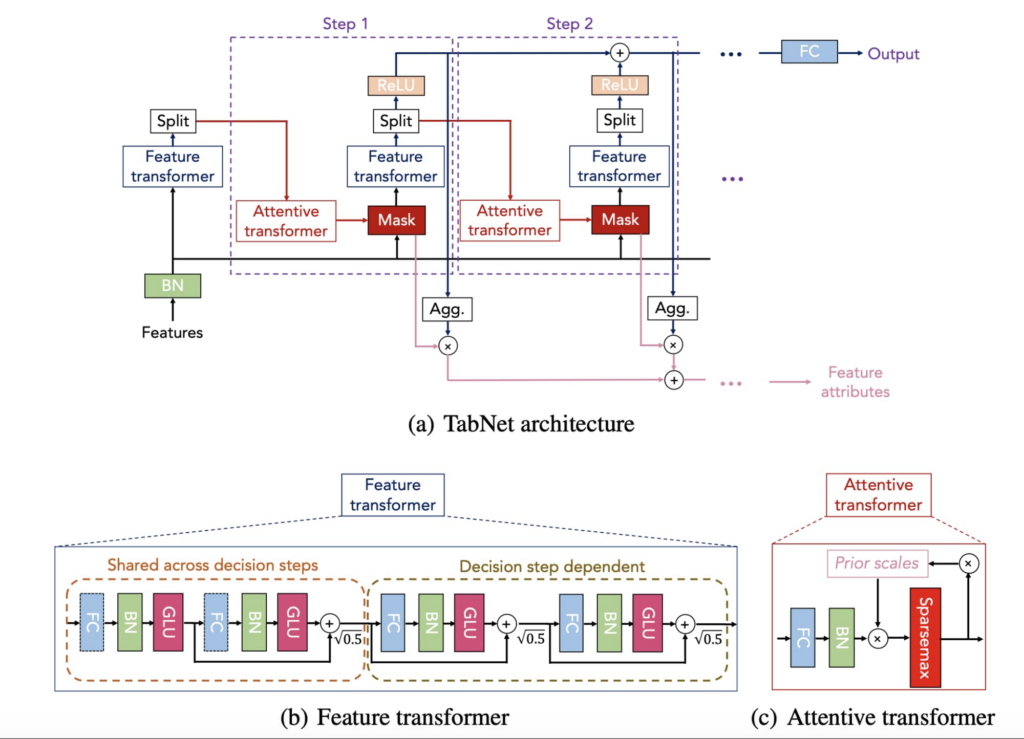
TabNet has a specially-designed architecture (overviewed in Fig. 1), based on sequential attention, that selects which model features to reason from at each step. This mechanism makes it possible to explain how the model arrives at its predictions and the thoughtful design helps with superior accuracy. TabNet not only outperforms alternative models (including neural networks and decision trees) but also provides interpretable feature attributions. More details, including results on academic benchmarks, can be found in our AAAI 2021 paper.
Since its publication, TabNet has received significant traction from various enterprises across different industries and a variety of high-value tabular data applications (most of which include the ones for which deep learning was not even used a priori). It has been used by numerous enterprises like Microsoft, Ludwig, Ravelin, and Determined. Given high customer interest on TabNet, we’ve worked on making it available on Vertex given the real-world deep learning development and productionization needs, as well as improving its performance and efficiency.
Highlights of TabNet on Vertex AI Tabular Workflows
Scaling to Very Large Datasets
Fueled by the advances in cloud technologies like BigQuery, enterprises are increasingly collecting more tabular data, and datasets with billions of samples and hundreds/thousands of features are becoming the norm. In general, deep learning models get better learning from more data samples, and more features, with the optimal methods as they can better learn the complex patterns that drive the predictions. The computational challenges become significant though when model development on massive datasets is considered. This results in high cost or very long model development times, constituting a bottleneck for most customers to fully take advantage of their large datasets. With TabNet on Tabular Workflows, we’re making it more efficient to scale to very large tabular datasets.
Key Implementation Aspects: The TabNet architecture has unique advantages for scaling: it is composed mainly of tensor algebra operations, it utilizes very large batch sizes, and it has high compute intensity (i.e., the architecture employs a high number of operations for each data byte transmitted). These open a path to efficient distributed training on many GPUs, utilized to scale TabNet training in our improved implementation.
In TabNet on Vertex AI Tabular Workflows, we have carefully engineered the data and training pipelines to maximize hardware utilization so that users can get the best return for their Vertex AI spending. The following features enable scale with TabNet on Tabular workflows:
- Parallel data reading with multiple CPUs in a pipeline optimized to maximize GPU utilization for distributed training, reflecting best practices from Tensorflow.
- Training on multiple GPUs that can provide significant speedups on large datasets with high compute requirements. Users can specify any available machine on GCP with multiple GPUs, and the model will automatically run on them with distributed training.
- For efficient data parallelism with distributed learning, we use Tensorflow mirrored distribution strategy to support data parallelism across many GPUs. Our results demonstrate >80% utilization with several GPUs on billion-scale datasets with 100s-1000s of features.
Standard implementations of deep learning models could yield a low GPU utilization, and thus inefficient use of resources. With our implementation, TabNet on Vertex, users can get the maximal return on their compute spend on large-scale datasets.
Examples on real-world customer data: We have benchmarked the training time specifically for enterprise use cases where large datasets are being used and fast training is crucial. In one representative example, we used 1 NVIDIA_TESLA_V100 GPU to achieve state-of-the-art performance in ~1 hour on a dataset with ~5 million samples. In another example, we used 4 NVIDIA_TESLA_V100 GPUs to achieve state-of-the-art performance in ~14 hours on a dataset with ~1.4 billion samples.
Improving Accuracy given Real-World Data Challenges
Compared to its original version, TabNet on Vertex AI Tabular Workflows has improved machine learning capabilities. We have specifically focused on the common real-world tabular data challenges. One common challenge for real-world tabular data is numerical columns having skewed distributions, for which we productionized learnable preprocessing layers (e.g. including parametrized power transform families and quantile transformations) that improve the TabNet learning. Another common challenge is the high number of categories for categorical data, for which we adopted tunable high-dimensional embeddings. Another one is imbalance of label distribution, for which we added various loss function families (e.g. focal loss and differentiable AUC variants). We have observed that such additions can provide a noticeable performance boost in some cases.
Case studies with real-world customer data: We have worked with large customers to replace legacy algorithms with TabNet for a wide range of use cases, including recommendation, rankings, fraud detection, and estimated arrival time predictions. In one representative example, TabNet was stacked against a sophisticated model ensemble for a large customer. It outperformed the ensemble in most cases, leading to a nearly 10% error reduction on some of the key tasks. This is an impressive result, given that each percentage improvement on this model resulted in multi-million savings for the customer!
Out-of-the-box Explainability
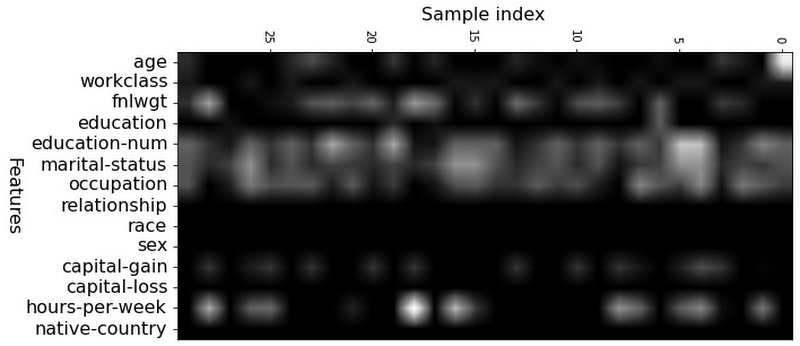
In addition to high accuracy, another core benefit of TabNet is that, unlike conventional deep neural network (DNN) models such as multi-layer perceptrons, its architecture includes explainability out of the box. This new launch on Vertex Tabular Workflows makes it very convenient to visualize explanations of the trained TabNet models, so that the users can quickly gain insights on how the TabNet models arrive at its decisions. TabNet provides feature importance output via its learned masks, which indicate whether a feature is selected at a given decision step in the model. Below is the visualization of the local and global feature importance based on the mask values. The higher the value of the mask for a particular sample, the more important the corresponding feature is for that sample. Explainability of TabNet has fundamental benefits over post-hoc methods like Shapley values that are computationally-expensive to estimate, while TabNet’s explanations are readily available from the model’s intermediate layers. Furthermore, post-hoc explanations are based on approximations to nonlinear black-box functions while TabNet’s explanations are based on what the actual decision making is based on.
Explainability example: To illustrate what is achievable with this kind of explainability, Figure 2 below shows the feature importance for the Census dataset. The figure indicates that education, occupation, and number of hours per week are the most important features to predict whether a person can earn more than $50K/year (the color of corresponding columns are lighter). The explainability capability is sample-wise, which means that we can get the feature importance for each sample separately.
Benefits as a Fully-Managed Vertex Pipeline
TabNet on Vertex Tabular Workflows makes the model development and deployments tasks much simpler – without writing any code, one can obtain the trained TabNet model, deploy it in their application, and use the MLOps capabilities enabled by Vertex Managed Pipelines! Some of these benefits are highlighted as:
- Compatibility with Vertex AI ML Ops for implementing automated ML at scale including products like Vertex AI Pipelines and Vertex AI Experiments.
- Deployment convenience: Vertex AI prediction services, both in batch and online mode, are supported out-of-the-box.
- Customizable feature engineering to enable the best utilization of the domain knowledge of users.
- Using Google’s state-of-the-art search algorithms, automatic tuning to identify the best-performing hyperparameters, with automatic selection of the appropriate hyper-parameter search space based on dataset size, prediction type, and training budget.
- Tracking the deployed model and convenient evaluation tools.
- Easiness in comparative benchmarking with other models (such as AutoML and Wide & Deep Networks) as the user journey would be unified.
- Multi-region availability to better address international workloads.
More details
If you’re interested in trying TabNet on Vertex AI on your tabular datasets, please check out Tabular Workflow on Vertex AI and fill out this form.
Acknowledgements: We’d like to thank Nate Yoder, Yihe Dong, Dawei Jia, Alex Martin, Helin Wang, Henry Tappen and Tomas Pfister for their contributions to this blog.
Next-Level Search: Discover the Game-Changing Capabilities of Enterprise Search on Gen App Builder

1193
Of your peers have already read this article.
4:30 Minutes
The most insightful time you'll spend today!
In our conversations with customers, few generative AI use cases have driven as much enthusiasm as generative search. Leaders at enterprises know the limits of traditional enterprise search, with queries producing a list of links based on pattern matching, and significant manual investigation required to find the more relevant answers. In generative AI, these leaders see an opportunity to leverage their data more effectively and deeply, including applying it to conversational apps that can answer complex questions, produce accurate summaries that synthesize many sources, and help people get the information they need, faster.
Enterprise Search on Generative AI App Builder (Gen App Builder) lets organizations create custom chatbots and semantic search applications in as little as a few minutes, with minimal coding needed to get started and enterprise-grade management and security built in. Customers can combine their internal data with the power of Google’s search technologies and generative foundation models, delivering relevant, personalized search experiences for enterprise applications or consumer-facing websites.
To date, most approaches to combining generative AI and search technology have been inadequate for the scale and reliability needed for enterprise use. For example, building search by breaking long documents into chunks and feeding each segment into an AI assistant typically isn’t scalable and doesn’t effectively provide insights across multiple sources. Likewise, many solutions are limited in the data types they can handle, prone to errors, and susceptible to data leakage. Bespoke, do-it-yourself approaches are generally no easier, with production-grade solutions often requiring complex tasks like integrating embeddings data with foundation models and significant use case data testing. Even when organizations make these efforts, the resulting solutions still tend to lack feature completeness and reliability, with significant investments of time and resources required to achieve high-quality results.
These challenges demonstrate that to effectively implement generative search, organizations typically need more than access to powerful foundation models. They also likely need the ability to ground model outputs in specific data, so that outputs are more relevant and less likely to include mistakes or “hallucinations.” They generally need safeguards that protect their data, how it is accessed, and how it is used. And they generally need the process to be high-performant and scalable out of the box, making the functionality easy to use even if the organization lacks data science and machine learning expertise.
Let’s look at how Enterprise Search on Gen App Builder helps customers bypass these scale and reliability challenges, so they can start leveraging generative search quickly.
The intersection of generative AI and enterprise data
Enterprise Search on Gen App Builder lets developers create search engines that help ground outputs in specific data sources for accuracy and relevance, can handle multimodal data such as images, and include controls over how answer summaries are generated. Multi-turn conversations are supported so that users can ask follow up questions as they peruse outputs, and customers have control over their data—including the ability to support HIPAA compliance for healthcare use cases. All of this is available as a fully managed service, so developers can focus on building rather than cloud complexity.
Gen App Builder’s out-of-box capabilities can remove the need for data chunking, generating embeddings, or managing indexes, hiding complexity behind a straightforward interface that lets developers build apps in minutes with little or no coding and no prior machine learning experience. With the ability to ingest large volumes of documents and support for both unstructured and structured data, apps built with Gen App Builder help customers solve the long-standing headache of finding relevant information across the organization, turning tasks that used to take hours into quick searches or conversational explorations with an app.
These capabilities are underpinned by both Google’s foundation models and a variety of Google Search technologies, including:
- Semantic search, which helps deliver more relevant results than traditional keyword-based search techniques by using natural language processing and machine learning techniques to infer relationships within the content and intent from the user’s query input.
- Google’s understanding of how users search for information.
- Google’s expertise in understanding relevance, which considers factors such as content popularity and user personalization of content when determining the order in which search results are displayed.
For more advanced use cases, Gen App Builder can be easily integrated with Vertex AI for in-depth foundation model tuning, enabling flexible input and output search formats.
As always with our AI products, Gen App Builder has been evaluated for alignment with our AI Principles, which is reflected by the product’s many safeguards against bias, toxic content, and unhelpful outputs. Whether for prototypes built in minutes or apps with many custom components, Enterprise Search on Gen App Builder offers a robust suite of user-friendly tools for customers across industries and levels of expertise.
How customers are innovating with Enterprise Search
After gaining access to Enterprise Search on Gen App Builder via our trusted tester program, a number of customers are already leveraging the product for novel use cases.
Priceline is harnessing Gen App Builder and Vertex AI for a range of projects, including internal search engines for employees and a new chatbot to assist customers as they make travel plans. Slated to be available across both desktop and mobile experiences, Priceline’s chatbot will help customers find the right information faster via always-on, personalized experiences, including answering nuanced questions like, “What are the best 4-star hotel options in midtown Manhattan within walking distance to Central Park?” and “Can you help me extend my hotel reservation for an additional night?”
“Priceline is charting a course to transform the novelty of generative AI into lasting value for our customers and our business. We believe it’s not just about having the latest technology; it’s also about practically targeting innovation to the right challenges and opportunities,” said Marty Brodbeck, Chief Technology Officer, Priceline. “With Google Cloud as our AI innovation partner, we’re doubling down on our commitment to delivering the fastest, most seamless and informative booking experience for our customers, from personalized planning and travel inspiration to customer service.”
Vodafone is experimenting with Enterprise Search and foundation models on Gen App Builder to build a tool that can rapidly and securely query documents, search, and understand specific commercial terms and conditions. Vodafone Voice and Roaming Services has over 10,000 contracts with other telecommunications companies worldwide, in a variety of formats such as PDFs, images, and complex tables. Searching this document repository is often a time consuming process for employees.
“Every day we introduce and manage new services like 5G to a roaming footprint comprising more than 700 operators in 210 countries to ensure both Vodafone and our partners’ business customers, holidaymakers, and Internet of Things devices stay connected when abroad. With Enterprise Search on Gen App Builder, we are building an intelligent assistant to securely and quickly search contracts.” said Sherif Bakir, CEO of Vodafone Voice and Roaming Services. “With generative AI, we’re accelerating otherwise protracted processes, increasing productivity and operational efficiency.”
Software startup Trender.ai, which creates customer monitoring and intelligence solutions for B2B relationships, is using Gen App Builder to build a product that can synthesize information from social media, public sources, and CRM data so that users can form more productive, personal relationships with prospects and customers.
“With Enterprise Search on Gen App Builder, we have been able to do things in the last month that we had projected to take 12-18 months on our prior roadmap,” said Betsy Bilhorn, co-founder at Trender.ai. “We had expected it would take at least 12 months to build and train models from an individual’s public social, web, and other data, and to then be able to ask questions like ‘What things are most important to this person?’ or ‘When and how is the best way to make an introduction to this prospect that they’ll respond to?’ Last year, we thought getting to this vision was a bit of a moonshot for a startup our size — but now we were able to achieve this in under a month.”
Stop searching for solutions — start discovering insights
We’re excited to see how customers use Enterprise Search on Gen App Builder to leverage data in powerful ways, discover new insights, and create useful, personal, and efficient experiences.
Today, we’re pleased to help our customers accomplish these goals, with the general availability of Enterprise Search on Gen App Builder for customers on the allowlist (i.e., approved for access). Please contact your Google Cloud sales team for access and pricing details. We are also launching two new features within Enterprise Search on Gen App Builder that are available today in our preview offering: multi-turn search, which supports asking follow-up questions, and content recommendations to find semantically relevant content. Access to the preview offering is available via Google Cloud’s trusted tester program. Read more about Enterprise Search on Gen App Builder and sign up for access on our webpage.
We’re also bringing generative AI features of Enterprise Search to our existing solutions like Contact Center AI and Document AI. As an example, starting this month, customers can preview generative AI-powered search in Document AI Warehouse. To keep up with our latest generative AI news, don’t miss The Prompt or our generative AI primer for executives on Transform with Google Cloud.
Discover Gen App Builder: Transform Search and Conversational Experiences Through Generative AI

1253
Of your peers have already read this article.
3:30 Minutes
The most insightful time you'll spend today!
If you’ve been exploring recently-launched consumer generative AI tools like Bard and thinking about how to build similar experiences for your business, Generative AI App Builder, or Gen App Builder for short, is here to get you started.
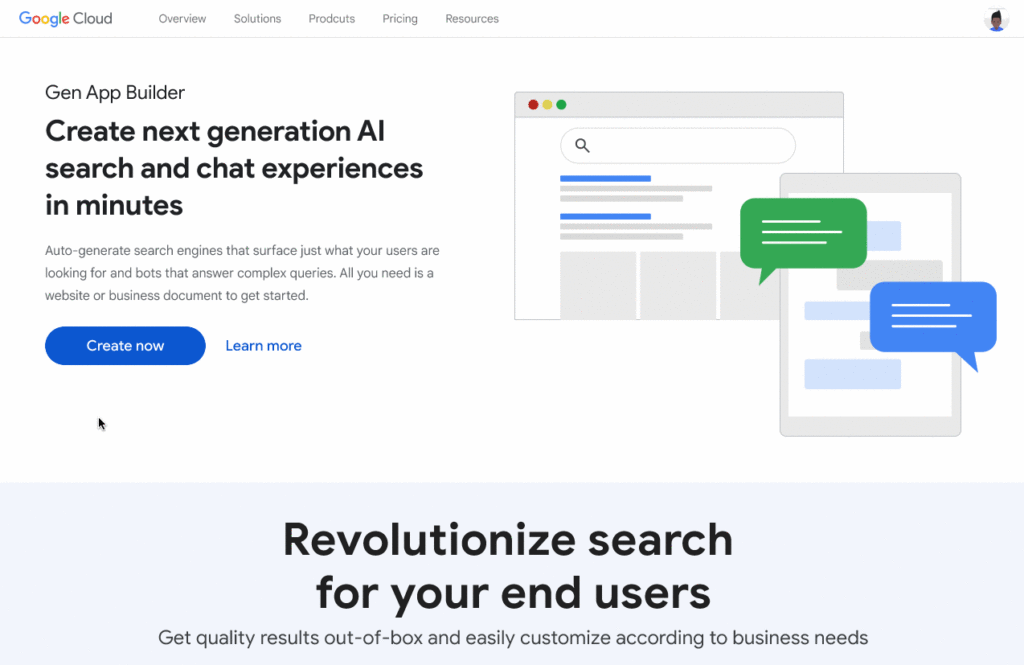
Gen App Builder is part of Google Cloud’s recently announced generative AI offerings and lets developers, even those with limited machine learning skills, quickly and easily tap into the power of Google’s foundation models, search expertise, and conversational AI technologies to create enterprise-grade generative AI applications.
“Google Cloud’s leading AI technology enables STARZ customers to discover more relevant content, increasing engagement with, and the likelihood of completing the content served to them,” says Robin Chacko, EVP Direct-to-Consumer, STARZ. “We’re excited about how generative AI-powered search will help users find the most relevant content even easier and faster.”
Gen App Builder is exciting because unlike most existing generative AI offerings for developers, it offers an orchestration layer that abstracts the complexity of combining various enterprise systems with generative AI tools to create a smooth, helpful user experience. Gen App Builder provides step-by-step orchestration of search and conversational applications with pre-built workflows for common tasks like onboarding, data ingestion, and customization, making it easy for developers to set up and deploy their apps. With Gen App Builder developers can:
- Build in minutes or hours. With access to Google’s no-code conversational and search tools powered by foundation models, organizations can get started with a few clicks and quickly build high-quality experiences that can be integrated into their applications and websites.
- Combine the power of foundation models with information retrieval to find relevant, personalized information. Enterprises can build apps that understand user intent via natural language, and surface the right information with associated citations and attributions from a company’s public and private data. They can also fully control what data their applications access and the content or topics they want to address.
- Build multimodal apps that can respond with text, images, and other media. Gen App Builder supports not just text, but also other modalities such as images and videos. It allows developers to build apps using a combination of text and images as inputs to find information across documents, photos, and video content, enabling richer customer interactions.
- Combine natural conversations with structured flows. Developers can granularly blend the output of foundation models with controls to ground answers in enterprise content, and step-by-step conversation orchestration to guide customers to the right answers.
- Provide the ability to transact and connect to third party apps and services. Gen App Builder makes it simple to create digital assistants and bots that not only serve content, but also connect to purchasing and provisioning systems to enable transactions from the conversational UI, and escalate customer conversations to a human agent when the context demands.
A new generation of conversational AI experiences and assistants
Consumers of enterprise applications expect to interact with technology in a seamless, conversational way to quickly find the information they need and act on it. Gen App Builder can help reinvent these customer and employee experiences by ingesting large, complex datasets that are specific to your company–from websites, documents, and transactional systems like billing and inventory, to emails, chat conversations, and more. These AI-powered apps can synthesize information across all of these sources to provide specific, actionable responses, using only the data you have provided.
Some of the most popular uses are in customer service, where generative apps can contribute to increasing revenue, customer satisfaction, and customer loyalty. For example, if a retail customer reaches out to modify an order, a virtual agent can help them change it to another product. The customer doesn’t even need to provide the new product name—they can just upload an image and let the agent guide them through the rest. Watch this demo to see how a retail chatbot can use multimodal capabilities to help a consumer navigate various options on the website, including giving the customer ideas on how to use the product and even helping them complete the purchase with the ability to transact within the conversational UI. This scenario could apply to multiple industries and use cases, ranging from consumer goods and public services, to finance and internal corporate systems like intranets.
Combining the power of Google-quality search with foundation models
Finding the right information from data across the organization is a critical requirement within any enterprise. Yet it can be challenging to build high-quality enterprise search experiences with existing tools. Current systems struggle to understand user intent, are difficult to implement and customize, and don’t provide a high-quality user experience.
One of the most exciting features of Gen App Builder is the ability to combine the power of Google-quality search with generative AI to help enterprises find the most relevant and personalized information when they need it. With Gen App Builder, enterprises can build conversational search experiences across their public and private data in minutes or hours with no coding experience.
Enabling multimodal search across text, images and video within the enterprise is a key aspect of the search experiences in Gen App Builder. In addition to providing high-quality search results, Gen App Builder can conveniently summarize the results and provide corresponding citations in a natural, human-like fashion. Gen App Builder also automatically extracts key information from the data and enables personalized results for users. Watch this demo to see how these capabilities can come together to transform the search experience for employees at a financial services firm. The ability to integrate Google-quality search within the enterprise’s applications means they can enjoy a new level of data utilization, drive increased process efficiencies, and provide delightful experiences to their employees and customers.
“Customers have been shopping at Macy’s for generations. Being able to deliver 360° personalization and contextual recommendations will help ensure that Macy’s is still providing future generations of shoppers with a seamless, exceptional experience,” said Bennett Fox-Glassman, Senior Vice-President, Customer Journey, Macy’s. “We’ve already realized an increase in revenue per visit and conversion rates had great success using Google Cloud’s AI technology and are looking forward to exploring how these latest announcements bring together Natural Language Processing and Generative AI capabilities to deliver next-gen search and conversational experiences for our customers.”
The ability to intuitively interact with complex data across a variety of sources allows organizations to better serve their customers and deliver more relevant offerings. Combined with conversational and fulfillment abilities, the potential for improving customer engagement and employee productivity is immense. We’re excited to see how developers and enterprises use a mix of these capabilities to power new experiences and revenue opportunities.
If you’re interested in a closer look at the Gen App Builder, tune into this session at the Data Cloud & AI Summit. Take a step forward to getting hands-on and join the waitlist for our trusted tester program. And finally, bookmark our generative AI landing page to keep abreast of the latest news, updates and possibilities from this exciting new world of Gen Apps.
5717
Of your peers have already watched this video.
2:00 Minutes
The most insightful time you'll spend today!
Metro Consolidates 100 SAP Instances on Google Cloud
German retailer Metro, with operations in 25 countries across Europe and Asia and employing over 150,000 people, decided to consolidate its 100 SAP instances into one SAP S/4HANA system running on the Google Cloud Platform.
This helped the company lower costs, increase efficiency, and improve customer experience. In addition, the company is using Google BigQuery and advanced analytics to increase its sales.
Watch Timo Salzsieder, Metro CIO/CSO, explain the company’s journey with SAP on Google Cloud.
More Relevant Stories for Your Company

Google’s Lesson on Leveraging AI and More to Optimize Cloud Value for Innovation
Google has managed to stay ahead of the curve and demonstrate its 'growth while staying innovative' approach using advanced open technologies, AI/ML based analytics solutions, as well as tools for team collaboration and skill development, automation and storage security. Businesses too can achieve the same by deriving maximum value from

Beyond Traditional Learning: AI-based Online Learning Platform and Google Cloud Solutions Push Learners to Get Ahead
The combination of a vital need for IT experts among businesses and a digital skills gap is making lifelong learning increasingly critical. Beyond professional development, learning new skills offers additional rewards from building peer connections to boosting your creativity. That’s why in 2020 Krishna Deepak Nallamilli and I launched KIMO.ai to reimagine how people

Reasons to Leverage Vertex AI Custom Training Service
At one point or another, many of us have used a local computing environment for machine learning (ML). That may have been a notebook computer or a desktop with a GPU. For some problems, a local environment is more than enough. Plus, there's a lot of flexibility. Install Python, install

Simplifying Unstructured Data Analytics with BigQuery ML and Vertex AI: A Comprehensive Guide
Unstructured data such as images, speech and textual data can be notoriously difficult to manage, and even harder to analyze. The analysis of unstructured data includes use cases such as extracting text from images using OCR, sentiment analysis on customer reviews and simplifying translation for analytics. All of this data
