





Transformation Cloud: A New Wheel of Innovation and Digital Transformation

3362
Of your peers have already read this article.
1:30 Minutes
The most insightful time you'll spend today!
Looking back on the past year, I see challenges—but also reinvention. Reinvention in how children are educated. Reinvention in how medical professionals provide care. Reinvention in how customers purchase products. This reinvention was made possible by all of the IT leaders around the world who had a vision about what could be possible with technology.
Technology has allowed people to work and complete critical activities safely outside of their standard locations. But, it has also enabled transformation in ways we have not seen before: in how people collaborate, in how businesses operate, and most important to me, in how organizations innovate.
Rethinking what it means to transform
The leading indicator for organizations that are accelerating their innovation during this time is how they are thinking about transformation. Instead of asking infrastructure questions about where their apps and services should run, they are asking transformation questions about how to build an environment that enables every person, process, and technology to adapt in order to bring the highest level of innovation to the business.
Innovative companies have moved beyond migrating their data centers to the cloud, changing not only where their business is done but, more importantly, how it is done. For example, Papa John’s recently announced they are building a digital platform that looks at real-time data across the business to improve its loyalty programs, website, and customer and partner experiences. Albertsons Companies is transforming itself by reinventing grocery shopping, both the digital and physical aisle, through shoppable maps, AI-powered conversational commerce, and predictive grocery list building. Airbus is reimagining their work environment to embrace the hybrid work reality. And Siemens is partnering with Google Cloud to reinvent industrial manufacturing with AI to empower employees, automate mundane tasks, and improve product quality.
Here, transformation is made possible with technologies that enable new innovations for their customers versus decisions about where infrastructure should be run. And this aligns with a recent study by Forrester that states the top two IT initiatives for the next 12 months are to increase innovation and to invest in technology that helps employees do their jobs better.1
Some of the best conversations I’ve had with customers are focused on how to:
- Accelerate transformation while also maintaining the freedom to adapt to market needs.
- Make every employee—data scientists to sales associates—smarter with real-time data to make the best decisions.
- Bring people together and enable them to communicate, collaborate, and share with each other when they can not meet in person.
- Protect everything that matters to us—our people, our customers, our data, our customers’ data, and each transaction we undertake.
This new customer thinking is driving new technology requirements—requirements that can be solved through a transformation cloud. A transformation cloud accelerates an organization’s digital transformation through app and infrastructure modernization, data democratization, people connections, and trusted transactions. The result is an organization – and its workers – that can take advantage of all of the benefits of cloud computing to drive innovation.
The new requirements for innovation
Organizations want to work with multiple cloud providers to choose the best technology for each of their apps and services while also mitigating against inevitable cloud outages and vendor lock in. They value the flexibility of open source based solutions and look to our multicloud platforms like Google Kubernetes Engine and Anthos to instill freedom in how they innovate and drive differentiated customer experiences. It is no surprise that, in a recent Google-commissioned IDG research study, 78% of Global IT leaders stated that multi/hybrid cloud support is a major consideration when selecting a cloud provider and 74% preferred open source cloud solutions.2 Customers like MLB, DenizBank, and Macquarie Bank understand the necessity of a multicloud strategy and are taking advantage of Google Cloud’s open, hybrid architecture to give them the maximum flexibility to run their business how and where they want.
These organizations also want to use data to better understand their customers, enhance their products, and improve inventory accuracy in order to make real-time decisions—and bring it together into a cohesive data cloud. They value how analytics solutions democratize access to data for all employees and how embedded AI helps them predict and automate the future. The Forrester study mentioned above also shows that companies focused on improving their use of data for better decision-making, are taking actions to improve data self-service capabilities and make access to data and insights more democratic.3 Customers like Twitter, PayPal, The Home Depot, HSBC, and Stanford Medicine, unify their data across their organizations to power deeper AI-driven business insights, make better real-time decisions, and build and run their data-driven applications.
And while technology is driving many of the transformations we see, so are an organization’s people. Workers are finding new ways to strengthen human connections, deepen their impact, and serve customers while transforming how work happens—as shown in the fact that 59% of organizations in the IDG study accelerated or newly introduced remote working and collaboration capabilities in 2020.4 Customers like Kia Motors, Cambridge Health Alliance, and PwC are using Google Workspace to enable teams of all sizes to connect, create, collaborate, and to drive innovation from any device, and any location.
Finally, the innovation that we see in every digital transaction is matched with new ways to protect and secure the business. Organizations want to protect their employees, customers, and partners against emerging threats, analyze massive amounts of data to secure infrastructure, and build a long term strategy for strategic governance of their assets regardless of their location. Getting this right is essential as organizations see security as a top pain point impeding innovation.5 Customers like Equifax and Evernote are using Google Cloud’s secure platform and security products to extend customer confidence anywhere their systems may operate.
Google Cloud technologies are already powering customers’ transformation clouds
Supporting our customers’ reinventions are our top priority and we believe that together, we can pave the way for what is next. With our investments in multicloud and AI/ML, to sustainable infrastructure, industry solutions, and technology that improves our communities, such as COVID-19 vaccine distribution, we are proud that our customers trust Google Cloud solutions to digitally transform their business.
We have lots more to tell you about in the coming months, starting with our Data Cloud Summit on May 26th. Between this event, and the multiple other events we have this summer, you will learn about how our industry leadership and collaboration with our partners are enabling our customers to build powerful transformation clouds to support their continued reinvention.
1. Forrester Analytics Business Technographics® Priorities And Journey Survey, 2021
2. IDG Communications, Inc: “No Turning Back: How the Pandemic Has Reshaped Digital Business Agendas”, 2021
3. Of the companies that prioritize data in decision making, 37% are improving data self-service capabilities and 30% are making access to data and insights more democratic (Forrester Analytics Business Technographics® Priorities And Journey Survey, 2021)
4. IDG Communications, Inc, “No Turning Back: How the Pandemic Has Reshaped Digital Business Agendas”, 2021
5. 33% of organizations stated Security risks & concerns as a top pain point impeding innovation (IDG Communications, Inc, “No Turning Back: How the Pandemic Has Reshaped Digital Business Agendas”, 2021)
3468
Of your peers have already watched this video.
1:30 Minutes
The most insightful time you'll spend today!
Pharma Firm Drives 80% Improvement in Speed with SAP on Google Cloud
FFF Enterprises is a leading supplier of critical-care biopharmaceuticals, plasma products, and vaccines. Their passion for patient safety and product efficacy drives their mission of Helping Healthcare Care.
For FFF Enterprises if they have to focus on ERP infrastructure, that takes away from getting products to patents. Learn why FFF Enterprises chose to deploy SAP on Google Cloud and drove an 80% improvement in speed for their SAP environment at a lower cost.
4894
Of your peers have already watched this video.
9:37 Minutes
The most insightful time you'll spend today!
L’Oréal: Managing Big-data Complexity with Google Cloud
L’Oreal is a global company with a presence in 150 countries worldwide. Between managing all of its brands and requirements for different countries, L’Oreal looks to data to make insightful business decisions. How does L’Oreal unify its data across all its systems and databases? How does L’Oreal make the data accessible to thousands of employees? In this video, Antoine Castex, Enterprise Architect at L’Oreal, discusses with Martin Omander how L’Oreal built a serverless, multi-cloud warehouse based on Google Cloud.
Chapters:
0:00 – Intro
0:23 – Why does L’Oreal need a new data warehouse?
0:51 – Who is the L’Oreal group?
1:35 – Which systems does L’Oreal use?
2:14 – How does L’Oreal manage complexity?
3:59 – What is ELT?
4:57 – Who are L’Oreal’s data consumers?
5:41 – How L’Oreal built the data warehouse
8:51 – L’Oreal’s future plans
9:10 – Wrap up
Google Cloud Workflows → https://goo.gle/3q20M1V
Cloud Run → https://goo.gle/3CSWbXG
Eventarc → https://goo.gle/3B7qhFy
BigQuery → https://goo.gle/3KHgyJ3
Looker → https://goo.gle/3Rx4Ind
Checkout more episodes of Serverless Expeditions → https://goo.gle/ServerlessExpeditions
Subscribe to Google Cloud Tech → https://goo.gle/GoogleCloudTech
Google Cloud’s Autism Career Program to Nurture Neurodiverse Talent

3560
Of your peers have already read this article.
1:30 Minutes
The most insightful time you'll spend today!
My passion for neurodiversity began 10 years ago, when I became involved with Els for Autism, an organization that works with children and adults who have autism, as well as their families. At the time, I had a friend who was struggling to find resources for his son with autism. The foundation promotes acceptance and inclusion for people on the spectrum, helping them live independently and find jobs that harness their talents and skills. The organization’s focus on autism in the workplace resonated deeply with me, due to the rich experiences I had working with individuals with autism over the course of my career.
Approximately two percent of the population has autism, but it’s estimated this number is actually quite low as many individuals go undiagnosed. Of those that have been diagnosed, only 29% have had any sort of paid work in their lives. Personally, I find this tragic, because individuals with autism can be highly-functioning and contributing professionals in any organization. Too often, though, the interview process can pose challenges due to unconscious bias from a hiring manager or interviewer, for example, if the candidate doesn’t look an interviewer in the eyes or asks for additional time to complete a test. This bias often unintentionally marginalizes great candidates and means businesses miss out on valuable talent who can contribute and enrich the workplace.
Introducing Google Cloud’s Autism Career Program
It is in that spirit that I am excited to announce the launch of Google Cloud’s Autism Career Program, designed to hire and support more talented people with autism in the rapidly growing cloud industry.
We are working with experts from the Stanford Neurodiversity Project (part of the Stanford University School of Medicine), which provides consultation services to employers to advise on opportunities and success metrics for neurodiverse individuals in the workplace.
One key pillar of our program is to train up to 500 Google Cloud managers and others who are involved in hiring processes. Our goal is to empower these Googlers to work effectively and empathetically with autistic candidates and ensure Google’s onboarding processes are accessible and equitable. Stanford will also provide coaching to applicants, as well as ongoing support for them, their teammates and managers once they join the Google Cloud team.
We’re taking this approach to break down the barriers that candidates with autism most often face. In addition to bias, there may be challenges with how interviews are structured or conducted without the right tools. For these reasons, we will offer candidates in this program reasonable accommodations like extended interview time, providing questions in advance, or conducting the interview in writing in a Google Doc rather than verbally on a call. These accommodations don’t give those candidates an unfair advantage. It’s just the opposite: They remove an unfair disadvantage so candidates have a fair and equitable chance to compete for the job.
This program is just one example of Google Cloud’s commitment to inclusion, and it is an important step forward to building a more representative team and creating value for customers and stakeholders.
Ubuntu Pro Images Now Available on Google Cloud

4824
Of your peers have already read this article.
2:00 Minutes
The most insightful time you'll spend today!
Today, we’re pleased to announce the general availability of Ubuntu Pro images on Google Cloud, providing customers with an improved Ubuntu experience, expanded security coverage, and integration with critical Google Cloud features. In partnership with Canonical, we’re making it even easier for customers that have fully embraced open source to ensure security and compliance for their most mission-critical and enterprise workloads.
With Ubuntu Pro on Google Cloud, you now have access to features like:
- 10-year lifetime security updates – Canonical backs Ubuntu Pro for 10 years with security updates and a guaranteed upgrade path.
- FIPS & CC-EAL2 certification – Ubuntu Pro includes components that meet requirements from entities like FedRAMP, HIPAA, ISO, and PCI.
- Open-source security coverage – Protect your most important open-source workloads including MongoDB, Apache Kafka, Redis, NGINX, and PostgreSQL.
- Multi-version availability – Pro images are available for the three most popular Ubuntu Server distributions: 16.04 LTS, 18.04 LTS, and 20.04 LTS.
- Kernel Livepatch – Kernel patches are delivered immediately without having to reboot your VMs.
- Optional CIS and DISA STIG profiles – Choose from two leading profiles to harden your environment according to industry benchmarks.
- Cloud-based pricing – Ubuntu Pro does not require a contract, and pricing tracks with the underlying compute cost depending on the instance type.
Extended Security Maintenance (ESM) for Ubuntu 16.04 LTS with Ubuntu Pro
Availability of Ubuntu Pro images is especially important if you’re an Ubuntu 16.04 LTS customer and want extended security maintenance (ESM) for your virtual machines but don’t want to upgrade to Ubuntu 18.04 LTS or Ubuntu 20.04 LTS versions immediately. ESM is included with Ubuntu Pro 16.04. You can move your workloads from Ubuntu 16.04 LTS VM instances to Ubuntu Pro 16.04 instances to continue receiving ESM and all the above-mentioned benefits, without having to test your applications on a new version of the OS.
Gojek has evolved from offering just ride-hailing to a suite of more than 20 services today, serving everyday solutions for millions of users across Southeast Asia.
“We needed more time to comprehensively test and migrate our Ubuntu 16.04 LTS workloads to Ubuntu 20.04 LTS, which would mean stretching beyond the standard maintenance timelines for Ubuntu 16.04 LTS. With Ubuntu Pro on Google Cloud, we now have the ability to postpone this, and in moving our 16.04 workloads to Ubuntu Pro, we benefit from its live kernel patching and improved security coverage for our key open source components.”—Kartik Gupta, Engineering Manager for CI/CD & FinOps at Gojek
“With the launch of Ubuntu Pro on Google Cloud, we build on our joint investments with Google to optimize Ubuntu performance on Google Cloud, and add comprehensive security patching and Long Term Support for another 30,000 open source packages—the widest range of security-maintained open source on the planet,” said Mark Shuttleworth, CEO of Canonical. “As the world moves to open source for everything, Canonical offers the safety net of security maintenance that enterprises count on to unleash their developers.”
Getting started
Getting started with Ubuntu Pro on Google Cloud is simple. You can now purchase these premium images directly from Google Cloud by selecting Ubuntu Pro as the operating system straight from the Google Cloud Console.
To learn more about Ubuntu Pro on Google Cloud, please visit the documentation page and read the announcement from Canonical.
Google Introduces ML-based Predictive Autoscaling to Forecast Capacity and Match Scaling Demands

4979
Of your peers have already read this article.
3:00 Minutes
The most insightful time you'll spend today!
At Google Cloud, we believe you get most benefits from the cloud when you scale infrastructure based on changing demand. Compute Engine allows you to configure autoscaling to save costs during periods of low demand, and add capacity to support peak loads.
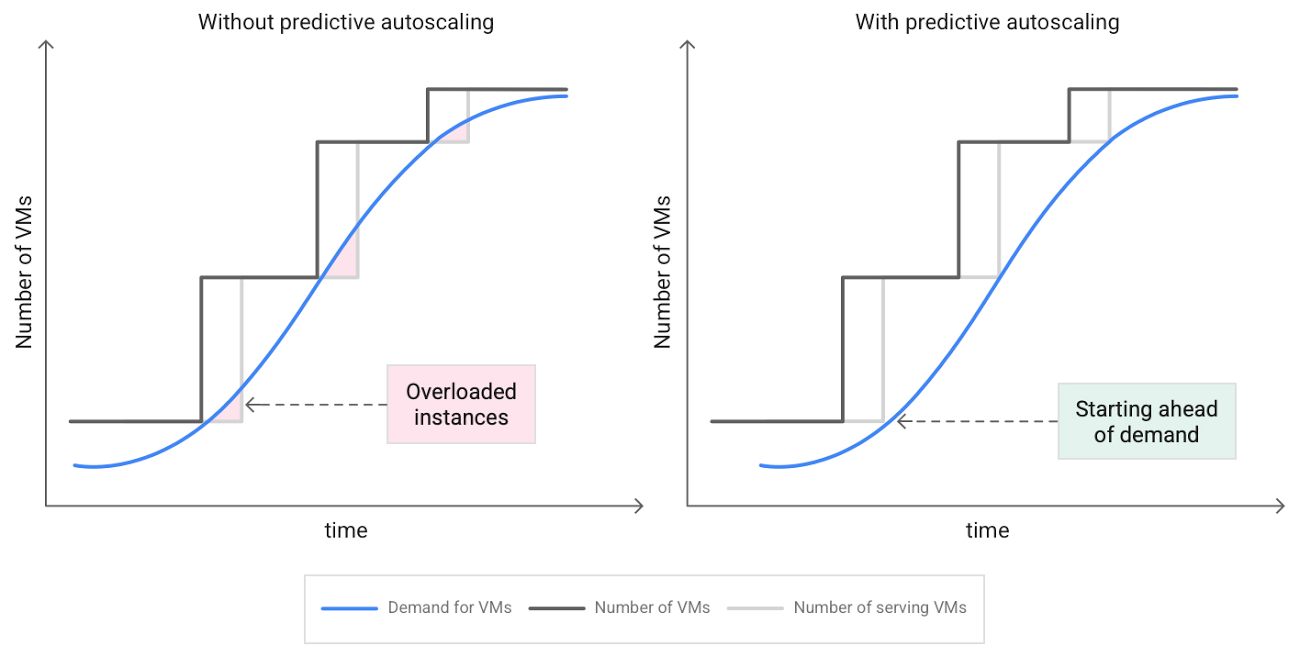
When you use a managed instance group (MIG), you can have an autoscaler automatically create or delete virtual machine (VM) instances based on increases or decreases in load. However, if your application takes several minutes to initialize, creating VMs in response to growing load might not increase your application’s capacity quickly enough. For example, if there’s a large increase in load (like when users first wake up in the morning), some users might experience delays while your application is initializing on new instances.
A good way to solve this problem would be to create VMs ahead of demand so that your application has enough time to initialize beforehand. This requires knowing upcoming demand. If only we could predict the future… Well, now we can!
Introducing predictive autoscaling
Predictive autoscaling uses Google Cloud’s machine learning capabilities to forecast capacity needs. It creates VMs ahead of growing demand allowing enough time for your application to initialize.
How does it work?
Predictive autoscaling uses your instance group’s CPU history to forecast future load and calculate how many VMs are needed to meet your target CPU utilization. Our machine learning adjusts the forecast based on recurring load patterns for each MIG.
You can specify how far in advance you want autoscaler to create new VMs by configuring the application initialization period. For example, if your app takes 5 minutes to initialize, autoscaler will create new instances 5 minutes ahead of the anticipated load increase. This allows you to keep your CPU utilization within the target and keep your application responsive even when there’s high growth in demand.
Many of our customers have different capacity needs during different times of the day or different days of the week. Our forecasting model understands weekly and daily patterns to cover for these differences. For example, if your app usually needs less capacity on the weekend our forecast will capture that. Or, if you have higher capacity needs during working hours, we also have you covered.
Why should you try it?
Predictive autoscaling continuously adapts forecasted capacity to best match upcoming demand. Autoscaler checks the forecast several times per minute and creates or deletes VMs to match its prediction. The forecast itself is updated every few minutes to match recent load trends so if your growth rate is higher or lower than usual we will adjust the forecast accordingly. This gives you capacity needed to cover peak load while saving on cost when demand goes down.
You can start using predictive autoscaling without worry as it’s fully compatible with the current autoscaler. Autoscaler will calculate enough VMs to cover both forecasted as well as real-time CPU load—whichever is higher. This works with other autoscaling features as well: you can scale based on schedule, your Load Balancer request target or Cloud Monitoring metrics. Autoscaler provides enough capacity to all of your configurations by taking the highest number of VMs needed to meet all your targets.
Getting started
You can enable predictive autoscaling in the Google Cloud Console. Select an autoscaled MIG from the instance groups page and click Edit group. Change predictive autoscaling configuration from Off to Optimize for availability.
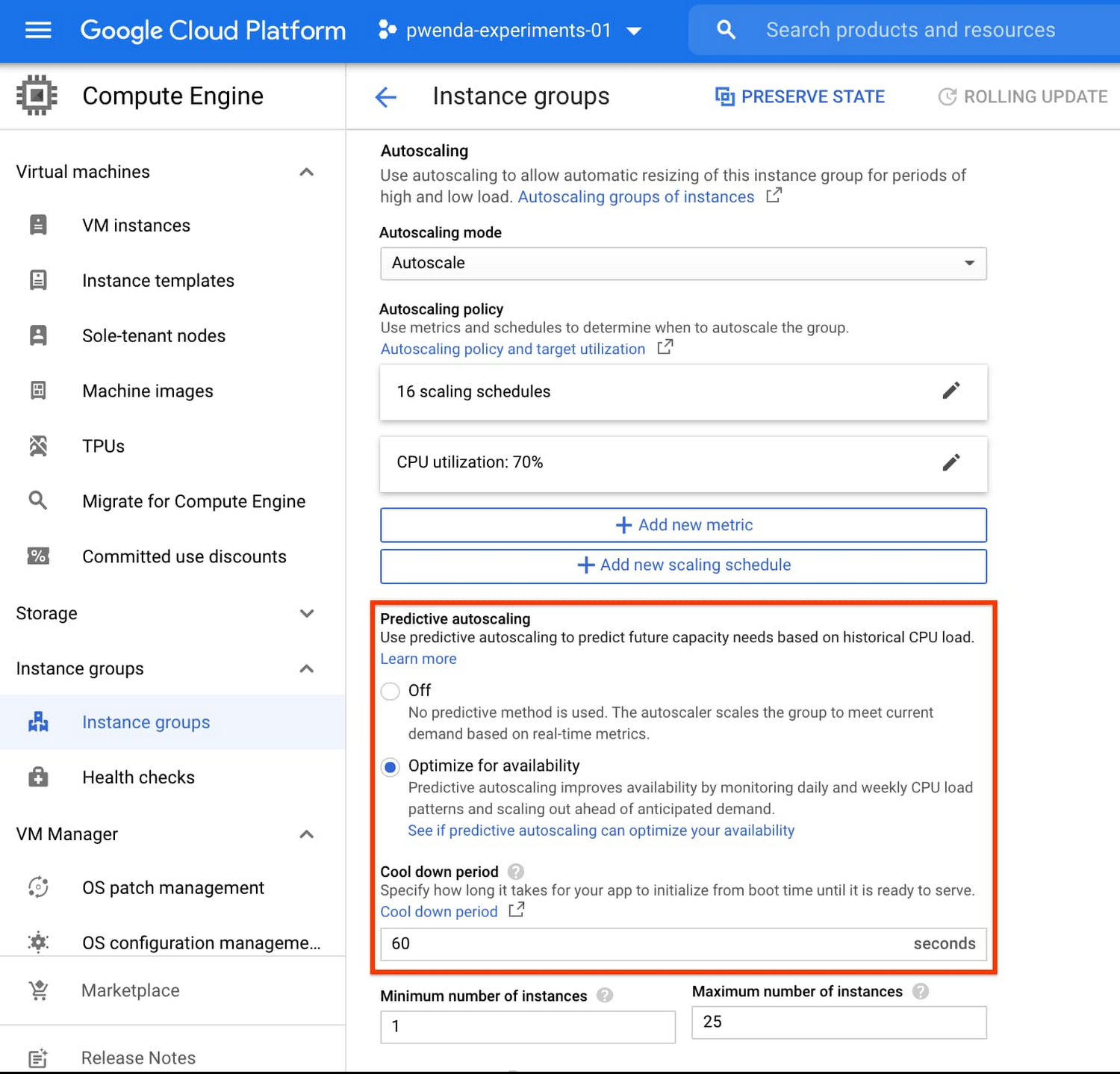
To better understand whether predictive autoscaling is good for your application, click the link See if predictive autoscaling can optimize your availability. This will show you a comparison of the last seven days with your current autoscaling configuration vs. with predictive autoscaling enabled.
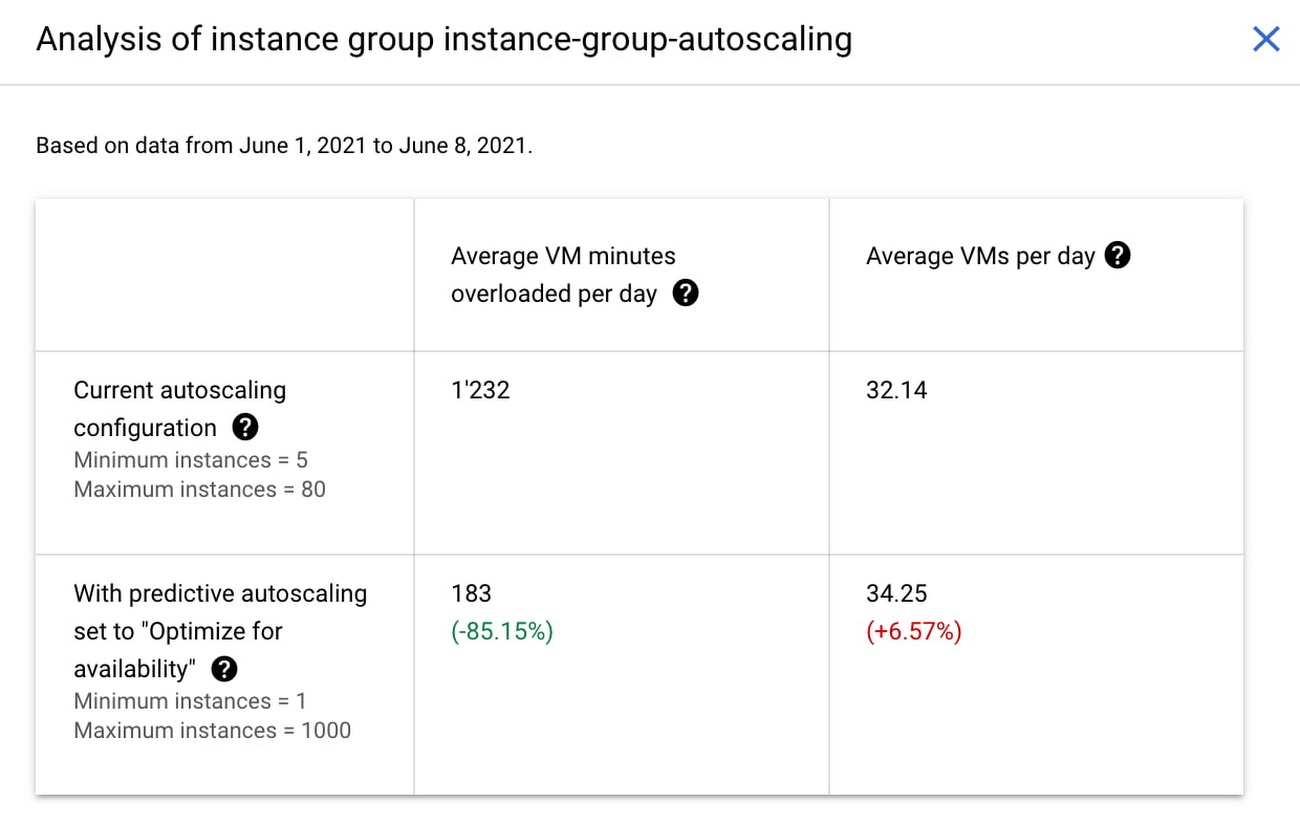
In the above chart,
- Average VM minutes overloaded per day shows how often your VMs exceed your CPU utilization target. This happens when demand is higher than available capacity. Predictive autoscaling can reduce this by starting VMs ahead of anticipated load.
- Average VMs per day is a proxy for cost. This shows how much additional VM capacity you need to keep your CPU utilization within the target you have set. You can optimize your cost by adjusting Minimum instances andCPU utilization as explained below.
Optimizing your configuration
Make sure your Cool down period reflects how long it takes for your application to initialize from VM boot time until it’s ready to serve the load. Predictive autoscaling will use this value to start VMs ahead of forecasted load. If you set it to 10 minutes (600 seconds) your VMs will start 10 minutes before the load is expected to increase.
Review your autoscaling CPU utilization target and Minimum number of instances. With predictive autoscaling you no longer need a buffer to compensate for the time it takes for a VM to start. If your application works best at 70% CPU utilization you don’t need to set target to a much lower value as predictive autoscaling will start VMs ahead of usual load. A higher CPU utilization and lower Minimum number of instances allows you to reduce the cost as you don’t need to pay for additional capacity to prepare for growing demand.
Try predictive autoscaling today
Predictive autoscaling is generally available across all Google Cloud regions. For more information on how to configure, simulate and monitor predictive autoscaling, consult the documentation.
More Relevant Stories for Your Company

Manipal Group: Delivering High-Quality Patient Care with Google Cloud
One of India’s best-known healthcare brands, Manipal Group prides itself on clinical excellence and a patient-centric approach. From humble beginnings in 1953 as a single teaching hospital—the Kasturba Medical College—in a university town in Karnataka, India, Manipal Group has grown to a presence in seven cities in India and operations in Malaysia

TVG Network Turns to Google Cloud and Saves $0.5 Million a Year
Google Cloud Results Maximizes revenue by allowing customers to place bets faster and more confidentlyScales for major racing events with 80% less IT involvement and up to $500,000 annual savingsImproves time to market for new product releases by more than 30xHelps enable richer mobile experiences to keep fans engagedProcesses up

3 Important Factors to Consider for Moving Large-scale On-prem Data to Cloud with Storage Transfer Service
Organizations have been moving their on-premises data and applications to the cloud for the past several years, driven by reasons as varied as application modernization and content delivery to archival. In particular, we have seen migration momentum pick up in sectors like media and entertainment, where customers are rethinking how

An Expert’s Opinion on What Early-stage Startups Must Know
As lead for analytics and AI solutions at Google Cloud, my team works with startups building on Google Cloud. This puts us in the fortunate position to learn from founders and engineers about how early-stage startups’ investments can either constrain them or position them for success, even at the seed
