





An Expert’s Opinion on What Early-stage Startups Must Know

6444
Of your peers have already read this article.
3:00 Minutes
The most insightful time you'll spend today!
As lead for analytics and AI solutions at Google Cloud, my team works with startups building on Google Cloud. This puts us in the fortunate position to learn from founders and engineers about how early-stage startups’ investments can either constrain them or position them for success, even at the seed level. In this post, I want to share a few of the best practices to keep in mind as you’re building.
Understand your value proposition before diving into a technology stack
If you’re launching a startup in the cloud, you’re no doubt thinking about a technology stack, but it’s important to step back a bit and think carefully about the major value proposition that your startup offers to your customers. That value proposition is going to fundamentally drive the kind of technology that you should pick.
For example, does your system need processing in real time, or can it be done in a batch mode? Can you rely on once-a-day insights or do the insights have to come in as events happen?
Additionally, what kind of latency will your customers face? That latency makes your value proposition either usable or unusable. Early on in Google’s development, leaders realized that no one was going to wait more than a few hundred milliseconds for a web page to show them their results, and that realization drove the technology decisions that have allowed Google to scale from being a startup in a garage to being a trillion dollar company. Your startup needs to define its value to customers with this level of specificity before it can build a technology stack suited to its needs.
Focus on customer interactions
A few companies have gracefully pulled off big IT pivots that reshaped their value proposition. Netflix, for example, moved from mostly sending DVDs through the mail to becoming a streaming service and major content producer. That’s a huge shift in the user experience and the technology stack necessary to support it, even if the underlying value proposition (i.e., get content to customers) was broadly the same. But it’s also an outlier. If you’re planning for potential changes of this magnitude, rather than focused on getting your value proposition to users, you probably need to sharpen what that value proposition is.
Specifically, you need a clear vision of how customers will access and interact with your business. Typically, they’ll do so over a website or a mobile app, but there are still so many variables.
Are customers going to transmit documents? If so, in what format? Is handwriting supported or is input limited to typing? Can they use images for optical character recognition? Will it mostly be forms? Will the data be structured or unstructured? If all that sounds a little overwhelming, don’t worry, it’ll seem simpler by the end of this article—but also be aware: we’re just getting warmed up.
Imagine that most of your customers will access your business via voice, so you know you’ll want to prioritize conversational workflows. That’s a start—but dig deeper. Even if we suppose you’re usingDialogflow, a Google Cloud conversational AI platform that lets you build and deploy virtual agents, we’re still not really seeing the value proposition. How will all this work, from the beginning of a typical full customer interaction to the resolution? How many interactions will have to be facilitated over low-bandwidth connections, for example? When it comes to user interactions, make sure you can see an end-to-end use case.
Another example: you’re building a retail website, and one of your end-to-end use cases involves the customer asking if a certain amount of a given product is in stock, whether it’s one unit of the product, ten or hundreds. If the product is not sufficiently stocked, you want your app to offer similar items that are. Will your technology stack support this end-to-end use case?
These considerations are not an argument for premature optimization. There’s value in moving fast, getting minimum viable products to users, and then iterating. But in the early stages, you only get one chance to start on the right foot—and how you navigate that chance will influence a lot of dollars and effort down the road. You need to make sure you have business use cases, not just an idea, before you can start designing a technology stack.
Here’s how to get in the right frame of mind. Pick three use cases: two that are “bread and butter” and one that is technologically complex. Make sure your proposed technology stack can support all three, end to end.
Default toward higher levels of abstraction
Now that we’re in the right frame of mind, we’re ready to think about the technology stack more directly.
As a startup, you’ll need to conserve resources, and to do that, you’ll want to build at the highest level of abstraction possible for your value proposition. For example, you probably don’t want your people setting up clusters. You don’t want them configuring things if they can use a fully managed service. You want them focused on building your prototype, not managing infrastructure.
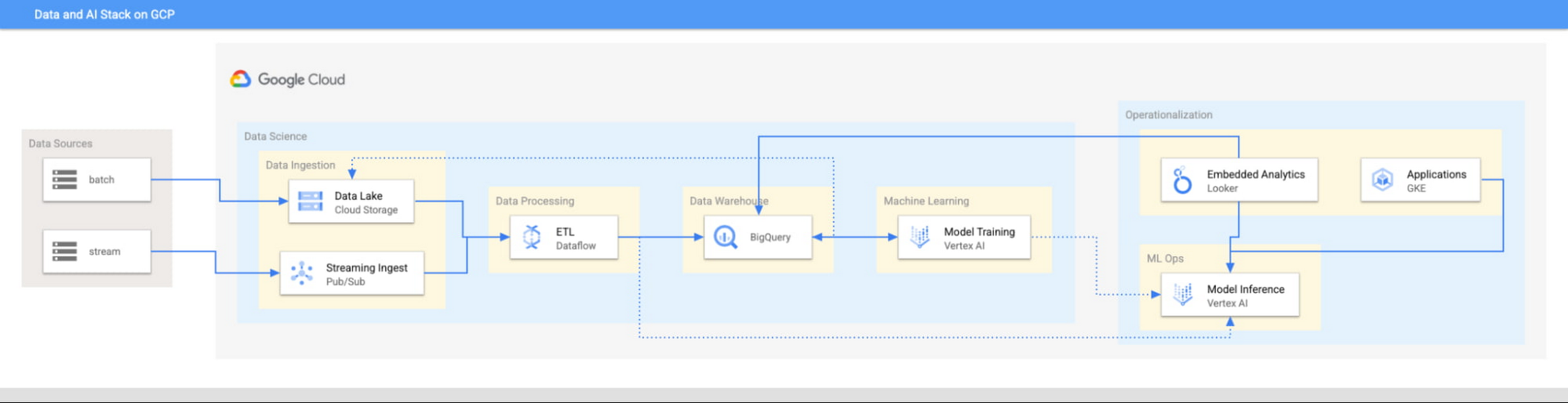
This focus has definitely informed how we create products at Google Cloud, as our canonical data stack—Pub/Sub, Dataflow, BigQuery, and Vertex AI—consists of auto-scaling and serverless products.
But management of infrastructure is not the only place where you should err toward a less-is-more philosophy.
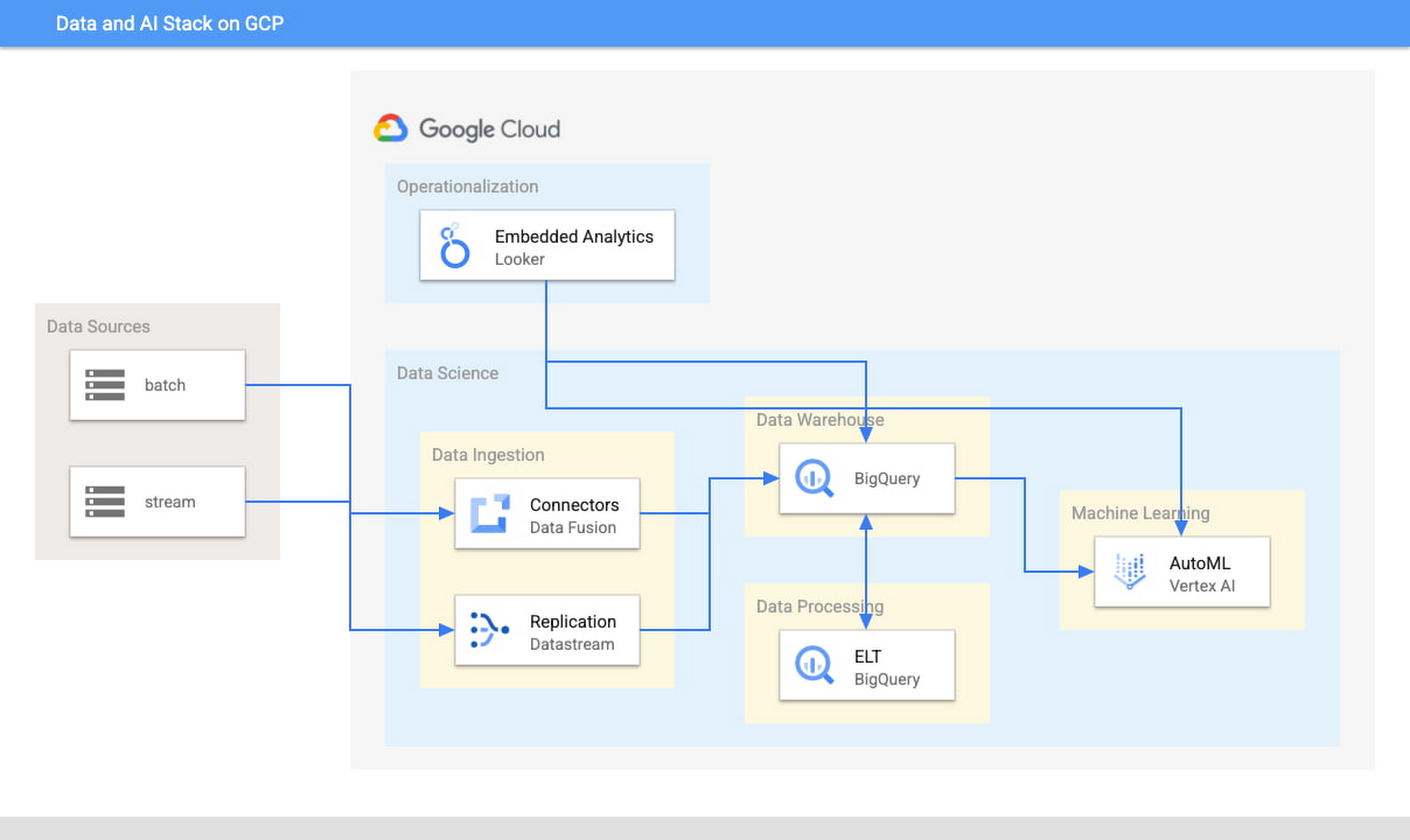
When it comes to architecture, choose no-code over low-code and low-code over writing custom code. For example, rather than writing ETL pipelines to transform the data you need before you land it into BigQuery, you could use pre-built connectors to directly land the raw data into BigQuery. That’s no code right there. Then, transform the data into the form you need using SQL views directly in the data warehouse. This is called ELT, and it is low code. You will be a lot more agile if you choose an ELT approach over an ETL approach.
Another place is when you choose your ML modeling framework. Don’t start with custom TensorFlow models. Start with AutoML. That’s no-code. You can invoke AutoML directly from BigQuery, avoiding the need to build complex data and ML pipelines. If necessary, move on to pre-built models from TensorFlow Hub, HuggingFace, etc. That’s low-code. Build your own custom ML models only as a last resort.
Focus on getting your vision to market, not chasing technology hype
The goal is to pick the right technology stack for bringing your vision to market, generating value for customers, conserving resources, and maintaining flexibility for growth. Early IT investments should usually gravitate toward things that preserve flexibility, such as managed services built on standard protocols or open APIs, but they needn’t always rush to the flashiest technologies. The answer isn’t always ML, for example. The answer might be heuristics to start, with a path to ML once you have collected enough data. You want to make sure that your intelligence layer has enough abstraction so you can mark it up with simple rules at first, but then replace it with a more robust system as you go along.
Launch and iterate fast with these principles
The preceding discussion is a reminder that your most expensive resource is your people—and that you really want them to be focused on building your prototype, minimum viable product or production app You want to launch fast and iterate fast, and the only way you can do that is by focusing on the things that differentiate you.
But regardless of the technologies you use, the bottom line is the same: follow these four principles.
- Figure out your major value proposition and design your tech stack around it.
- Be very careful about user interactions. User experience is super important; you need to make sure you deliver the kind of experience that your customers have grown to expect.
- When you’re building, pick the highest possible level of abstraction possible—the most fully managed tools and no-code/low-code frameworks that give you the functionality that you need.
- Instead of choosing new or flashy technologies, consider if you can build a “good enough” minimum viable product quickly and come back to a better implementation later.
To learn more about why startups are choosing Google Cloud, click here.
The Future of Retail: Automated Customer Journeys Powered by Technology

3677
Of your peers have already read this article.
1:30 Minutes
The most insightful time you'll spend today!
Editor’s note: To kick off the new year and in preparation for NRF The Big Show, we invited partners from across our retail ecosystem to share stories, best practices, and tips and tricks on how they are helping retailers transform during a time that continues to see tremendous change. Please enjoy this entry from our partner.
If you put a pot of water on the stove, it doesn’t heat up instantly. It simmers slowly at first, eventually picking up steam to reach a rolling boil. The retail landscape is not so different. Capgemini’s research shows the sector has evolved over four generations, from the early days of fragmented outlets to omnichannel and customer-centric focuses, with a fifth generation on the horizon that promises to be centered on consumption.
- Generation 1: Fragmented outlets
- Generation 2: Chain concentration
- Generation 3: Omnichannel
- Generation 4: Consumer-centric
- Generation 5: Consumption-centric
Although incremental change allows companies to experiment and iterate during their digital journeys, the COVID-19 pandemic rapidly accelerated the evolution of online and contactless shopping. Evolution became a revolution, with most Consumer Product and Retail (CPR) companies still mastering the omnichannel generation of their digital transformation to create a seamless shopping experience. Companies that are more digitally mature are already aspiring to the consumer-centric phase, embracing opportunities made possible by technology such as personalization and automation.
What consumers want
Customers have more choices in how they shop and engage with brands. This has made it harder for brands to predict and anticipate needs across customer journeys. And that’s convincing some companies to innovate more quickly as consumer demand drives the need for speed and scale.
Think about your own online behavior. Say you’re shopping for an item and searching online for the closest store in your neighborhood. Google is likely your go-to for finding that information. Looking to troubleshoot an issue with a product or seek out a service? Again, you’ll likely hit up Google first, not even considering going directly to a brand’s website for answers.
Both scenarios point to a disconnect between virtual and physical worlds, a gap technology can bridge in numerous ways such as breaking down silos and integrating fragmented media channels. Interestingly, though, not everything will be centered online all the time. In our recent study on consumer behavior, The great consumer reset, Capgemini discovered 57 percent of shoppers plan to return to brick-and-mortar stores post-pandemic, which is basically unchanged from the 59 percent who often interacted with physical stores before.
But business as usual? Not even close. Consumers have come to expect a frictionless shopping experience (buy online, pick up in store) or an immersive one (products displayed online using augmented reality), and are not content to return to in-store lineups, empty shelves, or a one-size-fits-all approach. Moreover, customers want personalized interactions while ensuring their data and privacy are protected.
So the role of the store is changing. In fact, many online-only brands are opening brick-and-mortar establishments to drive customer experience. In our research on “smart stores,” we found the majority of consumers (66 percent) believe automation can improve their shopping experience by solving the challenges they face at retail stores.
From personalization to serendipity
Retailers must recognize that they have to win consumer trust and confidence. Many consumers believe retailers’ use of tech is focused on reducing costs rather than easing friction. And they’re right. That same Capgemini research found that only one-third (35 percent) of retailers consider “solving customer pain points” as the most important criteria when deciding which automation use cases to implement.
“Retailers are largely in the early stages of adopting automation, and that’s an opportunity to rethink how they’re using technology, not just to smooth out friction and engender consumer trust but to build unexpected consumer benefits,” says Neerav Vyas, Head of Customer First, Co-Chief Innovation Officer, Insights & Data, North America, Capgemini. “We’re trying to move towards this idea of delivering serendipitous experiences to bridge the physical and digital divide.”
The focus is not solely on shoppers seeking out a specific product. “When consumers are in an exploratory mood, retailers can recommend products and services customers didn’t even know they wanted,” says Vyas. For example, business teams that use personalization platforms as part of an integrated media strategy can optimize algorithms against outcomes such as improving conversion and driving engagement.
Vyas says the elevated experience from “personalization to serendipity” fosters trust in the ability of recommendation architectures to persuade and influence consumers’ choices in beneficial ways. A case in point: our research found that half (52 percent) of spending by millennials goes towards experience-related purchases. As always, the key is to meet consumers where they are. Even better, according to Vyas, is to anticipate and understand when signals like customer intent are changing.
How to create value throughout the customer journey
One solution companies can implement right now is an integrated media spend platform that incorporates reporting, planning, and strategy across the entire customer journey. This offers value throughout the customer journey by using technology to reduce friction along the way. Think of it as starting with the customer looking for a product (search and discovery), moving on to the purchase (omnichannel basket, “shoppable” screens) and pick up/delivery (QR code scan in store), and through to post-purchase engagement with the retailer (Google Contact Center AI).
Such a holistic approach also accelerates data acquisition, integration, and reporting using advanced analytics to break down silos and emphasize the importance of privacy and first-party data. This in turn guides end-to-end interventions across customer journeys that enable optimized media spend, empowers businesses to analyze their spend distribution, fine-tunes owned and paid tactics with agencies, and promotes stewardship to support audit efficacy.
A culture of experimentation
With this data-driven focus, CPRs can create a 360-degree perspective of the customer. That intelligence can be used to enhance and humanize automated shopping experiences by putting the customer in control, whether online, in store, or across company brands. Moreover, by using Google Cloud’s emerging technologies such as artificial intelligence (AI), we help companies accelerate value across the spectrum, from supply-chain optimization and customer innovation to consumer experience.
Building a culture of experimentation is a team effort. “It’s not ever just one person who had a big idea. It’s all incremental steps,” says Jennifer Marchand, Google Cloud COE Leader, Capgemini. “Finding the right use case and timing is everything.” Take Google Glass Enterprise, she continues. For greater consumer experience, it can enable in-store associates to better serve with hands-free checkout, customer personalization and recommendations, and special offers. At the same time, Computer Vision and Smart Shelves can help prioritize tasks for employees, notifying them of low stock or a spill in the store.
Marchand points out that companies and consumers alike might not be ready to fully adopt some technology like facial recognition, but since almost everyone has a smartphone these days, they can benefit from automation with ease. “What’s interesting,” she adds, “is the way Google thinks about these types of problems, solving them for the long term.”
The store of tomorrow
Imagine a truly frictionless shopping experience, where state-of-the-art computer vision and AI identifies the products you pick up, put back, and keep, allowing you to head home, completely bypassing the checkout, with a 99 percent accuracy rate and receipts sent directly to your mobile app. That utopian experience is already taking shape at CornerShop, Capgemini’s live experimental store in London, UK.
Jamie MacLoud, Transformation & Strategy Consultant at frog, part of Capgemini, describes the retail space, which runs on Google Cloud, as the store of tomorrow, and not the distant future. It’s an experiential space where retailers and brands can explore, develop, and test technological shopping innovations in real-time. The outcome is a clearer understanding of how digital innovation can enable new ways to progress the customer experience, improve in-store operations, and help consumers to rediscover the joy of in-person retail through new ways to shop and engage with brands.
“We build, test, and learn about store concepts of tomorrow that we believe could be implemented into actual stores in the next one to two years. Getting these experiences in front of real customers in the CornerShop allows us to generate tangible learnings that we can share with our clients and use to shape future store strategy” says MacLeod. CornerShop was opened to the public in two eight-week stints, which allowed real-time testing to see what technologies resonated with customers, which brands can adapt and scale. Frictionless checkout, not surprisingly, was a big win for customers, but the technology underpinning the “virtual try-on” of clothing was deemed more suitable for the store of the future.
So, unlike an innovation lab, CornerShop lets companies experiment risk free, speeding up the process from hypothesis to full-scale implementation. It’s also another step toward solving the challenges customers face, while delivering those serendipitous experiences that build brand loyalty and longevity.
Learn more about how Capgemini is partnering with Google Cloud to help retailers create next-generation shopping experiences today.
We would like to acknowledge Jamie MacLoud, Transformation & Strategy Consultant at frog, part of Capgemini and Neerav Vyas, Head of Customer First, Co-Chief Innovation Officer, Insights & Data, North America at Capgemini who supported with invaluable insights and subject matter expertise in the writing of this blog post.

Evernote Ditches Private Cloud for Google Cloud and Improves Performance and Uptime
DOWNLOAD CASE STUDY4371
Of your peers have already downloaded this article
1:30 Minutes
The most insightful time you'll spend today!
More than 200 million Evernote users now more securely store billions of notes and attachments—the equivalent of roughly 10 copies of every modern book ever published. The company’s private cloud was no longer enough to scale to support such a dynamic infrastructure, so Evernote migrated its service to Google Cloud Platform and closed its data center, allowing employees to focus on product innovation instead of maintenance.
Evernote moved 5 billion notes and 12 billion attachment files to Google Cloud Platform, an endeavor that was expected to take 9-12 months. Evernote used the Google Professional Services team to guide it through solution planning, architecting, and migrating 3.5PB of data in only 70 days, and with minimal customer impact.
Customers benefit from the data processing power of Google Cloud Platform and are enjoying noticeable performance boosts. And because Google Cloud Platform encrypts customer data stored at rest by default, Evernote offers increased security, giving customers peace of mind that their data is safe.
And rather than pouring resources into day-to-day infrastructure maintenance and monitoring, Evernote’s employees can now focus more time and energy into developing new features and responding to customer needs.
Cloud on Europe’s Terms: How Google Sets to Deliver Cloud Services for Driving Digital Sovereignty

5156
Of your peers have already read this article.
1:30 Minutes
The most insightful time you'll spend today!
Cloud computing is globally recognized as the single most effective, agile and scalable path to digitally transform and drive value creation. It has been a critical catalyst for growth, allowing private organizations and governments to support consumers and citizens alike, delivering services quickly without prohibitive capital investment. European organizations—in both the public and private sectors—want a provider to deliver a cloud on their terms, one that meets their requirements for security, privacy, and digital sovereignty, without compromising on functionality or innovation.
Last year, we set out an ambitious vision of sovereignty along three distinct pillars: data sovereignty (including control over encryption and data access), operational sovereignty (visibility and control over provider operations), and software sovereignty (providing the ability to run and move cloud workloads without being locked-in to a particular provider, including in extraordinary situations such as stressed exits). After extensive dialogue with customers and policymakers, we are today unveiling ‘Cloud. On Europe’s Terms’. As part of this initiative, we will continue to demonstrate our commitment to deliver cloud services that provide the highest levels of digital sovereignty, all while enabling the next wave of growth and transformation for Europe’s businesses and organizations.
Google Cloud’s baseline controls and security features offer strong protections, meet current robust security and privacy requirements, and address many customer needs. Yet each country in Europe has its own characteristics and expectations. Certain customers in Europe may require more flexibility than current public and private cloud offerings may provide. We want to deliver a platform that allows customers to deploy workloads with the desired local control, without losing the transformational benefits of the public cloud.
We are now delivering on this new vision collaboratively with trusted local technology providers in Europe, starting with T-Systems in Germany. Today, together with T-Systems, we announced a partnership to build a Sovereign Cloud offering in Germany for private and public sector organizations. The offering will become available in mid 2022 with additional features being added over time.
In this new joint offering, T-Systems will manage sovereignty controls and measures, including encryption and identity management of the Google Cloud Platform. In addition, as part of their offering, T-Systems will operate and independently control key parts of the Google Cloud infrastructure for T-Systems Sovereign Cloud customers in Germany.
We are committed to building trust with European governments and enterprises with a cloud that meets their digital sovereignty, sustainability and economic objectives. We are starting with T-Systems today and will continue by partnering with trusted technology providers in selected markets across the region.
Customers in other markets across Europe will be able to use these trusted partner offerings or use Google Cloud’s controls to exercise autonomous control over data access and use; exercise choice over the infrastructure that is used to process that data; and avoid cloud vendor lock-in.
With Google Cloud, our customers also automatically benefit from sustainable business transformation on the cleanest cloud in the industry. Today, we are the largest annual corporate purchaser of renewable energy globally, and by 2030, we aim to operate entirely on 24/7 carbon-free energy in all of our cloud regions worldwide.
We’ll continue to listen to our customers and key stakeholders across Europe who are setting policy and helping shape requirements for customer control of data. Our goal is to make Google Cloud the best possible place for sustainable, digital transformation for European organizations on their terms—and there is much more to come.
How Retailers Can Beat Inflation Like a Pro With These 5 Tips

2837
Of your peers have already read this article.
3:30 Minutes
The most insightful time you'll spend today!
Budget concerns and inflation shock are causing noticeable shifts in consumer behavior, a head-spinning turnabout since the pandemic days of 2020. We went from not having access to enough goods to now not having the right goods at the right price points. Heading into the holiday season, retailers will need to look sharp and be able to deliver value to the increasingly cost-conscious consumer — with frictionless product discovery and digital shopping experiences, relevant inventory, and personalization.
Those are a few of the insights gleaned from a recent eMarketer webcast on how retailers can better combat the effects of inflation, with pragmatic recommendations from experts including Amy Eschliman, managing director of retail solutions strategy and industry engagement at Google Cloud; Alexis Hoopes, vice president and head of e-commerce and direct-to-consumer (DTC) at Mattel Inc; and Elissa Quinby, head of retail insights at Quantum Metric. We’d like to share five key takeaways that retailers can adopt.
1. Be prepared for earlier holiday planning. Budget-conscious buyers are planning their purchases earlier than ever. According to our partner Quantum Metric’s latest Retail Benchmarks research, 40% of U.S. consumers and 30% in the UK have already started their holiday shopping1. At Mattel, Alexis noted, “We’ve learned to be nimble and early for our consumers, and to have products available for them when they’re ready to shop.” With higher prices, she added, “Consumers are preplanning and researching more, viewing product detail pages multiple times to check a higher-price item before adding it to their basket.”
Quantum Metric’s same research also shows that while average cart values grew between January to July 2022 — larger than they were at the same time last year1 — consumers were shopping less frequently. Because of higher prices, 37% of shoppers are now pre-planning and purchasing items all at once to help keep to their budget1. Amy observed. “That means retailers need to make it super easy for customers to find what they want to avoid shopping-cart abandonment.”
Retailers who make it easier for shoppers to find the right products, by providing Google-quality search and recommendations, can help reduce cart abandonment and increase conversions.
2. Get a handle on out-of-stock issues. While many of the supply-chain issues that surfaced during the pandemic have cleared up, inventory continues to be a challenge in retail. During the 2021 holiday season, Google/Ipsos research shows that consumers saw a 253% increase in “out of stock” messages versus pre-pandemic2. Elissa further pointed out that a great majority of both U.S. and UK consumers experience out-of-stock issues several times a month. It’s a fluid situation, however, with retailers facing bloated inventory as consumer demands quickly pivot from, for example, branded goods to generic or white-label items. “In the next six months or so, you really need to make sure you have the right inventory to meet consumer demands,” she advised.
The need for end-to-end visibility and the ability to act in real-time across the supply chain has never been more pressing. Google Cloud and our partners are tackling the top supply chain issues head on with solutions that enable end-to-end visibility, analytics and alert-driven event management as well as AI solutions and automation to streamline processes like procurement, fulfillment, and delivery.
3. Introduce value: communicate the quality of the product and the experience. While rising prices are paramount for many shoppers, it’s a common misconception that consumers are making purchase decisions based solely on price. Alexis remarked, “In e-commerce, we talk about price, product, service, and experience. Price is only one of the pillars for consumers. At Mattel, we are fully focused on product and experience. What makes this special? How do we connect directly in new ways to the consumer? Create ‘wow’ moments and deeper connections. When we think about value for our consumers, it’s the strength of the products that will drive the purchase.”
Elissa also noted that while consumers are doing a lot of comparison shopping, it’s really about value, whether a high-quality product or a high-quality experience. Quantum Metric’s Continuous Product Design solution, which is built with BigQuery, ingests data across multiple digital touchpoints, including from mobile and web applications, and connects customer signals to every stage of the product lifecycle to help deliver the products and experiences that customers actually want.

4. Ensure consistent experiences across channels. Today, consumers crave the cross-channel shopping experience. “The channel experience has gone from online to in-store to now everywhere,” Amy commented. “We call it ubiquitous digital shopping.” Elissa added that 75% of consumers do most of their shopping digitally. However, mobile drives 67% of digital traffic, but just 49% of sales.1 “Recent trends in traffic and conversion rates by device show that we can expect the most traffic for the big sale days on mobile,” she said. “People are looking for discovery and awareness, maybe even adding items to the cart as a placeholder or reminder. But they prefer to complete a sale on a desktop. It will be critical for retailers to offer a consistent experience, especially on major sale days like Black Friday and Cyber Monday.” Elissa also advised wrapping up any experiments with product and site design early, making sure to understand the customer experience holistically across the organization and prioritizing efforts to eliminate friction.
Consumers now expect to be able to shop wherever and whenever best fits their needs, whether in a store, on your website, through your app, or from within a social media ad, and have it be a consistently good experience no matter how they first entered or exited your commerce site. Google’s 2022 Retail Marketing Guide provides useful insights and tips on how to grow your online and in-app sales.
5. Personalize touchpoints to build loyalty. Connecting with your customer base and making sure they understand the value of your offering is essential. Alexis noted that the key is to keep your messages fresh as the holiday shopping season expands, providing new messages as they keep coming back to your store. “We need to engage them by helping them find what they are looking for at the right time,” she said. “Recognize that they are doing more planning and wish-list building early, then buying last-minute gifts at lower prices towards the end. Make sure those are front and center.”
Alexis also pointed out that today, consumers are providing more data points with the products they view or the items sitting in their carts. “What’s so great about e-commerce is that we can use all of this to create more personalized, direct messages targeted to those consumers,” she commented.
Amy recommended continuing to focus on conversion with product discovery and personalization, harnessing customer data to drive insights and action. “Any company’s biggest asset is their data. Using it in as many ways possible and activating it across the company is incredibly important,” she remarked. “Take advantage of your first-party data to activate everything from marketing campaigns to a more efficient supply chain. For every customer who comes to one of your digital properties, make sure your product discovery is as easy as possible. Pay attention to your recommendations, driving personalization to make that experience as unique and fruitful for the customer as possible.”
Achieving these objectives requires a modern cloud data warehouse and activation of a customer data platform. Retailers can explore how Google Cloud’s advanced data capabilities and our ecosystem of partners can power a customer data platform that supports more personalized marketing, shopping experience, and customer service.
While these are our key takeaways, we invite you to register to watch the on-demand webinar, “5 Ways Retailers Can Combat the Effects of Inflation,” for even more insights.
- Quantum Metric Retail Benchmarks, “Adjusting for Inflation.” The report is based on aggregated browsing behavior from January to July 2022, paired with a survey of 3,400 consumers in the U.S. and UK.
- Google/Ipsos, Holiday Shopping Study, Oct 2021 – Jan 2022, Online survey, US, n=7,253, Americans 18+ who conducted holiday shopping activities in past two days

IDC: Firms Should Migrate VM-based Enterprise Workloads to Google Cloud for Optimal Price, Performance, and Security
DOWNLOAD WHITEPAPER4433
Of your peers have already downloaded this article
5:30 Minutes
The most insightful time you'll spend today!
Public cloud platforms provide the scale, elasticity, and operational efficiency that enable enterprises to both innovate and deliver more products and services to the market faster. This increased ability to innovate provides enterprises a competitive advantage and the businesses agility to stay ahead of their competition. Enterprises should leverage the business agility that public cloud infrastructure enables to their strategic advantage. Thus incorporating a cloud platform is an inherent part of their initiatives to modernize their IT infrastructure.
Enterprise cloud adoption is not without challenges. Enterprises cite a lack of skill set, decision fatigue, operational challenges, security concerns, and unpredictable TCO as significant inhibitors to adopting a public cloud service provider. Information technology decision makers (ITDMs) are caught between the need to innovate faster and the fear of instability and mismatched expectations. This dilemma is why enterprises that partner with a trusted service provider before, during, and after migration are more likely to succeed in their cloud journey.
Google Cloud is an ideal platform for virtual machine (VM)–based applications due to its key technical capabilities, such as high-performing virtual machines, including compute-optimized and memory-optimized VMs; custom sizes for virtual machines; high-performance network infrastructure for faster data transfers; and data protection capabilities.
Download this IDC report to understand why ITDMs should consider Google Cloud as the preferred cloud services partner — owing to Google Cloud being a reliable platform for VM-based applications; a trusted partner before, during, and after application migration; and an innovator to future proof the enterprise IT infrastructure.
More Relevant Stories for Your Company

10 Reasons that Make Google Cloud the Champion of IaaS
When you choose to run your business on Google Cloud you benefit from the same planet-scale infrastructure that powers Google’s products such as Maps, YouTube, and Workspace. We have picked 10 ways in which Google Cloud Infrastructure services outshine alternatives in the market in how they simplify your operations, save

Google Cloud and Ericsson to Deliver 5G and Edge Cloud Solutions
Editor’s note: 5G is much more than a network—it’s a platform for innovation with the ability to provide immediate global scale and enable use cases that we haven’t even dreamed of yet. But to achieve this, industry players must come together to drive this growing ecosystem. Today, Erik Ekudden, CTO




Modeling and Comparing Cloud Solutions, Costs, and Strategy
Sole-tenant nodes? VMaaS and CloudSimple? N1 vs N2 vs E2 instances? BYO Microsoft or Linux licenses? Understand how the choices available with Google Cloud can maximize your savings while expanding your migration scenarios. Watch this webinar and learn how to assess your on-premises private cloud and compare your per-VM costs

Google and Fervo Agreement to Shape-up Plans for 24/7 Carbon-free Energy by 2030
When Google announced our plan to go beyond purchasing renewable power for 100% of our energy usage and operate on 24/7 carbon-free energy by 2030, we noted that achieving this goal will require new transaction structures, advancements in clean energy policy, and innovative new technologies. Today, we’re pleased to announce that one of
