





Takeaways from the Google Cloud Public Sector Summit on Prioritizing Tech Investments

4778
Of your peers have already read this article.
3:00 Minutes
The most insightful time you'll spend today!
Editor’s note: Today’s post highlights five takeaways from our session at the first ever Google Cloud Public Sector Summit. To watch the full session, check out All the Right Moves: Prioritizing Investments in Technology.
Now more than ever, government agencies need to invest in digital services to fulfill their missions and better serve communities. Yet modernization isn’t a one-and-done approach; it’s a sustained effort, with multi-year implications, and requires careful consideration of how to integrate existing investments to optimize costs. Digital transformation requires coordination between different programs and agencies, including all of their many competing considerations. In short, maximizing technology investments requires careful planning, strategic thinking, and industry partners that can provide flexibility and security and meet agencies where they are.
I sat down with Suzette Kent, former U.S. federal chief information officer, and Dominic Sale, assistant commissioner for Technology Transformation Services at the General Services Administration (GSA) for a conversation to unpack this important topic and discuss industry best practices.
The panelists had five tips for government employees who are making technology purchasing decisions for their agency.
1. Put the agency’s mission first.Avoid getting distracted by exciting new trends and focus on long-term goals that can impact which procurement strategies or funds could be used. The discussion started with how government agencies could cut through the noise about technology and prioritize which technology is best for their needs. Sale and Kent agreed that an agency should focus on its core mission outcomes and let its technology needs flow from that. Sale also emphasized the importance of having technology design respond to humans’ needs, which has historically been a challenge for government agencies.
For agencies to stay focused on their mission, final decisions about technology need to be made by the program manager who best understands each program’s mission. The government CIO’s role is to be the enabler for the technology and leverage it at the enterprise level, particularly when it comes to sharing infrastructure. The takeaway: enable mission programs by empowering your teams and providing access to authorized, compliant, innovative data platforms that programs can move confidently and quickly with.
2. Invest in interoperability. Agency employees often struggle to balance the need for a positive return on investment (ROI) with requirements for meeting mission objectives. While the panelists agreed that the total cost of ownership was important, they also emphasized taking an expanded view of ROI, including future-proofing and investing in functionality that may not realize its return for many years based on the initiative. Saving money isn’t particularly valuable if the solution doesn’t meet an agency’s needs. When choosing a technology partner, government employees should understand its long-term vision to ensure that the partner fits agency priorities. Partners’ technologies should also integrate seamlessly with existing systems so agencies don’t duplicate investment costs.
For example, Google Anthos extends Google Cloud services and engineering practices into an organization’s existing environment, establishing operational consistency across apps and modernization. With Anthos, agencies can simply and securely build and deploy applications anywhere, integrating cloud services across platforms. This allows them to enjoy a consistent DevOps experience for hybrid and multi-cloud environments and enables new innovation. Most importantly, this enables an enterprise data platform, one of the largest catalysts for mission transformation and applied AI.
3. Take advantage of artificial intelligence (AI) benefits. Over the course of the pandemic, the rapid application of AI has improved government productivity, efficiency, and the ability to deliver critical new services to the public at scale. This has further cemented AI’s role as an essential government technology for the present and future. In fact, Nextgov reports that “46% of government IT specialists plan to use AI and machine learning (ML) for embedded systems in the near future.”
As we’ve seen over the course of the pandemic, government programs can start small with AI pilots before moving into broad deployment. This can help agencies understand AI’s potential before moving to full production. People always supervise AI technologies, and the possibilities are endless. Google Cloud’s Contact Center AI (CCAI) has helped government agencies improve the customer experience, by allowing citizens to schedule vaccine appointments via a platform of their choice with up to 28 languages and dialects, and manage vaccine deployment. The U.S. Navy spends billions annually to fight rust and corrosion on its ships. Inspections of ships, aircraft and vehicles are a time-consuming and critical part of keeping the U.S. Navy at top performance so Google Cloud and Simple Technology Solutions (STS) rapidly built an AI-based corrosion-detection and analysis system. The system detected and analyzed corrosion on vessels with 90% accuracy and will eventually be used to automate inspections of vessels, aircraft, and vehicles—saving billions of dollars. Document AI helps a variety of government agencies scale their document processing, reducing the time it typically takes to process enormous amounts of data and related citizen claims.
Successful adoption of AI also depends on the quality of the data. Ultimately, agencies need high-quality enterprise data pipes so that employees and the community trust the system and public sector agencies. Sale described a GSA project that used AI bots to read legal contracts and look for particular phrases that would indicate a specific use case. Previously, an employee would have had to read through the contracts and search for the information. In this way, AI is saving the government both money and time.
4. Creating better experiences for the public. Sale observed that, “trust is the government’s currency and profit motive.” And trust comes when the public can be served with the same modern tools and technology they’re used to – in real-time and with transparency in mind. For example, agencies can provide transparency in public-facing dashboards for programs and supply services that deliver information in real-time through solutions like CCAI.
Trust also requires that constituents feel that government agencies will keep their data safe and secure. The need for a globally secure infrastructure with systems that are up-to-date and designed with security at every level, underpinned by zero-trust enterprise-wide remains paramount – particularly after the series of recent cyberattacks targeting government IT infrastructure.
5. Finding the right technology partner. Government leaders need technology partners who provide a flexible and interoperable platform to integrate existing investments and maximize technical value. Historically, public sector agencies have largely been forced to adopt private clouds, which has reduced their access to richer features, and hindered their ability to adopt a full range of security and product capabilities. The right partner won’t require government leaders to compromise on functionality or service availability to achieve compliance. The right partner can harness the power of emerging technology to make it Government-ready and the true promise of cloud– the access and integration of open data– to make missions more powerful and impactful for the constituencies they serve.
Redefining Network Security with Google Cloud’s Secure Web Proxy

1198
Of your peers have already read this article.
3:30 Minutes
The most insightful time you'll spend today!
Google Cloud provides multiple layers of security to help customers stay ahead of evolving threats and keep their cloud workloads safe. Today at our annual Security Summit, we are excited to announce the general availability of Secure Web Proxy, a new cloud-first network security offering that provides web egress traffic inspection, protection, and control. Secure Web Proxy (Cloud SWP) can help networking and security teams implement Zero Trust networking principles, discover malicious activity, and support forensic investigations
How Secure Web Proxy works
You configure workloads to use Secure Web Proxy as a gateway. Web requests can originate from virtual machine (VM) instances, containers, serverless environments, and workloads outside of Google Cloud connected by Cloud VPN or Cloud Interconnect. Policies and rules in Cloud SWP will be applied to traffic sent from these workloads to the internet.
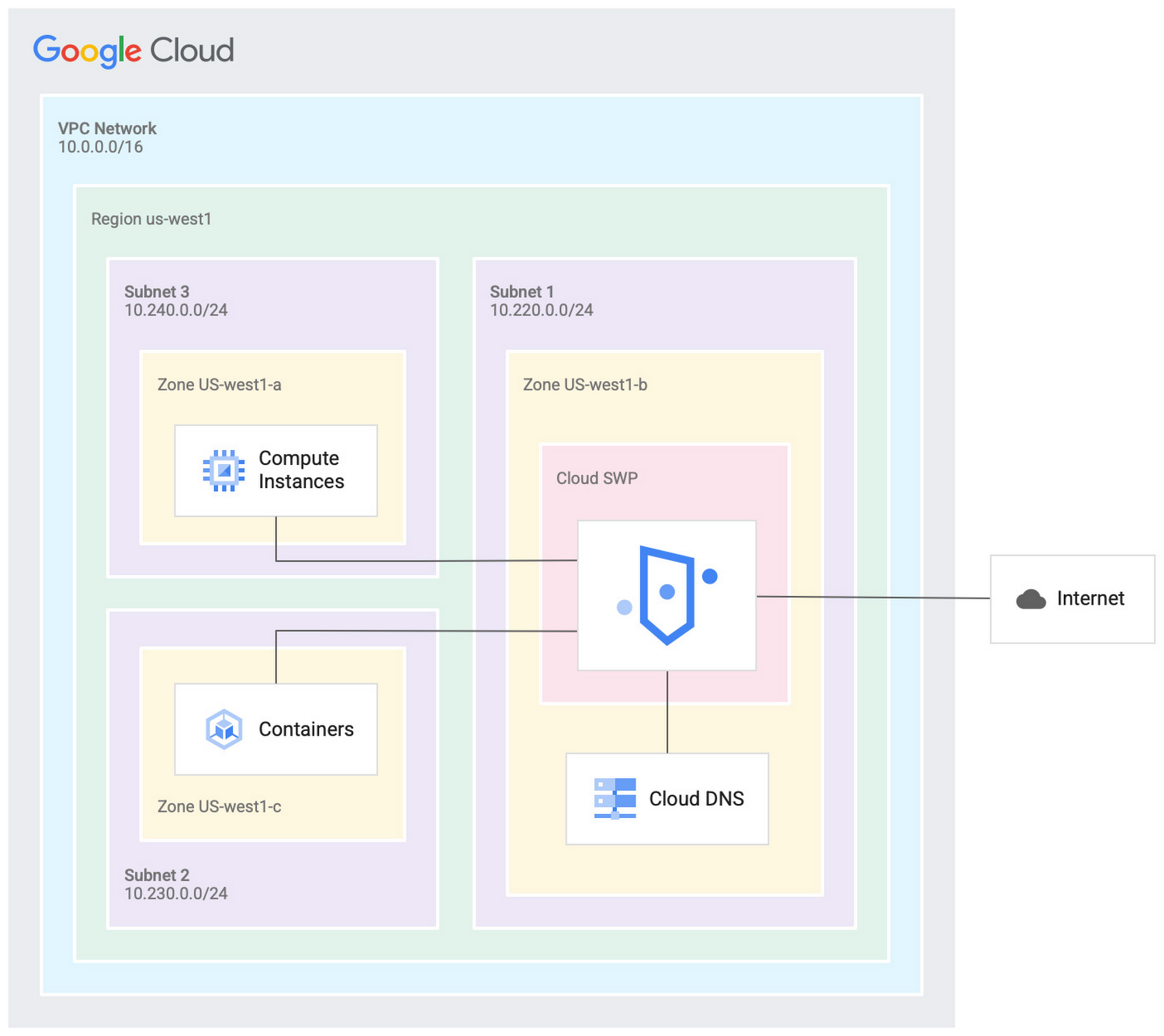
Cloud SWP helps enable organizations to enforce granular access policies, limiting egress web traffic based on source, identities, destination, or request types. With Cloud SWP you can create policies with Google Cloud Identity Access Management (IAM) context using service accounts and secure tags to block egress. For example, you can set a policy to limit a service account to sending traffic to a specific outbound destination.
Secure Web Proxy offers a scalable TLS inspection service that lets you intercept TLS traffic, inspect the encrypted request, and enforce your policies. Cloud SWP integrates with Cloud Logging to record metrics and transaction logs for requests handled by the proxy.
Common use cases for Secure Web Proxy
Many organizations employ a proxy like Cloud SWP to programmatically restrict workload access to only trusted external web services.
You can also use Cloud SWP to monitor outbound access. The proxy identifies traffic that doesn’t conform to policy and logs it to Cloud Logging. This allows you to monitor internet usage, discover and disrupt threats on your network by spotting command and control traffic or anomalous data transfers. Logs can be also used in forensics to investigate security events and incidents involving egress web traffic.
Operational benefits
Secure Web Proxy is another example of how Google Cloud continues to deliver built-in, cloud-first security capabilities that offer operational efficiencies for our customers.
Cloud SWP is easy to deploy and manage because it is a managed service. Unlike frequently deployed proxy solutions, it does not require users to configure virtual machines (VMs) to run and scale the proxy. Security patching is handled automatically. As your business and outbound traffic grows, Cloud SWP takes care of growing your proxy infrastructure for you.
Secure Web Proxy can also help make cloud migrations more seamless. If you are using an on-premises proxy, you can easily port the existing proxy’s policies to Cloud SWP when you migrate the app, maintaining the same egress protection in the cloud as you had on-premises.
Customer testimonials
Preview customers validated the operational and security value of implementing Cloud SWP:
“Google’s Secure Web Proxy is a powerful tool that can help businesses of all sizes protect their cloud workloads from online threats. By using the granular policy controls and TLS inspection, we are ensuring that our cloud applications only access approved external destinations. Additionally we are able to comply with data security regulations,” said David Saleh, director, Cloud Architecture and Application Security, ATB Financial.
“Secure Web Proxy has helped us to improve our security in Google Cloud. We are now able to filter outbound HTTP and HTTPS traffic from our applications. In addition, having a native solution will allow us to replace the VM-based solution we currently have, providing us with cost savings and continuing to deliver on our strategy of replacing products with cloud native services,” said Roberto Vega, cloud analyst, Carrefour.
Getting started with Secure Web Proxy
You can get started with Cloud SWP by visiting our documentation page to learn more about Cloud SWP prerequisite requirements and configuration options. If you want to quickly evaluate Cloud SWP for your cloud environment, use the SWP evaluation guide for step-by-step instructions. Be sure to check out all our sessions at this year’s Google Cloud Security Summit.
The Ultimate Guide to VPC Service Controls: Strengthening Your Security Posture

2511
Of your peers have already read this article.
2:30 Minutes
The most insightful time you'll spend today!
While cloud security skeptics might believe that data in the cloud is just one access configuration mistake away from a breach, the reality is that a well-designed set of defense in depth controls can help minimize the risk of configuration mistakes and other security issues. Our Virtual Private Cloud (VPC) Service Controls can play a vital role in creating an additional layer of security while also making it easier to manage your data in a way that most cloud services can’t do today.
Organizations across industries and business models use cloud services for activities such as processing their data, performing analytics, and deploying systems. VPC Service Controls can empower an organization when deciding how users and data can cross the perimeter of the supported cloud services, if at all. While VPC Service Controls are designed to help stop attackers, they can also enable contextual trusted data sharing (similar to how Zero Trust allows contextual access).
What are VPC Service Controls
VPC Service Controls help administrators define a security perimeter around Google-managed services, which can control communication to and between those services. The Service Controls isolate your Google Cloud resources from unauthorized networks, including the internet. For example, this can help you keep a clear separation between services that are allowed to run in production and services that are not.
VPC Service Controls can help you prevent mistakes that lead to costly data breaches because they control access to your data at a granular level. They add context-aware access controls on these services, and can help you achieve your organization’s Zero Trust access goals.
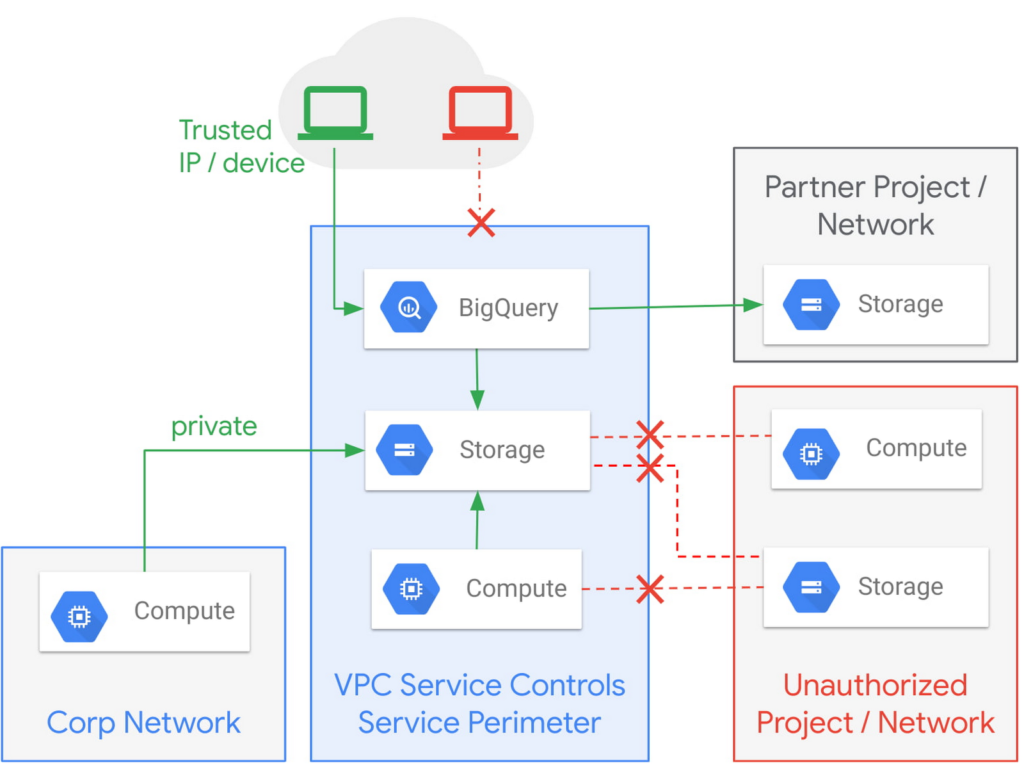
Example of the fine-grained policies based on access context that can be implemented with VPC Service Controls.
Like wearing two layers of clothing made from different fabrics to protect you from winter weather, VPC Service Controls may appear similar to Identity and Access Management (IAM) but they come from a different approach to implementing security. IAM enables granular identity based access control; VPC Service Controls create a security perimeter that protects your cloud resources and sets up private connectivity to Google Cloud’s APIs and services. While it’s recommended to use both, VPC Service Controls have an added bonus: They can support blocking data theft during a breach.
The additional layer of security that VPC Service Controls offer customers is challenging to achieve with on-premise systems or even with other cloud providers. You can think of it as an firewall for APIs that also adds a logical security control around three paths that data can take:
- From the public internet to your resources
- Inside your VPC and the cloud service perimeter
- For service-to-service communication (for example, denying access to someone who wants to load data to BigQuery or exfiltrate data from a BigQuery instance.)
How VPC Service Controls can help stop attackers
VPC Service Controls are used to enforce a security perimeter. They can help isolate resources of multi-tenant Google Cloud services, which can help reduce the risk of data exfiltration or a data breach.
For example, a bank that migrated financial data processing to Google Cloud can use VPC Service Controls to isolate their processing pipeline from public access (or any unauthorized access) by defining a trusted service perimeter.
How VPC Service Controls can enable trusted sharing
VPC Service Controls are used to securely share data across service perimeters with full control over what resource can connect to other resources, or outside the perimeter. This can help mitigate data exfiltration risks stemming from stolen identities, IAM policy misconfigurations, some insider threats, and compromised virtual machines.
Returning to our bank example, that same bank using VPC Service Controls may securely share or access data across Service Perimeters and Organizations. They may allow access to specific partners and for specific operations.
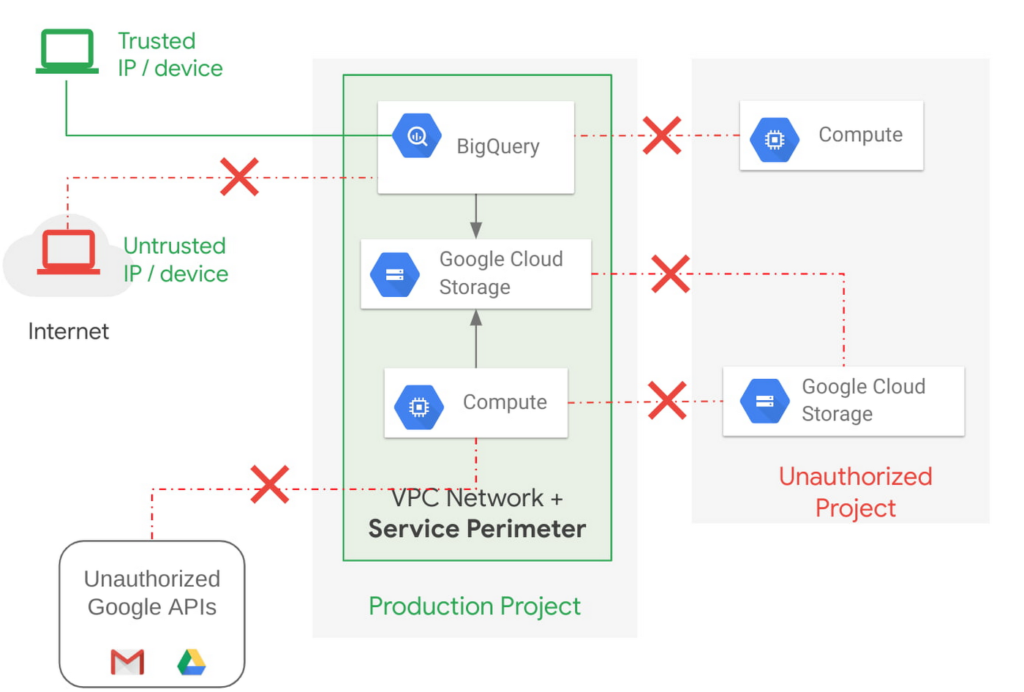
Example of allowing an authorized device plus authorized access.
How VPC Service Controls support Zero Trust access
VPC Service Controls deliver Zero Trust access to multi-tenant Google Cloud services. Clients can restrict access to authorized IPs, client context, user identity, and device parameters while connecting to multi-tenant services from the internet and other services.
A bank can use moving its services to the public cloud as an opportunity to abandon outdated access management approaches and adopt Zero Trust access. VPC Service Controls let them create granular access control policies in Access Context Manager based on attributes such as user location and IP address. For example, it would allow an analyst to only access Big Query from a corporate device on the corporate network during business hours. These policies can help ensure the appropriate security controls are in place when granting access to cloud resources from the Internet.
Next steps with VPC
Check out these pages to learn more about VPC Service Controls for your sensitive cloud deployments, especially for regulated workloads. This blog is the third in our Best Kept Security Secrets series, which includes how to tap into the power of Organization Policy Service and how Cloud EKM can help resolve the cloud trust paradox.
5234
Of your peers have already watched this video.
17:00 Minutes
The most insightful time you'll spend today!
AppSheet: Reduce Shadow IT and Accelerate Development of Enterprise-grade Apps
Google Cloud findings suggest that nearly 40 percent of organizations’ investments are consumed by shadow IT and can be a detractor to the adoption of cutting-edge tools and solutions. Also, about 51 percent of the surveyed executives are of the opinion that the inability to adapt to digital transformation trends and practices are at the risk of going out of business in the next 3-4 years. However, enterprises need not be blindsided by the mounting expenses involved with the implementation and optimization of solutions and tools meant for empowering employees. AppSheet, Google Cloud’s no-code application development and automation platform is at the helm of empowering organizations to custom build apps for employees without relying on third-party services.
Watch the video from the Google Workspace sessions of Next ’21 to hear experts’ insights on AppSheet to effectively govern workforce and ward off security threats to helps employees build enterprise-grade applications!
4672
Of your peers have already watched this video.
1:30 Minutes
The most insightful time you'll spend today!
Best Practices to Protect APIs against 6 Common Threats
APIs are exposed to a set of vulnerabilities that are both, unique and similar to that of software and web apps. Watch the video to learn six common API threats and best practices to protect from unwanted attacks.
Connected Data is the Lifeblood of Today’s Retailers: IDC’s 2022 Research

4692
Of your peers have already read this article.
4:00 Minutes
The most insightful time you'll spend today!
For a look ahead at the trends that will animate the retail industry this year, let’s take a look back at the 2022 National Retail Federation (NRF) “Big Show” in NYC.
Attendees at January’s event were treated to tangible examples of how retail challenges are being solved today, including new solutions to help them parse customer expectations and buying patterns, adapt stores into omni-channel experience hubs, and improve data visibility and actionability.
NRF 2022 also took the “omni-channel everything” theme of last year’s show to the logical next level: Enabling the best hybrid experiences. The message came through loud and clear of the importance of integration and interoperability in this new hybrid world – making everything work well together.
The need for modern digital infrastructure to enable this blending of physical and digital retail smoothly is paramount. To that end, technology vendors demonstrated how digital transformation initiatives, such as contactless and real time IoT and mobile applications, need to be built on cloud, edge, and secure connectivity to allow retailers to achieve the modern seamless hybrid retail that today’s consumer wants.
Other prominent themes and technologies highlighted at NRF included: extending engagement in the metaverse, sustainability, physical and digital security, and the agility and adaptability imperative.
The Metaverse and Hybrid (Omni-channel) Experiences
Today, the metaverse is an extension of our lives, enhanced by technology, which exists as a series of virtual worlds. In the future, the metaverse will be an interconnected, endless world where digital and physical lives fully converge. Imagine waiting for an appointment at a real booth on the NRF show floor while your avatar roams a fully fleshed-out digital NRF, meeting other virtual attendees, stopping for coffee at the digital Starbucks, and paying for a coffee that an in-the-flesh Starbucks employee brings to them. Digital and physical selves merge seamlessly in the metaverse, as the worlds draw closer together.
In the metaverse, brands have a digital presence, too. Nike filed seven trademarks late last year, including those for “Nike,” “Just Do It,” and its swoosh logo, and posted openings for virtual designer roles, indicating its intent to make and sell virtual branded sneakers and apparel. It subsequently purchased RTFKT Studios, a company that already makes and sells NFTs and digital sneakers. (In one collaboration with teenage artist FEWOCiOUS, the company sold 600 pair/NFTs of sneakers in just six minutes to the tune of more than $3.1 million.)
The metaverse also opens possibilities for gathering data about consumers and product demand. Imagine a sneaker drop in the virtual world. Certain styles of new kicks sell like gangbusters, giving the brand insight into what might sell IRL, intelligence that leads to trend-right production and less inventory headed for markdown or landfills. The metaverse can be a vehicle for more sustainable operations.
The metaverse further bridges the narrowing gap between digital worlds and physical worlds. Most consumers aren’t outfitting an avatar, but they are moving between online and offline and expect retailers to accommodate those hybrid omni-channel journeys seamlessly. Those demands have accelerated around last-mile delivery and experiences such as buying online and picking up in store (BOPIS) or at curbside, shopping in store and returning merchandise online, adding items to a BOPIS purchase when at the store, or communicating a substitution to the third-party grocery delivery service
Hybrid experiences open opportunities to please the consumer in new ways, but they also add expense and complexity. The need to meet this demand while enabling profitability was a major theme behind many of the technologies discussed at NRF. These included artificial intelligence (AI) for recommending the right product, return logistics software for defining and guiding product-specific reverse logistics workflows, order orchestration and fulfillment applications for omni-channel shopping, and last-mile delivery visibility for optimizing customer experience, to name a few. Also on display were task management applications help to improve and optimize in-store employee engagement, as well as touch-free applications to allow for faster payments and customer self-service checkout. RFID continues to improve inventory accuracy and inventory locating on the shelf, throughout the store, and the supply chain.
Sustainability
NRF 2022 saw a strong focus on sustainability. An NRF/IBV study released at the show highlighted the significant embrace of sustainable shopping by consumers. According to the survey, 62% of shoppers are “willing to change their purchasing habits to reduce environmental impacts.” About half indicated a willingness to pay a premium – on average a 70% premium – for sustainable products and brands.
Retailers are working to improve sustainability and reduce carbon footprint across operations by using sustainable sourcing through the supply chain, the store, and even returns. Tech vendors unveiled a variety of solutions enabled by cloud/edge, AI, computer vision, and IoT/RFID to allow retailers to effectively measure and record their environmental efforts, with the goal of reducing their impact.
Several cloud and digital infrastructure providers showcased sustainability clouds and other technology aimed at asset management with the goal of reducing energy consumption, water usage, waste. Examples included using IoT sensors to reduce water usage, optimizing re-use of store assets, and dashboards that allow retailers to accurately monitor and measure carbon output. However, such sustainability solutions can be most successful when running on the next-generation digital infrastructure that helps retailers better compete and differentiate in today’s omni-channel world.
Physical and Digital Security
According to a 2021 NRF survey, 57% of U.S. retailers reported the pandemic led to an increase in organized retail crime, while 50% reported an increase in shoplifting. When IDC’s Future Enterprise Resiliency & Spending Survey, Wave 10 (November 2021) asked retailers which digital infrastructure investments would provide the greatest strategic advantage in 2022, their #1 response was “cybersecurity and recovery investments.”
A wide range of technology vendors acknowledged retailer concerns with regards to security, fraud, and loss prevention:
- Networking, connectivity, and edge vendors highlighted multilayer security solutions that promise to protect data from a range of IoT applications that utilize customer and associate data. Many offer security consulting services to address varied threats including ransomware, retail crime, and loss prevention.
- Security and e-commerce security vendors showcased solutions to prevent fraud and abuse in e-commerce applications as well as omni-channel applications such as BOPIS and curbside pickup, using AI-based analysis for identifying “bad”/risky customers and mitigating risk.
- Cloud vendors highlighted how retail clouds provide consistent, reliable identity management and data security.
- POS/payments/store technology vendors emphasized their ability to handle payments securely from any platform with multifactor tokenization, improved identity techniques such as biometrics and voice authentication, as well as AI-enabled and computer vision solutions for loss prevention at checkout and at the door.
The Agility and Adaptability Imperative
On display at the show were multiple flavors of the digital infrastructure technology that retailers need to achieve agile, personalized, data-driven, integrated seamless operations across the many channels of today’s retail landscape. The emphasis was apt. More than half of retailers plan to boost investment in business agility and operational agility over the next 12 months, according to IDC’s Future Enterprise Resiliency & Spending Survey, Wave 10 (November 2021).
Technology vendors highlighted their connectivity investments to enable business and operational agility and their technology investments for better ease of integration, scalability, and the ability to more easily swap out or mix and match applications with integrated platforms, open systems, hybrid cloud, and retail industry clouds.
Vendors also showed off infrastructure to better harness data while enabling its visibility, maximizing its value, and providing the data-driven personalization essential for competitive advantage and differentiation. Highlights included fast, secure connectivity, 5G and Wifi-6, and edge- and cloud-enabled data and AI platforms to generate real-time insights – all designed to enable today’s omni-channel retail.
Advice for the technology buyer
Retailers should consider these key themes from NRF 2022 when making technology investment decisions for 2022 and beyond. To avoid lagging behind those retailers already moving toward thriving into the future, take action to:
- Enable the seamless, contactless omni-channel approach that today’s consumers want and expect.
- Replace legacy infrastructure that was not built to handle the modern retail environment that requires the agility and adaptability to seamlessly connect rapidly increasing volumes of data securely and more quickly than ever.
Whether sustainability, adaptability, the metaverse, or security are top concerns, addressing business needs holistically and strategically should be job #1.
Continue the conversation by downloading our Transforming retail and CPG markets whitepaper today.
More Relevant Stories for Your Company

How Firewall Insights can Simplify Corporate Firewall Rules
Corporate firewalls typically include a massive number of rules, which accumulate over time as new workloads are added. When rules stack up piecemeal like this, misconfigurations occur that, at best, create headaches for security administrators, and at worst, create vulnerabilities that lead to security breaches. To address this, we have

Cloud KMS with Cloud Storage: Better Performance for High-intensity Workloads
Encryption is critical for securing sensitive data while it is stored and transits the cloud. Today, Cloud Storage encrypts data server-side with standard Google-managed encryption keys by default, and can also encrypt data with customer-managed encryption keys that are stored and managed by Cloud Key Management Service (Cloud KMS). While customers have

10 Reasons that Make Google Cloud the Champion of IaaS
When you choose to run your business on Google Cloud you benefit from the same planet-scale infrastructure that powers Google’s products such as Maps, YouTube, and Workspace. We have picked 10 ways in which Google Cloud Infrastructure services outshine alternatives in the market in how they simplify your operations, save

The Right Datawarehouse Helps Fight Climate Change, While Improving Customer Experience
When you think about climate change, you might not consider a daily commute to work or a drive around town as big contributing factors. And yet, transport is the fastest growing source of CO2 emissions from fossil fuel, which in turn is the largest contributor to climate change. This is the key insight
