





Simplifying Payments for SMBs: Helcim’s Transformational Approach

1455
Of your peers have already read this article.
6:00 Minutes
The most insightful time you'll spend today!
Small and medium-sized businesses and enterprises are the backbone of the US economy generating more than 44% of GDP1. Yet these organizations are still underserved when it comes to online financial tools—and dealing with payments is no exception. Complaints include hidden fees, limited capabilities, long-term lease agreements, and poor customer service.
These are the issues that we wanted to solve when we launched Helcim in 2020 in Calgary (Alberta, Canada). We provide a payment service that offers low rates through our interchange plus pricing model, no monthly fee for the core payments offering, and numerous payment options, as well as simple, affordable hardware such as card readers.
Our digital-first approach makes it easy for owners of small and medium-sized businesses to get started. Online sign-up means no paperwork and near instant access to Helcim’s software and all-in-one platform experience. Merchants can choose from a range of payment solutions from the Helcim app including in-person payments, SMS payment requests, online invoices with pay now buttons, and more.
To achieve our goals, we built most of the business systems and processes in-house including our technology stack, financial partnerships, marketing, and everything in between. This is something that few startups would dare to do, but it enabled us to build a payments platform offering the rich capabilities and performance SMBs really need.
Taking control with the cloud
Before migrating our infrastructure to Google Cloud, it was hosted at two colocation data centers in Calgary. This model served us well, but as we grew, most of our hardware needed to be replaced to maintain service security and performance.
A successful round of Series A funding also impacted our trajectory. Giving us the fuel we needed to scale and innovate faster. When we considered the choice between making a large capital investment in our existing environment, or to transition to the cloud, the decision was clear: The cloud was the way to go.
We looked at other big names in cloud hosting and tested another platform. But Google Cloud is by far the best environment for us. It’s much easier for a lean technology team to manage, as we embark on our first cloud strategy. It also offers all the tools and advanced machine learning capabilities we need.
Google Cloud also comes with the backing of Alphabet, a business that in the past five years has spent more on research and development than any other organization in the S&P 5002. The ability to engage the Google Workspace account team for guidance to improve our everyday processes was another bonus.
A variety of investment and training programs from Google Cloud also influenced our decision. We participated in Google for Startups Accelerator Canada which gave us access to Google Cloud experts across all our technology domains. This helped accelerate our infrastructure migration while ensuring we optimized every service from day one. We were also eligible for $100,000 USD of Google Cloud credits, covering our Google Cloud costs which helped us get everything up and running cost-effectively. The partnership with the wider Google team has been extremely impactful as we stand everything up for our business.
But ultimately, it’s the sheer depth and breadth of the Google Cloud environment that makes the difference. Here are the Google Cloud tools we currently have at Helcim.
We chose BigQuery because it is easy to aggregate new data and apply the right access controls. It also delivers outstanding performance running our analytics workloads.
Vertex AI makes the deployment of new models exponentially faster, and with Google Cloud, we can do most of the work through containers instead of proprietary tooling.
GKE has enabled us to migrate to a fully managed cloud service and avoid a lift-and-shift exercise that would have prevented us from getting the full benefits of a containerized infrastructure. Running a new GKE environment also enabled us to significantly reduce platform latency by 20%-50%. We can now deploy projects in hours instead of days.
We updated our centralized file system to use Cloud Storage, which is faster and more scalable.
All of our software today is built on top of MySQL, so CloudSQL was the natural choice for cloud database management.
Cloud Run is more flexible than other serverless tools and was an easy way to reduce the burden of managing some of our services.
Boosting performance across the business
By migrating to Google Cloud, we transformed our application performance. We were able to decouple the infrastructure between systems and use modern server hardware for our compute and database instances. With very little change to our code, we saw a 50%+ increase in the speed of our entire platform.
Giving developers more control of the technology running their systems via containers means that they can enhance systems through more frequent language updates and by deploying new technologies to optimize workloads.
We can more closely monitor our systems to diagnose issues and fix their root cause faster. Being able to quickly add resources gives us further options if we experience platform latency or increased traffic.
Maintaining momentum with machine learning
Leveraging Vertex AI has significantly reduced the time it takes the team to build and deploy new machine learning models. Greater agility in our data stack has also freed up time for exploratory work in the data team. For instance, by creating low fidelity proxy data for human behavior in the application process, we created a new model that will reduce the number of manually reviewed batches by more than 10%.
We’ve also been able to improve our deployment process and the time to rollback. As a result, breaking changes in production have been reduced from more than five minutes to less than 30 seconds.
Thanks to BigQuery, we can make better use of data to support key business decisions. Previously it was hard to aggregate data from different sources and while maintaining our strict requirements for customer data confidentiality. We also needed specialist SQL knowledge to consume it. By investing in a more modern data stack, the availability of trusted data across the organization has increased exponentially.
We’ve also overcome the constraints imposed by static hardware environments especially when maintaining a high-availability configuration between two locations. With Google Cloud, we’re no longer constrained by such a rigid arrangement and the deployment velocity of new infrastructure tooling has been reduced from months to days.
Security is another area where Google Cloud excels. From hackers and fraudsters to bots and web attacks, it protects our users, applications, and data, while facilitating compliance with local and regional authorities. We can also integrate more easily with our security partners ensuring that we can empower our team to stay ahead of cyber criminals and other external threats.
Building the payments platform for the future, today
When we look to the future, Google Cloud opens the door to dozens of opportunities to widen our appeal to SMBs while remaining competitive. Its advanced infrastructure for cloud computing, data analytics and ML supports our roadmap to profitability and will help us attract future rounds of funding.
Above all it provides a foundation for growth. We grew 400% in 2021 and raised more capital in the spring of 2022 to grow even faster. In 2022 we were also listed as one of the top payments processors by industry publications such as Nerdwallet and Merchant Maverick. With Google Cloud, we can build on this success, continue to innovate, and help our SMB customers take their payments and e-commerce strategies to the next level.
If you want to learn more about how Google Cloud can help your startup, visit our page here to get more information about our program, and sign up for our communications to get a look at our community activities, digital events, special offers, and more.
To learn more about Google for Startups Accelerators and to apply to a program in your region, visit the website here.
1. Small Businesses Generate 44 Percent Of U.S. Economic Activity
2. Alphabet: Big Value In Big Tech
How AI-powered ML Models Helps Run Unemployment Claims Verification at Scale

8369
Of your peers have already read this article.
2:00 Minutes
The most insightful time you'll spend today!
With unemployment application submissions reaching record numbers over the past year, state and local agencies in the United States have faced the challenge of processing unprecedented numbers of claims per week. The digital infrastructure most agencies have in place is unable to handle this volume, resulting in constituents waiting longer, and bad actors taking advantage of vulnerable systems. The Department of Labor Inspector General estimates that $63 billion in claims distributed is either an improper payment or fraud.
Validating claims also requires secure data sharing with other agencies for document and identity verification. Government leaders need a way to allow case adjudicators to quickly and confidently release backlogged claims, integrate with existing systems, and segment legitimate claims from potentially fraudulent ones — all within limited government budgets — securely and at scale.
Implementing a fraud detection solution on Google Cloud
States were under pressure to release payments, while also filtering out potentially fraudulent claims. SpringML and Google Cloud developed a framework to give adjudicators a reliable verification process that quickly filters potentially fraudulent claims, while processing the remaining claims so benefits reach citizens in a timely manner. SpringML and Google Cloud, applied AI-powered machine learning models to detect anomalous patterns in large datasets. Using Google Cloud tools, SpringML implemented a solution to streamline workflows, improve efficiencies, automate processes and identify potentially fraudulent claims.
SpringML used a variety of Google Cloud products to deliver a fraud detection solution, including:
- Google Cloud Storage to store and manage data
- BigQuery to store tabular data and BigQuery Machine Learning (BQML) to conduct machine learning on that data
- AutoML solutions to build predictive models and risk scoring
- Visualization tools such as Looker and Data Studio to present data and help government leaders make informed decisions.
Implementing machine learning to detect improper payments allows agencies to classify claims as “fraud” or “not fraud” based on the number of flags, as well as prioritize the most urgent claims. Deploying intelligent virtual agents to handle frequently asked questions meant that live agents could focus their time on more challenging cases.
Even once the pandemic is behind us, there will be bad actors trying to take advantage of overwhelmed or legacy systems. We’ve identified a few best practices for agencies managing enormous case loads and looking to improve improper payment analytics:
- Move your systems to the cloud. Many on-premises legacy systems can’t update their applications and scale to meet the volume of claims. Moving to a cloud environment enables rapid solution deployment and ingestion of large amounts of data without fear of overloading the system. The cloud scales with you–cost-effectively and securely.
- Understand patterns in the data. The answer is always in the data — we used deep analysis to help uncover suspicious patterns in large data sets. We implemented unsupervised machine learning to learn behaviors and create configurable rules that adjust to new information that comes into the system. We can uncover patterns that are likely associated with fraud – ones that a human might have missed.
- Use AI/ML tools to automate your existing systems and teams. These tools enable humans to work smarter and more efficiently. We automate anomaly detection and create dashboards for adjudicators to rapidly process claims. We are enabling the Wisconsin Department of Workforce Development by implementing automatic calculations and processing of recharge amounts, resulting in faster processing times and fewer human errors. Proactive fraud detection and timely calculation of recharge payment allowed DWD to ensure the benefits reached the right individuals.
- Build flexibility into your systems. We discovered that fraud patterns change over time. For instance,flags for fraud during March-May 2020 were vastly different from those we found in June-July 2020. Google Cloud tools make it easy to continually update algorithms to detect patterns and integrate external data sources.
Using Google Cloud tools, we can update digital infrastructure and incorporate machine learning best practices to help organizations efficiently process large volumes of claims and identify high probability fraudulent ones. SpringML provides consulting and implementation services and industry-specific analytics solutions that deliver high-impact business value to accelerate data-driven digital transformation. Learn more about fraud detection and how to improve improper payments analytics by watching our webinar.
Expect 40 Percent Higher Price-performance than General Purpose VM with Google TAU VMs!

3260
Of your peers have already read this article.
3:00 Minutes
The most insightful time you'll spend today!
In November 2021, we announced the general availability of Tau VMs. Since then, Google Cloud’s Tau VMs with Google Kubernetes Engine (GKE) have unlocked value for many customers who are now using Tau VMs for their production workloads, such as: Ascend, who achieved over 125% higher performance; Nylas, who gained over 40% higher price-performance; and OpenX, who achieved 40% better price-performance while at the same time reducing their application latency by 62%.
T2D is the first instance type in the Tau VM family and is built on the latest 3rd generation AMD EPYCTM processors, offering 42% higher price-performance compared to general-purpose VMs from any of the leading public cloud vendors. Tau VMs offer a leading combination of performance, price, and full x86 compatibility, offering customers the lowest cost solution for scale-out workloads. Tau VMs are available in predefined shapes, with up to 60vCPUs per VM, 4GB of memory per vCPU, networking up to 32 Gbps and a slew of storage options including Standard, Balanced and Performance PD. Tau VMs are also available as Spot VMs, offering an over 60% discount compared to on-demand pricing.
For customers looking for advanced container orchestration, GKE delivers high levels of reliability, security, and scalability, and has supported Tau VMs since the day they became available on Google Cloud. Tau VMs are ideal for CPU-bound workloads such as web-serving with encryption, video encoding, compression/decompression, image processing and horizontally-scaled applications. Using Tau VMs along with GKE’s cost-optimization best practices can help lower your total cost of ownership. You can add Tau VMs to new or existing GKE clusters by specifying the Tau T2D machine type in your GKE node-pools through the Cloud console or by using –machine-type in gcloud.
Here is what some of our customers have to say about Tau VMs:

Ascend provides a unified analytics and data engineering platform, and chose Tau VMs along with GKE to run their data-intensive workload — primarily because of Tau’s absolute performance and price-performance advantage.
“Our core capability at Ascend is bringing together data ingestion, transformation, delivery, orchestration and observability into a single platform. To operate at scale and keep pace with our telemetry data production rates, high single-threaded performance is critical. With Google Cloud’s Tau VMs with Google Kubernetes Engine (GKE), we are able to achieve over 125% higher performance than previous generation families. This has completely changed our ability to query historical metrics. Where previously metric queries against historical data over ranges longer than a couple hours were difficult, we can now easily query data ranges of multiple weeks.” – Joe Stevens, Tech Lead – Infrastructure, Ascend.io

Nylas is a pioneer and leading provider of productivity infrastructure solutions for modern software. In the past year, Nylas has been using GKE in their journey to reinvent their architecture and provide their enterprise customers with a bi-directional universal email sync, security compliance with the highest enterprise standards, and industry-specific machine learning services.
“For our core application, Google’s Tau VMs with Google Kubernetes Engine delivers over 40% better price-performance than Amazon’s Graviton-based VMs. Further, Tau VMs maintain x86 compatibility and eliminate the need to maintain a separate stack for ARM. We are moving our workload from Amazon Web Services to Google Cloud to take advantage of these benefits.” – David Ting, SVP of Engineering, Nylas

OpenX operates an independent ad exchange. Operating 100% on Google Cloud has enabled OpenX to achieve improved performance, scalability, speed and global reach.
“At OpenX, our ad-exchange services over 200 billion requests every day. Getting the best combination of performance and price from the infrastructure is critically important for us. We use multiple Google Kubernetes Engine (GKE) clusters across geographic regions with autoscaling to power our ad-delivery components. Running Google Cloud’s Tau VMs with GKE has enabled over 40% better price-performance and 62% latency reduction for our application as compared to the prior generation family. We have made the move to Tau VMs for our application to take advantage of these benefits.” – Paul T.Ryan, CTO, OpenX
We are excited to see Tau VMs adding value for so many of our customers by enabling industry leading price-performance for a variety of workloads.
If you haven’t tried Tau VMs yet, give them a try today in our Iowa, Netherlands and Singapore regions and move your production workloads to Tau VMs. Tau VMs will be arriving in additional regions and zones in the coming weeks. You can provision GKE node pools based on Tau VMs and explore how you can take advantage of improved price-performance for your scale-out containerized workloads.
To get started, go to the Google Cloud Console, select Google Kubernetes Engine, and choose Tau T2D for your GKE nodes. To learn more about Tau VMs or other Compute Engine VM options, check out our machine types and our pricing pages.
Google Cloud and Univision Partnership to Up the Ante in UX for Spanish-speaking Audience

6859
Of your peers have already read this article.
1:00 Minutes
The most insightful time you'll spend today!
The past year has given everyone lots to think about—about our priorities as people and as businesses. As the world retreated behind closed doors, we saw how shared interests and experiences can bring us together. As the world grappled with a common enemy, we witnessed just how differently individuals, communities and indeed entire countries can experience a situation. And as we faced seemingly unending obstacles to making it through the pandemic, we saw how making smart decisions based on data can drive meaningful solutions—fast.
That’s why we here at Google Cloud are so proud to partner Univision, the country’s leading Spanish-language content and media company. By partnering with Google Cloud, Univision will be able to accelerate growth across its portfolio of properties, deliver an enhanced user experience for Spanish-speaking audiences and provide the enterprise solutions needed to create the Spanish-language media company of the future.
According to Instituto Cervantes, there are over 580 million Spanish language speakers worldwide. Those viewers, like people everywhere, are avid consumers of streaming content. In Q4 of 2020 alone, viewing time for that content increased by 44%1, and in 2020, from 50%2 more sources. With that surge in demand, Univision needed a cloud provider whose infrastructure could reach Hispanic viewers around the world. With two-plus decades spent building out its network and data centers, as well as global content-delivery capabilities, Google Cloud has the infrastructure Univision needs to reach viewers across the Spanish-speaking world.
At the same time, with such a diverse audience for their content, Univision needs to target that content to viewers’ specific preferences. By applying Google Cloud’s artificial intelligence (AI) and machine learning (ML) technology across its content, Univision intends to personalize content based on shows users have previously watched, enhancing their engagement and viewing experience.
And as Univision transforms the user experience, it can use Google Cloud’s data and analytics suite to garner deeper insights into its audience and forge stronger relationships with them on an individual basis. With Looker and BigQuery, Univision employees will have access to real-time data to help them make business decisions about programming.
Univision will also migrate video distribution and production operations to Google Cloud, where we’ll help them streamline media workflows and develop innovative new capabilities. Meanwhile, Google Cloud’s tight business and technical integration with other Google services will help ensure Univision reaches viewers on the device of their choice, wherever they are in the world. For example, in the coming years, Univision will expand its global YouTube partnership and will integrate with entertainment features on Google Search that help people better discover TV shows and movies. The company will also use Google Ad Manager for global ad decisioning and Google’s Dynamic Ad Insertion for PrendeTV and future video-on-demand offerings. Finally, Univision will distribute its content and services on Google Play across Android phones and tablets, as well as Google TV and other Android TV OS devices.
We’re thrilled to partner with Univision to help them reach the Spanish-speaking world with their content. With our cloud portfolio, we can help them reach individual viewers around the world, with personalized content that they can consume however they see fit. Best of all, together, we can help them achieve this vision fast, leveraging established cloud, content delivery, and data analytics technologies. You can learn more about the partnership here.

3589
Of your peers have already downloaded this article
1:30 Minutes
The most insightful time you'll spend today!
Through customer interviews, a survey, and data aggregation, Forrester concluded that migrating and running SAP on Google Cloud has a number of benefits, including financial benefits.
Download this Forrester infographic to understand the 3-year financial impact it can have on your organization.
AI in Manufacturing Already A Mainstream: Google Cloud Study

5657
Of your peers have already read this article.
3:00 Minutes
The most insightful time you'll spend today!
While the promise of artificial intelligence transforming the manufacturing industry is not new, long-ongoing experimentation hasn’t yet led to widespread business benefits. Manufacturers remain in “pilot purgatory,” as Gartner reports that only 21% of companies in the industry have active AI initiatives in production.
However, new research from Google Cloud reveals that the COVID-19 pandemic may have spurred a significant increase in the use of AI and other digital enablers among manufacturers. According to our data—which polled more than 1,000 senior manufacturing executives across seven countries—76% have turned to digital enablers and disruptive technologies due to the pandemic such as data and analytics, cloud, and artificial intelligence (AI). And 66% of manufacturers who use AI in their day-to-day operations report that their reliance on AI is increasing.

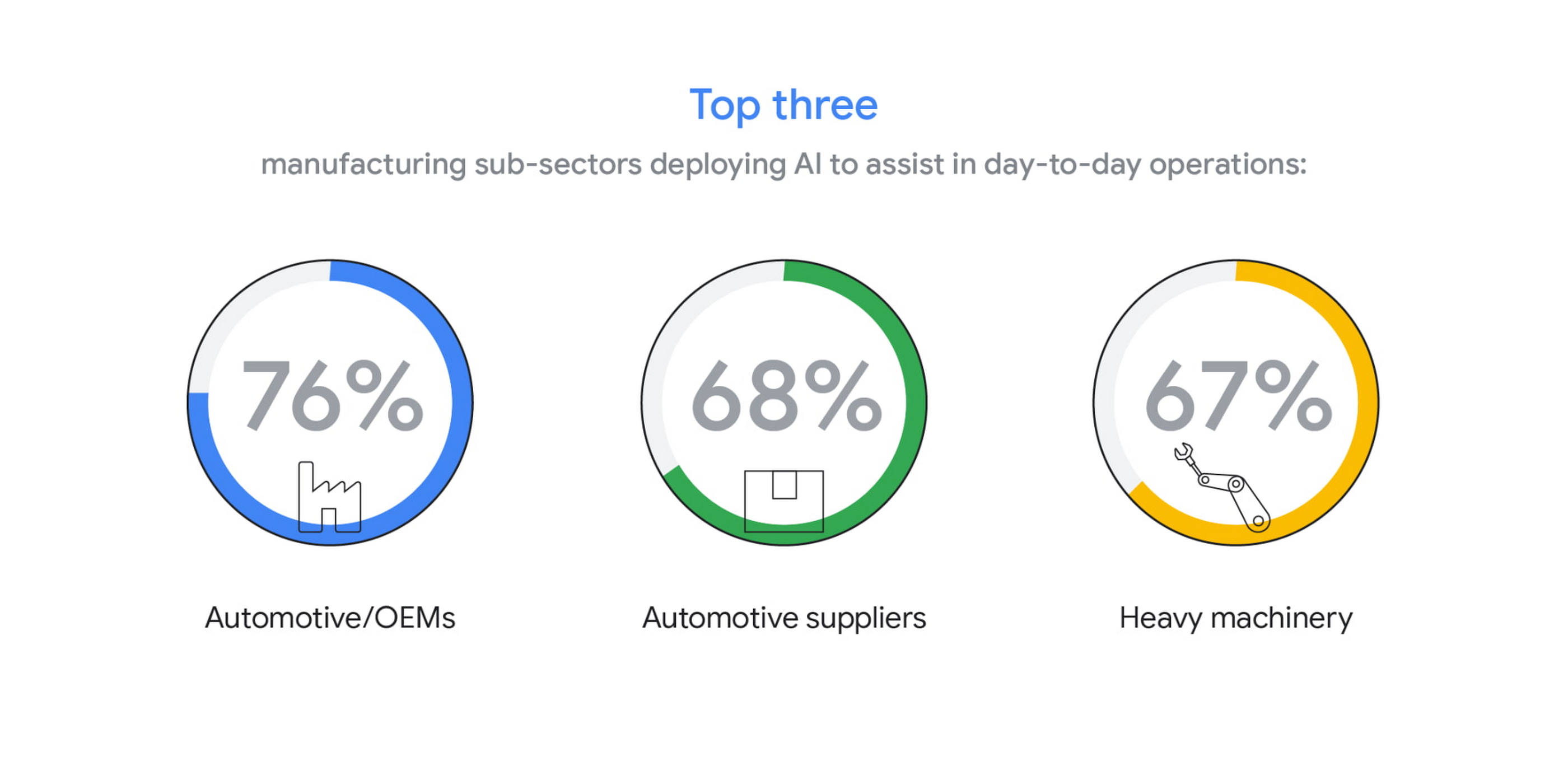
The top three sub-sectors deploying AI to assist in day-to-day operations are automotive/OEMs (76%), automotive suppliers (68%), and heavy machinery (67%).
In fact, Bryan Goodman, Director of Artificial Intelligence and Cloud, Ford Global Data & Insight and Analytics shares, “Our new relationship with Google will supercharge our efforts to democratize AI across our business, from the plant floor to vehicles to dealerships. We used to count the number of AI and machine learning projects at Ford. Now it’s so commonplace that it’s like asking how many people are using math. This includes an AI ecosystem that is fueled by data, and that powers a ‘digital network flywheel.’”
Moving from edge cases to mainstream business needs
Why are manufacturers now turning to AI in increasing numbers? Our research shows that companies who currently use AI in day-to-day operations are looking for assistance with business continuity (38%), helping make employees more efficient (38%), and to be helpful for employees overall (34%). It’s clear that AI/ML technology can augment manufacturing employees’ efforts, whether by providing prescriptive analytics like real-time guidance and training, flagging safety hazards, or detecting potential defects on the assembly line.

In terms of specific AI use cases called out by the research, two main areas emerged: quality control and supply chain optimization. In the quality control category, 39% of surveyed manufacturers who use AI in their day-to-day operations use it for quality inspection and 35% for product and/or production line quality checks. At Google Cloud, we often speak with manufacturers about AI for visual inspection of finished products. Using AI vision, production line workers can spend less time on repetitive product inspections and can instead focus on more complex tasks, such as root cause analysis.
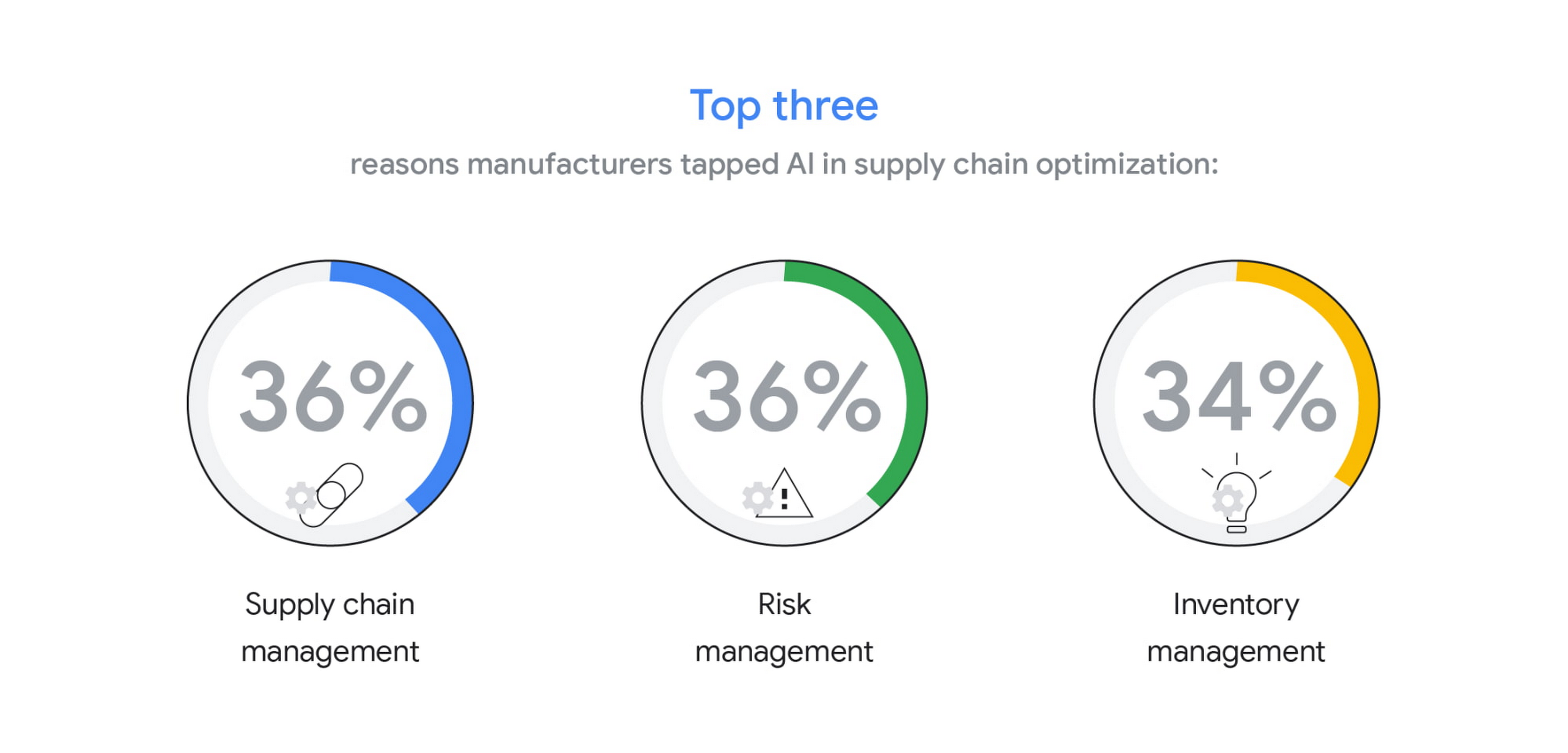
In the supply chain optimization category, manufacturers said they tapped AI for supply chain management (36%), risk management (36%), and inventory management (34%).
In our day-to-day work, we’re seeing many manufacturers rethink their supply chains and operating models to better accommodate for the increased volatility that has been brought about by the pandemic and support the secular trend of consumers asking for increasingly individualized products. We’ll share more on deglobalization in the third installment of our manufacturing insights series.
AI use differs by geography, but not for the reasons you may think
The extent to which AI is already being used today varies quite strongly between geographies, according to our research. While 80% and 79% of manufacturers in Italy and Germany respectively report using AI in day-to-day operations, that percentage plummets in the United States (64%), Japan (50%) and Korea (39%).

It’s tempting to state this disparity is due to an “AI talent gap.” Although the most common barrier, just a quarter (23%) of manufacturers surveyed believe they don’t have the talent to properly leverage AI. Cost, too, does not appear to be a roadblock (21% of those surveyed). Rather, from our observations, the missing link appears to be having the right technology platform and tools to manage a production-grade AI pipeline. This is obviously the focus of our efforts and others in the space, as we believe the cloud can truly help the industry make a step change.
Looking ahead: The Golden Age of AI for manufacturing
The key to widespread adoption of AI lies in its ease of deployment and use. As AI becomes more pervasive in solving real-world problems for manufacturers, we see the industry moving away from “pilot purgatory” to the “golden age of AI.” The manufacturing industry is no stranger to innovation, from the days of mass production, to lean manufacturing, six sigma and, more recently, enterprise resource planning. AI promises to bring even more innovation to the forefront.
To learn more about these findings and more, download our infographic here and our full report here.
Research methodology
The survey was conducted online by The Harris Poll on behalf of Google Cloud, from October 15 – November 4, 2020, among 1,154 senior manufacturing executives in France (n=150), Germany (n=200), Italy (n=154), Japan (n=150), South Korea (n=150), the UK (n=150), and the U.S. (n=200) who are employed full-time at a company with more than 500 employees, and who work in the manufacturing industry with a title of director level or higher. The data in each country were weighted by number of employees to bring them into line with actual company size proportions in the population. A global post-weight was applied to ensure equal weight of each country in the global total.
More Relevant Stories for Your Company

PaGaLGuY Turns to Google Cloud Platform to Power Leading India Education Network
Founded in 2006, PaGaLGuY started as a forum that enabled students, typically aged between 20 and 30 to discuss and seek advice on academic issues. By 2011, PaGaLGuY had increased its traffic to about 250,000 page views per month. The business is now one of India’s largest education networks and

This Chart, from Home Depot, Dramatically Demonstrates the Power of a Cloud Data Warehouse
The Home Depot (THD) is the world’s largest home-improvement chain, growing to more than 2,200 stores and 700,000 products in four decades. Much of that success was driven through the analysis of data. This included developing sales forecasts, replenishing inventory through the supply chain network, and providing timely performance scorecards. However,

Financial Firms Can Enjoy These 8 Benefits by Migrating and Running on Google Cloud VMware Engine
The COVID-19 pandemic brought dramatic changes to the financial services industry. Already under pressure from nimble young fintechs to modernize, established banks and insurers were undergoing incremental digital transformation. But in 2020, they hit the gas pedal. Branches closed and remote work became the norm. Almost overnight, employees needed secure remote access

Reducing Data Costs by 80% with Google Cloud: Inshorts’ Success in the Indian Mobile News Market
Across India, hundreds of millions of people turn to their smartphones for news that will enhance their lives and help them achieve their goals. According to Professor Rasmus Kleis Nielsen, Director of the Reuters Institute for the Study of Journalism: “The past few years have seen explosive growth in mobile
