





OCR Engine Upgrade: Document AI Introduces 3 New Capabilities

2495
Of your peers have already read this article.
2:30 Minutes
The most insightful time you'll spend today!
Documents are indispensable parts of our professional and personal lives. They give us crucial insights that help us become more efficient, that organize and optimize information, and that even help us to stay competitive. But as documents become increasingly complex, and as the variety of document types continues to expand, it has become increasingly challenging for people and businesses to sift through the ocean of bits and bytes in order to extract actionable insights.
This is where Google Cloud’s Document AI comes in. It is a unified, AI-powered suite for understanding and organizing documents. Document AI consists of Document AI Workbench (state-of-the-art custom ML platform), Document AI Warehouse (managed service with document storage and analytics capabilities), and a rich set of pre-trained document processors. Underpinning these services is the ability to extract text accurately from various types of documents with a world-class Document Optical Character Recognition (OCR) engine.
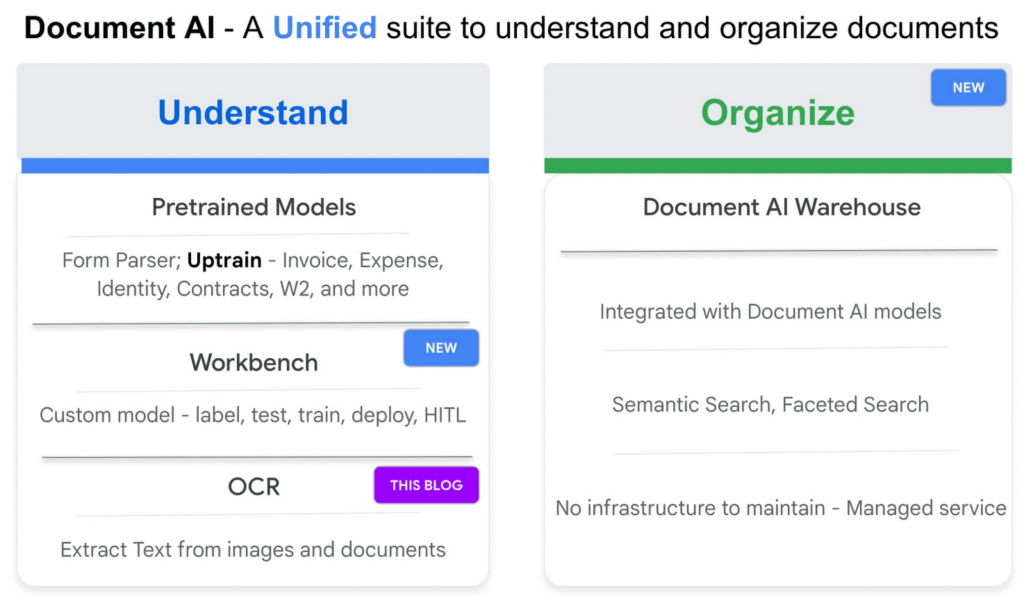
Google Cloud’s Document AI OCR takes an unstructured document as input and extracts text and layout (e.g., paragraphs, lines, etc.) from the document. Covering over 200 languages, Document AI OCR is powered by state-of-the-art machine learning models developed by Google Cloud and Google Research teams.
Today, we are pleased to announce three new OCR features in Public Preview that can further enhance your document processing workflows.
1. Assess page-level quality of documents with Intelligent Document Quality (IDQ)
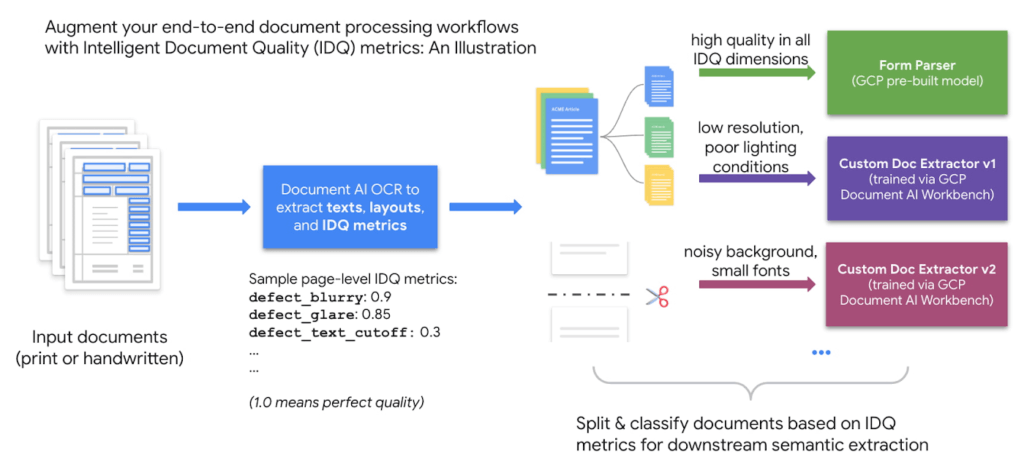
With Document AI OCR, Google Cloud customers and partners can programmatically extract key document characteristics – word frequency distributions, relative positioning of line items, dominant language of the input document, etc. – as critical inputs to their downstream business logic. Today, we are adding another important document assessment signal to this toolbox: Intelligent Document Quality (IDQ) scores.
IDQ provides page-level quality metrics in the following eight dimensions:
- Blurriness
- Level of optical noise
- Darkness
- Faintness
- Presence of smaller-than-usual fonts
- Document getting cut off
- Text spans getting cut off
- Glares due to lighting conditions
Being able to discern the optical quality of documents helps assess which documents must be processed differently based on their quality, making the overall document processing pipeline more efficient. For example, Gary Lewis, Managing Director of lending and deposit solutions at Jack Henry, noted, “Google’s Document AI technology, enriched with Intelligent Document Quality (IDQ) signals, will help businesses to automate the data capture of invoices and payments when sending to our factoring customers for purchasing. This creates internal efficiencies, reduces risk for the factor/lender, and gets financing into the hands of cash-constrained businesses quickly.”
Overall, document quality metrics pave the way for more intelligent routing of documents for downstream analytics. The reference workflow below uses document quality scores to split and classify documents before sending them to either the pre-built Form Parser (in the case of high document quality) or a Custom Document Extractor trained specifically on lower-quality datasets.
2. Process digital PDF documents with confidence with built-in digital PDF support
The PDF format is popular in various business applications such as procurement (invoices, purchase orders), lending (W-2 forms, paystubs), and contracts (leasing or mortgage agreements). PDF documents can be image-based (e.g., a scanned driver’s license) or digital, where you can hover over, highlight, and copy/paste embedded text in a PDF document the same way as you interact with a text file such as Google Doc or Microsoft Word.
We are happy to announce digital PDF support in Document AI OCR. The digital PDF feature extracts text and symbols exactly as they appear in the source documents, therefore making our OCR engine highly performant in complex visual scenarios such as rotated texts, extreme font sizes and/or styles, or partially hidden text.
Discussing the importance and prevalence of PDF documents in banking and finance (e.g., bank statements, mortgage agreements, etc.), Ritesh Biswas, Director, Google Cloud Practice at PwC, said, “The Document AI OCR solution from Google Cloud, especially its support for digital PDF input formats, has enabled PwC to bring digital transformation to the global financial services industry.”
3. “Freeze” model characteristics with OCR versioning
As a fully managed cloud-based service, Document AI OCR regularly upgrades the underlying AI/ML models to maintain its world-class accuracy across over 200 languages and scripts. These model upgrades, while providing new features and enhancements, may occasionally lead to changes in OCR behavior compared to an earlier version.
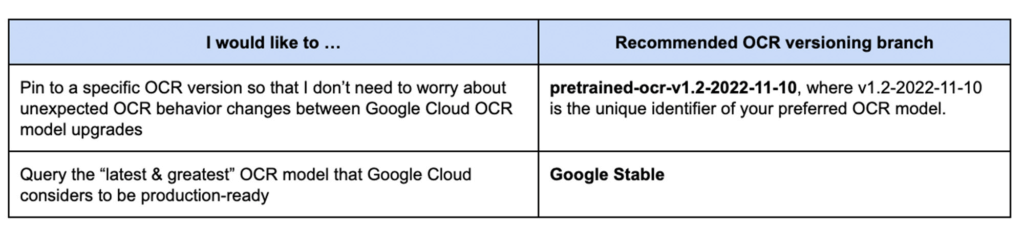
Today, we are launching OCR versioning, which enables users to pin to a historical OCR model behavior. The “frozen” model versions, in turn, give our customers and partners peace of mind, ensuring consistent OCR behavior. For industries with rigorous compliance requirements, this update also helps maintain the same model version, thus minimizing the need and effort to recertify stacks between releases. According to Jaga Kathirvel, Senior Principal Architect at Mr. Cooper, “Having consistent OCR behavior is mission-critical to our business workflows. We value Google Cloud’s OCR versioning capability that enables our products to pin to a specific OCR version for an extended period of time.”
With OCR versioning, you have the full flexibility to select the versioning option that best fits your business needs.
Getting Started on Document AI OCR
Learn more about the new OCR features and tutorials in the Document AI Documentation or try it directly in your browser (no coding required). For more details on what’s new with Document AI, don’t forget to check out our breakout session from Google Cloud Next 2022.
2863
Of your peers have already watched this video.
16:00 Minutes
The most insightful time you'll spend today!
Conversational AI in Search, Maps and Online Shopping!
Did you know about 77 percent of customers are likely to make a purchase from a brand they can message with? Direct interaction with the brand to gather product information shortens buyers’ journey and personalizes it with appropriate messages. To helps businesses add speed, simplicity and convenience in brand-customers interaction, Google’s Business Messages helps add chat feature in Search, Maps or other mediums.
Watch the video to learn to integrate conversational AI based on Google’s superior AI and ML features and build interactive and connected chat automation using Google Cloud’s suite of tools and products!
IKEA’s AI-driven Personalized and Real-time Recommendations Up its Conversion Rates and Average Order Value

4879
Of your peers have already read this article.
3:00 Minutes
The most insightful time you'll spend today!
Background
At IKEA we have multiple places in our customer journey in various channels where different kinds of personalization can deliver a superior customer experience. Product recommendations in the shopping basket, content recommendations in editorial sections, inspirational recommendations on product pages and more. After a while in the broader “recommendations” team there was a decision to split the team to have one sub-team focused on product recommendations. The pandemic altered customer behavior and needs as well. At that inflection point we decided to change our way of working and dive head-first into a more scientific approach to handle the operational complexities of delivering high quality product recommendations at scale. We deemed this necessary to improve our level of personalization and to have a holistic understanding of our customers.
Data Driven Decisions
The first step was to radically improve our ability to get high-quality quantitative information to understand how our ‘recommendation’ solutions affected personalization. We did this through high volume A/B testing on customer behaviour and after initial experimentation, we had a few key learnings:
- The mix of both UX and algorithms are really important for a cohesive customer experience.
- The quality of personalization can’t be measured in silos. Statistical significance can be attained by testing several groups of recommendations at once.
Once we came up with a solid framework for gathering data and acknowledged how little we knew about our customers, we were able to explore an incredible number of creative options – nothing was off the table. This was a very humbling experience, in that it opened up new perspectives for personalization, a more curious and less confined way of thinking. We learned to trust the data because it might show you things you don’t expect.
Experimentation and Learning Framework
Our teams created ways to quickly deploy experimental modifications to our existing solution. This enabled experimentation in the front-end with the user experience, including details in headings and images. This also covered tweaks in the backend with anything from detailed manual additions or removals of recommendations to mixing and matching of various algorithms both home grown and from Recommendations AI.
This flexibility came with an overhead–more complexity and cost relative to directly retrieving recommendations from Recommendations AI. However, the benefit was that we were no longer dependent on manual evaluation of what made for a good recommendation system. We aligned on a data-driven and qualitative approach to provisioning recommendations and significantly accelerated our experimentation timeline. Together with optimization of the CI/CD pipeline this enabled the team to take an idea or hypothesis from inception to A/B testing with customers in less than half an hour.
Recommendations AI Experiments
Our team’s infrastructure was already running on GCP and when we received early access to Recommendations AI, the requirements to get started were minimal and that allowed us to start with initial tests requiring minimal effort and investment.
We started with a few use-cases and identified places where our existing recommendation algorithms needed improvement or complementary recommendations. We also explored additional ways where more useful information could be presented to the customers through personalized recommendations.
Recommendations AI Model Combinations
While Recommendations AI might be considered a simple API to get a set of product recommendations, as we dove deeper into the solution it became apparent that it could be tweaked in several different ways to offer many fine tuning configurations to meet business goals. While too much fine tuning and customization could lead to subpar performance, in general we found that it was a great strategy to give us several versions of ML powered recommendations to work with. The further you personalize the experience, the more options you have to likely pick the best one for the customer.
Recommendations AI models like ‘Recommended for you’, ‘Frequently Bought Together’ and ‘Others you may like’; are coupled with business goals like optimizing for conversion rate, click through rate and revenue. We experimented with many different model combinations and custom rules. All this was easily configurable right in the GCP console. One of the simplest custom configurations we used was to only recommend items that were in stock, and when items were out of stock we looked at similar items that were available to augment the experience.
Collaboration with Google
Our collaboration with Google Cloud accelerated our learning process during experimentation. We worked closely together early in the product development. Additionally, their model provided flexibility to change direction and allow for more options than we had previously. Ultimately, this provided us a way to drastically improve our time to market with a product that produced tremendous results that we could not have accomplished on our own.
Results and Takeaways
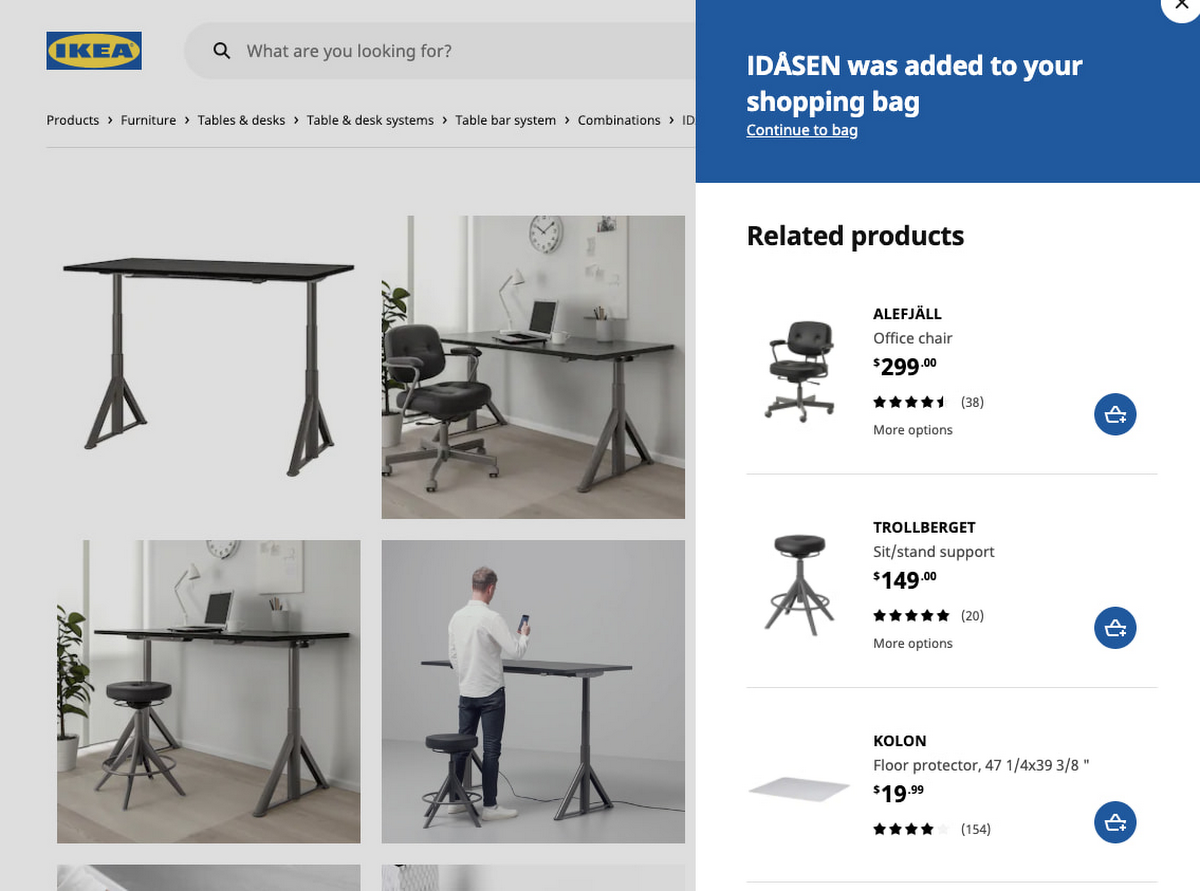
With more personalized and real-time recommendations available we saw great success. We were able to increase the number of relevant recommendations displayed on a page by +400%. To accommodate the wider repertoire of recommendations we had to change the user experience. For example, in some places we had horizontally scrolling displays of product recommendations which were much easier for customers to use.
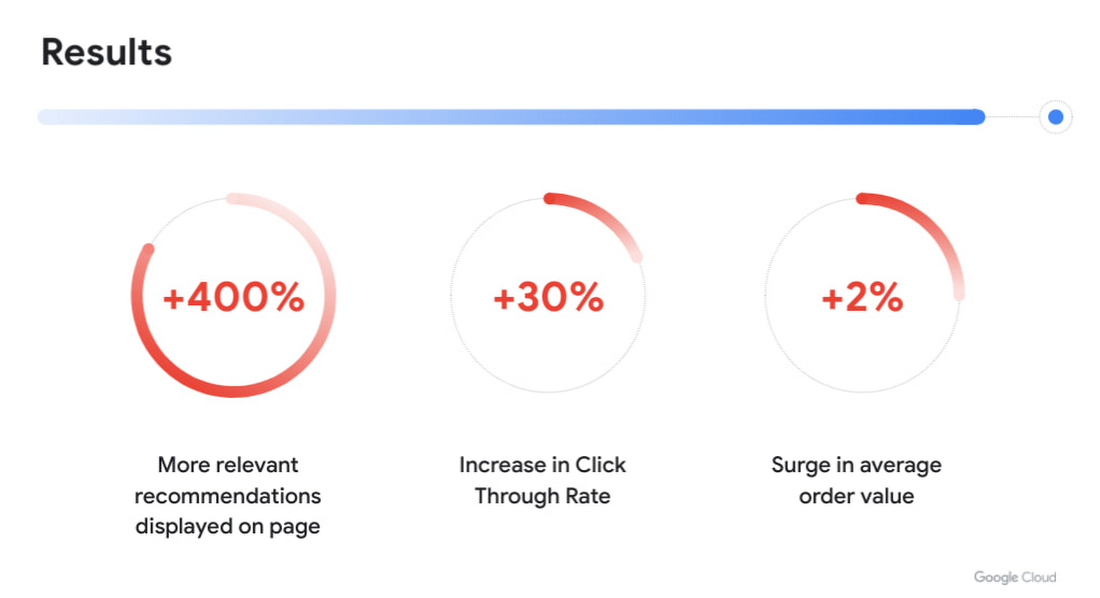
Another consequence of displaying more personalized recommendations was tangible improvement to conversion rate and average order value. Recommendations AI algorithms helped customers in two ways:
- Customers were able to find products that they liked quickly and establish their preferred choice among other options more quickly as well, giving them confidence to make a purchase through much fewer clicks. Even though we previously already had well tuned recommendations of several types, with Recommendations AI we measured +30% improvement in click through rates.
- Average order value saw a +2% surge with numerous examples of how Recommendations AI could help customers find both attractive and directly complementary products, expanding the customer purchase from a single product to an entire home furnishing solution.
As a direct effect of having stronger business results, the team started exploring more places in the customer journey where our growing buffet of recommendations could be used. We’d start with an initial experiment to answer if displaying recommendations in the specific context made sense at all. Frequently the data that emerged from these experiments prodded us to iterate further on what additional types of recommendations would be most appropriate to show to the customer as the customer’s behaviour evolved. Today, most of IKEA’s site recommendations are powered by Recommendations AI.
One key takeaway is that for some types of personalized recommendations there are benefits to using advanced algorithms that require a lot of high level data science and engineering competence to build since they outperform simplistic approaches. In some places, simplistic approaches work very well and in others the right decision is to not have product recommendations at all. For an effective use of product recommendations you need to have all the above options and the ability to tell when to use which one.
Next steps
When working with something so tightly related to customer experience, there is a constant change in user behaviour and new learnings to observe and adapt to. Product recommendations are rarely the main stand alone experience and frequently something that is used to help and enhance an experience. We see a lot of value in having a large toolbox of possible options and a team with a relentless focus on collaboration to improve the customer experience. We’re working directly with the Recommendations AI team and experimenting with several new features that we’re excited about.
In the future we see opportunities of improving the customer journey through a more visual experience that inspires the customer rather than relying on customers to use their imagination to visualize groups of products together. Vision Product Search provides that and is something we’re looking into deploying next. We’ll be sharing more about our journey with Recommendations AI at the Google Cloud Retail Summit session ‘IKEA’s Approach to Building a Powerful Recommendations Engine’ on July 27th 2021.
Best wishes to all developers from the IKEA product recommendations team & the Google Recommendations AI team!
Everything a Marketer Needs to Know About Machine Learning

3573
Of your peers have already read this article.
8:30 Minutes
The most insightful time you'll spend today!
As consumer expectations grow for more personalized, relevant, and assistive experiences, machine learning is becoming an invaluable tool to help meet those demands.
It’s helping marketers create smarter customer segmentations, deliver more relevant creative campaigns, and measure performance more effectively. In fact, 85% of executives believe AI will allow their companies to obtain or sustain a competitive advantage.1
We created this guide to help you optimize your machine learning marketing efforts — whether you’re just starting out or you want to discover more benefits of machine learning.
ML Models Built on Google Cloud Solutions Help You Virtually Participate in National Muffin Day!

2960
Of your peers have already read this article.
2:00 Minutes
The most insightful time you'll spend today!
If you’re here you’re probably wondering: what on Earth is the connection between muffins and machine learning, and what is National Muffin Day? To understand this, let’s start with National Muffin Day: an annual holiday co-founded by Jacob and his friend Julia Levy in 2015 to bake muffins and raise money for homelessness. National Muffin Day will occur on Sunday, February 20 this year. For more information on how to participate in National Muffin Day (which involves delicious baked goods and donations to people in need), please see the information at the bottom of this post. Last year, a colleague connected Jacob with Sara, who had done several baking projects that used machine learning to generate new recipes. They decided to collaborate for this year’s National Muffin Day, adding a new muffin recipe created with the help of machine learning.
In this post, we’ll explain how Sara used Google Cloud to develop a new muffin recipe, show you how you can participate virtually in National Muffin Day, and of course—share the recipe.
Machine learning for muffins
At its core, machine learning is the process of finding patterns in data and using those patterns to make predictions on new data. After a lot of baking over the past few years, Sara learned that baking is also based on patterns. For example, the ratio of flour, fat, liquid, and sugar that make up a cookie is very different from the ratio of those ingredients for a bread, a pie crust, or a muffin. She used that discovery to create a recipe for a hybrid cake + cookie, and a cake filled with Maltesers. Next up: muffins!
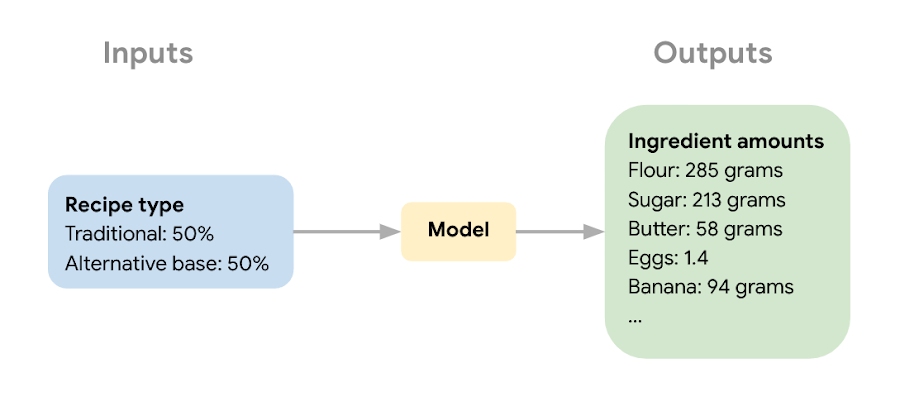
The first step was figuring out how to translate the task of generating a new muffin recipe into a machine learning task. To solve this, she planned to use numerical data on the amounts of different ingredients in a muffin recipe to train the model. Sara considered two types of models for this task: classification and regression. A classification model would categorize muffin recipes into different muffin types based on their ingredient amounts, and a regression model would do the reverse: take a type of muffin and return the amount of each ingredient needed to make it. She decided to build a regression model, since it would be more fun for the model to return ingredient amounts, rather than tell you which type of muffin recipe you’re already making.
Implementing this first required identifying a few muffin categories and collecting recipe data. This presented a new challenge, since her previous baking models used categories for distinct baked goods (i.e. cakes, cookies, breads). After scouring through quite a few recipes, Sara discovered that many muffins fall into two types: those that use only traditional ingredients as their base (flour, sugar, butter, milk, etc.), and those that include an alternative ingredient, most commonly a pureed fruit, to make the base (like bananas, applesauce, or pumpkin). Using those two categories, the model would take the type of muffin as input and return the amounts of base ingredients required to make that recipe. Here, the inputs can be any values adding up to 100%:
The next step in the ML process was collecting recipe data to use for model training and narrowing down the ingredients used to train the model. Sara wanted the model to learn the combination of core ingredients that make up a muffin batter, rather than flavorings and additions like blueberries, vanilla extract, or chocolate chips. These tasty additions could be added after the model helped create the muffin batter. Once she gathered enough recipes, she removed extra ingredients for training purposes and converted ingredients from different recipes into the same unit (grams, milliliters, and teaspoons).
Building a muffin model with Vertex AI
Sara uploaded the muffin ingredient data into BigQuery, and then created a notebook instance in Vertex AI Workbench to analyze the data. With the new Workbench managed instances, you can interactively query BigQuery tables directly from your instance and copy the code to download your data to a notebook as a Pandas DataFrame:

From her notebook instance, Sara experimented with different ML frameworks and model types. She landed on a Scikit-learn regression model to solve this task, and to mimic a real-world production environment, decided to convert this workflow into a ML pipeline. Using the Kubeflow Pipelines SDK, she ran the following on Vertex Pipelines:
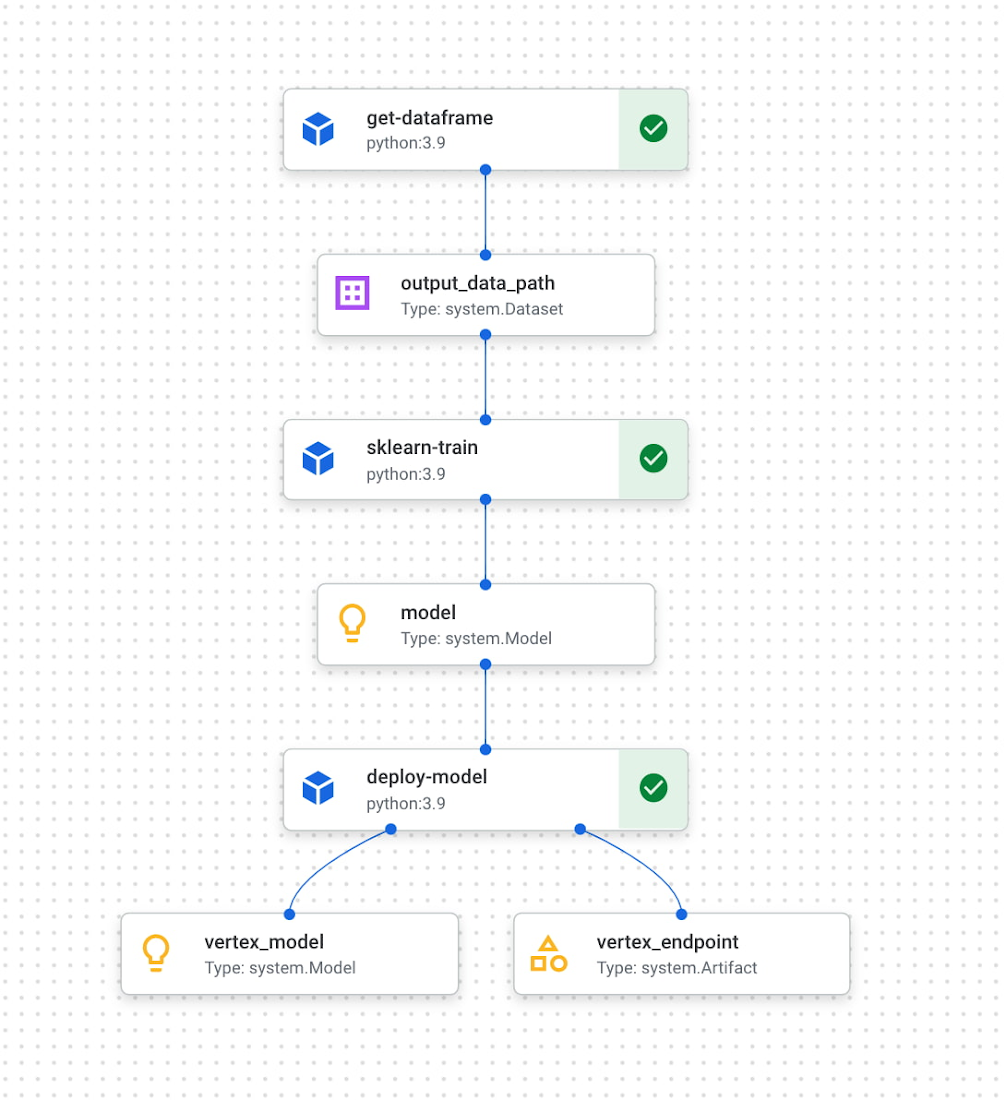
The first component reads the ingredient data from BigQuery and converts it into a Pandas DataFrame which is passed to the next pipeline step. In this step, we train a custom Scikit-learn model on the recipe data. Finally, this model is deployed to an endpoint in Vertex AI. To put it all together, Sara built a web app that allowed her to easily generate ingredient amounts for different muffin types. The web app uses the Vertex AI SDK to call the deployed model endpoint and return ingredient amounts.
The recipe
With a deployed recipe generation model, the only thing left to do was test recipes in the kitchen! Because the model only returns ingredient amounts, there were still many key human elements to complete the baking process: adding yummy additions to the core muffin batter, making adjustments to optimize taste, determining the method for adding ingredients, baking time, and more. After testing a few recipes generated by the model, we landed on a favorite which we’re very excited to share with you here.
Berry ML Muffins

Makes 12 muffins
Flour 285 grams (2 cups)
Granulated sugar 250 grams (1 cup)
Baking powder 2 teaspoons
Baking soda ¼ teaspoon
Salt ½ teaspoon
Cinnamon ½ teaspoon
Milk 170 ml (⅔ cup), room temperature
Butter 55 grams (¼ cup), melted and slightly cooled
Eggs 1 egg plus 1 egg white, room temperature
Canola or vegetable oil 50 grams (¼ cup)
Sour cream 50 grams (3 tablespoons + ¾ teaspoon), room temperature
Vanilla extract 1 ½ teaspoons
Blueberries or raspberries 240 grams (1 ½ cups)
Coarse sugar, like demerara or turbinado (optional for topping) 1 tablespoon
- Measure your three cold ingredients and allow them to come to room temperature: 1 egg + 1 egg white, sour cream, and milk.
- Preheat the oven to 375 F / 190 C. Line a 12-muffin tin with cupcake liners or lightly grease with baking spray.
- In a large bowl, whisk together flour, baking powder, baking soda, salt, and cinnamon. Set aside.
- Melt your butter in a medium heat proof bowl, and allow it to cool slightly for a few minutes. Whisk in sugar until combined. Then add egg, oil, and vanilla, milk, and sour cream and whisk until fully incorporated.
- Pour the wet ingredients into the dry ingredients, mixing with a spatula until just combined. Be careful not to overmix, it’s ok if there are a few lumps in your batter.
- Prepare your fruit. If you can’t decide whether to use blueberries or raspberries, divide your batter into two bowls and do both! Crush half of your fruit and fold it into the batter. Then mix in the remaining whole berries.
- Divide the mixture evenly into the muffin tin. Optionally (but extra tasty), sprinkle the tops of each muffin with about ⅛ teaspoon of coarse sugar. Turbinado or demerara sugar work well for this. This will caramelize and add a nice texture to the tops of your muffins.
- Bake at 375 for 22 – 24 minutes, or until a toothpick inserted in the center comes out clean. For best results, do a toothpick test in a few muffins since not all ovens have an even temperature throughout. Let the muffins cool in the muffin tin for a few minutes, then transfer to a wire rack to cool completely.
- Enjoy!
How can you participate in National Muffin Day?
Participation in National Muffin Day is as easy as 1-2-3!
- On February 20, Bake Muffins. It’s time to dust those muffin tins, grab your blueberries, chocolate chips, rhubarb, and favorite ingredients, and create some magical scrumdiddlyumptiousness! If you want to join Jacob in a virtual baking party, you can register here.
- Then, Give. In non-pandemic years, we asked our bakers to personally hand muffins to hungry folks in their cities. While this is a valuable and rewarding experience, the current state of Covid means this practice is still unsafe, so we request that you refrain from doing this. Instead, if it feels safe, we encourage you to take your delicious baked goods and donate them to local homeless shelters, which can distribute them to those in need. Alternatively, you can share your muffins with friends and families and then make a donation to an organization that benefits people experiencing homelessness, like the ones listed below in step 3.
- Share Your Muffin Pics on Social Media. We’d love to see your muffins! Share your pictures on Twitter or Instagram with the hashtags #givemuffins, or share them to our official Facebook Event page. For each individual baker who participates, we will make donations to Project Homeless Connect, which provides much needed resources to people experiencing homelessness in San Francisco, Family promise, which supports unhoused families nationwide, and Pine Street Inn which provides resources for people experiencing homelessness in Boston. Donations will be on a per-baker basis (with up to $80 donated per baker!), so please feel free to loop in your significant others, kids, nieces and nephews, roommates, friends, and anybody else with a giving spirit who loves deliciousness!
AI Booster: how Vodafone is supercharging AI & ML at scale

3226
Of your peers have already read this article.
3:30 Minutes
The most insightful time you'll spend today!
One of the largest telecommunications companies in the world, Vodafone is at the forefront of building next-generation connectivity and a sustainable digital future.
Creating this digital future requires going beyond what’s possible today and unlocking significant investment in new technology and change. For Vodafone, a key driver is the use of artificial intelligence (AI) and machine learning (ML), enabling predictive capabilities in enhancing the customer experience, improving network performance, accelerating advances in research, and much more.
Following 18 months of hard work, Vodafone has made a huge leap forward in advancing its AI capabilities at scale with the launch of its “AI Booster” AI / ML platform. Led by the Global Big Data & AI organization under Vodafone Commercial, the platform will use the latest Google technology to enable the next generation of AI use cases, such as optimizing customer experiences, customer loyalty, and product recommendations.
Vodafone’s Commercial team has long focused on advancing its AI and ML capabilities to drive business results. Yet as demand grows, it is easier said than done to embed AI and ML into the fabric of the organization and rapidly build and deploy ML use cases at scale in a highly regulated industry. Accomplishing this task means not only having the right platform infrastructure, but also developing new skills, ways of working, and processes.
Having made meaningful strides in extracting value from data by moving it into a single source of truth on Google Cloud, Vodafone had already significantly increased efficiency, reduced data costs, and improved data quality. This enabled a plethora of use cases that generate business value using analytics and data science. The next step was building industrial scale ML capability, capable of handling thousands of ML models a day across 18+ countries, while streamlining data science processes and keeping up with technological growth.
Knowing they had to do something drastically different to scale successfully, along came the idea for AI Booster.
“To maximize business value at pace and scale, our vision was to enable fast creation and horizontal / vertical scaling of use cases in an automated, standardized manner. To do this, 18 months ago we set out to build a next-generation AI / ML platform based on new Google technology, some of which hadn’t even been announced yet.
“We knew it wouldn’t be easy. People said, ‘Shoot for the stars and you might get off the ground…’ Today, we’re really proud that AI Booster is truly taking off, and went live in almost double the markets we had originally planned. Together, we’ve used the best possible ML Ops tools and created Vodafone’s “AI Booster Platform” to make data scientists’ lives easier, maximise value and take co-creation and scaling of use cases globally to another level,” says Cornelia Schaurecker, Global Group Director for Big Data & AI at Vodafone.
AI Booster: a scalable, unified ML platform built entirely on Google Cloud
Google’s Vertex AI lets customers build, deploy, and scale ML models faster, with pre-trained and custom tooling within a unified platform. Built upon Vertex AI, Vodafone’s AI Booster is a fully managed cloud-native platform that integrates seamlessly with Vodafone’s Neuron platform, a data ocean built on Google Cloud.
“As a technology platform, we’re incredibly proud of building a cutting-edge MLOps platform based on best-in-class Google Cloud architecture with in-built automation, scalability and security. The result is we’re delivering more value from data science, while embedding reliability engineering principles throughout,” comments Ashish Vijayvargia, Analytics Product Lead at Vodafone
Indeed, while Vertex AI is at the core of the platform, it’s much more than that. With tools like Cloud Build and Artifact Registry for CI/CD, and Cloud Functions for automatically triggering Vertex Pipelines, automation is at the heart of driving efficiency and reducing operational overhead and deployment times. Today, users simply complete an online form, and then, within minutes, receive a fully functional AI Booster environment with all the right guardrails, controls, and approvals.
Not long ago it could take months to move a model from a proof of concept (PoC) to launching live in production. By focusing on ML operations (MLOps), the entire ML journey is now more cost-effective, faster, and flexible, all without compromising security. PoC-to-production can now be as little as four weeks, an 80% reduction.
Diving a bit deeper, Vodafone’s AI Booster Product Manager, Sebastian Mathalikunnel, summarizes key features of the platform: “Our overarching vision was a single ML platform-as-a-service that scales horizontally (business use cases across markets) and vertically (from PoC to Production). For this, we needed innovative solutions to make it both technically and commercially feasible. Selecting a few highlights, we:
- completely automated ML lifecycle compliance activities (drift / skew detection, explainability, auditability, etc.) via reusable pipelines, containers, and managed services;
- embedded security by design into the heart of the platform;
- capitalized on Google-native ML tooling using BQML, AutoML, Vertex AI and others;
- accelerated adoption through standardized and embedded ML templates.”
For the last point, Datatonic, a Google Cloud data and AI partner, was instrumental in building reusable MLOps Turbo Templates, a reference implementation of Vertex Pipelines, to accelerate building a production-ready MLOps solution on Google Cloud.
“Our team is devoted to solving complex challenges with data and AI, in a scalable way. From the start, we knew the extent of change Vodafone was embarking on with AI Booster. Through this open-source codebase, we’ve created a common standard for deploying ML models at scale on Google Cloud. The benefit to one data scientist alone is significant, so scaling this across hundreds of data scientists can really change the business,” says Jamie Curtis, Datatonic’s Practice Lead for MLOps.
Reimagining the data scientist & machine learning engineer experience
With the new technology platform in place, driving adoption across geographies and markets is the next challenge. The technology and process changes have a considerable impact on people’s roles, learning, and ways of working. For data scientists, non-core work now is supported by machines in the background—literally at the click of a button. They can spend time doing what they do best and discovering new tools to help them do the job.
With AI Booster, data scientists and ML engineers have already started to drive greater value and collaborate on innovative solutions. Supported by instructor-led and on-demand learning paths with Google Cloud, AI Booster is also shaping a culture of experimentation and learning.
Together We Can
Eighteen months in the making, AI Booster would not have happened without the dedication of teams across Vodafone, Datatonic, and Google Cloud. Googlers from across the globe were engaged in supporting Vodafone’s journey and continue to help build the next evolution of the platform.
Cornelia highlights that “all of this was only possible due to the incredible technology and teams at Vodafone and Google Cloud, who were flexible in listening to our requirements and even tweaking their products as a result. Alongside our ‘Spirit of Vodafone,’ which encourages experimenting and adapting fast, we’re able to optimize value for our customers and business. A huge thank you also to Datatonic, who were a critical partner throughout this journey and to Intel for their valuable funding contribution.”
The Google & Vodafone partnership continues to go from strength to strength, and together, we are accelerating the digital future and finding new ways to keep people connected.
“Vodafone’s flourishing relationship with Google Cloud is a vital aspect of our evolution toward becoming a world-leading tech communications company. It accelerates our ability to create faster, more scalable solutions to business challenges like improving customer loyalty and enhancing customer experience, whilst keeping Vodafone at the forefront of AI and data science,” says Cengiz Ucbenli, Global Head of Big Data and AI, Innovation, Governance at Vodafone.
Find out more about the work Google Cloud is doing to help Vodafone here, and to learn more about how Vertex AI capabilities continue to evolve, read about our recent Applied ML Summit.
More Relevant Stories for Your Company




Transitioning Kagglers to TPU with TF 2.x
Kaggle has, historically, become synonymous with machine learning competitions but it's much more than that. Kaggle is a data science platform. Over 5 million data scientists from all over the world come to Kaggle to not only not only participate in machine learning competitions but to learn data science build



Chronicle Security Analytics: Key to Address Security Data Overload
Google Cloud's Chronicle is a security analytics platform built for modern use cases to combat modern threats. In today's world, enterprises have undergone significant changes in all aspects, and must adapt to their security needs to counter threats and attacks. Watch the video to learn Google Cloud's initiative to help

BigQuery ML for Sentiment Analysis: How to Make the Most of Your Data
Introduction We recently announced BigQuery support for sparse features which help users to store and process the sparse features efficiently while working with them. That functionality enables users to represent sparse tensors and train machine learning models directly in the BigQuery environment. Being able to represent sparse tensors is a

BigQuery Explainable AI for Demystifying the Inner Workings of ML Models. Now GA!
Explainable AI (XAI) helps you understand and interpret how your machine learning models make decisions. We're excited to announce that BigQuery Explainable AI is now generally available (GA). BigQuery is the data warehouse that supports explainable AI in a most comprehensive way w.r.t both XAI methodology and model types. It does this at
