





Impact of Cloud FinOps on Your Business Can be Measured with Five Key Metrics!

3100
Of your peers have already read this article.
6:00 Minutes
The most insightful time you'll spend today!
Value of Establishing a Baseline for Metrics
As organizations continue to leverage cloud investments to drive their business growth and top line revenue, business, finance, and technology executives need to become increasingly connected in their efforts to deliver strong business outcomes. More than ever before, executives need to quantify the value of their investments in business and technology capabilities. As such, business and IT leaders need a set of value metrics that cover both operational and strategic outcomes, as well as risks and opportunities. Nevertheless, operational IT metrics are often disconnected from business outcomes, and executives need to establish the connection between technology and business outcomes to facilitate a meaningful dialogue between IT and business leaders.
Like many aspects of IT operations, metrics and KPIs are commonly a journey. Organizations typically start this journey with unit metrics focusing on cloud costs and eventually progress toward a set of clearly defined business value metrics.
As we define the set of metrics across the five key building blocks of Cloud FinOps, which include Accountability & Enablement, Measurement & Realization, Cost Optimization, Planning & Forecasting, and Tools & Accelerators, we ensure that these metrics are easily measurable and commonly attainable across the organizations that are on the journey of digital transformation.
Accountability and Enablement Metric
The Accountability and Enablement pillar is foundational to building a culture of cost and value awareness and charts the course for both the process and cultural transformation journey in cloud FinOps. The primary goal is to help drive financial accountability and accelerate business value realization by streamlining IT financial processes and enabling frictionless cloud governance. Enablement empowers IT, finance, and business teams with training to better understand cloud resources and strategies to efficiently deploy and manage them. Driving accountability and enablement starts with a charter and core governance policies, and then guides the transformation of processes that link finance, IT, and business owners.
We recommend adopting Cloud Enablement % as the standard metric for the accountability and enablement pillar, measured by the # of business leaders trained and certified / total # of business leaders in the organization.

This is an important metric as many organizations fail to adopt Cloud FinOps because of lack of awareness and training. This cloud enablement metric will help business leaders better understand the value of cloud and how it can be an enabler to drive sustainable business outcomes.
The cloud enablement metric can easily be implemented through a set goal based on the number of identified business leaders across the organization. With that said, it is important to utilize the Pareto principle of 80/20 rule here and identifying the key business leaders who are extensively consuming services on the cloud should be the primary focus. Google Cloud recently published a new Cloud Digital Leader certification that is aimed for business leaders and executives. By obtaining the Cloud Digital Leader certification, it ensures the individual is well-versed in basic cloud concepts and can demonstrate a broad application of cloud computing knowledge in a variety of applications and how Google Cloud services can help achieve desired business goals. In addition, the FinOps Foundation also provides training and certification to practitioners in a large variety of cloud, finance and technology roles to validate their FinOps knowledge and enhance their professional credibility.

Ultimately, we see that a target goal of over 70% of business leaders achieving the Cloud Digital Leader certification can significantly drive alignment and adoption of Cloud FinOps across the organization and leverage cloud technologies as an enabler to create sustainable business outcomes.
Measurement and Realization Metric
Foundational to any good process is accurate data and effective metrics, which starts with the notion of cloud costs visibility and traceability. This is driven by proper resource hierarchy and project structure standards and supported by a labeling and tagging data architecture behind your organization’s use of cloud resources. While many common tags include IT-driven designators such as application, environment, and project, it is important to design a direct connection to your P&L into your labeling and tagging architecture, by including cost centers or the chart of accounts as tags. Furthermore, automation of tagging ensures that all taggable resources are deployed with consistent and accurate labels and feed FinOps metrics with reliable data.
Establishing consistent and detailed tagging is essential to attributing cloud resources not only to specific products and projects, but also to detailed cost centers aligned with lines of business and associated P&Ls. In order to establish a full chargeback of typical cloud services, customers will need to attribute costs associated with 3 types of cloud resources. The first and most straightforward will be attributing taggable resources (compute instances, databases, and storage buckets) that are aligned to a specific P&L, such as where a given application is solely consumed by one line of business.
The second situation is where taggable resources are shared across multiple lines of business. Many customers will resort to using traditional P&L allocation models, such as using business revenue or headcount of the associated business units to divy up the costs. In order to more accurately allocate shared application costs, leading-edge customers use elements in their cloud microservices architecture, such as API calls, to specifically measure the relative consumption of shared applications.
The third type of cloud resources are those that cannot be tagged. Common examples include support, networking costs, and third party Marketplace costs. Here, traditional P&L allocation models as described above (using headcount or revenue) are commonly used. Some customers will use the relative distribution of their taggable resource allocations to appropriate non-taggable costs to their business units, while some types of costs, such as networking, are allocated based on API calls.
To measure the effectiveness of the Measurement & Realization pillar of cloud FinOps across these three types of cloud resources, we recommend adopting Cloud Allocation % as the lead metric. This metric is measured as the percentage of total cloud costs (taggable resources consumed by individual business units, taggable resources shared across multiple business units, and non-taggable resources) allocated to responsible business owners.

This metric can be used to support both Showback (cloud costs held in a central IT P&L but reported to business units) and Chargeback models (cloud costs fully charged to business unit P&Ls), and reflects the underlying effectiveness and accuracy of resource tagging and cost attribution to business units. Cloud Allocation % can be implemented in two ways. The basic implementation would qualify costs apportioned by any P&L metric (either by consumption or by traditional P&L allocation such as by revenue or headcount). The more advanced implementation of this metric would only qualify those resources (both specific and shared) that use either tagging or API calls to measure consumption and attribute associated costs to business units.

Customers evolving from a Crawl to a Walk stage of implementation will seek to allocate 70% or more of their total cloud costs, while those moving to a Run state will achieve 90% or greater cost attribution based on direct consumption measures.
Cost Optimization Metric
Cloud cost optimization is not just about cutting costs—it’s about knowing where to spend your money to maximize the business value. It is an iterative and continuous process that provides a consistent methodology to visualize and manage cloud consumption in a most cost effective way. Success in cost optimization can result not only in significant reductions of cloud spend, but sometimes also in improved application performance to manage higher traffic (user requests per seconds or transaction processed) within the same cost envelope.
It is important for an organization to automate reports generated by ingesting billing usage and cost data as well as recommendations generated for optimizations. These optimizations reflect the potential savings (also known as unrealized savings) which allows the team to prioritize implementations to realize the cost savings.
Typically potential savings contains adoption of:
- Pricing optimizations like Committed Use Discounts (resource-based and spend-based), BigQuery reservations, etc.
- Resource optimizations of wasteful resources (including aged snapshots, idle instances, and over-sized databases) that don’t provide any business value.

Capturing this metric is important as it allows the organization to keep a pulse on inefficiencies that exist in the organization and allows businesses to focus on achieving cost savings thereby capturing true value of running their workloads in the cloud.
The cost optimization metric can be implemented by integrating Recommendation Hub in your FinOps workflows. Recommendations Hub is part of Active Assist that contains a portfolio of intelligent tools and capabilities to help you optimize your workloads with minimal effort. It surfaces a summary of all recommendations across your projects along with potential cost savings ($) so you can prioritize your cost optimization effort. We have seen customers realize savings by taking action on recommendations generated by idle VM recommender, Committed Use Discount recommender, VM machine type recommender and many more.

Ultimately we see customers achieving realized savings of over 90% on total cloud service optimizable. We have seen customers reinvest these savings into creating differentiated products and offerings and improving their customer experience, thus accelerating business value realization from the cloud.
Planning and Forecasting Metric
Financial planning is a foundational capability within finance organizations that will directly influence each company’s capabilities of cloud computing forecast accuracy. Financial planning focuses on accurately forecasting financial metrics that are set on an annual basis to guide the company’s financial objectives. The annual plans are measured on a quarterly basis and adjusted based on performance throughout the year; the forecast performance is monitored on a monthly basis to help influence operational results.
Planning and forecasting cloud computing costs is typically the responsibility of the team responsible for cloud operations. Operational forecast planning is based on consumption workload plans, historical trajectory, seasonality and leading indicators. Transformational projects also create material risks to forecast accuracy.
Establishing accurate financial forecasting in the cloud spend requires rethinking traditional approaches to asset depreciation run-outs and trend-based forecasting of maintenance and licensing costs. Using workload-specific forecasting models that leverage a combination of trend-based models for steady-state workloads, driver-based models for scaling applications, as well as monthly variance analysis can greatly improve the accuracy of dynamic cloud needs.
Capturing and measuring forecast accuracy enables companies to understand if they do what they plan. Companies get what they measure and so by measuring and discussing variances to forecast accuracy it enables better control of cloud spend allocations.
Cloud computing forecast accuracy should be included as a topic that Finance and Cloud operations teams discuss at least monthly. The cloud operations team should monitor forecast trajectory during the month and evaluate adjustments when they identify unexpected shifts.
An effective forecast accuracy is one that avoids surprises to company executives and investors. Cloud computing often has more variability and seasonality than depreciation of capex from on prem environments. Coordinating project and sprint agile management can help avoid surprises. If a development change creates an unexpected jump in spending then change management processes should be reviewed to avoid future surprises.
Tools and Accelerators Metric
Employing proper tools and accelerators are important to fully benefiting from FinOps practices. In earlier stages, companies may have limited their ability to report detailed analysis of cloud spend. As practices mature and improve, labeling and tagging of resources proves valuable to understanding costs for specific projects/teams and for building unit cost metrics.
These capabilities can become even more powerful through automated monitoring of resources that offers insights on spend, value, compliance and recommendations.
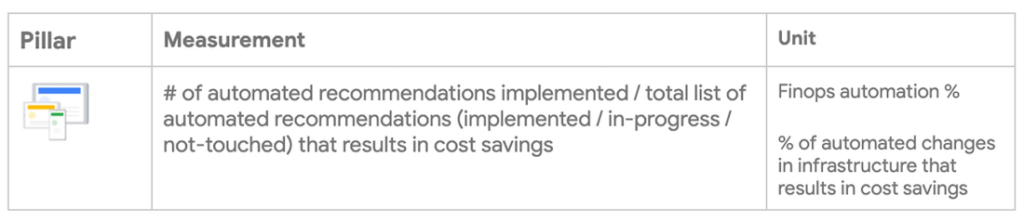
Therefore the recommended measure of Tools & Accelerators maturity is to evaluate the # of automated recommendations that have been implemented as a % of total list of automated recommendations generated that results in cost savings
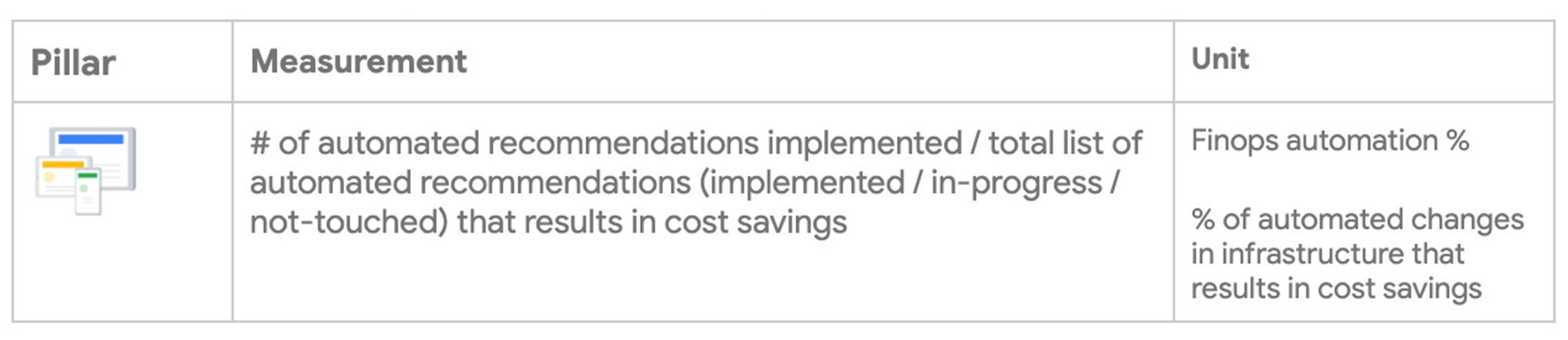
This is an important metric because as the organization onboards newer workloads to the Cloud environment, lack of robust actionable recommendations and monitoring can lead to increased cloud waste. This has been a key component prohibiting organizations from realizing the total value of their cloud investment.
Customers starting on their tool maturity journey can leverage Google’s out of the box recommendations Hub to get started. The Recommendation Hub is a place in the Google Cloud Console where you can view, prioritize, and apply these recommendations. Some examples include VM right sizing recommendations, BQ slot optimizations, Committed use Discount etc, Idle resource recommendations. This can further be integrated into any existing enterprise tooling using the recommendations API. As organizations mature, they can leverage Cloud Monitoring to create advanced recommendations based on custom business logic.
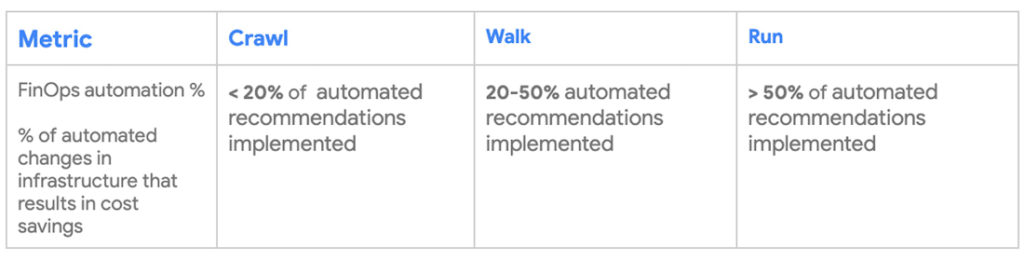
Ultimately, we see that a target goal of over 50% of automated recommendations implemented as the tooling for surfacing recommendations matures and this will ensure that the organization can minimize and eliminate cloud waste to maximize value from cloud investment.
Bringing this together with a Cloud FinOps Dashboard
As technology and business goals continue to evolve over time, it is essential to establish a process where the Cloud FinOps metrics are continuously reviewed whenever the goals change. Furthermore, it is important to note that not all organizations need to achieve the “Run” state of the identified metrics target. The metrics are means to achieve the business outcomes based on the organization’s priorities. By collaborating with cross-functional teams to quantify and measure the impact of the Cloud FinOps metrics, executive leaders can quickly obtain buy-in, highlight common-shared goals, and move fast.
At Google Cloud, we have developed solutions to help our customers build a Cloud FinOps Dashboard to capture these metrics to drive a culture of change and equip the transformation and business leaders with the tools to share and track the results of the key metrics. Successful adoption of the Cloud FinOps metrics enable organizations to focus on the business outcomes and the dashboard provides a meaningful feedback loop to report on the impact and drive visibility across the organization.
So, where are you now in your FinOps journey, and how do you move beyond the challenges ahead? Google can help you start the conversation and accelerate your path to maximizing business value with the cloud.
No matter where you are on the cloud transformation journey, through an interactive session with Google, we can bring executives across the organization together to work toward a shared vision and a plan to accelerate and realize business value in the cloud. If you are interested in more information, please contact us.
Special thanks to Daniel Pettibone, Amitai Rottem, Bruce Warner, Jon Naseath, and Nihar Jhawar for co-authoring and contributing to this blog post and the members of the FinOps Foundation including J.R. Storment, Vas Markanastasakis, Anders Hagman, John McLoughlin, Mike Bradbury, and Rich Hoyer for providing their domain expertise and continuous support to this important cloud FinOps topic.
How the Telegraph is Reimagining Media with Google Cloud

10188
Of your peers have already read this article.
3:30 Minutes
The most insightful time you'll spend today!
Whether they’re reading the newspaper on the way to work, or catching up on the latest headlines on their smartphones, readers expect up-to-the-minute news wherever and whenever makes the most sense for them. As a result, media companies are increasingly looking for ways to improve, expand, and simplify their offerings, and they’re increasingly looking to the cloud to do it.
For more than 160 years The Telegraph has been counted on by readers across the United Kingdom and globally for award-winning news and journalism. An early adopter of cloud technology, it’s been a G Suite customer since 2008 and has already been using Google Cloud Platform to analyze digital behaviors to improve engagement and advertising performance since 2016.
Recently, The Telegraph announced it’s migrating fully to Google Cloud. By migrating all their production and pre-production services, they aim to deliver content faster, provide compelling experiences to readers, and reduce environmental impact.
“We are delighted to announce our newest collaboration with Google Cloud,” said Chris Taylor, Chief Information Officer, The Telegraph. “We have always worked closely with Google as they help us to provide our readers with great experiences on our digital products, collaboration software and internet scale through search. Their continued leadership in projects such as Kubernetes are enabling us to build flexible development environments that truly support DevOps.”
Powering the Digital Publishing Ecosystem
The Telegraph produces large volumes of digital content every day. It was imperative for them to find a cloud provider they could trust to support this ecosystem. By working with Google Cloud they have changed the way they see and engage with data: they can collect new information about their products every second and use that to continually hone their strategy. The Telegraph are placing more confidence and trust in the data captured about their content and now have one of the best available pieces of technology for capturing and analyzing the stories they publish in real-time.
Leveraging AI to support journalists
Time is critical when journalists are on a story, and The Telegraph wants to put important data in the hands of its journalists right when they need it. To do this, it will be using AutoML to classify content for journalists and make it more discoverable. For example, a reporter will be able to bring up relevant assets that link to their stories. It will also apply AutoML to classify Telegraph stock photos to help journalists attach compelling visual content to their stories faster.
Building compelling reader experiences with the help of APIs
Readers have an ever-increasing expectation of personalization. To meet this need, The Telegraph launched My Telegraph, currently live in beta, to offer registered readers personalized news experiences based on their interests or the particular journalists they want to follow. My Telegraph was developed on an API management platform provided by Google Cloud’s Apigee. You can learn more about how it’s applying API management to My Telegraph, in this blog post.
Working for environmental good
The Telegraph is the biggest selling quality newspaper in the UK, an accolade which requires it to print and distribute hundreds of thousands of copies each day. Optimal management of print production is important, and by using a combination of the cloud and machine learning, The Telegraph is better able to predict demand for physical newspapers, maximizing sales and minimizing waste. This makes great business sense for The Telegraph but also has great environmental benefit.
Indian social media platform ShareChat saw a 50% reduction in costs after migrating to Google Cloud

4356
Of your peers have already read this article.
6:30 Minutes
The most insightful time you'll spend today!
One of the key trends that emerged from the lockdown brought about by the COVID-19 outbreak was the significant rise in people seeking entertainment online.
According to data released by Carat India, smartphone usage increased by 1.5 hours a week and social media consumption nearly doubled to 280 minutes a day. Of India’s 670 million internet users, a significant percentage live in rural areas, which saw a surge in demand for local language content.
As India’s premier social media platform, ShareChat saw significant engagement from its 60 million monthly active users (MAU) during the lockdown. The platform now has surpassed 120 million MAU post the government banning 59 Chinese apps in the last week of June.
ShareChat was founded by Ankush Sachdeva (co-founder and Chief Executive Officer), Farid Ahsan (co-founder and Chief Operating Officer), and Bhanu Pratap Singh (co-founder and Chief Technical Officer), in 2015.
In a recent conversation with YourStory, Bhanu spoke about content consumption during COVID-19, how they are reaching out to the country’s vernacular audience and their recent transition to Google Cloud.
Read the Full Story on YourStory
How Ather Energy is leveraging the Cloud to build and scale smart mobility solutions for India

8393
Of your peers have already read this article.
8:30 Minutes
The most insightful time you'll spend today!
In 2013, long before the world was discussing clean energy and sustainable practices, two IIT Madras graduates — Swapnil Jain and Tarun Mehta — had an idea to develop India’s first-ever electrical scooter.
This was at a time when auto manufacturers were still focusing on fossil-fuel-driven vehicles and ‘eco-friendly’ mobility solutions were more a trendy alternative catering to a niche market.
The duo founded Ather Energy in 2013 and launched their first fully-electric scooter, the Ather S340, in Bengaluru in 2016. Since then, the company has released several new models into the market and is planning to expand to eight more cities by the end of the year.
To support the smooth running of their vehicles, lower costs, improve time to market, and create great customer experience, Ather turned to Google Cloud.
Read the Full Story on YourStory
8419
Of your peers have already watched this video.
21:00 Minutes
The most insightful time you'll spend today!
Journey to Transformation and Modernization with Google’s Distributed Cloud
Google Cloud has been leading the way of helping businesses make most from their cloud investments to drive digital transformation through modern application platforms that cater to today’s customer needs. Watch the video from the Next ’21 to explore three areas where companies are supported by Google Cloud throughout their cloud evolution journey–cloud migration and modernization, extension of services and engineering practices to hybrid and multicloud environments, and delivery of high performance with planet scale distributed infrastructure. Also, learn how Google Cloud is equipped for more complex and unique use cases, from datacenter to the edge. Hear the strategies and customer stories that can help your business modernize people, processes, and applications to fully leverage Google’s distributed cloud!

2761
Of your peers have already downloaded this article
4:30 Minutes
The most insightful time you'll spend today!
Google partnered with IDC Retail Insights to conduct a survey of retailers across the globe to assess the state of transformation and develop an index of digital maturity. Learn more about the changes in digital resilience over the last year and the areas of innovation over the next 12 months.
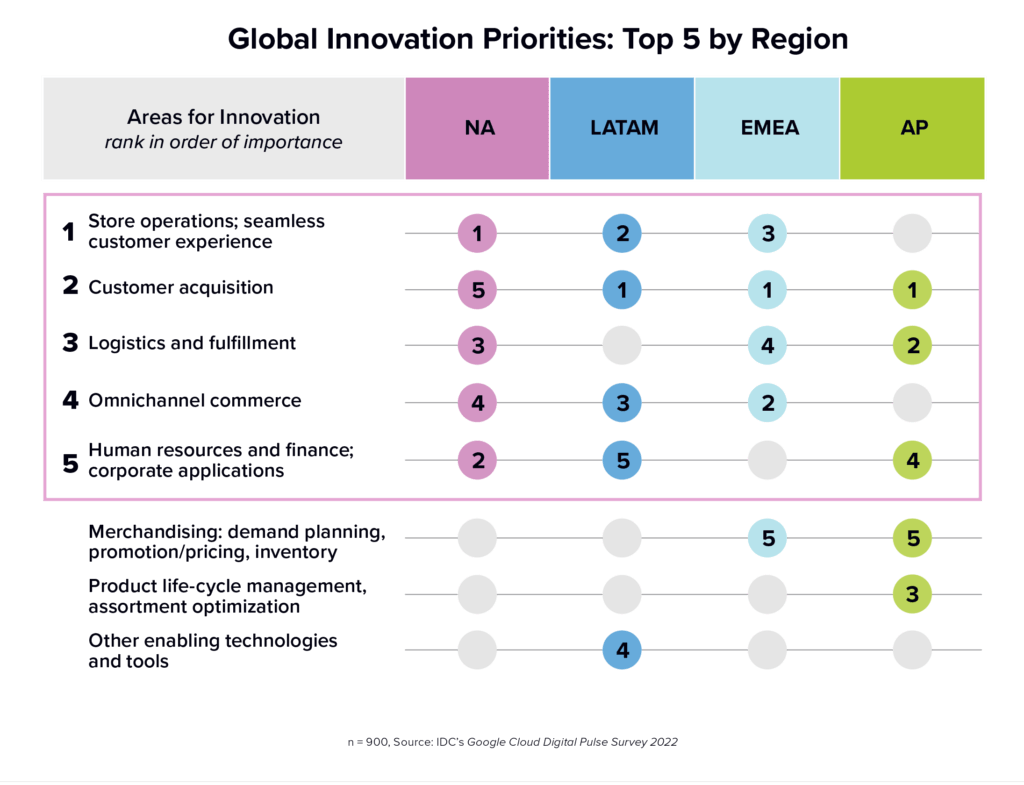
In this IDC Infobrief, you will learn:
- Where retailers stand on the path to digital resilience
- Top challenges retailers face with digitization and how that’s changed in the last 12 months
- Key areas for innovation and use cases among retailers at different stages of digital maturity
- How innovation can help organizations advance and respond evolving customer expectations
More Relevant Stories for Your Company

Marxent Leverages Google Cloud to Elevate Customer Journeys on Retail Apps with 3D Shopping Experiences
As ecommerce for home goods exploded in popularity during COVID, furniture and DIY retailers looked to find new ways to grow online transaction sizes to in-store levels. Shopping for furniture and home improvement projects has always been challenging online. Furniture, kitchen cabinets, fixtures, and appliances become a part of daily

Held Back by Database Scalability, This Financial Services Company Switches to Google Cloud and Cloud Spanner
Azimut Group operates an international network of companies handling investment and asset management, mutual funds, hedge funds, and insurance. Founded in Milan, Italy in 1988, Azimut Group today has branches in fifteen countries, including Brazil, China, and the USA. “We have subsidiaries and manage funds all over the world,” explains Simone

Qlik and Google Cloud Combo: Extending Integration of SAP Data on BigQuery
If your organization is one of the 52% of SAP customers whose top analytics pain point is data integration1, Google Cloud has got you covered. By working with partners like Qlik, we are expanding our integration options and bringing real-time replication capability for SAP to BigQuery. Integrated data for accelerated insights

Google Cloud and Univision Partnership to Up the Ante in UX for Spanish-speaking Audience
The past year has given everyone lots to think about—about our priorities as people and as businesses. As the world retreated behind closed doors, we saw how shared interests and experiences can bring us together. As the world grappled with a common enemy, we witnessed just how differently individuals, communities
