





IBL Education’s GenAI-based chat mentor with Google

897
Of your peers have already read this article.
3:30 Minutes
The most insightful time you'll spend today!
With more than 6 years of experience in building open source and Generative AI in education at scale, ibleducation.com continues to evolve its approach and services. More recently, the company became an education-focused Vertex AI integrator. They provide enterprises and academic institutions with a platform to build, train and securely customize large language models (LLMs) for interactive mentors using Google’s Vertex AI.
“The education industry only recently began understanding the value of Generative AI with open source and the opportunities it presents,” says Miguel Amigot II, Chief Technology Officer at ibleducation.com. “We’re providing the chance to build a new type of learning, mentoring, and analytics platform that gives organizations total control over their training methods, data, and more, without locking into one vendor.”
Organizations large and small, including Fortune 500 companies and leading universities institutions, use ibleducation.com to support their learners, allow educators to develop coursework, and provide engineers with a solid platform to build on.rely on it to power their learning strategies.
Recently, ibleducation.com chose to partner with Google Cloud to improve its platform and scale beyond its base of millions of users.
Harnessing the power of GenAI in education and training
ibleducation.com initially began working with Google Cloud to unify its education data strategy to drive real-time and predictive analytics.
“Google Cloud outperforms others when it comes to maintaining control over algorithms and general data governance,” says Amigot. “We’re fortunate to be able to maintain ownership of our models while maintaining a pay-per-use pricing model. This is critical for our business. It allows our clients to avoid lower-value maintenance tasks, focus on innovation and user experience, and not worry about excessive costs.”
In the past, because of the high costs and need for AI and engineering talent to produce large language models, schools have been unable to take full advantage of open-source education technologies. Together, ibleducation.com and Google Cloud democratize access to AI-enabled tools for educators worldwide.
With a strong analytics and AI foundation, ibleducation.com has been able to personalize, translate, and create education content faster than before. This has been especially effective in improving accessibility, as automated translation and repurposing ensures those with visual and hearing impairments can interact with the content.
“Google Cloud enables us to reduce the total cost of building, running, and maintaining large language models by more than 70%,” says Amigot. “We’ve seen language model hosting costs decrease before, but nothing like this.”
Bringing AI-powered content creation to educators
Vertex AI has been especially useful in creating content, helping ibleducation.com to dramatically scale out its learning materials. Usage-based pricing mixed with an open-source model gives ibleducation.com the resources to support its users in developing evolving, valuable learning experiences to serve people worldwide.
Additionally, Google Cloud powers ibleducation.com’s Generative AI-based mentors, which provides a one-to-one learning experience to students and professionals looking for tailored skills development.
“The mission is to provide educators with a centralized system wherein they can manage everything from indexing data about customer courses to designing and facilitating UI/UX for users’ digital mentors,” says Amigot. “Google Cloud has helped us cover all of these bases.”
ibleducation.com allows users to create virtual mentors that provide personalized teaching, assess student knowledge, guide students through skills and learning paths, and offer robust learning analytics. Text-to-text and speech-to-speech interfaces can be offered over Slack, Discord, text message-based bots, web scripts, and LTI integrations.
“AI Mentor has been a very effective tool for our users because it adapts to the needs of educators and organizations very quickly,” says Amigot. “We’re seeing people use it for teaching assistance, marketing and administration, and a lot more. Vertex AI allows us to have many models for any variety of purposes.”
Looking forward, ibleducation.com is looking to continue taking personalized learning to new heights.
“From a mission standpoint, we want to expand to reach all the organizations not currently served by online education through our platform, analytics, and other AI-powered services,” says Amigot. “Our relationship with Google Cloud is instrumental in achieving our goal to democratize access to next-generation educational capabilities to more communities and organizations around the globe.”
Ready to take the next step? Join our upcoming GenAI workshop for higher education to learn how Google’s AI tools can help education institutions or explore our EdTech solutions to see how you can make education more personal, safe, and accessible with 100+ cutting-edge products.
12045
Of your peers have already watched this video.
3:26 Minutes
The most insightful time you'll spend today!
How L&T Financial Services Processes 95% of Motorcycle Loans in Less Than Two Minutes
L&T Financial Services is one of the largest lenders in India. India’s demonetization policy in recent years has led to a shift from cash transactions to digital payments. In 2016, the government withdrew 500 and 1000 rupee notes from circulation and encouraged a heavily cash-based population to deposit their canceled notes in banks. Financial institutions needed to pivot to a new way of doing business to stay competitive. L&T Financial Services modernized its IT infrastructure to keep up with changes and capture digital opportunities.
“Working capital is crucial to stimulate growth in rural communities. Our role as a lender is to provide access to funds. We don’t want to burden borrowers with the complexities of getting a loan. Towards this end, digitization is an important step,” says Dinanath Dubhashi, Managing Director and CEO at L&T Financial Services. “Google Cloud helps us streamline service delivery and identify the right customers. By offering the fastest processing time in the industry, we want to be the go-to lender for all customers.”
L&T Financial Services considered multiple cloud providers before choosing Google Cloud. According to Dinanath, Google Cloud understands both the need for businesses to move fast and the need for IT to modernize at different speeds. “We weren’t forced to abandon existing IT systems and migrate lock, stock, and barrel to Google Cloud on day one.”
L&T Financial Services engaged Google Cloud Professional Services to guide its digital transformation journey. The smooth migration from proof of concept to full-scale deployment on Google Cloud took a matter of months.
“Collaboration: a small idea with big opportunities. G Suite helps us connect remote branches with the head office, easily access shared files to submit and track approvals, and conduct face-to-face discussions to accelerate approval processes.”
—Dinanath Dubhashi, MD and CEO, L&T Financial Services
Digitizing the workforce with G Suite
The move to the cloud at L&T Financial Services started in 2017 when the company introduced G Suite to its 14,500 employees. The legacy email system was cumbersome to use, especially for frontline staff who need email access while they are on the road. Using Gmail, employees can connect with customers and co-workers from anywhere, on any device. Employees save time by scheduling meetings with Calendar, collaborating on Docs, and conducting video calls using Hangouts Meet.
Converting data into credit insights using BigQuery
Taking data intelligence one step further, L&T Financial Services adopts a responsible lending approach by applying algorithm-based data analytics to improve credit standards. Beyond traditional data such as credit score and credit payment history, the company also considers macro-economic indicators for risk audits. For example, a farmer’s ability to pay off the loan of his new tractor depends on a successful planting and harvest. So L&T Financial Services feeds long-term data into BigQuery and runs queries to predict loan defaults based on rainfall and crop yield.
Gyfted: Finding the Right Man for the Job Using Google Cloud AI/ML Tools

2568
Of your peers have already read this article.
2:00 Minutes
The most insightful time you'll spend today!
It’s no secret that many organizations and job seekers find the hiring process exhausting. It can be time consuming, costly, and somewhat risky for both parties. Those are just some of the experiences we wanted to change when we started Gyfted, a pre-vetted talent marketplace for people who complete tech training or degree programs and are looking for the right career move. At the same time, we’re helping businesses save time and improve recruiting outcomes with our automated candidate screening and sourcing tools.
Our vision is clear: To take a candidate through one structured hiring process, and then put them in front of thousands of companies. It’s similar to the common app system in higher education. Sounds simple, but it is a herculean technical and UX task. To succeed we had to combine advanced psychometric testing, machine learning, the latest in behavioral design, and develop the highest quality structured, relational dataset to represent candidate and manager profiles and preferences on our network. Fortunately, we were cofounded by world-leading experts in these areas including Dr. Michal Kosinski, one of the world’s top computational psychologists, and Adam Szefer, a gifted young technologist. We’ve been joined by a group of equally talented employees, most of whom work remotely in Poland, US, Switzerland, UK, Israel, and Ukraine.
The influence of dating platforms and matching
When seeking inspiration, we were influenced by the success of dating platforms, especially Bumble with its focus on commitment. These platforms have done a great job using design to match people together.
We like to think we’re doing the same for recruiters and candidates in terms of not only role and culture fit matching, but also through a fundamental feature of Gyfted, which is that our job-seekers are anonymous. This helps recruiters meet one of their goals today, which is to minimize bias in the hiring process and enable objective, diversity-oriented recruiting.
Another of our unique selling points is that we conduct candidate screening that is gamified and automated, with a structured interview, where the interview remains with the candidate’s profile. We roughly estimate that just for the 15 million open jobs on LinkedIn, if companies fill in 50% of those via external recruiting, and conduct a screening interview with 10 candidates per job filled at $50/hour paid to an employee to do the screening, that’s $3.75 billion and 75 million hours in direct costs. This is on top of applying for jobs, selecting CVs, and coordinating the process, which takes an even bigger financial and time toll on both applicants and recruiters. Instead, it would be better to take one interview for 1000 companies. The impact of what we want to achieve with our vision is enormous.
We also offer career discovery and career search tools for job candidates. This includes free, personalized feedback for every job-seeker. Right now, we’re aiming the service at students, bootcamp graduates and juniors, helping them to land jobs in tech and the creative industry at large. Next, we’ll expand into mid and senior roles. In the long run we want to reshape how recruiting happens through a common app that saves everyone in the market significant time and resources, helping people find jobs not only faster, but jobs that truly fit them.
Developing advanced AI applications with Google Cloud
We obtained our original funding from angel and institutional investors, and we were selected into the Fall 2021 batch of StartX, the non-profit start-up accelerator and founder community associated with Stanford University. But like most startups our budgets are tight, and we need to find ways to operate as efficiently as possible, especially when building out our technology stack and developer environment.
That’s where Google Cloud comes in. It’s a lot more affordable and flexible than competing solutions, and our developers love it. We use Google App Engine for the hosting and development of our applications giving us enormous flexibility. Vertex AI enables us to build, deploy, and scale machine learning models faster, within a unified artificial intelligence platform. On top of that we use Google Vertex AI Workbench as the development environment for the data science workflow, which allows us to have everything that we need to host and develop innovative AI-based applications.
BigQuery, Google Cloud’s serverless data warehouse, is another stand-out solution for us. We use it to crunch big data from all our systems and the UX is very intuitive and easy to use, allowing us to use it across the business and get insights from a wide range of employees, not just technical experts.
Above all, Google Cloud helps us solve the main platform challenges facing Gyfted including scalability and identity management, so we are perfectly positioned for growth. Right now, we handle about 2 million candidate interactions, a volume we expect to grow exponentially. As that number grows, we rely on Google Cloud to help us scale securely and with reliability.
Eliminating bias from the hiring process
Our technology partners have also been integral to helping us get to an advanced stage of our beta program. MongoDB on Google Cloud takes the data burden off our teams and reduces time to value of our applications. We can stay nimble and can scale database capacity at the push of a button.
Our collaboration with the Google team has been fantastic. Our Startup Success Manager is an expert when it comes to Google Cloud solutions, and he also understands our business from his own experience as an entrepreneur and an investor. It’s great to have an internal point of contact who can help us navigate all of Google’s resources.
I’d also stress the extent to which Google Cloud values align with ours. For example, a key benefit for our customers is the ability to strip unconscious bias out of the hiring process. Google Cloud tools support this commitment to diversity, especially when we are building out our AI models.
On a team level, we also appreciate the support that Google Cloud has shown through its Google Support Fund for Start-ups in Ukraine. This has helped many Ukrainian businesses to continue to operate at a very challenging time, including startups with remote, distributed teams in Poland where most of us stem from.
If I had to sum up Google Cloud and our collaboration with Google for Startups in a phrase, I’d say that it adds enormous value to our business while removing much of the risk when scaling up a start-up. We’ve seen the addition of many new tools and features in the past two years and our Google mentors are always looking at the best way these can be integrated with Gyfted’s own roadmap. That means that we can continue to transform recruiting and hiring processes with the support of one of the world’s most advanced tech companies as a strategic growth partner.

If you want to learn more about how Google Cloud can help your startup, visit our page here to get more information about our program, and sign up for our communications to get a look at our community activities, digital events, special offers, and more.
SEED: The 4 Areas of a Well-functioning and Responsible AI

4341
Of your peers have already read this article.
2:00 Minutes
The most insightful time you'll spend today!
The future of AI is better AI—designed with ethics and responsibility built in from the start. This means putting the brakes on AI-driven transformation until you have a well-functioning strategy and process in place to ensure your models deliver fair outcomes. Failing to recognize this imperative is a threat to your bottom line. The following post provides a simple framework to follow to keep your business on the right track as you place more trust in algorithms.
AI is inherently sociotechnical. AI systems represent the interconnectedness of humans and technology. They are designed to be used by and to inform humans within specific contexts, and the speed and scale of AI means that any lack of responsibility—such as bias, safety, privacy, scientific excellence etc—will also replicate at that same speed and scale. Without ethics and responsibility built in by design, AI systems lack the critical “inputs” or societal context that enable long term success.
Lawsuits stemming from AI systems that are biased towards certain groups are stacking up. In August 2020, IBM was forced to settle a lawsuit with the city of Los Angeles for misappropriating data it collected for its weather channel app. Health services company, Optum, is being investigated by regulators for creating an algorithm that allegedly recommended that doctors and nurses pay more attention to white patients than to sicker black patients. And Facebook, which granted Cambridge Analytica, a political firm, access to the personal data of more than 50 million people, is buried in legal work. Google has also run into its share of issues with algorithms making egregious mistakes.
While lawsuits are real, the foundational reason ethical AI is critical to your bottom line is trust. Without it, increasingly, consumers will ignore you and choose a brand they do trust. Research from Kantar, which runs one of the largest global brand equity studies (4 million consumers, 18,000 brands, across 50 markets), revealed that almost 9% of a brand’s equity is driven by corporate reputation, of which responsibility is a key attribute. Over the last decade, the importance of responsibility to consumers in relation to making brand choices has tripled.
The study stated brands perceived to be among the world’s most trusted and responsible shared three crucial factors that proved particularly important for building consumer trust and confidence, even when a brand might be new to a market. These are:
- Honesty and openness
- Respect and inclusion
- Identifying with and caring for customers
Brands that develop these associations more strongly tend to outperform their competitors in defending and growing their brand value.
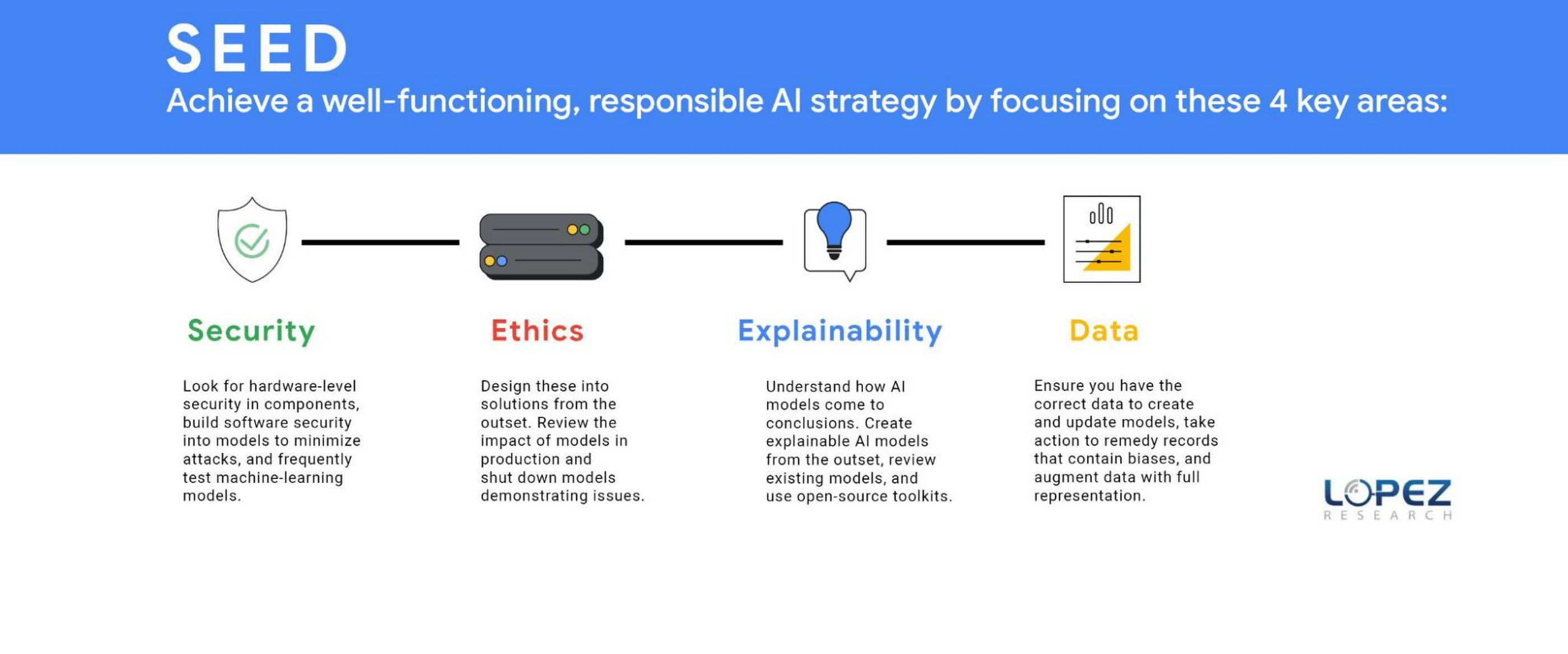
Technology and business leaders need to focus on four areas to accomplish a well-functioning ethical AI strategy. Lopez Research refers to this group of tasks as SEED, which stands for security, ethics, explainability, and data (SEED). Each of these topics could be an article in itself, but this post will define several essential components.
SECURITY (S)
It might not seem obvious, but a robust AI strategy requires an embedded security strategy. Companies should look for hardware-level security in components such as GPUs and CPUs. IT leaders should build software security into models to minimize attacks such as poisoning, evasion, deepfakes, backdoors, and model extraction. The threat of adversarial data poisoning attacks machine learning models by maliciously introducing inaccurate data designed to corrupt the model’s ability to be accurate. Another security threat is model extraction, also known as model cloning, where a hacker finds a way to either reconstruct a black-box machine learning model or extract the training data. The first line of defense against all security attacks is to design security at the outset, but the next best step is to frequently test models to ensure they are operating as planned. Business leaders, data science experts, and IT leaders must work together to regularly review the outcomes of AI models.
ETHICS (E)
Today, organizations must understand that ethics should be designed into the solution at its outset. The ethics process starts with defining the potential positive and negative outcomes of the model that your business is creating. Once the team has evaluated potential harmful effects, which means unpacking the systems, beliefs, power hierarchies and dynamics that interconnect with the technology, it’s your responsibility to eliminate or minimize the impact of these outcomes. It’s also critically important to review the impact of models in production and shut down models demonstrating issues. An example of this was the public beta release of the Tay chatbot that Microsoft deployed and rapidly shut down because it propagated negative biases.
Yet, many organizations aren’t taking this action. The FICO study revealed that 93% of companies said responsible AI was critical for success but only 33% of these companies were measuring AI model outputs to ensure these models were operating as expected (measuring for model drift). Another survey by Pew Research revealed that 68% believe that ethical principles focused primarily on the public good will not be employed in most AI systems by 2030.
Regulations may turn this tide, regardless of whether organizations plan to adopt an ethical AI framework. Laws governing the ethical use of data in AI are expected to be finalized as soon as 2022, such as the European Commission’s proposed legal framework for AI. Organizations that start with ethical use of AI in mind will be better positioned to deal with customer privacy concerns and regulatory compliance.
EXPLAINABILITY(E)
As models have become more sophisticated, it’s also become increasingly difficult to explain why a model created a specific outcome. In the FICO Responsible AI report, 65% of respondents could not explain how specific AI model decisions or predictions are made, and only 35% said their organization made an effort to use AI in a way that was transparent and accountable. However, it’s never been more important to clarify how AI models came to conclusions such as why a loan was denied, why a particular strategy should be implemented, and how AI selected a set of resumes to review for a position. The goal is to create an explainable AI model from the outset but many of today’s models lack this capability. Every business should review its existing models and use open-source toolkits that can be found on Github.com that support the interpretability and explainability of machine learning models.
Keep in mind that explainability isn’t one-size-fits-all. Different stakeholders need different types of information. Much of explainability to date has focused on “opening the black box” which gets equated to information that is only useful for other data scientists. That’s important, but it doesn’t help the line of business users whose workflows AI is integrated into, or end users who deserve information about how decisions are made; or policymakers who don’t have data science backgrounds, and so on.
DATA (D)
An equally important item in ethics is data. Ethics starts with ensuring you have the correct data to create and update models. Three main issues include representative data, inherent biases within existing data, and inaccurate data. A critical issue that most companies miss in creating models is that current data sets frequently lack full market representation. A recent Capgemini Research Institute report revealed that 65% of executives “were aware of the issue of discriminatory bias” with these systems.
Awareness is the first step, but organizations must take action to remedy this issue. Historical data may no longer serve a company’s current needs for model creation. Historical records may contain biases against certain groups. For example, historical criminal data records show an imbalance in ethnic groups’ incarceration, which would lead to model biases. Additionally, laws and societal norms also change. Certain groups were prosecuted for sexual preference in the past, but today this information would create an inaccurate model.
Companies have also discovered that using demographic data, a common practice in marketing, can also lead to model bias. For example, individuals that primarily used cash for transactions and others that lived in specific zip codes were at a disadvantage in banking models to determine creditworthiness. To minimize these issues, a company needs to augment its data with full representation in areas such as ethnicity, gender, age, behavioral and economic profiles.

Design AI models with a continuous feedback loop
Another, more prominent, yet tricky issue is data accuracy. As the adage says, garbage in, equals garbage out. The least appreciated but arguably the most essential component of the AI model lifecycle is ensuring the model has accurate data at all times. Inaccurate data from either poor data hygiene or data that was tampered with for security purposes can cause model failures. Organizations need to invest the time and resources to ensure they have the correct data. Data privacy is another key element that businesses must address, but the concepts of data privacy, sovereignty, and security are significant enough that we will come back to this in a separate article.
Overall, it’s clear that while we may have an abundance of data, it most likely doesn’t represent what we want to model for the future. A successful AI strategy is an ethical AI strategy that requires the organization to be thoughtful in its model creation by ensuring it has a broad representation of accurate data and testing the outcomes to ensure the models are secure and operating as expected.
Organizations that define an AI model lifecycle with a continuous feedback loop will reap the benefits of better intelligence. This will increasingly mean stronger, longer lasting trust with customers and staying on the right side of new laws and regulations.
Held Back by Database Scalability, This Financial Services Company Switches to Google Cloud and Cloud Spanner

11603
Of your peers have already read this article.
4:30 Minutes
The most insightful time you'll spend today!
Azimut Group operates an international network of companies handling investment and asset management, mutual funds, hedge funds, and insurance. Founded in Milan, Italy in 1988, Azimut Group today has branches in fifteen countries, including Brazil, China, and the USA.
“We have subsidiaries and manage funds all over the world,” explains Simone Bertolotti, IT Manager at Azimut Holding S.p.a. “That means that any technology that we put in place has to cover needs from many different countries.”
“When complicated analysis has to be executed, we have to increase our table space in a couple of minutes so that the AI can drill down into the data and deliver the information we need.”
—Simone Bertolotti, IT Manager, Azimut Holding S.p.a.
Azimut manages its funds with investment advisors who use information sourced from Bloomberg, Reuters and others. “They use a huge amount of data,” says Simone. “They work with spreadsheets, algorithms, formulae and they analyse data in minutes.” In finance, every second is crucial, which is why Azimut decided to develop a risk management dashboard that can process information even more quickly, then distribute it worldwide.
“When an advisor manages data, that data is used to make immediate decisions on funds, capital movements or whether to sell stock,” says Simone. “They have to be ready to make recommendations for any amount of data that comes to them. For our dashboard, that means that when additional information arrives or complicated analysis has to be executed, we have to increase our table space in a couple of minutes so that the AI can drill down into the data and deliver the information we need.”
Generating insights at speed
Investors and investment managers make decisions based on the most accurate, up-to-date information possible. For Azimut Group, information sourced through financial data vendors such as Bloomberg and Reuters provided only part of the data that the group required.
“We looked to collect information from a range of different providers,” explains Simone, “then analyse it to develop a predictive algorithm that could work faster than an advisor stationed at the terminal. We set ourselves the challenge to try to manipulate that data to add new insights into our matrix, so that every one of our branches across the world can see risk information about the funds in real-time.”
“We compared Google Cloud Platform’s performance with our previous cloud provider, and saw huge benefits of switching to Google. For me, the key performance issue is scaling. With Google Cloud Platform I know that I can increase and decrease my infrastructure quickly, when I need it.
—Simone Bertolotti, IT Manager, Azimut Holding S.p.a.
The first cloud provider Azimut used to build its system struggled to scale quickly to meet different kinds of data challenges. “If we wanted to add more cores, that was fine,” says Simone. “But the previous cloud provider made it complicated to raise the amount of space in a database infrastructure and scale up to demand. Scaling up for more in-depth analysis would take a day, and our need was immediate.”
That’s why Azimut switched one year ago to Google Cloud Platform to run the 150 VMs on its risk analysis platform. “We compared Google Cloud Platform’s performance with our previous cloud provider, and saw huge benefits of switching to Google. For me, the key performance issue is scaling,” says Simone. “With Google Cloud Platform I know that I can increase and decrease my infrastructure quickly, when I need it. Instead of waiting a day to scale up infrastructure, we can request and add space to our database in a couple of minutes.”
The infrastructure of Azimut’s solution handles around 800TB of data per month, and Google’s global network of servers and high-speed connections ensure that it gets to where it’s most needed by the most direct route. Impressed by the speed, security and availability of Google Cloud Platform, Azimut has moved its intranet on to Google Cloud Platform, too, eliminating the need for staff to login with VPNs.
“Instead of waiting a day to scale up infrastructure, we can request and add space to our database in a couple of minutes.”
—Simone Bertolotti, IT Manager, Azimut Holding S.p.a.
Driving ahead with Noovle
For Azimut, migrating the risk management dashboard is the latest of many Google product collaborations with cloud consultancy Noovle. “Everything started five years ago,” says Simone, “when Noovle assisted us in migrating to Gmail from our on-premise email solution. From G Suite to Google Cloud Platform, we’ve had a great relationship. Noovle provides consultancy services, support for mobility, and external advisors who work on our premises, such as when they trained us how to broadcast our meetings on Google Hangouts. As an independent company, we know we can trust them for transparent advice. All they care about is the best way to get a job done and to help us reach our goals.”
New app, new customers
In a business case comparison, Google Cloud Platform cost Azimut 35% less to run than the previous cloud provider. Now the group is building a major new mobile application on Google App Engine to be released in 2018.
“The new mobile application will allow customers to trade directly, without human advisors, by proposing different investment solutions depending on targets the customers set,” says Simone. “So if a customer aims to make money with investments, they enter their relevant personal information and we carry out the necessary regulatory checks and suggest what they could buy. The entire project will be based on Google Cloud Platform, so customers can control their investments through the app while we manage the fund, using Google Cloud Spanner on the backend.”
Collateral IT: Leveraging Google Cloud for Enhanced Asset Allocation at HSBC

2596
Of your peers have already read this article.
2:30 Minutes
The most insightful time you'll spend today!
Have you ever heard of an optimization problem? Imagine you have a million marbles, all of different sizes, colors, patterns, and weights. You need to fill up 1,000 jars of different sizes with them, but each jar has restrictions as to which colors, patterns, and how many marbles of each type it can hold. After filling all the jars, you may keep any leftover marbles, so you want to ensure that these are the shiniest ones in the bunch. How do you go about solving this puzzle? There are many possibilities, but what would be the most efficient way to guarantee you’ll reach the best possible outcome every time?
At HSBC, our Collateral Treasury desk and Collateral Management team have been solving a similar problem, but instead of marbles and jars, we work with around 50,000 assets that can be used as collateral, and 1,000s of collateral accounts.
Our Collateral Treasury Trading desk helps finance our Markets business by providing the required collateral, such as certain debt or equities, to cover its obligations to a client. The collateral could be used by HSBC for its margin requirements, CCPs (Central Counterparty Clearing Houses), or for securities financing transactions. Each obligation can have different eligibility criteria about what assets can be used as collateral for each client. These rules and restrictions revolve around the type of asset allowed or daily liquidity factors.
The process of matching collateral to obligations is known as an allocation, and it can get complicated the more diverse the collateral pool and the more customers you have. It is important to allocate collateral in the most efficient way and, traditionally, this business problem has been managed manually or by a third party against a set of simple rules.
But by collaborating with Google Cloud, we can improve collateral allocation through automation. Even small efficiency gains have the potential to make a significant difference when the amount of collateral inventory managed is tens of billions of dollars. It means the Collateral Treasury desk is much more efficient when managing its own funding costs or regulatory ratios such as the Liquidity Coverage Ratio (a key financial resource measure for banks that ensures sufficient high quality assets are readily available to survive periods of liquidity stress).
Leveraging AI to tackle a complex business problem
Our solution is OPTIC, a HSBC platform utilizing Google Operation Research Tools, or OR-Tools, an open-source optimization library provided by Google AI. Its main goal is to allow the Collateral Treasury desk to automate the collateral allocation process in the most optimal way on any given day. OPTIC’s architecture is based on microservices and provides the ability to handle large volumes of data, for which a scalable and self-managed infrastructure is needed. OPTIC runs on Google Kubernetes Engine, which provides it with workload rebalancing, auto-scaling capabilities, and high availability.
Additionally, we collaborated with Google Operations Research, which gave us access to the experience of Google AI engineers who were able to advise us on the best way to implement their optimization libraries to solve our business problem.
We’ve found that using linear programming solvers such as Google OR-Tools is the best way to achieve the optimization capability that fundamentally changes how we manage our inventory. It enables us to optimize for multiple outcomes and be certain that we are doing this in the most efficient way possible.
Finding the optimal way forward with automation
OPTIC works by consuming data feeds from a multitude of systems, then it standardizes the data, and combines with decision-making parameters and weightings Google OR-Tools can use, to understand and arrive at an optimal outcome. OPTIC can also provide insights and metrics that help optimize business decisions such as which assets can be added or removed in the future to make collateral allocation even more efficient.
Looking forward, this project makes us optimistic about using Google Kubernetes Engine to manage more of our microservices in other platforms. This will mean that we can scale without worrying about hardware or making big changes to our environment. With this solution, we’ll be able to mobilize and optimize our collateral according to our own view of the value and quality of the collateral, as well as the best fit for our exposures at any given time.
Over time, the project can bring visible long-term benefits to HSBC’s Markets business, including decreased operational risks and potential to save significant funding costs. Next, we will continue to add new capabilities and data sources to our solution to continue solving some of the most complex business challenges in our industry.
More Relevant Stories for Your Company




Google had Enough of Flooding in India. Here’s What It Did About It
Over the last century, floods have become the most common and deadly natural disaster on the planet. Many countries currently lack effective early warning systems and alerts. Today, 20 percent of flood fatalities occur in India. To help, Google sent a team to study the Ghaghara River, near Patna. “In

VCP Peering and Private Endpoints on Vertex AI to Better Security and Predictions in Near Real-time
One of the biggest challenges when serving machine learning models is delivering predictions in near real-time. Whether you’re a retailer generating recommendations for users shopping on your site, or a food service company estimating delivery time, being able to serve results with low latency is crucial. That’s why we’re excited

AL/ML and Data Products Delivered through Google Cloud Makes them Leader of Gartner 2022 Magic Quadrant
Gartner® named Google as a Leader in the 2022 Magic Quadrant™ for Cloud AI Developer Services report. This evaluation covered Google’s language, vision and structured data products including AutoML, all of which we deliver through Google Cloud. We believe this recognition is a reflection of the confidence and satisfaction that



The Secret to Accelerated ML Model Training
As an infrastructure or a data science professional, it’s more critical than ever to keep abreast of the changes taking place to the infrastructure powering machine learning. If we take a step back, we will realize that there’s been a tremendous amount of progress in machine learning in the last
