





How Google Cloud’s Scalable Data Storage and High Compute Resources Fuel Investment Research

6295
Of your peers have already read this article.
1:30 Minutes
The most insightful time you'll spend today!
Investment management is a heavily data-driven industry—portfolio managers and investment researchers require a large number of data sources to guide them in shaping their investment strategies.
New cloud capabilities and technologies enable investment managers to process data faster than ever before and iterate on ideas quickly to fuel innovation in the signal generation process and gain a competitive edge.
Using the cloud for investment research workflows makes it easier to onboard data from data providers, spin up large compute workloads in the midst of market volatility or during heavy research cycles, and manage complex machine learning or natural language workflows to gain market insights.
We hear from industry leaders that they’re exploring new ways to run investment research. “Differentiated investment strategies require new types of information sources, and new ways to process that information,” David Easthope, senior analyst, Market Structure and Technology, Greenwich Associates. “And that, of course, relies heavily on having access to reliable and scalable storage, computational, and AI / ML resources. More specifically, quantitative strategies can benefit from the computational platforms and embedded AI/ML capabilities the cloud can offer.”
Google Cloud gives investment managers essential components to work and operate faster as they bring their investment research workflows to the cloud. Here are the key highlights:
1. Simplify, speed up your data acquisition, discovery, and analytics
The foundation of any investment strategy starts with data—acquiring it, detecting patterns, and analyzing it for insights. Enabling data providers to easily share large datasets such as tick history within a high-performance analytics engine can greatly reduce the data engineering overhead when possible.
Once data is onboarded, you can tag business and technical metadata related to your datasets and provide portfolio managers the ability to discover these datasets via a search interface.
We further review analytics options for various scenarios, including aggregating massive datasets, creating dashboards, and incorporating streaming analytics workloads.
2. Take advantage of burst compute workloads
Data engineers and researchers require ready access to burst compute capabilities to perform backtesting, portfolio simulations and run risk calculations. Cloud works well for these workloads due to its elasticity, consumption-based models, and hardware evolution.
Many investment managers are shifting to a container-based strategy along with a Kubernetes-based scheduler for greater consistency, scaling and efficiency in environments with a large number of researchers. Cloud managed services and a rich suite of CI/CD tools can make this vision a reality while improving security and developer productivity.
3. Tackle machine learning (ML) and model deployment with the help from cloud
Quantitative researchers scour vast amounts of market and alternative data sources searching for signals and correlations, while ML engineers have the challenge of taking these signals and moving them to production.
Google Cloud empowers users to create and operationalize their models without wasting valuable time with a comprehensive set of MLOps tools.
In this paper, we explore multiple solutions for ML and model deployment. Those capabilities reduce the amount of time operationalizing ML models, so quants and data scientists have more time to devote to differentiating activities.
4. Get the data you need in less time with Natural Language and Document AI
Thousands of financial filings, news articles, and sell-side research reports are generated every day, and it’s difficult for humans alone to process this volume of information. These documents are often generated in many languages and the ability to do entity recognition, sentiment or syntactical analysis in those languages, or perhaps translate them into the language of the portfolio manager is of critical importance. Google Cloud provides these capabilities through pre-trained models, or allows you to train high-quality models with your own datasets.
Getting started
There are plenty of emerging technologies, tools, and approaches available to help investment managers today. At Google Cloud, we can help you access, organize, and utilize these essential components to make your research faster, reliable, and more valuable.
To learn more about these four keys to better investment research, check out our whitepaper for more.
How Can Brands Evolve in Post-pandemic Era amid Changing Consumer Behavior Patterns

3653
Of your peers have already read this article.
1:30 Minutes
The most insightful time you'll spend today!
2020 saw an unprecedented change in consumer behaviour around the world, with shoppers finding new ways of discovering, evaluating and buying products. This has created fresh expectations for both brands and retailers to drive consumer closeness, embrace the digital moment and transform their operations to be more agile and sustainable. These themes have been top of mind in my conversations with our CPG customers, and set the tone at Google Cloud Summit for Retail and Consumer Goods, which concluded this week. I couldn’t be more proud of our team and thankful for our customers that supported us by participating in our sessions and attending the event.
I joined Google Cloud in January 2021 after a long career in the CPG industry, and as I shared in my CPG keynote at the summit, I am thrilled to be helping bring the power of Google to drive industry innovation in CPG. At Google we call this ‘new normal’ the transformation cloud era, where we’re working with customers who want to not just save money on storage or compute, but to use cloud and digital technologies to drive agility across their business. I also call it the era of ‘consumer switching’, because Covid-19 has accelerated the likelihood of consumers to switch brands or the way they shop. Some of these changes are still happening; over 40% shoppers in a recent Google survey reported that in March 2021 they changed brands or shopped online for something they were previously buying in store.
At Google, we have an amazing team of strategists who have been researching, observing, and analyzing the many facets of consumer behavior over the last few years. In the opening keynote at the Summit Capturing the Hearts and Minds of Today’s Consumers, Google’s Human Truths Team kicked off the Retail & Consumer Goods summit by sharing some of their consumer insights, including what behavior patterns they think will “stick” as we move into a post-pandemic world. I think these insights are especially relevant for brands, as they speak to some of our latest findings on the CPG shopper’s mindset.
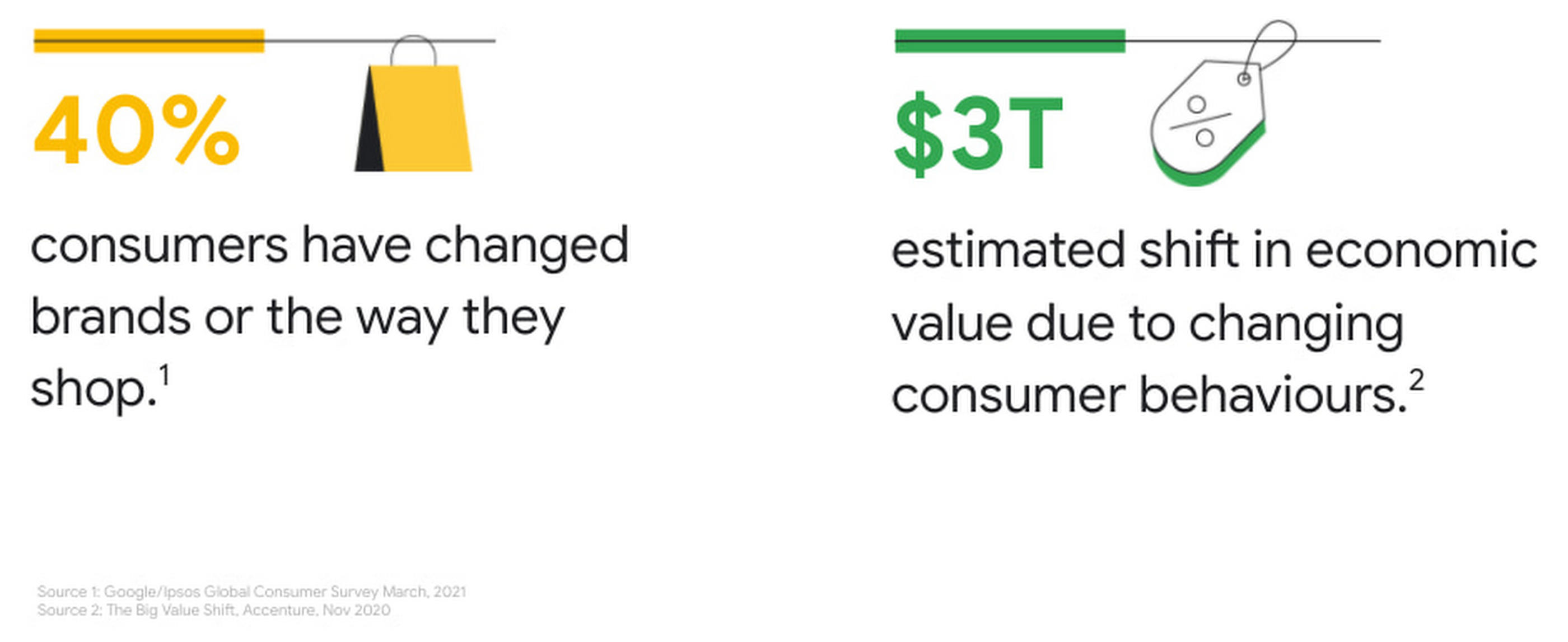
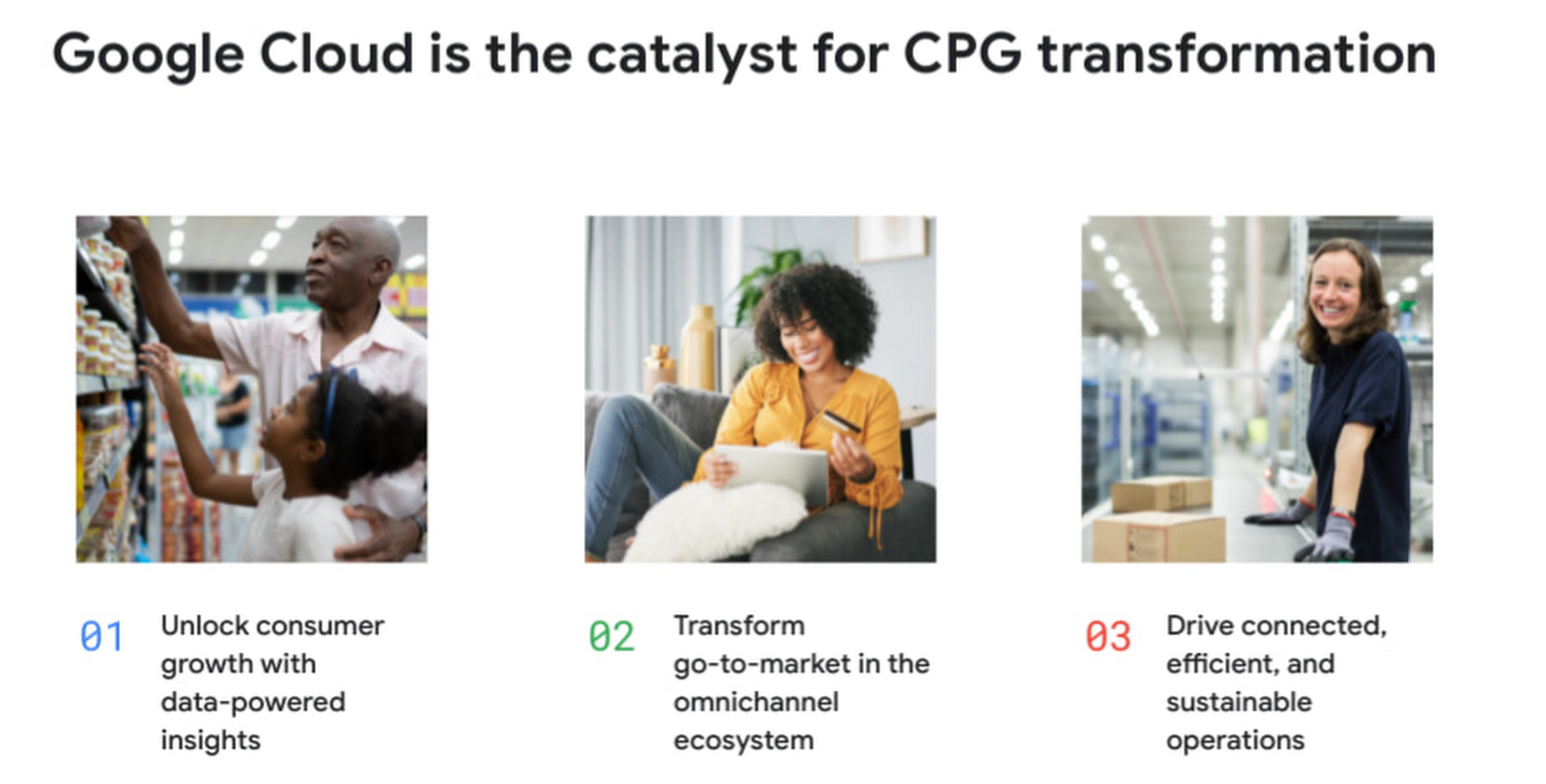
Accenture estimates that there could be a 3 trillion dollar shift in value between companies as a result of consumers shifting brands and behaviours. While it is not known who the winners of the shift will be, one thing is certain – those who will be able to leverage data and analytics fastest will benefit the most from these times of rapid change. I shared some of the implications for the CPG industry in my keynote How to grow brands in times of rapid change along with the three key areas in which Google cloud is helping CPG companies drive brand success:
- Unlocking consumer growth with data powered insights
- Transforming go-to-market in the omnichannel ecosystem
- Driving connected, efficient, and sustainable operations
Let’s take a quick look at each of them:
Unlocking consumer growth with data-powered insights
The digital marketing ecosystem is transforming for a privacy centric world, and brands are seeing a direct impact in marketing effectiveness. As the CPG industry becomes more consumer-centric and shifts more toward direct-to-consumer (D2C) business models, acquiring and activating consented first-party consumer data presents a clear opportunity to capitalize on new consumer demands.
As a result, CPGs are turning to consumer data platforms (CDPs) to help them unify, manage, enrich, and secure all of their disparate data from different marketing tools, website analytics, email campaigns, loyalty programs, and more. Google Cloud and our ecosystem of partners can help CPGs build a privacy-centric CDP which brings together all their customer and marketing data into a modern data warehouse, with built-in predictive data visualization tools and models. With a CDP built on Google Cloud, you can integrate data from Google Marketing Platform to drive predictive marketing and media effectiveness. And with pre-built connectors you can also easily integrate non-Google media and data from other enterprise platforms like SAP and Oracle to leverage consumer data for more integrated decision making. Democratize access to data across the organization with our Business Intelligence tool Looker to enable faster decisions in real-time from marketing to supply chain to product innovation.
At the Retail & CPG Summit we shared how retailers and brands can drive consumer closeness in a privacy-centric world featuring Procter & Gamble’s experience building and activating consumer data in a privacy-safe way to serve consumers better and maximize marketing effectiveness and drive growth across their business. And in a demo, Constellation Brands shared how they’re leveraging real-time data from several commercial sources using Looker to unpack insights and develop action plans.
Transforming go-to-market in the omnichannel ecosystem
Amidst COVID-19 restrictions and rolling lockdowns, ecommerce activity has surged past a point of no return. Direct to consumer (D2C) or digitally native brands were able to minimize consumers switching during the pandemic by offering a great online experience. While in-person shopping remains important, consumers are expecting more digital and omnichannel experiences and many will continue to explore new brands and purchase online. CPGs that want to maintain their market leadership can no longer afford to ignore the key role omnichannel capabilities will play in capturing the attention of both retailers and consumers. Even if D2C sales are not a big portion of your business, you will benefit from first-party data that can help you drive insights and product innovation.
CPG brands want to transform their older, clunky ordering processes into modern digital shopping experiences. Re-platforming legacy solutions on Google Cloud not only accelerates application innovation, but also makes it easier to quickly launch new features and products. At Google Cloud we have transformed ecommerce for large D2C brands and traditional retailers, so we know what a best in class D2C experience looks like. And we can bring it to your brands. We already help some of the biggest brands in retail modernize ecommerce and enhance product discovery with solutions like Visual Search and Recommendations AI. All of these can help you build a best in class omni channel presence for your brands.
We had several sessions on improving your omni channel experience, including
Why search abandonment is the metric that matters featuring Macy’s and Conversational Commerce with Google with Albertsons, where we shared how Google’s conversational experiences can help consumers message businesses from wherever they are, and whenever they need them.
Driving connected, efficient, and sustainable operations
The superpowers of AI/ML are not just for marketing. Did you know that research from MIT and Google Cloud has found companies that use AI/ML can drive 2x more data-driven decisions, 5x faster decision making, and 3x faster execution? By connecting your operations in real time with demand signals like search, trends, weather, mobility and supercharging this data with AI and ML, you can make smarter and quicker business decisions. For example, you can use search trends to drive demand forecasting and ramp up manufacturing for popular products.
Google Cloud can help you modernize legacy business applications by migrating them to the cloud and using AI/ML and smart analytics to drive business outcomes. Take SAP for example – a Forrester study found that modernizing SAP with Google not only resulted in 56% more efficient IT teams – it also generated 160% 3-year ROI.
SAP data on Google Cloud breaks down silos across SAP, marketing, manufacturing systems, and external data sources for next-level intelligent operations. For example, with SAP and Google Cloud, you can combine product, media, CRM, digital commerce and site data from SAP and non-SAP sources to uncover stronger consumer insights and fuel product discovery along the path to purchase. You can merge SAP product and sales data with consumer, market data and Google geo trends to drive targeted promotion outcomes, maximizing the ROI of promotional dollars across retail channels. You can also integrate supply chain and manufacturing data from SAP systems with consumer, marketing and Google geo market data to improve demand forecasting and optimize supply chain logistics. The possibilities are endless. This is why we describe SAP modernization as The Gift That Keeps On Giving. Check out the session on SAP from the Summit and hear from Rodan + Fields on their experience of modernizing SAP on Google Cloud.
Another solution that excites me is Vertex AI, which transforms the demand forecasting process. Traditional demand forecasting accuracy is a challenge for most CPGs. Current forecasting methods do not take into account granular factors that impact demand, like local weather, demographics, or unforeseen events. With our recently launched Vertex Forecast, Google is making it much easier to start using cutting-edge machine learning models for demand forecasting. In our session Demand Forecasting: Time for Intelligence, Not Intuition featuring American Eagle Outfitters, we share how you can adopt a data science approach to demand forecasting that’s customized to your unique needs.
CPG organizations come to Google for help solving their toughest problems, whether it be driving new consumer growth, unlocking new routes to market, or building connected, sustainable operations. And we bring the best of Google: innovation, culture, infrastructure, AI/ML, and a deep understanding of consumer behaviour to help them build best-in-class brands.
I’d like to end with a topic that’s very close to my heart. This is around Solving for Sustainability in Retail and Consumer Goods. Our research shows that 62% of shoppers cared about at least one sustainability aspect when purchasing online in 2020. In addition, the events of the past year have triggered consumers to re-evaluate their relationships with brands and prioritize those that are more sustainable in the context of the pandemic. Watch this session to learn more about how retailers and consumer goods companies can leverage technology, data, and machine learning to help make sustainability a core part of the recovery.
All our session content is available on demand. Ready to learn more about how we’re helping CPG brands and manufacturers drive results? Learn more about Google Cloud’s consumer packaged good solutions and reach out to your Google Cloud sales executive to set up a deeper conversation on how we can help you grow your brands today and in the future.
The Power of Two: Best Practices for Mergers & Acquisitions on Google Cloud

3382
Of your peers have already read this article.
3:00 Minutes
The most insightful time you'll spend today!
Congratulations! Your company just acquired or merged with another organization, beginning an important new chapter in its history. But like with many business deals, the devil is in the details — particularly when it comes to integrating the two companies’ cloud domains and organizations. In this blog post, we look at how to approach mergers and acquisitions (M&A) from the perspective of Google Cloud. These are the best practices that your Google Cloud Technical Account Managers follow — or that we recommend you follow if you plan to perform the integration yourself.
Although there are various M&A scenarios, here are the two most common ones we will focus on:
- Both entities engaged in the M&A have some presence on Google Cloud and are looking for some level of integration
- Only one of the entities has a presence on Google Cloud, and is looking at best ways to work together
Depending on your situation, your approach to integrating the two companies will vary substantially.
When both companies have a Google Cloud presence
In the first scenario, let’s assume company A is acquiring company B. Prior to the M&A, both companies have their own Google Cloud Organizations — the top level structures in the Google Cloud resource hierarchy — and have one or more billing accounts associated with them. There are also various Folders and Projects below each Google Cloud Organization. In this scenario, here are the key questions to ask:
- How do you plan to integrate/consolidate two distinct Google Cloud Organizations?
- How do you plan to organize the billing structure?
- How do you handle Projects under the two Organizations?
- What is the identity management strategy for the two Organizations?
For each of these key questions, go ahead and formulate a detailed plan of action. If you have access to the Technical Account Manager service through Google Cloud Premium Support, you can reach out to them to further develop this plan.
Understanding Google Cloud Organizations
From an organizational integration standpoint, when each entity in an M&A has its own Google Cloud Organization, you have various options: no integration, partial, or full.
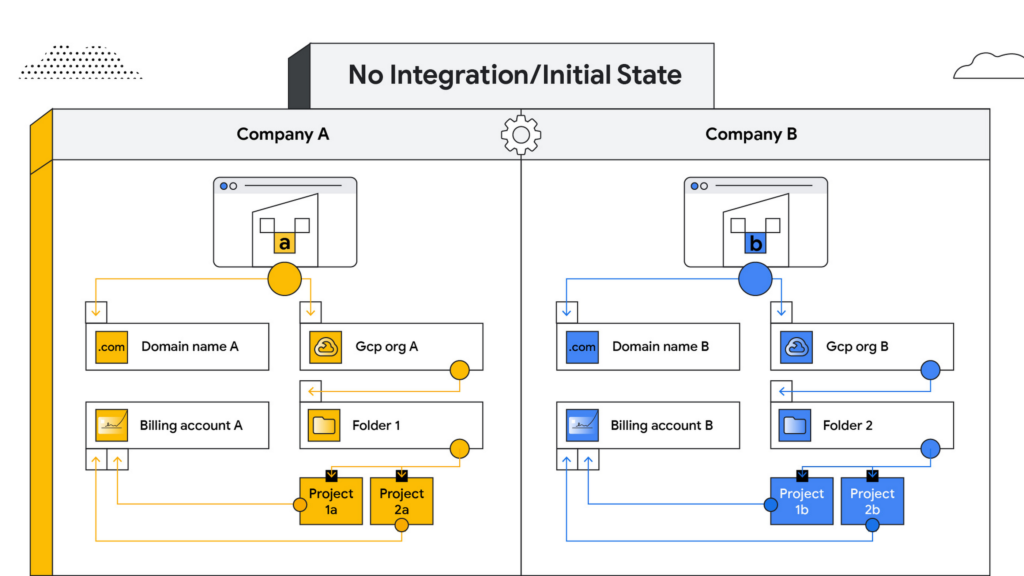
No integration – When company B operates as an independent entity from company A, no migration is required. One caveat is if company A has negotiated better pricing terms/discounts and support packages with Google Cloud. In that case, you can sign an affiliate addendum by working with your Google Cloud account team to help unlock the same benefits for company B.
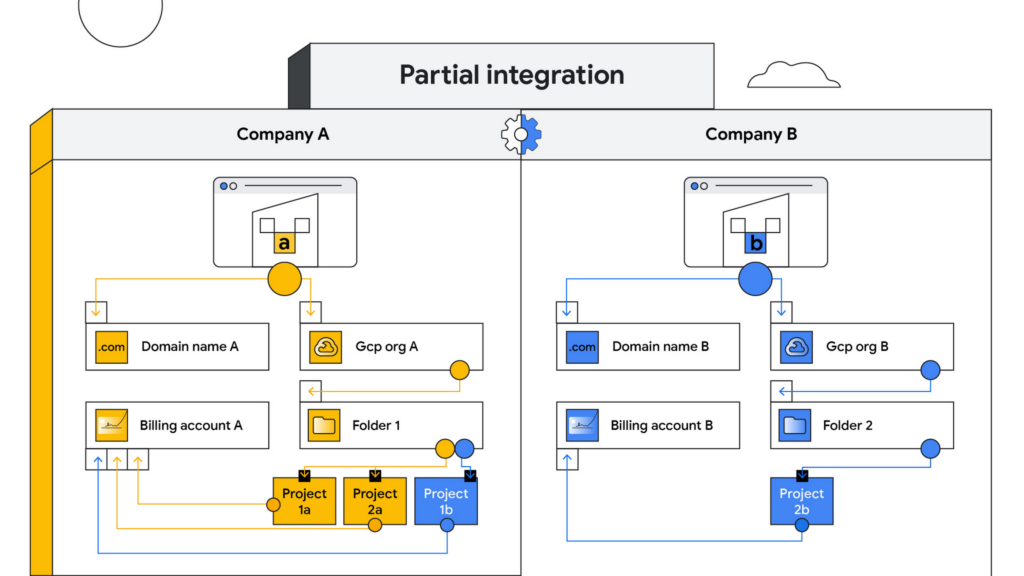
Partial integration – Some projects move over to company A from company B and others stay with Company B. There can be some shared access between the two companies and each of the organizations can continue to use their existing identity providers. This can be a self-serve or a paid services engagement with Google Cloud depending on the complexity of the two companies and how many project migrations need to take place between them.
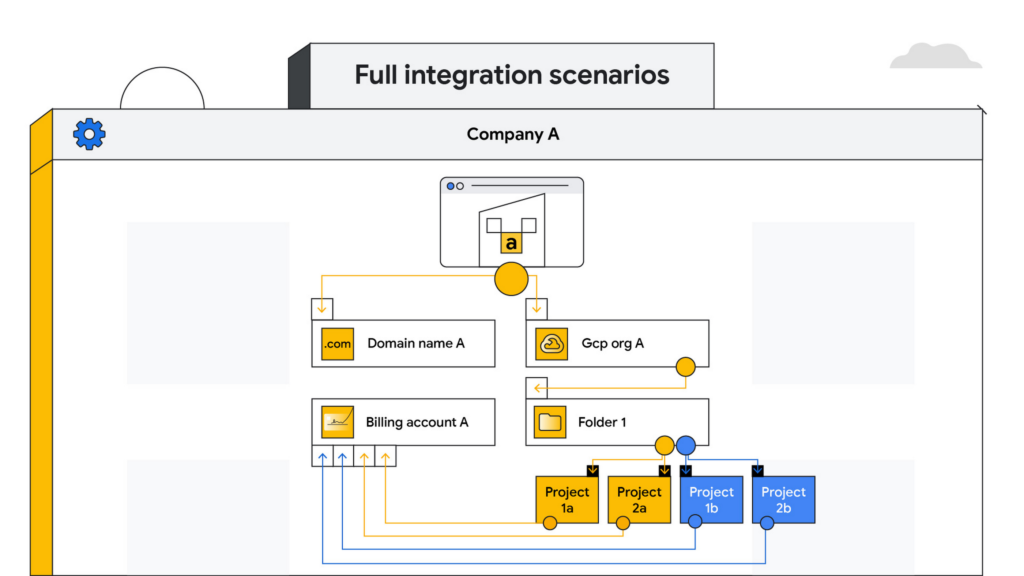
Full integration – Company B is fully incorporated into company A. This means you go through a full billing, Google Workspace identity and project migration from company B into company A. This can be a complex process and we highly recommend engaging your Google Cloud account teams to scope out a paid services engagement to go through this transition.
Planning your project migration
No matter what you want your end state to look like, project migration requires careful planning. Again, if you have an assigned Technical Account Manager, please reach out to them to ensure that you have a conversation around best practices before starting this migration.
If you’re taking a self-service approach, at a high level, we recommend leveraging the Resource Manager API to manage your project migrations. Do keep in mind that there are several prerequisites and required permissions documented here that need to be assigned before going down this path.
In addition, please be sure to read the billing and identity management considerations below to ensure that you are covering all of the bases associated with such a migration, as your choices can fundamentally alter your Google Cloud footprint.
Billing considerations
When deciding how to structure your Organizations and billing accounts, our recommendation is to always limit the number of Organization nodes and use the Folder structure to manage departments/teams within it. Creating additional Organization nodes is only advised in cases where you require a level of isolation for certain Projects from central administration for a specific business reason, for example, if the company being acquired already has their own Organization node and there is a business justification to let it operate as a standalone entity.
Warning: If you have multiple Organization nodes, be aware that you will not have central visibility across all your organizational resources, and that policy management across different Organization nodes can be cumbersome. You will also have to manage multiple Workspace accounts and manage identities across them, which can be difficult, especially when operating at scale.
From a billing account management perspective, our recommendation is to create one central billing account that lives within the Organization node with tags and labels incorporated for additional granularity. However, there are a few business cases which warrant the creation of additional billing accounts such as:
- You need to split charges for legal or accounting purposes
- Invoices are paid in multiple currencies
- You need to segregate usage to draw down on a Google Cloud promotional credit
- Subsidiaries need their own invoice
Keep in mind that committed-use and spend-based discounts and promotional credits cannot be shared across billing accounts and are provisioned on a per-billing-account basis. As such, more billing accounts can make it harder to leverage these discounts and credits.
Identity management
As you might expect, merging two entities has identity management implications. Cloud Identity is the solution leveraged by Google Cloud to help you manage your user and group identities. Even if the acquired company only uses the productivity products that are part of Google Workspace, the identities would still be managed by Cloud Identity.
Google Workspace considerations
To move large amounts of content into a Google Workspace domain, we recommend one of three options, depending on your end goal and data complexity:
- For general migrations: Leverage Google Workspace Migrate to move data into your Workspace domain from either another Workspace domain or a third-party productivity solution
- For manual migrations: Use the Export tool to move your organization’s data to a Cloud Storage archive so you can selectively download exported data by user and service
- For complex Google Workspace scenarios: Speak with your Google Cloud Technical Account Manager about the possibility of using a custom scoped engagement to merge two Google Workspace environments without business interruption
When only one company is on Google Cloud
Now, let’s consider the scenario where only company A has a presence on Google Cloud but company B does not. The approach you take to integrate the two organizations largely depends on your desired end state — full, partial or no integration.
If the plan is to eventually integrate company B into company A, your approach here will have a lot of similarities with the ‘full integration’ option mentioned above — just at a later point in time.
You may also run into a scenario where company B has a presence on an alternative cloud platform and you need to migrate resources into or out of Google Cloud. Again, similar to the partial integration option called out above, a paid engagement or a self-service exercise would be a good fit depending on the complexity of the desired end state.
Here to help
A merger or acquisition is an exciting milestone for any company, but one that needs to be managed carefully. Once you carefully review these considerations, develop a plan of action for your organization. You can also engage Google’s Professional Services for a paid engagement or Google’s Technical Account Management Service for a self-managed process to achieve the desired results.
If you are going through or considering going through M&A at your organization and have a different scenario than what we have discussed, please feel free to reach out to your account teams for guidance or contact us at https://cloud.google.com/contact.
LearningMate & Google Cloud Partnership to Aid Equitable Educational Opportunities

3443
Of your peers have already read this article.
1:30 Minutes
The most insightful time you'll spend today!
A “one size fits all” approach to education no longer works in today’s classrooms. Using cloud-based technologies, schools and educators can take a more personalized approach to education–one that suits each student’s unique learning style, abilities, and needs.
Taking the lead toward more equitable educational opportunities worldwide, education technology pioneer, LearningMate, is partnering with Google Cloud to offer intelligent, personalized learning via Google Cloud’s Student Success Services.
In a student survey by EDUCAUSE, a nonprofit association whose mission is to advance higher education through the use of information technology, nearly all respondents asked for more digital learning and study options. Given a list of educational material types, such as study guides and recorded lessons, 93 percent said they would like to have online access to at least two options and more than half (56 percent) chose seven or more.
The trend towards student choice challenges educators to reconsider how they teach and support learners. Students expect the same qualities in their lessons as they encounter in their other, non-school related digital experiences: personalization; user-friendliness; and engagement. Educators who are used to a more top-down education model can struggle to meet these new expectations.
Google Cloud created Student Success Services to help education institutions meet learners where they are—in the digital age. This suite of tools and services uses Google’s advanced artificial intelligence (AI) and analytic tools to:
- Engage with students via an AI-powered learning platform and interactive tutor
- Help educators and learners collaborate more effectively
- Provide current, actionable data on student progress
To bring our Student Success Services to more schools and organizations worldwide, we’re partnering with LearningMate — a global leader in digital learning infrastructure. LearningMate is a key go-to-market partner, helping schools design, launch, and maintain their own learning infrastructure. To start, LearningMate is adding Google’s AI-powered learning platform to its Frost platform, a popular content management for education.
As the education model continues to change and digital learning becomes the norm, disadvantaged students risk getting left behind. For these learners, the “digital divide” is very real, and stands to hinder them further–not only in school, but in society and the workplace in later life.
“The gap will only widen between those with digital advantages and those who struggle to gain access to devices and network necessities,” EDUCAUSE states. To meet all these challenges, schools need a diverse mix of tools, methods, and partnerships.
To help close the digital divide among students, digital tools need to be able to scale up or down so institutions and districts of any size and budget can use them. Google Cloud designed Student Success Services with this ability in mind. By offering these services, LearningMate aims to ensure that even schools with smaller teams and fewer resources can offer individualized learning experiences to their students.
With LearningMate and Google’s nearly 40 years of combined experience in education, this partnership aims to help educators better understand their students’ engagement, performance, and preferences. To learn more about Student Success Services and our collaboration with LearningMate, watch this session from our Government and Education Summit.

6558
Of your peers have already downloaded this article
5:30 Minutes
The most insightful time you'll spend today!
What’s behind the rising confidence in cloud security? First hand experience, and careful, systematic assessments that tap multiple sources such as detailed audits and comparisons. The most frequent driver of increased confidence was the direct experience of the quality of security in the cloud versus on-premises.
As a result, the use of Cloud is expected to rise to 65 percent of workloads by 2019, according to a recent survey of more than 500 global CIOs conducted on behalf of Google Cloud in association with MIT SMR Custom Studio. Increased confidence in cloud security along with the increased need for agility and speed are driving this growth in cloud adoption.
Download this exclusive report and understand why CIOs have a growing confidence in cloud security, how they are basing their hosting decisions on the flexibility and integration offered by the cloud, and their plans to use the cloud for future workloads.
Transformation Cloud: A New Wheel of Innovation and Digital Transformation

3364
Of your peers have already read this article.
1:30 Minutes
The most insightful time you'll spend today!
Looking back on the past year, I see challenges—but also reinvention. Reinvention in how children are educated. Reinvention in how medical professionals provide care. Reinvention in how customers purchase products. This reinvention was made possible by all of the IT leaders around the world who had a vision about what could be possible with technology.
Technology has allowed people to work and complete critical activities safely outside of their standard locations. But, it has also enabled transformation in ways we have not seen before: in how people collaborate, in how businesses operate, and most important to me, in how organizations innovate.
Rethinking what it means to transform
The leading indicator for organizations that are accelerating their innovation during this time is how they are thinking about transformation. Instead of asking infrastructure questions about where their apps and services should run, they are asking transformation questions about how to build an environment that enables every person, process, and technology to adapt in order to bring the highest level of innovation to the business.
Innovative companies have moved beyond migrating their data centers to the cloud, changing not only where their business is done but, more importantly, how it is done. For example, Papa John’s recently announced they are building a digital platform that looks at real-time data across the business to improve its loyalty programs, website, and customer and partner experiences. Albertsons Companies is transforming itself by reinventing grocery shopping, both the digital and physical aisle, through shoppable maps, AI-powered conversational commerce, and predictive grocery list building. Airbus is reimagining their work environment to embrace the hybrid work reality. And Siemens is partnering with Google Cloud to reinvent industrial manufacturing with AI to empower employees, automate mundane tasks, and improve product quality.
Here, transformation is made possible with technologies that enable new innovations for their customers versus decisions about where infrastructure should be run. And this aligns with a recent study by Forrester that states the top two IT initiatives for the next 12 months are to increase innovation and to invest in technology that helps employees do their jobs better.1
Some of the best conversations I’ve had with customers are focused on how to:
- Accelerate transformation while also maintaining the freedom to adapt to market needs.
- Make every employee—data scientists to sales associates—smarter with real-time data to make the best decisions.
- Bring people together and enable them to communicate, collaborate, and share with each other when they can not meet in person.
- Protect everything that matters to us—our people, our customers, our data, our customers’ data, and each transaction we undertake.
This new customer thinking is driving new technology requirements—requirements that can be solved through a transformation cloud. A transformation cloud accelerates an organization’s digital transformation through app and infrastructure modernization, data democratization, people connections, and trusted transactions. The result is an organization – and its workers – that can take advantage of all of the benefits of cloud computing to drive innovation.
The new requirements for innovation
Organizations want to work with multiple cloud providers to choose the best technology for each of their apps and services while also mitigating against inevitable cloud outages and vendor lock in. They value the flexibility of open source based solutions and look to our multicloud platforms like Google Kubernetes Engine and Anthos to instill freedom in how they innovate and drive differentiated customer experiences. It is no surprise that, in a recent Google-commissioned IDG research study, 78% of Global IT leaders stated that multi/hybrid cloud support is a major consideration when selecting a cloud provider and 74% preferred open source cloud solutions.2 Customers like MLB, DenizBank, and Macquarie Bank understand the necessity of a multicloud strategy and are taking advantage of Google Cloud’s open, hybrid architecture to give them the maximum flexibility to run their business how and where they want.
These organizations also want to use data to better understand their customers, enhance their products, and improve inventory accuracy in order to make real-time decisions—and bring it together into a cohesive data cloud. They value how analytics solutions democratize access to data for all employees and how embedded AI helps them predict and automate the future. The Forrester study mentioned above also shows that companies focused on improving their use of data for better decision-making, are taking actions to improve data self-service capabilities and make access to data and insights more democratic.3 Customers like Twitter, PayPal, The Home Depot, HSBC, and Stanford Medicine, unify their data across their organizations to power deeper AI-driven business insights, make better real-time decisions, and build and run their data-driven applications.
And while technology is driving many of the transformations we see, so are an organization’s people. Workers are finding new ways to strengthen human connections, deepen their impact, and serve customers while transforming how work happens—as shown in the fact that 59% of organizations in the IDG study accelerated or newly introduced remote working and collaboration capabilities in 2020.4 Customers like Kia Motors, Cambridge Health Alliance, and PwC are using Google Workspace to enable teams of all sizes to connect, create, collaborate, and to drive innovation from any device, and any location.
Finally, the innovation that we see in every digital transaction is matched with new ways to protect and secure the business. Organizations want to protect their employees, customers, and partners against emerging threats, analyze massive amounts of data to secure infrastructure, and build a long term strategy for strategic governance of their assets regardless of their location. Getting this right is essential as organizations see security as a top pain point impeding innovation.5 Customers like Equifax and Evernote are using Google Cloud’s secure platform and security products to extend customer confidence anywhere their systems may operate.
Google Cloud technologies are already powering customers’ transformation clouds
Supporting our customers’ reinventions are our top priority and we believe that together, we can pave the way for what is next. With our investments in multicloud and AI/ML, to sustainable infrastructure, industry solutions, and technology that improves our communities, such as COVID-19 vaccine distribution, we are proud that our customers trust Google Cloud solutions to digitally transform their business.
We have lots more to tell you about in the coming months, starting with our Data Cloud Summit on May 26th. Between this event, and the multiple other events we have this summer, you will learn about how our industry leadership and collaboration with our partners are enabling our customers to build powerful transformation clouds to support their continued reinvention.
1. Forrester Analytics Business Technographics® Priorities And Journey Survey, 2021
2. IDG Communications, Inc: “No Turning Back: How the Pandemic Has Reshaped Digital Business Agendas”, 2021
3. Of the companies that prioritize data in decision making, 37% are improving data self-service capabilities and 30% are making access to data and insights more democratic (Forrester Analytics Business Technographics® Priorities And Journey Survey, 2021)
4. IDG Communications, Inc, “No Turning Back: How the Pandemic Has Reshaped Digital Business Agendas”, 2021
5. 33% of organizations stated Security risks & concerns as a top pain point impeding innovation (IDG Communications, Inc, “No Turning Back: How the Pandemic Has Reshaped Digital Business Agendas”, 2021)
More Relevant Stories for Your Company
Forrester and IDC’s Research Confirms Quantifiable Benefits of Running SAP on Google Cloud
Cloud migration is top of mind for most companies with SAP applications. While the advantages of the cloud for SAP customers is generally understood, the move itself can be complicated and disruptive. So what actually are the business benefits and cost savings? How long will it take to recoup such

Dual Run: A Proven Solution for Secure Mainframe Modernization
CIOs are again evaluating their mainframe investments, balancing rising operational costs and difficulty finding talent with the perceived costs and risks of moving critical applications to the cloud. Increased business agility, technical innovation, computing elasticity, customer insights, and a growing talent pool all encourage CIOs to migrate and modernize from
Three German Retail Firms Choose Google Cloud to Migrate SAP Workloads for Business Transformation
The retail industry is rapidly evolving, with customers demanding exceptional digital experiences, and retailers adjusting their businesses to be more efficient. With many retailers relying on SAP for critical business functions like digital transactions, finance, supply chains and more, this shift has led them to look for ways to modernize

A Pro’s Tip on Choosing the Right Google Cloud Compute Options
Where should you run your workload? It depends...Choosing the right infrastructure options to run your application is critical, both for the success of your application and for the team that is managing and developing it. This post breaks down some of the most important factors that you need to consider
