





How Companies can Improve Scalability, Flexibility, and Reliability While Reducing Costs: Tips from Route4Me

3979
Of your peers have already read this article.
3:30 Minutes
The most insightful time you'll spend today!
Google Cloud Results
- Improves application performance by 8x to 12x; customers can create increasingly complex optimized driving routes in single-digit seconds
- Improves customer satisfaction via increased reliability and greater application performance
- Focuses on adding value to customers by improving software and algorithms, not infrastructure management
- Saves 5x in infrastructure costs
In 2009, Dan Khasis needed to rent an apartment. His search had him driving around the greater New York City area in unfamiliar areas, scattershot-style, often ending up where he started. The frustrating experience led the serial entrepreneur to launch Route4Me, a smartphone navigation app to help consumers create driving routes optimized for multiple stops.
Soon, business users recognized Route4Me’s value and requested enhancements specifically for them. While route optimization apps for big businesses already existed, they were almost exclusively offline desktop programs that were expensive to purchase, deploy, and get trained on. Recognizing the opportunity, Route4Me developed an affordable route optimization solution across various devices, such as smartphones, smartwatches, and telematics devices. The software was tailored to logistics-intensive businesses such as last-mile delivery services and business units conducting field sales, field service, and field marketing functions.
As Route4Me grew its user base, it became clear that its infrastructure of rented, dedicated servers from various providers wasn’t sustainable. “The hardware costs seemed low, but there were many risks and hidden costs,” says Dan Khasis, Co-founder and CEO at Route4Me. For example, “Multi-zone disaster recovery, high availability, automated failover, and on-demand surging of many nodes was simply impossible,“ he adds.
Because under the hood Route4Me’s routing optimization platform requires complex computations, the company needed a globally scalable infrastructure capable of delivering low latency and high throughput. Route4Me also needed to stay competitive by developing and delivering new services as quickly and efficiently as possible.
For these and other reasons, Route4Me moved 100% into the cloud. “Like many entrepreneurial software companies, we test all the latest technologies we can find before upgrading. Typically we go with the fastest technology, with a strong bias towards open source and open standards,” Khasis says. Based on extensive testing, Route4Me selected Google Cloud Platform (GCP). Along with the scalability, flexibility, reliability, and low-cost structure of GCP, Route4Me had already migrated its entire platform to containerized microservices, which Khasis says “are extremely stable and reliable” on Google Kubernetes Engine. While Route4Me has proprietary routing and route optimization engines, it uses Google Maps for high-precision geocoding and as the frontend.
With GCP, Route4Me has reduced its IT infrastructure costs while delivering faster route optimizations and more reliable service to customers. Because of GCP, the company is also planning to add services that will deliver the fastest possible routing simulations and calculations to customers at a price that Khasis says is “impossible without a mature cloud-based platform like GCP.”
Unexpected savings, pleasant surprises
The migration to GCP and Kubernetes Engine required Route4Me to revamp its Service-Oriented Architecture (SOA) and convert millions of lines of code into containerized microservices running on Kubernetes Engine. With more than 150 microservices and thousands of add-on modules and features offered on the Route4Me platform, the migration took several months. But the transition, which began in May 2017 and concluded toward year’s end, went smoothly. “Thanks to the reliability and open source portability of Google Kubernetes Engine, Route4Me experienced one-tenth of the problems that we’ve had when onboarding to other cloud providers,” says Khasis.
Halfway into the migration, Route4Me engineers discovered an unexpected cost savings. The ability to run preemptible virtual machine (VM) instances with Kubernetes Engine resulted in a 90% savings in infrastructure costs, according to Khasis.
The engineering team was also pleasantly surprised by the improved intra-system latency and performance between the Google network and those of third-party systems and other data centers that Route4Me connects to. Overall latency dropped from 8x to 12x. “Where it used to take 8 to 14 seconds to plan a complicated route, now it takes as little as 2 seconds,” Khasis says. Route4Me is also running most of its transactional and operational data through Google BigQuery for a variety of business use cases, including complex machine learning tasks such as geospatial analytics, geospatial pattern detection, and synthetic density.
Scaling while delivering great performance
Route4Me algorithms take into account such data as driving distance, driving time, who’s driving, the day of the week, the vehicle being used, weather conditions, and dozens of other attributes. “All those scenarios and data have to be run in near real time,” Khasis explains. The Route4Me system must access multiple internal and external databases, aggregate all the information in parallel, and deliver it using a high-speed infrastructure platform.
“Our core services and algorithms work much faster on a Google architecture, bringing the total time to solve a complex route problem down to single-digit seconds.” “Many of those steps are resource-intensive,” Khasis adds. “With Kubernetes Engine clusters, we can do much more, scaling up and down as needed, and still deliver great performance to customers around the world.”
Because of its scale, Route4Me built its own automation system for marketing, support, and communications with its customers. “Since we moved our proprietary marketing automation system to GCP, we began delivering our omni-channel marketing communications more reliably, and the correct message reached customers faster and at just the right moment,” says Khasis. “That’s translated to happier customers and increased revenue.”
Customer satisfaction has increased, too, because Route4Me’s users experience far fewer slowdowns than before due to the reliability of GCP. The reliability also means the company spends less time worrying about certain clusters or servers going down for extended periods of time. “We have zero sysadmins, which was the Achilles heel of some of my previous startups,” says Khasis. “So we can focus on software development rather than infrastructure management.”
In order to scale as needed and develop new features, Khasis had expected the company would need to hire more SysAdmin, DevOps, and SecOps staff. “But once we migrated to the modern GCP environment, we didn’t have to make those hires. We saved a lot of money by not having to hire, train, and manage more people,” explains Khasis.
Flexible GCP pricing, in which customers only pay for what they use, has saved Route4Me money on its IT infrastructure. “Preemptible server pricing on GCP is so aggressive,” Khasis says. “If servers are automatically shut off for a certain time period, we don’t pay for them for that period. And if servers are on for a certain amount of time, we get an automatic 30% discount. We’re saving money on the platform with fixed and dynamic workloads.”
Per-second billing with GCP also helps Route4Me cut costs. “If it only takes 25 seconds to do something, we only pay for those 25 seconds,” Khasis says. For the same 25 seconds, other cloud providers might charge for 10 minutes usage or even an hour.”
Road map for the future
In the coming year, Route4Me plans to offer additional add-ons as part of its self-service marketplace, providing customers with transparent pricing on highly complex route optimizations. The service will be extremely valuable to heavy users. For instance, if an organization has to visit 50,000 locations by a certain time, it might wonder if it needs to add 20 people to make that happen and how much it’s going to cost. “Because we’re on GCP, our customer can run a variety of complicated routing scenarios to see which one is the most efficient in seconds instead of minutes,” says Khasis. “As far as I know, none of our competitors can offer that kind of service, giving us an edge as well as a new revenue stream.”
Going forward, Route4Me will begin migrating a huge portion of its core routing optimization platform to Google Google Cloud Spanner. “We want to take further advantage of Cloud Spanner, which comes closest to the CAP theorem and permits us to operate an infinitely scalable and nearly indestructible platform,” Khasis says.
As one example, Route4Me receives telematics data, such as GPS coordinates, from Internet of Things (IoT) devices in smartphones and vehicles, and performs complex algorithmic analysis running on Cloud Spanner. This provides real-time return on investment (ROI) information, so customers can see how much money they’re saving by using Route4Me routing optimization services.
“In order to help as many logistics-intensive businesses as possible, we intend to migrate our proprietary mapping, routing, and route optimization services to Cloud Spanner to take advantage of its extreme reliability and redundancy, and the multi-availability zones of Google Cloud Platform,” says Khasis.
Route4Me also plans to leverage Google machine learning technology, in part to make its routing solution available for use in autonomous and drone vehicles, as well as decentralized edge computing deployments. In addition, Google security and encryption technology will help the company expand its offerings to the heavily regulated medical industry.
Over 60 Route4Me team members use G Suite for almost everything. ”We’re interested in using everything possible with G Suite. We get inspiration from G Suite, too. A lot of thinking and effort went into improving G Suite, and we use that as inspiration to improve own products.”

How The New York Times Increased Speed of Delivery by Using Kubernetes
DOWNLOAD CASE STUDY6166
Of your peers have already downloaded this article
2:40 Minutes
The most insightful time you'll spend today!
When New York Times decided a few years ago to move out of its data centers, its first deployments on the public cloud were smaller and less critical applications that were being managed on virtual machines.
“We started building more and more tools, and at some point, we realized that we were doing a disservice by treating Amazon as another data center,” says Deep Kapadia, Executive Director, Engineering at The New York Times.
Kapadia was tapped to lead a Delivery Engineering Team that would “design for the abstractions that cloud providers offer us.”
The team decided to use Google Cloud Platform and its Kubernetes-as-a-service offering, GKE (Google Kubernetes Engine). Owing to Google Cloud solution and GKE, The New York Times was able to increase the speed of delivery.
Some of the legacy VM-based deployments took 45 minutes; with Kubernetes, that time was “just a few seconds to a couple of minutes,” says Brian Balser, Engineering Manager at The New York Times.
“Teams that used to deploy on weekly schedules or had to coordinate schedules with the infrastructure team, now deploy their updates independently, and can do it daily when necessary,” says Tony Li, Site Reliability Engineer, The New York Times.
Adopting Cloud Native Computing Foundation technologies allowed The New York Times to have a more unified approach to deployment across the engineering staff, and portability for the company.
Manhattan Associates and Google Cloud: How the Partnership Accelerates Future of Digital Retail

4961
Of your peers have already read this article.
1:30 Minutes
The most insightful time you'll spend today!
While the shift to digital business and the cloud has been well under way for some years now, organizations today have a new sense of urgency due to COVID-19. Delivering digital transformation is no longer a ‘nice to have’ option, rather, it is an operational imperative. Taking advantage of the infrastructure, platform and solution gains that cloud and microservices architecture provide is a must for brands today.
At Google Cloud, we understand the pressures and challenges organizations of all sizes, across all industries are facing. The pandemic has dramatically impacted global commerce at-large, exposing (for many organizations across multiple sectors) gaps in omnichannel capabilities, business continuity and forecasting plans, not to mention spots in supply chain agility, resilience and responsiveness.
A rapidly evolving consumer-driven commerce landscape has put innovation squarely in the spotlight for supply chain teams all over the world, with the effects of the global pandemic making it increasingly difficult for manufacturers, wholesalers, third party logistics providers and retailers (in particular) to weather the perfect storm of fast-moving consumer trends and a need for ‘always on’ digital innovation.
These same effects have driven increasing interest and uptake of technology like the Manhattan Active® suite of solutions, as well as our own cloud platform; both of which afford organizations the levels of agility, flexibility and scalability needed to insulate their people, processes and long-term business strategies against unforeseen future obstacles such as global pandemics or international trade disputes.
An excellent example of this agility, flexibility and scalability in action is PVH’s response to the global pandemic. One of the most admired fashion and lifestyle companies with such iconic brands as Calvin Klein, TOMMY HILFIGER, Van Heusen, and IZOD, PVH was forced to temporarily close its physical stores and, as a result, experienced a sudden massive increase in online sales. The retailer was able to quickly pivot by adjusting its business rules in Manhattan Distributed Order Management (part of Manhattan Active Omni) to expose store inventory to online consumers and reroute its fulfillment processes. Thanks to Manhattan’s solution delivered through Google Cloud, in a matter of days, PVH was able to leverage both its distribution centers and vast store network to fulfill its online orders.
“The events of 2020 have accelerated retail and ecommerce operations forward,” said David Herridge, executive vice president of Global Value Chain Technologies for PVH. “With quick, creative thinking and the right partner, we were able to pivot operations, satisfy our customers and prepare for the future.”
Manhattan’s products have been recognized for their ability to solve real-world challenges through innovation, and used by many of the world’s top brands to solve some of their most complex commerce and supply chain challenges: the latest recognition is Manhattan’s position as sole leader in the 2021 Forrester Wave™ for Order Management Solutions.
Since December 2018, Google Cloud has been collaborating closely with the team at Manhattan and its ‘always on’, versionless approach to innovation. And, during the last two and a half years, Manhattan has significantly accelerated its cloud-first solutions and market adoption, resulting in tremendous growth in its overall cloud business efforts.
By building cloud native solutions on Google Cloud, the teams at Manhattan continue to deliver the high-performance, elastic, high-redundancy, secure solutions their customers rely on. Moreover, it means both Google Cloud and Manhattan continue to innovate and push the boundaries of what is possible in terms of the supply chain and omnichannel innovations that underpin global commerce – innovation that is needed more now than maybe ever before.
Our commitment to distributed cloud solutions and ongoing innovation, not to mention the fact Google Cloud operates a net carbon-neutral cloud, means that the working partnership between both industry leading teams continues to be a perfect match of brand values; not just from a technology perspective, but also a long-term sustainability and environmental one too.
More information on the partnership can be found here.

Forrester Surveyed Indian Retailers About Digital Transformation. Here’s What They Found
DOWNLOAD WHITEPAPER3992
Of your peers have already downloaded this article
12:30 Minutes
The most insightful time you'll spend today!
As today’s empowered consumers demand more of the retail experience than ever before, leading retailers and brands in India are investing to rethink and reinvent in their customers’ cross-touchpoint experiences.
Our survey results demonstrate that retail decision makers understand that better customer experience can yield financial benefits, including faster revenue growth, and elevate the reach of influence and brand in the market.
Forty percent or more of retail executives are prioritizing revenue growth, improvement of customer experience (CX), and simplification of operations as the top priorities in their business agendas over the next year.
The survey also covers:
- Key Drivers For Retail Organizations To Migrate Application To Public Cloud
- Cloud Investments In The Retail Industry
- The Three Dimensions That The Industry’s Cloud Challenges Are Taking
- The Top Agendas Retailers Want to Accomplish with the Public Cloud
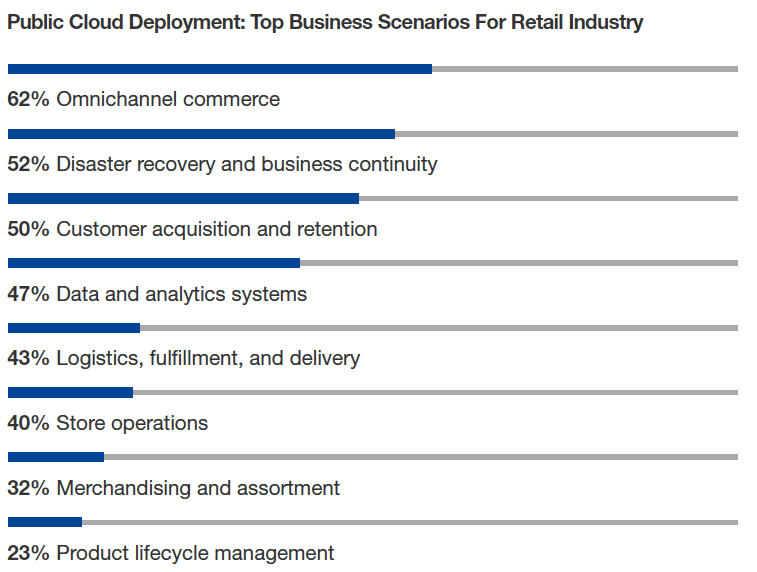
Download Forrester’s Retail Report Now.
Insurer Uses Google Cloud AI to Battle Slow Growth: It Improves Sales by 5% in 8 Weeks

8832
Of your peers have already read this article.
7:30 Minutes
The most insightful time you'll spend today!
For a business to succeed in the long term, it needs to learn not just to adapt to inevitable change, but to harness it. South Africa-based PPS has been an insurance company since 1941 and today is the biggest mutual insurance provider in the country.
As a mutual company, PPS is owned by more than 200,000 members, making them shareholders. In recent years, PPS and other companies like it have been affected by a number of external factors.
“For one thing, technology platforms have brought in a new gig economy that has all kinds of implications for insurance,” says Avsharn Bachoo, CTO at PPS. “What we’ve been seeing is basically a disruption of the South African insurance industry. We chose to see that as an opportunity.”
“Our servers were at the end of their life cycle and we had to decide whether to refresh them or switch completely. To embrace the world of AI and machine learning effectively, we knew we needed a cloud-based infrastructure. We’ve found the answer in Google Cloud Platform.”
—Avsharn Bachoo, CTO, PPS
In early 2018, faced with an uncertain economic environment that was squeezing growth and profitability, PPS decided to transform itself from a traditional broker-based business into a digital insurance provider. A key pillar of this new strategy was to overhaul the company’s technology infrastructure. To turn the strategy into reality, Avsharn and his team chose Google Cloud Platform (GCP).
“Our servers were at the end of their life cycle and we had to decide whether to refresh them or switch completely,” says Avsharn. “To embrace the world of AI and machine learning (ML) effectively, we knew we needed a cloud-based infrastructure. We’ve found the answer in Google Cloud Platform.”
Power, speed, flexibility with Google Cloud Platform
Previously, PPS maintained an on-premises IT infrastructure, which worked for its traditional business but was unsuited for its new way of working. In early 2018, the company started working on new products for its members but this required large amounts of compute power that proved prohibitively expensive with on-premises servers. Even existing products were starting to require more than the infrastructure could deliver. Aging equipment meant that it’s testing and quality assurance environments bore little resemblance to the actual production environment.
“We had no pre-production environments at all,” says Avsharn, resulting in more work for developers after products had been released. Meanwhile, the capital required to buy and configure more servers for new projects meant fewer resources available for innovation, and left the company less able to react to changes in the market. PPS knew it had to find a cloud-based alternative.
Shortly after devising a new digital strategy, PPS engineers attended a training session on cloud infrastructure given by leading South African Google Cloud Partner Siatik. Impressed with the presentation, PPS engaged Siatik to help run a proof of concept for a cloud-based infrastructure, running on GCP. With on-site engineers and constant communication, Siatik formed a very close working relationship with PPS. “The team at Siatik was exemplary,” recalls Avsharn. “They were well-organized, with cutting-edge technical acumen and very creative solutions to our problems. They were real game-changers.”
“We wanted the platform to retrain its models in response to new data and improve its recommendations with more information. Normally this would be a manual process but Google Cloud ML Engine lets the models do this automatically.”
—Kimoon Kim, Lead Solution Architect and Data Engineer, Siatik
The proof of concept was successful, with GCP outperforming the existing infrastructure in terms of how it handled compute demands, databases, and storage.
“It’s the speed of GCP that really impresses us,” says Avsharn. PPS saw that GCP wasn’t just an opportunity to migrate its existing infrastructure to the cloud. With Siatik’s help, it redesigned its monolithic core architecture to one based around microservices using Google Kubernetes Engine (GKE). For data processing and storage, Cloud Dataflow and Cloud Datastore proved invaluable, while Stackdriver helped the IT team stay on top of logging and monitoring the system.
“Google Cloud makes migrations very easy,” says Brett St. Clair, CEO at Siatik. “It takes care of all the hard work with configurations and replications, so when we switch the machines on, everything is ready and working.”
The ease with which PPS migrated to GCP means that it can now tackle strategic goals much more quickly than before. The most ambitious of these is an AI-powered product recommendation platform. Information is collected from customers who opt in at a defined point in their journey, this database is queried using BigQuery, and the information is fed into the platform. The AI model then calculates the most appropriate products for each member, according to their personal history.
“Most of the product recommendation engines out there are based on clustering, where you’re offered products based on your peer groups,” explains Avsharn. “For the first time, we can make recommendations to members based on their individual preferences and historical behavior. That’s really powerful for us.”
Siatik helped PPS use TensorFlow and Cloud Machine Learning Engine to build the AI platform. For the engineers, these easy-to-use tools helped speed up the process considerably, allowing them to host the models locally without any fuss. Previously, it took one to three months to manually build the model and match an offer to a customer. With the AI platform, a match takes just a few minutes. Cloud ML Engine, in particular, helped the platform adapt to new information on the fly and easily make adjustments to its hyperparameters, that is, preset variables which define the model-training process.
“We wanted the platform to retrain its models in response to new data and improve its recommendations with more information,” says Kimoon Kim, Lead Solution Architect and Data Engineer at Siatik. “Normally this would be a manual process but Google Cloud ML Engine lets the models do this automatically.”
“Google Cloud helped us cancel out a lot of the noise around machine learning and AI. We don’t have to build new complicated algorithms or hire huge teams of data scientists to benefit. We just bring our data and use the right tools to focus on what’s really important.”
—Avsharn Bachoo, CTO, PPS
Harnessing artificial intelligence for real-world results
PPS deployed its new AI recommendation platform in December, 2018. Just a couple of months later, its impact was clear. “In around eight weeks, we saw a 5 percent growth in sales,” says Avsharn. “It’s been a direct result of building our recommendation platform with Google Cloud. We can offer the right products to the right members.”
For developers and engineers at PPS, working with Google Cloud gives them access to high performance technology and automation options with GKE. As a result, the infrastructure runs 70 percent faster than before with fewer cores and less memory. Developers can also work in mature testing environments, and for the first time, are able to build pre-production environments, leading to better quality products. More strategically, moving to a serverless, cloud-based infrastructure has helped PPS take control of its budget, moving away from intermittent, large capital spends to more manageable, project-to-project flows of operational expenditure. The company expects to see savings of around 50 percent, or $695,000.
“We have a lot more flexibility with our resources thanks to Google Cloud,” says Avsharn. “When we have a new idea, we don’t have to outlay new capital such as servers before we can even start working on it. We just spin up instances when we want and spin them back down when we’re done.”
With the AI platform deployed and working well, PPS is already looking at ways to improve it, including real-time updates and further automation. Soon, the company will integrate the platform with more sales campaigns for more effective targeting to boost sales even further. Meanwhile, it’s also experimenting with machine learning to spot patterns in data at scale for fraud analytics and risk assessment.
For PPS, working with Google Cloud has helped it transform quickly and effectively from disrupted to disruptor. The company is now looking to gain the same transformative effects by implementing G Suite for increased productivity and collaboration.
“Google Cloud helped us cancel out a lot of the noise around machine learning and AI,” says Avsharn. “We don’t have to build new complicated algorithms or hire huge teams of data scientists to benefit. We just bring our data and use the right tools to focus on what’s really important.”
Cloud and AI Paves the Future of Finance: Excerpts from FIA Boca 2022

6609
Of your peers have already read this article.
4:00 Minutes
The most insightful time you'll spend today!
Financial markets were among the first to adopt new technologies, and that has certainly been true of the derivatives markets, which were early adopters of electronic trading. Going forward, new capabilities will transform the way industry participants communicate, analyze, and trade.
I sat down with Google Cloud’s Phil Moyer and former SEC Commissioner, Troy Paredes, for a fireside chat at FIA Boca 2022 to discuss the future of markets and policy, the new technologies that are already paving the way for greater speed and transparency, and how cloud can help promote greater resiliency, performance, and security to enable the long-term vision for the market. The following is a summary of our discussion.
The current state of cloud technology
When it comes to technology adoption, we’re seeing the market and participants adopt cloud technologies, and increasingly, machine learning (ML) on a wider scale. Cloud technology allows for easier, faster, and much more secure experimentation with large datasets and ML.
A recent Google sponsored study by Coalition Greenwich (September, 2021) showed that more than 93% of trading systems, exchanges, and data providers are in some way providing services on the cloud. The same study, revealed that about 72% of the financial industry across the buy side and sell side, intend to consume public cloud-data based market data within the next 12 months.
Data-driven decision-making and risk management have always been, and continue to remain, the cornerstones of the financial markets. Over time, technology innovation has facilitated access to better insights from data, and therefore, better decision-making and the ability to manage risk. That expectation is now mainstream, and will continue to grow in sophistication.
The multi-phased technology trajectory
The movement of exchanges to the cloud will occur in a “crawl-walk-run” fashion, with low-hanging fruits the first to be picked in the near term while bigger, paradigmatic changes will occur over the medium and long term. Some organizations are starting all three stages simultaneously, understanding that each will move at an independent cadence.
The “crawl” phase is one in which foundations are built, starting with organizations moving data to the cloud and experimenting with some degree of analytics. It’s one of the most important phases because it’s where the opportunity to increase transparency and risk management takes shape.
In moving to the cloud, the infrastructure – which in the past relied on a combination of people, processes, and some technology – becomes the code that runs applications. This early phase is key to empowering organizations to shift to a cloud-based, agile-first operating model that makes it easier and more seamless to launch new products in the future, including by freeing up people and resources from IT management to more mission-focused work.
Establishing the cloud operating model simplifies the “walk” and “run” phases where compliance is more automated, latency-sensitive applications are more readily available, and the next generation of exchanges, market participants, and regulators is better prepared to meet future challenges.
The “walk” phase is where much of the innovation happens. Exchanges are making significant progress in leveraging foundational data decisions in the “crawl” phase and innovations in the cloud to improve settlement, clearing, risk management, collateral management, and compliance, and launch new products.
And finally, the “run” phase is where organizations will start to move the latency-sensitive markets to the cloud, as the markets increasingly will demand low-latency and high performance along with transparency and analytics to solve historical obstacles to market access.
Opportunities for both regulators and market participants
Any time significant technological change takes place, regulators explore its implications, particularly with respect to their ability to meet their regulatory objectives.
Increasingly, we are seeing technological change driving more opportunities for regulators and market participants alike. Such changes may also allow better protection of the marketplace, with greater integrity and transparency.
Over time, regulatory regimes – rules, regulations, statutes, interpretations, and guidance – will also adjust to new technologies, both benefiting the marketplace and advancing regulatory goals.
As one example, the cloud is increasing the ability to meet compliance obligations by allowing compliance to be built into transactions. Moreover, predicated on the vision of real-time regulatory reporting, and given the pace of technological change in the marketplace over the last several years, various regulators have been using more advanced analytics. This trend will continue to help them more effectively and efficiently meet their objectives, and monitor and meet the expectations they have for the entire market.
Machine learning’s role in the financial markets
Google Cloud’s head of AI and Industry Solutions, Andrew Moore, said that ML will be doing three key things for us in the next 10 years: giving us meaning, providing concierge services, and serving as a guardian. Extracting information that is critical to investor decision-making can be extremely important. With more data than ever, ML can increase the ability to process it while also becoming more accessible in the cloud and better supporting regulatory objectives.
The technology will likely manifest in trading and anti-money laundering activities as they relate market functions, as well as managing a wide variety of risks – supporting the interests of both investors and regulators in terms of decision-making, surveillance, and protections.
Rather than taking individuals out of the equation, the digitization of markets, assets, and guard rails combined with ML will allow people to focus their expertise in different ways to achieve key objectives.
Building the market foundation for the future
The goals of operational resiliency, security, and privacy will continue to be critical for building the market foundation for both participants and regulators. While technology promises to create advantages in concrete, tangible ways, it will be important to scrutinize potential risks and concerns.
Priority one for technology providers is to build an environment of trustless security, including encryption at motion and encryption at rest, ensuring that markets are operationally resilient while instilling confidence for any exchange that runs on top of that infrastructure. Multicloud architectures and approaches are likely also to be part of the solution for operational resilience.
Throughout time, liquidity has been the outcome of improved access, transparency, and security. Technology providers are responding by sharing both the responsibility for, and fate of, the markets of the future to build an efficient, faster, and more transparent and secure financial industry.
You can learn more about our approach in our newest white paper, Building the financial markets foundation for the future.
More Relevant Stories for Your Company
Building a Large-Scale Migration Program with Google Cloud
Many organizations are looking to the public cloud to solve on-premises infrastructure challenges. These range from capacity constraints, aging hardware, or reliability issues; or alternatively, organizations may be looking to capitalize on the value that cloud infrastructure can bring - saving money through automatic scaling, or deriving business value from
Google Cloud Announces General Availability of BigQuery Row-level Security
Data security is an ongoing concern for anyone managing a data warehouse. Organizations need to control access to data, down to the granular level, for secure access to data both internally and externally. With the complexity of data platforms increasing day by day, it's become even more critical to identify

Marxent Leverages Google Cloud to Elevate Customer Journeys on Retail Apps with 3D Shopping Experiences
As ecommerce for home goods exploded in popularity during COVID, furniture and DIY retailers looked to find new ways to grow online transaction sizes to in-store levels. Shopping for furniture and home improvement projects has always been challenging online. Furniture, kitchen cabinets, fixtures, and appliances become a part of daily

Forrester Report on Indian Healthcare: Why this Sector’s Seeing Greater Cloud Investments than BFSI or Retail
The healthcare industry in India is experiencing a rapid change, becoming one of India’s largest sectors in terms of both revenue and employment. But healthcare firms are under immense pressure to improve clinical outcomes and reduce the cost of care. Healthcare firms must recognize that their patients are customers who
