





How APIs are Helping Malaysia’s Largest Investment Company Innovate Quickly

3610
Of your peers have already read this article.
3:30 Minutes
The most insightful time you'll spend today!
Permodalan Nasional Berhad (PNB) is one of Malaysia’s largest investment institutions with more than RM300 billion ($71 milion) in assets under management. Through our wholly-owned company, Amanah Saham Nasional Berhad (ASNB), we manage 14 funds with a total value of RM235.74 billion ($56.34 million) as of Dec. 31, 2018.
To expand the range of people who can invest and participate in the economy, our unit trust funds enable the public to invest as little as RM10 ($2.50) into any of our funds. With each investment, unit-holders (a unit-holder is an investor who holds securities of trust) are able to participate in the local and international investment activities managed by PNB and ASNB. They also gain dividends from their investment at the end of the financial year for the funds that they invest in.
Accelerating access to services with APIs
As chief technology officer for PNB, I lead the retail and asset management technology aspects of the business. My team and I manage the basic IT systems such as email and networks, but also the more exciting and complex IT infrastructures, including investment core systems and data analytics for the unit trust teams.
In January 2017 (prior to joining PNB), I observed unit holders waiting in a long line just to update their account balances following a dividend announcement. Unit-holders had limited options then: they were required to visit an ASNB branch or one of our agent banks to complete the transaction. When PNB hired me three months later, I was determined to create a self-service balance checker that would reduce our unit-holders’ waiting time. My team first built an application on an Android tablet that communicated to our backend via APIs. Then we constructed a kiosk around this and started our first self-service kiosk. We have built 120 kiosks across Malaysia in six months.
While we made progress in creating new solutions for our unit-holders, we were missing an API management framework to manage our APIs. After extensive market research, we decided on the Apigee API management platform as it was the most suitable platform to build our capabilities for developing and managing APIs. Apigee’s technical capabilities coupled with responsive support from Google Cloud were important factors. Being new to APIs, we value the quick and ready technical support made available to us. In addition, the secure and flexible system that Apigee offers is critical to us because as a financial institution, security is of paramount importance.
In July 2017, we migrated our retail core system from mainframe base to a modern, cloud-based infrastructure. In August of the same year, a newly developed web portal provided our unit-holders access to their accounts through their mobile devices for the first time. The customer response was very encouraging and uptake has been very high since then.
The portal uses APIs to enable our 14 million unit-holders to check balances, reinvest, edit their personal information, and access account statements. For now, the portal is only available to unit-holders who pre-register via an in-person onboarding process. We are currently awaiting regulatory direction on electronic Know Your Customer (eKYC) rules that will impact digital onboarding before we can enable access to new unit-holders via their mobile devices.
Creating new channels for financial inclusion
To date, our web portal and APIs have generated approximately RM2 billion (USD500 million) in annual investments. This equates to about five percent of our total yearly investments contributed via the digital platform. While this is encouraging progress, there is much more potential that we can tap into, including the collection and analysis of consumer behavior data. Moving forward, this valuable information will provide insights for us to improve customer experience and fine-tune our offerings.
A typical bank integration typically takes six months at a high cost. Excluding the governance and compliance approval period, our key APIs can be consumed in under three months, at minimal cost. Banks that use APIs will find ours easy to work with. This simplifies our agent onboarding process.
APIs enable us to innovate further by expanding our capabilities and reach. We are currently onboarding a few PNB agent banks and we look forward to the possibility to connect to fintech players in Malaysia, especially e-wallet solution providers. API simplify the communications between multiple systems and offer a world of possibilities for our business.
4585
Of your peers have already watched this video.
1:30 Minutes
The most insightful time you'll spend today!
Introduction to Cloud Shell Editor
Watch the video to understand how Google’s Cloud Shell Editor and its powerful features-packed environment can streamline your development workflows.
Google Extends Support for Windows Server Containers on Anthos for Faster App Modernization and Consistent Dev Experience

5594
Of your peers have already read this article.
3:00 Minutes
The most insightful time you'll spend today!
Today, many applications in organizations’ data centers run on Windows Server. Modernizing these traditional Windows apps onto Kubernetes promises a host of benefits: a consistent platform across environments, better portability, scalability, availability, simplified management and speed of deployment, just to name a few. But how? Rewriting traditional .NET applications to run on Linux with .NET Core can be challenging and time-consuming. There is, however, a lower-toil, more developer friendly option.
Last year, we announced support for Windows Server containers running on Google Kubernetes Engine (GKE), our cloud-based managed Kubernetes service, which lets you take the advantage of containers without porting your apps to .NET core or rewriting them for Linux. Today, we’re going a step further with support for Windows Server containers on Anthos clusters on VMware in your on-premises environment. Now available in preview, you can consolidate all your Windows operations across on-prem and Google Cloud.
Bringing Windows Server support to our family of Kubernetes-based services—GKE running on Google Cloud, and Anthos everywhere—with the same experience, lets you modernize apps faster and achieve a consistent development and deployment experience across hybrid and cloud environments. Further, by running Windows and Linux workloads side by side, you get operational consistency and efficiency—no need to have multiple teams specializing in different tooling or platforms to manage different workloads. The single-pane-of-glass view and the ability to manage policies from a central control plane simplifies the management experience, while bin packing multiple Windows applications drives better resource utilization, leading to infrastructure and license savings.
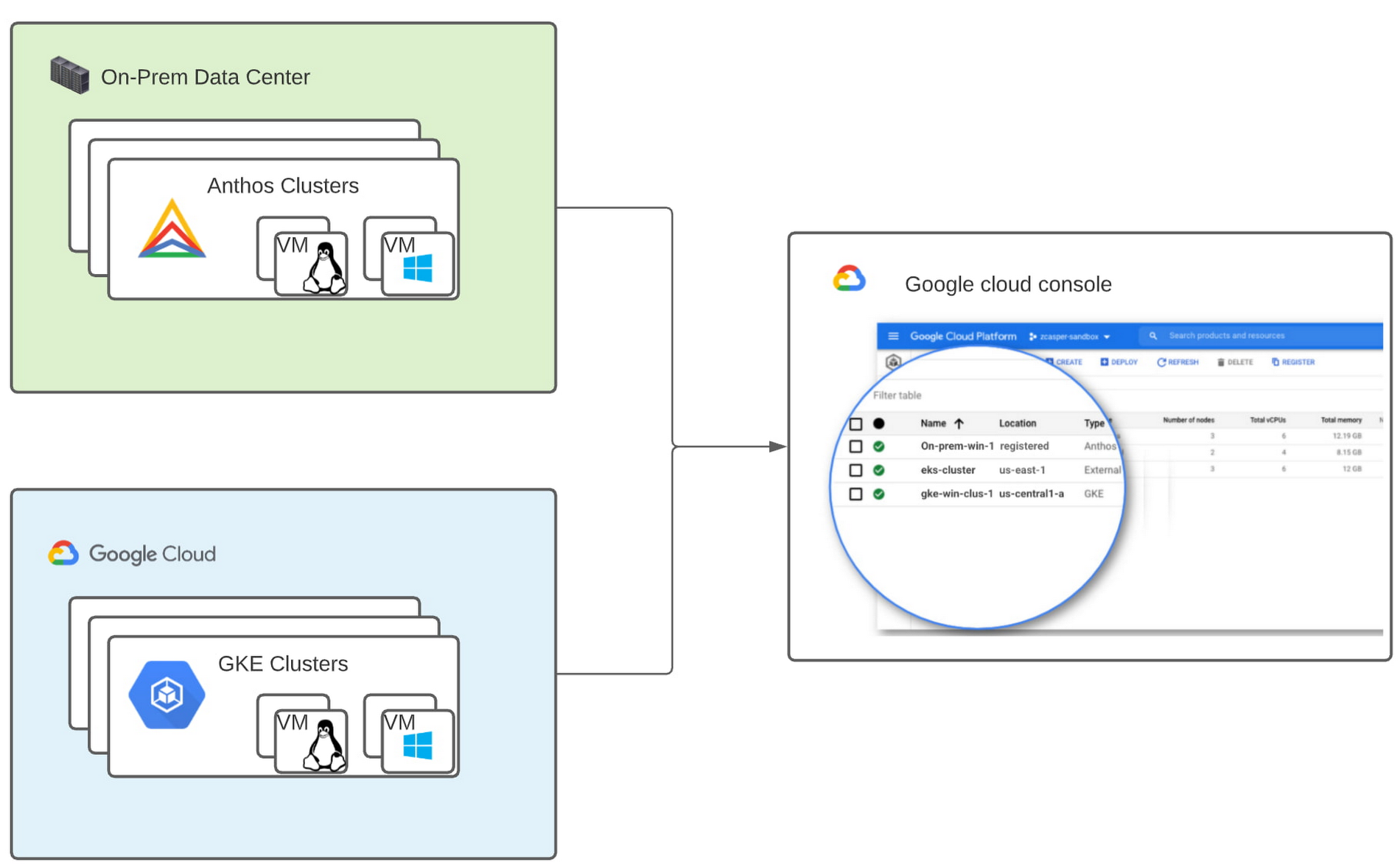
With all these benefits, it’s no surprise that customers such as Thales, a French multinational firm specializing in aerospace and security services, have been able to reap significant benefits by moving Windows applications to GKE.
“We moved our Windows applications from VMs to Windows containers on GKE and now have a unified mechanism for Linux and Windows-based application management, scaling, logging, and monitoring. Earlier, setting up these applications in VMs and configuring them for high availability used to take up to a week, and the applications were not easily scalable,” said Najam Siddiqui, Solutions Architect at Thales. “Now with GKE, the setup takes only a few minutes. GKE’s automatic scaling and built-in resiliency features make scaling and high-availability setup seamless. Also, manually maintaining the VMs and applying security patches used to be tedious, which is now handled by GKE.”
Let’s take a deeper look at the architecture that lets you run your Windows container-based workloads on-prem.
Windows Server running on-prem with Anthos
The diagram below illustrates the high-level architecture of running Windows container-based workloads in an on-prem GKE cluster with Anthos. Windows server node-pools can be added to an existing or new Anthos cluster. Kubelet and Kube-proxy run natively on Windows nodes, allowing you to run mixed Windows and Linux containers in the same cluster. The admin cluster and the user cluster control plane continue to be Linux-based, providing you a consistent orchestration experience and management ease across Windows and Linux workloads.
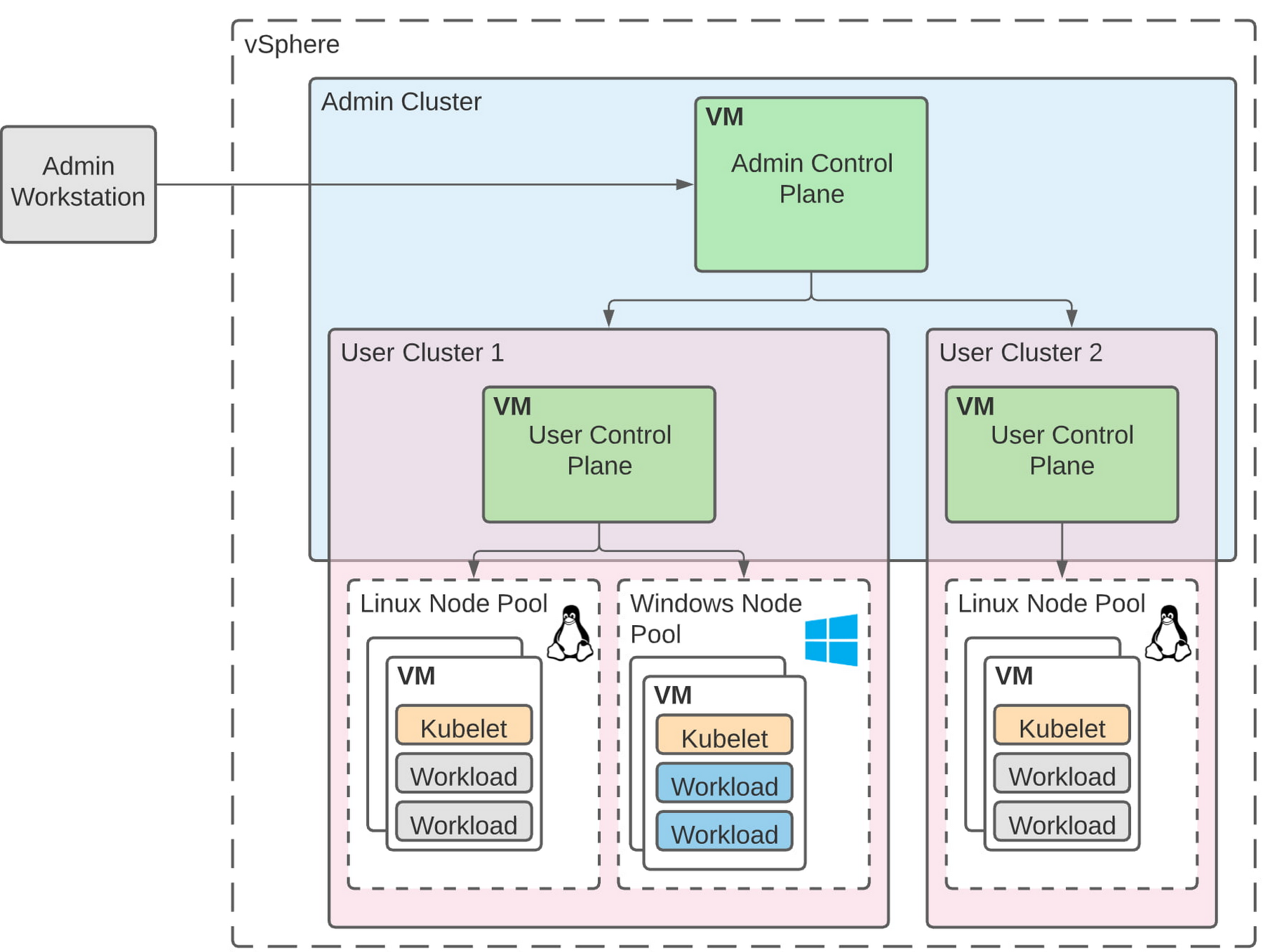
Get started today
When considering modernizing your on-prem Windows estate, we recommend running Windows Server containers on Anthos in your own data center. If you are new to Anthos, the Anthos getting started page and the Coursera course on Architecting Hybrid Cloud with Anthos are good places to start. You can also find detailed documentation on our website, and our partners are eager to help you with any questions related to the published solutions, as is the GCP sales team. And as always, please don’t hesitate to reach out to us at anthos-onprem-windows@google.com if you have any feedback or need help unblocking your use case.

APIs and IT Rationalization: Cost Avoidance and Cost Savings for Enterprise IT
DOWNLOAD E-BOOK3808
Of your peers have already downloaded this article
6:30 Minutes
The most insightful time you'll spend today!
The dynamic and fast-moving business environments of today demands that technology leaders and teams deliver more at a lightning speed, all the while working within the constraints of shoe-string budgets and tight project timelines. Winning in today’s environment requires a more strategic approach to optimize utilization of resources, remove unnecessary spend and free more dollars for innovation.
In every organization there are several necessary and unnecessary costs distributed throughout a typical enterprise architecture. There are two main aspects to focus on in IT rationalization: cost avoidance and cost savings. Implementing an API tier can lead to operational efficiencies , faster development, and cost savings and avoidance.
Read this eBook to explore the less well-understood and sometimes harder to find opportunities for reducing spend like cost avoidance (not paying for something that you would have had to pay for otherwise) and cost savings (reducing or eliminating a current expense). Learn how strategically integrating APIs can help you counteract the complexity of organic technology accretion, enable both cost savings and cost avoidance and improve business efficiency.
3796
Of your peers have already watched this video.
8:00 Minutes
The most insightful time you'll spend today!
Target Leverages Google Cloud to Create Market-defining Online Experience
In the hyper-competitive world of online retail sales, ease-of-use and transaction speed can make or break business outcomes. However, a few years ago US Retail giant Target was going through a period of uncertainty.
While the company had over 1800 stores across the US with an estimated 85% of US consumers shopping at a Target store and over 25 million people visiting the Target website or using its app each month, it was still losing ground.
In spite of having millions of loyal customers, the company was dangerously late on digital and its technology wasn’t keeping pace with unstable systems to boot. The company faced the twin challenges of trying to operate today’s business as efficiently as possible and creating tomorrow’s business as quickly as possible. On the one hand it needed productivity and stability and on the other it wanted speed and disruption. Not an easy task to accomplish.
That’s when Target decided to use Google Cloud to solve its challenges. See how Target leveraged Google Cloud to create a market-defining online experience that has made customers happier and more loyal.
Google Cloud’s Transfer Services Helps Move Nuro’s Petabytes of Data from Edge to the Cloud

5150
Of your peers have already read this article.
3:00 Minutes
The most insightful time you'll spend today!
Engineers that build last-mile delivery services belong to an elite order, a hallowed subcategory. Delivery customers are incredibly demanding when it comes to speed and convenience, and the services they use must take variables like increased traffic, road conditions, human error, and even driver availability into account every day.
Nuro is a company with a new approach to delivery services. Nuro has a fleet of autonomous vehicles designed to address many of the problems related to last-mile delivery. And every day, these vehicles — and their sensors — generate a lot of data before parking for the night. For Nuro engineers, that data can help them understand the impact of new on-road features, make improvements to their vehicles’ software, and ensure even better deliveries for their customers.
For Nuro, the key challenge is how to move petabytes of data as quickly, securely, and easily as possible from their edge environments, like vehicle depots, to Google’s Cloud Storage. For this delivery effort, Nuro selected Google’s Transfer Appliance with its new online transfer capability, now generally available.
Helping Nuro to speed up data delivery from the edge to the cloud
Like many Google Cloud customers, Nuro collects data from remote environments, like vehicle depots, that have different networking and storage capabilities when compared to a traditional data center. For a transfer solution to be effective moving unstructured data from these environments to the cloud, the solution needs to be easy to deploy and automate, while still providing similar performance as a more complicated alternative.
The Transfer Appliance was built for this use case. It arrives to customers as a physical appliance with a preconfigured version of Google’s Storage Transfer Service software already installed. Customers can move files to the appliance by using SFTP or SCP, or, alternately, can mount the appliance as an NFS share and copy target. Data can be stored locally on the appliance or transferred over the network, and secure encryption — at-rest and in-flight — is enabled by default.
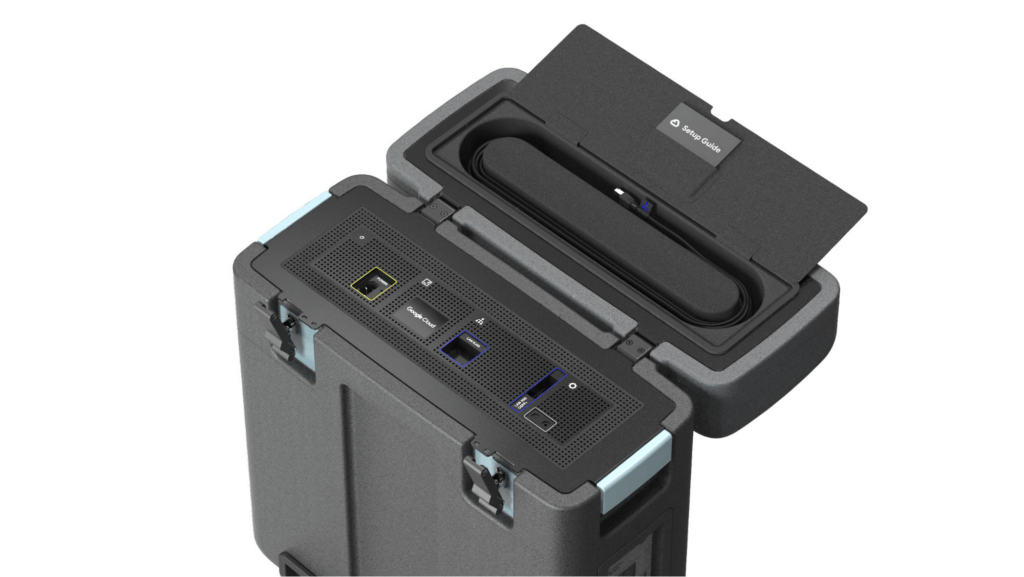
With these new appliances, Nuro will be able to automate much of their storage transfer needs. When their autonomous vehicles return to the depot, they can move data like software logs, LIDAR data, and sensor data — all ideal fits for Google’s Cloud Storage — from parked vehicles to the Transfer Appliance. Online transfers can then be performed throughout the day, ensuring a steady stream of valuable data in the cloud for developers to analyze and use in their nightly builds. All of this will help Nuro’s engineering leaders like Jie Pan to run more productive development teams with less operational overhead.
“Our autonomous vehicles generate a tremendous amount of useful data, and our goal is to get that data to our engineers as soon as possible,” said Jie Pan, Engineering Manager at Nuro. “When vehicles return to the depot, we can move data hourly into Cloud Storage over the network. We also have the flexibility to return the Transfer Appliance back to Google Cloud. Most importantly, this rapid transfer architecture gives a meaningful boost to engineering productivity and development velocity.”
Going the extra mile
Engineering and infrastructure leaders understand the value of delivering the right data to the right teams, as fast as possible. By adding preconfigured, over-the-network transfer into a turnkey Transfer Appliance, Google Cloud customers can more easily automate these data deliveries by scheduling regular migrations of on-premises files, objects, and other unstructured data to our Cloud Storage.
As Nuro continues to grow their manufacturing and testing footprint, they plan to use Transfer Appliances to further scale and simplify their data migration from on-premises to Google Cloud. Cutting the time to migrate their data by more than half will make for happier, more productive developers, and that will help Nuro bring us all the future of delivery a little faster.
If you’d like to learn more about Transfer Appliance and its new online transfer capability, click here or reach out to your Google Cloud account team.
More Relevant Stories for Your Company

Speeding Up App Modernization with Apigee and Anthos
If you build apps and services that your customers consume, two things are certain: You’re exposing APIs in some form or the other. Your apps are made by multiple functions working together to deliver products and services. As you scale up and grow, your enterprise architecture can benefit from a sound

How Toyota’s Google Cloud-powered Voice Assistant Gives a Turboboost to Drivers’ Experience
Over the decades, technology has helped us organize large amounts of physical information in ways that are streamlined, efficient, and easily accessible. Rows upon rows of encyclopedias are no longer needed; simply punch in or speak a query into Google Search and find numerous results at your fingertips. There’s no
2022’s First Cloud CISO Perspectives: Recap of the Megatrends, Releases and News
I’m excited to share our first Cloud CISO Perspectives post of 2022. It's already shaping up to be an eventful year for our industry and we’re only in month one. There’s a lot to recap in this post, including the U.S. government’s recent efforts to address critical security issues, like

Driving Digital Success: Three ROI Criteria for Competitive Advantage
Choosing ROI criteria that drive smart decisions about digital investments is necessary to win in the app economy. But according to an Apigee Institute survey of IT and Marketing executives, there is a wide gap between what corporate leaders believe are the best ROI metrics and what are actually used in most
