





2022’s First Cloud CISO Perspectives: Recap of the Megatrends, Releases and News
9338
Of your peers have already read this article.
3:00 Minutes
The most insightful time you'll spend today!
I’m excited to share our first Cloud CISO Perspectives post of 2022. It’s already shaping up to be an eventful year for our industry and we’re only in month one. There’s a lot to recap in this post, including the U.S. government’s recent efforts to address critical security issues, like open source software security and zero trust architectures. We’ve also released new resources from our Google Cybersecurity Action Team like the Cloud Security Megatrends and the Boards of Directors whitepaper on cloud risk governance.
Cloud Security Megatrends
We’re often asked if the cloud is more secure than on-prem (and why) so we shared our answer in a recent blog post. At Google Cloud, security by design is our priority. We’ve long adopted zero-trust principles for our baseline security architectures and built a global network that relies on defense in depth layers to protect against configuration errors and attacks. But security is always evolving and that is why we also take advantage of the following megatrends:
- Economy of scale: Decreasing the marginal cost of security raises the baseline level of security.
- Shared fate: A flywheel of increasing trust drives more transition to the cloud, which compels even higher security and even more skin-in-the-game from the cloud provider.
- Healthy competition: The race by deep-pocketed cloud providers to create and implement leading security technologies is the tip of the spear of innovation.
- Cloud as the digital immune system: Every security update the cloud gives the customer is informed by some threat, vulnerability, or new attack technique often identified by someone else’s experience. Enterprise IT leaders use this accelerating feedback loop to get better protection.
- Software-defined infrastructure: Cloud is software defined, so it can be dynamically configured without customers having to manage hardware placement or cope with administrative toil. From a security standpoint, that means specifying security policies as code, and continuously monitoring their effectiveness.
- Increasing deployment velocity: Because of cloud’s vast scale, providers have had to automate software deployments and updates, usually with automated continuous integration/continuous deployment (CI/CD) systems. That same automation delivers security enhancements, resulting in more frequent security updates.
- Simplicity: Cloud becomes an abstraction-generating machine for identifying, creating and deploying simpler default modes of operating securely and autonomically.
- Sovereignty meets sustainability: The cloud’s global scale and ability to operate in localized and distributed ways creates three pillars of sovereignty. This global scale can also be leveraged to improve energy efficiency.
If you’re an IT decision maker, pay attention to these megatrends that will continue to drive and reinforce cloud security and will outpace the security of on-prem infrastructure well into the future.
U.S. Federal government cybersecurity momentum
- Open source software security: Earlier this month, Google participated in the White House Summit on open source software security. The meeting came at a critical time for the industry following December’s Log4j vulnerabilities and was both a recognition of the challenge and an important first step towards addressing it. The open source software ecosystem is not homogenous, despite the fact that the industry often thinks of or treats it this way. Some of it, like Linux, is highly curated, while other critical software is supported through diffuse communities including technology companies and other stakeholders. There is also a long tail of many other critical projects driven by a dedicated community of maintainers around the world, including Googlers. In light of this reality, we welcomed the chance to share our recommendations to advance the future of open source software security. Some work we’ve done includes founding the Open Source Security Foundation, which has been instrumental already in making security improvements. We’ve also helped drive a number of key security initiatives within the open source community including security scorecards, the SLSA framework to improve the security and integrity of open source packages, and Secure Open Source Rewards to financially incentivize improvements to critical open source security projects.
- OMB’s Federal zero trust strategy: The publication of the Office of Management and Budget’s zero trust architecture strategy marks an important step for the U.S. federal government’s efforts to modernize under Executive Order 14028. Google Cloud supports this approach, which recognizes the immense security benefits offered by modern computing architectures. For the past decade, Google has successfully applied zero trust principles through our BeyondCorp and BeyondProd frameworks for providing end-user access and securing our cloud workloads. And we’ve brought these best practices from our own journey to global governments and businesses of any size through solutions like BeyondCorp Enterprise and capabilities like Binary Authorization and Anthos Service Mesh, which are embedded in Anthos, our managed application platform. For Federal agencies embarking on this zero trust journey, the Google Cybersecurity Action Team will offer our expertise by conducting Zero Trust Foundations strategy workshops, which can help organizations in the public and private sectors develop actionable and achievable strategies and plans for zero trust implementation.
Google Cybersecurity Action Team Highlights
Here are the latest updates, products, services and resources across our security teams this month:
Security
- Democratizing security operations: We recently announced that Siemplify, a leading security orchestration, automation and response (SOAR) provider, is joining Google Cloud to help companies better manage their threat response. Providing a proven SOAR capability with Chronicle’s approach to security analytics is an important step forward in our vision to advance invisible security and democratize security operations for every organization.
- Security by design: The Highmark Health security team is using “secure-by-design” techniques to address the security, privacy, and compliance aspects of its Living Health solution with Google Cloud’s Professional Services Organization (PSO). Google has long advocated for and followed security by design principles, which is why we’re continuously building enhanced security, controls, resiliency and more into our cloud products and services.
- Secure collaboration for hybrid work environments: The Google Workspace team shared its recommendations for businesses as they prepare for the future of work, where the hybrid/flexible work model is becoming standard practice and a new approach to security is essential.
- Anthos Policy Controller CIS Benchmark enforcement: A big part of our shared fate philosophy is to build secure products and not just security products. A recent example of this in action is embedding CIS benchmark policy conformance in the Anthos Policy Controller. We believe the more we embed approaches like this into our products, the more application and infrastructure teams can intrinsically embed security at the start and reduce toil for the security team.
- DevOps for technology-driven organizations and startups: A key success factor for many security programs is the partnership and integration with development teams, and there are some great resources and lessons in our DORA research.
- Security by design with Chrome OS: ABN AMRO’s Asia-Pacific region team recently shared how they are using Chrome OS and CloudReady to work securely in the cloud, reduce total cost of ownership, and add flexibility for employees. This is a great example of secure by design principles in the use of Chromium.
Risk & Compliance
- Boards of Directors summary guide to cloud risk governance: The latest whitepaper from the Google Cybersecurity Action Team outlines how boards of directors can prioritize safe, secure, and compliant adoption processes for cloud technologies within their organizations.
- TruSight Risk Assessment of Google Cloud: TruSight recently released a comprehensive
risk assessment report on Google Cloud. Our Enterprise Trust team collaborated on this robust assessment of Google Cloud services to validate the design and implementation of controls. TruSight’s risk assessment of our security controls will help customers accelerate and complete their risk management due diligence. - Data governance: Check out this new blog series on data governance where our teams explain the role of data governance, its importance, and the necessary processes to run an effective data governance program. Implementing data governance will help maximize value derived from business data, build user trust, and ensure compliance with required security measures.
Controls and Products
- Encrypting Data Fusion: To help meet the security, privacy and compliance requirements of customers in regulated industries like finance or public sector, we announced the general availability of Customer Managed Encryption Keys (CMEK) integration for Cloud Data Fusion, which enables encryption of both user data and metadata at rest with a key that customers can control through our Cloud Key Management Service (KMS).
Don’t forget to sign-up for our newsletter if you’d like to have our Cloud CISO Perspectives post delivered every month to your inbox. We’ll be back next month with more updates and security-related news.

Google Named a Leader in the 2019 Gartner Magic Quadrant for Full Life Cycle API Management
DOWNLOAD WHITEPAPER4170
Of your peers have already downloaded this article
3:30 Minutes
The most insightful time you'll spend today!
The number of APIs within organizations is growing very rapidly not only in IT departments, but also within lines of business (LOBs). Every connected mobile app, every website that tracks users or provides a rich user experience, and every application deployed on a cloud service uses APIs.
LOBs see them as a way to innovate quickly, which enables them to disrupt markets and competitors by introducing new offerings or new channels.
Hence, having the right API management tool is crucial for managing API complexity. Today’s full life cycle API management involves:
- The planning, design, implementation, testing, publication, operation, consumption, maintenance, versioning and retirement of APIs
- Delivery of a developer portal through which to target, market to and govern communities of developers who embed APIs
- Runtime management
- Estimation of APIs’ value
- The use of analytics to understand patterns of API usage
This Magic Quadrant provides key insights into the strengths and challenges of the major vendors in the full life cycle API management market.
Google Cloud expands availability of enterprise-ready generative AI

1068
Of your peers have already read this article.
1:30 Minutes
The most insightful time you'll spend today!
Generative AI continues to develop at a blistering pace, making it more important than ever that organizations have access to enterprise-ready capabilities to help them leverage this disruptive technology.
Harnessing the power of decades of Google’s research, innovation, and investment in AI, Google Cloud continues to make generative AI available with baked-in security, data governance, and scalability across the board.
To this end, last month, we announced the general availability of Generative AI support on Vertex AI, giving our customers the ability to access powerful foundation models from Google Research and tools for customizing and applying them.
Today we are announcing the general availability (GA) of four important foundation models for Vertex AI. These include Imagen, PaLM 2 for Chat, Codey, and Chirp. For each of these models, organizations can access APIs on Model Garden and do prompt design and tuning on Generative AI Studio.
- Imagen includes four key features:
- Image generation for creating studio-grade images at scale
- Image editing to edit generated or existing images via text prompts
- Image captioning for creating captions of images at scale
- Visual Question & Answering (VQA) for interacting with, analyzing, and explaining images
- PaLM 2 for Chat follows the general availability of PaLM 2 for Text in June
- Codey supports code generation, completion, and code chat
- Chirp supports multilingual Speech AI
We’re also announcing Multimodal Embeddings API in preview, which lets customers combine the power of Vertex AI’s generative AI models with their proprietary data, to generate embeddings, or interchangeable vector representations, of their text and image data. These capabilities can enable data science teams to deliver a variety of downstream tasks such as image classification, content recommendations, and visual search.
In this blog post, we’ll explore what your organization can do with these powerful models and how Vertex AI provides the enterprise-ready capabilities you can use to get up and running with generative AI.
Helping to drive enterprise value from Generative AI models
Powerful models are the foundation of generative AI, but the software, tools, and infrastructure that surround these models are equally important for enterprise adoption. Organizations face challenges not only accessing these models, but also integrating AI while maintaining protection over intellectual property, adhering to regulations around data security and privacy, and ensuring models and applications are safe to use. Many organizations also want to use generative AI without incurring large costs or managing huge clusters.
We help address these challenges head-on with Vertex AI’s platform capabilities for scalable application integration, purpose-built AI infrastructure, secure and private data customization, and responsible use of this technology.
Let’s see how each of these pillars can help your organization.
Access models to build production-ready generative applications
Vertex AI can make it easy to access foundation models, as today’s model announcements attest. While models are an inextricable part of generative AI, the software that helps enterprises use this technology is equally important—which is why Vertex AI also offers a range of tools for tuning, deploying, monitoring, and maintaining models, so you can build differentiated applications using your own data.
Turning to today’s announcements, in May we announced Imagen, our foundation model for image generation. Now, we are excited to announce Imagen is generally available with an allowlist (i.e., approved access via your sales representative), letting onboarded customers start using image generation and editing capabilities. Visual Q&A and Captioning for production workloads are also generally available for all customers. Visual Q&A provides new ways to engage with image-based data like retail products or image libraries. This new capability can give you answers to questions about an image, helping you analyze large amounts of data quickly, and it can even help the visually impaired understand images or graphs that they wouldn’t be able to otherwise. Captioning, meanwhile, can make it easy to generate relevant descriptions for your images. Captions can help with indexing and searching, as well as assigning image descriptions to product listings on eCommerce websites.
“Imagen is beginning to power key capabilities within Omni, Omnicom’s open operating system, that will enable 17,000+ trained and certified users to create audience-driven customized images in minutes. Imagen has been instrumental in offering a scalable platform for image generation and customization. Integrating it into our platform allows us to expand the scope of audience-powered creative inspiration, at a scale that wasn’t previously possible,” said Art Schram, Annalect Chief Product Officer at Omnicom. “We’re starting to adopt the latest features like styles and fine tuning, and engineering data-driven prompts. We look forward to continuing to provide our users relevant visual inspiration in a responsible way.”
“The latest improvements in Imagen’s product preservation capabilities are a perfect match for Typeface’s focus on personalized AI for brands,” explained Vishal Sood, Head of Product at Typeface. “By combining Google Vertex AI’s Imagen with Typeface’s brand-personalized AI, we are able to help enterprises to create 10x personalized content in a fraction of time.”
Google Shopping recently built an application called Product Studio using Imagen on Vertex AI. Product Studio can enable merchants to create rich product images quickly and easily, at a fraction of the time it takes to do professional product photo shoots. “We’re excited about the feedback we’re getting from merchants in our early pilots, who say that Product Studio, which leverages Imagen on Vertex AI, helps them generate and publish lifestyle product photos directly to their product catalogs,” says Jeff Harrell, Google’s Senior Director of Product Management for Merchant Shopping.
Announced in May, PaLM 2 is a family of models that power dozens of Google products, including Bard and Duet AI in Google Cloud. With the PaLM 2 for Chat model, now generally available, you can leverage Google’s PaLM’s variety of abilities for multi-turn chat applications, such as shopping assistants, customer support agents, and more.
ThoughtSpot, provider of a widely-adopted business intelligence platform, is using PaLM 2 to build a new feature in ThoughtSpot for Google Sheets called “AI Explain,” which can instantly generate explanations of charts, visuals, and anomalies, and will launch new conversational AI and ML-enabled predictive forecasting capabilities into its analytics platform.
With Codey, your organization’s developers can accelerate a wide variety of coding tasks, helping to empower them to work efficiently and close skills gaps. The model enables not only code completion and code generation capabilities, but also chat to help with debugging, documentation, learning new concepts, and more. Since launching in preview in May, we’ve added additional programming languages including Go, Google Standard SQL, Java, Javascript, Python, and Typescript. We’ve also improved the quality of code responses and increased serving capacity, enabling your developers with the right tools to enter the era of generative engineering.
“Security and privacy are key to incorporating AI into the software development lifecycle,” said David DeSanto, Chief Product Officer at GitLab. “GitLab leverages Vertex AI to deliver new, AI-powered features with a privacy-first approach, including the ability to run our own models and leverage Codey foundation models built on top of PaLM 2. The GitLab DevSecOps platform empowers organizations to harness the benefits of AI for faster software delivery, while ensuring their data, intellectual property, and source code are protected.”
Originally released in May in preview, Chirp is a version of our 2 billion-parameter speech model, which was trained on millions of hours of audio and supports over 100 languages. Chirp achieves 98% accuracy on English and relative improvement of up to 300% in languages with less than 10 million speakers. Whether the use case involves customer support, transcriptions, or voice control, Chirp can help your organization communicate with customers and constituents inclusively, by engaging audiences in their native languages.
Last but not least, our Multimodal Embeddings API, now in preview, can unlock an array of new applications, such as image and text-based recommendations, by enabling the processing of text and images interchangeably. This capability complements our Text Embeddings API, which became generally available in June, and remains a recommended choice for those with fully text-based use cases. Multimodal Embeddings API makes it possible to categorize images and text together and can be crucial for use cases like retail recommendation systems that can provide relevant outputs from both images of products and text descriptions.
Match generative AI with infrastructure
Beyond access to models and tools for building generative AI apps, you need infrastructure to make sure your apps can scale and reliably perform — ideally without running into daunting compute costs or management overhead that distracts your technical talent from building innovative products. Google Cloud offers the choice and power to run smaller models running finite tasks at the lowest latency levels, as well as to run large models capable of cutting-edge experiments.
As our large language model customers are looking to scale up their projects and applications using our models, they often need assurances that their requests will be serviced with acceptable performance. This is especially critical for delivering real-time applications where customer service is paramount. Starting in August, Vertex AI will support provisioned, dedicated generative AI capacity that can deliver guaranteed throughput. This feature can be especially beneficial to customers who have a high volume of sustained workloads.
Leverage generative AI while protecting data and privacy
One capability enabled by Google Cloud is the ability to customize models using your own data. Vertex AI can help customers keep their data protected, secure, and private. When a company tunes a foundation model in Vertex AI, private data, model outputs, and prompts can be kept private, and they are never used in the foundation model training corpus. We recently published a whitepaper, “Adaptation of Large Foundation Models,” which outlines how we help protect customer data.
Auditability and compliance are essential to helping ensure the security and privacy of customer data. We also engage in comprehensive GDPR privacy efforts, including our transparency commitments for customer data usage and the support for our customer’s Data Protection Impact Assessments (DPIAs). Now, we’re excited to support HIPAA compliance for many of our generally available models on Vertex AI, so that healthcare and life science customers with whom we have a Business Associate Agreement can run workloads with Protected Health Information (PHI) data on Google Cloud.
Innovate responsibly
Our AI Principles put beneficial use, user safety, and avoidance of harms above business outcomes and are embedded in how we develop our AI products. We’ve conducted extensive reviews on our generative AI products to identify potential risks and have developed guardrails to mitigate these impacts. For example, to address concerns around safety, we’ve implemented safety filters for bias, toxicity, and other harmful content. We also equip our customers with the tools they need to help reduce risk within their applications and provide recommendations to help navigate responsible AI.
Bring the power of generative AI to your organization
With both a wide selection of foundation models and extensive, enterprise-grade platform capabilities, Vertex AI continues to unlock ways for your business or organization to access foundation models, tune them on your proprietary data, and leverage them for differentiated apps and digital experiences. To take the next step, visit our product page or reach out to our sales representatives to gain access to our latest capabilities.
Investing for Future: Why Shifting Security Left Helps Your Bottom Line

4476
Of your peers have already read this article.
3:30 Minutes
The most insightful time you'll spend today!
The concept of “shifting left” has been widely promoted in the software development lifecycle. The concept is that introducing security earlier, or leftwards, in the development process will lead to fewer software-related security defects later, or rightwards, in production.
Shifting cloud security left can help identify potential misconfigurations earlier in the development cycle, which if unresolved can lead to security defects. Catching those misconfigurations early can improve the security posture of production deployments.
Why shifting security left matters
Google’s DevOps Research and Assessment (DORA) highlights the importance of integrating security into DevOps in the 2016 State of DevOps Report. The report discussed the placement of security testing in the software development lifecycle. The survey found that most security testing and tool usage happened after the development of a release, rather than continuously throughout the development lifecycle. This led to increased costs and friction because remediating problems found in testing may involve big architectural changes and additional integration testing, as shown in Figure 1. For example, security defects in production can lead to GDPR violations, which can carry fines up to 4% of global annual revenue.
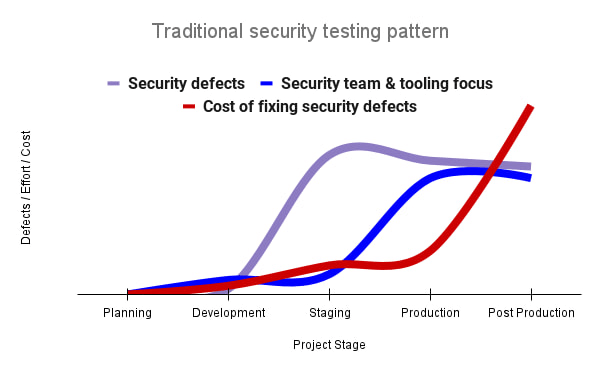
By inserting security testing into the development phase, we can identify security defects earlier and perform the appropriate remediation sooner. This results in fewer defects post-production and reduces remediation efforts and architectural changes. Figure 2 shows us that integrating security earlier in the SDLC results in overall decreases in security defects and associated remediation costs.
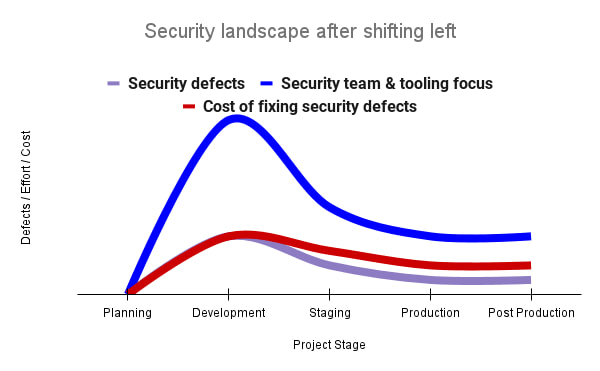
The 2021 State of DevOps Report expands the work of the 2016 report and advocates for integrating automated testing throughout the software development lifecycle. Automated testing is useful for continuously testing development code without the need for additional skills or intervention by the developer. Developers can continue to iterate quickly while other stakeholders can be confident that common defects are being identified and remediated.
From code to cloud
The DORA findings with regard to code security can also be applied to cloud infrastructure security. As more organizations deploy their workloads to the cloud, it’s important to test the security and configurations of cloud infrastructure. Misconfigurations in cloud resources can lead toward security incidents that could lead to data theft. Examples of such misconfigurations include overly permissive firewall rules, public IP addresses for VMs, or excessive Identity and Access Management (IAM) permissions on service accounts and storage buckets.
We can and should leverage different Google Cloud services to identify these misconfigurations early in the development process and prevent such errors from emerging in production to reduce the costs of future remediation, potential legal fines, and compromised customer trust.
The key tools in our toolshed are Security Command Center and Cloud Build. Security Command Center provides visibility into misconfigurations, vulnerabilities, and threats within a Google Cloud organization. This information is critical when protecting your cloud infrastructure (such as virtual machines, containers, web applications) against threats, or identifying potential gaps from compliance frameworks (such as CIS Benchmarks, PCI-DSS, NIST 800-53, or ISO 27001.
Security Command Center further supports shifting security left by allowing visibility of security findings at the cloud project level for individual developers, while still allowing global visibility for Security Operations. Cloud Build provides for the creation of cloud-native CI/CD pipelines. You can insert custom health checks into a pipeline to evaluate certain conditions (such as security metrics) and fail the pipeline when irregularities are detected. We will now explore two use cases that take advantage of these tools.
Security Health Checker
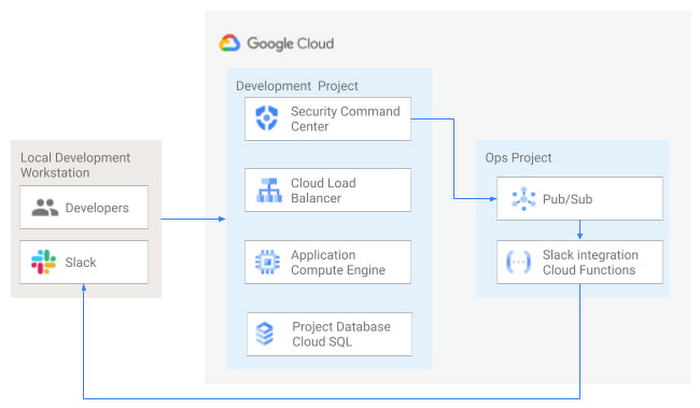
Security Health Checker continuously monitors the security health of a Google Cloud project and promptly notifies project members of security findings. Figure 3 shows developers interacting with a Google Cloud environment with network, compute, and database components. Security Command Center is configured to monitor the health of the project.
When Security Command Center identifies findings, it sends them to a Cloud Pub/Sub topic. A Cloud Function then takes the findings published to that topic and sends them to a Slack channel monitored by infrastructure developers. Just like a spell checker providing quick feedback on misspellings, Security Health Checker provides prompt feedback on security misconfigurations in a Google Cloud project that could lead to deployment failures or post-production compromises. No additional effort is required on the part of developers.
Security Pipeline Checker
In addition to using Security Command Center for timely notification of security concerns during the development process, we can also integrate security checks into the CI/CD pipeline by using Security Command Center along with Cloud Build as shown in Figure 4.
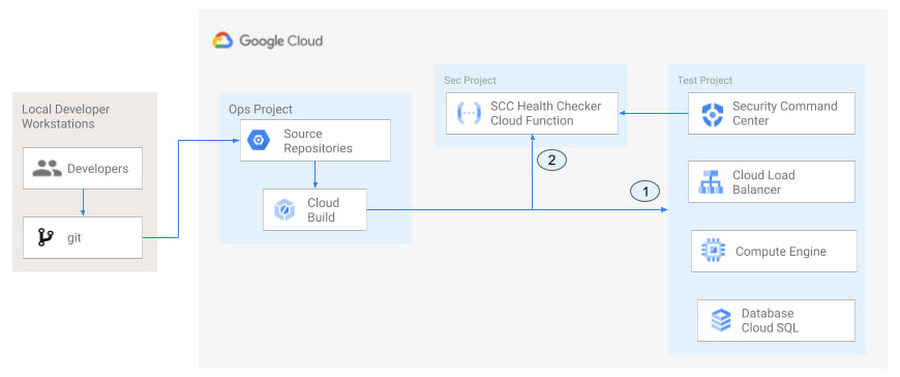
The pipeline begins with a developer checking code into a git repository. This repository is mirrored to Cloud Source Repositories. A build trigger will begin the build process. The build pipeline will include a short waiting period of a few minutes to give Security Command Center a chance to identify security vulnerabilities. A brief delay may appear undesirable at first, but the analysis that takes place during that interval can result in the reduction of security defects post-production.
At the end of the waiting period, a Cloud Function serving as a Security Health Checker will evaluate the findings from Security Command Center (Connector 1 in Figure 4). If the validator determines that unacceptable security findings exist, the validator will inject a failure indication into the pipeline to terminate the build process (Connector 2 in Figure 4). Developers have visibility into the failure triggers and remediate them before successfully deploying code to production. This is in contrast to the findings in the 2016 State of DevOps Report wherein organizations that didn’t integrate security into their DevOps processes spent 50% more time remediating security issues than those who “shifted left” on security.
Closing thoughts
DORA’s 2016 State of DevOps report called out the need for “shifting left” with security, introducing security earlier in the development process to identify security vulnerabilities early to reduce mitigation efforts post-production. The report also advocated for automated testing throughout the software development lifecycle.
We looked at two ways of achieving these objectives in Google Cloud. The Security Health Checker provides feedback to developers using Security Command Center and Slack to notify developers of security findings as they pursue their development activities. The Security Pipeline Checker uses Security Command Center as part of a Cloud Build pipeline to terminate a build pipeline if vulnerabilities are identified during the build process. To implement the Security Heath Checker and the Security Pipeline Checker, check out the GitHub repository. We hope these examples will help you to “shift left” using Google Cloud services. Happy coding!
This article was co-authored with Jason Bisson, Bakh Inamov, Jeff Levne, Lanre Ogunmola, Luis Urena, and Holly Willey, Security & Compliance Specialists at Google Cloud.
Bigbasket: Delivering Groceries Across 25 Cities in India

7306
Of your peers have already read this article.
1:30 Minutes
The most insightful time you'll spend today!
When Bigbasket was founded in December 2011, it guaranteed to deliver goods within a one-hour delivery slot of its customers’ choosing or it would refund them 10 percent of their orders. The company also introduced an express service, delivering groceries within 90 minutes of an order being placed.
Bigbasket needed a mapping platform that could help it meet its delivery times, and offer a familiar interface to customers. MediaAgility, a digital consulting company, recommended Google Maps Platform to Bigbasket.
When customers use the Bigbasket mobile app to place orders, they select their locations on a Google Map. The prices and availability of groceries varies according to location, so a customer’s location determines the cost of the order and what can be ordered.
Google Maps Platform Results
- Bigbasket handles more than one million orders per month, and delivers in more than two dozen cities in India
- Bigbasket now has more than four million customers
- Orders are delivered on time, increasing customer loyalty
It is also used to determine driver routes. Bigbasket used the Maps Javascript API to build a web-based app for the company’s backend that tracks all orders and delivery progress. Dispatchers use the Directions API to match drivers with orders and customers, and the Distance Matrix API to get estimate the time of arrival for deliveries. As dispatchers track the progress of deliveries on the map, they can tweak routes as necessary.
“We’ve built Bigbasket from the ground up using Google Maps Platform. It makes sure we have the right customer locations and deliver to them on time. We couldn’t have started Bigbasket without Google Maps. It helps us to be fast and efficient, and make sure our customers get what they’ve ordered quickly,” said Pramod Jajoo, Chief Technology Officer, Bigbasket
4165
Of your peers have already watched this video.
1:30 Minutes
The most insightful time you'll spend today!
Video: How Pitney Bowes Leveraged Apigee to Create New Revenue Streams
Headquartered in Stamford, Connecticut, Pitney Bowes helps businesses navigate the complex world of commerce. They enable organizations to send parcels and packages across the globe. Pitney Bowes serves 90 percent of Fortune 500 companies, has 90 plus years of innovation, supports 1.5 million small businesses and has 15,000 employees globally.
The company leveraged the Apigee platform and was able to create a self-service model for both its internal and external customers. The monetization capability of Apigee empowered the organization to create new revenue streams.
“The monetization capability of Apigee has helped us create new revenue streams and business models for Pitney Bowes. Now we have tens and millions of dollars in revenue that we never had in 2016,” says Roger Pilc, Chief Innovation Officer, Pitney Bowes.
Watch the full video to get more insights on how Apigee helped Pitney Bowes boost its business.
More Relevant Stories for Your Company


Telstra Leverages APIs To Accelerate Digital Transformation
Telstra is Australia’s leading telecommunications and technology company, offering a full range of communication services and competing in all telecommunications markets. In Australia, it provides 17.7 million retail mobile services, 4.9 million retail fixed voice services and 3.6 million retail fixed broadband services. But owing to legacy infrastructure the company

Swiggy: Delivering Local Food Within 40 Minutes
Founded in 2014, Swiggy started small, delivering food to a few neighborhoods in Bengaluru, India. As the company grew, the team wanted a mapping technology that could help expand the service throughout India. Swiggy needed a scalable mapping platform that covered a wide geographic area and offered tools to help

Learn About Kf: How it Helps Move Existing Cloud Foundry Workloads to Kubernetes
While many companies are writing brand-new Kubernetes-based applications, it’s still quite common to find companies who want to migrate existing workloads. A common source platform for these applications is Cloud Foundry. However, getting an existing Cloud Foundry application running on Kubernetes can be non-trivial, especially if you want to avoid

AgroStar: Small farms in India getting big help from the cloud
AgroStar has launched a cloud-based mobile app that is helping to boost crop yields and encourage best practices for small farmers in India. Launched as an on-premises ecommerce platform selling farm tools in 2008, the firm turned to Google Cloud Platform (GCP) to expand its offering. It now uses cloud-based analytics and is
