





Grofers Turns to Google Cloud for Building Delivery System

4783
Of your peers have already read this article.
2:00 Minutes
The most insightful time you'll spend today!
About Grofers
Grofers is an India-based local mobile e-commerce platform that delivers groceries, fruits and vegetables, cosmetics and electronics. Customers use Grofers’ mobile app to shop for products from local stores in 17 cities in India.

Google Cloud Results
- Scaled from 10,000 orders to more than 70,000 orders a day
- Increased the average number of deliveries per driver from five to nearly 15
- Maintains 100 percent uptime
India-based Grofers is a hyperlocal mobile platform that delivers groceries, fruits and vegetables, cosmetics and electronics. Customers use Grofers’ mobile app to shop for products from local stores in 17 cities in India.
In 2015, the number of deliveries Grofers fulfilled was growing at the rate of 10 times a month, and its delivery system struggled under the stress. When traffic spiked on weekends, its database frequently crashed. Fulfilling and delivering orders depended on manual processes such as telephone calls. Grofers needed a solution that would allow it to quickly scale and improve its delivery process.
Building an entire backend in two weeks
When Grofers launched in 2013, the logistics system was entirely manual. Staff at the headquarters called delivery drivers with order details and delivery addresses. Drivers then decided what order to pick up goods from local merchants. With a small number of customers and orders, that wasn’t a problem. But the manual system couldn’t handle growth. Grofers recognized it had to automate the system.
To do that, it turned to Google Cloud Platform. Grofers built a new backend for its delivery system using Google App Engine. When an order arrives, the new system looks at the status of all drivers — including their current location, the order he’s completing, and the pickup and delivery locations on the route. Based on that information, the system calculates the optimal driver for each order and sends the driver the order via a mobile app.
The system also takes advantage of Google Cloud Endpoints, which generates libraries for Javascript, iOS and Android. Grofers used Google Cloud Endpoints to create mobile apps to communicate with its delivery staff.
Scaling fast, dramatically improving delivery metrics
With the new backend and mobile apps, Grofers can scale quickly to keep up with its rapid growth. Grofers now delivers 70,000 orders per day, up from 10,000 before the GCP deployment, and has had 100 percent uptime. Each driver handles an average of 15 orders per day, compared to only five previously, letting Grofers handle more work with less staff. All this has been accomplished at very low cost: Prakash says that GCP costs account for only two percent of the company’s infrastructure spending. Without GCP, Prakash says the backend would be far more expensive and account for up to 50 percent of the company’s infrastructure expenses.
How Cloud Networks Enable CSPs to Deliver 5G

5116
Of your peers have already read this article.
3:00 Minutes
The most insightful time you'll spend today!
Communication services providers (CSPs) are experiencing a period of disruption. Overall revenue growth is decelerating and is projected to remain below 1 percent per year, following a trend that started even before the pandemic.1 At the same time, driven by the pandemic, data consumption in 2020 increased by 30 percent relative to 2019, with some operators even reporting increases of 60 percent.2
The combination of pressure on revenues with rising data traffic costs is forcing operators to innovate in three fundamental ways. First, operators are looking to establish new sources of revenue. Second, increased network utilization must be met with a reduction in network cost. And third, there is an opportunity to gain new customers by improving the customer experience.
Fortunately, 5G offers a path forward across each of these three areas. Concepts such as network slicing and private networks allow CSPs to offer differentiated network services to public sector and enterprise customers. The disaggregation of hardware and software allows new vendors with unique strengths to enter the market and to enable CSPs to build, deploy, and operate networks in fundamentally new ways. And the ability to place workloads at the edge permits CSPs to offer compelling experiences to consumers and businesses alike. In this blog, we will discuss how CSPs can create a solid foundation for their cloud networks.
Understanding telecommunications networks
First, it is useful to consider the way telecommunications networks were traditionally built. Initially, networks were built using physical network functions (PNFs) — appliances that used a tight combination of hardware and software to perform a specific function. PNFs offered the benefit of being purpose-built for a specific application, but they were inflexible and difficult to upgrade. As an example, deploying new features frequently required replacing the entire PNF, i.e., deploying a new hardware appliance.
The first step in improving deployment agility came with the concept of virtualized network functions (VNFs), software workloads designed to operate on commercial off-the-shelf (COTS) hardware. Rather than utilizing an integrated hardware and software appliance, VNFs disaggregated the hardware from the software. As such, it became possible to procure the hardware from one vendor and the software from another. It also became possible to separate the hardware and software upgrade cycles.
However, while VNFs offered advantages over PNFs, VNFs were still an intermediate step. First, they typically needed to be run within a virtual machine (VM), and as such required a hypervisor to interface between the host operating system (OS) and the guest OS inside the VM. The hypervisor consumed CPU cycles and added inefficiency. Second, the VNF itself was frequently designed as a monolithic function. This meant that while it was possible to upgrade the VNF separately from the hardware, such an upgrade, even for a feature that affected only a portion of the VNF, required deployment of the entire large VNF. This created risk and operational complexity, which in turn meant that upgrades were delayed just as they were with PNFs.
Creating the foundation for cloud networks
The trick to establishing your cloud based network resides in the challenge of moving from VNFs to containerized network functions (CNFs) — network functions organized as containers as a collection of small programs, each of which can be independently operated.
The concept of containers is not new. In fact, Google has been using containerized workloads for over 15 years. Kubernetes, which Google developed and open-sourced, is the world’s most popular container orchestration system, and is based on Borg, Google’s internal container management system.3 There are lots of benefits to using containers, but fundamentally, it frees developers from worrying about resource scheduling, interprocess communication, security, self-healing, load balancing, and many other tedious (but important!) tasks.
Consider just a couple examples of benefits that containerization brings to network functions. First, when upgrading the network function to implement new features, you no longer need to re-deploy the entire network function. Instead, you only need to re-deploy the containers that are affected by the upgrade. This improves developer velocity and reduces the risk of the upgrade because, rather than infrequent upgrades that each introduce substantial changes, you can now have frequent upgrades that each deploy small changes. Small changes are less risky because they are easier to understand and to roll back in case of anomaly. Incidentally, this also improves your security posture because it reduces the time between when a security vulnerability is discovered and when a patch is deployed.
Speaking of security, another example of the benefits that containerization brings to network functions is an automatic zero-trust security posture. In Kubernetes, the communication among microservices can be handled by a service mesh, which manages mundane aspects of inter-services communication such as retries in case of failure and providing observability into communication. It can also manage other essential aspects such as security. For example, Anthos Service Mesh, which is a fully-managed implementation of the open-source Istio service mesh (also co-developed by Google), includes the ability to authenticate and encrypt all communications using mutual TLS (mTLS) and to deploy fine-grained access control for each individual microservice.
Automation and orchestration for cloud networks
CNFs bring tremendous benefits, but they also bring challenges. In place of a relatively small number of network appliances, we now have a large number of containers, each of which requires configuration, management, and maintenance. In the past, many of these processes were accomplished using manual techniques, but this is impossible to accomplish economically and reliably at the scale required by CNFs.
Fortunately, there are cloud-native approaches to solving these challenges. First, consider the problem of autonomously deploying and maintaining CNFs. The ideal way is to use the concept of Configuration as Data. Unlike imperative techniques such as Infrastructure as Code, which provide a detailed description of a sequence of steps that need to be executed to achieve an objective, Configuration as Data is a declarative method whereby the user specifies the desired end state (i.e., the actual desired configuration) and relies on automated controllers to continuously drive the infrastructure to achieve that state. Kubernetes includes such automated controllers, and the great news is that this method can be used not just for infrastructure but also for the applications residing on top of it, including CNFs. This cloud-native technique frees you from the toil and associated risk of writing detailed configuration procedures, so you can focus on the business logic of your applications.
As another example, consider the problem of understanding your network performance, including anomaly detection, root cause analysis, and resolution. The cloud-native approach starts with creating a data platform where both infrastructure and CNF monitoring data can be ingested, regularized, processed, and stored. You can then correlate data sets against each other to detect anomalies, and with AI/ML techniques, you can even anticipate anomalies before they happen. AI/ML is likewise indispensable in gaining an understanding of why the anomaly is happening, i.e. performing root cause analysis, and automated closed-loop controllers can be developed to correct the problem, ideally before it even happens.
Architecting for the edge
The transition from VNFs to CNFs is a critical piece in addressing the challenge that CSPs face today, but it alone is not enough. CNFs need infrastructure to run on, and not all infrastructure is created equal.
Consider a typical 5G network. There are some functions, such as those associated with an access network, that need to be deployed at the edge. These functions require low latency, high throughput, or even a combination of the two. In 5G networks, examples of such functions include the radio unit (RU), distributed unit (DU), centralized unit (CU), and the user plane function (UPF). The first three are components of the radio access network (RAN), while the last is a component of the 5G core. At the same time, there are some other control plane functions such as the session management function (SMF) or the authentication and mobility management function (AMF) that do not have such tight latency and high throughput requirements and can thus be placed in a more centralized data center. Furthermore, consider an AI/ML use case where a particular model (perhaps for radio traffic steering) needs to run at the network edge because of its latency requirements. While the model itself needs to run at the edge, model training (i.e., generating the model coefficients) is frequently a compute-intensive exercise that is latency-insensitive and is thus more optimal to run in a public cloud region.
All of these use cases have one thing in common: they call for a hybrid deployment environment. Some applications must be deployed at the edge as close to the user as possible. Others can be deployed in a more centralized environment. Still others can be deployed in a public cloud region to take advantage of the large amount of compute and economies of scale available therein. Wouldn’t it be convenient — if not transformational — if you could use a single environment for deploying at the edge, in a private datacenter, and in public cloud, with a consistent set of security, lifecycle management, policy, and orchestration resources across all such locations? This is indeed what Google Distributed Cloud, enabled by Anthos, brings to the table.
With Google Distributed Cloud, you can architect a 5G network deployment such as the one shown below.

Business benefits of cloud networks
Beyond the technical benefits, consider the business benefits of such an architecture. First, by following the best practices of hardware and software disaggregation, it permits the CSP to procure the infrastructure and the network functions from different vendors, spurring competition among vendors. Second, each workload is placed in precisely the right location, enabling efficient utilization of hardware resources and offering compelling low-latency, high-throughput services to users. Third, because the architecture utilizes a common hybrid platform (Anthos), it makes it easy to move workloads across infrastructure locations. Fourth, the separation of workloads into microservices accelerates time-to-market when developing new features or applications, such as those enabling enterprise use cases. And finally, the container management platform supports the simultaneous deployment of both network functions and edge applications on the same infrastructure, allowing the operator to deploy new experiences such as AR/VR directly on bare metal as close to the user as possible.
The next generation cloud network is now
There is a lot more we could say, but perhaps the most important takeaway is that this architecture is not a future dream. It exists today, and Google is working with leading CSPs and network vendor partners to deploy it, helping them realize the promise of 5G to deliver new revenues, reduce operating costs, and enable new customer experiences.
To learn more, watch the video series on the cloudification of CSP networks.
Discover what’s happening at the edge: How CSPs Can Innovate at the Edge.
1.Statista, Forecast growth worldwide telecom services spending from 2019 to 2024
2 PricewaterhouseCoopers, Global entertainment and media outlook 2021-2025
3. Borg: The Predecessor to Kubernetes
Google Cloud’s 101 Illustrated References for Cloud Engineers and Architects

3376
Of your peers have already read this article.
1:30 Minutes
The most insightful time you'll spend today!
Many people are visual learners; I am definitely one of them, and judging by the tremendous response you all showed to Google Cloud Sketchnotes on LinkedIn and Twitter, you are too.
-Priyanka Vergadia, Lead Developer Advocate, Google
“A picture is worth a thousand words”
Shortly after I started creating and sharing visual explanations of Google Cloud concepts in late 2020, I began receiving overwhelmingly positive feedback from fellow cloud architects and enthusiasts. That feedback led me to think about pulling these sketches together into a reference guide — a one-stop shop for cloud learning fun. So here it is!
🥁 Introducing “Visualizing Google Cloud: 101 Illustrated References for Cloud Engineers and Architects”
🤔 What is this book about?
This book is my way of making Google Cloud technical concepts fun and interesting via visual storytelling. It covers Google Cloud essentials from end to end, with a visual explanation of each concept, how it works, and how you can apply it with other concepts to meet the needs of your real-world use case. After reading thousands of pages of Google Cloud documentation and experimenting with virtually every Google Cloud product, I distilled that experience down to this book of accessible, bite-sized visuals.
The sketches are spread across five broad categories:
- Infrastructure, storage, and databases: Run and scale applications seamlessly
- Data analytics and machine learning: Derive actionable insights from data
- Networking: Connect, scale, secure, modernize, and optimize your infrastructure
- Application development and modernization: Build apps using containers and microservices
- Security: Protect data, users, and applications in cloud
🙋♀️ Who is this book for?
It is for all cloud enthusiasts. It is for anyone who is planning a cloud migration or new cloud deployment, preparing for cloud certification, or looking to make the most of Google Cloud. If you are a cloud solutions architect, an IT decision-maker, or a data and machine learning engineer, you will find this book a good starting point. In short, this book is for YOU!
When you get the book you’ll not only help yourself, you’ll also help provide meals for schoolchildren who need them. All the books’ proceeds go directly to the awesome folks at Wiley and a charity that fights malnutrition and supports the right to education.
🪜 Next Steps
I hope this book helps you on your Google Cloud journey by making it both easier and more fun. Are you ready to dive in? Order here, learn more about how the idea of the book came about here and please share your thoughts with me on Twitter or LinkedIn.
3437
Of your peers have already downloaded this article
1:30 Minutes
The most insightful time you'll spend today!
Enterprises developing digital leadership are increasingly moving out of their data centers to focus on core business innovation, and save on complex infrastructure costs. This puts challenges related to demand peaks and business continuity under a magnifying glass.
Many CIOs are under pressure to complete migrations quickly — 68% of CIOs are seeking to migrate existing applications to the cloud, according to Forrester. Motivations range from cost or risk reductions, to refocusing on agility and speed.
As they assess their options, many enterprises face an enormous challenge of balancing the function of their existing infrastructure with a new operating model in the cloud. This involves thousands of variables, different technologies, different processes and skills, disparate teams, and competing interests.
Download this guide and see hoo to craft a strategy out of the data center and into public cloud. It surfaces typical industry patterns, key dimensions to be taken into account while designing the journey, as well as Google’s capabilities and approach to executing a successful modernization, to help you drive lower costs and increased agility.
Synopsys & Google Cloud: Helping Semiconductor Companies Drive Electronic Design Automation Innovation

2852
Of your peers have already read this article.
2:30 Minutes
The most insightful time you'll spend today!
Google Cloud and Synopsys Inc are partnering to help semiconductor companies drive Electronic Design Automation (EDA) innovation in the cloud to accelerate time to market, and lower costs across the entire semiconductor product life cycle. Synopsys is the industry’s largest provider of EDA technology used in the design and verification of integrated circuits, or semiconductor chips. Bringing Synopsys technology onto Google Cloud enables customers to benefit from scalable cloud bursting and complementary licensing models to help them quickly deploy and scale Synopsys’ EDA tools. Semiconductor companies can significantly accelerate chip design and production, increase designer productivity, and empower innovation in power-performance-area optimization.
Google Cloud Platform has enabled high performance computing workloads, such as those used by today’s semiconductor chip designers, to deliver exceptionally fast results and reduce prototyping from years to months. Google Cloud’s HPC services have delivered highly scalable solutions across multiple industries – from scientific research to autonomous vehicle testing and simulation.
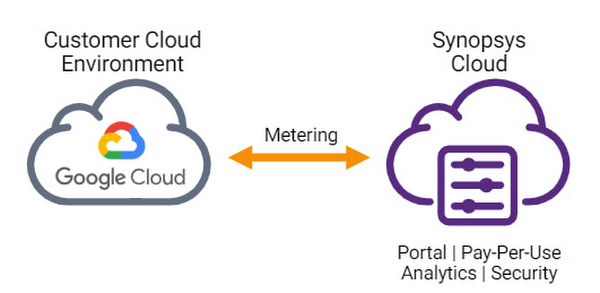
EDA software is a large consumer of high performance computing capacity in the cloud. With the release of Synopsys Cloud bring-your-own-cloud (BYOC) solution on Google Cloud, chip designers can now scale their Google Cloud infrastructure with Synopsys’s leading EDA tools under the flexible FlexEDA pay-per-use model and access unlimited EDA software license availability on-demand by the hour or minute.
The Synopsys Cloud BYOC deployment architecture on Google Cloud is enabled through their unique cloud metering service which uses Google Cloud regional MIGs (Managed Instance Groups) for autoscaling and multi-zone deployment. This enables the service to scale up to meet customer workload demands and scale down to optimize costs. Secrets used by Synopsys Cloud are securely stored in Google Secret Manager and usage data is encrypted using Google Cloud key management, providing customers with a highly secure design environment.
Synopsys Cloud also leverages Google Cloud’s Ops Agent and Operations Suite Dashboards are used to show metric data, alerting policies, and log entries, providing customers with detailed analytics visibility to make better chip design project lifecycle management decisions. The Synopsys Cloud BYOC solution has been validated with EDA workloads scaling out to thousands of cores on Google Cloud, using Google Filestore network file storage during validation to provide the highest throughput performance.
Vikram Bhatia, Head, Synopsys Cloud Product Management, Synopsys said, “With the release of Synopsys Cloud BYOC solution on Google Cloud, we are transforming the way our mutual semiconductor customers can design the chips of the future. Google Cloud has been leading the innovation wave for semiconductors in the cloud and we are excited about being an early adopter in leveraging those innovations for our unique EDA offerings on the cloud.” Customers can evaluate a full featured Synopsys Cloud BYOC environment on Google Cloud for free by signing up at: synopsys.com/cloud.
“Combined with GCP’s unique platform services for AI, security, and shared storage, the Synopsys Cloud BYOC solution creates a compelling package for semiconductor designers who will create the next generation of chips for the world’s insatiable needs” says Simon Floyd, Industry Director, Manufacturing & Transportation, Google Cloud.
Google Cloud provides everything you need, including free Google Cloud credits to get you up and running. Click here to learn more about Semiconductors on Google Cloud.
A Pro’s Tip on Choosing the Right Google Cloud Compute Options

5720
Of your peers have already read this article.
2:00 Minutes
The most insightful time you'll spend today!
Where should you run your workload? It depends…Choosing the right infrastructure options to run your application is critical, both for the success of your application and for the team that is managing and developing it. This post breaks down some of the most important factors that you need to consider when deciding where you should run your stuff!
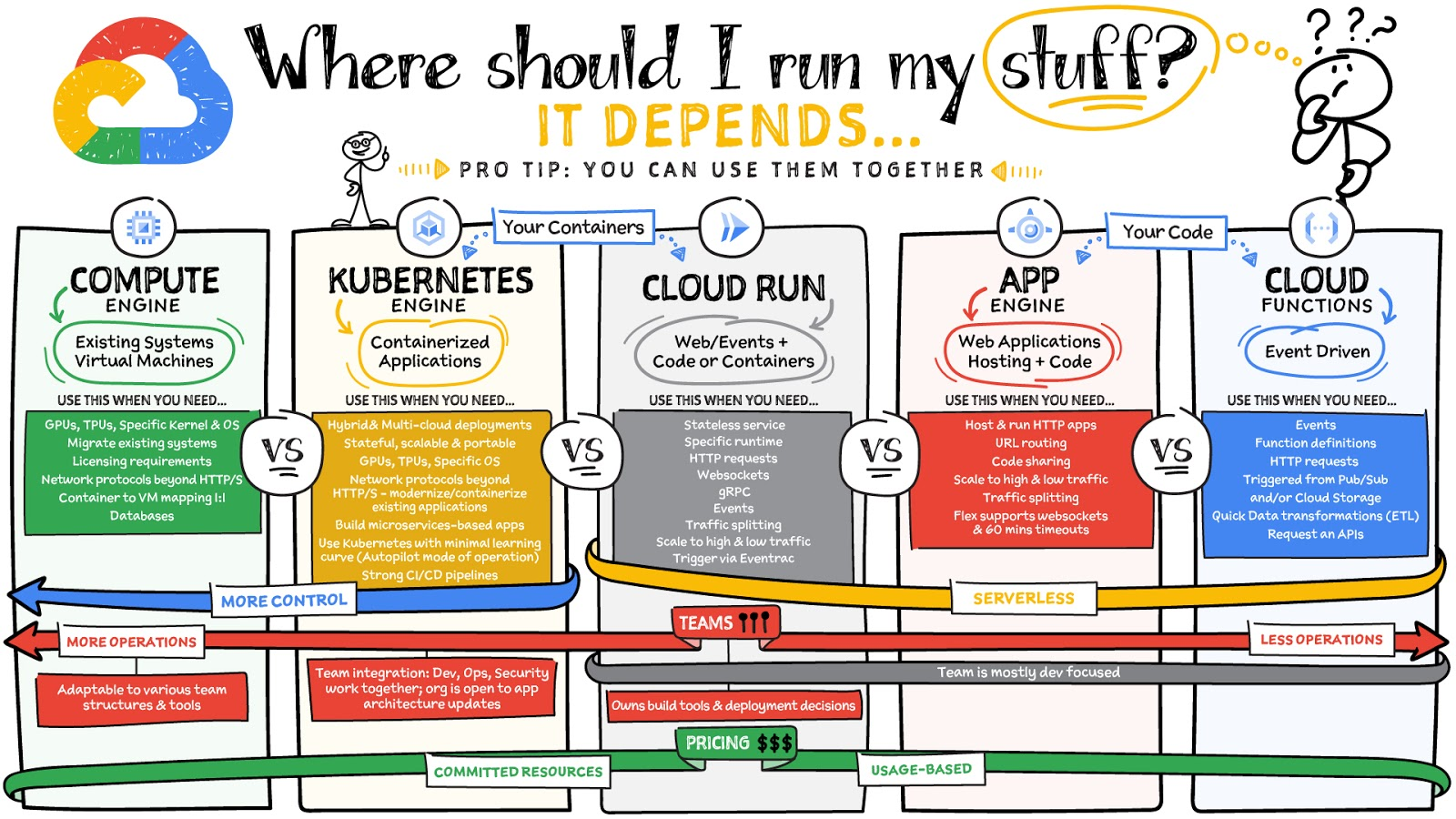
What are these services?
- Compute Engine – Virtual machines. You reserve a configuration of CPU, memory, disk, and GPUs, and decide what OS and additional software to run.
- Kubernetes Engine – Managed Kubernetes clusters. Kubernetes is an open-source system for automating deployment, scaling, and management of containerized applications. You create a cluster and configure which containers to run; Kubernetes keeps them running and manages scaling, updates and connectivity.
- Cloud Run – A fully managed serverless platform that runs individual containers. You give code or a container to Cloud Run, and it hosts and auto scales as needed to respond to web and other events.
- App Engine – A fully managed serverless platform for complete web applications. App Engine handles the networking, application scaling, and database scaling. You write a web application in one of the supported languages, deploy to App Engine, and it handles scaling, updating versions, and so on.
- Cloud Functions – Event-driven serverless functions. You write individual function code and Cloud Functions calls your function when events happen (for example, HTTP, Pub/Sub, and Cloud Storage changes, among others).
What level of abstraction do you need?
- If you need more control over the underlying infrastructure (for example, the operating system, disk images, CPU, RAM, and disk) then it makes sense to use Compute Engine. This is a typical path for legacy application migrations and existing systems that require a specific OS.
- Containers provide a way to virtualize an OS so that multiple workloads can run on a single OS instance. They are fast and lightweight, and they provide portability. If your applications are containerized then you have two main options.
- You can use Google Kubernetes Engine, or GKE, which gives you full control over the container down to the nodes with specific OS, CPU, GPU, disk, memory, and networking. GKE also offers Autopilot, when you need the flexibility and control but have limited ops and engineering support.
- If, on the other hand, you are just looking to run your application in containers without having to worry about scaling the infrastructure, then Cloud Run is the best option. You can just write your application code, package it into a container, and deploy it.
- If you just want to code up your HTTP-based application and leave the scalability and deployment of the app to Google Cloud then App Engine — a serverless, fully-managed option that is designed for hosting and running web applications — is a good option for you.
- If your code is a function and just performs an action based on an event/trigger, then deploying it with Cloud Functions makes sense.
What is your use case?
- Use Compute Engine if you are migrating a legacy application with specific licensing, OS, kernel, or networking requirements. Examples: Windows-based applications, genomics processing, SAP HANA.
- Use GKE if your application needs a specific OS or network protocols beyond HTTP/s. When you use GKE, you are using Kubernetes, which makes it easy to deploy and expand into hybrid and multi-cloud environments. Anthos is a platform specifically designed for hybrid and multi-cloud deployments. It provides single-pane-of-glass visibility across all clusters from infrastructure through to application performance and topology. Example: Microservices-based applications.
- Use Cloud Run if you just need to deploy a containerized application in a programming language of your choice with HTTP/s and websocket support. Examples: websites, APIs, data processing apps, webhooks.
- Use App Engine if you want to deploy and host a web based application (HTTP/s) in a serverless platform. Examples: web applications, mobile app backends
- Use Cloud Functions if your code is a function and just performs an action based on an event/trigger from Pub/Sub or Cloud Storage. Example: Kick off a video transcoding function as soon as a video is saved in your Cloud Storage bucket.
Need portability with open source?
If your requirement is based on portability and open-source support take a look at GKE, Cloud Run, and Cloud Functions. They are all based on open-source frameworks that help you avoid vendor lock-in and give you the freedom to expand your infrastructure into hybrid and multi-cloud environments. GKE clusters are powered by the Kubernetes open-source cluster management system, which provides the mechanisms through which you interact with your cluster. Cloud Run for Anthos is powered by Knative, an open-source project that supports serverless workloads on Kubernetes. Cloud Functions use an open-source FaaS (function as a service) framework to run functions across multiple environments.
What are your team dynamics like?
If you have a small team of developers and you want their attention focused on the code, then a serverless option such as Cloud Run or App Engine is a good choice because you won’t have to have a team managing the infrastructure, scale, and operations. If you have bigger teams, along with your own tools and processes, then Compute Engine or GKE makes more sense because it enables you to define your own process for CI/CD, security, scale, and operations.
What type of billing model do you prefer?
Compute Engine and GKE billing models are based on resources, which means you pay for the instances you have provisioned, independent of usage. You can also take advantage of sustained and committed use discounts.
Cloud Run, App Engine, and Cloud Functions are billed per request, which means you pay as you go.
Conclusion
It’s important to consider all the relevant factors that play a role in picking appropriate compute options for your application. Remember that no decision is necessarily final; you can always move from one option to another.
To explore these points in more detail, please take a look at the “Where Should I Run My Stuff?” video.
For more #GCPSketchnote, follow the GitHub repo & thecloudgirl.dev. For similar cloud content follow us on Twitter at @pvergadia and @briandorsey
More Relevant Stories for Your Company

You Can Now ‘Listen’ to Over 50 Tech Blogs on Google Cloud Reader
🎧 Prefer to listen? Check out this episode on the Google Cloud Reader podcast If you’re anything like me, you love reading, but also appreciate that sometimes your eyes need to be doing other things; whether it’s finding your exit off the highway, or keeping your puppy from destroying the couch. And

IBM Spectrum LSF and Google Collab: Leverage Google Cloud’s Scalability and Compute Engine Infrastructure
High Performance Computing (HPC) is prevalent today across many industries, including financial services, life sciences, higher education research, manufacturing, and energy. More and more businesses are deploying HPC workloads in the cloud to take advantage of its elasticity, scalability, and availability. Job schedulers are critical for HPC applications given the nature of

Building a Stronger South Bend through Cloud Computing Education
The city of South Bend, Indiana has announced they are working with Google Cloud to connect 500 local job seekers with no-cost access to Google Cloud Skills Boost through Upskill SB. This initiative will train, upskill, and certify residents in cloud computing skills to create pathways to technical jobs. As companies, nonprofits, and
Know Your Org’s Carbon Emission Per Workload with Active Assist
Last year, we analyzed the aggregate data from all customers across Google Cloud, and found over 600,000 gross kgCO2e in seemingly idle projects that could be cleaned up or reclaimed — which would have a similar impact to planting almost 10,000 trees1. Today, we’re making it easy for you to identify if
