





AI-powered Business Messages for Timely, Engaging and Helpful Conversations with Customers

9400
Of your peers have already read this article.
2:00 Minutes
The most insightful time you'll spend today!
Over the last two years, we’ve seen a significant uptick in the number of people using messaging to connect with businesses. Whether it was checking hours of operation, verifying what was in stock, or scheduling a pick-up, the pandemic caused a significant shift in consumer behavior.
- 45% of users are spending more time on messaging services because of the pandemic
- 85% of consumers would like to message brands directly
With the rise in demand for messaging, consumers expect communication with businesses to be speedy, simple, and convenient. For businesses, keeping up with customer inquiries can be a labor-intensive process, and offering 24/7 support outside of store hours can be costly.
To help businesses seamlessly deliver helpful, timely, and engaging conversations with customers when and where they need help, we introduced AI-powered Business Messages.
https://youtube.com/watch?v=fcgP3RHjBLY%3Fenablejsapi%3D1%26
What is AI-powered Business Messages?
With AI-powered Business Messages, you can connect with your customers in their moment of need, in the places they’re looking for answers—such as Google Search, Google Maps, or any brand-owned channel. For instance, check out how Walmart customers in the US are able to receive real-time information on product availability, straight from a search results page.
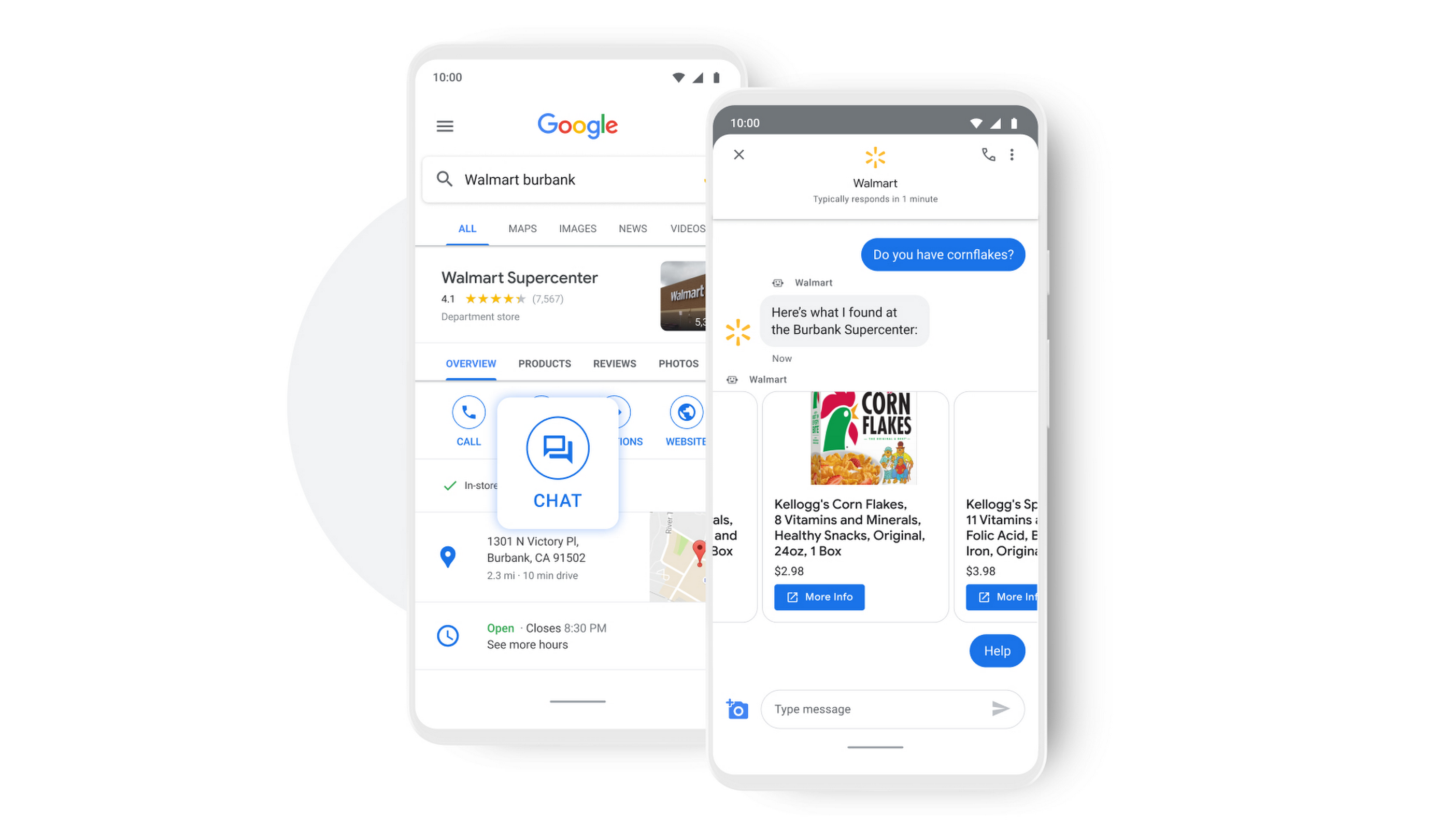
People turn to Google when they are searching for answers to their questions, looking to buy something, or trying to accomplish a particular task with one of our many tools. In fact, 68% of all online experiences begin with a search engine.
At Google, we know how important it is for interactions with a brand to be personalized, helpful, and simple. With AI-powered Business Messages, customers are able to chat with virtual agents that understand, interact, and respond in natural ways.
We are also combining smart automation with the ability for customers to chat with live agents when it’s really needed. This approach saves your customers precious time, while also saving you money. And with Business Messages automatically handling many customer inquiries in the background, businesses have the option to distribute their human customer service agents to address other needs.
Getting started with conversational AI is easy with Bot-in-a-Box
We know it can be difficult to get started with AI. That’s why we are utilizing existing Google AI tools like Dialogflow—part of Google Cloud Contact Center AI—to create the capability within Google’s Business Messages called Bot-in-a-Box, which makes getting started with Conversational AI easy. Bot-in-a-Box allows for fast and effective adoption of automation for businesses of all sizes.
Enabling Business Messages with Bot-in-a-Box can be as simple as leveraging an existing customer FAQ document you already have, whether it’s from a web page or an internal document. And since the conversational AI is powered by Business Messages and Dialogflow working together, your chat bot is able to understand and respond to customer questions automatically without the need to write code.
Bot-in-a-Box also supports other critical journeys like “Custom Intents.” That means that your bot is able to understand the different ways customers express a similar question and respond accurately by using machine learning capabilities.

Finding success
In April 2021, Wake County courthouses in North Carolina partnered with Tango Technology to implement Business Messages when it became apparent that being able to provide the public and attorneys with around-the-clock access to information would significantly reduce the pressure on courthouse staff. Using Bot-in-a-Box, Tango Technology was able to customize a solution for Wake County Courthouse, Justice Center, and Clerk of Superior Court in just four days.
“With the combination of Google’s Business Messages, GCP, and Dialogflow, we were able to spin up an AI-driven bot for the courts in days. And the technology stack allows us to continually improve by adding functionality in an agile process.”— Mike Lotz, Co-Founder, Tango Technology
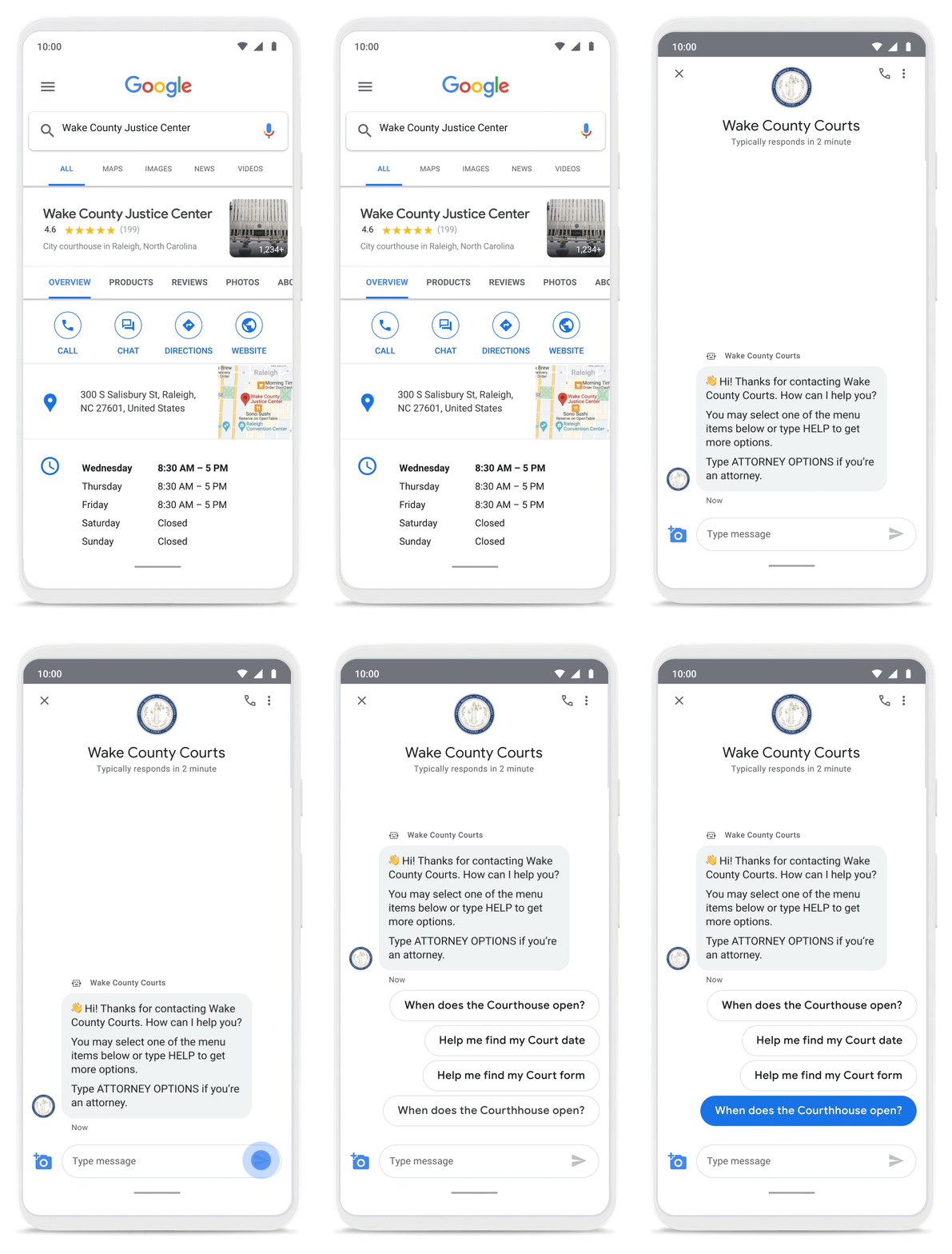
With Business Messages, North Carolina courthouses saw a 37% decrease in the call volume handled by courthouse staff. With 398,298 fewer phone calls during the first year of operation, the AI-based messages helped Wake County Courthouse work more efficiently and productively.
We’ve seen many brands benefiting from AI-powered Business Messages. For instance, Levi’s saw a 30% increase in off-hours shoppers and surpassed 85% customer satisfaction scores after implementing Business Messages. They also drove 30x more store-related questions than Levi’s website chat.
Bring Google’s conversational AI to your storefront with Business Messages
Google’s Business Messages makes it easier for businesses of all sizes to engage their existing or potential customers in a virtual conversation, when and where they need it.
To learn more, watch our Cloud Next session here or visit us at g.co/businessmessages. We have specialized services to help you get started and can share the wisdom of our channel partners and dedicated experts who specialize in unleashing the potential of conversational AI.
Delivering 10X Improvement to Risk and Regulatory Reporting Through Cloud and AI
5003
Of your peers have already read this article.
2:30 Minutes
The most insightful time you'll spend today!
Enterprise agility and the ability to innovate, adapt and respond quickly to the ever-changing risk and regulatory landscape is no longer a choice, but the cornerstone of successful digital transformation and commercial growth. Traditional access to and ways of managing data invariably create challenges in dealing with multiple data repositories, reconciliations, fire-drills, etc.
In response, the move to cloud is increasing significantly. It enables risk analytics and regulatory reporting at scale in a secure environment with data storage, management and encryption capabilities as a standard. In addition, as regulatory reporting requirements become more granular, machine learning can help facilitate new insights and allow for risk management to become more embedded into operational processes.
This webinar will address the day-to-day challenges in risk management and regulatory compliance, while also exploring how technological innovations can provide massive improvements and potential.
Key themes
- Real-life data challenges in the eyes of risk managers: can compliance, fraud detection and identifying liquidity positions be improved through the use of AI?
- Innovative approaches to streamline regulatory reporting to derive deeper customer insights from data at the moment of truth.
- Reimagining operations: how to modernise the data infrastructure to accommodate data explosion, drive flexibility and deliver a more cost effective outcome.
5584
Of your peers have already watched this video.
1:30 Minutes
The most insightful time you'll spend today!
A Quick Guide to Cloud Monitoring
Cloud Monitoring is a tool that allows you to gain visibility into the performance, availability, and health of your applications and infrastructure. In this video, we show you what Cloud Monitoring is and how you can use it to custom define service-level objectives (SLOs), monitor application metrics, and the overall health of your applications infrastructure. Watch to learn how you can use Cloud Monitoring!
How Cloud Networks Enable CSPs to Deliver 5G

5149
Of your peers have already read this article.
3:00 Minutes
The most insightful time you'll spend today!
Communication services providers (CSPs) are experiencing a period of disruption. Overall revenue growth is decelerating and is projected to remain below 1 percent per year, following a trend that started even before the pandemic.1 At the same time, driven by the pandemic, data consumption in 2020 increased by 30 percent relative to 2019, with some operators even reporting increases of 60 percent.2
The combination of pressure on revenues with rising data traffic costs is forcing operators to innovate in three fundamental ways. First, operators are looking to establish new sources of revenue. Second, increased network utilization must be met with a reduction in network cost. And third, there is an opportunity to gain new customers by improving the customer experience.
Fortunately, 5G offers a path forward across each of these three areas. Concepts such as network slicing and private networks allow CSPs to offer differentiated network services to public sector and enterprise customers. The disaggregation of hardware and software allows new vendors with unique strengths to enter the market and to enable CSPs to build, deploy, and operate networks in fundamentally new ways. And the ability to place workloads at the edge permits CSPs to offer compelling experiences to consumers and businesses alike. In this blog, we will discuss how CSPs can create a solid foundation for their cloud networks.
Understanding telecommunications networks
First, it is useful to consider the way telecommunications networks were traditionally built. Initially, networks were built using physical network functions (PNFs) — appliances that used a tight combination of hardware and software to perform a specific function. PNFs offered the benefit of being purpose-built for a specific application, but they were inflexible and difficult to upgrade. As an example, deploying new features frequently required replacing the entire PNF, i.e., deploying a new hardware appliance.
The first step in improving deployment agility came with the concept of virtualized network functions (VNFs), software workloads designed to operate on commercial off-the-shelf (COTS) hardware. Rather than utilizing an integrated hardware and software appliance, VNFs disaggregated the hardware from the software. As such, it became possible to procure the hardware from one vendor and the software from another. It also became possible to separate the hardware and software upgrade cycles.
However, while VNFs offered advantages over PNFs, VNFs were still an intermediate step. First, they typically needed to be run within a virtual machine (VM), and as such required a hypervisor to interface between the host operating system (OS) and the guest OS inside the VM. The hypervisor consumed CPU cycles and added inefficiency. Second, the VNF itself was frequently designed as a monolithic function. This meant that while it was possible to upgrade the VNF separately from the hardware, such an upgrade, even for a feature that affected only a portion of the VNF, required deployment of the entire large VNF. This created risk and operational complexity, which in turn meant that upgrades were delayed just as they were with PNFs.
Creating the foundation for cloud networks
The trick to establishing your cloud based network resides in the challenge of moving from VNFs to containerized network functions (CNFs) — network functions organized as containers as a collection of small programs, each of which can be independently operated.
The concept of containers is not new. In fact, Google has been using containerized workloads for over 15 years. Kubernetes, which Google developed and open-sourced, is the world’s most popular container orchestration system, and is based on Borg, Google’s internal container management system.3 There are lots of benefits to using containers, but fundamentally, it frees developers from worrying about resource scheduling, interprocess communication, security, self-healing, load balancing, and many other tedious (but important!) tasks.
Consider just a couple examples of benefits that containerization brings to network functions. First, when upgrading the network function to implement new features, you no longer need to re-deploy the entire network function. Instead, you only need to re-deploy the containers that are affected by the upgrade. This improves developer velocity and reduces the risk of the upgrade because, rather than infrequent upgrades that each introduce substantial changes, you can now have frequent upgrades that each deploy small changes. Small changes are less risky because they are easier to understand and to roll back in case of anomaly. Incidentally, this also improves your security posture because it reduces the time between when a security vulnerability is discovered and when a patch is deployed.
Speaking of security, another example of the benefits that containerization brings to network functions is an automatic zero-trust security posture. In Kubernetes, the communication among microservices can be handled by a service mesh, which manages mundane aspects of inter-services communication such as retries in case of failure and providing observability into communication. It can also manage other essential aspects such as security. For example, Anthos Service Mesh, which is a fully-managed implementation of the open-source Istio service mesh (also co-developed by Google), includes the ability to authenticate and encrypt all communications using mutual TLS (mTLS) and to deploy fine-grained access control for each individual microservice.
Automation and orchestration for cloud networks
CNFs bring tremendous benefits, but they also bring challenges. In place of a relatively small number of network appliances, we now have a large number of containers, each of which requires configuration, management, and maintenance. In the past, many of these processes were accomplished using manual techniques, but this is impossible to accomplish economically and reliably at the scale required by CNFs.
Fortunately, there are cloud-native approaches to solving these challenges. First, consider the problem of autonomously deploying and maintaining CNFs. The ideal way is to use the concept of Configuration as Data. Unlike imperative techniques such as Infrastructure as Code, which provide a detailed description of a sequence of steps that need to be executed to achieve an objective, Configuration as Data is a declarative method whereby the user specifies the desired end state (i.e., the actual desired configuration) and relies on automated controllers to continuously drive the infrastructure to achieve that state. Kubernetes includes such automated controllers, and the great news is that this method can be used not just for infrastructure but also for the applications residing on top of it, including CNFs. This cloud-native technique frees you from the toil and associated risk of writing detailed configuration procedures, so you can focus on the business logic of your applications.
As another example, consider the problem of understanding your network performance, including anomaly detection, root cause analysis, and resolution. The cloud-native approach starts with creating a data platform where both infrastructure and CNF monitoring data can be ingested, regularized, processed, and stored. You can then correlate data sets against each other to detect anomalies, and with AI/ML techniques, you can even anticipate anomalies before they happen. AI/ML is likewise indispensable in gaining an understanding of why the anomaly is happening, i.e. performing root cause analysis, and automated closed-loop controllers can be developed to correct the problem, ideally before it even happens.
Architecting for the edge
The transition from VNFs to CNFs is a critical piece in addressing the challenge that CSPs face today, but it alone is not enough. CNFs need infrastructure to run on, and not all infrastructure is created equal.
Consider a typical 5G network. There are some functions, such as those associated with an access network, that need to be deployed at the edge. These functions require low latency, high throughput, or even a combination of the two. In 5G networks, examples of such functions include the radio unit (RU), distributed unit (DU), centralized unit (CU), and the user plane function (UPF). The first three are components of the radio access network (RAN), while the last is a component of the 5G core. At the same time, there are some other control plane functions such as the session management function (SMF) or the authentication and mobility management function (AMF) that do not have such tight latency and high throughput requirements and can thus be placed in a more centralized data center. Furthermore, consider an AI/ML use case where a particular model (perhaps for radio traffic steering) needs to run at the network edge because of its latency requirements. While the model itself needs to run at the edge, model training (i.e., generating the model coefficients) is frequently a compute-intensive exercise that is latency-insensitive and is thus more optimal to run in a public cloud region.
All of these use cases have one thing in common: they call for a hybrid deployment environment. Some applications must be deployed at the edge as close to the user as possible. Others can be deployed in a more centralized environment. Still others can be deployed in a public cloud region to take advantage of the large amount of compute and economies of scale available therein. Wouldn’t it be convenient — if not transformational — if you could use a single environment for deploying at the edge, in a private datacenter, and in public cloud, with a consistent set of security, lifecycle management, policy, and orchestration resources across all such locations? This is indeed what Google Distributed Cloud, enabled by Anthos, brings to the table.
With Google Distributed Cloud, you can architect a 5G network deployment such as the one shown below.

Business benefits of cloud networks
Beyond the technical benefits, consider the business benefits of such an architecture. First, by following the best practices of hardware and software disaggregation, it permits the CSP to procure the infrastructure and the network functions from different vendors, spurring competition among vendors. Second, each workload is placed in precisely the right location, enabling efficient utilization of hardware resources and offering compelling low-latency, high-throughput services to users. Third, because the architecture utilizes a common hybrid platform (Anthos), it makes it easy to move workloads across infrastructure locations. Fourth, the separation of workloads into microservices accelerates time-to-market when developing new features or applications, such as those enabling enterprise use cases. And finally, the container management platform supports the simultaneous deployment of both network functions and edge applications on the same infrastructure, allowing the operator to deploy new experiences such as AR/VR directly on bare metal as close to the user as possible.
The next generation cloud network is now
There is a lot more we could say, but perhaps the most important takeaway is that this architecture is not a future dream. It exists today, and Google is working with leading CSPs and network vendor partners to deploy it, helping them realize the promise of 5G to deliver new revenues, reduce operating costs, and enable new customer experiences.
To learn more, watch the video series on the cloudification of CSP networks.
Discover what’s happening at the edge: How CSPs Can Innovate at the Edge.
1.Statista, Forecast growth worldwide telecom services spending from 2019 to 2024
2 PricewaterhouseCoopers, Global entertainment and media outlook 2021-2025
3. Borg: The Predecessor to Kubernetes
This Chart, from Home Depot, Dramatically Demonstrates the Power of a Cloud Data Warehouse
7626
Of your peers have already read this article.
2:30 Minutes
The most insightful time you'll spend today!
The Home Depot (THD) is the world’s largest home-improvement chain, growing to more than 2,200 stores and 700,000 products in four decades. Much of that success was driven through the analysis of data. This included developing sales forecasts, replenishing inventory through the supply chain network, and providing timely performance scorecards.
However, to compete in today’s business world, THD has taken this data-driven approach to an entirely new level of success on Google Cloud, providing capabilities not practical on legacy technologies.
The pressures of contemporary growth that drove much of the work are familiar to many businesses. In addition to everything it was doing, THD needed to better integrate the complexities in its related businesses, like tool rental and home services. It needed to better empower teams, including a fast-growing data analysis staff and store associates with mobile computing devices. It wanted to better use online commerce and artificial intelligence to meet customer needs, while maintaining better security.
Even before addressing these new challenges, THD’s existing on-premises data warehouse was under stress as more data was required for analytics and data analysts were utilizing the data with increasingly complex use cases. This drove rapid growth of the data warehouse, but also created constant challenges for the team in managing priorities, performance, and cost.
In order to add capacity to the environment, it was a major planning, architecture, and testing effort. In one case, adding on-premises capacity took six months of planning and a three-day service outage. Within a year, capacity was again scarce, impacting performance and ability to execute all the reporting and analytics workloads required. The capacity refresh cycles were shrinking, and the expecations for data were growing. There had to be a better way.
Still, THD did not take its move to the cloud lightly. A large-scale enterprise data warehouse migration involves tremendous effort among people, process, and technology. After careful consideration, THD chose Google Cloud’s BigQuery for its cloud enterprise data warehouse.
BigQuery, a scalable serverless data warehouse, was better on cost, infrastructure agility, and analytics capability, driving better insights with improved performance. There are no service interruptions when capacity is added, and that capacity can be added within a week (and soon same day). It doesn’t require complex system administration, and its standard SQL support means people can easily ramp up quickly. Valuable BigQuery products like Identity and Access Management meant THD could create many separate Google Cloud projects, while ensuring that different teams weren’t interfering with each other or accessing protected data.
THD also utilizes BigQuery’s flat-rate monthly pricing model that allows teams to budget their capacity based on need and provides billing predictability. The capacity not being used by a given project is available for enterprise use. This ensures no surprises when the monthly bill arrives and provides all analytical users access to significant computing power.
While THD’s legacy data warehouse contained 450 terabytes of data, the BigQuery enterprise data warehouse has over 15 petabytes. That means better decision-making by utilizing new datasets like website clickstream data and by analyzing additional years of data.
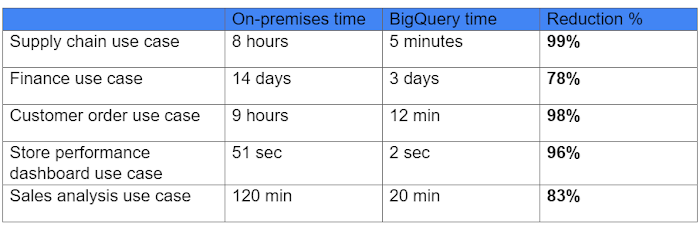
As for performance, look at this chart:
With the cloud EDW migration complete, and the legacy on-premises data warehouse retired, analysts now execute more complex and demanding workloads that they would not have been able to complete before, such as utilizing Datalab for orchestrating analytics through Python Notebooks, utilizing BigQuery ML for machine learning directly against the BigQuery data (no movement of large datasets), and AutoML to help determine the best model for predictions.
Additionally, engineers at THD have adapted BigQuery to monitor, analyze, and act on application performance data across all its stores and warehouses in real time, something that was not practical in the on-premises system.
With over 600 projects that THD now has on Google Cloud, the BigQuery story is just one of the many ways that Google Cloud is working with THD to deliver meaningful business results, every day.
Google Cloud and StartEd Join Forces to Boost EdTech Startups

1346
Of your peers have already read this article.
2:00 Minutes
The most insightful time you'll spend today!
Over the past few years, as the education sector was going through transformative change, EdTech startups rose to meet the demand of learners and help address some of the biggest challenges in education. At Google Cloud, we’re inspired by how EdTech startups continue to solve challenges with agility, innovative technology, and determination. We’re proud to help EdTechs make learning more personal, safe, and accessible, and we’re working to connect EdTech startups with the right people, products, and best practices that will help them grow
Announcing a new partnership with StartEd
Google Cloud is excited to announce a partnership to offer mentor-based programming for EdTechs with StartEd — an organization that accelerates education innovators addressing Early Childhood, K-12, HigherEd, Workforce, and Adult Learning.
Founded by entrepreneurs nearly ten years ago, StartEd is on a mission to attract and develop a network of innovators working to ensure equitable, quality education and lifelong learning opportunities for all. The company trains and connects thousands of diverse entrepreneurs, educators, and investors at for-profit and not-for-profit organizations each year, working alongside corporations, foundations, and higher education institutions across the United States.
StartEd has helped grow more than 2,500 companies and built a mentor network of over 800 senior leaders with deep expertise in early-stage EdTech companies. The StartEd community now numbers more than 25,000 members.
“I am thrilled to embark on this transformative partnership with Google Cloud,” said Ash Kaluarachchi, StartEd CEO and managing director. “This alliance not only amplifies our mission to empower and nurture the world’s education innovators at every point in their journey, but it also unlocks unprecedented potential for the entire EdTech ecosystem. Together, we’re poised to redefine the future of education and work and to create lasting, positive impact for generations to come.”
Mentoring and networking opportunities for EdTech startups
Through this partnership, U.S.-based EdTech startups can apply to a new program, StartEd sponsored by Google Cloud. The program offers startups access to personal coaching, hands-on training, business support, and a large network of industry experts to help them accelerate their growth and transform education. Beyond the benefits from StartEd, startups will gain access to cloud credits, technical support from Google Cloud, and coaching from Google’s education leadership.
More Relevant Stories for Your Company

Why Indian Enterprises Need to Embrace The Cloud-First Imperative to Accelerate Digital Transformation
Digital transformation is rewriting the rules of business both in India and worldwide. Digital customer experiences deliver easy, effective, and emotional touchpoints that focus operations on what the customers value. Around half of Indian decision makers prioritize the improvement of CX and the simplification of operations, as top priorities in



Accelerate Your Digital Transformation Through a Modern Infrastructure
Learn about the latest advancements to Google Cloud Platform’s unique infrastructure to accelerate enterprise workloads and build planet scalable solutions. Hear how Google Cloud’s infrastructure enables you to solve problems faster, more securely, and at greater scale. See how Google Cloud is accelerating the support for enterprise workloads like SAP,

Data-first Digitization Helps Leverage the Cloud for Your Mainframe Assets
For many enterprises, the venerable mainframe is home to decades’ worth of data about the company’s customers, processes and operations. And it goes without saying that the business would like access to that mainframe data — to report on it, to analyze it with big data analysis tools, or to

Kohl’s Leverages Google Cloud Platform for Omnichannel Retail
Kohl’s is an omnichannel retailer focused on driving traffic, operational efficiency and delivering seamless omnichannel customer experiences. Ratnakar Lavu is Kohl’s Senior Executive Vice President and Chief Technology Officer. He, and Kohl’s, are at the forefront of retail technology innovation, focusing on a frictionless customer journey across digital, mobile and
