





Google Cloud Content Protection: Unlock the Power of CSAP for Security

1299
Of your peers have already read this article.
2:45 Minutes
The most insightful time you'll spend today!
Content production is increasingly happening in the cloud. While moving a creative process that spans three centuries into the modern era brings challenges and risks, MovieLabs is one organization that takes digital transformation seriously.
A nonprofit research and development group founded by a consortium of the major Hollywood studios, MovieLabs describes their mission as “exploring innovative solutions to industry challenges shared by both our member studios and the broader production, post-production and distribution ecosystem.”
In more than 50 pages of densely-packed ideas and principles, MovieLab’s The Evolution of Media Production lays out an ambitious and revelatory vision for streamlining media production in the cloud. The key themes are summarized in 10 declarative statements, which envision a new modality for media production by the year 2030:
- All assets are created or ingested straight into the cloud and do not need to be moved.
- Applications come to the media.
- Propagation and distribution of assets is a “publish” function.
- Archives are deep libraries with access policies matching speed, availability and security to the economics of the cloud.
- Preservation of digital assets includes the future means to access them and edit them.
- Every individual on a project is identified and verified, and their access permissions are efficiently and consistently managed.
- All media creation happens in a highly secure environment that adapts rapidly to changing threats.
- Individual media elements are referenced, accessed, tracked and interrelated using a universal linking system.
- Media workflows are non-destructive and dynamically created using common interfaces, underlying data formats and metadata.
- Workflows are designed around real-time iteration and feedback.
The four bolded statements above are further explored in a follow-up whitepaper from MovieLabs, The Evolution of Production Security, which likewise offers six statements about what secure production in the cloud should look like:
- Security is Intrinsic and does not Inhibit Creative Processes
- The Security Architecture Addresses Challenges Specific to Cloud Workflows
- Production Workflows, Processes, and Assets are Secure, even on Untrusted Infrastructure
- The Content Owner Controls Security and Workflow Integrity
- The Security Can Be Scaled to Appropriate Levels and Can Integrate
- The Security Architecture Limits the Spread of any Breach and is Adaptable
The key to understanding these two papers is repeated in their titles: Evolution. Neither document is meant to outline solely what’s possible today; rather they are beacons guiding us toward a future in which the movie business is truly transformed by the cloud operating model. That means a future where media productions run much more like software supply chains: with speed, agility, and scale, and without sacrificing availability or security.
The good news is that it is possible to deploy secure production workloads in the cloud today. Using some of the built-in security features of Google Cloud, content producers can achieve Common Security Architecture for Production (CSAP) “Level 100” security for their assets (using the CSAP scale L100-L300).
However, we think that “evolution” word is important. As many companies have learned, operating an infrastructure cloud can be costly and often presents new threat vectors for attackers. Our mission at Google Cloud is to provide scalable, reliable services for traditional IT functions and to accelerate the abilities of every organization to digitally transform its business.
We believe the era of the transformation cloud is dawning, and companies who have been successfully operating in the cloud for years are now looking for ways to reduce costs while maintaining the cloud-scale advantages of agility and global reach. This aligns perfectly with the evolutionary vision of the MovieLabs papers, which envision media workflows changing radically to embrace cloud dynamism without all the unnecessary asset movement and complexity.
An important part of that vision from Google Cloud is that cloud service providers should remain open and interoperable with other clouds and infrastructures.
Here is a quickstart guide to mapping the L100 CSAP requirements to Google Cloud:
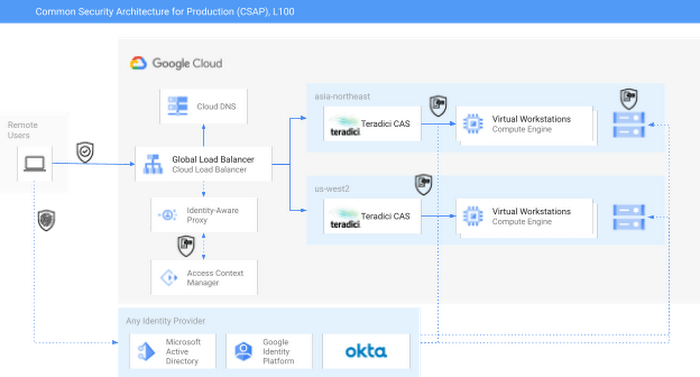
As you can see in the diagram, external identity providers (IdPs) such as Okta or Active Directory can serve as core security components of a CSAP L100 architecture. Alternatively, Google Cloud services such as Cloud Identity or Managed AD could be substituted.
Next, Google Cloud’s Identity-Aware Proxy (IAP) can be used in combination with Access Context Manager (ACM) to act as the first Policy Enforcement Point. This is an optional step, since it is somewhat redundant with the routing and authorization function performed by the native HP/Teradici Connection Brokers. However, IAP and ACM are core components of Google Cloud’s BeyondCorp architecture, on which CSAP is based. Additionally, adopting IAP with ACM offers productions the ability to swap out the Teradici PCoIP protocol for an alternative, such as Unity’s Parsec, without sacrificing security.
The Teradici Connection Broker is also a Policy Enforcement Point, since groups and role membership can be used to enforce access to specific workstations.
Finally, the identity context for each user is passed through to the storage layer. For some productions, Google Cloud Storage (GCS) buckets may offer enough functionality; GCS offers an S3-compatible API which should make it easy to immediately adopt OSS tools built for S3. Other options for this include the managed NetApp Cloud Volumes and Dell PowerScale for Google Cloud services. Both of these are managed shared storage services which offer file-level access controls using standard SMB/NFS permissions. There are also a variety of third-party filers available in the Google Cloud Marketplace, such as Nasuni. You can read more about those here.
For added security, both NetApp and PowerScale should be configured to use the private services access model in Google Cloud. This effectively limits any external access to these resources by only allowing traffic from user-managed VPCs into the Google-managed and peered VPC.
Following this architecture, you can see how to achieve CSAP L100 compliance by using either only Google Cloud services or a mix of managed and cloud-first services. In either scenario, access is managed through a unified control plane and based on both user identity and role. Zero Trust principles such as context-aware access and dynamic rulesets could further be applied to the Authentication step using either Google Cloud IAP or the equivalent services from Okta, Active Directory, or others.
At this weekend’s National Association of Broadcasters conference, Google experts will be talking about the cloud and content production, and the intersection of AI and media. The journey to 2030 is only just beginning.
2022’s First Cloud CISO Perspectives: Recap of the Megatrends, Releases and News
9347
Of your peers have already read this article.
3:00 Minutes
The most insightful time you'll spend today!
I’m excited to share our first Cloud CISO Perspectives post of 2022. It’s already shaping up to be an eventful year for our industry and we’re only in month one. There’s a lot to recap in this post, including the U.S. government’s recent efforts to address critical security issues, like open source software security and zero trust architectures. We’ve also released new resources from our Google Cybersecurity Action Team like the Cloud Security Megatrends and the Boards of Directors whitepaper on cloud risk governance.
Cloud Security Megatrends
We’re often asked if the cloud is more secure than on-prem (and why) so we shared our answer in a recent blog post. At Google Cloud, security by design is our priority. We’ve long adopted zero-trust principles for our baseline security architectures and built a global network that relies on defense in depth layers to protect against configuration errors and attacks. But security is always evolving and that is why we also take advantage of the following megatrends:
- Economy of scale: Decreasing the marginal cost of security raises the baseline level of security.
- Shared fate: A flywheel of increasing trust drives more transition to the cloud, which compels even higher security and even more skin-in-the-game from the cloud provider.
- Healthy competition: The race by deep-pocketed cloud providers to create and implement leading security technologies is the tip of the spear of innovation.
- Cloud as the digital immune system: Every security update the cloud gives the customer is informed by some threat, vulnerability, or new attack technique often identified by someone else’s experience. Enterprise IT leaders use this accelerating feedback loop to get better protection.
- Software-defined infrastructure: Cloud is software defined, so it can be dynamically configured without customers having to manage hardware placement or cope with administrative toil. From a security standpoint, that means specifying security policies as code, and continuously monitoring their effectiveness.
- Increasing deployment velocity: Because of cloud’s vast scale, providers have had to automate software deployments and updates, usually with automated continuous integration/continuous deployment (CI/CD) systems. That same automation delivers security enhancements, resulting in more frequent security updates.
- Simplicity: Cloud becomes an abstraction-generating machine for identifying, creating and deploying simpler default modes of operating securely and autonomically.
- Sovereignty meets sustainability: The cloud’s global scale and ability to operate in localized and distributed ways creates three pillars of sovereignty. This global scale can also be leveraged to improve energy efficiency.
If you’re an IT decision maker, pay attention to these megatrends that will continue to drive and reinforce cloud security and will outpace the security of on-prem infrastructure well into the future.
U.S. Federal government cybersecurity momentum
- Open source software security: Earlier this month, Google participated in the White House Summit on open source software security. The meeting came at a critical time for the industry following December’s Log4j vulnerabilities and was both a recognition of the challenge and an important first step towards addressing it. The open source software ecosystem is not homogenous, despite the fact that the industry often thinks of or treats it this way. Some of it, like Linux, is highly curated, while other critical software is supported through diffuse communities including technology companies and other stakeholders. There is also a long tail of many other critical projects driven by a dedicated community of maintainers around the world, including Googlers. In light of this reality, we welcomed the chance to share our recommendations to advance the future of open source software security. Some work we’ve done includes founding the Open Source Security Foundation, which has been instrumental already in making security improvements. We’ve also helped drive a number of key security initiatives within the open source community including security scorecards, the SLSA framework to improve the security and integrity of open source packages, and Secure Open Source Rewards to financially incentivize improvements to critical open source security projects.
- OMB’s Federal zero trust strategy: The publication of the Office of Management and Budget’s zero trust architecture strategy marks an important step for the U.S. federal government’s efforts to modernize under Executive Order 14028. Google Cloud supports this approach, which recognizes the immense security benefits offered by modern computing architectures. For the past decade, Google has successfully applied zero trust principles through our BeyondCorp and BeyondProd frameworks for providing end-user access and securing our cloud workloads. And we’ve brought these best practices from our own journey to global governments and businesses of any size through solutions like BeyondCorp Enterprise and capabilities like Binary Authorization and Anthos Service Mesh, which are embedded in Anthos, our managed application platform. For Federal agencies embarking on this zero trust journey, the Google Cybersecurity Action Team will offer our expertise by conducting Zero Trust Foundations strategy workshops, which can help organizations in the public and private sectors develop actionable and achievable strategies and plans for zero trust implementation.
Google Cybersecurity Action Team Highlights
Here are the latest updates, products, services and resources across our security teams this month:
Security
- Democratizing security operations: We recently announced that Siemplify, a leading security orchestration, automation and response (SOAR) provider, is joining Google Cloud to help companies better manage their threat response. Providing a proven SOAR capability with Chronicle’s approach to security analytics is an important step forward in our vision to advance invisible security and democratize security operations for every organization.
- Security by design: The Highmark Health security team is using “secure-by-design” techniques to address the security, privacy, and compliance aspects of its Living Health solution with Google Cloud’s Professional Services Organization (PSO). Google has long advocated for and followed security by design principles, which is why we’re continuously building enhanced security, controls, resiliency and more into our cloud products and services.
- Secure collaboration for hybrid work environments: The Google Workspace team shared its recommendations for businesses as they prepare for the future of work, where the hybrid/flexible work model is becoming standard practice and a new approach to security is essential.
- Anthos Policy Controller CIS Benchmark enforcement: A big part of our shared fate philosophy is to build secure products and not just security products. A recent example of this in action is embedding CIS benchmark policy conformance in the Anthos Policy Controller. We believe the more we embed approaches like this into our products, the more application and infrastructure teams can intrinsically embed security at the start and reduce toil for the security team.
- DevOps for technology-driven organizations and startups: A key success factor for many security programs is the partnership and integration with development teams, and there are some great resources and lessons in our DORA research.
- Security by design with Chrome OS: ABN AMRO’s Asia-Pacific region team recently shared how they are using Chrome OS and CloudReady to work securely in the cloud, reduce total cost of ownership, and add flexibility for employees. This is a great example of secure by design principles in the use of Chromium.
Risk & Compliance
- Boards of Directors summary guide to cloud risk governance: The latest whitepaper from the Google Cybersecurity Action Team outlines how boards of directors can prioritize safe, secure, and compliant adoption processes for cloud technologies within their organizations.
- TruSight Risk Assessment of Google Cloud: TruSight recently released a comprehensive
risk assessment report on Google Cloud. Our Enterprise Trust team collaborated on this robust assessment of Google Cloud services to validate the design and implementation of controls. TruSight’s risk assessment of our security controls will help customers accelerate and complete their risk management due diligence. - Data governance: Check out this new blog series on data governance where our teams explain the role of data governance, its importance, and the necessary processes to run an effective data governance program. Implementing data governance will help maximize value derived from business data, build user trust, and ensure compliance with required security measures.
Controls and Products
- Encrypting Data Fusion: To help meet the security, privacy and compliance requirements of customers in regulated industries like finance or public sector, we announced the general availability of Customer Managed Encryption Keys (CMEK) integration for Cloud Data Fusion, which enables encryption of both user data and metadata at rest with a key that customers can control through our Cloud Key Management Service (KMS).
Don’t forget to sign-up for our newsletter if you’d like to have our Cloud CISO Perspectives post delivered every month to your inbox. We’ll be back next month with more updates and security-related news.
Deep Dive into Google Cloud’s Security Track at the Next 21

3040
Of your peers have already read this article.
4:30 Minutes
The most insightful time you'll spend today!
In every industry, in every part of the world, cybersecurity concerns continue to grow in the wake of attacks on critical infrastructure and the software supply chain. Governments and businesses of all sizes recognize that they must do more to protect their employees, customers and citizens.
But doing more of the same, like putting security band-aids on legacy infrastructure, is no longer helpful or productive. We need an enduring commitment, in products, people and monetary terms, to drive meaningful improvements in our collective security posture. Google recently announced a $10 billion investment to advance the security of governments around the world, and by extension, help enterprises and organizations to do the same.
Over the past year, Google Cloud has been delivering on our vision of Invisible Security for our customers, where capabilities are continuously engineered into both our trusted cloud platform and market-leading products to bring the best of Google’s security to wherever your IT assets are. But being a provider of best-in-class technology is not enough. We want to share our expertise to help organizations with their security transformation and offer even more ways to accelerate these essential improvements. This week, at Google Cloud Next ‘21, we’re sharing the first of what will be many more steps in advancing these efforts.
Introducing our Cybersecurity Action Team
While access to the latest, most advanced security technology is important, the expertise of what it will take to become resilient in the face of today’s risk and threat environment is foundational.
Today, we’re announcing the formation of the Google Cybersecurity Action Team. The Google Cybersecurity Action Team marshals experts from across Google to form what we believe will be the world’s premier security advisory team. It has a singular mission to support the security and digital transformation of governments, critical infrastructure, enterprises and small businesses.
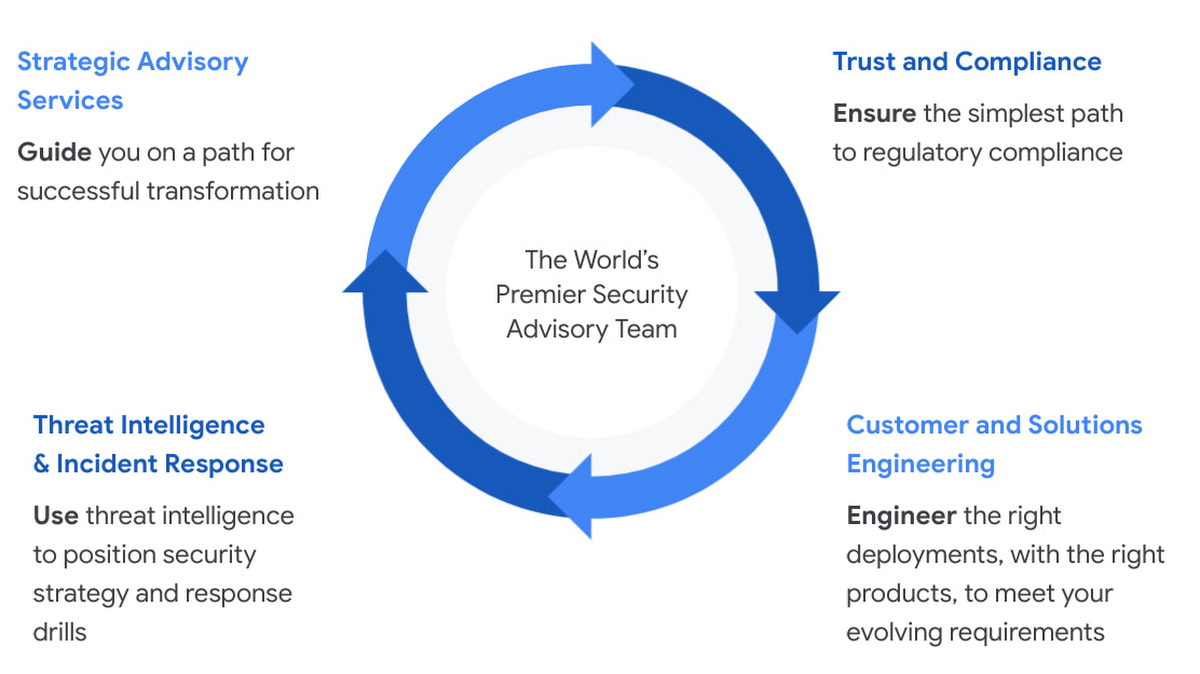
Building on existing security solutions engineering efforts, today the Google Cybersecurity Action Team announced a security and resilience framework that delivers a roadmap for a comprehensive security management program aligned with the National Institute of Standards and Technology’s Cybersecurity Framework using cloud technologies from Google Cloud and our partners.
“Google Cloud has been a critical partner in the BBVA security journey, helping us protect our customers’ sensitive and proprietary data with modern frameworks like zero trust and secure-by-default products like Google Workspace,” said Alvaro Garrido, Chief Security Officer at BBVA. “We look forward to the strategic services and guidance the Google Cybersecurity Action Team will deliver as we continue on our security transformation.”
Learn more about the Cybersecurity Action Team here.
Announcing a safer way to work
Bringing you the expertise and hands-on guidance to help with your security transformation is just one valuable step. We recognize that too many organizations can’t wait any longer to begin their modernization efforts – they need a new baseline, and they need it now.
That’s why today, we’re announcing the launch of our Google Work Safer offering, designed to help organizations, their employees, and partners collaborate and communicate securely and privately in today’s hybrid work environment. Work Safer provides companies with access to best-in-class security for email, meetings, messages, documents, and more. It uniquely brings together the cloud-native, zero-trust solutions of Google Workspace with BeyondCorp Enterprise for secure access with integrated threat and data protection. For customers who want secure devices, Work Safer includes Pixel phones managed with Android Enterprise, Chrome Enterprise Upgrade, and HP Chromebooks. Customers can also leverage Google’s Titan Security Keys for account protection, reCAPTCHA Enterprise for website fraud prevention, Chronicle for security analytics, and a variety of migration services for a seamless transition.
The program is designed to meet the needs of all organizations, including small businesses, enterprises and public sector institutions, many of which are reliant on legacy technology and often lack expertise to fully address rising security challenges associated with hybrid work. To learn more, visit our Work Safer homepage.
Advancing our trusted cloud with new security capabilities
Above all, security has been and continues to be the cornerstone of our product strategy. There are three critical areas where Google Cloud’s capabilities can make a meaningful difference for any business’ or government’s digital security transformation:
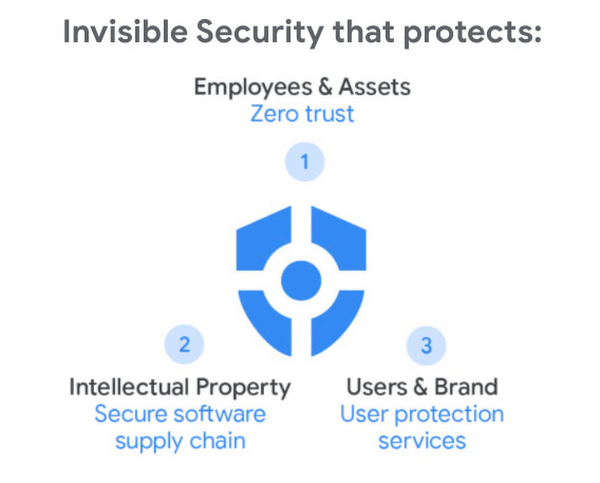
At Next’ 21, we’re introducing new security products and partnerships that will enable you to:
- Protect your employees with new zero trust access capabilities: We’re delivering new features that expand the surface area for our zero trust access solution, BeyondCorp Enterprise, to cover all your apps – both modern and legacy. The new client connector, now in preview, enables identity and context-aware access to non-web applications running in Google Cloud and non-Google Cloud environments. We are also making it easier for admins to diagnose access failure, triage events, and unblock users with the new Policy Troubleshooter feature. You can learn more about both of these new enhancements in the live BeyondCorp Enterprise demo on October 13.
- Improve your detection and response capabilities: We announced a new collaboration with Cybereason for Extended Detection and Response (XDR) across endpoints, networks, cloud and workspaces. The combination of these capabilities delivers a cloud-native XDR solution, Cybereason XDR powered by Chronicle, that automates prevention for common attacks, guides analysts through security operations and incident response, and enables threat hunting with precision at a pace never before achieved. We are also deepening the integration between Chronicle and Security Command Center (SCC) on GCP. New integrations in preview centralize alerts and investigative workflows across the two platforms, and enable threat-specific pivots by enriching SCC alerts with intelligence on associated threat actors and entities.
- Automate and bolster protection of your sensitive data: Automatic DLP, now in preview, is a prime example of how we are making Invisible Security a reality. It’s a game-changing capability that discovers and classifies sensitive data for all the BigQuery projects across your entire organization without you needing to do a single thing. We’re also introducing Ubiquitous Data Encryption, a solution which combines our generally available Confidential Computing, External Key Management, and Cloud Storage products to seamlessly encrypt data as it’s sent to the cloud. Using your External Key Management solution, data can now only be decrypted and run in a confidential VM environment, greatly limiting potential exposure.
- Protect your IP and implement a zero trust software supply chain: Today, we’re building on our zero trust software supply chain with new launches. Cloud Build is SLSA Level -1 compliant by default, with scripted builds and available provenance. With the new Build Integrity feature, Cloud Build automatically generates a verifiable build manifest that includes a signed certificate describing the sources that went into the build, the hashes of artifacts used, and other parameters. Additionally, Binary Authorization’s integration with Cloud Build makes it easy to set up deploy-time constraints. You can also now easily pair Binary Authorization with Cloud Run to ensure only trusted images make it to production. These integrations are now generally available.
- Protect your users and brand: We recently announced the preview of Cloud Armor Bot Management, which integrates Cloud Armor and reCAPTCHA Enterprise. You can enable protection without any server-side changes to your applications, and because detection and enforcement happens in-line, at the edge of Google’s network, you can mitigate threats before they have a chance to impact your applications, whether they run on GCP, on premise, or in a hybrid or multicloud deployment.
- Ensure secure collaboration: Today, Google Workspace is also introducing new security features. Client-side encryption for Google Meet, in beta, gives customers direct control of encryption keys and the identity service used to access keys. Data Loss Prevention (DLP) for Google Chat, in beta, helps prevent sensitive information from leaking outside of your organization. Check out the blog post from Google Workspace to learn more.
As we head into three days of great content and engagements from our security and technology teams across Google Cloud at Next ‘21, we want to leave you with this: You are not alone on your security journey. Our goal is to ensure that every day, you are making your organization safer because you have partnered with us. Please make sure to watch our security experts, customers, and partners in our track sessions to go deep on the topics and products that matter most to you.
Confidential GKE Nodes: Now Available on Compute Optimized C2D VMs

1244
Of your peers have already read this article.
1:30 Minutes
The most insightful time you'll spend today!
Today, we are happy to announce that Confidential GKE Nodes are available on compute optimized C2D VMs.
Many companies have adopted Google Kubernetes Engine (GKE) as a key component in their application infrastructure. In some cases, the advantages of using containers and Kubernetes can surpass those of traditional architectures, but migrating to and operating apps in the cloud often requires strategic planning to reduce risk and prevent data breaches. This is where Confidential GKE Nodes can be utilized to enhance the security of your GKE clusters or node pools.
Confidential GKE Nodes leverage specialized hardware to encrypt data in-use and are ideal for organizations processing sensitive data in the cloud. To make it easier to start using Confidential GKE Nodes, GKE standard workloads you run today can run as confidential GKE workloads without code changes on your end.
Security underpinnings of Confidential GKE Nodes
As we expand the Confidential Computing product portfolio from Confidential VMs to Confidential GKE Nodes to Confidential Dataproc, ensuring high performance is key. Confidential GKE Nodes are built on the same technology foundation as Confidential VM and utilize the Secure Encrypted Virtualization (SEV) capability of AMD EPYC™ processors. This feature allows you to keep data encrypted in memory with node-specific, dedicated keys that are generated and managed by the processor. The keys are generated in hardware during node creation and reside solely within the processor, making them unavailable to Google Cloud or other nodes running on the host.
Combined with the high performance of C2D VMs
Previously, Confidential GKE Nodes were generally available only on general purpose N2D VMs, but now they’re also available on compute optimized C2D VMs. The C2D machine series provides VM sizes ranging from 2 vCPUs to 112 vCPUs, offers up to 896 GB of memory, and are suited for performance-intensive workloads. C2D standard and C2D high-CPU machines serve compute-bound workloads including high-performance web servers and media transcoding. C2D high-memory machines serve specialized workloads such as high-performance computing (HPC) and electronic design automation (EDA), which require more memory.
Confidential GKE Nodes on compute-optimized C2D VMs could be a fit for use cases that require high performance and security. You can achieve encryption in-use for data processed inside your GKE cluster or just on specific node pools, without significant performance degradation. This is relevant for industries such as financial services, healthcare, retail, blockchain, and telecommunications, which often have sensitive data or personally identifiable information (PII) that requires additional security measures.
How MATRIXX used Confidential GKE Nodes
MATRIXX Software chose Confidential GKE Nodes to provide transparent encryption for data in-use to supplement encryption for data at-rest to secure personal subscriber data as required by privacy regulations.
MATRIXX Digital Commerce Platform (DCP) is a real-time 5G monetization for the communications industry, serving many of the world’s largest operator groups, regional carriers, and emerging digital service providers. MATRIXX used Google Cloud Confidential GKE Nodes to deliver a cloud-first digital commerce solution that enables commercial and operational agility for current and new telco business models.
A whitepaper titled “Protecting Your 5G Revenue Stream in the Cloud,” described how when MATRIXX DCP is deployed with Confidential Computing on Google Cloud, “its subscriber data, account balances, network events and charges/revenue streams are encrypted in use without making any code changes to the application or compromising on performance.”
Confidential GKE Nodes are globally available
At Google Cloud, we’re committed to investing in Confidential Computing, so we’ve expanded our support to VM families like C2D VMs. Confidential GKE Nodes running on C2D VMs are available in regions across the globe, including us-central1 (Iowa), asia-southeast1 (Singapore), us-east1 (South Carolina), us-east4 (North Virginia), asia-east1 (Taiwan), and europe-west4 (Netherlands). Note that Confidential GKE Nodes are available where C2D or N2D machines are available.
Pricing for Confidential GKE Nodes
There is no additional cost to deploy Confidential GKE Nodes, other than the costs of Compute Engine and Confidential VM pricing.
Try out Confidential GKE Nodes for cluster-level enablement
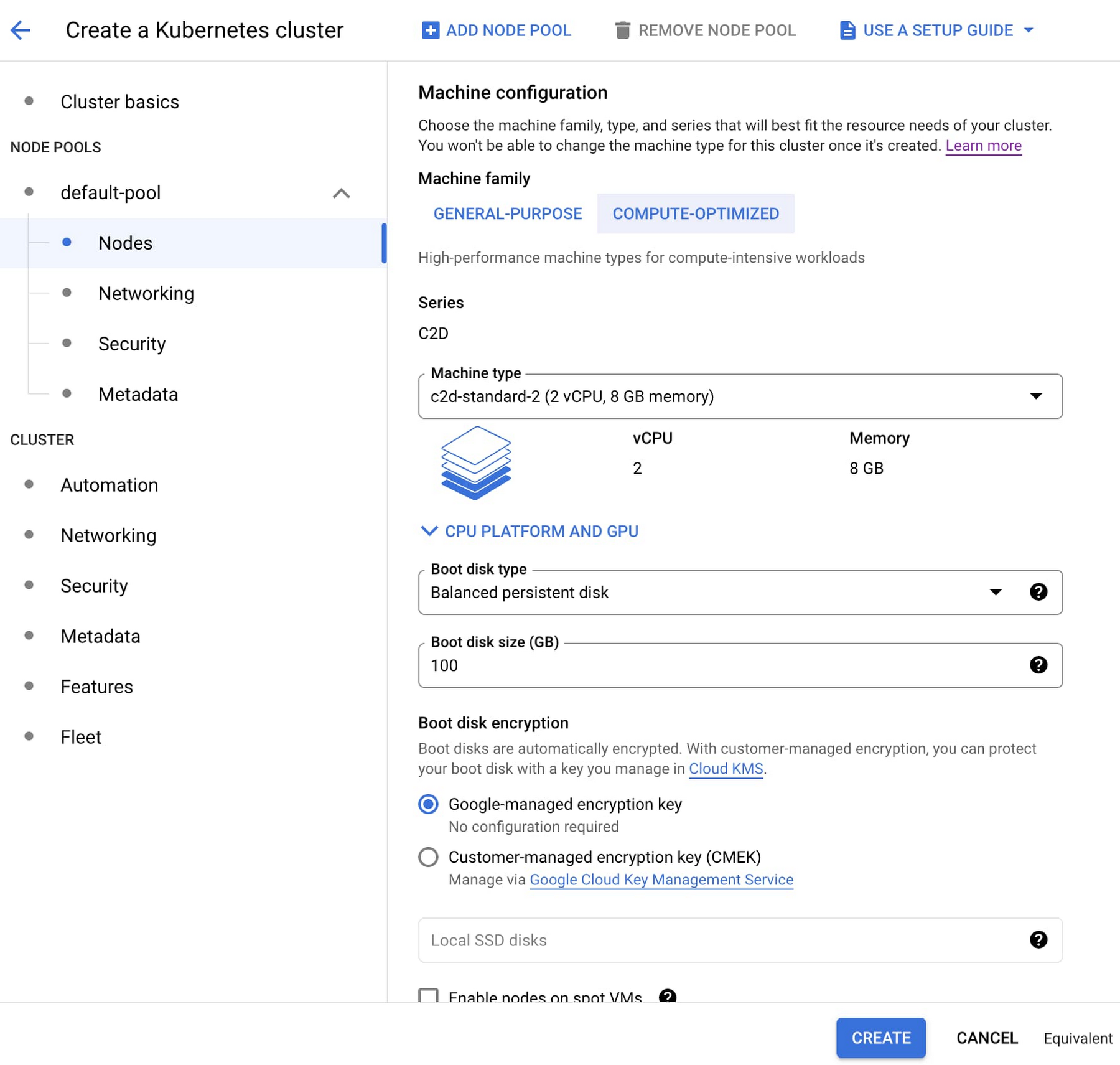
- First, go to the Google Kubernetes Engine page in the Google Cloud console. In the top navigation bar, click Create. In the Create Cluster modal, choose ‘Standard: You manage your cluster’ and click Configure.
- Next, from the left navigation pane, under Cluster, click Security. Select the ‘Enable Confidential GKE Nodes’ checkbox.
- Then, from the left navigation pane again, under Node Pools, click Nodes. Under Machine Configuration and Machine family, select the Compute-optimized tab, and choose a C2D machine type.
Configure the rest of the cluster as desired and click Create.
Making secure design choices should be easy, especially when the workloads involve high-performance processing of sensitive data. You can help protect your sensitive applications and data today by adding Confidential GKE Nodes to your GKE workloads. Learn more about Confidential Computing here.

The Many Risks of Ignoring the Impact of a Tighter Cloud Security Framework
DOWNLOAD WHITEPAPER3236
Of your peers have already downloaded this article
3:30 Minutes
The most insightful time you'll spend today!
The perimeter has disappeared and access to company data is no longer limited to your physical office or your employees. Instead, in today’s transformed workforce – increasingly connected, collaborative and in the cloud – the security perimeter has become dispersed and elastic, wrapped around each user and device.
Moreover, ‘users’ no longer refers to simply employees, but also vendors, partners, contractors, and customers. Each of these groups has its own requirements – access to different information and applications, from different locations and different devices. In this ever-evolving ecosystem of users, apps, and devices, traditional approaches to identity and access management aren’t ready for this new environment.
Time-consuming and complex, these approaches were built for the on-premise world (think cumbersome VPNs, limited device access and inconvenient authentication), instead of today’s cloud-first world.
Organizations are also facing increased pressure for digital transformation, higher compliance standards to prevent the loss of company data, and more sophisticated cyber-attacks – it’s no wonder organizations are grappling with these unprecedented pressures. Clearly, a new approach to identity management is needed.
That’s where Cloud Identity can help – an identity, access and device management (IAM/EMM) platform that helps organizations maximize user and IT efficiency, protect company data with Google-grade security, and transition to a digital workspace at their own pace.
Vulnerability Exploitability eXchange: Prioritize cybersecurity risk for the healthcare industry

2556
Of your peers have already read this article.
1:30 Minutes
The most insightful time you'll spend today!
Diagnosing and treating chronic pain can be complex, difficult, and full of uncertainties for a patient and their treating physician. Depending on the condition of the patient and the knowledge of the physician, making the correct diagnosis takes time, and experimenting with different treatments might be required.
This trial-and-error process can leave the patient in a world of pain and confusion until the best remedies can be prescribed. It’s a situation similar to the daily struggle that many of today’s security operations teams face.
Screaming from the mountain tops “just patch it!” isn’t very helpful when security teams aren’t sure if applying a patch might create even worse issues like crashes, incompatibility, or downtime. Like a patient with chronic pain, they may not know the source of the pain in their system. Determining which vulnerabilities to prioritize patching, and ensuring those fixes actually leave you with a more secure system, is one of the hardest tasks a security team can face. This is where a Vulnerability Exploitability eXchange (VEX) comes in.
The point of VEX
In previous blogs, we’ve discussed how establishing visibility and awareness into patient safety and technology is vital to creating a resilient healthcare system. We’ve also looked at how combining software bills of materials (SBOM) with Google’s Supply chain Levels for Software Artifacts (SLSA) framework can help build more secure technology that enables resilience.
The SBOM provides visibility into the software you’re using and where it comes from, while SLSA provides guidelines that help increase the integrity and security of software you then build. Rapid diagnostic assessments can be added to that equation with VEX, which the National Telecommunications and Information Administration describes as a “companion” document that lives side-by-side with SBOM.
To go back to our medical metaphor, VEX is a mechanism for software providers to tell security teams where to look for the source of the pain. VEX data can help with software audits when inventory and vulnerability data need to be captured at a specific point in time. That data also can be embedded into automated security tools to make it easier to prioritize vulnerability patching.
You can then think of SBOM as the prescription label on a bottle of medication, SLSA as the child-proof lid and tamper-proof seal guaranteeing the safety of the medication, and VEX as the bottle’s safety warnings. As a diagnostic aide, a VEX can help security teams make accurate diagnoses of “what could hurt” and system weaknesses before the bad guys do.
Yet making an accurate assessment of that threat model can be challenging, especially when looking at the software we use to run systems. The ability to quickly and accurately evaluate an organizations’ weaknesses and pain points can be vital to hastening response to a vulnerability and stopping cyberattacks before they become destructive. We believe that VEX is an important part of the equation to help secure the software supply chain.
As an example, look no further than the Apache Log4j vulnerabilities revealed in December 2021. Global industries including healthcare were dealt another blow when Apache’s Log4j 2 logging system was found to be so vulnerable that relatively unsophisticated threat actors could quickly infiltrate and take over systems. Through research conducted by Google and information contributed by CISA, we learned of examples of where vulnerabilities in Log4j 2, a single software component, could potentially impact thousands of companies using software that depend on it because of its near-ubiquitous use.
While a VEX would not capture zero-day vulnerabilities, it would be able to inform security teams of other known vulnerabilities in Log4j 2. Once vulnerabilities have been published, security teams could use SBOM to find them, and use VEX to understand if remediation is a priority or not.
How does VEX contribute to visibility?
A key reason we focus on visibility mechanisms like SBOM and SLSA is because they give us the ability to understand our risks. Without the ability to see into what we must protect, it can be difficult to determine how to quickly reduce risk.
Visibility is a crucial first step to stopping malicious hackers. Yet without context, visibility leaves security teams overwhelmed with data. Why? Well, where would you start when trying to mitigate the 30,000 known vulnerabilities affecting just open source software, according to the Open Source Vulnerabilities database(OSV)? NIST’s National Vulnerability Database (NVD) is tracking close to 181,000 vulnerabilities. We’ll be patching into the next millennium if we adopt a “patch everything” approach.
It’s impossible to address every vulnerability individually. To make progress, security teams need to be able to prioritize findings and go after the ones that will have the greatest impact first. The goal of a VEX artifact is to make prioritization a little easier.
While SBOMs are created or changed when the material included in a build is updated, VEXs are intended to be changed and distributed when a new vulnerability or threat has changed. This means that VEX and SBOM should be maintained separately. Since security researchers and organizations are constantly discovering new cybersecurity vulnerabilities and threats, a more dynamic mechanism like VEX can help ensure builders and operators have the ability to quickly ascertain the risks of the software they are using.
Let’s dig into this VEX example from CycloneDX. You can see the list of vulnerabilities found, third parties who track and report those vulnerabilities, vulnerability ratings per CVSS, and most importantly, a statement from the developer that guides the operator reading the VEX to those vulnerabilities that are exploitable and need to be protected. At the bottom, you’ll see the VEX “affects” an SBOM.
This information allows the user of the VEX document to refer to its companion SBOM. By necessity, the VEX is intentionally decoupled from the SBOM because they need to be updated at different times. A VEX document will need to be updated when new vulnerabilities emerge. An SBOM will need to be updated when changes to the software are made by a manufacturer. Although they can and need to be updated separately, the contents of each document can stay aligned because they are linked.
Increasing resilience powered by visibility—SBOM+VEX+SLSA
VEX could dramatically improve how security vulnerabilities are handled. It’s not uncommon to find operators buried in vulnerabilities, best-guessing the ones that need fixing, and trying to make sense of tens (and sometimes hundreds) of pages of documentation to determine the best, lowest impact fix.
With SBOM+SLSA+VEX, operators are using software-driven mechanisms to conduct analyses and evaluate risk instead of relying on intuition and best guesses. The tripartite SBOM+SLSA+VEX approach provides an up-to-date list of issues and perspective on what needs attention. This is a transformative development in security—enabling teams to get a better handle on doing vulnerability mitigation, starting where it could hurt the most.
Driven by repeated cyberattacks on critical infrastructure such as healthcare, government regulators have taken a more interested stance in software security and supply chains. Strengthening the effectiveness of SBOMs in the United States is a big part of the newly proposed Protecting and Transforming Cyber Health Care (PATCH) Act. The law would require medical device manufacturers adhere to minimum cybersecurity standards in their products, including the creation of SBOMs for their devices, and plans to monitor and patch any cybersecurity vulnerabilities that are discovered during the device’s lifetime.
Meanwhile, new draft medical device cybersecurity guidance from the FDA continues that agency’s involvement in aggressively encouraging medical device manufacturers to improve the cybersecurity resilience of their products. The White House spoke for SBOMs, as well. An Executive Order from May 2021 lays out requirements for secure software development, including the production and distribution of SBOM for software used by the federal government.
Regardless of how these initiatives pan out, Google believes controls like those provided by SBOM+SLSA+VEX are critical to protect software and build a resilient healthcare ecosystem. This approach provides detailed, critical risk exposure data to security teams so they can take necessary steps to reduce immediate and long-term risks.
What do we suggest you do?
At Google, we are working with the Open Source Security Foundation on supporting SBOM development. Our Know, Prevent, Fix report on secure software development creates a broader outline of how Google thinks about securing open source software from preventable vulnerabilities. You can read more about these efforts for securing workloads on Google Cloud from our Cloud Architecture Center. Take a look at Cloud Build, a Google Cloud service that can be used to generate up to SLSA Level 2 build artifacts.
Customers often have difficulty getting full visibility and control over vulnerabilities because of their dependence on open source software (OSS). Assured Open Source Software (Assured OSS) is the Google Cloud service that helps teams both secure the external OSS packages they use and overcome avoidable vulnerabilities by simply eliminating them from the code base. Finally, ask us about Google’s Cybersecurity Action Team, the world’s premier security advisory team and its singular mission supporting the security and digital transformation of governments, critical infrastructure, enterprises, and small businesses.
If you’re a software supplier, please consider our suggestions above. Whether you are or not, you should begin:
- Contractually mandating SBOM+VEX+SLSA (or their equivalent) artifacts to be provided for all new software.
- Train procurement teams to ask for and use SBOM+VEX+SLSA to make purchasing decisions. There should be no reason an organization procures software or hardware with known, preventable issues. Even if they do, the information these mechanisms provide should help security teams decide if they can live with the risks before equipment enters their networks.
- Establishing a governance program that ensures those who control procurement decisions are aware of and owning the risks associated with software they are buying.
- Enabling security teams to build pipelines to ingest SBOM+VEX+SLSA artifacts into their security operations and use it to strategically advise and drive mitigation activities.
At Google, we believe the path to resilience begins with building visibility and structural awareness into the software, hardware, and equipment it rides on as a critical first step. Time will tell if VEX becomes widely adopted, but the point behind it won’t change—we can’t know how we are vulnerable without visibility. VEX is an important concept in this regard.
Next month, we’ll be shifting gears slightly to focus on building resilience by establishing a security culture that obsesses over its patients and products.
More Relevant Stories for Your Company

What’s in Line for Google Cloud’s Europe Customers in Regards to the E.U.-U.S. Data Transfer Framework
Last week, the European Commission and U.S. Government agreed on a new E.U.-U.S. data transfer framework. Earlier today, Google shared that it welcomes these efforts by the U.S. government to enhance privacy protections for E.U. data and facilitate trusted transatlantic data flows. For our Google Cloud customers, we intend to

New ML-Powered API Abuse Detection
API security incidents are increasingly common and disruptive. With the growth of API traffic, enterprises across the world are also experiencing an uptick in malicious API attacks, making API security a heightened priority. According to our latest API Security Research Report, 50% of organizations surveyed have experienced an API security incident

Protect Users in Apps with Multi-Factor Authentication
These days, using a password alone to secure user accounts containing sensitive, identifiable, or private information just isn’t sufficient. Passwords are often subject to reuse and can easily be phished and stolen. With this in mind, we recently teamed up with researchers from New York University and the University of

How Firewall Insights can Simplify Corporate Firewall Rules
Corporate firewalls typically include a massive number of rules, which accumulate over time as new workloads are added. When rules stack up piecemeal like this, misconfigurations occur that, at best, create headaches for security administrators, and at worst, create vulnerabilities that lead to security breaches. To address this, we have
