





Protect Users in Apps with Multi-Factor Authentication

3366
Of your peers have already read this article.
1:30 Minutes
The most insightful time you'll spend today!
These days, using a password alone to secure user accounts containing sensitive, identifiable, or private information just isn’t sufficient. Passwords are often subject to reuse and can easily be phished and stolen.
With this in mind, we recently teamed up with researchers from New York University and the University of California, San Diego to find out just how effective basic account hygiene is at preventing account takeovers. The research showed that simply adding a SMS as a second factor to a Google account can block up to 100% of automated bots, 96% of bulk phishing attacks, and 76% of targeted attacks that occurred during our investigation.
To help you enhance the security of your apps and protect your users, Identity Platform now supports multi-factor authentication (MFA) with SMS in beta.
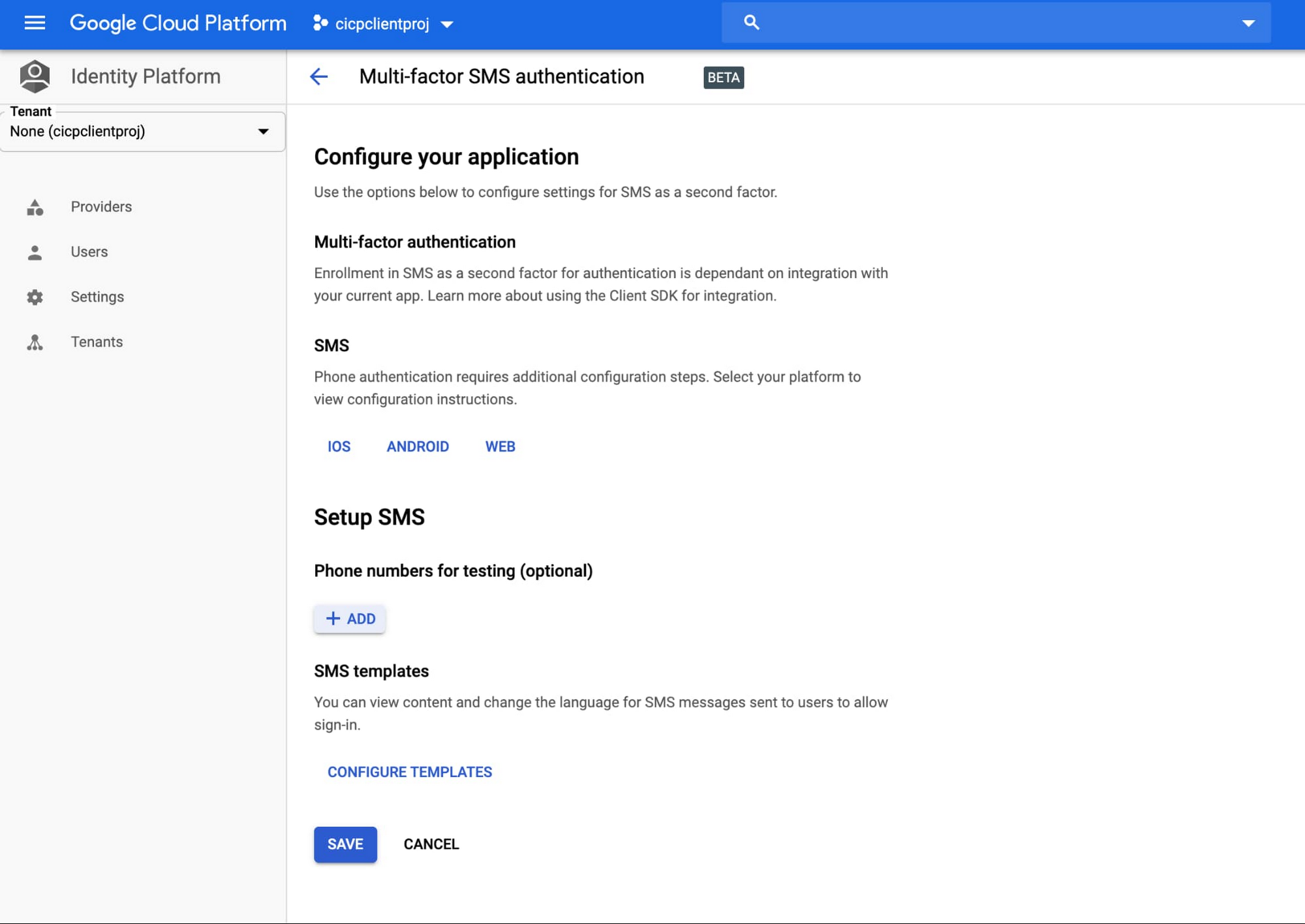
You can now configure Identity Platform to require users who attempt to login to your application to self-enroll in MFA—also known as two-factor authentication (2FA)—and register a device that is capable of receiving SMS messages. When users attempt to sign-in to your app with their first-factor credential (email/password, social login, SAML, OIDC), Identity Platform will require them to enter the six-digit authentication code that it sends via SMS to their registered devices before they can sign-in to your apps and services.
Getting started
You can learn more about this new feature by checking out the documentation page. To get started with Identity Platform, enable it in GCP Marketplace, watch our Cloud Next ‘19 presentation, and read the quickstart.

3527
Of your peers have already downloaded this article
10:45 Minutes
The most insightful time you'll spend today!
In its 25-criterion evaluation of data security portfolio providers, Forrester identified the 13 most significant ones and researched, analyzed, and scored them.
Here’s a summary of what Forrester said about Google Cloud
- Google puts cloud and cloud security at the center of its strategy. Capabilities from Google Cloud Platform, G Suite, Cloud Security Command Center, G Suite Security Center, BeyondCorp, and more are a part of Google’s overall portfolio. There is support for hybrid environments (multi-cloud and on-premises) and use of open source models where it’s possible to enable integration and portability. Its tools are software-based, available in management console or via APIs, and enable organizations to ease into automation to scale data security efforts.
- Google supports a Zero Trust approach with its capabilities to identify data, map flows, encrypt, control access, and automate. Strengths include depth and granularity in access control and security data analytics. Weaknesses include user-driven data classification and file encryption. Customers appreciate Google’s ease of deployment and scalability of its capabilities. Google is a good fit for buyers whose infrastructure runs on Google Cloud and G Suite.
Download the report now!
How Air Asia’s CIO Ensures Its 22,000 Employees Service Customers Efficiently and Preserve Security

3527
Of your peers have already read this article.
2:48 Minutes
The most insightful time you'll spend today!
At AirAsia, we operate a fleet of more than 270 aircraft across 23 markets, fly to more than 150 destinations and carry 100m guests each year. We’ve also been named the world’s best low-cost carrier for 11 years running. To accomplish all of this, we rely heavily on our 22,000 Allstars (employees). As AirAsia co-founder Tony Fernandes likes to say, “it has always been about the people.”
In my role as CIO, it’s critical that I give our Allstars the tools and technology they need to get their jobs done, while at the same time ensuring that our company’s data is protected and secure. While this is challenging enough in normal circumstances, we’re also in the midst of rapidly moving from legacy on-premises technologies to the cloud. Google Cloud has been a critical partner for us on this journey.
Identity challenges
AirAsia, like many other enterprises, has relied on a legacy on-premises directory for many years. As our company has quickly grown and expanded to new markets and regions, we’ve had to manage multiple servers across a number of on-premises data centers and the public cloud, which has proved costly and time-consuming.
Our Allstars, located all across Asia, need to easily access a number of legacy on-premises apps in addition to a growing number of SaaS apps. As a business, we also needed a more seamless integration between our HR system of record and our identity solution for user provisioning and lifecycle management. Solving these challenges with our existing on-premises directory was simply not feasible for us.
In recent years, we partnered with Google Cloud to help drive our digital transformation, including moving dozens of workloads and apps to Google Cloud Platform (GCP), deploying G Suite as our collaboration and productivity solution for all of our employees, and replacing thousands of Windows laptops with fast and secure Chromebooks.
We brought up our identity concerns with the Google Cloud team, and after a number of conversations, we decided to deploy Cloud Identity, Google’s cloud-based identity, and access management solution, to help address the identity challenges we were facing.
Why Cloud Identity for AirAsia?
We ended up choosing Cloud Identity for a few key reasons. Here at AirAsia, we are eager to move to the cloud as quickly as possible, and moving identity management to the cloud is a key enabler of this and our broader digital transformation. Managing identities from the cloud also enables us to have a single identity and set of credentials for each employee, which they can use to access all of the applications they need to be productive, both in the cloud and on-premises.
In addition, deploying Cloud Identity is a key step towards enabling the BeyondCorp (or zero trust) security model, which we feel is the best approach to strengthen our security posture and fight modern threats. Cloud Identity also integrates seamlessly with our existing technologies, which includes not only Google Cloud products like GCP, G Suite, and Chrome OS, but also third-party tools like Citrix, Papercut, and others.
And finally, Cloud Identity offered us significant cost and resource savings. With Cloud Identity in place, our IT department can spend less time worrying about managing multiple on-premises directory servers and can instead focus on delivering value to our Allstar employees.
What’s in Line for Google Cloud’s Europe Customers in Regards to the E.U.-U.S. Data Transfer Framework

2954
Of your peers have already read this article.
4:00 Minutes
The most insightful time you'll spend today!
Last week, the European Commission and U.S. Government agreed on a new E.U.-U.S. data transfer framework. Earlier today, Google shared that it welcomes these efforts by the U.S. government to enhance privacy protections for E.U. data and facilitate trusted transatlantic data flows. For our Google Cloud customers, we intend to make the protections offered by this new framework available once it is implemented.
Last year, we reaffirmed our commitment to E.U. businesses after the European Data Protection Board (EDPB) issued its Recommendations on Supplementary Measures, following Europe’s top court ruling invalidating the E.U.-U.S. Privacy Shield Framework and upholding the E.U. Standard Contractual Clauses (SCCs).
Since then, we’ve continued to help our customers meet stringent data protection requirements by offering industry-leading technical controls, contractual commitments, and risk assessment resources. We’ve also continued our advocacy to create more legal certainty around transatlantic data flows.
Today, we would like to provide an update to our customers on this work.
A customer-controlled cloud
Google Cloud1 continues to be a leading provider of technical and security controls to help meet customers’ data protection requirements, as well as their increasing data sovereignty expectations.
We are committed to building our Cloud on Europe’s terms, including by offering customer-managed encryption and data localization for a growing list of key products and collaborating with local partners to provide the highest levels of sovereignty, all while enabling the next wave of growth and transformation for Europe’s businesses and organizations.
Google Cloud Platform
We recently announced the general availability of Assured Workloads for the E.U. This product helps Google Cloud Platform (GCP) customers protect their data by allowing them to:
- Store their data in their choice of E.U. Google Cloud region(s)
- Ensure that only E.U. persons – located in the E.U. – have access to the data and provide customer support
- Deploy cryptographic control for data access, including customer-managed encryption keys
Cloud External Key Manager (EKM) enables customers to encrypt data in a variety of services with keys that are stored and managed in a third-party key management system deployed outside of Google’s infrastructure. Google Cloud continues to be the only cloud provider to enable customers to store and manage encryption keys for cloud-resident data outside the provider’s infrastructure with customer’s control over decryption based on specific justifications, including government access requests.
Key Access Justifications greatly advances the control that GCP customers have over their data by giving customers a justification every time their externally hosted keys have to be used to decrypt data. Signed Access Approval (SAA) adds a layer of extra assurance that requires explicit customer consent for any administrative access to customer data or configurations.
Google Cloud’s Confidential Computing portfolio is a breakthrough technology that allows customers to encrypt their most sensitive data in the cloud while in-use. Ubiquitous Data Encryption further extends data protection by providing cryptographic protection for this data at-rest, in-transit, and in-use. The keys used to encrypt customer data outside of GCP using Cloud EKM are securely shared with applications operating within Confidential environments.
Google Workspace
Our Google Workspace (including Workspace for Education) customers can choose to store their covered data in Europe. Additionally, with Client-Side Encryption, we offer customers direct control of encryption keys and the identity service they choose to access those keys. With Client-Side Encryption, customer data is indecipherable to Google, while users can continue to take advantage of Google’s native web-based collaboration, access content on mobile devices, and share encrypted files externally. Client-Side Encryption is currently available in Public Beta for Google Drive, Docs, Sheets, and Slides, and we plan to extend it to Gmail, Calendar and Meet. Additionally, customers can also benefit by choosing third party solutions that offer similar encryption capabilities with select Google Workspace services.
Legal Basis for International Data Transfers
We updated our data processing terms for GCP and Google Workspace and Cloud Identity to reflect various modules of the new E.U. Standard Contractual Clauses (SCCs) approved by the European Commission on June 4, 2021, as well as separate U.K. SCCs.
Google Cloud plans to adopt the new E.U.-U.S. data transfer framework and offer it as a transfer solution to our cloud customers, as further detailed in our data processing terms.
Advocacy and Additional Helpful Resources
We have adopted the Trusted Cloud Principles with industry peers to demonstrate our commitments to protect the rights of our Google Cloud customers. We will continue to support the ongoing work of the Organisation for Economic Co-operation and Development on government access to data and the negotiation of CLOUD Act Agreements — including between the U.S. and E.U. — as vehicles for surveillance reform.
We will continue to publish additional materials on our Cloud Privacy Resource Center, such as our whitepaper on safeguards for international data transfers with Google Cloud.
Millions of organizations with users in Europe rely on our cloud services to run their businesses every day, and we remain steadfastly committed to helping them meet their regulatory requirements by maintaining a diverse set of compliance tools.
Google Cloud: Google Workspace (including Google Workspace for Education) and Google Cloud Platform (GCP)
Google’s BeyondCorp to Accelerate U.S. Govt’s Zero Trust Journey

3014
Of your peers have already read this article.
3:00 Minutes
The most insightful time you'll spend today!
In May, the White House issued an Executive Order aiming to improve the nation’s cybersecurity defenses and requiring US Federal agencies to develop plans to implement Zero Trust architectures in alignment with National Institute of Standards and Technology National Institute of Standards and Technology (NIST) guidance. This Executive Order also calls on agencies to accelerate cloud adoption, with a preference for cloud capabilities that implement or advance the adoption of Zero Trust.
Zero Trust moves front and center
The White House guidance is timely and necessary given the surge of ransomware and other cyber attacks over the past year targeting remote workers and VPNs, software supply chains, identity infrastructure and email, and various critical infrastructure sectors. These attacks have raised concerns about cyber-risk across the board, including pervasive IT monocultures that persist, unquestioned, despite their exploitability by attackers.

This order ties together multiple strands of US cybersecurity best practices and policy that have evolved over the past decade, including stronger identity and access controls, expanded use of encryption and authentication, increased monitoring and visibility, and prioritizing high-value IT assets. Yet the urgent challenge of cybersecurity requires more than simply adding to the existing proliferation of cyber tools or ratcheting up traditional measures around hygiene and compliance. The Administration’s focus on Zero Trust marks a critical shift to prioritizing architectures in which the strategic coordination of layered cyber defenses drives improved cyber outcomes.
In many ways then, the demand for accelerating the adoption of Zero Trust in federal IT is not a new requirement, as departments and agencies are already implementing many of the core technical components that can contribute to achieving the goals laid out in the executive order.
What is new, however, is the fact that Zero Trust, when done right, is primarily an outcomes-oriented approach to security. Successfully implementing Zero Trust can drive down cyber risk, transform the daily security experience of users, reduce management complexity and toil for IT managers, and improve the overall productivity of the workforce.
Outcomes, not just technology
Successfully implementing Zero Trust is not about the individual technology components and inputs themselves. Instead, what matters most is how security components are integrated and orchestrated to achieve and enforce a simple set of core principles:
- Connecting from a particular network must not determine which services you can access
- Access to services and data is granted based on what we know about you and your device
- All access to services must be authenticated, authorized and encrypted.
Using this set of principles as our north star, Google began our Zero Trust journey, with BeyondCorp, over a decade ago, under similar circumstances to those driving federal cybersecurity policy now. Google had been targeted by nation-state cyber attacks (Operation Aurora), and in the aftermath, we recognized that providing remote access with VPNs was not sustainable or efficient for business performance, especially at a time when Google’s global workforce was growing rapidly. Something had to change.
To improve our security posture and user experience, we had to reimagine our infrastructure and production networks. This ultimately drove innovations in how we protect our supply chains and resulted in a complete rethinking of the scale, analytics and visibility needed to fully modernize and transform enterprise security. The journey forced us to consolidate redundant systems, understand usage patterns better, and transform how people experience security day to day.

A shift in technology and a change in mindset
When we developed BeyondCorp, we had to reimagine our infrastructure and production networks in order to affect a better security posture and user experience. This ultimately drove innovations in how we protect our supply chains and resulted in a complete rethinking of the scale, analytics and visibility needed to fully modernize and transform enterprise security.
Moving to a Zero Trust approach drastically changed how Google’s end users did business and reduced the toil on both individual users and IT professionals to do their part to secure the enterprise, further fostering the innovation, architectures, operational integrations and best practices we see today. Now, the layered defenses and invisible security our users experience have been incorporated into Google’s secure cloud offerings, so our customers can experience the same benefits and provide their users with a secure and productive work environment.
Leadership for a cross-team journey
Of course, change isn’t trivial, especially in government. A shift in behavior, user experience, collaboration, tools and infrastructure requires planning, change management, and executive support. To make the Zero Trust journey a success, organizations need the long-term focus and vision of leadership to drive meaningful change. For traditional security and technology leaders, accelerating the journey to Zero Trust will require them to think less tactically and and act more strategically, in order to focus more on outcomes and less on inputs, and to integrate, harmonize, orchestrate and automate what were previously standalone IT and security efforts. For non-technology leaders, their engagement and leadership is essential – and much more likely – given the visible benefits to collaboration, culture, and the business from what could otherwise be seen as a technology-centric initiative.
Done right, Zero Trust brings a sea change from how most people experience security. The crossroads of the Zero Trust journey present organizations with two clear choices: stick with an old and not-so-secure security model that’s clunky and burdensome, or adopt a new model that’s more intuitive, easy, and secure.
Jump start your own journey
Today, the same opportunity exists to transform government security, operations, and organizational models by implementing Zero Trust. By sharing lessons learned from Google’s BeyondCorp journey and building core security capabilities into many of our cloud products, our goal is to help government agencies accelerate their own Zero Trust journey, transforming the security posture of their highest value and most-critical applications and data.
To learn more, watch our on-demand sessions from the Google Cloud Government Security Summit,
About the authors
Dan Prieto previously served in the White House as Director for Cybersecurity Policy on the staff of the National Security Council. He also served as CTO and Director of the Defense Industrial Base Cybersecurity Program in the Office of the Department of Defense CIO.
Max Saltonstall tells stories about Google Cloud, how we use similar Cloudy tools inside Google, and what diverse solutions Cloud’s many customers have created. At Google he’s worked within DoubleClick, Corporate Engineering, Staffing and the Cloud CTO Office.
8417
Of your peers have already watched this video.
21:00 Minutes
The most insightful time you'll spend today!
Journey to Transformation and Modernization with Google’s Distributed Cloud
Google Cloud has been leading the way of helping businesses make most from their cloud investments to drive digital transformation through modern application platforms that cater to today’s customer needs. Watch the video from the Next ’21 to explore three areas where companies are supported by Google Cloud throughout their cloud evolution journey–cloud migration and modernization, extension of services and engineering practices to hybrid and multicloud environments, and delivery of high performance with planet scale distributed infrastructure. Also, learn how Google Cloud is equipped for more complex and unique use cases, from datacenter to the edge. Hear the strategies and customer stories that can help your business modernize people, processes, and applications to fully leverage Google’s distributed cloud!
More Relevant Stories for Your Company

Stop Cribbing About Shadow IT and Start Taking Charge Now
Employees use tools at their disposal to get work done, but if these tools (often legacy) hamper collaboration or are inflexible, they’ll turn to less secure options for the sake of convenience. According to Gartner, a third of successful attacks experienced by enterprises will come from Shadow IT usage by 2020.
Security in the Cloud: Google’s Answer
Protecting a global network against persistent and constantly evolving cyber threats is one of the most important challenges faced by Google Cloud. So, how does Google’s global network protects seven different global businesses, each with over 1 billion customers, including popular Google services such as Google Search, YouTube, Maps, and

Learn to Use reCAPTCHA Enterprise to Protect Your Website from Fraud
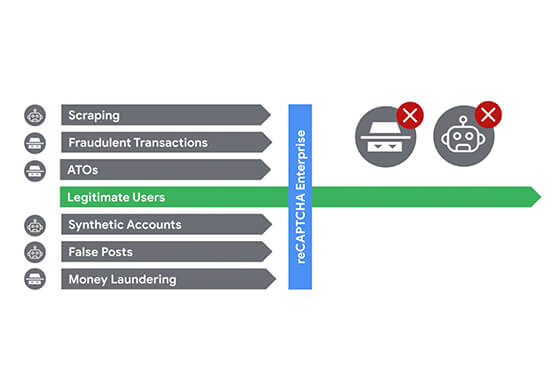
One of the top questions enterprises have is: How can I use reCAPTCHA Enterprise to protect my website from online fraudulent activity? Fraudulent web activities cost enterprises billions of dollars each year. Security teams need to keep the bad actors out of their websites and ensure that their customers can

Case Study: How Exabeam Unlocked its Ability to Scale for Storage & Ingest Data from More Than 500 Security Vendors
Editor’s note: The post is part of a series highlighting our awesome partners, and their solutions, that are Built with BigQuery. Exabeam, a leader in SIEM and XDR, provides security operations teams with end-to-end Threat Detection, Investigation, and Response (TDIR) by leveraging a combination of user and entity behavioral analytics (UEBA)
