





Datashare for Financial Services: Securing the Publishers and Consumers’ Access to Market Data

8570
Of your peers have already read this article.
4:30 Minutes
The most insightful time you'll spend today!
Access to the cloud has advanced the distribution and consumption of financial information on a global scale. In parallel, the global financial data landscape has been transformed by an influx of alternative data sources, including social media, meteorological data, satellite imagery, and other data. Exchanges and market data providers now find they need to include these new datasets to enrich their products and compete, which has meant they now must consider cloud-based models to keep up with the demands of their customers who expect easy, quick, flexible and cost-efficient ways to consume market data.
To address these needs, today we’re announcing the general availability of Datashare for financial services, a new Google Cloud solution that brings together the entire capital markets ecosystem—data publishers, and data consumers—to exchange market data securely and easily.
Datashare helps organize third-party financial information, making it accessible and useful to market data publishers and data consumers. We open-sourced the entire Datashare solution so market data publishers can now onboard their licensed datasets to Google Cloud securely, quickly and easily, while data consumers can consume that data as a service in tools of their preference, such as BigQuery.
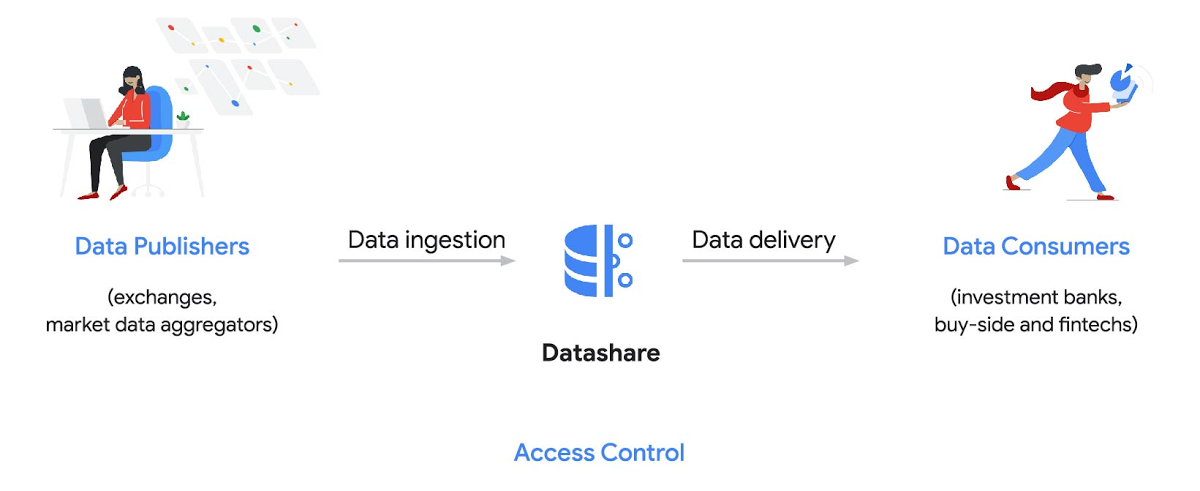
Three ways to distribute and consume your data
Batch data delivery
Datashare provides a batch data delivery mechanism for data publishers to deliver their reference data, historical tick data, alternative market data sources and more via BigQuery, reducing the administrative burden on data consumers to extract insights from data.
Real-time data streaming delivery
By using this event-based data delivery channel for rapidly changing instrument prices, tick data, orders, news and others via Pub/Sub, data consumers can reliably process individual messages or rewind to a point in time to replay a prior market scenario and test model changes.
Monetizing licensed datasets
Market data publishers can onboard their licensed datasets to Google Cloud and make them available via a one-stop-shop on Google Cloud Marketplace, enabling a new sales channel to expand market reach.
Reference architecture
Check out the diagram below to see how you can share your batch and real-time data directly to your Google Cloud customers with BigQuery and Pub/Sub.

As you can see in the above reference architecture, both publishers and consumers can derive several benefits from the solution:
Benefits for data publishers
- You no longer have to maintain your own delivery and licensing infrastructure.
- You can easily package and deliver granular data products and experiments with SQL.
- You can have a solution that scales with your business as data volumes and number of customers grow.
Benefits for data consumers
- Your data is ready for analysis and machine learning (ML)— you no longer have to maintain extract, transform, and load (ETL) pipelines to load files and transform data.
- You can avoid the expense and burden of maintaining multiple copies of large data files.
- You can be more targeted with consumption of data using BigQuery queries, improving performance, and compliance, and reducing cost.
Accessing the datasets
Google Cloud has been working with multiple industry firms on innovating in the market data space. By using Datashare for publishing, data publishers can make their entire datasets available on Google Cloud. Early adopters of Datashare include firms such as OneTick and Accern. OneTick’s datasets include reference and historical futures data (that can be accessed in our console with your login). Accern’s datasets include alternative data such as market sentiment and credit analysis data (that can be accessed in our console with your login).
To make it more helpful, we partnered with Accern to create a hypothetical scenario to describe the data acquisition and analytics process step-by-step.
Accern use case
As a sustainability analyst, you require an economic, social and governance (ESG) dataset to determine which sector is the most widely covered ESG sector by analysts, and to also identify the sector with the lowest ESG sentiment score. Now, you can discover and acquire an ESG dataset in Google Cloud.
Step 1. Navigate to the Financial Services solutions page in the Google Cloud console:

Step 2. Click a dataset, for example Accern AI-Generated ESG Insights, then review the overview details, plans and pricing, documentation and support information. To view the available pricing tiers, click ‘View All Plans’. Once you’ve decided on a tier that you would like to subscribe to, click ‘Select’, choose a billing account and review and accept the terms of service to complete the subscription. Once the steps are complete, click ‘Subscribe’ at the bottom. An overlay window will appear, click ‘Register with Accern’ to activate and complete the subscription.
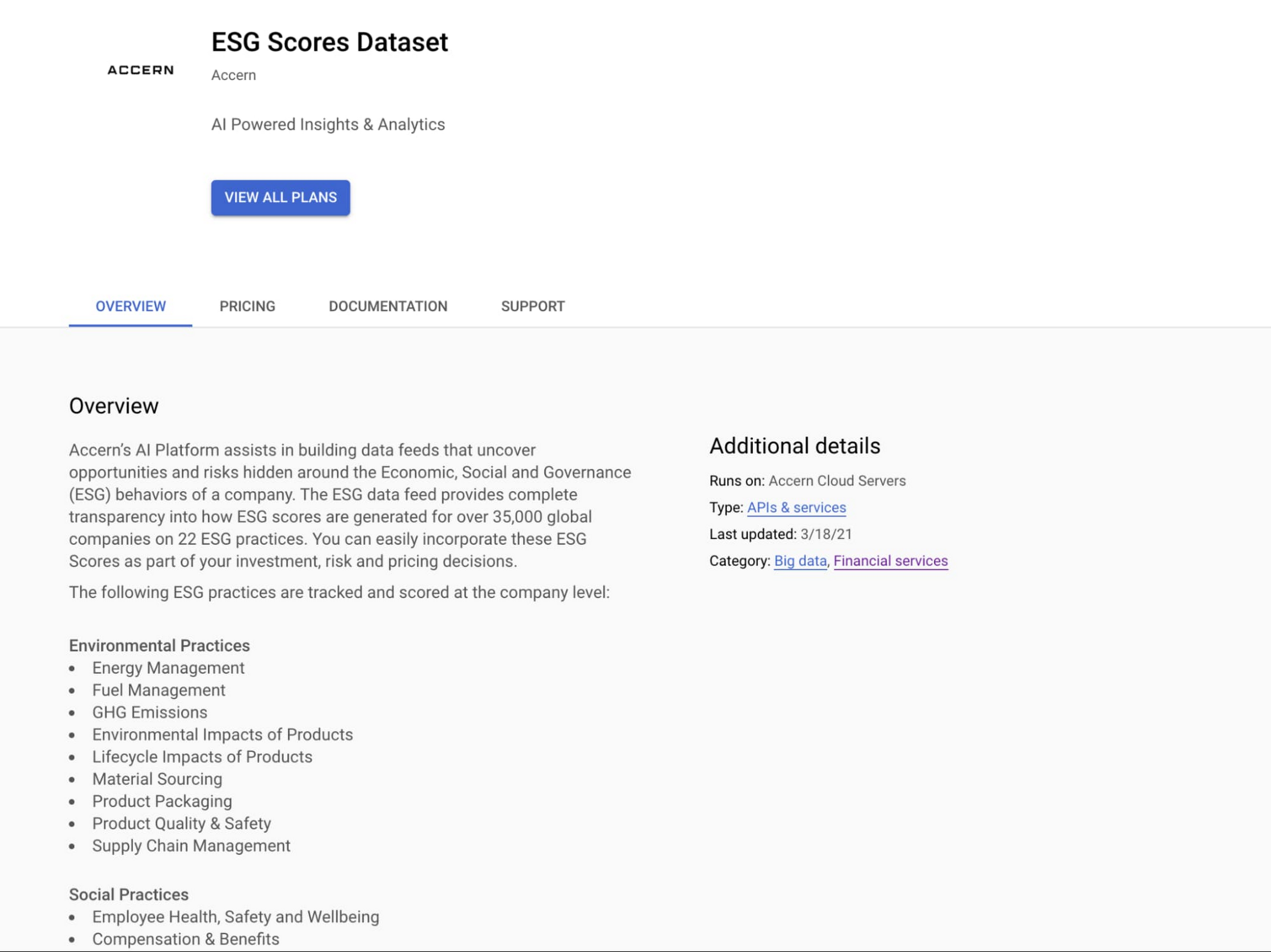

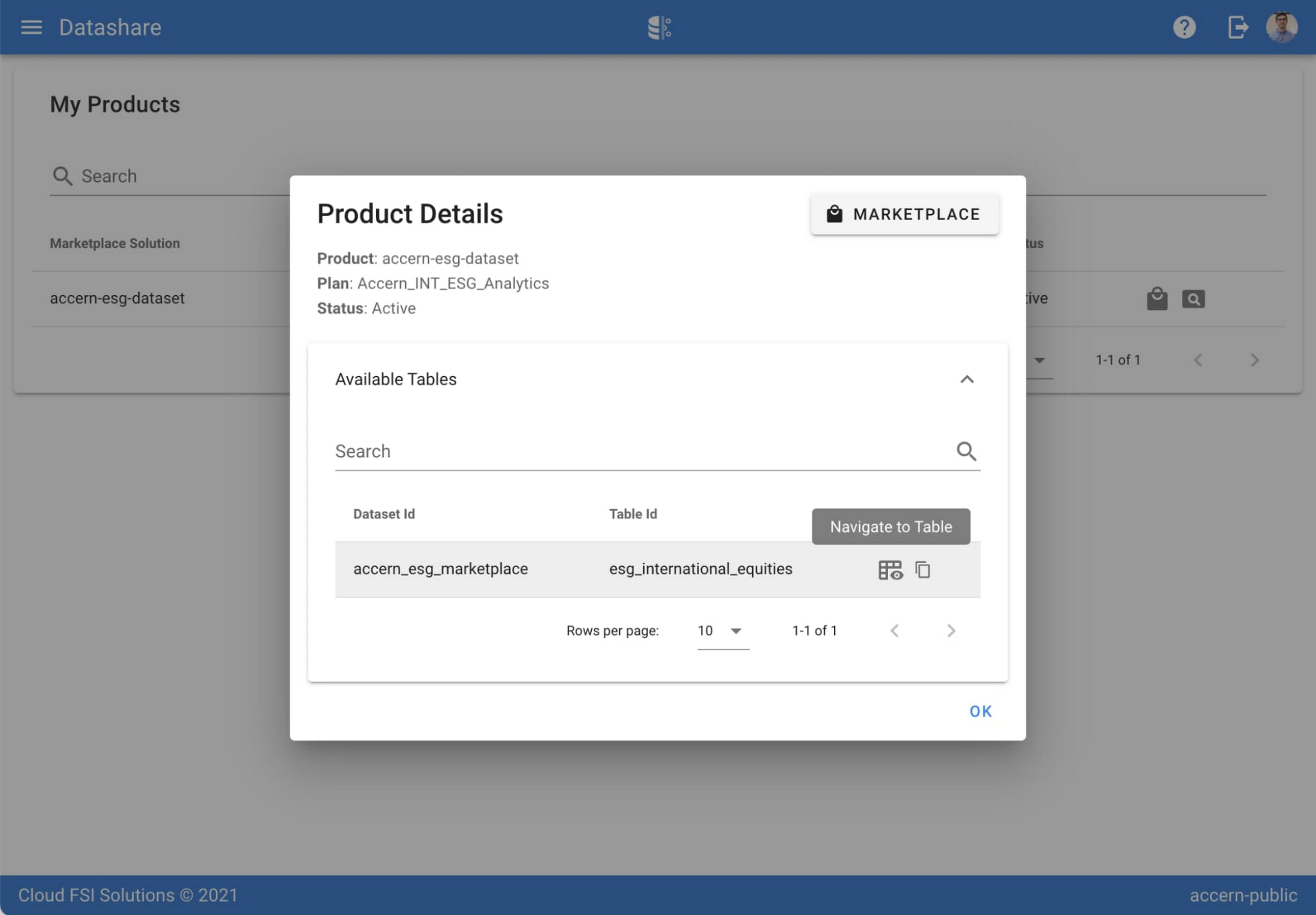
Step 3. Once activation is complete, you’ll be directed to the Datashare ‘My Products’ screen. Voila! You are now subscribed to Accern’s ESG Scores dataset and can access it in your Google Cloud instance using BigQuery. To access the data, click the hour glass icon on the corresponding ‘My Products’ record that you just purchased. An overlay will present you with the details on the dataset and/or table. Click the ‘Navigate to Table’ button to navigate through to the BigQuery console.


Step 4. Now that you have access and are in the BigQuery console, it’s time to generate data insights.
For this example, we’ve eliminated the company identifying information that is included as part of the subscription and aggregated company ESG in a view where each row represents a day, an industry sector, a specific identified ‘ESG Issues’ (event_group and event) and the respective ‘ESG Sentiment’ per issue.

For example, row 1 indicates that within the ‘Healthcare’ sector, there was a ‘Social – Civil Society’ issue identified and it had a negative ESG sentiment score of -15.35.
Step 5. Generate a report by exporting it to Data Studio to build visualizations and conduct additional analysis on the ESG data.
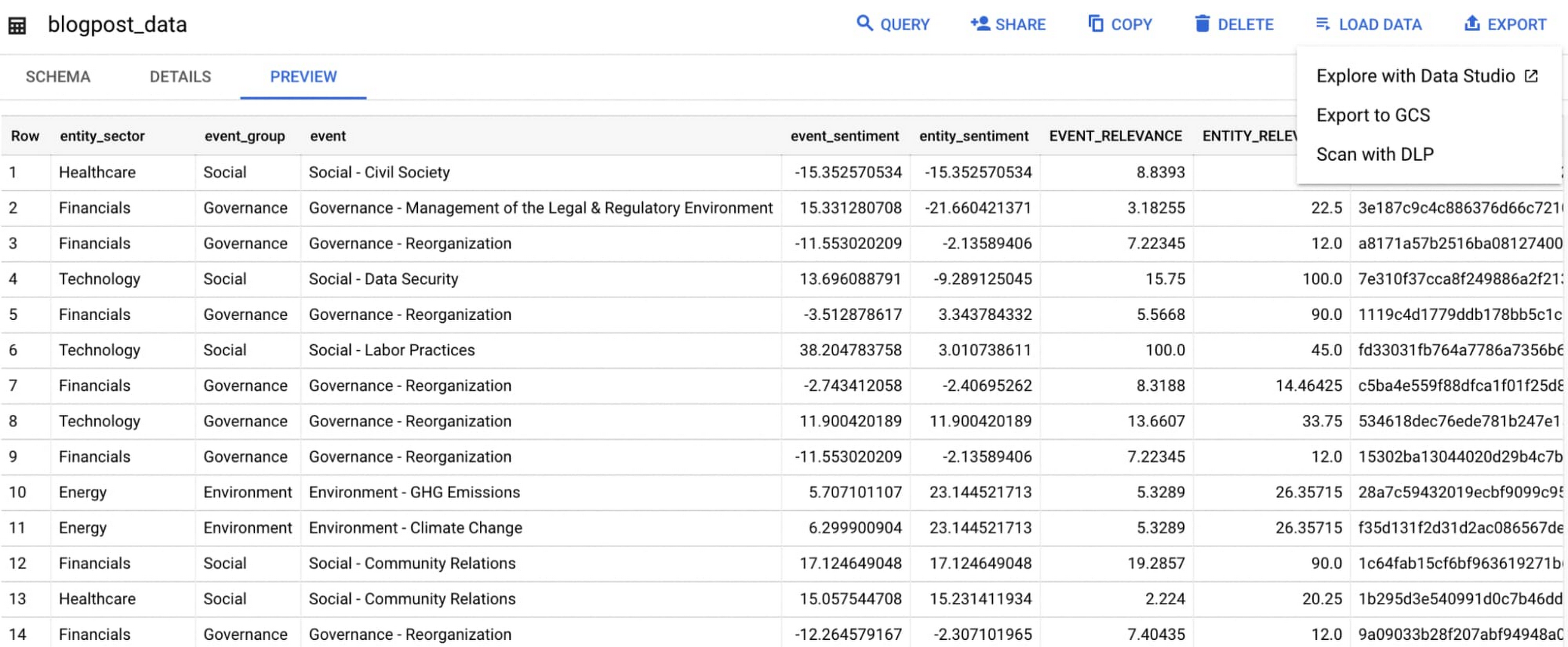
Select ‘Export’ and ‘Explore with Data Studio’.
Step 6. Build a simple/basic report.
Now that the ESG data appears in Data Studio, you can start by building a simple chart to help you understand which industry sectors have the highest volume of discussions around ESG and the overall ESG Sentiment per industry sector.
To build the chart:
- Select the chart type ‘Table’.
- Include
Entity_Sectoras your dimension to aggregate results by ‘Industry Sector.’ - Include
Signal_IDas a measure to count the number of ESG passages identified per ‘Industry Sector.’ - Include
AVG(Event_Sentiment)as a measure to display the overall ESG Sentiment per ‘Industry Sector’ across ESG Issues.

You can see sectors that are most discussed when it comes to ESG related topics and their corresponding ‘ESG Sentiment’ scores.
Step 7. Build your final report in Data Studio.
As a next step you can further drill into the data to understand ESG data specific to each ‘Industry Sector’ and identify positive and negative ESG practices.
Accern has built a more complex sample dashboard and made it available publicly here. You can interact with this report and play around with the data. The dashboard can help to identify material ESG insights for each sector to inform your investment and risk processes. If you have additional questions, you can reach out to Accern directly.

Discovering, accessing and analyzing licensed datasets is quick and easy. Stay tuned for more updates on new licensed datasets.
Publishing your data via Datashare
If you are a publisher of market data, alternative, or exotic data, you can use Datashare to get it published on Google Cloud Marketplace.
Start by joining the Partner Advantage program by registering for the Partner Advantage Portal and applying for the Partner Advantage Build Model engagement. Visit our getting started guide for information to get started on publishing licensed datasets in the Marketplace. Stay tuned for a future blog post about using Datashare to publish datasets in the Marketplace.
More solutions for capital markets
Check out other Google Cloud solutions for capital markets.
BURGER KING Germany: Serving Up Marketing Insights and Supply Chain Visibility Easily

13950
Of your peers have already read this article.
8:30 Minutes
The most insightful time you'll spend today!
Do hamburgers really come from Hamburg? This may still be a matter of debate, but the popularity of American-style burger joints not just in Hamburg but all over Germany, is clear. Germany’s top two fast food companies are both burger chains. One of them is BURGER KING®, a global brand that welcomes more than 11 million customers worldwide every day. The company arrived in Germany in 1976, when its first restaurant opened in Berlin. It now operates more than 100 restaurants across Germany, with franchisees operating more than 600 restaurants of their own.
“In the fast food industry, being able to move quickly is very important. That means delivering the right promotion to our app or launching a viral campaign within days. To do that across more than 700 restaurants, we need the support of the right technology.”
—Oliver Mielentz, IT Manager, BURGER KING® Deutschland GmbH
Previously a subsidiary of the U.S. business, BURGER KING® Germany became an independent company in 2015. As a result, it needed to develop its own IT infrastructure, and the changeover needed to happen fast. “We had to put in place systems that would work for the entire network of franchisees and enable us to easily roll out campaigns,” explains Oliver Mielentz, IT Manager at BURGER KING® Deutschland GmbH.
With the help of Google Cloud Premier partner Cloudwürdig, BURGER KING® Germany chose Google Cloud and G Suite as the right combination to suit its needs.
“In the fast food industry, being able to move quickly is very important,” says Oliver. “That means delivering the right promotion to our app or launching a viral campaign within days. To do that across more than 700 restaurants, we need the support of the right technology.”
Building a franchisee platform in just three months
When a business has multiple franchisees, it’s important to make sure everyone is on the same page, especially in the fast-paced fast food environment. “We have to collate data from all our franchisees and produce reports quickly in order to react to changes in customer behavior,” explains Oliver. “That means processing every transaction that takes place in our restaurants.” Following the restructure, BURGER KING® Germany also needed to build a secure invoicing system with data storage and optimize its communication channels.
“Using Tableau with BigQuery, we’re able to produce reports very quickly. Previously, it took much longer, as data had to be fetched manually. Our reaction time is now almost a business day faster.”
—Oliver Mielentz, IT Manager, BURGER KING® Deutschland GmbH
With support from Witter-IT, BURGER KING® Germany chose Cloudwürdig to build its BKD Connect internal platform on Google Cloud. Thanks to the ready-to-go tools on Google Cloud, it was able to put its invoicing system and data warehouse in place in just three months.
For the BURGER KING® Germany data warehouse, Cloudwürdig built an ETL pipeline that channels ticket data for every sale into BigQuery. “Data is gathered from the restaurants,” says Oliver, “and using Tableau with BigQuery, we’re able to produce reports very quickly. Previously, it took much longer, as data had to be fetched manually. Our reaction time is now almost a business day faster.”
As the ticket data for every transaction is stored in BigQuery, the marketing team can easily see exactly which products are selling well. That’s crucial for tweaking promotions as well as monitoring the supply chain to make sure enough produce is delivered to restaurants in response to changes in demand.
“Thanks to BigQuery, we have a speedy data pipeline that enables us to react on the same day to changes in the market and eliminate bottlenecks in production,” says Oliver.
Switching to G Suite to improve communication
To enable franchisees to sign in to its BKD Connect Platform, BURGER KING® Germany needed a secure authentication system. To solve that problem, it chose to provide franchisees with G Suite accounts. “It’s really easy to set up a new franchisee on the platform. I just create a new G Suite account and Drive folder for it, and it’s ready to go,” says Oliver. G Suite also helps the franchise network to run efficiently, as daily reports are automatically saved to Drive and shared to the appropriate regional network. “Thanks to that system, it’s much easier for any team at headquarters to access the information it needs,” Oliver explains.
BURGER KING® Germany also recently extended its use of G Suite across the whole company. “Following an evaluation of our previous email and productivity software, I made the decision to switch solely to G Suite,” says Oliver. BURGER KING® Germany employees now use Gmail, Calendar, and Drive for their day-to-day productivity needs. “We only just completed the migration, but already, everyone’s happy,” says Oliver. “It’s so easy to share a file using Drive or set up a meeting on Calendar.”
“We’re big fans of Hangouts Meet, and we have two rooms here at our Hanover headquarters equipped with Hangouts Meet hardware,” Oliver adds. “The speech quality is good, and it’s helpful to be able to see every participant, especially when you’re running a meeting with multiple franchisees.”
Optimizing infrastructure to power innovative campaigns
The BURGER KING® app, available for iOS and Android, helps the company to deliver a great customer experience. Through their MyBK accounts, guests can access coupons and special promotions. “We had a really interesting campaign for Easter: guests used the app to hunt for virtual Easter eggs,” explains Oliver. “We knew it was going to be big, and our previous back end wouldn’t have been able to handle the traffic.”
To enable the marketing campaign to go ahead, BURGER KING® Germany moved the back end of the app, along with its website, to Google Cloud. For developing and running its web and app back ends, it now uses App Engine and virtual machines on Compute Engine, as well as Memorystore and Cloud Functions. For monitoring and logging, it uses Stackdriver, and Cloud CDN and Cloud DNS to easily handle its traffic.
“We ran the campaign without any performance issues, even though we were receiving several million hits a day,” says Oliver. Since migrating the back end to Google Cloud, the marketing team also launched the popular “Escape the Clown” campaign. “That campaign blew our minds!” says Oliver. “It wouldn’t have been possible without Google Cloud, because it required a lot of back end capacity.”
To develop the app infrastructure it needs, BURGER KING® Germany relies on Cloudwürdig. “Working with Cloudwürdig is great because the team has the same agile mindset as us,” says Oliver. “When we have a new idea, we just set up a meeting, and in a couple of days the new infrastructure is in place. For Escape the Clown, it only took a few weeks to get everything ready to launch.”
Leveraging integrated tools to grow the business
Using Google Cloud together with G Suite enables BURGER KING® Germany to run its franchise network efficiently, while keeping its IT team lean. “Google Cloud and G Suite are the perfect fit for the way of working at BURGER KING® Germany,” says Oliver. “Many of the company’s operatives are often on the road, visiting restaurants and franchisees. With these tools, they can work flexibly and react quickly to the situation on the ground.”
“In order to grow the business, we need to use the data we receive every day to understand exactly what is happening in our restaurants. With the tools provided by Google Cloud, we can get more guests through the door and offer them a better experience.”
—Oliver Mielentz, IT Manager, BURGER KING® Deutschland GmbH
It also helps to keep infrastructure costs under control. “With Google Cloud, we only pay for what we use, which is really important for us,” Oliver explains. “It means we can scale up quickly if we see an opportunity to react to a trend in customer behavior and launch a new marketing campaign that resonates with the moment. When it’s finished, we can then scale down again, and that definitely saves us money.”
BURGER KING® is now working with Cloudwürdig to add more functionality to the BURGER KING® app using Google Kubernetes Engine. “We like to work with customers long-term to support their digital transformation. BURGER KING® Germany is a great example of how one project can develop into a great collaboration,” says Benny Woletz, Managing Director of Cloudwürdig.
BURGER KING® also plans to expand its presence in Germany and gain a greater market share by further tailoring both its marketing and the way it runs its restaurants to answer its guests’ needs. “In order to grow the business, we need to use the data we receive every day to understand exactly what is happening in our restaurants,” says Oliver. “With the tools provided by Google Cloud, we can get more guests through the door and offer them a better experience.”
Know the Leaders of Google Cloud Public Sector Community

5018
Of your peers have already read this article.
1:30 Minutes
The most insightful time you'll spend today!
At Google Cloud, being a strategic partner is part of our DNA. Whether it’s listening closely to our customers, helping to build team skills for innovation or simply being there (since we know the cloud is 24/7), we get excited about working hands-on with customers to deliver new solutions.
As we look to solve decades-old challenges with new technologies in workforce productivity, cybersecurity, and artificial intelligence/machine learning, we know that we are only as good as the people behind the technology. Today, we’re proud to spotlight a few of the inspiring folks behind Google Cloud Public Sector and celebrate their recognition in the industry.
Melissa Adamson, Head of Government Channels at Google Cloud, has been named to the highly respected Women of the Channel list for 2021. This annual list recognizes the unique strengths, leadership and achievements of female leaders in the IT channel. The women honored this year pushed forward with comprehensive business plans, marketing initiatives and innovative ideas to support their partners and customers.
Melissa was brought on to build the Public Sector channel from scratch. The initial focus was building the channel for the US government team and has since expanded to include education, Canada and Latin America.
Having a career background at both Microsoft and Accenture, Melissa leveraged her extensive professional network to build the organic partnerships needed to accelerate the Public Sector partner ecosystem. This helped her drive two key wins (US Postal Service and PTO) and personally recruit top cloud partners in the industry. Melissa loves card games and is learning a new language.
Todd Schoeder, Director of Global Public Sector Digital Strategy, was recently featured in the “Top 20 Cloud Executives to Watch in 2021” by Wash Exec. Recognized for his work in helping customers navigate through the impact of COVID-19 and developing innovative solutions to meet mission challenges, he says: “New partnerships are required to solve for the problems of the future. Challenges that were previously thought of as insurmountable, too risky or expensive, are actually quite the opposite — as long as you have the right partner that is working in your best interest with you.”
Josh Marcuse, Head of Strategy & Innovation, received his second Wash100 Award for leading a digital transformation team that works to drive the development of public sector solutions, including cyber defense, smart cities, and public health.
Josh has launched services to support collaborative team operations including Workspace for Government and an artificial intelligence-based customer service platform to support remote work needs. His work also includes leading Google Cloud’s partnerships with organizations to improve data sharing in the public health community, contact tracing activities, and supporting research efforts across national laboratories.
Like Melissa, Josh was brought on to build a new team dedicated to strategy and innovation. This team’s purpose is to bring an intense focus to public sector mission outcomes and the public servants who own them. Josh spent a decade pushing digital modernization and workforce transformation at the U.S. Department of Defense, and co-founded the Federal Innovation Council at the Partnership for Public Service, and now brings that domain expertise to supporting government workers who are driving digital transformation.
Join us in celebrating these folks for their leadership and contributions!
Google Cloud Featured at TechCrunch Disrupt 2021

4925
Of your peers have already read this article.
1:30 Minutes
The most insightful time you'll spend today!
Startups need to move quickly and focus their limited resources on areas where they can differentiate. If infrastructure isn’t your differentiator, don’t put a lot of energy into your infrastructure when someone else can do it for you. What’s more, time-to-market matters to startups more now than ever. Successful early stage companies know this, and leverage existing tools, libraries, frameworks and innovations whenever possible.
Next week Google Cloud will be featured at TechCrunch Disrupt, the iconic annual event where “founders and investors shaping the future of disruptive technology” come together to share stories, network, and learn from each other. Google Cloud will host a session and Google Cloud engineers will be available in a virtual booth to answer startup questions.
The session, “Demo Derby – How startups are disrupting the status quo with innovative data analytics, AI and modern app development” will be a fun, fast-paced set of presentations showing short demos of startups and startup projects built with Google Cloud.
Demo Derby Presenters
- Andrea Le Vot, Chief Data Protection Officer with startup BlueZoo will deliver a demo showing how they are revolutionizing the property insurance industry with AI and Cloud – and doing so while actually protecting people’s privacy.
- Dale Markowitz and Zack Akil, Applied AI Engineers, will show how easy it is to use AI for everything from video search to editing to automated translation.
- Vidya Nagarajan, Group Product Manager from Google Cloud will deliver a fast paced demo that shows how startups can drive developer productivity with serverless innovations.
“Disrupt is iconic for its engagement with founders, investors, and the broad community of early stage companies,” said Andrea Le Vot, Chief Data Protection Officer at BlueZoo. “We are thrilled to share our insights with others in our community, and to show how we have partnered with Google Cloud to innovate faster than most of the larger, well funded insurance companies in our market.”
The series of snippet sized demos will be followed by a roundtable discussion with the demo developers focused on lessons learned, best practices, how to reduce time-to-market, and how to focus on where you can most effectively differentiate.
The session will air on Day One of the event: Tuesday September 21, 2021 at 1pm PT and will be available on demand after the event for all Disrupt attendees.

3400
Of your peers have already downloaded this article
10:00 Minutes
The most insightful time you'll spend today!
Business Value of Google Cloud for SAP Environments examines the impact of how migrating SAP workloads, data, and applications to Google Cloud can benefit organizations. Through interviews with Google Cloud customers, IDC developed a Business Value model to show the clear value of running their SAP environments on Google Cloud.
In this IDC Business Value paper sponsored by Google Cloud, you’ll learn how organizations:
- Saw 46% lower cost of operations by running equivalent SAP environments on Google Cloud;
- Enabled IT infrastructure, database, and security teams to work 56% more efficiently and effectively;
- Minimized productivity and revenue losses by 98% associated with unplanned outages; and
- Achieved three-year benefits of $4.8 million per organization based on infrastructure cost savings, staff efficiencies, and employee productivity and revenue gains as described.
Download this white paper now to learn how moving your SAP environment to Google Cloud can give your company a competitive edge.
Melbourne Joins Google’s 26 Cloud Regions

5003
Of your peers have already read this article.
1:30 Minutes
The most insightful time you'll spend today!
We opened our Sydney cloud region in 2017 and, since then, we have continued to invest and expand across Australia and New Zealand to support the digital future of organizations of all sizes. In Australia, Google Cloud supports almost A$3.2 billion in annual gross benefits to businesses and consumers. This includes A$686 million to businesses using Google Workspace and Google Cloud Platform, another A$698 million to Google Cloud partners, and A$1.8 billion to consumers.1
For customers in Australia, New Zealand and across Asia Pacific, we’re excited to announce that our new Google Cloud region in Melbourne is now open. Designed to help businesses build highly available applications for their customers, the Melbourne region is our second Google Cloud region in Australia and 11th to open in Asia Pacific.
We’re celebrating the occasion with a digital event where federal minister for the Digital Economy, Jane Hume, and customers Australia Post, Trade Me, Bendigo and Adelaide Bank, The Australian Football League and Macquarie Bank will share their perspectives. Come join us!
A global network of regions
Melbourne joins the existing 26 Google Cloud regions connected via our high-performance network, helping customers better serve their users and customers throughout the globe. With this our second region in Australia, customers benefit from improved business continuity planning with distributed, secure infrastructure needed to meet IT and business requirements for disaster recovery, all the while maintaining data sovereignty in-country.

With this new region, Google Cloud customers operating in Australia and New Zealand will benefit from low latency and high performance of their cloud-based workloads and data. Designed for high availability, the region opens with three zones to protect against service disruptions, and offers a portfolio of key products, including Compute Engine, Google Kubernetes Engine, Cloud Bigtable, Cloud Spanner, and BigQuery.
We also continue to invest in expanding connectivity across the Australia and New Zealand region by working with partners to establish subsea cables and new Dedicated Cloud Interconnect locations and points of presence in major cities including Sydney, Melbourne, Perth, Canberra, Brisbane and Auckland.
Collectively, this will deliver geographically distributed and secure infrastructure to customers across Australia and New Zealand – which is especially important for those in regulated industries such as Financial Services and the Public Sector.
What customers and partners are saying
Navigating this past year has been a challenge for companies as they grapple with changing customers demands and greater economic uncertainty. Technology has played a critical role, and we’ve been fortunate to partner with and serve people, companies, and government institutions around the world to help them adapt. The Google Cloud region in Melbourne will help our customers adapt to new requirements, new opportunities and new ways of working.
“We moved to Google Cloud to improve the stability and resilience of our infrastructure and become more cloud-native as part of a digital transformation program that keeps the customer at the heart of our business. We welcome Google Cloud’s investment in ANZ and the opportunities the Google Cloud Melbourne region presents to improve Trade Me’s agility and performance. – Paolo Ragone, Chief Technology Officer, Trade Me
“We initially turned to Google Cloud to help us process parcels faster and gain deeper insights into our business and its processes. The relationship has continued to deliver benefits to our customers and our organization and we welcome Google Cloud’s opening of the Melbourne region as presenting even more opportunities for businesses to innovate and generate efficiencies.” – Munro Farmer, Chief Information Officer, Australia Post.
“We are well progressed with our multi-year strategy to grow and transform our organization to be Australia’s bank of choice. Google Cloud’s advanced data capabilities and renowned culture of innovation are strongly aligned to this strategy and will allow us to become even more innovative and agile in responding to our customers’ ever-changing needs. We were quick to run our workloads out of the Melbourne cloud region and we believe Google Cloud’s expanded investment in local infrastructure will further assist us on our business transformation journey.” – Andrew Cresp, Chief Information Officer, Bendigo and Adelaide Bank.
“We have a clear vision when it comes to innovating to deliver world-class service to our customers, and our partnership with Google Cloud is core to that strategy. The company’s continued investments in local infrastructure and technology present new opportunities for us as we advance our transformation journey in this digital-first era.” – Chris Smith, Vice President, Digital Service, Optus
Our global ecosystem of channel partners has expanded by more than 400% in the last two years, and we look forward to continuing our close relationships with partners in Australia and New Zealand as we help customers modernize, innovate, scale and grow.
“Australian companies are increasingly realising the benefits of their cloud investments and are now looking to transform their organisations at scale. We are excited about the potential and new value that the Google Melbourne Cloud region will bring to our clients as we continue to work together on delivering intelligent and innovative solutions to Australian organisations.” – Tara Brady, CEO of Accenture Australia and New Zealand
“Google Cloud has always been there for its customers for the long haul and the opening of the new Melbourne Cloud region is great news. This increased resilience and scale will empower companies of all sizes to be bold in accelerating their digital transformation plans.” – Tony Nicol, CEO of Servian
“We’re excited about the launch of the Melbourne Cloud region. It will cater to the needs of industries we work closely with including healthcare and financial services, and will further enhance how we jointly deliver on the compliance, privacy and security requirements of companies as they advance their digital transformation.” – Simon Poulton, CEO of Kasna
“The opening of the new Google Cloud region in Melbourne is fantastic news as it now enables DXC customers access to enhanced services for their mission critical application and data solutions across two regions within Australia. As our customers modernise their application estate, many are seeking dual region cloud services, and DXC is excited to partner with Google Cloud to deliver these services to customers in Australia and New Zealand.” – Tim Fraser, Google Practice Lead ANZ at DXC Technology
Helping customers build their transformation clouds
Google Cloud is here to support businesses, helping them get smarter with data, deploy faster, connect more easily with people and customers throughout the globe, and protect everything that matters to their businesses. The cloud region in Melbourne offers new technology and tools that can be a catalyst for this change. Click here to learn more about all our Google Cloud locations.
1. AlphaBeta, The Economic Impact of Google Cloud to Australia, July 2021
More Relevant Stories for Your Company

Go Green with Google’s Latest Tool and Pick the Most Sustainable Cloud Region
As a Google Cloud customer, your carbon footprint is already carbon neutral: Google first achieved carbon neutrality in 2007, and has been purchasing enough solar and wind energy to match 100% of its global electricity consumption since 2017. Now, Google is targeting a new sustainability goal: operating on carbon-free energy (CFE) 24/7,

FAQs: Everything Your Need to Know About Cloud Computing
There are a number of terms and concepts in cloud computing, and not everyone is familiar with all of them. To help, we’ve put together a list of common questions, and the meanings of a few of those acronyms. You can find all these, and many more, in our learning resources.

What Our Google Cloud Experts Say About Multi-cloud Journey
Do you want to fire up a bunch of techies? Talk about multicloud! There is no shortage of opinions. I figured we should tackle this hot topic head-on, so I recently talked to four smart folks—Corey Quinn of Duckbill Group, Armon Dadgar of Hashicorp, Tammy Bryant Butow of Gremlin, and James Watters of VMware—about what multicloud is

Gartner Names Google Cloud a Leader in the 2019 Cloud Infrastructure as a Service Market
As increasing amount of cloud IaaS is being bought for traditional IT, with an emphasis on cost reduction, safety and security, service providers are offering a high-quality service, with excellent availability, good performance, high security and good customer support. In its Magic Quadrant for Cloud Infrastructure as a Service (IaaS),
