





Confidential GKE Nodes: Now Available on Compute Optimized C2D VMs

1245
Of your peers have already read this article.
1:30 Minutes
The most insightful time you'll spend today!
Today, we are happy to announce that Confidential GKE Nodes are available on compute optimized C2D VMs.
Many companies have adopted Google Kubernetes Engine (GKE) as a key component in their application infrastructure. In some cases, the advantages of using containers and Kubernetes can surpass those of traditional architectures, but migrating to and operating apps in the cloud often requires strategic planning to reduce risk and prevent data breaches. This is where Confidential GKE Nodes can be utilized to enhance the security of your GKE clusters or node pools.
Confidential GKE Nodes leverage specialized hardware to encrypt data in-use and are ideal for organizations processing sensitive data in the cloud. To make it easier to start using Confidential GKE Nodes, GKE standard workloads you run today can run as confidential GKE workloads without code changes on your end.
Security underpinnings of Confidential GKE Nodes
As we expand the Confidential Computing product portfolio from Confidential VMs to Confidential GKE Nodes to Confidential Dataproc, ensuring high performance is key. Confidential GKE Nodes are built on the same technology foundation as Confidential VM and utilize the Secure Encrypted Virtualization (SEV) capability of AMD EPYC™ processors. This feature allows you to keep data encrypted in memory with node-specific, dedicated keys that are generated and managed by the processor. The keys are generated in hardware during node creation and reside solely within the processor, making them unavailable to Google Cloud or other nodes running on the host.
Combined with the high performance of C2D VMs
Previously, Confidential GKE Nodes were generally available only on general purpose N2D VMs, but now they’re also available on compute optimized C2D VMs. The C2D machine series provides VM sizes ranging from 2 vCPUs to 112 vCPUs, offers up to 896 GB of memory, and are suited for performance-intensive workloads. C2D standard and C2D high-CPU machines serve compute-bound workloads including high-performance web servers and media transcoding. C2D high-memory machines serve specialized workloads such as high-performance computing (HPC) and electronic design automation (EDA), which require more memory.
Confidential GKE Nodes on compute-optimized C2D VMs could be a fit for use cases that require high performance and security. You can achieve encryption in-use for data processed inside your GKE cluster or just on specific node pools, without significant performance degradation. This is relevant for industries such as financial services, healthcare, retail, blockchain, and telecommunications, which often have sensitive data or personally identifiable information (PII) that requires additional security measures.
How MATRIXX used Confidential GKE Nodes
MATRIXX Software chose Confidential GKE Nodes to provide transparent encryption for data in-use to supplement encryption for data at-rest to secure personal subscriber data as required by privacy regulations.
MATRIXX Digital Commerce Platform (DCP) is a real-time 5G monetization for the communications industry, serving many of the world’s largest operator groups, regional carriers, and emerging digital service providers. MATRIXX used Google Cloud Confidential GKE Nodes to deliver a cloud-first digital commerce solution that enables commercial and operational agility for current and new telco business models.
A whitepaper titled “Protecting Your 5G Revenue Stream in the Cloud,” described how when MATRIXX DCP is deployed with Confidential Computing on Google Cloud, “its subscriber data, account balances, network events and charges/revenue streams are encrypted in use without making any code changes to the application or compromising on performance.”
Confidential GKE Nodes are globally available
At Google Cloud, we’re committed to investing in Confidential Computing, so we’ve expanded our support to VM families like C2D VMs. Confidential GKE Nodes running on C2D VMs are available in regions across the globe, including us-central1 (Iowa), asia-southeast1 (Singapore), us-east1 (South Carolina), us-east4 (North Virginia), asia-east1 (Taiwan), and europe-west4 (Netherlands). Note that Confidential GKE Nodes are available where C2D or N2D machines are available.
Pricing for Confidential GKE Nodes
There is no additional cost to deploy Confidential GKE Nodes, other than the costs of Compute Engine and Confidential VM pricing.
Try out Confidential GKE Nodes for cluster-level enablement
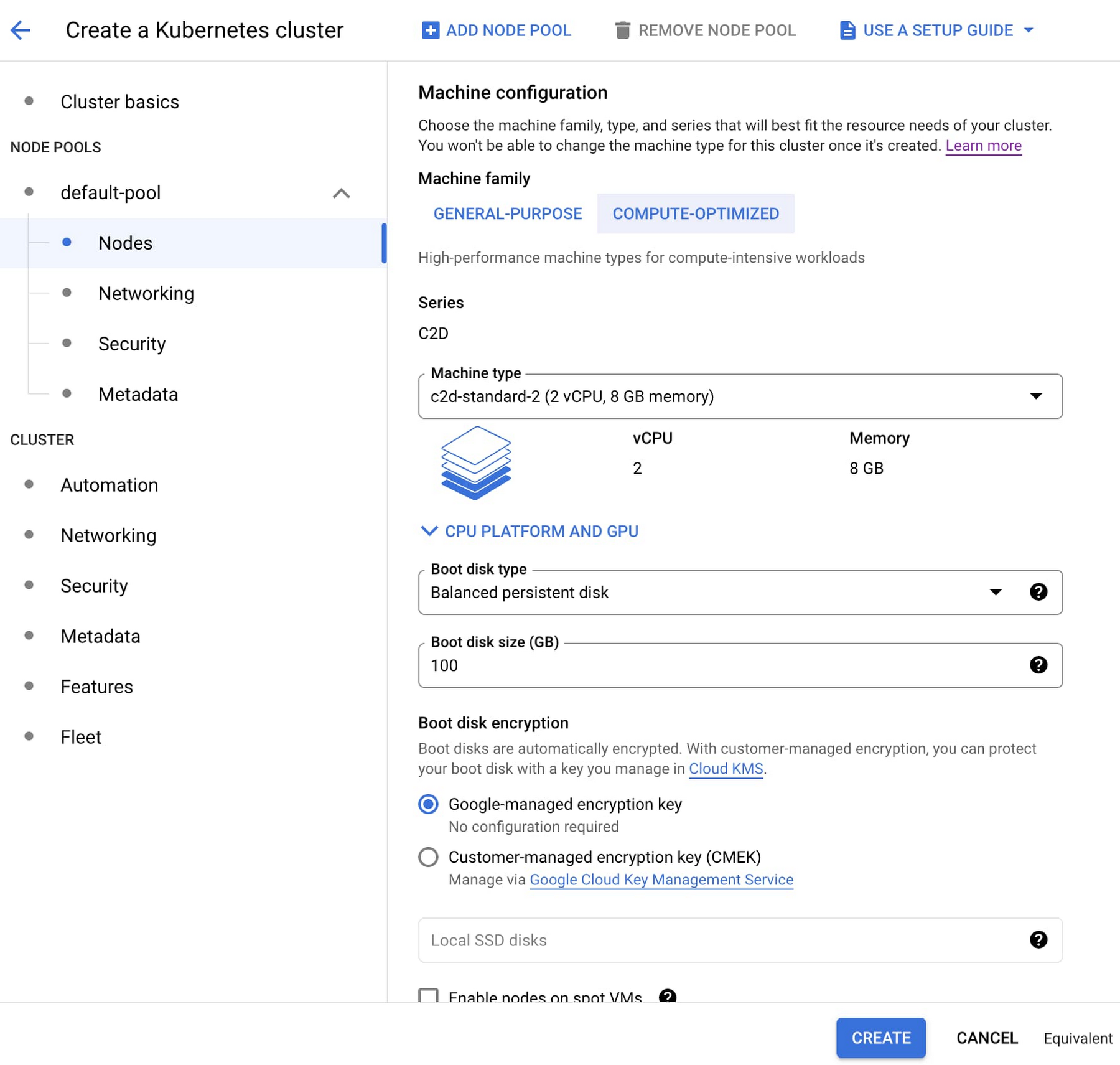
- First, go to the Google Kubernetes Engine page in the Google Cloud console. In the top navigation bar, click Create. In the Create Cluster modal, choose ‘Standard: You manage your cluster’ and click Configure.
- Next, from the left navigation pane, under Cluster, click Security. Select the ‘Enable Confidential GKE Nodes’ checkbox.
- Then, from the left navigation pane again, under Node Pools, click Nodes. Under Machine Configuration and Machine family, select the Compute-optimized tab, and choose a C2D machine type.
Configure the rest of the cluster as desired and click Create.
Making secure design choices should be easy, especially when the workloads involve high-performance processing of sensitive data. You can help protect your sensitive applications and data today by adding Confidential GKE Nodes to your GKE workloads. Learn more about Confidential Computing here.
Confidential GKE Nodes: Now Available on Compute Optimized C2D VMs
1246
Of your peers have already read this article.
1:30 Minutes
The most insightful time you'll spend today!
Today, we are happy to announce that Confidential GKE Nodes are available on compute optimized C2D VMs.
Many companies have adopted Google Kubernetes Engine (GKE) as a key component in their application infrastructure. In some cases, the advantages of using containers and Kubernetes can surpass those of traditional architectures, but migrating to and operating apps in the cloud often requires strategic planning to reduce risk and prevent data breaches. This is where Confidential GKE Nodes can be utilized to enhance the security of your GKE clusters or node pools.
Confidential GKE Nodes leverage specialized hardware to encrypt data in-use and are ideal for organizations processing sensitive data in the cloud. To make it easier to start using Confidential GKE Nodes, GKE standard workloads you run today can run as confidential GKE workloads without code changes on your end.
Security underpinnings of Confidential GKE Nodes
As we expand the Confidential Computing product portfolio from Confidential VMs to Confidential GKE Nodes to Confidential Dataproc, ensuring high performance is key. Confidential GKE Nodes are built on the same technology foundation as Confidential VM and utilize the Secure Encrypted Virtualization (SEV) capability of AMD EPYC™ processors. This feature allows you to keep data encrypted in memory with node-specific, dedicated keys that are generated and managed by the processor. The keys are generated in hardware during node creation and reside solely within the processor, making them unavailable to Google Cloud or other nodes running on the host.
Combined with the high performance of C2D VMs
Previously, Confidential GKE Nodes were generally available only on general purpose N2D VMs, but now they’re also available on compute optimized C2D VMs. The C2D machine series provides VM sizes ranging from 2 vCPUs to 112 vCPUs, offers up to 896 GB of memory, and are suited for performance-intensive workloads. C2D standard and C2D high-CPU machines serve compute-bound workloads including high-performance web servers and media transcoding. C2D high-memory machines serve specialized workloads such as high-performance computing (HPC) and electronic design automation (EDA), which require more memory.
Confidential GKE Nodes on compute-optimized C2D VMs could be a fit for use cases that require high performance and security. You can achieve encryption in-use for data processed inside your GKE cluster or just on specific node pools, without significant performance degradation. This is relevant for industries such as financial services, healthcare, retail, blockchain, and telecommunications, which often have sensitive data or personally identifiable information (PII) that requires additional security measures.
How MATRIXX used Confidential GKE Nodes
MATRIXX Software chose Confidential GKE Nodes to provide transparent encryption for data in-use to supplement encryption for data at-rest to secure personal subscriber data as required by privacy regulations.
MATRIXX Digital Commerce Platform (DCP) is a real-time 5G monetization for the communications industry, serving many of the world’s largest operator groups, regional carriers, and emerging digital service providers. MATRIXX used Google Cloud Confidential GKE Nodes to deliver a cloud-first digital commerce solution that enables commercial and operational agility for current and new telco business models.
A whitepaper titled “Protecting Your 5G Revenue Stream in the Cloud,” described how when MATRIXX DCP is deployed with Confidential Computing on Google Cloud, “its subscriber data, account balances, network events and charges/revenue streams are encrypted in use without making any code changes to the application or compromising on performance.”
Confidential GKE Nodes are globally available
At Google Cloud, we’re committed to investing in Confidential Computing, so we’ve expanded our support to VM families like C2D VMs. Confidential GKE Nodes running on C2D VMs are available in regions across the globe, including us-central1 (Iowa), asia-southeast1 (Singapore), us-east1 (South Carolina), us-east4 (North Virginia), asia-east1 (Taiwan), and europe-west4 (Netherlands). Note that Confidential GKE Nodes are available where C2D or N2D machines are available.
Pricing for Confidential GKE Nodes
There is no additional cost to deploy Confidential GKE Nodes, other than the costs of Compute Engine and Confidential VM pricing.
Try out Confidential GKE Nodes for cluster-level enablement
- First, go to the Google Kubernetes Engine page in the Google Cloud console. In the top navigation bar, click Create. In the Create Cluster modal, choose ‘Standard: You manage your cluster’ and click Configure.
- Next, from the left navigation pane, under Cluster, click Security. Select the ‘Enable Confidential GKE Nodes’ checkbox.
- Then, from the left navigation pane again, under Node Pools, click Nodes. Under Machine Configuration and Machine family, select the Compute-optimized tab, and choose a C2D machine type.
Configure the rest of the cluster as desired and click Create.
Making secure design choices should be easy, especially when the workloads involve high-performance processing of sensitive data. You can help protect your sensitive applications and data today by adding Confidential GKE Nodes to your GKE workloads. Learn more about Confidential Computing here.
Public Cloud’s Zero Trust Architecture Keeps Enterprise Data Safe

4618
Of your peers have already read this article.
5:00 Minutes
The most insightful time you'll spend today!
Over the past decade, cybersecurity has posed an increasing risk for organizations. In fact, cyber incidents topped the recent Allianz Risk Barometer for only the second time in the survey’s history. The challenges in combating these risks only continue to grow. Adversaries tend to be agile and are consistently looking for new ways to land within your digital environments. They also drive attack vectors that work, which means enterprise risk leaders are now forced to look for new ways of securing infrastructure and data.
Cloud comes of age in the modern day cybersecurity threat landscape
When cloud, in its various delivery models, was first introduced, it didn’t fit neatly into the security frameworks that had seemingly protected networks for many decades. Public cloud was the answer to ongoing IT challenges: scale, resources, security capabilities, and budget cycle limitations. Now, public cloud is meeting the increasing challenge of implementing cybersecurity controls and frameworks that are capable of protecting today’s global enterprise.
Cloud adoption – with all its scale and redistribution of longstanding security paradigms – is the optimal choice for infrastructure and security, particularly as organizations grapple with the need to engage in digital transformation. We assert that successful digital transformation is impossible without incorporating the use of the scale, security architecture, and resiliency of the cloud.
Consequently, cloud adoption becomes a necessary component of roadmap discussions and planning as your organization looks to reduce overall risk. Risk leaders and enterprise cybersecurity leaders must consider that moving data, digital processes, and priority workloads to the public cloud is a crucial step for meeting the current and future digital needs of the enterprise. Going forward, this digital transformation increasingly will include hybrid infrastructure environments composed of a combination of on-premises and cloud solutions.
Pinpointing where threats thrive
As digital environments become more complex within a given organization, proactively countering adversaries becomes all the more difficult. It’s harder to implement, scale, and adhere to existing security and control frameworks. It’s also increasingly challenging to apply framework guidance to new applications, build and support infrastructure within a secure foundation, and maintain good cyber hygiene through the digital lifecycle.
As reported by TechTarget, the 2020 hack of the SolarWinds Orion IT performance monitoring system is a prime example. It grabbed headlines “not because a single company was breached, but because it triggered a much larger software supply chain incident.” This vulnerability in popular, commercially available, and widely utilized software compromised the data, networks, and systems of thousands of companies when a routine software update turned out to be backdoor malware.
A close look at the root problems behind high-profile security breaches reveals that it’s a lack of agility and an inability to scale resources that prohibit the modern security organization’s ability to respond quickly enough to counter new challenges. Look even closer and you’ll often find an insufficient implementation of best practices and ineffective solutions, leaving an organization continually chasing the next tool or solution and scrambling to stay ahead of emerging threats.
While the cost to individual businesses is high, most organizations struggle with the needed skills and resources to rigorously maintain data security basics and ensure readiness for inevitable attacks. The previous sentence is especially true when you consider that maintaining an effective state of cybersecurity readiness is a costly practice that requires the continual development of expertise, the evaluation of new tools, and an ongoing element of vigilance.
Threat visibility is a big part of the problem. You can’t protect your company from what you can’t see. For individual enterprises – with critical data workloads housed in a combination of on-premises servers, a variety of endpoints, and both private and public cloud instances – staying ahead in the ongoing battle requires a new approach.
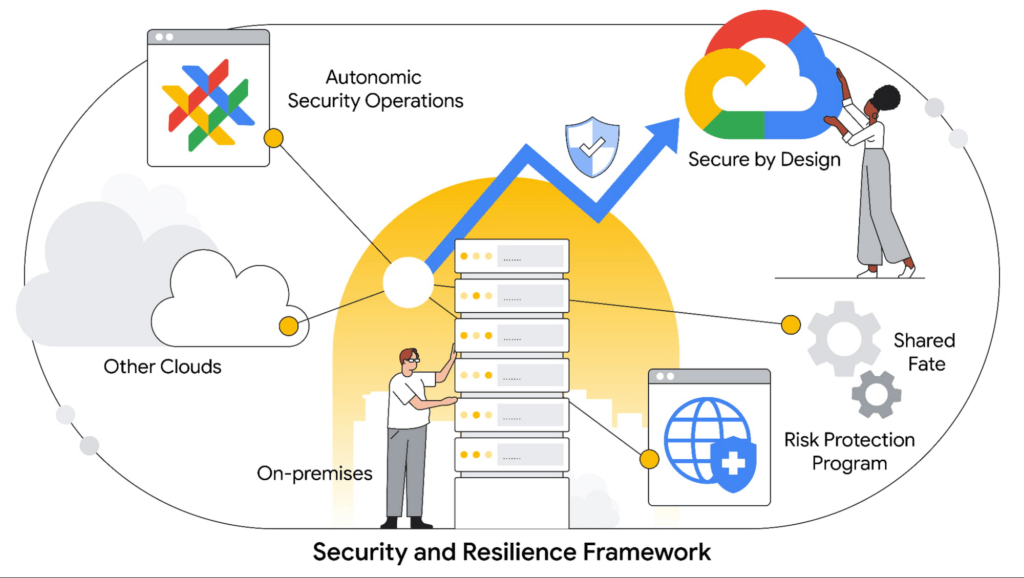
The identification of actionable alerts and other data contributes to a better overall state of readiness. Thought leadership and discussions related to Autonomic Security Operations provide a promising outlook for security organizations willing to lean into the changing technology landscape – a landscape that now benefits from leveraging automation and machine learning currently used in security stacks. Reducing the chance of introducing vulnerabilities or missing-critical alerts starts with ensuring full visibility into an increasingly expanding and complex environment.
The evolution of a shared responsibility to a shared fate
Industry megatrends are driving cloud adoption and with it a path to improved cybersecurity. Among these trends is the concept of shared fate as an evolution of the historical shared-responsibility model. Shared fate drives a flywheel of increasing trust which develops as more enterprises transition to the cloud. This compels an even higher security investment and a more vested interest from cloud service providers.
At Google Cloud, shared fate means we take an active stake in our customers’ security posture, offering capabilities and defaults that help ensure secure deployments and configurations in the public cloud. We also offer experience-based guidance on how to configure cloud workloads for security, and can assist with risk management, reduction, and transfer.
The Google Cloud Risk Protection Program represents the continuing evolution of the shared-fate model. The program offers a practical solution that provides the modern enterprise a snapshot comparison of its current security state against well-adopted cloud-security frameworks. It also give you an opportunity to explore cyber insurance designed to meet your needs from our partners Allianz and Munich Re.
When performed with diligence, cloud adoption can help increase your overall cybersecurity effectiveness. Using a hybrid approach – and steadily reducing which data assets remain on premises – can strengthen your overall security posture and reduce risks to the organization.
Cloud security and the ability to reduce risk
In comparison to the enterprise-by-enterprise security scramble to protect data and workloads in individual private clouds, global public cloud solutions like Google Cloud can be a force multiplier when adhering to established best practices. By that, we mean, quite literally, that you get more security at every touchpoint – from infrastructure and software to access and data security.
Strong security in the public cloud starts with the foundational pieces: the hardware and design elements. At Google, for example, we take a security-by-design approach within both the data center and purpose-built components themselves. Within Google Cloud, data is encrypted by default – both at rest and in transit. Google’s baseline security architecture adheres to the zero trust principles, meaning that every network, device, person, or service initially cannot be trusted.
Embarking on a zero trust architecture journey gives modern security practitioners the ability to methodically shut down traditional attack vectors. Zero trust also provides more granular visibility and control of rapidly expanding environments. The recent emphasis of its benefits, as the U.S. White House set forth through an executive order on increasing cybersecurity resilience, is an example of the wide-scale recognition by both government and industry on the benefits of this approach.
Since adopting a zero trust approach more than a decade ago, Google has achieved a recognizable level of maturity, reflected by our internal infrastructure and multiple enterprise offerings, enabling different aspects of the zero trust security journey.
Compliance and privacy drive critical elements of the cloud adoption cycle
Privacy frameworks, regulatory compliance, and data sovereignty are driving critical elements of the cloud adoption cycle. Cloud providers must ensure they have the necessary controls, attestations, and abilities to audit in order to provide organizations with the tools to preemptively satisfy regulatory and compliance mandates across the globe.
Now consistently expected to be part of a design feature that’s built into the cloud journey, it cannot simply be an add-on capability. The direction of this evolution promises to play more of a role in the future of cloud adoption, not less. Because this is an ongoing component of enterprise risk evaluation, your business must consider cloud providers that can partner on this critical aspect of the journey – and not leave you without the resources to respond to this growing critical need.
Building trust into your digital transformation journey
Digital transformation is difficult because the modern enterprise must build and design for both today and tomorrow. From a security perspective, the challenge has often been that security industry practitioners cannot always predict what the future will look like. That said, there are clear steps you can take to mitigate all-around risk throughout the process.
How you approach the cloud is, of course, integral to your journey, but it doesn’t need to be an all-or-nothing proposition. And although technology debt continues to persist with legacy systems, that doesn’t mean you shouldn’t begin to move forward.
Google Cloud enables you to modernize at your own pace and understand what’s realistic. We recommend you move what data you can to a more secure public cloud today, followed by a phased approach to move more in the months and years that follow. The key tenets of our approach to security in the public cloud include:
- The security-by-design posture of Google Cloud can help modern-day enterprises scale security capabilities and reduce risk with an architecture built on zero trust principles.
- The Google Cloud approach to security and resiliency includes a framework to help you protect against adverse cyber events by using our comprehensive suite of solutions.
- Google Cloud can help ensure your organization adheres to the requirements of a growing and increasingly complex regulatory and compliance environment.
- The ideal model of a future organization is one where cloud plays a major role in infrastructure design and architecture. Your organization should begin to view public cloud as an enabler of the business and a core component of digital transformation.
As you transition more data to the public cloud, it’s paramount that trust is ingrained in every step you take with your cloud service provider. Many service providers readily take on a shared responsibility with your organization when it comes to security. At Google, we take it several steps further with our shared fate model to help ensure data security in the public cloud. Your future and our’s are part of the same data security journey.
Google Cloud is Every Retailer’s Most Trusted Cloud

6606
Of your peers have already read this article.
3:00 Minutes
The most insightful time you'll spend today!
Whether they were ready for it or not, the COVID-19 pandemic transformed many retailers into digital businesses. Retailers made huge investments into commerce technologies, customer experience tools, sales and fulfillment technology, and improving digital experiences to continue providing their goods and services to their customers. Now, more than a year into the COVID-19 pandemic, digital retail is the new normal. In fact, many retailers are planning on expanding their digital investments. However, as their digital footprint expands, so do their threats and security concerns.
As a digital-focused retailer, your website is the most visible part of your attack surface. Your website is where your customers search for goods or services, make payments, or learn more about your brand. However, your website does not operate in isolation. There is an underlying infrastructure as well as the services that run on top of it that need protection from a wide array of attacks that may seek to compromise your data, internal employees, business, and customers. During this week’s Google Cloud Retail Summit, we’ve shared why Google Cloud is built to be the most trusted cloud for retailers. From providing you with control over your data as you move from your own data centers to the public cloud to giving you built-in technology to protect your applications all the way to your end users, Google Cloud helps you safely migrate to and operate in our Trusted Cloud.
Trusted Cloud Gives You Control, Transparency, and Sovereignty
- Access Transparency: We offer the ability to monitor and approve access to your data or configurations by Google Cloud support and engineering based on specific justifications and context, so you have visibility and control over insider access.
- Certificate Authority Service (CAS): CAS is a highly scalable and available service that simplifies and automates the management and deployment of private CAs while meeting the needs of modern developers and applications. With CAS, you can offload to the cloud time-consuming tasks associated with operating a private CA, like hardware provisioning, infrastructure security, software deployment, high-availability configuration, disaster recovery, backups, and more, allowing you to stand up a private CA in minutes, rather than the months it might normally take to deploy.
- Confidential Computing: We already encrypt data at-rest and in-transit, but customer data needs to be decrypted for processing. Confidential Computing is a breakthrough technology which encrypts data in-use—while it’s being processed. Confidential VMs take this technology to the next level by offering memory encryption so that you can further isolate your workloads in the cloud. With the beta launch of Confidential VMs, we’re the first major cloud provider to offer this level of security and isolation while giving you a simple, easy-to-use option for your newly built and “lift and shift” applications.
- Cloud Key Management: We allow you to configure the locations where your data is stored, where your encryption keys are stored, and where your data can be accessed from. We give you the ability to manage your own encryption keys, even storing them outside Google’s infrastructure. Using our External Key Management service, you have the ability to deny any request by Google to access encryption keys necessary to decrypt customer data at rest for any reason.
Trusted cloud Helps You Prevent, Detect, and Respond to Threats
- BeyondCorp Enterprise is Google’s comprehensive zero trust product offering. Google has over a decade of experience managing and securing cloud applications at a global scale, and this offering was developed based on learnings from our experience managing our own enterprise, feedback from customers and partners, as well as informed by leading engineering and security research. We understand that most customers host resources across different cloud providers. With this in mind, BeyondCorp Enterprise was purpose-built as a multicloud solution, enabling customers to securely access resources hosted not only on Google Cloud or on-premises, but also across other clouds such as Azure and Amazon Web Services (AWS).
- Cloud Armor: We’re simplifying how you can use Cloud Armor to help protect your websites and applications from exploit attempts, as well as Distributed Denial of Service (DDoS) attacks. With Cloud Armor Managed Protection Plus, you will get access to DDoS and WAF services, curated rule sets, and other services for a predictable monthly price.
- Chronicle: Chronicle is a threat detection solution that identifies threats, including ransomware, at unparalleled speed and scale. Google Cloud Threat Intelligence for Chronicle surfaces highly actionable threats based on Google’s collective insight and research into Internet-based threats. Threat Intel for Chronicle allows you to focus on real threats in the environment and accelerate your response time.
- Google Workspace Security: Used by more than five million organizations worldwide, from large banks and retailers with hundreds of thousands of people to fast-growing startups, Google Workspace and Google Workspace for Education include the collaboration and productivity tools found here. Google Workspace and Google Workspace for Education are designed to help teams work together securely in new, more efficient ways, no matter where members are located or what device they use. For instance, Gmail scans over 300 billion attachments for malware every week and prevents more than 99.9% of spam, phishing, and malware from reaching users. We’re committed to protecting against security 1 threats of all kinds, innovating new security tools for users and admins, and providing our customers with a secure cloud service.
- Identity & Access Management IAM: Identity and Access Management (IAM) lets administrators authorize who can take action on specific resources, giving you full control and visibility to manage Google Cloud resources centrally. For enterprises with complex organizational structures, hundreds of workgroups, and many projects, IAM provides a unified view into security policy across your entire organization, with built-in auditing to ease compliance processes.
- reCAPTCHA Enterprise: reCAPTCHA has over a decade of experience defending the internet and data for its network of more than 5 million sites. reCAPTCHA Enterprise builds on this technology with capabilities, such as two-factor authentication and mobile application support, designed specifically for enterprise security concerns. With reCAPTCHA Enterprise, you can defend your website against common web-based attacks like credential stuffing, account takeovers, and scraping and help prevent costly exploits from malicious human and automated actors. And, just like reCAPTCHA v3, reCAPTCHA Enterprise will never interrupt your users with a challenge, so you can run it on all webpages where your customers interact with your services.
- Security Command Center: With Security Command Center (SCC), our native posture management platform, you can prevent and detect abuse of your cloud resources, centralize security findings from Google Cloud services and partner products, and detect common misconfigurations, all in one easy-to-use platform. We have Premium tier for Security Command Center to provide even more tools to protect your cloud resources. It adds new capabilities that let you spot threats using Google intelligence for events in Google Cloud Platform (GCP) logs and containers, surface large sets of misconfigurations, perform automated compliance scanning and reporting. These features help you understand your risks on Google Cloud, verify that you’ve configured your resources properly and safely, and document it for anyone who asks.
- VirusTotal: VirusTotal inspects items with over 70 antivirus scanners and URL/domain blocklisting services, in addition to a myriad of tools to extract signals from the studied content. Any user can select a file from their computer using their browser and send it to VirusTotal.
- Web Risk API: With Web Risk, you can quickly identify known bad sites, warn users before they click infected links, and prevent users from posting links to known infected pages from your site. Web Risk includes data on more than a million unsafe URLs and stays up to date by examining billions of URLs each day.
Trusted cloud Plays an Active Role in Our Shared Fate
Our trusted cloud provides a shared-fate model for risk management. We stand with retailers from day one, helping them implement best practices for safely migrating to and operating in our trusted cloud.
We hope you enjoy the sessions we’ve created for you with Google Cloud Retail Summit and that they help you understand the ways our trusted cloud can help secure retailers all over the world.
5565
Of your peers have already downloaded this article
1:30 Minutes
The most insightful time you'll spend today!
Protecting a global network against persistent and constantly evolving cyber threats is one of the most important challenges faced by Google Cloud. So, how does Google’s global network protects seven different global businesses, each with over 1 billion customers, including popular Google services such as Google Search, YouTube, Maps, and Gmail?
The answer is a multi-step process, which is constantly changing and evolving to stay one step ahead of the malicious hackers and attackers. For instance, it’s network communications protocols—the rules that enable communications between systems—change multiple times per second to make malicious intrusions much harder.
Data in Google Cloud is encrypted both in transit and at rest. Google’s network capacity far exceeds any traffic load it hosts to thwart and DDoS attack. In addition, it has numerous other products, tools, and processes at work to provide defense in depth.
Download this e-book to get a detailed overview of Google Cloud’s approach to security and privacy.

3438
Of your peers have already downloaded this article
14:30 Minutes
The most insightful time you'll spend today!
Security analytics and operations can be complex, requiring highly skilled professionals and detailed processes. To overcome these issues, security teams tend to deploy an array of security analytics tools and technologies to collect, process, analyze, and act upon growing volumes of security telemetry.
Despite this investment, however, many organizations continue to find it difficult to manage cyber risk or detect and respond to cyber incidents.
How can CISOs address these issues and develop effective security analytics and operations processes? In order to get more insight into these trends, ESG surveyed 406 IT and cybersecurity professionals at organizations involved with the planning, implementation, and/or operations of their organization’s information security policies, processes (including purchase decisions), or technical safeguards and familiar with their organization’s collection and/or analysis of security data in support of information security management strategy.
This study sought to:
- Determine current strategies used for security analytics and operations.
- Understand the impact of using public cloud resources for processing and storing data on security analytics and operations technology decisions.
- Identify how security analytics and operations challenges are affecting organizations’ ability to monitor cyber risks and detect/respond to cyber-attacks
- Uncover future enterprise security analytics and operations strategies and plans.
Download your copy today!
More Relevant Stories for Your Company

New ML-Powered API Abuse Detection
API security incidents are increasingly common and disruptive. With the growth of API traffic, enterprises across the world are also experiencing an uptick in malicious API attacks, making API security a heightened priority. According to our latest API Security Research Report, 50% of organizations surveyed have experienced an API security incident

Bringing Multiple Security Elements Together: Chrome
Security and the way we’ve been able to advance user protections over the years is hands down one of my favorite topics when it comes to Chrome. I’ve been on the Chrome team for over 14 years and have seen the browser evolve to become a critical tool that helps

Encryption in Transit: The Next Level in Cloud Security
Security is often a deciding factor when choosing a public cloud provider. At Google Cloud, security is of the utmost importance and the security strategy encompass authentication, integrity, and encryption, for both data at rest and in transit. Hence, Google Cloud encrypts and authenticates all data in transit at one

Nine Interesting Google Cloud Identity and Environment Features to Know About!
I’ve been at Google Cloud just a few weeks, following years of experience as an AWS Hero and building on other clouds. So last week’s Google Cloud Next–my first!—was a bit of a culture shock. On the GCP podcast, I used the word “intentionality” to describe what I’m seeing: a thoughtful,
