





Collaboration with Google Cloud: Introducing Cloud Analytics by MITRE Engenuity Center
3026
Of your peers have already read this article.
3:30 Minutes
The most insightful time you'll spend today!
The cybersecurity industry is faced with the tremendous challenge of analyzing growing volumes of security data in a dynamic threat landscape with evolving adversary behaviors. Today’s security data is heterogeneous, including logs and alerts, and often comes from more than one cloud platform. In order to better analyze that data, we’re excited to announce the release of the Cloud Analytics project by the MITRE Engenuity Center for Threat-Informed Defense, and sponsored by Google Cloud and several other industry collaborators.
Since 2021, Google Cloud has partnered with the Center to help level the playing field for everyone in the cybersecurity community by developing open-source security analytics. Earlier this year, we introduced Community Security Analytics (CSA) in collaboration with the Center to provide pre-built and customizable queries to help detect threats to your workloads and to audit your cloud usage. The Cloud Analytics project is designed to complement CSA.
The Cloud Analytics project includes a foundational set of detection analytics for key tactics, techniques and procedures (TTPs) implemented as vendor-agnostic Sigma rules, along with their adversary emulation plans implemented with CALDERA framework. Here’s a overview of Cloud Analytics project, how it complements Google Cloud’s CSA to benefit threat hunters, and how they both embrace Autonomic Security Operations principles like automation and toil reduction (adopted from SRE) in order to advance the state of threat detection development and continuous detection and response (CD/CR).
Both CSA and the Cloud Analytics project are community-driven security analytics resources. You can customize and extend the provided queries, but they take a more do-it-yourself approach—you’re expected to regularly evaluate and tune them to fit your own requirements in terms of threat detection sensitivity and accuracy. For managed threat detection and prevention, check out Security Command Center Premium’s realtime and continuously updated threat detection services including Event Threat Detection, Container Threat Detection, and Virtual Machine Threat Detection. Security Command Center Premium also provides managed misconfiguration and vulnerability detection with Security Health Analytics and Web Security Scanner.
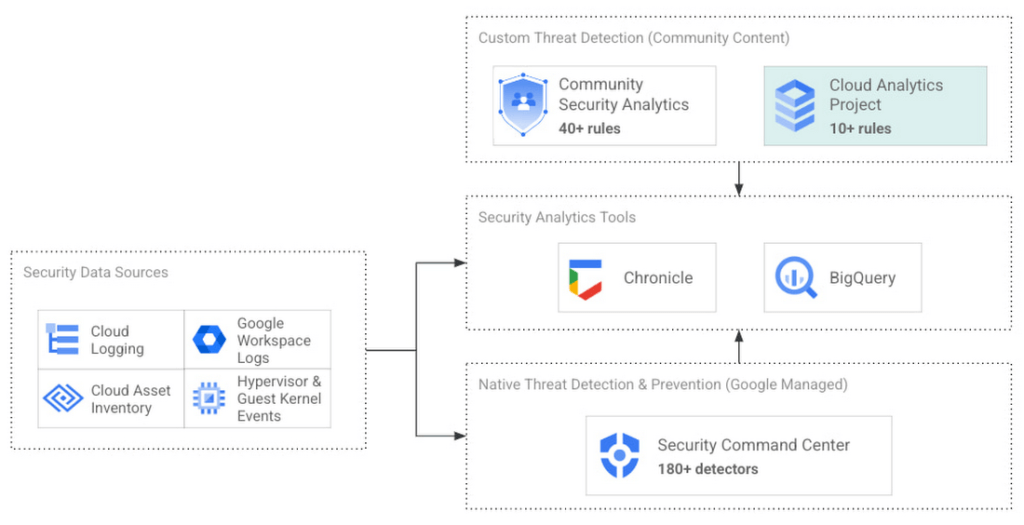
Cloud Analytics vs Community Security Analytics
Similar to CSA, Cloud Analytics can help lower the barrier for threat hunters and detection engineers to create cloud-specific security analytics. Security analytics is complex because it requires:
- Deep knowledge of diverse security signals (logs, alerts) from different cloud providers along with their specific schemas;
- Familiarity with adversary behaviors in cloud environments;
- Ability to emulate such adversarial activity on cloud platforms;
- Achieving high accuracy in threat detection with low false positives, to avoid alert fatigue and overwhelming your SOC team.
The following table summarizes the key differences between Cloud Analytics and CSA:
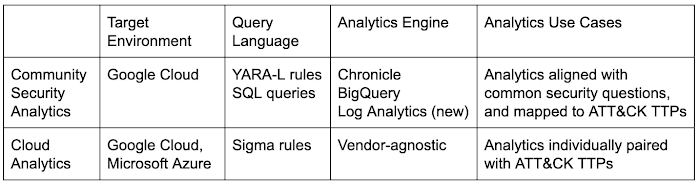
Together, CSA and Cloud Analytics can help you maximize your coverage of the MITRE ATT&CK® framework, while giving you the choice of detection language and analytics engine to use. Given the mapping to TTPs, some of these rules by CSA and Cloud Analytics overlap. However, Cloud Analytics queries are implemented as Sigma rules which can be translated to vendor-specific queries such as Chronicle, Elasticsearch, or Splunk using Sigma CLI or third party-supported uncoder.io, which offers a user interface for query conversion. On the other hand, CSA queries are implemented as YARA-L rules (for Chronicle) and SQL queries (for BigQuery and now Log Analytics). The latter could be manually adapted to specific analytics engines due to the universal nature of SQL
Getting started with Cloud Analytics
To get started with the Cloud Analytics project, head over to the GitHub repo to view the latest set of Sigma rules, the associated adversary emulation plan to automatically trigger these rules, and a development blueprint on how to create new Sigma rules based on lessons learned from this project.
The following is a list of Google Cloud-specific Sigma rules (and their associated TTPs) provided in this initial release; use these as examples to author new ones covering more TTPs.
Sigma rule example
Using the canonical use case of detecting when a storage bucket is modified to be publicly accessible, here’s an example Sigma rule (copied below and redacted for brevity):
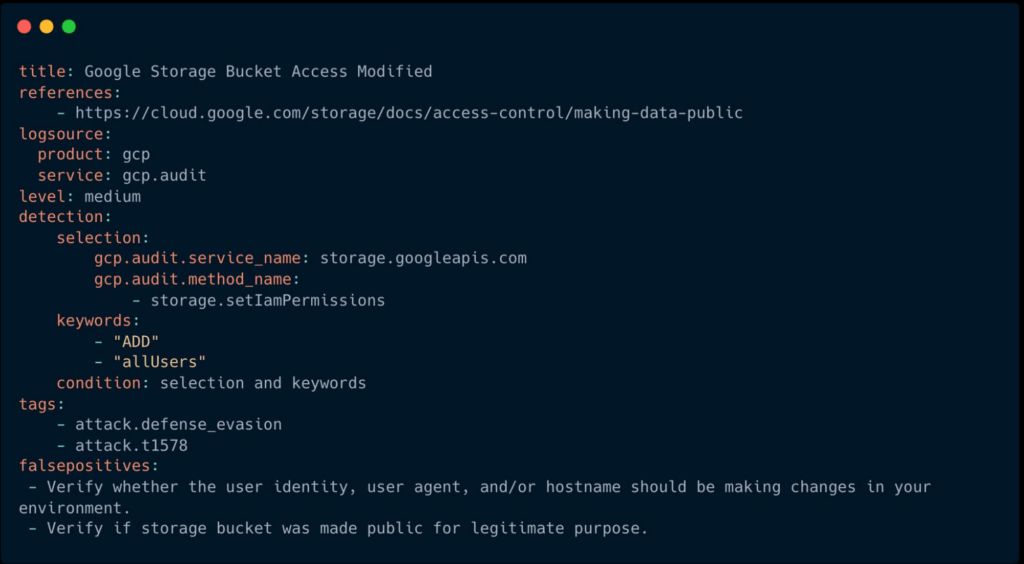
The rule specifies the log source (gcp.audit), the log criteria ( storage.googleapis.com service and storage.setIamPermissions method) and the keywords to look for (allUsers, ADD) signaling that a role was granted to all users over a given bucket. To learn more about Sigma syntax, refer to public Sigma docs.
However, there could still be false positives such as a Cloud Storage bucket made public for a legitimate reason like publishing static assets for a public website. To avoid alert fatigue and reduce toil on your SOC team, you could build more sophisticated detections based on multiple individual Sigma rules using Sigma Correlations.
Using our example, let’s refine the accuracy of this detection by correlating it with another pre-built Sigma rule which detects when a new user identity is added to a privileged group. Such privilege escalation likely occurred before the adversary gained permission to modify access of the Cloud Storage bucket. Cloud Analytics provides an example of such correlation Sigma rule chaining these two separate events.
What’s next
The Cloud Analytics project aims to make cloud-based threat detection development easier while also consolidating collective findings from real-world deployments. In order to scale the development of high-quality threat detections with minimum false positives, CSA and Cloud Analytics promote an agile development approach for building these analytics, where rules are expected to be continuously tuned and evaluated.
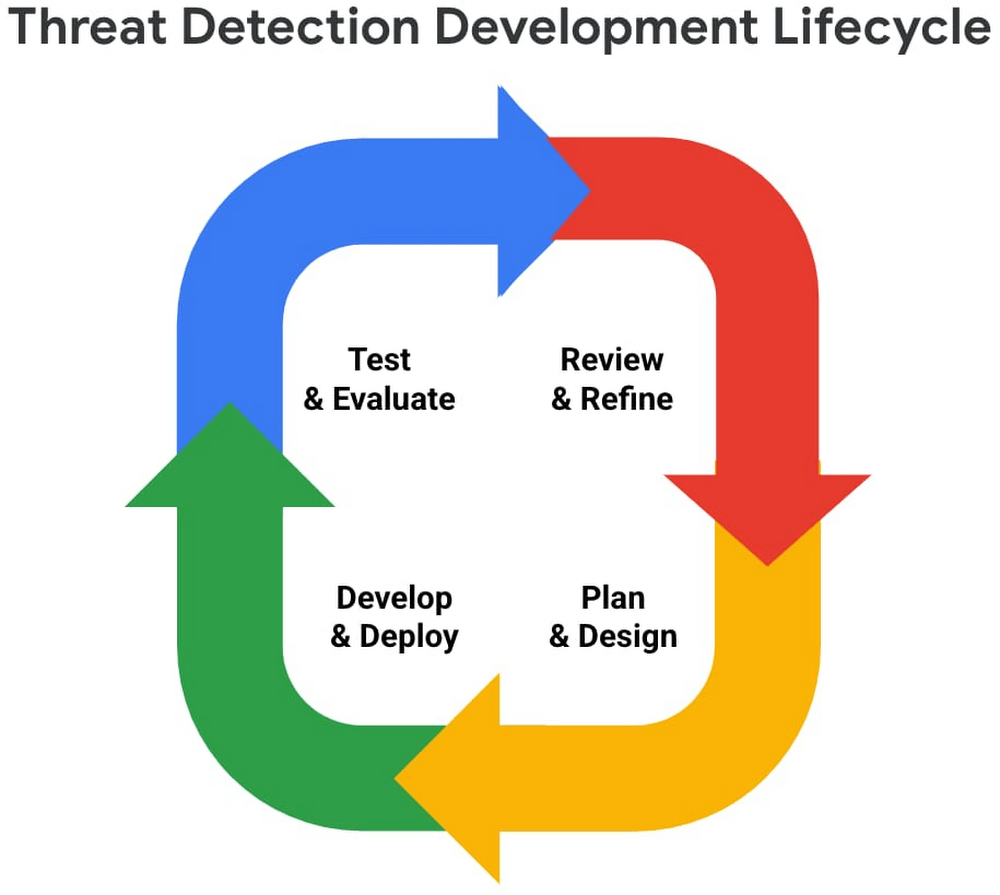
We look forward to wider industry collaboration and community contributions (from rules consumers, designers, builders, and testers) to refine existing rules and develop new ones, along with associated adversary emulations in order to raise the bar for minimum self-service security visibility and analytics for everyone.
Acknowledgements
We’d like to thank our industry partners and acknowledge several individuals across both Google Cloud and the Center for Threat-Informed Defense for making this research project possible:
Desiree Beck, Principal Cyber Operations Engineer, MITRE
Michael Butt, Lead Offensive Security Engineer, MITRE
Iman Ghanizada, Head of Autonomic Security Operations, Google Cloud
Anton Chuvakin, Senior Staff, Office of the CISO, Google Cloud
Vodafone Leverages Google Cloud to Aid COVID-19 Frontline with Anonymized Insights on Population Mobility

11176
Of your peers have already read this article.
1:30 Minutes
The most insightful time you'll spend today!
Editor’s note: When Europe’s largest mobile communications company, Vodafone, was asked by the European Commission to help understand population movement across the European Union and the UK to help fight COVID-19, it was able to provide anonymized mobile network-based insights to answer the call. Here’s how Vodafone, with the support of Google Cloud, rapidly mobilized the COVID-19 frontline, while respecting its customers’ privacy.
With the emergence of COVID-19 in early 2020, the European Commission—the executive branch of the European Union (EU)—knew that technology would be instrumental in its fight to control the pandemic. With various lockdowns imposed across its member states, the Commission was keen to predict and prevent the spread of COVID-19 and to manage the related social, political and financial impacts.
Mobile network data helps track COVID-19 across the EU
Mobile networks produce location data, which can be turned into useful anonymous insights to understand population movement within a geographic area. The European Commission, working with mobile industry association GSMA (Groupe Speciale Mobile Association), asked Europe’s major mobile phone operators for help in producing insights to support the fight against COVID-19. As the largest mobile network operator within the EU, Vodafone saw this as a critical opportunity to participate.
Vodafone had previous experience of using mobile network data to support pandemic research. For example, in 2019, Vodafone provided mobility pattern analysis to help track the spread of Malaria in Mozambique. And, during the early stages of the COVID-19 pandemic (prior to working with the European Commission), Vodafone assisted the Italian and Spanish governments in understanding their citizens’ mobility patterns. Vodafone had also previously offered anonymized and aggregated population mobility insights to support public transport and tourism authorities and retail organizations in a number of countries. Consequently, Vodafone was perfectly placed to play a greater role in supporting the European Commission’s response to the pandemic.
When asked to assist the European Commission, Vodafone first considered how it could safely share its data with the governing body without providing details on the individual movements of its customers. It realized it could achieve this through an elaborate set of anonymization and aggregation techniques. Insights are aggregated from a minimum of 50 users and Vodafone only shared these anonymous insights and never the actual raw data with the Commission. As specified by the EU, these insights are then presented onto a large geographical region, typically a city or a county with thousands of people living in that area.
These insights illustrate how people move, helping to determine how lockdowns and self-isolation measures were impacting behaviors.
Using Google Cloud to collate and store population mobility data
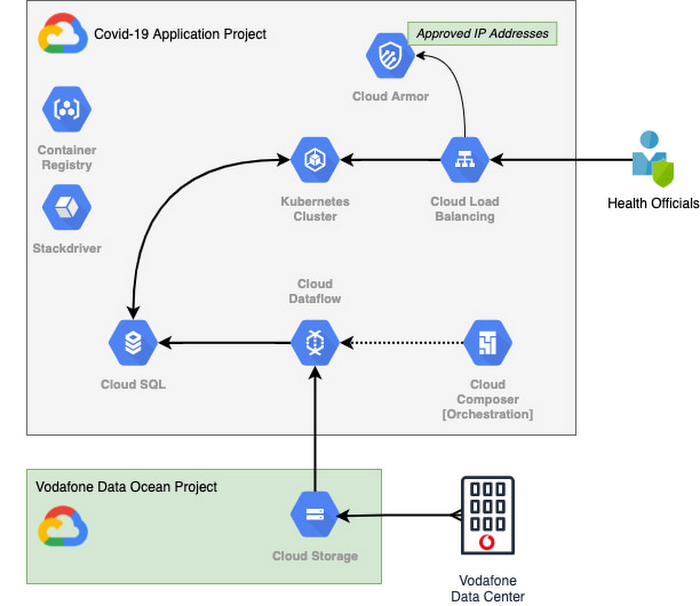
In April 2020, Vodafone began migrating its operations, including its mobile data, to Google Cloud on servers in Europe and the UK with elaborate security safeguards, including encryption, building on a previous partnership.
With the data residing in EU and UK data centers and not the United States, Vodafone could then retrieve anonymous insights from Google Cloud Storage instantaneously. Before supplying any information to the European Commission, however, Vodafone used Dataflow to validate the data and run a series of tests to ensure the database had accurate data, before ingesting and archiving the relevant metrics. For instant access, the data was then made available to the European Commission using a Redis database on Google Kubernetes Engine.
To ensure aggregate Vodafone customer data was always safe, secure, and anonymous, all entry points to the front-end were protected behind Google Cloud Armor, where only specific IP addresses were allowed. Using these tools, seamless data pipelines fed in predefined key performance indicators from each specified European market. While data quality measures ensured the definitions for metrics across markets were consistent and could be accurately compared.
The architecture (pictured below) shows how Vodafone integrated and anonymized its data on Google Cloud.
Live interactive dashboard shows population mobility in real-time
With its data integrated on Google Cloud, Vodafone created a live, interactive dashboard to track mobility patterns and share relevant information with the European Commission in real-time.
The European Commission Joint Research Center (JRC) was able to gather valuable information from these insights, which enabled them to see where population mobility was aiding the spread of the disease, when cross-referenced with health data. It could also assess the implications of lockdowns on different populations and forecast cross-country spreading.
Mobile data aids disease modeling for multiple stakeholders
The Vodafone data became instrumental in modeling the likely course of the disease too. For example, the University of Southampton in the UK used it to predict the outcome of different coordinated COVID-19 exit strategies across Europe. This research was published in Science Magazine in September 2020.
The Vodafone data dashboard continues to be used by individual governments, NGOs and organizations to further investigate the impacts of the pandemic and to measure the effectiveness of response strategies alongside the rollout of vaccination programs. The project also helped Vodafone win a DataIQ award for most effective stakeholder engagement.
Using the learnings from this project, Vodafone has been able to adapt its own B2B solution, called Vodafone Analytics, by adaptIng and migrating the code to work in Google Cloud Platform. This solution has been rolled out across Germany, Greece, Portugal and South Africa, and new countries are being onboarded every day. Vodafone Analytics already has more than 100 customers leveraging it for a variety of use cases—Italian fashion retailer OVS, uses it for its smart retail operation, while global real estate company, JLL, uses it to understand the footfall passing through its properties.
Working together, Vodafone and Google Cloud continue to help a range of organizations, governments, and NGOs navigate through the ongoing pandemic, optimize their operations, and help the greater good, without infringing individuals’ fundamental rights to privacy.
To learn more about Google Cloud and Vodafone, watch our full interview here.
Case Study: How Exabeam Unlocked its Ability to Scale for Storage & Ingest Data from More Than 500 Security Vendors

3090
Of your peers have already read this article.
2:30 Minutes
The most insightful time you'll spend today!
Editor’s note: The post is part of a series highlighting our awesome partners, and their solutions, that are Built with BigQuery.
Exabeam, a leader in SIEM and XDR, provides security operations teams with end-to-end Threat Detection, Investigation, and Response (TDIR) by leveraging a combination of user and entity behavioral analytics (UEBA) and security orchestration, automation, and response (SOAR) to allow organizations to quickly resolve cybersecurity threats. As the company looked to take its cybersecurity solution to the next level, Exabeam partnered with Google Cloud to unlock its ability to scale for storage, ingestion, and analysis of security data.
Harnessing the power of Google Cloud products including BigQuery, Dataflow, Looker, Spanner and Bigtable, the company is now able to ingest data from more than 500 security vendors, convert unstructured data into security events, and create a common platform to store them in a cost-effective way. The scale and power of Google Cloud enables Exabeam customers to search multi-year data and detect threats in seconds
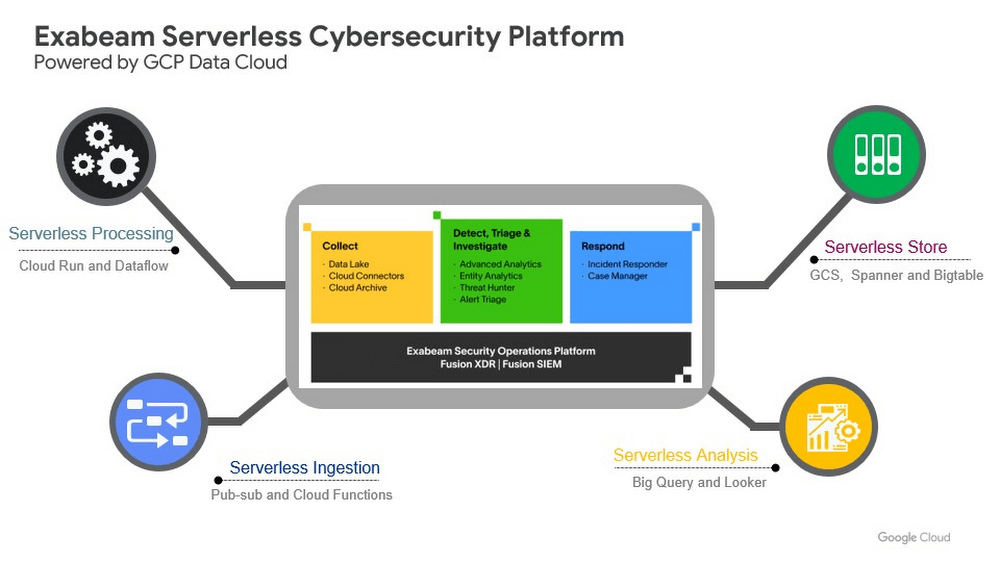
Google Cloud provides Exabeam with three critical benefits.
- Global scale security platform. Exabeam leveraged serverless Google Cloud data products to speed up platform development. The Exabeam platform supports horizontal scale with built-in resiliency (backed by 99.99% reliability) and data backups in three other zones per region. Also, multi-tenancy with tenant data separation, data masking, and encryption in transit and at rest are backed up in the data cloud products Exabeam uses from Google Cloud.
- Scale data ingestion and processing. By leveraging Google’s compute capabilities, Exabeam can differentiate itself from other security vendors that are still struggling to process large volumes of data. With Google Cloud, Exabeam can provide a path to scale data processing pipelines. This allows Exabeam to offer robust processing to model threat scenarios with data from more than 500 security and IT vendors in near-real time.
- Search and detection in seconds. Traditionally, security solutions break down data into silos to offer efficient and cost-effective search. Thanks to the speed and capacity of BigQuery, Security Operations teams can search across different tiers of data in near real time. The ability to search data more than a year old in seconds, for example, can help security teams hunt for threats simultaneously across recent and historical data.
Exabeam joins more than 700 tech companies powering their products and businesses using data cloud products from Google, such as BigQuery, Looker, Spanner, and Vertex AI. Google Cloud announced the Built with BigQuery initiative at the Google Data Cloud Summit in April, which helps Independent Software Vendors like Exabeam build applications using data and machine learning products. By providing dedicated access to technology, expertise, and go-to-market programs, this initiative can help tech companies accelerate, optimize, and amplify their success.
Google’s data cloud provides a complete platform for building data-driven applications like those from Exabeam — from simplified data ingestion, processing, and storage to powerful analytics, AI, ML, and data sharing capabilities — all integrated with the open, secure, and sustainable Google Cloud platform. With a diverse partner ecosystem and support for multi-cloud, open-source tools, and APIs, Google Cloud can help provide technology companies the portability and the extensibility they need to avoid data lock-in.
To learn more about Exabeam on Google Cloud, visit www.exabeam.com. Click here to learn more about Google Cloud’s Built with BigQuery initiative.
Chrome OS’s Hybrid Work Model Powers Google’s Return to Work Strategy

7482
Of your peers have already read this article.
1:30 Minutes
The most insightful time you'll spend today!
The pandemic continues to deeply affect our lives around the globe. In some places, new cases are surging and returning to work is the last thing on people’s minds. In other areas, conditions are improving and companies are starting to think about transitioning their workforce back to the office.
Exactly when and how to do this remains complex and varies by country, industry, and company. What’s certain is that hybrid work will become an essential part of the business world moving forward. And finding solutions that bridge the gap between “in-person” and “somewhere else” are crucial.
At Google, we’ve been focused on what the hybrid transformation means for us. To prepare for hybrid work, using modern solutions is a key enabler.
Chrome OS: Supporting Google’s return to office strategy
At Google, we’ll move to a hybrid work week where most Googlers spend approximately three days in the office and two days wherever they work best. It’s no surprise that as the modern, secure, cloud-first platform, Chrome OS is playing a key role in our transition to a hybrid work model. Because Chrome OS devices can easily be shared, more flexible working models and spaces are now possible. And with user profiles stored in the cloud and collaboration solutions like Google Workspace, employees can log in to any Chrome OS device, access what they need and pick up where they left off.
Here are just a few ways we are using Chrome OS and its tools to support the return to the office:
- In select office locations, Googlers can reserve desks through an internal booking tool set up with a high-performance Chromebox, keyboard, mouse, and monitor. Employees can log in to the Chromebox which syncs their cloud profile, and start working with the same environment they have on all their Chrome OS devices.
- We’re announcing new docking stations that are designed for Chrome OS devices and allow employees to bring in their Chromebook from home, connect to the dock with one USB-C cable, and use a monitor, keyboard, and mouse for a full desktop experience.
- Every Chrome OS device enables a zero-trust security working model with BeyondCorp Enterprise providing our workforce with simple and secure access to applications while providing additional security controls for IT.
- We’ve deployed the new Chrome OS Readiness Tool to our extended workforce to identify employees that are able to switch to Chrome OS. This allows us to expand the latest security, deployment, and manageability benefits to more of the workforce.
Additional ways Chrome OS is helping organizations with return to office
We aren’t the only ones supporting our return to office and hybrid work strategy with Chrome OS. We’ve heard more ways our customers are using Chrome OS to make the transition as smooth as possible. These include:
- Streamlining deployment and management of Chrome OS devices using zero-touch enrollment which allows devices to automatically enroll into a corporate domain without IT configuration.
Grab & Go Chromebooks being used for frontline and hybrid information workers, allowing employees to grab a Chromebook from a cart and get to work right away. - Parallels Desktop for Chrome OS being deployed to allow employees to access Windows or legacy apps locally on their Chrome OS devices.
- Existing Windows and Mac devices being modernized and repurposed to run a Chrome OS experience using CloudReady. (Google is currently offering a CloudReady promotion. Learn more here.)
While the Chrome OS team has been working towards making remote working as seamless as possible for IT, we’ve also made advancements in supporting traditional technology that’s required in the office.
- In October, we announced Chrome Enterprise Recommended: a collection of identity, printing, productivity, communications, and virtualization solutions that are verified to run great on Chrome OS.
- With the increased usage of video conferencing on Chrome OS devices, we’ve made improvements to Google Meet and Zoom performance including camera and video improvements to reduce any unnecessary processing and features that intelligently adapt to your device, your network, and what you are working on.
- For improved access to Windows and legacy apps, VMware Horizon introduced multi-monitor support and USB redirection and Citrix Workspace released a tech preview with webcam enhancements and Microsoft Teams optimizations.
- We integrated with the Okta Workflows platform, so IT administrators can include Chrome OS in it’s access logic and deploy quickly without code. Recently, we’ve added the ability to require users to reauthenticate on their Chrome OS device once Okta has detected that the user has changed their password. Try out this new capability by signing up for our Trusted Tester program.
- We’ve increased our support for direct IP printing with additional printer models since the beginning of 2020. In addition, we have made improvements to management features, including support for multiple print servers and launched policy APIs to provide a better IT admin experience.
Join us for a digital event with Modern Computing Alliance and its newest member HP
Last year we announced the launch of the Modern Computing Alliance—a collaboration of industry leaders including Box, Chrome Enterprise, Citrix, Dell, Google Workspace, Imprivata, Intel, Okta, RingCentral, Slack, VMware, and Zoom aim to create the pioneering solutions that businesses need. We are thrilled to introduce HP, who brings their innovative hardware and enterprise hardware expertise to the Modern Computing Alliance and has been working closely with the alliance to ensure true silicon-to-cloud innovation.
As an alliance, we’ve been deeply engaged in the hybrid work shift. We invite you to join us for a digital event where we discuss questions about returning to work. Like how product design can encourage participation and collaboration regardless of where employees are, important security issues to keep in mind, and what factors businesses should consider to support a safe, working environment.
Home. Heading back. Hybrid.
Hear from the experts on hybrid work and return to office.
Date: May 20th, 2021
Register here.
If you are ready to try Chrome OS today, it’s easy to get started. You can contact us to get connected to a partner, sign up for a free 30-day trial of Chrome Enterprise Upgrade to start managing Chrome OS devices, or deploy the Chrome OS Readiness Tool to identify employees that are ready to switch to Chrome OS.POSTED IN:
If You Don’t Have These Features in Your Cloud, You’re Missing the Mark on Security

3298
Of your peers have already read this article.
6:00 Minutes
The most insightful time you'll spend today!
At Google Cloud, we work tirelessly to give our customers increased levels of control and visibility over their data. We’ve come out with new capabilities for data encryption, network security, security analytics, and user protection designed to deliver on that promise.
External Key Manager: Store and manage encryption keys outside of Google Cloud
We give enterprises a broad range of encryption options so you can appropriately balance risk, control, security, and operational complexity when protecting your cloud workloads.
Google Cloud encrypts customer data at-rest by default and offers customers multiple options to control and manage their encryption keys. Today, we’re pleased to announce the next level of control with our new External Key Manager. Coming soon to beta, External Key Manager works with Cloud KMS and lets you encrypt data in BigQuery and Compute Engine with encryption keys stored and managed in a third-party key management system deployed outside Google’s infrastructure. External Key Manager allows you to maintain separation between your data at-rest and your encryption keys while still leveraging the power of cloud for compute and analytics.
To make this new service easy to implement, we are working with five industry-leading key management vendors: Equinix, Fortanix, Ionic, Thales and Unbound.
Key Access Justifications: Decide when and why your data can be decrypted
We believe that trust in the cloud is created through transparency. Google Cloud led the industry in providing meaningful transparency into provider access to customer data, and now we’re extending that transparency to use of encryption keys. Key Access Justifications is a new feature that will work with External Key Manager. It provides a detailed justification each time one of your keys is requested to decrypt data, along with a mechanism for you to explicitly approve or deny providing the key using an automated policy that you set.
Using External Key Manager and Key Access Justifications together, you can deny Google the ability to decrypt your data for any reason. As a result, you are the ultimate arbiter of access to your data–a level of control not available from any other cloud provider. Key Access Justifications is coming soon to alpha for BigQuery, and Compute Engine/Persistent Disk and covers the transition from data-at-rest to data-in-use. Customers interested in becoming early adopters can sign up here.
These new encryption innovations complement other recently released encryption options:
- Customer-managed encryption keys for Cloud SQL, now generally available (GA)
- Customer managed encryption keys for GKE persistent disks, a beta feature for Google Kubernetes Engine (GKE)
- Application layer secrets encryption in GKE, a GA feature which enables envelope encryption for your Kubernetes secrets
- Key import for Cloud HSM, a GA feature which lets users generate and use their own keys with Google Cloud’s managed HSM service
- Cloud HSM availability in all Google Cloud regions and multi-regions (with the exception of global multi-region)
All these updates offer you more control over how your data is protected.
Defend against internet threats
When you stand up applications on Google Cloud, you benefit from DDoS and web attack protection at Google scale. Google Cloud Armor works with our global Cloud Load Balancing infrastructure and provides always-on attack detection and mitigation so you can run your business without interruption.
Today, we’re pleased to announce the beta of Cloud Armor’s new web application firewall (WAF) capabilities to help protect applications against targeted and distributed internet threats. You can now configure Cloud Armor policies with geo-based access controls, pre-configured WAF application protection rules to mitigate OWASP Top 10 risks, and a custom rules language to create custom Layer-7 filtering policies.
Cloud Armor also now integrates with Cloud Security Command Center (Cloud SCC), notifying customers of suspicious application traffic patterns directly in the Cloud SCC dashboard.
Collect and inspect network traffic at scale
As networks grow in complexity, monitoring traffic helps you manage performance and security. In public cloud environments however, capturing network traffic reliably at scale for monitoring has been a challenge.
Our new Packet Mirroring service, now in beta, allows you to collect and inspect network traffic for Compute Engine and GKE; it’s available for all machine types in all of our regions. With this service, you can use third-party tools to more proactively detect threats, better respond to intrusions with signature-based attack detection, and better identify zero-day attacks with anomaly detection. For more, watch this video.
We’ve built an ecosystem of partners so you can use Packet Mirroring with third-party tools of your choice, including products from Awake Security, Check Point, Cisco, Corelight, cPacket Networks, ExtraHop Networks, Flowmon, Ixia by Keysight, Netscout, and Palo Alto Networks.
Protect G Suite and Cloud Identity users
Google’s Advanced Protection Program is our strongest protection for users at risk of targeted attacks. In the enterprise, this includes IT administrators and executives. Today, the Advanced Protection Program is starting to roll out to G Suite and Cloud Identity customers. With the Advanced Protection Program for the enterprise, we’ll enforce a specific set of policies for enrolled users including security key enforcement, blocking access to untrusted apps and enhanced scanning for email threats. Learn more.
We’re also introducing app access control, helping you reduce the risk of data loss by limiting access to G Suite APIs to third-party apps you trust. You can also more easily manage and restrict which Google APIs are available for use by third-party and customer-owned apps, and see which apps are verified by Google. Learn more.
Benefit from unique Google threat intelligence in Cloud Security Command Center
We continue to build products that help our customers benefit from the techniques we’ve developed to defend Google. Whether you are using Cloud Security Command Center to improve your security posture on GCP, or Chronicle Backstory to monitor your data on premise or in other clouds, we’re packaging threat detection and prevention capabilities that are available only from Google, and giving them to you.
Event Threat Detection, now in beta, helps you detect threats targeting your cloud resources using logs, so you can send incidents to your SIEM (Security Information and Event Management system) for further investigation. Event Threat Detection relies on Google threat intelligence to help you spot and stop threats before they result in business damage or loss.
Security Health Analytics helps you prevent incidents by identifying potential misconfigurations and compliance violations in your GCP resources and suggesting appropriate corrective action.
As we continue to innovate and simplify security management on GCP, Event Threat Detection and Security Health Analytics will be bundled in a Premium Edition of Cloud Security Command Center with other new capabilities that help you meet industry compliance requirements, catch web application vulnerabilities, detect compromised VMs, and discover other threats. The Premium Edition will give you a comprehensive, easy-to-deploy set of tools to protect your cloud resources. To learn more about how to use Cloud Security Command Center, check out our recent video series.
Chronicle: security analytics wherever your apps are deployed
Chronicle’s Backstory product was designed by former Google security professionals to enable anyone to use the types of techniques we use to detect threats and investigate security incidents. It brings world-class strengths in data analytics to your security data, privately and easily.
Many organizations leverage a mix of on-prem environments and multiple clouds to run their applications, making it difficult to collect and store security telemetry from various systems and tie individual events together for analysis. Backstory, our flagship offering for hybrid security analytics, offers you this level of intelligence. With just a few clicks, in minutes, you can aggregate and analyze your security telemetry wherever your apps may run, and where they might run in the future.
How Google Cloud Helps Educational Institutions Ward off the Risk of Data Breaches

2941
Of your peers have already read this article.
2:00 Minutes
The most insightful time you'll spend today!
In the US alone, 24.5 million school records have been leaked across 1,327 data breaches since 2005. And when +1.3 billion students moved to remote learning, the pandemic became an accelerant for cyber attacks with the number of attacks in education spiking 30% YoY during July and August 2020. In our experience working with education customers, we’ve seen three areas impacted by cyber attacks:
- Financial: Institutions experience financial loss from operational disruption and demands from cyber criminals who stole data. For example, The University of California, San Francisco confirmed it paid a ransom of $1.14 million to the criminals behind a cyber attack on its School of Medicine. To protect sensitive student data, the federal government released a statement encouraging all postsecondary institutions to implement NIST 800-171 controls, a policy designed to protect sensitive student data.
- Operational:Cyber attacks can prevent students, faculty and staff from accessing systems that are necessary to continue teaching, learning, and research initiatives, bringing operations to a halt. Hartford Public Schools in Connecticut postponed its first day of classes following a ransomware attack that shut down the district’s system.
- Reputational: Institutions who have financial or student data breaches can suffer from lower enrollment rates and a loss of grant funding. A study conducted by the Ponemon Institute pointed out that higher education institutions are judged largely on their reputation. A single data breach can significantly impact the reputation of the institution, in addition to substantial financial implications.
How is Google Cloud helping educational institutions put security in place before a data breach happens?
Google Cloud’s security model model, global infrastructure, and unique capability to innovate is helping academic institutions keep their organizations secure and in compliance. For example, Brown University leverages Google Workspace for Education to protect information sharing among faculty, students, and staff, while reducing IT maintenance costs.
Google Workspace helps establish each user’s identity in Google Cloud and this feature has become a core component of Google’s Zero Trust security model, implemented through BeyondCorp. By shifting access controls from the network perimeter to individual users, BeyondCorp enables secure work from virtually any location without the need for a traditional VPN.
Most academic institutions look to minimize their risk in a shared responsibility model when running infrastructure-as-a-service or platform-as-a-service workloads. Google Cloud has partnered with industry-leading security consortia like RHEDCloud to understand the specific needs of educational and academic research institutions, and follow applicable regulations and grant requirements. We have co-developed solutions with partners, like Burwood Group, to meet those needs and help our customers automate secure and compliant environments for their researchers, students and staff. Burwood Group has partnered with 27 top-tier research universities (R-1) to deploy security solutions. Here are a few of the products we’ve seen the most interest in:
- Blueprint scripts uses Google Cloud built-in services to automate the provisioning and management of enterprise applications and research environments to be in compliance with HIPAA, FedRAMP, CUI, NIST 800-53, NIST CSF, and GDPR regulations.
- Security Command Center manages assets in your organization, uncovers vulnerabilities and threats, and reviews your organization’s compliance. The solution generates security alerts and audit events from logs that integrate with existing enterprise systems like Security Information and Event Management (SIEMs), Endpoint Detection & Response (EDR’s) and Security, Orchestration, Automation, & Response (SOAR) tools.
- Chronicle, Google Cloud’s next generation SIEM platform, is changing the game. It is a cloud-native platform designed to ingest your organization’s logs for a flat rate, abandoning the tiered model most SIEM providers offer. It can sift through petabytes of data in seconds and is useful for organizations that are both cost and security conscious.
- VirusTotal Premium provides access to the world’s largest corpus of threat data to protect your organization proactively. The VT API can easily integrate into your commonly used SIEM, EDR and SOAR tools, alerting you to threats that would otherwise go unnoticed.
- reCAPTCHA, helps defend against common attack patterns such as scraping or credential stuffing in web applications.
- Cloud Armor defends against distributed denial-of-service (DDoS) attacks.
For research workloads, these tools provide controls for data ingestion, the export of research data, and, sharing permissions and auditability, allowing researchers to collaborate with other institutions. These tools also automate the provisioning of environments to provide secure execution of Jupyter notebooks and other applications commonly used in research, like Matlab, SAS and Python/R environments.
A customized approach that aligns with education-specific needs
Google Cloud has partnered with academic institutions and research groups to understand their specific needs, and co-develop solutions that help customers govern, control, and audit security and compliance for all types of workloads in a shared responsibility framework. These solutions integrate with most common enterprise and security systems and permit customization to accommodate specific needs around security or data sharing (e.g grant requirements).
To learn more, watch our latest on-demand webinar, Cloud Security Best Practices for Higher Education, hosted by Google Cloud and our partners, Burwood Group and Carahsoft.
More Relevant Stories for Your Company
VCP Peering and Private Endpoints on Vertex AI to Better Security and Predictions in Near Real-time
One of the biggest challenges when serving machine learning models is delivering predictions in near real-time. Whether you’re a retailer generating recommendations for users shopping on your site, or a food service company estimating delivery time, being able to serve results with low latency is crucial. That’s why we’re excited

Ubuntu Pro Images Now Available on Google Cloud
Today, we’re pleased to announce the general availability of Ubuntu Pro images on Google Cloud, providing customers with an improved Ubuntu experience, expanded security coverage, and integration with critical Google Cloud features. In partnership with Canonical, we’re making it even easier for customers that have fully embraced open source to ensure



How does Google Pick its Data Center ?
Google is well known for its sustainable tech and hardware initiatives. Did you know alongside its environmental friendly designs of its data centers, it takes into account various factors such as redundant power supplies, data replication, network connectivity, etc. Watch the video to learn more.

Redefining and Simplifying Security Analytics
Today’s security professionals face not only an ever-expanding list of threats, old and new, but also an excruciating choice of security approaches and tools. Nearly 2000 security vendors are trying to sell to large enterprises and small businesses. Most organizations have already invested heavily in cybersecurity solutions. From firewalls to
