





Casper on Google Cloud: Revolutionizing Web3 Development with Flexibility & Security

1431
Of your peers have already read this article.
1:30 Minutes
The most insightful time you'll spend today!
Casper Labs announced a collaboration with Google Cloud that will allow developers to launch public and/or private Casper nodes directly from Google Cloud. This enables a much more seamless and highly secure process for the millions of developers who want to build in blockchain environments without having to learn new, highly specialized programming languages. Additionally, Google Cloud will provide its scalable and reliable infrastructure to developers building on the Casper Protocol.
Blockchain technology is maturing
As blockchain technology matures, a growing number of businesses are embracing it as a key way to drive new efficiencies and realize cost savings.
According to a recent Casper Labs study, 87% of executives polled in the United States, United Kingdom and China reported plans to invest in a blockchain solution in 2023. This is due in no small part due to recent innovations that help organizations overcome the so-called Blockchain Adoption Trilemma, which previously held that it was impossible for any blockchain to be simultaneously a) decentralized, b) scalable, and c) secure.
Thanks to the rise of proof-of-stake blockchains like Casper, new models have emerged that enable a more scalable and secure architecture that no longer forces a compromise on decentralization.
Another trend facilitating these growing adoption rates is the rise of WebAssembly (WASM) as a baseline technology for newer blockchains, including Casper. WASM (created by W3C) makes application development in blockchain environments far more accessible and interoperable to the millions of developers worldwide who specialize in languages like Java, Javascript, C++ and Rust. Previously, any blockchain-based build required a high degree of specialized developer knowledge, which made it a much more challenging option for most organizations.
Meet Casper
Casper is a permissionless, decentralized public blockchain based on WASM that was built explicitly to foster enterprise adoption of blockchain technology. Beyond its more accessible model, Casper is the first and only blockchain to offer native upgradable smart contracts. This means that organizations can have the option to securely and consistently update software code even after it is running on Casper. This gives organizations the control and flexibility to use industry best practices, such as continuous deployment and continuous integration, which are already in use in their IT departments. Casper is also highly configurable and allows organizations to support public, private, and/or hybrid deployments.
Casper is also noteworthy for the presence of Casper Labs, a software development and professional services firm that supports organizations building on the Casper network. Unlike most blockchains that follow a more traditional open-source project, Casper Labs provides around-the-clock support and bespoke software development for enterprise organizations. Recently, Casper Labs helped patent management company IPwe execute the largest-ever blockchain deployment, featuring more than 25 million patents being added as custom NFTs to the Casper Blockchain.
How to get started with Casper on Google Cloud
Developers who want to start building on Casper can find a comprehensive series of tutorials here.
The Casper Association also recently announced a $25 million grant program to support projects and developers building on Casper. Interested participants can apply here.
Cloud Computing at Sea: Google Public Sector Boosts U.S. Navy Collaboration

3054
Of your peers have already read this article.
2:00 Minutes
The most insightful time you'll spend today!
With a global, always-on workforce, the U.S. Navy requires secure collaboration between teams across countries and time zones. This is especially relevant for the 50,000 U.S. Navy sailors deployed aboard approximately 100 ships at any given time, who need to connect with personnel at regional shipyards for everything from routine maintenance, to more serious ship repairs.
Google Public Sector directly assists Naval Sea Systems Command (NAVSEA), the largest of the U.S. Navy’s five “systems commands,” by providing support to the U.S. Naval Ship Repair Facility and Japan Regional Maintenance Center (SRF-JRMC) in Yokosuka and Sasebo, Japan. NAVSEA is using Google Workspace, which harnesses Google’s threat protection and zero trust capabilities, to enable effective, secure, and compliant collaboration between the SRF-JRMC and Navy stakeholders around the world.
The workforce in the SRF-JRMC facility had two unique challenges. The first was around ineffective collaboration and communication channels. Before deploying Google Workspace, a Navy officer in Japan would need to be on-base to communicate over a secure connection, and calls were typically late at night given the time difference. This challenge was even further magnified when the COVID-19 pandemic hit, further restricting staff mobility.
The second challenge was a language barrier. With more than 3,000 Japanese Master Labor Contract (MLC) employees providing critical support to SRF-JRMC’s shipyard, Navy leadership needed an easier way to communicate with their Japanese-speaking counterparts. Breaking down this barrier would ensure work could be completed faster and more effectively, facilitating a more collaborative environment.
Enabling secure collaboration
The Navy partnered with Google Public Sector to enable Google Workspace for SRF-JRMC. Today, Google Workspace assists the Navy’s shipyards by enabling Google Voice for secure voice over Internet Protocol (VoIP) calling options, so personnel can join calls and sessions on-site or at-home to communicate securely and reliably across continents. In addition, early access to solutions like English to Japanese translated captions in Google Meet help break down the language barrier by providing instant translation during meetings. The platform also saves the U.S. Navy thousands of dollars a month in phone bills by providing country-specific dial-in numbers for interviews.
Moreover, Google Workspace tools like Google Drive and Docs also help to simplify human resource workflows by streamlining the hiring for onboarding local Japanese employees for the shipyard. Having a shared Google Drive eliminates the need to send multiple files back and forth among the NAVSEA team, allowing them to minimize on-premises storage space. In addition, Google Docs enables Navy employees to communicate and collaborate with each other and with potential candidates securely, and across any device.
“As the largest overseas ship repair facility of the U.S. Navy, operational readiness and continuity of operations is our top priority,” said Peter Guo, chief information officer at SRF-JRMC. “Cloud collaboration capabilities provide us seamless and secure connectivity across continents and break down language barriers with our colleagues across the globe. We’ve improved our ability to operate anytime, and anywhere and have increased our ability to securely communicate and coordinate especially during network outages and natural disasters.”
Providing pandemic assistance
Google for Government’s Workspace solutions also became useful to the SRF-JRMC during the pandemic, providing valuable communication and collaboration tools during a time of uncertainty. In addition to deploying Google Workspace, SRF-JRMC’s IT department created a COVID-19 Pandemic Dashboard, a Google-based site that consolidated Japanese and international open-source data on COVID-19 outbreaks and provided updated guidance. The Dashboard was built in less than two hours, using Looker Studio, and it leveraged an automated data collection process to track local hospitalization numbers. Before building the site, it took the NAVSEA team hours to compile this information; now, the team can access this information in real-time.
“This Dashboard drastically reduced redundant weekly meetings centered on COVID-19 updates, and saved more than 10 hours per week manually gathering data and presenting it via slide decks,” said Guo. “Additionally, this capability enabled our leadership to make real-time, data-driven decisions and put necessary risk mitigations in place. It empowered supervisors across the shipyard to reference this website at any time and put additional health measures in place to minimize the transmission of COVID-19. Every minute counts at our two shipyards in Japan, so this made a tremendous impact on our operational efficiency and ensured the safety of our sailors.”
Delivering the best possible tools means making life better and work more fulfilling for millions of people, inside and outside of government. To help government agencies maintain access to communications and collaboration tools that they need during and after an incident to keep work going, we are also offering workshops for federal, state and local governments. Learn more about Google for Government solutions for the Department of Defense, and Google Workspace for Government.
Strengthening Operational Resilience in Financial Services by Migrating to Google Cloud

3268
Of your peers have already read this article.
3:30 Minutes
The most insightful time you'll spend today!
Operational resilience continues to be a key focus for financial services firms. Regulators from around the world are refocusing supervisory approaches on operational resilience to support the soundness of financial firms and the stability of the financial ecosystem. Our new white paper discusses the continuing importance of operational resilience to the financial services sector, and the role that a well-executed migration to Google Cloud can play in strengthening it. Here are the key highlights:
Operational resilience in financial services
Financial services firms and regulators are increasingly focused on operational resilience, reflecting the growing dependency that the financial services industry has on complex systems, automation and technology, and third parties.
Operational resilience can be defined as the “ability to deliver operations, including critical operations and core business lines, through a disruption from any hazard”1. Given this definition, operational resilience needs to be thought of as a desired outcome, instead of a singular activity, and as such, the approach to achieving that outcome needs to address a multitude of operational risks including:
- Cybersecurity: Continuously adjusting key controls, people, processes and technology to prevent, detect and react to external threats and malicious insiders.
- Pandemics: Sustaining business operations in scenarios where people cannot, or will not, work in close proximity to colleagues and customers.
- Environmental and Infrastructure: Designing and locating facilities to mitigate the effects of localised weather and infrastructure events, and to be resilient to physical attacks.
- Geopolitical: Understanding and managing risks associated with geographic and political boundaries between intragroup and third-party dependencies.
- Third-party Risk: Managing supply chain risk, and in particular of critical outsourced functions by addressing vendor lock in, survivability and portability.
- Technology Risk: Designing and operating technology services to provide the required levels of availability, capacity, performance, quality and functionality.
Operational resilience benefits from migrating to Google Cloud
There is a growing recognition among policymakers and industry leaders that, far from creating unnecessary new risk, a well-executed migration to public cloud technology over the coming years will provide capabilities to financial services firms that will enable them to strengthen operational resilience in ways that are not otherwise achievable.
Foundationally, Google Cloud’s infrastructure and operating model is of a scale and robustness that can provide financial services customers a way to increase their resilience in a highly commercial way.
Equally important are the Google Cloud products, and our support for hybrid and multi-cloud, that help financial services customers manage various operational risks in a differentiated manner:
- Cybersecurity that is designed in, and from the ground up. From encryption by default, to our Titan security chip, to high-scale DOS defences, to the power of Google Cloud data analytics and Security Command Center our solutions help you secure your environment.
- Solutions that decouple employees and customers from physical offices and premises. This includes zero-trust based remote access that removes the need for complex VPNs, rapidly deployed customer contact center AI virtual agents, and Google Workspace for best-in-class workforce collaboration.
- Globally and regionally resilient infrastructure, data centers and support. We offer a global footprint of 24 regions and 73 zones allowing us to serve customers in over 200 countries, with a globally distributed support function so we can support customers even in adverse circumstances.
- Strategic autonomy through appropriate controls. Our recognition that customers and policymakers, particularly in Europe, strive for even greater security and autonomy is embodied in our work on data sovereignty, operational sovereignty, and software sovereignty.
- Portability, substitutability and survivability, using our open cloud. We understand that from a financial services firm’s perspective, achieving operational resilience may include solving for situations where their third parties are unable, for any reason, to provide the services contracted.
- Reducing technical debt, whilst focusing on great financial products and services. We provide a portfolio of solutions so that financial services firms’ technology organisations can focus on delivering high-quality services and experiences to customers, and not on operating foundational technologies such as servers, networks and mainframes.

5689
Of your peers have already downloaded this article
5:30 Minutes
The most insightful time you'll spend today!
Modernizing apps on the cloud isn’t an “all or nothing” decision. Businesses want the option to modernize on-premises or choose multi-cloud solutions that meet their needs. That’s why we created a new solution for running apps anywhere – simply, flexibly, and securely. Embracing open standards, Anthos lets you run your applications, unmodified, on existing on-prem hardware investments or in the public cloud. So that you write once and deploy anywhere.
Download this report and find out how to:
- Decouple infrastructure and applications with containers and Kubernetes
- Decouple cloud teams from one another so they can work independently
- Meet the challenges of microservice management using service mesh
- Implement a zero-trust security model to enforce more granular controls while maintaining a consistent user experience
Cloud IoT Core Helps Businesses Leverage their IoT Data to Build a Competitive Edge

7091
Of your peers have already read this article.
1:30 Minutes
The most insightful time you'll spend today!
The ability to gain real-time insights from IoT data can redefine competitiveness for businesses. Intelligence allows connected devices and assets to interact efficiently with applications and with human beings in an intuitive and non-disruptive way. After your IoT project is up and running, many devices will be producing lots of data. You need an efficient, scalable, affordable way to both manage those devices and handle all that information.
IoT Core is a fully managed service for managing IoT devices. It supports registration, authentication, and authorization inside the Google Cloud resource hierarchy as well as device metadata stored in the cloud, and the ability to send device configuration from other GCP or third-party services to devices.
Main components
The main components of Cloud IoT Core are the device manager and the protocol bridges:
- The device manager registers devices with the service, so you can then monitor and configure them. It provides:
- Device identity management
- Support for configuring, updating, and controlling individual devices
- Role-level access control
- Console and APIs for device deployment and monitoring
- Two protocol bridges (MQTT and HTTP) can be used by devices to connect to Google Cloud Platform for:
- Bi-directional messaging
- Automatic load balancing
- Global data access with Pub/Sub
How does Cloud IoT Core work?
Device telemetry data is forwarded to a Cloud Pub/Sub topic, which can then be used to trigger Cloud Functions as well as other third-party apps to consume the data. You can also perform streaming analysis with Dataflow or custom analysis with your own subscribers.
Cloud IoT Core supports direct device connections as well as gateway-based architectures. In both cases the real time state of the device and the operational data is ingested into Cloud IoT Core and the key and certificates at the edge are also managed by Cloud IoT Core. From Pub/Sub the raw input is fed into Dataflow for transformation, and the cleaned output is populated in Cloud Bigtable for real-time monitoring or BigQuery for warehousing and machine learning. From BigQuery the data can be used for visualization in Looker or Data Studio and it can be used in Vertex AI for creating machine learning models. The models created can be deployed at the edge using Edge Manager (in experimental phase). Device configuration updates or device commands can be triggered by Cloud Functions or Dataflow to Cloud IoT Core, which then updates the device.
Design principles of Cloud IoT Core
As a managed service to securely connect, manage, and ingest data from global device fleets, Cloud IoT COre is designed to be:
- Flexible, providing easy provisioning of device identities and enabling devices to access most of Google Cloud
- IThe industry leader in IoT scalability and performance
- Interoperable, with supports for the most common industry-standard IoT protocols
Use cases
IoT use cases range across numerous industries. Some typical examples include:
- Asset tracking, visual inspection, and quality control in retail, automotive, industrial, supply chain and logistics
- Remote monitoring and predictive maintenance in oil & gas, utilities, manufacturing, and transportation
- Connected homes and consumer technologies.
- Vision intelligence in retail, security, manufacturing, and industrial sectors
- Smart living in commercial, residential, and smart spaces
- Smart factories with predictive maintenance and real-time plant floor analytics
For a more in-depth look into Cloud IoT Core check out the documentation.
https://youtube.com/watch?v=76v16P-Wqe4%3Fenablejsapi%3D1%26
For more #GCPSketchnote, follow the GitHub repo. For similar cloud content follow me on Twitter @pvergadia and keep an eye out on thecloudgirl.dev.
Impact of Cloud FinOps on Your Business Can be Measured with Five Key Metrics!

3097
Of your peers have already read this article.
6:00 Minutes
The most insightful time you'll spend today!
Value of Establishing a Baseline for Metrics
As organizations continue to leverage cloud investments to drive their business growth and top line revenue, business, finance, and technology executives need to become increasingly connected in their efforts to deliver strong business outcomes. More than ever before, executives need to quantify the value of their investments in business and technology capabilities. As such, business and IT leaders need a set of value metrics that cover both operational and strategic outcomes, as well as risks and opportunities. Nevertheless, operational IT metrics are often disconnected from business outcomes, and executives need to establish the connection between technology and business outcomes to facilitate a meaningful dialogue between IT and business leaders.
Like many aspects of IT operations, metrics and KPIs are commonly a journey. Organizations typically start this journey with unit metrics focusing on cloud costs and eventually progress toward a set of clearly defined business value metrics.
As we define the set of metrics across the five key building blocks of Cloud FinOps, which include Accountability & Enablement, Measurement & Realization, Cost Optimization, Planning & Forecasting, and Tools & Accelerators, we ensure that these metrics are easily measurable and commonly attainable across the organizations that are on the journey of digital transformation.
Accountability and Enablement Metric
The Accountability and Enablement pillar is foundational to building a culture of cost and value awareness and charts the course for both the process and cultural transformation journey in cloud FinOps. The primary goal is to help drive financial accountability and accelerate business value realization by streamlining IT financial processes and enabling frictionless cloud governance. Enablement empowers IT, finance, and business teams with training to better understand cloud resources and strategies to efficiently deploy and manage them. Driving accountability and enablement starts with a charter and core governance policies, and then guides the transformation of processes that link finance, IT, and business owners.
We recommend adopting Cloud Enablement % as the standard metric for the accountability and enablement pillar, measured by the # of business leaders trained and certified / total # of business leaders in the organization.

This is an important metric as many organizations fail to adopt Cloud FinOps because of lack of awareness and training. This cloud enablement metric will help business leaders better understand the value of cloud and how it can be an enabler to drive sustainable business outcomes.
The cloud enablement metric can easily be implemented through a set goal based on the number of identified business leaders across the organization. With that said, it is important to utilize the Pareto principle of 80/20 rule here and identifying the key business leaders who are extensively consuming services on the cloud should be the primary focus. Google Cloud recently published a new Cloud Digital Leader certification that is aimed for business leaders and executives. By obtaining the Cloud Digital Leader certification, it ensures the individual is well-versed in basic cloud concepts and can demonstrate a broad application of cloud computing knowledge in a variety of applications and how Google Cloud services can help achieve desired business goals. In addition, the FinOps Foundation also provides training and certification to practitioners in a large variety of cloud, finance and technology roles to validate their FinOps knowledge and enhance their professional credibility.

Ultimately, we see that a target goal of over 70% of business leaders achieving the Cloud Digital Leader certification can significantly drive alignment and adoption of Cloud FinOps across the organization and leverage cloud technologies as an enabler to create sustainable business outcomes.
Measurement and Realization Metric
Foundational to any good process is accurate data and effective metrics, which starts with the notion of cloud costs visibility and traceability. This is driven by proper resource hierarchy and project structure standards and supported by a labeling and tagging data architecture behind your organization’s use of cloud resources. While many common tags include IT-driven designators such as application, environment, and project, it is important to design a direct connection to your P&L into your labeling and tagging architecture, by including cost centers or the chart of accounts as tags. Furthermore, automation of tagging ensures that all taggable resources are deployed with consistent and accurate labels and feed FinOps metrics with reliable data.
Establishing consistent and detailed tagging is essential to attributing cloud resources not only to specific products and projects, but also to detailed cost centers aligned with lines of business and associated P&Ls. In order to establish a full chargeback of typical cloud services, customers will need to attribute costs associated with 3 types of cloud resources. The first and most straightforward will be attributing taggable resources (compute instances, databases, and storage buckets) that are aligned to a specific P&L, such as where a given application is solely consumed by one line of business.
The second situation is where taggable resources are shared across multiple lines of business. Many customers will resort to using traditional P&L allocation models, such as using business revenue or headcount of the associated business units to divy up the costs. In order to more accurately allocate shared application costs, leading-edge customers use elements in their cloud microservices architecture, such as API calls, to specifically measure the relative consumption of shared applications.
The third type of cloud resources are those that cannot be tagged. Common examples include support, networking costs, and third party Marketplace costs. Here, traditional P&L allocation models as described above (using headcount or revenue) are commonly used. Some customers will use the relative distribution of their taggable resource allocations to appropriate non-taggable costs to their business units, while some types of costs, such as networking, are allocated based on API calls.
To measure the effectiveness of the Measurement & Realization pillar of cloud FinOps across these three types of cloud resources, we recommend adopting Cloud Allocation % as the lead metric. This metric is measured as the percentage of total cloud costs (taggable resources consumed by individual business units, taggable resources shared across multiple business units, and non-taggable resources) allocated to responsible business owners.

This metric can be used to support both Showback (cloud costs held in a central IT P&L but reported to business units) and Chargeback models (cloud costs fully charged to business unit P&Ls), and reflects the underlying effectiveness and accuracy of resource tagging and cost attribution to business units. Cloud Allocation % can be implemented in two ways. The basic implementation would qualify costs apportioned by any P&L metric (either by consumption or by traditional P&L allocation such as by revenue or headcount). The more advanced implementation of this metric would only qualify those resources (both specific and shared) that use either tagging or API calls to measure consumption and attribute associated costs to business units.

Customers evolving from a Crawl to a Walk stage of implementation will seek to allocate 70% or more of their total cloud costs, while those moving to a Run state will achieve 90% or greater cost attribution based on direct consumption measures.
Cost Optimization Metric
Cloud cost optimization is not just about cutting costs—it’s about knowing where to spend your money to maximize the business value. It is an iterative and continuous process that provides a consistent methodology to visualize and manage cloud consumption in a most cost effective way. Success in cost optimization can result not only in significant reductions of cloud spend, but sometimes also in improved application performance to manage higher traffic (user requests per seconds or transaction processed) within the same cost envelope.
It is important for an organization to automate reports generated by ingesting billing usage and cost data as well as recommendations generated for optimizations. These optimizations reflect the potential savings (also known as unrealized savings) which allows the team to prioritize implementations to realize the cost savings.
Typically potential savings contains adoption of:
- Pricing optimizations like Committed Use Discounts (resource-based and spend-based), BigQuery reservations, etc.
- Resource optimizations of wasteful resources (including aged snapshots, idle instances, and over-sized databases) that don’t provide any business value.

Capturing this metric is important as it allows the organization to keep a pulse on inefficiencies that exist in the organization and allows businesses to focus on achieving cost savings thereby capturing true value of running their workloads in the cloud.
The cost optimization metric can be implemented by integrating Recommendation Hub in your FinOps workflows. Recommendations Hub is part of Active Assist that contains a portfolio of intelligent tools and capabilities to help you optimize your workloads with minimal effort. It surfaces a summary of all recommendations across your projects along with potential cost savings ($) so you can prioritize your cost optimization effort. We have seen customers realize savings by taking action on recommendations generated by idle VM recommender, Committed Use Discount recommender, VM machine type recommender and many more.

Ultimately we see customers achieving realized savings of over 90% on total cloud service optimizable. We have seen customers reinvest these savings into creating differentiated products and offerings and improving their customer experience, thus accelerating business value realization from the cloud.
Planning and Forecasting Metric
Financial planning is a foundational capability within finance organizations that will directly influence each company’s capabilities of cloud computing forecast accuracy. Financial planning focuses on accurately forecasting financial metrics that are set on an annual basis to guide the company’s financial objectives. The annual plans are measured on a quarterly basis and adjusted based on performance throughout the year; the forecast performance is monitored on a monthly basis to help influence operational results.
Planning and forecasting cloud computing costs is typically the responsibility of the team responsible for cloud operations. Operational forecast planning is based on consumption workload plans, historical trajectory, seasonality and leading indicators. Transformational projects also create material risks to forecast accuracy.
Establishing accurate financial forecasting in the cloud spend requires rethinking traditional approaches to asset depreciation run-outs and trend-based forecasting of maintenance and licensing costs. Using workload-specific forecasting models that leverage a combination of trend-based models for steady-state workloads, driver-based models for scaling applications, as well as monthly variance analysis can greatly improve the accuracy of dynamic cloud needs.
Capturing and measuring forecast accuracy enables companies to understand if they do what they plan. Companies get what they measure and so by measuring and discussing variances to forecast accuracy it enables better control of cloud spend allocations.
Cloud computing forecast accuracy should be included as a topic that Finance and Cloud operations teams discuss at least monthly. The cloud operations team should monitor forecast trajectory during the month and evaluate adjustments when they identify unexpected shifts.
An effective forecast accuracy is one that avoids surprises to company executives and investors. Cloud computing often has more variability and seasonality than depreciation of capex from on prem environments. Coordinating project and sprint agile management can help avoid surprises. If a development change creates an unexpected jump in spending then change management processes should be reviewed to avoid future surprises.
Tools and Accelerators Metric
Employing proper tools and accelerators are important to fully benefiting from FinOps practices. In earlier stages, companies may have limited their ability to report detailed analysis of cloud spend. As practices mature and improve, labeling and tagging of resources proves valuable to understanding costs for specific projects/teams and for building unit cost metrics.
These capabilities can become even more powerful through automated monitoring of resources that offers insights on spend, value, compliance and recommendations.
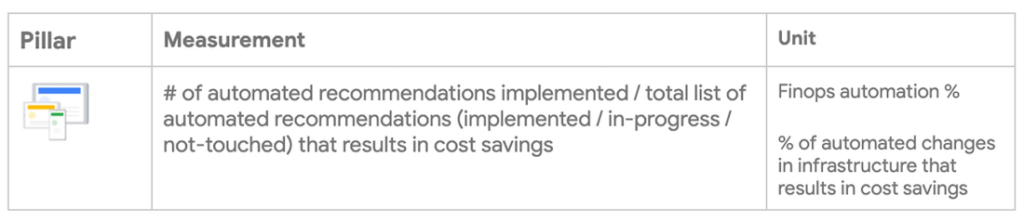
Therefore the recommended measure of Tools & Accelerators maturity is to evaluate the # of automated recommendations that have been implemented as a % of total list of automated recommendations generated that results in cost savings
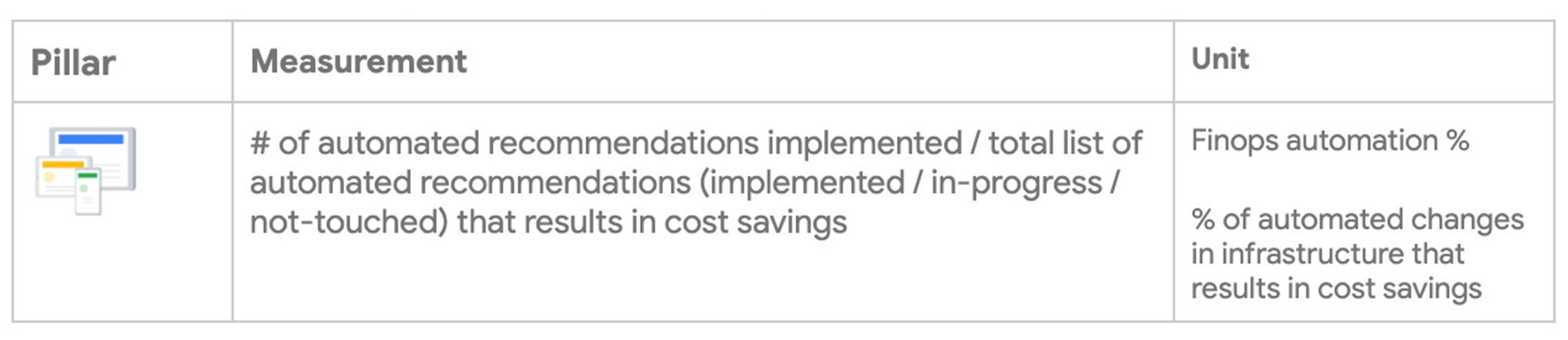
This is an important metric because as the organization onboards newer workloads to the Cloud environment, lack of robust actionable recommendations and monitoring can lead to increased cloud waste. This has been a key component prohibiting organizations from realizing the total value of their cloud investment.
Customers starting on their tool maturity journey can leverage Google’s out of the box recommendations Hub to get started. The Recommendation Hub is a place in the Google Cloud Console where you can view, prioritize, and apply these recommendations. Some examples include VM right sizing recommendations, BQ slot optimizations, Committed use Discount etc, Idle resource recommendations. This can further be integrated into any existing enterprise tooling using the recommendations API. As organizations mature, they can leverage Cloud Monitoring to create advanced recommendations based on custom business logic.
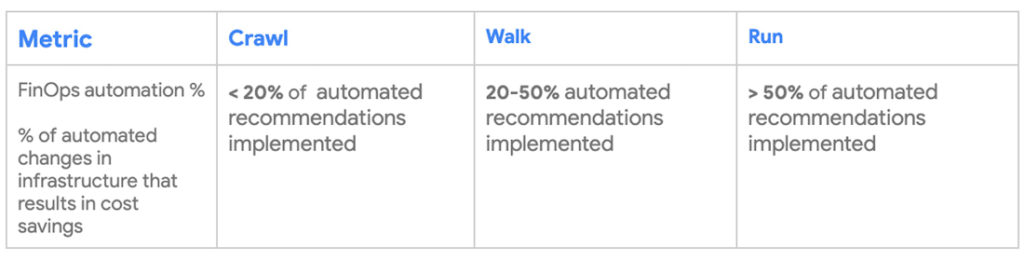
Ultimately, we see that a target goal of over 50% of automated recommendations implemented as the tooling for surfacing recommendations matures and this will ensure that the organization can minimize and eliminate cloud waste to maximize value from cloud investment.
Bringing this together with a Cloud FinOps Dashboard
As technology and business goals continue to evolve over time, it is essential to establish a process where the Cloud FinOps metrics are continuously reviewed whenever the goals change. Furthermore, it is important to note that not all organizations need to achieve the “Run” state of the identified metrics target. The metrics are means to achieve the business outcomes based on the organization’s priorities. By collaborating with cross-functional teams to quantify and measure the impact of the Cloud FinOps metrics, executive leaders can quickly obtain buy-in, highlight common-shared goals, and move fast.
At Google Cloud, we have developed solutions to help our customers build a Cloud FinOps Dashboard to capture these metrics to drive a culture of change and equip the transformation and business leaders with the tools to share and track the results of the key metrics. Successful adoption of the Cloud FinOps metrics enable organizations to focus on the business outcomes and the dashboard provides a meaningful feedback loop to report on the impact and drive visibility across the organization.
So, where are you now in your FinOps journey, and how do you move beyond the challenges ahead? Google can help you start the conversation and accelerate your path to maximizing business value with the cloud.
No matter where you are on the cloud transformation journey, through an interactive session with Google, we can bring executives across the organization together to work toward a shared vision and a plan to accelerate and realize business value in the cloud. If you are interested in more information, please contact us.
Special thanks to Daniel Pettibone, Amitai Rottem, Bruce Warner, Jon Naseath, and Nihar Jhawar for co-authoring and contributing to this blog post and the members of the FinOps Foundation including J.R. Storment, Vas Markanastasakis, Anders Hagman, John McLoughlin, Mike Bradbury, and Rich Hoyer for providing their domain expertise and continuous support to this important cloud FinOps topic.
More Relevant Stories for Your Company

Vimeo Looks to Google Cloud for High-Quality Video Delivery Service
Vimeo is a video-sharing platform that’s home to imaginative video creators and hundreds of millions of viewers. Sixty million people create, host, and sell high-quality videos on Vimeo, including more than 800,000 who subscribe to the service’s premium tools. Over 240 million people in more than 150 countries watch videos

Italian Utility Company Deploys its SAP Workloads on Google Cloud to Meet Sustainability Goals
With more than 2.5 million customers, Italian utility company A2A is committed to delivering electricity, gas, clean water, and waste collection every day. More recently, the company made another significant commitment: To incorporate the principles of the “circular economy” into its way of doing business — part of the UN
Google Cloud Migration Speeds Up The New York Times’ Journey to New Normal
Like virtually every business across the globe, The New York Times had to quickly adapt to the challenges of the coronavirus pandemic last year. Fortunately, our data system with Google Cloud positioned us to perform quickly and efficiently in the new normal. How we use data We have an end-to-end type of

Why VMs Need to Be First-Class Citizens Across Hybrid IT and Multicloud Architectures
As enterprise apps migrate to public clouds, VM migration strategies need to align with business priorities and budgets, according to research firm IDC. This is because virtual servers continue to support mission-critical enterprise workloads. Mature VMware environments support a wide range of critical workloads in environments that have been fine-tuned
