





Are Open Banking Regulations an Effective Entry into the API Economy?

4287
Of your peers have already read this article.
3:30 Minutes
The most insightful time you'll spend today!
With stated goals of increasing competition, innovation, and financial inclusion, bank regulators across the world are mandating that banks open their systems, enabling consumers to share their financial data with third parties.
One touted benefit of this sharing is that it may create digital banking ecosystems that offer consumers more services than ever, provide banking information and capabilities in more useful and convenient contexts, expand the market reach of ecosystem participants, and boost financial participation among the unbanked and underbanked.
These benefits involve requiring that banks produce application programming interfaces (APIs) to make data and functionality easy to share with partners in a standardized way and to give consumers control over the services with which their data is shared. Because APIs enable developers to leverage and reuse software for new services and digital experiences, including by combining APIs from multiple providers, tech pundits and commentators often refer to the “API economy” — that is, to digital ecosystems in which companies symbiotically share and combine their software to create richer offerings, to complement their proprietary strengths with offerings from other organizations, to share innovation across enterprises, and to expand into new sectors.
Rather than being able to access and act on financial data only through specific channels, for example, consumers in an Open Banking world would theoretically be able to use their money across a constantly-expanding array of apps and digital experiences. Likewise, rather than being confined to one bank’s specific digital services, consumers would be able to opt into a range of services, such as better loan matching or debt reduction advice, to help them do more with their money. Banks, meanwhile, would not have to create all aspects of digital experiences themselves but could rely on external partners, which they can add at unprecedented scale via APIs, to shoulder some of the burden of attracting and creating value for customers.
The envisioned disruption is sweeping, but key questions for bank leaders and bank investors remain, notably the extent to which the Open Banking movement will exert significant, durable impacts on market dynamics — and the extent to which Open Banking compliance constitutes an effective market entry into digital ecosystems and the celebrated benefits of the API economy.
Put simply, is complying with Open Banking regulations adequate to advance a bank’s digital strategy?
Building compliant APIs vs. entering the API economy
Individual regulators are fundamentally constrained in their ability to give banks detailed instructions on how to behave in digital ecosystems. Mandatory regulations can be originally conceived with only one or two business models in mind, not the many thousands of business models that could be partially or fully enabled by the API economy. Detailed rules and specifications may threaten the functionality of services, as regulatory interventions that give highly specific guidance may not be system- and business model-agnostic.
In terms of policy, the willingness of regulators to force banks to adopt APIs is highly significant, but because these regulatory interventions do not offer a meaningful and durable market entry roadmap for banks to follow, the regulations may be an initial catalyst to prompt financial market evolution rather than a natural and enduring end-state for business activity.
Aside from the constraints at the level of the individual bank regulator, there is limited consistency among Open Banking regulations across the globe. Europe’s PSD2 was the regulatory intervention that kicked off this global wave, but there are small but significant variations in the ripple of regulatory actions around the world.
In Australia, Open Banking is part of the Consumer Data Right, an initiative to give customers the right to access their data in a machine-readable form — a right the country does not confine to banking. In Singapore, the Monetary Authority of Singapore is pushing for a lightweight regulatory framework regime. Japan’s Amended Banking Act introduced a registration system for third party providers. Korea’s Financial Services Commission has launched a Fintech Open Platform. Mexico’s recent law to regulate financial technology institutions lays groundwork for an Open Banking regime. The Central Bank of Brazil is aiming to implement the relevant regulatory reforms by the end of 2019. For the largest, internationally diversified banks, these regional differences further complicate any effort to regard mere compliance with these interventions as an effective and coherent market entry strategy.
Despite these complexities and ambiguities, I’ve observed in my work consulting with financial institutions that some banks nevertheless treat Open Banking compliance projects as a means of market entry into the API economy. This mindset could be a costly mistake and may leave these banks at a significant competitive disadvantage as we continue to accelerate into the era of digital ecosystems. In addition to compliance, banks should view a commercial entry into a foreign country as a useful reference for entering the API economy.
Entering the API economy is like entering a foreign market
Banks executing a commercial entry into a foreign country will encounter cultural differences, whether in the form of language, ethnicity, religion, social networks, values or norms. When these cultural differences are large, market entry into a foreign market is more difficult.
The practical implications of administering new business activity in a foreign country also impact the level of difficulty. The physical distance between the home country and the foreign country has to be managed. Border hardness, time zones, and climate also impact the administrative challenges posed by the foreign country. Additionally, the market landscape is foreign. New countries can significantly differ in their natural, financial, and human resources. Staff sent to build up a new division in a new country will have to cope with different levels of market Infrastructure, information, and knowledge. Finally, the economics of entering a foreign country can be heavily influenced by historical and political factors such as a shared colonial history, common memberships of trading blocs, and shared currency zones.
These patterns of differences and similarities can likewise be observed when a bank tries to enter the API economy.
Like entry into a new territory, entry into the API economy may pose sharp cultural and operational differences for banks to grapple with. In this world of APIs and software ecosystems, an API provider’s commercial aim is to make third-parties the dominant force for innovation — that is, to securely share data and services with external contributors who build new connected experiences that generate value for the provider, much as ridesharing companies have generated value by leveraging APIs such as Google Maps. Enterprises focused on ecosystem development market their APIs as products for developers so that new innovation can emerge organically, without necessarily being pre-planned. Investment decisions in the API economy are driven by a desire to help preferred ecosystems to evolve fastest. All of this may be a very sharp change in culture for many banks that historically have sought to be the dominant innovator shaping customer experiences.
The established approach to innovation in banks is highly deliberate, aiming to match bank financial products to specific customer needs and to beat the financial product offerings of peer banks. Compared to modern digital ecosystems, these legacy banks’ resources for, scope of, and receptivity to innovation may be considerably constrained. Banks that actively treat the culture of the API economy as very foreign to their traditional corporate culture have a far greater chance of acknowledging these challenges and making a successful market entry into the API economy.
Many banks may also face challenges transitioning to ecosystem administration models. In traditional banking models, the C-suite commands and controls the bank staff that distributes products. Typically, very few external business partners are involved, and those that are have generally been deliberately, if not laboriously, selected. In contrast, the API economy requires the orchestration of very large numbers of third parties that add value to a bank’s innovation and distribution capabilities. Literally thousands of partners may access a bank’s APIs to build services atop banking data, extend a bank’s functionality or insert the bank’s APIs into new business contexts. In many ways, the whole point is that partnerships don’t have to occur in slow-moving, methodically planned formal partnerships but rather can be achieved at Internet scale while preserving control over and visibility into customer data. This shift in strategy is no small departure for many banks — so again, thinking of the endeavor as entry into a foreign market, rather than something that can be jumpstarted via regulations, is wise.
Crucially, the market landscape in the API economy is also very different from what legacy financial institutions are used to. Traditionally, banks have segmented the market into very large market segments (e.g. consumer banking, corporate banking, private banking etc.). In sharp contrast, the API economy sees partners working together to serve market micro-segments that would not be reachable and profitable by each individual enterprise working in isolation. Simply put, addressing all customer needs, from mainstream use cases to niche applications, is beyond the capabilities of any single enterprise and can generally only be achieved through ecosystems and partnerships. Because partners working together in the API economy seek to serve the customer through the customer’s preferred digital interface (which may be different than bank’s preferred digital interface), ecosystem partnerships represent a massive shift in marketing management, with major implications for a bank’s business architecture, technical architecture, governance, and risk management.
Additionally, in the API economy, pricing decisions are generally driven by a desire for ecosystem growth. Partners work together to extend the customization and value that customers experience when consuming services. By design, the intellectual property in an ecosystem becomes dispersed. Banks have traditionally sought to protect the exclusivity of their intellectual property, and they have often sought economic returns via cost-plus pricing and minimal customization of financial products. Just as with other aspects of the API economy, these ecosystem dynamics and economic relationships typically fall outside a bank’s status quo operations and strategies — more akin to entering a foreign market than to simply satisfying regulatory requirements.
The C-suite should be involved
To approach entry into the API economy as they would approach market entry into a foreign country, banks should consider focusing on a small number of products or segments. They should seek complementary partners who can help them adapt their skills to the API economy and extend the reach of their core differentiating strengths. Just like entry into a foreign market requires combining elements of the home country business model with new local elements, banks will have to transform to increase the effectiveness of their ecosystem participation.
Because an Open Banking compliance project involves regulators specifying the scope and schedule for mandatory APIs, the C-suite may feel relegated to the role of budget provider, which may tempt executives to delegate the sponsorship and steering of the project. Such delegation is not an option for a foreign market entry, where all decisions on scope, cost and timetable are strategic and entirely in the hands of the bank itself — and the C-suite should not consider it an option for entry into the API economy. Bank leaders need to be involved, as the organization likely will not be able to make the necessary strategic and operational transformations if the vision is not defined and driven from the top.
Shifting Down: A New Way to Cloud for Developers

913
Of your peers have already read this article.
4:30 Minutes
The most insightful time you'll spend today!
Application developers are the backbone of the modern cloud economy. The role of developers is felt in the seen and the unseen, from the smartphone apps we use every day to the network optimization that is powering a sustainable future. Given your importance in transforming so many fundamental aspects of society and industry, you’re facing more pressure than ever to remain innovative in the face of changing markets and industries. With limited time, shrinking budgets, increasingly complex environments, and compounding operational responsibilities, it’s no wonder that one of our most popular developer sessions last year at Next was focused on burnout.
Google remains a consistent advocate and ally of developers, from our ongoing contributions to open source projects like TensorFlow and Kubernetes to our free learning paths and certifications. The Application Developer spotlight session at Next ‘23 will lay out our aspiration to build a new way to cloud for developers. We favor “shifting down” instead of “shifting left,” to give you a cloud experience that is easy, fast, and secure.
An easy way to get started — with a trial at no charge for new users
Whether you’re just starting to create a new application, or laying the groundwork for your burgeoning developer career, navigating a new platform and its services can pose formidable challenges. Key details, like the more suitable Google Cloud service for running a dynamic website or estimating the cost of an application, may seem elusive. Moreover, as you transition from design to execution, it’s crucial to understand functional aspects like which APIs should be enabled or the IAM roles necessary for managing your services.
Today, we’re thrilled to announce the general availability of Jump Start Solutions to streamline your introduction to Google Cloud. These application and infrastructure solutions shift many of the tasks at the initial learning and researching phase down to the platform. Jump Start Solutions adhere to best practice principles and can be launched with a single click. Plus, new Google Cloud customers can take advantage of the $300 credit sign up trial. Whether you’re looking to explore, learn, or find a launching pad for creating production-ready applications, Jump Start Solutions are an easy starting point. Each solution comes with an estimated cost, comprehensive reference architecture, and tutorials.
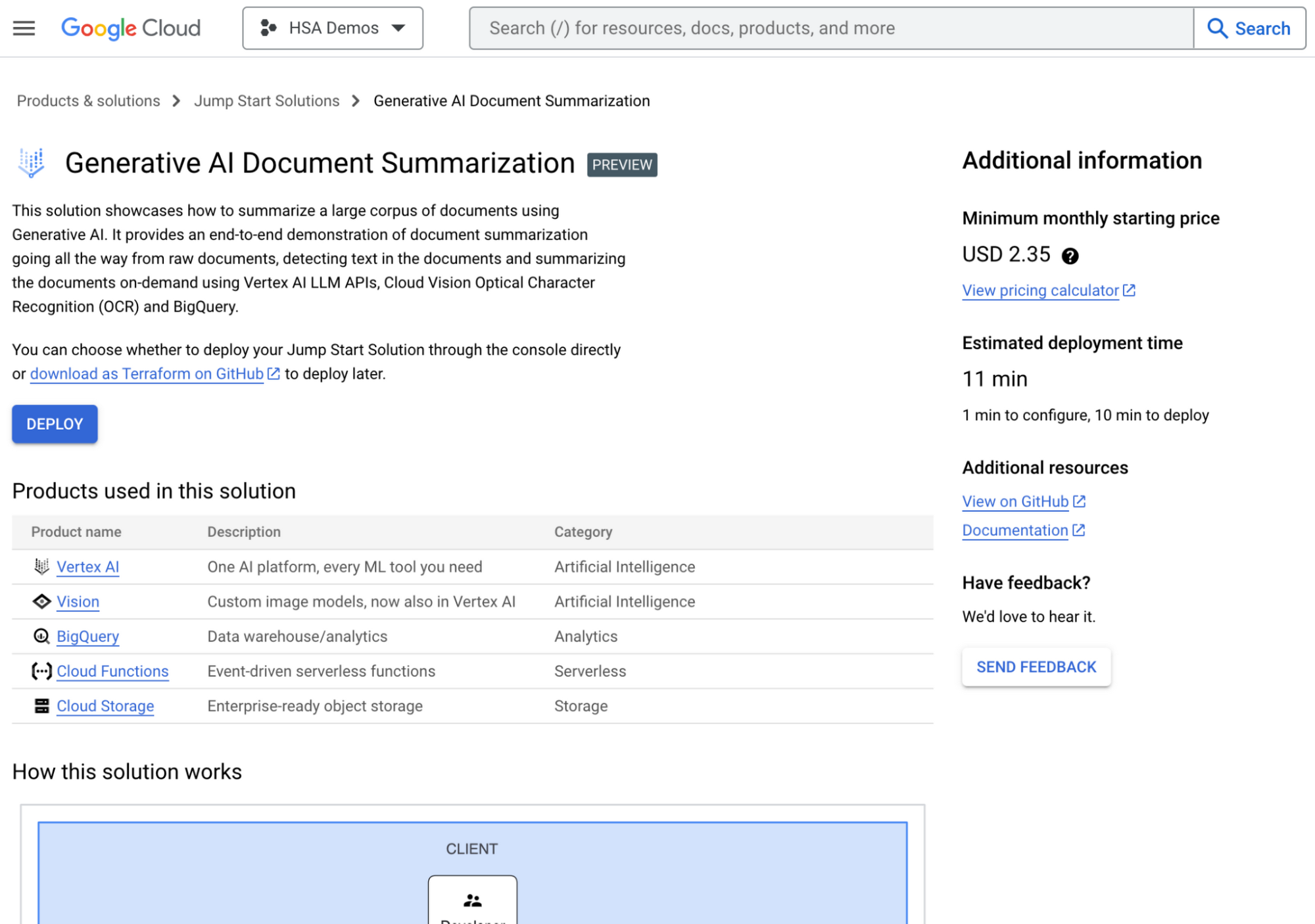
The Generative AI document summarization solution in the Google Cloud Console
Some of our 14 solutions available today include a generative AI-powered document summarization app and an AI-powered image processing app. These are just the beginning of a wide range of solutions which help you lay a secure and stable foundation from which to build, innovate, and grow.
Speeding up your development with AI and automation
Imagine training a generative AI model using the best practices, documentation, and architecture guidance of Google Cloud and applying that to your coding experience. No longer will you have to leave your IDE to research how to complete a coding task, no more repeating low-value manual tasks, and no more hunting for expert guidance.
Duet AI is now in preview across many services in Google Cloud to help shift the burden of researching, coding, and testing, down to the platform. A few of the ways developers can use Duet AI include:
- Code Completion and Code generation in your IDEs. You get recommendations as you type for full functions and code blocks based on comments, fixes for errors found in the code, and generation of unit tests for code directly in your IDE.
- Chat assistance so you can use natural language to ask questions about code bases and APIs, and retrieve coding best practices. Chat assistance is available across many Google Cloud products, such as in the Cloud Console, Cloud Workstations, BigQuery, Spanner, and Apigee.
Duet AI in Google Cloud supports 20+ programming languages such Go, Java, Javascript, Python, and SQL. Thanks to Cloud Code, you can use Duet AI with many popular IDEs such as VSCode, and JetBrains IDEs like IntelliJ, PyCharm, GoLand, and Webstorm. And, with Duet AI’s source citations, suggestions provided by Duet AI are automatically flagged when directly quoting at length from a source to help you comply with any license requirements.
Enterprise companies like Wayfair who are committed to enhancing developer productivity are already using Duet AI, and are excited about how it makes life easier for their developers.
“At Wayfair, developer productivity is top of mind for us. We are excited to incorporate Duet AI in our efforts to have developers across Wayfair build applications incredibly fast! With Duet AI, we can increase developer productivity, and joy at the same time.” – Mark Quigley, Director of Engineering Enablement, Wayfair
Shifting down interoperability
Modern application development stacks are a mosaic of in-house creativity and essential third-party applications such as CRM, ERP, or payment systems. What is the lifeblood linking these siloed pieces? Integration. Building integrations demands time-consuming development work, niche skills, and deep understanding of third party systems like SAP or Salesforce. These compounding complexities can delay delivery and increase budget costs. We envision a world where platforms shoulder the burden of integration, liberating developers to innovate with their regained time.
Today, we’re pleased to announce the general availability of Application Integration – a no-code integration platform as a service (iPaaS) designed to empower you to weave together your applications. Its intuitive drag-and-drop interface transforms the complex task of integration into a simple point-and-click journey. With 75+ pre-built connectors you can link Google Cloud services like BigQuery, Cloud Storage with third-party applications like Salesforce, MongoDB, Oracle, and SAP.
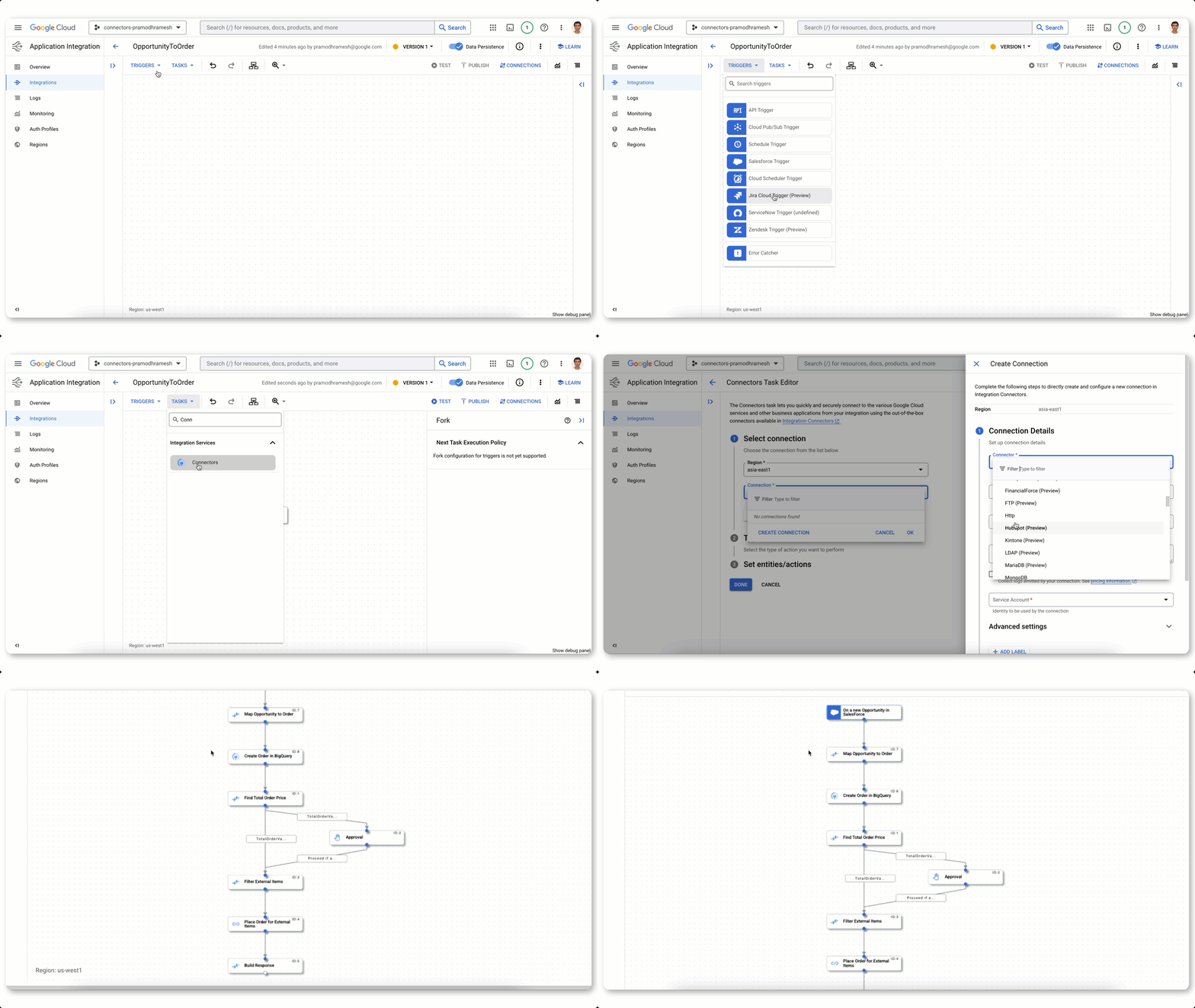
Building an integration flow using connectors, visual designer, and automated triggers
Further, Duet AI in Application Integration can shift even more work away from you and onto the platform. Using natural language, you can generate a recommended list of integration flows. Because Duet AI pulls context from your environment, it generates flows using your existing APIs and assets. To further harden your integration flows, Duet AI automatically generates documentation and test cases in a single click.
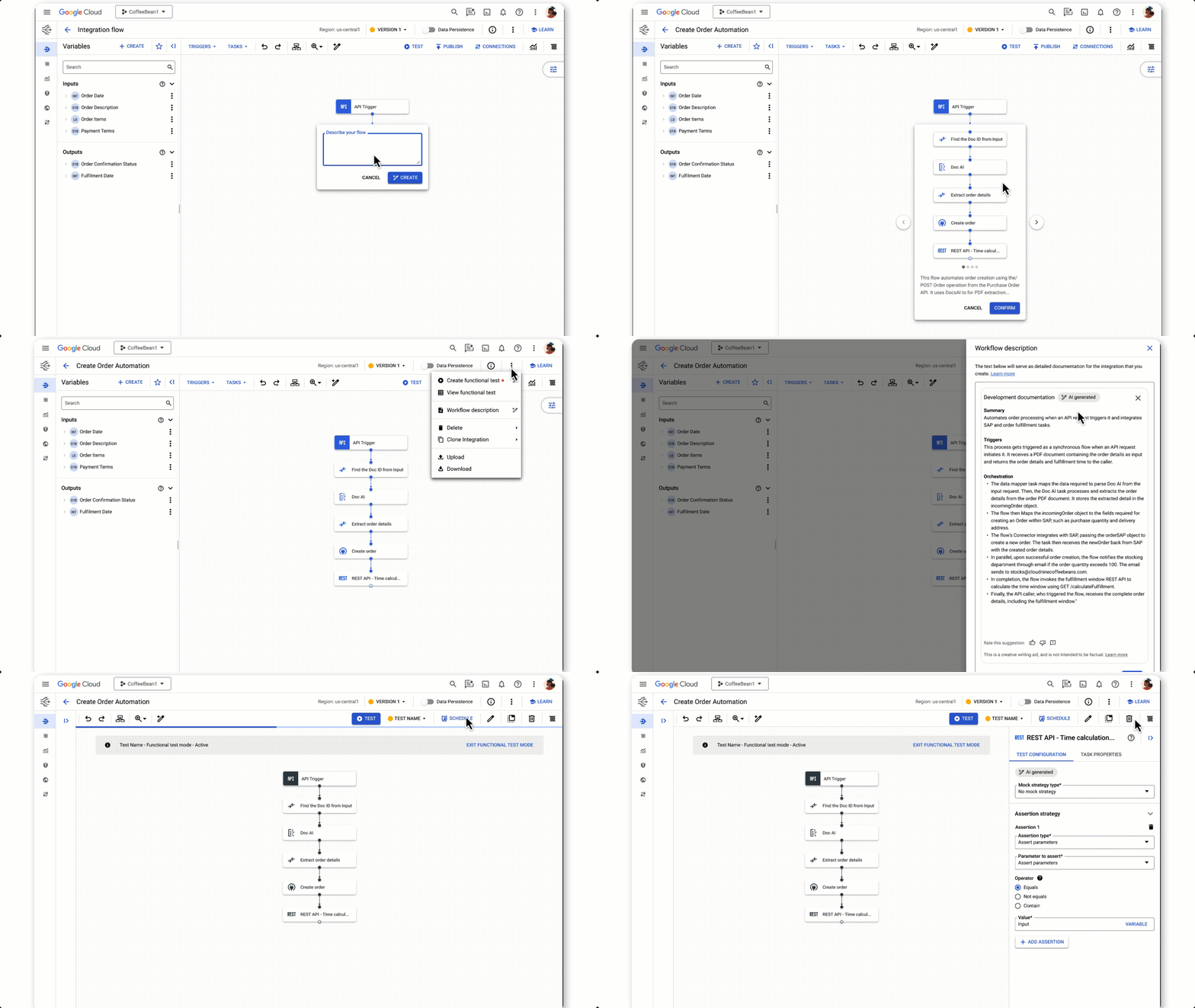
Using Duet AI to build integration flows, documentation, and tests with natural language
Secure, platform-driven application development
With the world’s attention on how AI will shape the future, the challenges created by distributed workforces continue to be felt. Developer teams need help with onboarding, access to consistent tools and libraries, and development environments powerful enough for today’s workloads.
We recently announced the general availability of Cloud Workstations, powerful, secure and customizable development environments available anywhere, using a browser, local IDE, or terminal. Cloud Workstations can shift the burden of provisioning, scaling, managing and securing developer environments down to the platform. And like many other services across Google Cloud, you can use Duet AI in Cloud Workstations to help make you more efficient with everything from writing code to implementing best practices.
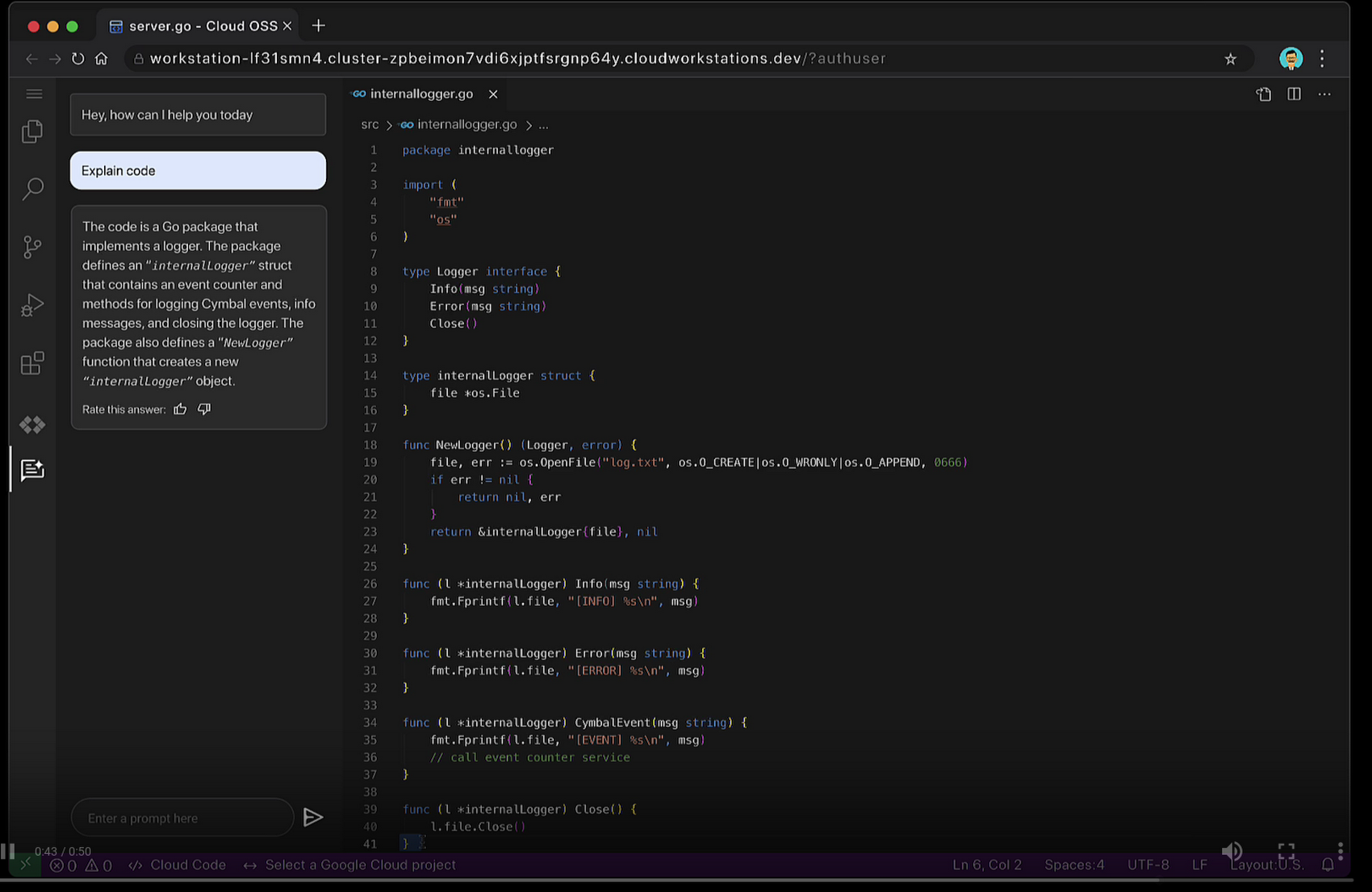
While the reality of geographically dispersed and rapidly growing development teams highlights the need to address traditional concerns, such as platform and data security, even greater scrutiny is placed on the software supply chain.
An expanded partnership with GitLab for secure DevOps
Google Cloud continues to grow at a fast pace and that means we are constantly welcoming many new developers to our platform. We know the tools you choose for software development are an important factor in your success. We want to make it easy to use the tools you love. Today we announced that Google Cloud and GitLab are partnering to offer a secure DevOps solution that can shift the work to connect our technologies down to the platform while giving you integrated source management, artifact management, CI/CD, and enhanced security features.
Developers already using Google Cloud gain access to GitLab’s comprehensive AI-powered DevSecOps platform and GitLab customers gain access to Google Cloud’s Secure Software Supply Chain technologies like Supply-chain Levels for Software Artifacts (SLSA), software bill of materials (SBOM), and Binary Authorization policies.
We can help you gain value from Google Cloud faster with deeply integrated partner tooling. That’s exactly what we are doing with our expanded GitLab partnership. Learn more on GitLab’s blog. You can also sign up to stay informed about the latest partnership developments.
Start shifting down with Google Cloud
At the heart of Google Cloud is a simple, yet powerful idea: to empower you to do what you excel at — coding exceptional software. In the fast-paced era of digital transformation, we understand the mounting pressures that developers face, which is why we believe it’s the responsibility of platforms to shoulder the burdens hindering your creative process. We’re helping you by streamlining your onboarding experience, optimizing your coding efficiency, and shifting the weight of security from you to the platform. We’re not alone in this journey; we’re collaborating with partners like Gitlab at our side. So if you’re an application developer, check out Google Cloud. It’s the new way to cloud on the cloud platform that’s designed to make your life easier.

APIs and IT Rationalization: Cost Avoidance and Cost Savings for Enterprise IT
DOWNLOAD E-BOOK3814
Of your peers have already downloaded this article
6:30 Minutes
The most insightful time you'll spend today!
The dynamic and fast-moving business environments of today demands that technology leaders and teams deliver more at a lightning speed, all the while working within the constraints of shoe-string budgets and tight project timelines. Winning in today’s environment requires a more strategic approach to optimize utilization of resources, remove unnecessary spend and free more dollars for innovation.
In every organization there are several necessary and unnecessary costs distributed throughout a typical enterprise architecture. There are two main aspects to focus on in IT rationalization: cost avoidance and cost savings. Implementing an API tier can lead to operational efficiencies , faster development, and cost savings and avoidance.
Read this eBook to explore the less well-understood and sometimes harder to find opportunities for reducing spend like cost avoidance (not paying for something that you would have had to pay for otherwise) and cost savings (reducing or eliminating a current expense). Learn how strategically integrating APIs can help you counteract the complexity of organic technology accretion, enable both cost savings and cost avoidance and improve business efficiency.
Google Cloud Helps Northwell Health to Boost Caregiver Productivity and Access to Right Care Using AI

7981
Of your peers have already read this article.
2:00 Minutes
The most insightful time you'll spend today!
Lung cancer is the leading cause of cancer death in the United States and like any cancer, early detection is crucial to survival. Screening at-risk populations is an important part of reducing mortality, and if concerning nodules are found on imaging, further testing may be required. Today, we’ll share how Northwell Health uses Google Cloud products such as Cloud Healthcare APIs and BigQuery to increase caregiver productivity and deliver better care for patients with findings that indicate potential development of lung cancer.
Northwell is New York’s largest healthcare provider
Northwell Health is New York’s largest healthcare provider with 23 hospitals and nearly 800 outpatient facilities. Northwell’s nearly 4,000 doctors care for millions of patients each year, and at this scale, there is an immense amount of healthcare data to manage. To better manage and leverage this data, Northwell Health partnered with Google Cloud starting in 2018.
Enabling caregivers to spend more time with patients
Nic Lorenzen, the lead developer of Northwell Emerging Technology and Innovation team, has a mission to put together data for caregivers in a way that makes sense. It is no secret that inefficient electronic health records systems have a negative impact on a physician’s ability to deliver quality care. Traditional EHRs have information distributed across many tabs, which forces caregivers to spend considerable time at the computer trying to find information. Moreover, speed of care matters. If care is delayed, patients may have to spend more time in the hospital and may suffer worse health outcomes.
To solve this problem, Nic’s team focused on giving caregivers the most relevant pieces of data at the right time by developing an intelligent clinician rounding app. The data needed to derive these insights can depend on the caregiver’s role–a nurse cares about different things than a cardiologist. This system aggregates multiple data sources, and provides patient-specific insights to caregivers.
This system would not have been possible before with traditional EHRs and data warehouses that have proprietary data models and rarely sync data in real time. Now with data easily accessible through Google Cloud’s Healthcare solutions, Nic’s team can deliver the right clinical information to the right people instantly. These days, Nic says, “instead of spending 75% of our time dealing with architecting the underlying platforms, we spend 75% of our time focused on higher value use cases for clinicians and patients. Google Cloud’s Healthcare solutions have greatly improved our developer productivity and time to value.”
Caregivers have found this new system to be a game changer.Before the implementation of this system, caregivers would spend, on average, seven to nine minutes finding the data needed to make medical decisions for one patient. Now, that aggregated information is delivered to a caregiver’s mobile device in less than a second.
Ensuring patients get the right care with the power of AI
There are a number of reasons why patients might not get the care that they need. For example, patients today can go to multiple hospitals and clinics settings, and coordinating care across multiple facilities is complex. Regional hospitals and clinics have their own siloed view of their data, so pertinent information gathered by one clinic might not be seen by another. These gaps in clinical data lead to gaps in patient care.
When a patient gets radiologic imaging, they may have findings unrelated to the reason they initially got the imaging. For example, a chest CT for a car accident might reveal an incidental lung nodule that could be cancerous. Unfortunately, research shows that a large portion of patients do not get follow up for these incidental findings because it isn’t the primary reason why the patient is seeing a doctor. Moreover, social determinants of health are a factor that affects which patients receive follow-up care. Identifying these patients and providing the necessary follow up care prevents adverse events related to delayed detection of cancer.

With Cloud Healthcare solutions, Northwell built an AI model to identify these patients so that oncologists can appropriately follow up with patients who have findings suspicious for lung cancer. The AI model detects incidental pulmonary nodules in radiology reports so that doctors can then contact the patients that need follow-up care. Nic says his team was able to build this system in a week: “Google Cloud did a lot of heavy-lifting for us and allowed us to get to the AI applications much faster. It allowed us to build a platform that just works.”
Healthcare systems can now rapidly generate healthcare insights with one end-to-end solution, Google Cloud Healthcare Data Engine. It builds on and extends the core capabilities of the Google Cloud Healthcare API to make healthcare data more immediately useful by enabling an interoperable, longitudinal record of patient data. Northwell Health uses Google Cloud as the core of their platform, enabling their developers to create solutions to the most pressing healthcare problems.
Special thanks to Kalyan Pamarthy, Product Management Lead on Cloud Healthcare and Natural Language APIs for contributing to this blog post.
Transform ‘Dark Data’ from Documents with Document AI, Cloud Functions and Workflows

8217
Of your peers have already read this article.
2:00 Minutes
The most insightful time you'll spend today!
At enterprises across industries, documents are at the center of core business processes. Documents store a treasure trove of valuable information whether it’s a company’s invoices, HR documents, tax forms and much more. However, the unstructured nature of documents make them difficult to work with as a data source. We call this “dark data” or unstructured data that businesses collect, process and store but do not utilize for purposes such as analytics, monetization, etc. These documents in pdf or image formats, often trigger complex processes that have historically relied on fragmented technology and manual steps. With compute solutions on Google Cloud and Document AI, you can create seamless integrations and easy to use applications for your users. Document AI is a platform and a family of solutions that help businesses to transform documents into structured data backed by machine learning. In this blog post we’ll walk you through how to use Serverless technology to process documents with Cloud Functions, and with workflows of business processes orchestrating microservices, API calls, and functions, thanks to Workflows.
At Cloud Next 2021, we presented how to build easy AI-powered applications with Google Cloud. We introduced a sample application for handling incoming expense reports, analyzing expense receipts with Procurement Document AI, a DocAI solution for automating procurement data capture from forms including invoices, utility statements and more. Then organizing the logic of a report approval process with Workflows, and used Cloud Functions as glue to invoke the workflow, and do analysis of the parsed document.
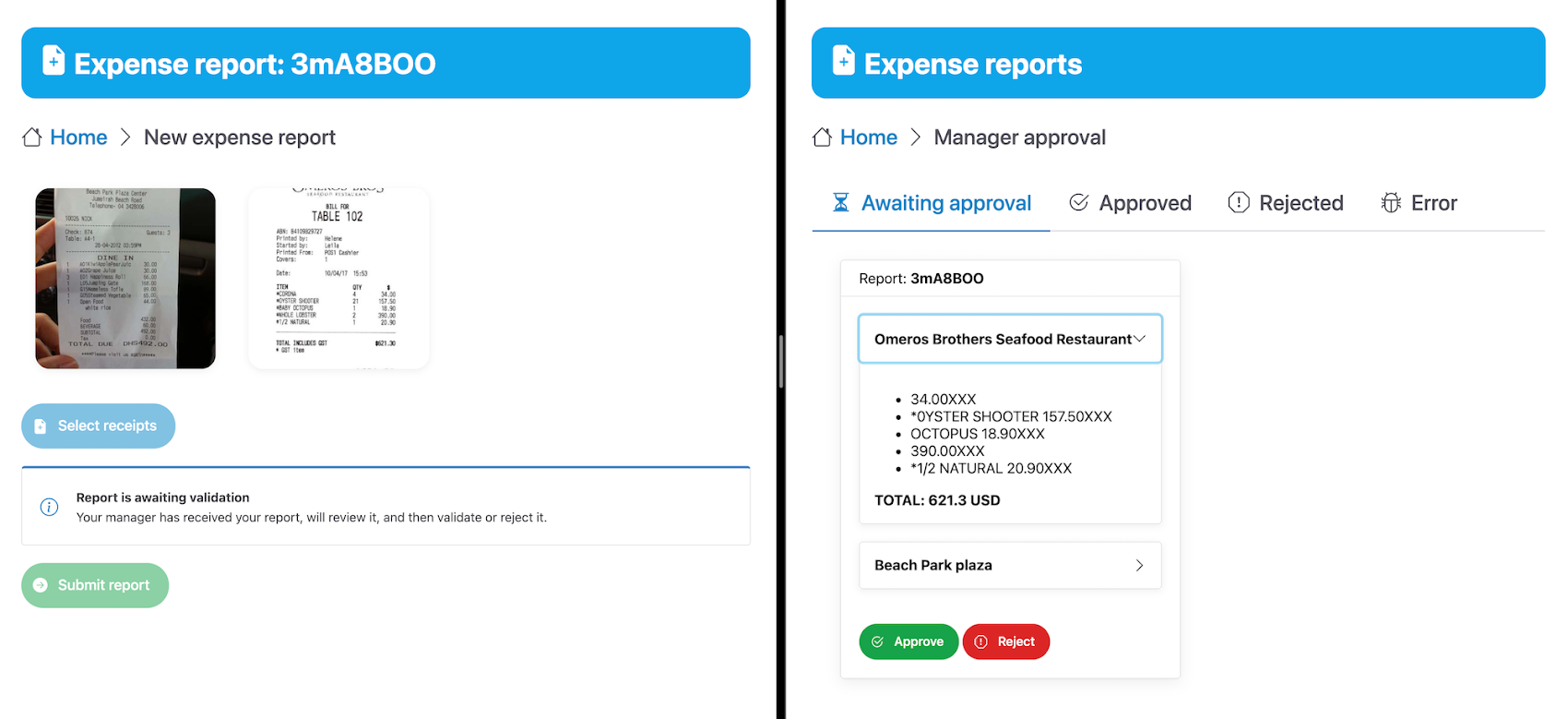
We also open sourced the code on this Github repository, if you’re interested in learning more about this application.
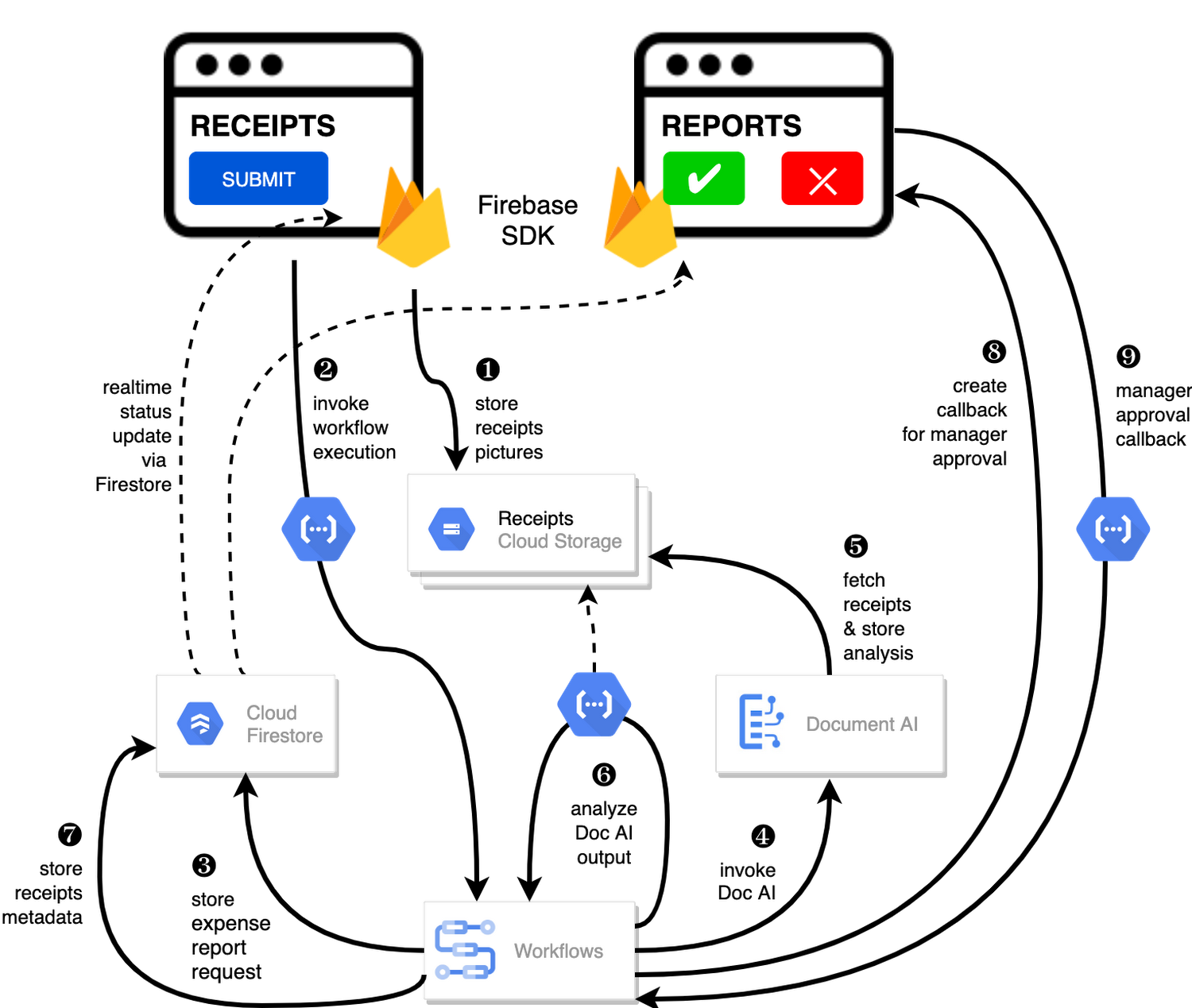
In the above diagram, there are two user journeys: the employee submitting an expense report where multiple receipts are processed at once, and the manager validating or rejecting the expense report.
First, the employee goes to the website, powered by Vue.js for the frontend progressive JavaScript framework and Shoelace for the library of web components. The website is hosted via Firebase Hosting. The frontend invokes an HTTP function that triggers the execution of our business workflow, defined using the Workflows YAML syntax.
Workflows is able to handle long-running operations without any additional code required, in our case we are asynchronously processing a set receipt files. Here, the Document AI connector directly calls the batch processing endpoint for service. This API returns a long-running operation: if you poll the API, the operation state will be “RUNNING” until it has reached a “SUCCEEDED” or “FAILED” state. You would have to wait for its completion. However, Workflows’ connectors handle such long-running operations, without you having to poll the API multiple times till the state changes. Here’s how we call the batch processing operation of the Document AI connector:
- invoke_document_ai:call: googleapis.documentai.v1.projects.locations.processors.batchProcessargs:name: ${"projects/" + project + "/locations/eu/processors/" + processorId}location: "eu"body:inputDocuments:gcsPrefix:gcsUriPrefix: ${bucket_input + report_id}documentOutputConfig:gcsOutputConfig:gcsUri: ${bucket_output + report_id}skipHumanReview: trueresult: document_ai_response
Machine learning uses state of the art Vision and Natural Language Processing models to intelligently extract schematized data from documents with Document AI. As a developer, you don’t have to figure out how to fine tune or reframe the receipt pictures, or how to find the relevant field and information in the receipt. It’s Document AI’s job to help you here: it will return a JSON document whose fields are: line_item, currency, supplier_name, total_amount, etc. Document AI is capable of understanding standardized papers and forms, including invoices, lending documents, pay slips, driver licenses, and more.
A cloud function retrieves all the relevant fields of the receipts, and makes its own tallies, before submitting the expense report for approval to the manager. Another useful feature of Workflows is put to good use: Callbacks, that we introduced last year. In the workflow definition we create a callback endpoint, and the workflow execution will wait for the callback to be called to continue its flow, thanks to those two instructions:
- create_callback:call: events.create_callback_endpointargs:http_callback_method: "POST"result: callback_details...- await_callback:try:call: events.await_callbackargs:callback: ${callback_details}timeout: 3600result: callback_requestexcept:as: esteps:- update_status_to_error:...
In this example application, we combined the intelligent capabilities of Document AI to transform complex image documents into usable structured data, with Cloud Functions for data transformation, process triggering, and callback handling logic, and Workflows enabled us to orchestrate the underlying business process and its service call logic.
Going further
If you’re looking to make sense of your documents, turning dark data into structured information, be sure to check out what Document AI offers. You can also get your hands on a codelab to get started quickly, in which you’ll get a chance at processing handwritten forms. If you want to explore Workflows, quickstarts are available to guide you through your first steps, and likewise, another codelab explores the basics of Workflows. As mentioned earlier, for a concrete example, the source code of our smart expense application is available on Github. Don’t hesitate to reach out to us at @glaforge and @asrivas_dev to discuss smart scalable apps with us.
SoFi Stadium Personalizes Fan Experiences with Game-changing App Built on Google Cloud and Deloitte

3208
Of your peers have already read this article.
2:00 Minutes
The most insightful time you'll spend today!
Editor’s note: Engineers from SoFi Stadium, Google Cloud, and Deloitte built a fan-ready Personal Concierge app that uses advanced analytics to tailor game-day experiences for every visitor. SoFi’s 10-year partnership with Google Cloud not only pumps up the fans. Advanced analytics also enable stadium employees to securely store, analyze, and action analytics data, and seamlessly collaborate through tools and services included in Google Cloud Workspace.
SoFi Stadium, an industry-leading, outdoor-indoor events facility and home of the Los Angeles Rams and Los Angeles Chargers, is the centerpiece of Hollywood Park, a near 300-acre sports and entertainment destination. With the capacity to host up to 100,000 spectators across a range of luxury and premium seating options, the 3.1 million square-foot SoFi Stadium is the largest in the NFL. Completed in September 2020, it has already secured a global reputation—scheduled to host Super Bowl LVI in 2022, the College Football National Championship Game in 2023, and the Opening and Closing Ceremonies of the Olympic Games in 2028. Under the same roof canopy as the stadium is the 2.5-acre American Airlines Plaza and the 6,000-seat performance venue, YouTube Theater.
Through a long-term partnership with Google Cloud, SoFi Stadium is personalizing fan experiences, enabling a more fulfilling, collaborative, and productive work experience for employees, and delivering game-changing technology to the event space.
Personalizing the experience for every fan
Sports fans are known for their fierce loyalty and camaraderie. While they come to game day ready to cheer with fellow fans, each spectator has a different vision for what will make for a memorable event. SoFi Stadium is helping customers choose their game day flow by extending a personalized, streamlined experience to every stadium goer through several new digital innovations powered by Google Cloud.
First there’s the Personal Concierge App. Powered by Google Cloud and built by Deloitte, this personalized navigation and security tool may be the game day MVP that sports fans have always dreamed of. Hours of precious viewing time can be lost navigating a stadium campus for seating, parking, food, access, and amenities. This application enables fans to quickly locate available parking locations, select the ideal transportation for game day through real-time Google Maps routing, and discover SoFi Stadium events all from their mobile device. Event-goers can also receive digital credentials through the app, enabling them to bypass lines and accelerate their access to luxury viewing suites.
The advanced data analytics accrued from multiple sources and processed through Google Cloud products such as Cloud Scheduler, App Engine, Dataflow, BigQuery, Looker, Firebase, and more, enable SoFi Stadium to anticipate spectator tastes. These Google Cloud tools can remember preferences and provide attendees with real-time personal recommendations around the clock.
Performing at the top of their game with Workspace
Advanced data analytics enhance employee experiences, too. Credentialed team members can securely store and analyze data from multiple sources, create operational dashboards with real-time data, track key performance indicators after events, and better forecast attendance, revenue by product, and other important business metrics.
In addition to deploying a number of Google Cloud solutions including Compute Engine, Kubernetes Engine, Cloud CDN, BigQuery, and others to power the Personal Concierge App, SoFi Stadium is empowering its employees by fully migrating to Google Cloud’s Workspace. Workspace streamlines the stadium’s business operations by fostering fast and seamless access to collaboration and performance tools. Built-in software—including Gmail for business, Docs, Drive, Calendar, and Meet—will help employees work smarter and meet securely from anywhere.
“We couldn’t have picked a better partner to help manage our technology needs,” said Skarpi Hedinsson, Chief Technology Officer, SoFi Stadium and Hollywood Park. “Incorporating Google’s solutions into critical areas of our business ensures we can usher in a new era of innovation in sports and entertainment, raising the bar on what the ultimate fan experience looks like globally.”
Making the big-game even bigger
As Hollywood Park combines the expertise of its team and Google Cloud engineers to power the future of sports and live events, SoFi Stadium prepares to welcome a product of this collaboration with the Infinity Screen by Samsung, the largest video board in sports. With 80 million pixels, weighing 2.2 million pounds, and boasting 120-yards in length, the Infinity Screen by Samsung leverages Google Cloud-based media workflows and optimization technology to power its game-changing screen.
Through its partnership with Google Cloud, SoFi Stadium is actively developing new media streaming and high-speed wireless solutions. In addition, SoFi Stadium has the world’s first 4K/HDR live production facility. These digital innovations are powering a new standard for sports fans and opening a path to redefine what can take game day from good to great.
More Relevant Stories for Your Company

5 Best Practices for Cloud Cost Optimization
When customers migrate to Google Cloud Platform (GCP), their first step is often to adopt Compute Engine, which makes it easy to procure and set up virtual machines (VMs) in the cloud that provide large amounts of computing power. Launched in 2012, Compute Engine offers multiple machine types, many innovative features, and is available in

How to Build an API Program That Doesn’t Suck
Modern web APIs allow businesses to build compelling experiences that generate, consume, and combine digital assets. They’ve become the foundation upon which digital business is built. But the path to success can be unclear, rough, and challenging. The game has changed, after all, and this requires tossing out many of

Google Unveils New Cloud Region in Delhi NCR to Power India’s Digitization
In the past year, Google has worked to surface timely and reliable health information, amplify public health campaigns, and help nonprofits get urgent support to Indians in need. Now, we are continuing to focus on helping India’s businesses accelerate their digital transformation, deepening our commitment to India’s digitization and economic recovery.

The Unintended Consequences of Scale
Cloud infrastructure offers so many advantages: on-demand scalability, built-in security, and a bevy of tooling to scale your business at the speed of the Internet. It enables companies to pursue “blitzscaling,” as Reid Hoffman calls it. Capital expenses that take years or decades to pay off are no longer required to
