





2021 was the Momentum for Contact Center AI!

3496
Of your peers have already read this article.
1:30 Minutes
The most insightful time you'll spend today!
2021 has been a high-stakes year for call centers, with many organizations forced to rapidly scale up their call center operations in response to ongoing pandemic disruptions. We’re proud that 2021 has also been an amazing year for Google Cloud’s Contact Center AI (CCAI), which has helped our customers adapt and thrive, despite the challenging conditions.
Beginning in January, we launched Dialogflow CX in GA. Agent Assist preview was released in May. Most recently, CCAI Insights GA was announced at Google Cloud NEXT in October. During NEXT, we shared lots of great content on how you can use CCAI to improve your customer experience with these breakout sessions:
- Using CCAI Insights to Better Understand Your Customers
- Customer Impact with Conversational AI
- Drive Results by Transforming the Customer Experience with AI-Powered Business Messages
But don’t just take our word for it. We also got a chance to hear how some companies are using CCAI to better reach their own customers, including The Home Depot, TELUS, and Love Holidays. We partnered with CDW to discuss transforming the contact center with AI and with Quantiphi on how to migrate from Dialogflow EX to CX. Our integration with Looker Block also makes CCAI Insights even more powerful by visualizing contact center metrics. Over the summer, we hosted a Dialogflow CX competition with more than 1,100 participants. Just last month, we showed how we’ve enabled businesses to use AI in their interactions using Google Business Messages. Looking to the future, we talked about the future in our article,“Reimagining your Customer Experience with Conversational AI.”
Amwell, a U.S.-based telehealth company that is launching CCAI, including the recently launched CCAI Insights, is among the enterprises harnessing AI to transform its call centers. “With Contact Center AI, we aim to digitize our support for improved operational efficiency and elevated analytics capabilities, while enhancing the customer experience for patients, providers, and staff,” says Paul Johnson, SVP Client Services at Amwell. “Contact Center AI Insights will allow Amwell to better understand why our platform users are reaching out to support and how they feel about the overall experience – valuable insights for our support organization.”
As we recap the momentum of CCAI for 2021, it’s also a good time to review exactly how CCAI works.
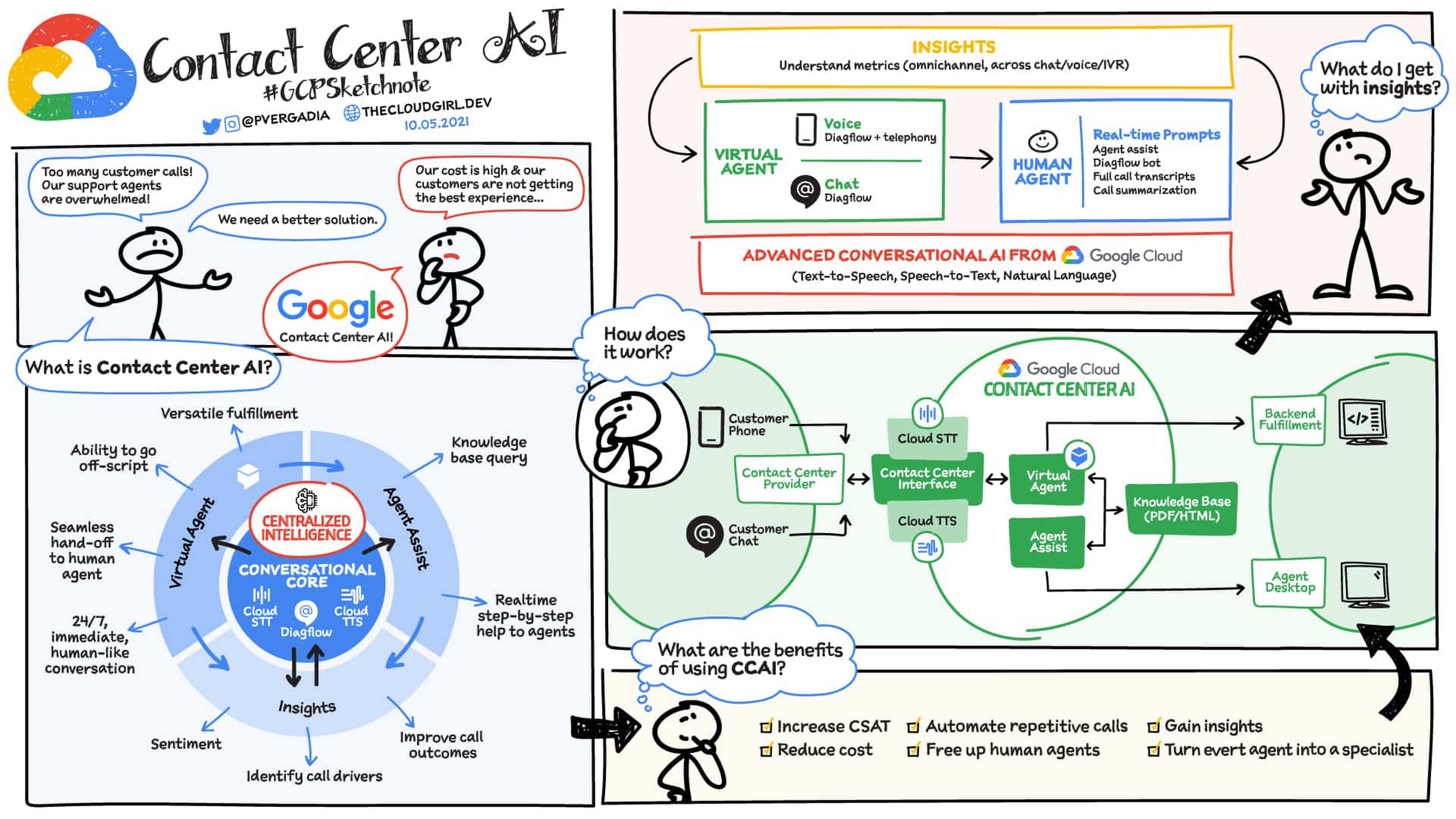
What is CCAI?
As the volume of customer calls increases, it’s becoming even more important to make the most of human agents’ time to lower costs and improve customer experiences. CCAI enables you to do just that: it frees human agents to concentrate on more complex calls by providing them with real-time information to better handle those calls.
Single source of intelligence: Contact Center AI provides a consistent, high-quality conversational experience across all channels and platforms, both human and virtual. Because the “brains” of CCAI are centralized in the cloud, you can apply consistent intelligence across every application in the customer journey.
Ability to go off-script: Huge cost savings can be realized by having a virtual agent handle voice calls. This is easier said than done, however, because conversations rarely are completely linear; instead, they meander from topic to topic, which is difficult to handle programmatically in a fixed-path Interactive Voice Response (IVR) system.
Contact Center AI has the ability to go “off script” — to let callers go down tangents or side paths to the main conversation, while still tracking towards the main objective of the call. With CCAI, your virtual agents can answer complex questions and complete complicated tasks, including allowing for unexpected stops and starts, unusual word choices, or implied meanings. Developers can define supplemental questions, and CCAI can easily retain the context, answer the supplemental question, and come back to the main flow.
Versatile fulfillment: CCAI has the ability to handle multiple use cases for the customer with the same virtual agent, which enables you to fully automate routine tasks and deflect calls. The same virtual agent can take a payment, update information like a phone number, give a customer information on their balance, and process information for other tasks, all within the same conversational flow.
How does CCAI work?
CCAI has three key components:
- Conversation Core: This is the central AI brain that underpins CCAI and its ability to understand, talk, and interact. It enables and orchestrates high-quality conversational experiences at scale making it possible for customers to have conversations with a virtual agent that are as good as conversations with a human agent.
- Understand – Speech-to-text speech recognition understands what customers are saying regardless of how they phrase things, what vocabulary they use, what accent they have, and so on.
- Talk – Text-to-speech enables virtual agents to respond to customers in a natural, human-like manner that pushes the conversation along, rather than frustrate them.
- Interact – Dialogflow identifies customer intent and determines the appropriate next step. You can build conversational flows in a point-and-click interface, and generate automated ML models for human-like conversational experiences.
- Virtual agents with Dialogflow: This component automates interactions with customers, using natural conversation to identify and address their issues. Virtual agents enable customers to get immediate help anytime, day or night. Agent Assist: This component brings AI to human agents to increase the quality of their work, while decreasing their average handling time. Agent Assist shares initial context and provides real-time, turn-by-turn guidance to coach agents through business processes, as well as full call transcriptions that agents can edit and file quickly.
- CCAI Insights: CCAI Insights aids your contact center management team in making better data driven decisions for their business by breaking down conversations using natural language processing and machine learning. Having this information allows your business to reduce manual analysis and focus on decision making like which conversations need your attention, where to deploy virtual agent automation to have the biggest impact and how to address your customer needs.
How does CCAI create experiences for agents and customers?
When a user initiates a chat or voice call and the contact center provider connects them with CCAI, a virtual agent engages with the user, understands their intent, and fulfills the request by connecting to the backend. If necessary, the call can be handed off to a human agent, who sees the transcript of the interaction with the virtual agent, gets feedback from the knowledge base to respond to queries in real time, and receives a summary of the call at the end. Insights help you understand what happened during the virtual agent and live agent sessions. The result is improved customer experiences and CSAT scores, lower agent handling times, and more time for human agents to spend on more complicated customer issues.
And there you have it: a quick overview of CCAI and its progress in 2021. For more details, check out the documentation or our CCAI solutions page.https://www.youtube.com/embed/6_Gilug2QYw?enablejsapi=1&
For more #GCPSketchnote, follow the GitHub repo. For similar cloud content follow me on Twitter @pvergadia and keep an eye out on thecloudgirl.dev.
5110
Of your peers have already watched this video.
1:47 Minutes
The most insightful time you'll spend today!
How adidas’s Marketing Team Benefits from Google Cloud Marketing Platform
We live in a world where the consumer journey is no longer linear, making it difficult to know when to deliver a brand message or a product message.
“We talk a lot about the consumer journey no longer being linear. It’s very difficult to know when the consumer is going to come in contact with your message. And because of that it makes it much harder to deliver the right message at the right time,” says Chris Murphy, Head of Digital Experience, adidas.
To solve the problem, adidas turned to the Google Cloud Marketing Platform to use audience insights to inform the art of storytelling and help teams, from brand marketing to retail to e-commerce, deliver relevant messages across channels.
“In a singular environment like Google Cloud Marketing Platform, when you’re able to see audience insights and information…we know when someone should be receiving a brand message versus a product message — when they’re thinking about buying or when they’re actually ready to purchase,” says Murphy.
It wasn’t easy at the start. “Being in brand marketing for so long, there was this initial pushback on data and the science behind it, because it was an art. But what we’re seeing now is the ability for data and insights to really inform the art of storytelling. It allows us to understand the impact that we’re having in real time,” says Kelly Olmstead, VP, Brand Activation for North America, adidas.
Today adidas’ marketing team depends more heavily on data and analysis to guide its strategy. “Starting every meeting with data and insights, that’s something that we want to take outside of just the marketing organization, and really infuse it across our culture here at adidas,” says Olmstead.
Watch how adidas benefits from using the Google Cloud Marketing Platform.
Empowering AI Startups: Google Cloud’s Game-Changing Benefits

1133
Of your peers have already read this article.
3:30 Minutes
The most insightful time you'll spend today!
New AI startup program benefits and Accelerator introduced at the Google Cloud Startup Summit
Google Cloud is committed to supporting the growth and advancement of startups, with particular focus on helping startups looking to build and scale. We’re seeing tremendous innovation from startups choosing Google Cloud to advance their generative AI development, thanks to our fully-managed and serverless data, AI, and infrastructure solutions. That’s why today’s Startup Summit, and announcements, are focused on AI.
Following our March 14th announcement that we were expanding the Google for Startups Cloud Program with exclusive benefits for AI startups, we’re excited to announce that the program is now live. Starting today, eligible seed to series A startups that use AI as their core technology to develop their primary products or solutions can apply here. This gives them access to all the Google for Startups Cloud Program benefits, including:
Up to $350,000 USD over two years in Google Cloud credits
For Google Cloud and Firebase usage covered in:
- Year 1: 100% up to $250,000 USD in Google Cloud credits [1] (includes standard program credits plus an additional $150,000 USD for the AI startup program)
- Year 2: 20% up to an additional $100,000 USD in Google Cloud credits
Technical & collaboration support
We’re providing credits to allow AI startups access to fast, high-quality Customer Care Enhanced Support, access to Google Cloud Startup Customer Engineers, and a dedicated Startup Success Manager to accelerate onboarding with Google Cloud. We’re also offering 12 months of free Google Workspace Business Plus for new sign-ups.
Additional AI benefits, such as access to AI experts, training, and resources include:
Webinars & live Q&A sessions
Exclusive access to join webinars and live Q&As with our Google Cloud AI product managers, engineers, and developers.
Insight into AI innovation
Direct visibility into Google Cloud’s latest AI advances and product roadmap.
Hands-on AI learning labs
Free access to advanced hands-on learning labs focused on AI/ML and the latest Google Cloud technology.
Exclusive AI ISV/Saas startup access to Built with Google Cloud AI
Access to the AI Center of Excellence, tools and training, co-marketing, and amplification on Google Cloud Marketplace. These resources have historically been available only to AI enterprise ISV/SaaS companies, but will now also be offered to ISV/SaaS startups in our program.
Dedicated AI technical guidance, workshops, and best practices
Architectural guidance and best practices to get started and build with Google Cloud AI solutions, including technical deep dives and hands-on workshops.
We’re also excited to announce an inaugural North American Google for Startups Accelerator: Cloud. This 10-week virtual Accelerator is equity-free and best suited for cloud-native startups leveraging AI and ML in their operations. Designed to help prepare for the next phase of the growth journey, participating startups will work with the best of Google’s programs, products, people, and technology. Applications are open now until May 30th and the program kicks off in July. Find out more here.
Our goal is to enable more AI-first startups and give them the technology, community, and resources they need to build and grow their startup faster, smarter, and cheaper. Furthermore, partnering with Google Cloud lets startups seamlessly integrate with other Google solutions and leverage our global infrastructure. Google Cloud’s AI platform, Vertex AI, gives startups the intelligence they need to make smart business decisions and allows them to easily build, deploy, and scale machine learning (ML) models faster. They can also quickly build with Google Cloud’s advanced generative AI technologies or use our best-in-class speech, vision, translation, and language APIs. To learn more about Google Cloud’s recently-announced Generative AI Support in Vertex AI, check out this deep dive, and to keep up with Google Cloud’s latest generative AI news and thought leadership, read The Prompt on Transform with Google Cloud.
Startups around the world are choosing Google Cloud. Join us and let’s build the future, together.
Cloud TPU v4: powerful and efficient ML infrastructure anywhere

2834
Of your peers have already read this article.
3:30 Minutes
The most insightful time you'll spend today!
Today, ML-driven innovation is fundamentally transforming computing, enabling entirely new classes of internet services. For example, recent state-of-the-art lage models such as PaLM and Chinchilla herald a coming paradigm shift where ML services will augment human creativity. All indications are that we are still in the early stages of what will be the next qualitative step function in computing. Realizing this transformation will require democratized and affordable access through cloud computing where the best of compute, networking, storage, and ML can be brought to bear seamlessly on ever larger-scale problem domains.
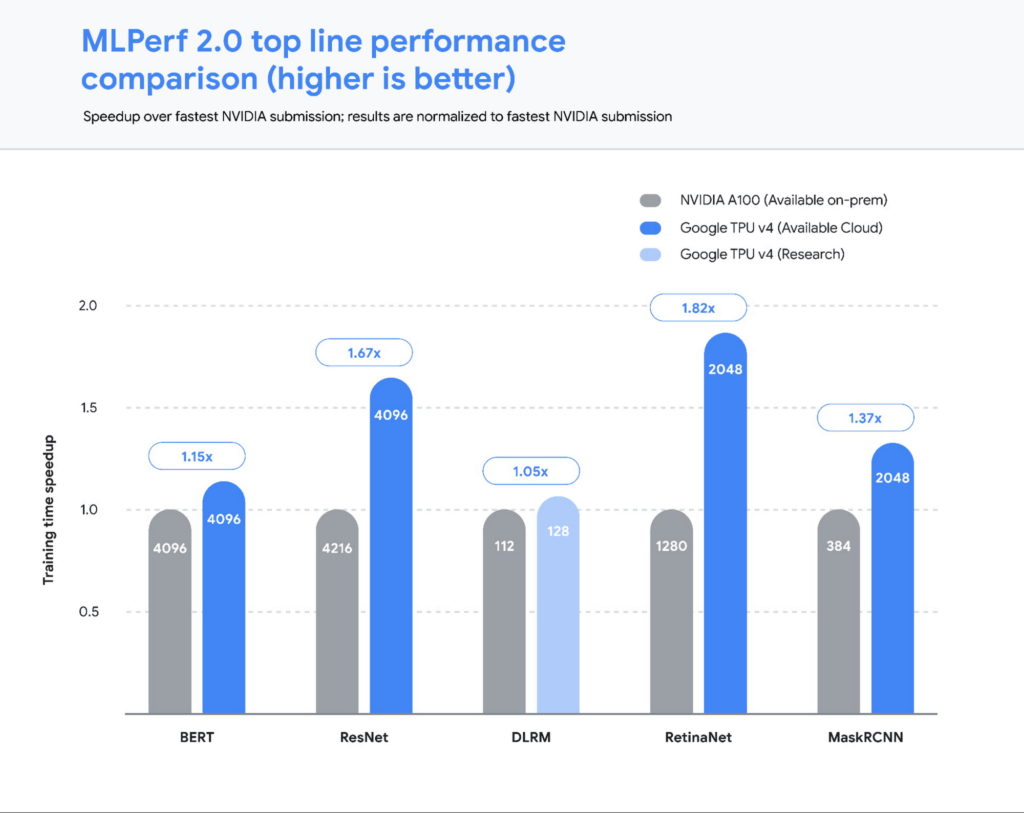
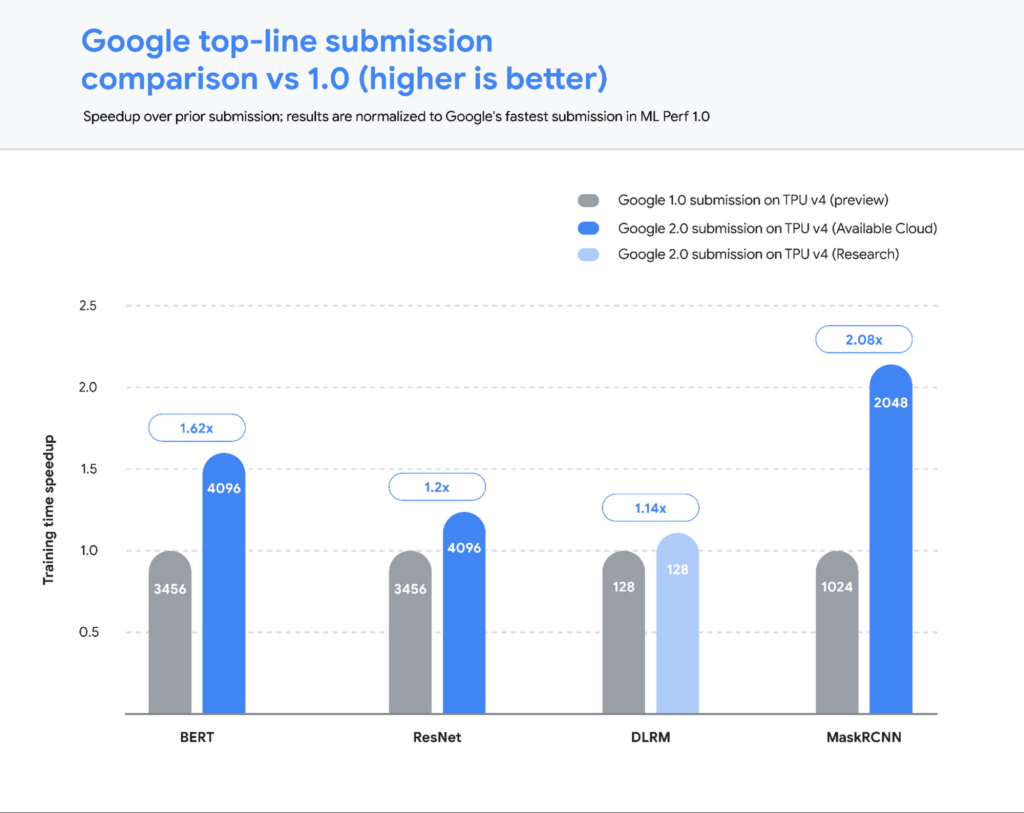
Today’s release of MLPerf™ 2.0 results from the MLCommons® Association highlights the public availability of the most powerful and efficient ML infrastructure anywhere. Google’s TPU v4 ML supercomputers set performance records on five benchmarks, with an average speedup of 1.42x over the next fastest non-Google submission, and 1.5x vs our MLPerf 1.0 submission. Even more compelling — four of these record runs were conducted on the publicly available Google Cloud ML hub that we announced at Google I/O. ML Hub runs out of our Oklahoma data center, which uses over 90% carbon-free energy.
Let’s take a closer look at the results.
Performance at scale…and in the public cloud
Our 2.0 submissions1, all running on TensorFlow, demonstrated leading performance across all five benchmarks. We scaled two of our submissions to run on full TPU v4 Pods. Each Cloud TPU v4 Pod consists of 4096 chips connected together via an ultra-fast interconnect network with an industry-leading 6 terabits per second (Tbps) of bandwidth per host, enabling rapid training for the largest models.
Hardware aside, these benchmark results were made possible in no small part by our work to improve the TPU software stack. Scalability and performance optimizations in the TPU compiler and runtime, including faster embedding lookups and improved model weight distribution across the TPU pod, enabled much of these improvements, and are now widely available to TPU users. For example, we made a number of performance improvements to the virtualization stack to fully utilize the compute power of both CPU hosts and TPU chips to achieve peak performance on image and recommendation models. These optimizations reflect lessons from Google’s cutting-edge internal ML use cases across Search, YouTube, and more. We are excited to bring the benefits of this work to all Google Cloud users as well.
Translating MLPerf wins to customer wins
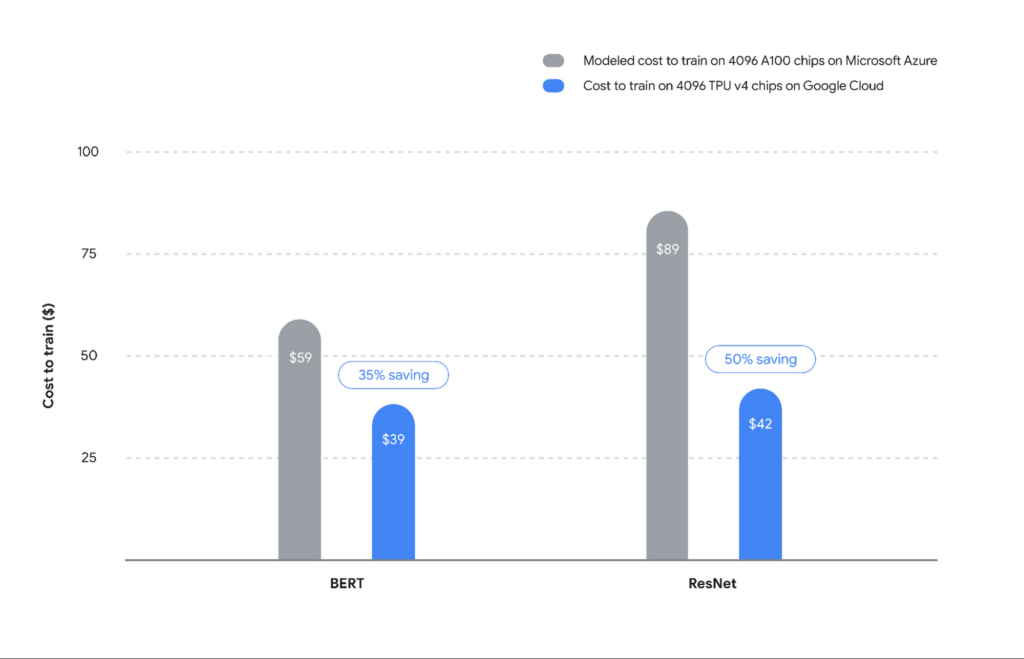
Cloud TPU’s industry-leading performance at scale also translates to cost savings for customers. Based on our analysis summarized in Figure 3, Cloud TPUs on Google Cloud provide ~35-50% savings vs A100 on Microsoft Azure (see Figure 3). We employed the following methodology to calculate this result:2
We compared the end-to-end times of the largest-scale MLPerf submissions, namely ResNet and BERT, from Google and NVIDIA. These submissions make use of a similar number of chips — upwards of 4000 TPU and GPU chips. Since performance does not scale linearly with chip count, we compared two submissions with roughly the same number of chips.
To simplify the 4216-chip A100 comparison for ResNet vs our 4096-chip TPU submission, we made an assumption in favor of GPUs that 4096 A100 chips would deliver the same performance as 4216 chips.
For pricing, we compared our publicly available Cloud TPU v4 on-demand prices ($3.22 per chip-hour) to Azure’s on-demand prices for A1003 ($4.1 per chip-hour). This once again favors the A100s since we assume zero virtualization overhead in moving from on-prem (NVIDIA’s results) to Azure Cloud.
The savings are especially meaningful given that real-world models such as GPT-3 and PaLM are much larger than the BERT and ResNet models used in the MLPerf benchmark: PaLM is a 540 billion parameter model, while the BERT model used in the MLPerf benchmark has only 340 million parameters — a 1000x difference in scale. Based on our experience, the benefits of TPUs will grow significantly with scale and make the case all the more compelling for training on Cloud TPU v4.
Have your cake and eat it too — a continued focus on sustainability
Performance at scale must take environmental concerns as a primary constraint and optimization target. The Cloud TPU v4 pods powering our MLPerf results run with 90% carbon-free energy and a Power Usage Efficiency of 1.10, meaning that less than 10% of the power delivered to the data center is lost through conversion, heat, or other sources of inefficiency. The TPU v4 chip delivers 3x the peak FLOPs per watt relative to the v3 generation. This combination of carbon-free energy and extraordinary power delivery and computation efficiency makes Cloud TPUs among the most efficient in the world.4
Making the switch to Cloud TPUs
There has never been a better time for customers to adopt Cloud TPUs. Significant performance and cost savings at scale as well as a deep-rooted focus on sustainability are why customers such as Cohere, LG AI Research, Innersight Labs, and Allen Institute have made the switch. If you are ready to begin using Cloud TPUs for your workloads, please fill out this form. We are excited to partner with ML practitioners around the world to further accelerate the incredible rate of ML breakthroughs and innovation with Google Cloud’s TPU offerings.
1. MLPerf™ v2.0 Training Closed. Retrieved from https://mlcommons.org/en/training-normal-20/ 29 June 2022, results 2.0-2010, 2.0-2012, 2.0-2098, 2.0-2099, 2.0-2103, 2.0-2106, 2.0-2107, 2.0-2120. The MLPerf name and logo are trademarks of MLCommons Association in the United States and other countries. All rights reserved. Unauthorized use is strictly prohibited. See www.mlcommons.org for more information.
2. MLPerf v1.0 and v2.0 Training Closed. Retrieved from https://mlcommons.org/en/training-normal-20/ 29 June 2022, results 1.0-1088, 1.0-1090, 1.0-1092, 2.0-2010, 2.0-2012, 2.0-2120.
3. ND96amsr A100 v4 Azure VMs, powered by eight 80 GB NVIDIA Ampere A100 GPUs (Azure’s flagship Deep Learning and Tightly Coupled HPC GPU offering with CentOS or Ubuntu Linux) is used for this benchmarking
4. Cost to train is not an official MLPerf metric and is not verified by MLCommons Association. Azure performance is a favorable estimate as described in the text, not an MLPerf result. Computations are based on results from MLPerf v2.0 Training Closed. Retrieved from https://mlcommons.org/en/training-normal-20/ 29 June 2022, results 2.0-2012, 2.0-2106, 2.0-2107.
How One Company Uses AI and Data Analysis to Boost Revenue

9438
Of your peers have already read this article.
4:30 Minutes
The most insightful time you'll spend today!
AI, deep learning, and image recognition is transforming the shopping experience. These technologies enable consumers to use product images or screenshots rather than text to search for similar products. This improves the customer experience and enables retailers with online and offline outlets to provide a genuine omnichannel experience.
The lack of complexity and the ease of use of BigQuery has enabled ViSenze to reduce its data infrastructure and management costs by 30%–50%, and scale up without incurring downtime.
—Renjie Yao, Data Platform Lead, ViSenze
Visual commerce provider ViSenze is helping some of the world’s leading retailers improve conversion rates through image-based search.
The business’s products also enable media companies to use the platform to turn images and videos into engagement opportunities—driving new and incremental revenues.
Created through NExT—a research center established by the National University of Singapore and Tsinghua University of China—ViSenze now operates in the United States, United Kingdom, India, China, and Singapore. The business is backed by Japan-based internet and ecommerce company Rakuten and cross-border investment specialist WI Harper Group.
Growth in SMB and Mobiles
Renjie Yao, Data Platform Lead at ViSenze, sees opportunities for growth in the small-to-medium business sector, where companies do not have the resources to build similar technologies, and with mobile device OEMs to integrate ViSenze natively on smartphones.
Phone owners can activate a “shopping lens” on camera and gallery apps to capture an image of a product. They then receive matching results from more than 800 partner merchants and retailers and can then click through to product pages on partner apps or mobile websites. Alternatively, they may use a photo to compare products sold on different sites or shop matching styles.
“Our research found Google Cloud provided a complete, integrated ecosystem rather than a disparate collection of tools and components, and so was ideal for our needs.”
—Renjie Yao, Data Platform Lead, ViSenze
The ViSenze API analyzes the contents of a selected or clicked image and sends the information back to the organization’s visual commerce platform. The platform feeds back similar results based on that information.
The ViSenze offering also extends to image analysis for the tagging of product attributes—such as a white turtleneck cardigan with full sleeves—to provide an improved search experience.
Data Vital to ViSenze
Capturing and analyzing large volumes of data is integral to ViSenze. “We have to understand how consumers interact with our customers’ ecommerce websites and apps,” says Yao. “For example, we need to know who has looked at a particular pair of jeans on a website and whether that visit led to a conversion. We can then tell that customer whether they need to make more stock available.”
ViSenze also relies on data to provide high-quality training for its image recognition models and its domain-specific models for online retail.
Protect Customer Data
Data is vital to ViSenze—but customer privacy is most important. “All the data we collect is transparent to our customers, meaning they can decide what they do not want us to collect. In addition, all personal data processing complies with privacy protection regulations in each region, such as the General Data Protection Regulation in Europe.”
A Quick Move to the Cloud
ViSenze started operations using servers, storage, networking, and associated systems in an on-premises data center operated by NExT.
However, to support rapid growth, the business decided to move its workloads to the cloud. ViSenze opted for a multi-cloud architecture, using in part a Google Cloud data infrastructure.
“Our research found Google Cloud provided a complete, integrated ecosystem rather than a disparate collection of tools and components, and so was ideal for our needs,” says Yao. “We could connect different components with the click of a mouse.” Further, the business found it could easily configure rules and pipelines to route data logs to relevant Google Cloud services.
The review found Google Cloud’s extensive managed services would also remove administration and maintenance tasks from ViSenze’s in-house technology team—freeing team members to focus on more valuable tasks.
In addition, Google Cloud provided the security features—including custom hardware running hardened operating systems and file systems and encryption of data at rest and in transit—needed to protect sensitive information. Finally, the location of Google Cloud regions in several countries would enable the business to meet regulatory and data sovereignty requirements.
A Three-Month Implementation
ViSenze opted to move to Google Cloud in mid-2017 and completed a three-month implementation using internal resources. “The process was very smooth and intuitive, and we had no problems building our entire data platform within Google Cloud,” says Yao.
The business now uses an architecture comprising Google Kubernetes Engine to manage and orchestrate Docker containers running in Google Cloud Platform; BigQuery to provide an analytics data warehouse, with Google Data Studio providing customizable visualization and reports; Stackdriver to monitor and manage virtual machine instances and services inside Google Cloud; Cloud SQL to manage its relational databases for real-time analytics; Compute Engine to provide compute resources; Cloud Storage to store files and objects; Cloud Pub/Sub to provide real-time messaging between applications; and Cloud Functions to build event-driven applications.
After collecting the request logs of users in virtual machine instances and Docker containers, ViSenze distributes them in three directions. “We export raw logs into Cloud Pub/Sub for indexing inside an Elasticsearch search engine, and to a BigQuery data warehouse for further analytics,” explains Yao. “We also use Cloud Functions-created applications to obtain the logs from Cloud Pub/Sub to perform some real-time calculations.”
“We are currently using Airflow workflow management on Compute Engine as our hosted ETL platform, but are likely to move to Cloud Composer in future.”
500 Million Records Per Day
With Google Cloud providing its data infrastructure, ViSenze is well positioned to meet internal and customer demands for more granular insights. The business is now processing 500 million records per day through BigQuery and saves up to one year’s aggregated data—excluding any personal data—in the data warehouse for analysis.
The nature of ViSenze’s business means most reports are generated for data processed on an hourly, daily, or monthly basis. “BigQuery is extremely stable and performance optimized, regardless of the volume of data it processes,” says Yao. “Across BigQuery and other Google Cloud Platform services, we’ve recorded 99.99% availability over the past year.”
The lack of complexity and the ease of use of BigQuery has enabled ViSenze to reduce its data infrastructure and management costs by 30%–50%, and scale up without incurring downtime.
“With BigQuery, we have saved the equivalent of two full-time engineers and now need only half of one person’s time to maintain our whole data platform,” says Yao.
“In addition, BigQuery integrates closely with Data Studio, enabling non-technical people in our product and business teams to create dynamic, detailed analysis dashboards. We now use Data Studio to create nearly 50 separate reports.”
The business has now grown to offer access to more than 1 billion users and a listing of more than 400 million purchasable products.
Next Steps
ViSenze is now researching the potential of the Cloud AutoML suite of machine learning products to improve the training of its models and run a fully managed NoSQL database through Cloud Datastore.
“A NoSQL database service is the only missing piece of our architecture for now, and using Cloud Datastore would enable us to focus almost exclusively on our business,” says Yao. “With Google Cloud Platform, we are ideally positioned to continue providing support to our business team and help them continue expanding into new markets.
“In addition, we can help retailers and consumers to unlock the potential of the web and apps to transform the purchasing experience.”
7453
Of your peers have already watched this video.
1:15 Minutes
The most insightful time you'll spend today!
An Indian Example of How to Really Up Your Customer Experience Game and Increase Conversion Rates With AI
How about selfie analysis of users to recommend them the right lipstick color?
That’s just one of the many ideas folks at Purplle.com came up with to improve the buying experience of Indian consumers.
And without the power of Google Cloud, it would probably have remained just that…an idea.
But today, thanks to Google Cloud, “Nothing seems impossible,” says Suyash Katyayani, CTO, Purplle.
Purplle.com is an online e-commerce company in India and one of the pioneers in creating a digitally-native beauty brands in India.
“The beauty industry is so data intensive that we needed to have a strong data strategy and we were looking out for solutions which would enable us to have a strong data pipeline and a strong data warehousing solution,” says Katyayani.
That’s when it turned to Google Cloud.
Additionally, Purplle.com, says Katyayani, does not have to worry about at what scale the company operates at because they have access to state-of-the-art infrastructure from Google Cloud available to them so that their developers can run experiments.
“The biggest plus point for us has been the agility that Google Cloud has added,” says Katyayani.
More Relevant Stories for Your Company



An Overview of Google’s Data Cloud
Data access, management and privacy has been at the center of priorities for enterprises that are aiming to be more agile, reliable and data-driven. Google Cloud's technology innovations spanning products like BigQuery, Spanner, Looker and VertexAI help organizations navigate the complexities related to siloed data in large volumes sprawled across

2022 Healthcare Trends: Healthcare Data, M&As, Better Patient Care, AI in Drug Development & Strategic Partnerships
The COVID-19 pandemic continues to push the healthcare and life sciences industry in entirely new ways. In record time, we’ve witnessed public health officials, vaccine developers, equipment manufacturers, and essential workers take life saving actions—regularly putting their own lives at risk—to respond to the exceptional challenges of our time. Yet

Mercari’s Big Leap: Supercharging Growth with Google Cloud’s BigQuery
When peer-to-peer marketplace Mercari came to the US in 2014, it had its work cut out for it. Surrounded by market giants like eBay, Craigslist, and Wish, Mercari needed to carve out an approach to compete for new users. Furthermore, Mercari wanted to build a network for buyers and sellers to return


Why it’s Easier Than Ever for Developers to Break Into Machine Learning and Data Science
This week we talk about machine learning, its best use cases, and how developers can break into machine learning and data science. Dale Markowitz, Google Developer Advocate, talks about natural language processing as well, explaining that it’s basically the intersection of machine learning and text processing. It can be used
