





DueDil Chooses Apigee to Leverage APIs for Customers’ Risk Monitoring with Better Insights

4836
Of your peers have already read this article.
1:30 Minutes
The most insightful time you'll spend today!
As their name reflects, DueDil provides due diligence services ranging from customer-specific risk evaluations and selections to customer onboarding and real-time risk monitoring for leading financial services, high-growth tech and insurance companies. Founded in 2009, the company helps more than 3,000 enterprise users from over 400 clients to not only understand with whom they’re doing business, but to do so with increased efficiency and in compliance with regulatory requirements.
Due diligence services have evolved in recent years, both because of new regulations and new technologies supplanting legacy systems and processes, many of which relied until recently on pen-and-paper workflows or exhaustive spreadsheet work. DueDil knew this technology transformation represented an opportunity to replace manual processes with automation–but it also recognized a second opportunity: to not merely process data but also activate it by connecting information in disparate IT systems and generating data-driven insights delivered at scale.
To capitalize on this opportunity, the company built its Business Information Graph, or B.I.G., a platform that maps approximately 300 million connections among companies. B.I.G. ingests billions of data points, and is refreshed multiple times per day, to surface unique insights about business’s relationships, such as fraud risks. The results that B.I.G. drives often speak for themselves: some DueDil customers onboard partners up to 80% faster, perform risk verification up to 18 times faster, and reduce time spent on manual portfolio checks by up to 80%.
What powers all of this transformation? Application Programming Interfaces (APIs).
“From a go-to-market standpoint, our product is an API,” said Denis Dorval, DueDil COO, in a recent webcast, explaining that customers can directly tap B.I.G.’s resources for themselves, and build atop them for their own needs, via DueDil’s API.
Choosing an API management platform to deliver fast, secure, and scalable APIs
To execute on their vision of connecting B2B ecosystems for better insights and efficiency, DueDil looked for a cloud provider that could fulfill several specific criteria. They needed robust management for the APIs with which their internal developers leverage different systems for new use cases and process automations, as well as for the productized API they offer to customers. They needed sophisticated analytics and abundant processing power to crunch through billions of data points. And, they needed enterprise-grade security, scalability, and agility to underpin it all. Last but not least, the company prioritized a smooth transition; DueDil did not want the user experience to suffer as it switched providers.
“The stability of Google Cloud’s Apigee API management platform and the strength of its services stood out”, said DueDil’s Engineering Manager, Robert Cicero.
“Apigee is a resilient and agile platform, fulfilling our need to build APIs quickly, safely, and at scale,” he remarked, noting that he appreciated that many of Apigee’s API security defense tools and policies work out-of-the-box. For instance, Apigee’s JSON threat detection policies, custom policies, and authentication and authorization processes can be deployed instantly and add minimal latency, meaning DueDil can stop security threats before they enter its network while still avoiding the risk of service lags.
Today, DueDil has five internal services that facilitate business due diligence, all exposed via Apigee. They also use Apigee’s monetization feature to drive API consumption. This said, because DueDil’s go-to-market strategy is fast-paced and client-oriented, they most often use Apigee to rapidly prototype APIs for their clients, so they can understand what a specific API would look like and how it would behave. This allows DueDil, its partners, and its customers to spend more time delivering value from insights rather than getting bogged down in building backend systems.
Moreover, Apigee made it simpler to also connect to other Google Cloud services, such as BigQuery, Google Data Studio, and Google Cloud Storage. Apigee acts as a central nervous system among systems, giving DueDil not only the ability to connect systems and automate processes but also insight and visibility into how its B.I.G. services are being used by partners and customers.
Plus, added Cicero, “the migration to Apigee was seamless, with arguably our biggest win being that no one knew that we had switched API management providers to Apigee.”
Leveraging APIs to provide self-service while enforcing security and governance policies
Moving forward, DueDil plans to leverage Apigee to give staff members and clients more privileges, visibility, and opportunity to create and edit apps in a self-service manner, without needing to rely on an IT department or endure long approvals processes. Harnessing APIs to open up B.I.G. and other capabilities to more teams across the company will also allow DueDil to move faster and include more people in the innovation process. Leveraging Apigee API management capabilities, DueDil also intends to dive deeper and experiment with other Google Cloud products and services, including Cloud Function, Cloud Pub/Sub, and more.
“At the end of the day, every company goes about due diligence a little differently. The only way that we at DueDil are able to provide something that is configurable and dynamic to diverse businesses is if we use platforms that can adapt, too,” said Cicero. “Apigee gives us the agility required to create and deliver for a wide variety of businesses.”
Google Cloud, today, works across banking, capitalmarkets, insurance, and payments worldwide to solve their most challenging problems. Click here to learn more about how Google Cloud Apigee API management can help you design, secure, analyze, and scale APIs anywhere with visibility and control. To try Apigee API management for free, click here.
Google Products Helps HMH’s Healthcare Staff Work from Anywhere Efficiently and Securely!

10214
Of your peers have already read this article.
3:00 Minutes
The most insightful time you'll spend today!
Hackensack Meridian Health (HMH) executive Mark Eimer explains how an ambitiously-timed rollout of a comprehensive suite of Google products helped the entire organization—from doctors to IT staff—achieve better security, cultivate a more equitable work environment, and ultimately, improve patient outcomes.
How does a recently merged, 17-hospital healthcare system fast-track a platform migration and hardware rollout securely and in a way that improves work for everyone, regardless of location or role? These are the questions that kept me up at night in early 2020, when the pandemic demanded a “big bang”—something our legacy laptops and operating systems couldn’t handle.
We began our work with Google in 2020 with the adoption of Chrome as our default browser. As we migrated platforms, keeping patient data safe was of the utmost importance to us, along with providing every staff member with the tools they needed to work virtually. Our staff often experienced issues accessing our web-based applications using Internet Explorer or Edge Browser, a problem that went away when we switched to Chrome. Chrome’s versatile compatibility also made it easier for my team to migrate all of our web-based operations, and Chrome’s security and manageability were key components to making this switch a huge win for the organization.
The success of this migration led us to extend our Google partnership to patient care applications—where Google’s expertise in AI and ML helps scale the use of diagnostics tools and improve other aspects of the patient journey.

Achieving security at every step
Like so many other healthcare organizations, we’ve been concerned about ransomware attacks. This is part of why we moved to Google Workspace and distributed over 3,000 Chrome OS devices in kiosk mode in March of 2020, when many of us went remote due to the pandemic. We were very concerned about team members accessing corporate applications through home devices that were running EOL operating systems (WIN7), as well as a general lack of antivirus and encryption measures.
We were protected by the fact that Google’s software and hardware both had built-in security features that we needed to stave off sophisticated attackers. For example, Chrome OS automatically updates to the latest security update and encrypts data living outside the cloud on the hardware. These features protected us from security-related disruptions, letting us securely move a huge library of file shares and emails across thousands of accounts to Google Chrome OS in just four months.
A year later, in March 2021, we migrated the enterprise over to Google Workspace and saw an immediate reduction in spam by 30% from the inherent built-in AI/ML. This meant staff were less likely to receive (and click through) phishing attempts. My team could connect, create, and collaborate easily and securely—even as more of us were working from home and needed to access sensitive data remotely.
Leveling the playing field
As an organization, we were surprised by how many team members didn’t have personal computers at home. We quickly decided that if we needed team members to work from home, the health network would have to supply hardware. Chromebooks’ lower price tag compared to PCs—on top of their built-in security controls—allowed us to purchase, deploy, and support that initial distribution of 3,000 Chromebooks to team members in less than three weeks, providing devices to every eligible remote employee instead of just a select few. This was vital to reaching our equitable technology goal as part of our diversity and inclusion initiative: everybody has the same tools to do good work.
When all employees have what they need to do their jobs well, we get better patient outcomes. Before we began this cloud adoption journey, patient and staff experiences were different within the hospitals and outside of them.
Now it’s the same wherever our staff is, and we’ve seen efficiency and accessibility benefits extend to the patient side. For example, we built a web-based contact center that supports 80 locations that use Workspace and Chrome OS devices. Since customer service, admin, and providers are all on the same system, it has become a one-stop shop for patients.
Furthermore, through the Grow with Google program, we were able to provide another benefit to employees that drove our equity goals. Google trained 50 non-IT staff members—from environmental services, food and nutrition, and other non-tech areas who were interested in making a career change to IT—on the Google products we were using. They may not have thought about switching to a career in IT before the Grow with Google program came to our organization, but through this partnership, they now have that opportunity.
A strategic, long-term partner
With any large-scale rollout, the work doesn’t end once laptops are in employee hands. Google has shown their commitment to long-term collaboration as they continuously optimize their products for the unique needs of healthcare providers and go the extra mile in tailoring tools to our staff’s workflows.
For example, on the Chrome OS side, the Google team has helped our registration desks and document centers with device integration for hardware like credit card readers and e-signature pads. They’ve also helped us meet security and privacy requirements mandated by state and federal governments around HIPAA, Medicaid, and Medicare reimbursements. Over this next year, we’ll look at a feature roadmap with Google Cloud to deliver further enhancements, iterating on the product itself to meet our needs for the present and the future.

Delivering the future of healthcare
The benefits we’ve seen around security and usability—and the ability to provide all staff with equal access to Google’s technology—are why we’re expanding our partnership with Google to both the administrative and clinical sides of HMH. In addition to further Google rollouts with corporate, next year we’re distributing Chromebooks to all 350 of our ambulatory clinics.
We’re also working with the Google professional services team to create a custom AI model that analyzes 3D mammogram images. This AI model will enable two providers to read mammograms—which adheres to international best practices but is currently rare in the US—without requiring additional time. Conducting double readings of mammograms will yield better health outcomes for our patients, such as a lower patient recall rate and an increased accuracy in detecting breast cancer.
We’re currently building the model using a variety of Google Cloud products, including Cloud Healthcare API. Once complete, this model is expected to be trained, deployed, and maintained in Google’s Vertex AI, allowing our providers to be more productive as they make clinical decisions with AI support. As the model is proven over time, we plan to make the predictive services accessible to other healthcare organizations.
With Google, we’re able to achieve a unified architecture for storing data as well as training and deploying AI models, which enable our staff to work more efficiently and securely from anywhere. While I may not be able to predict the future as accurately as AI can, I foresee our continued partnership with Google as a key part of HMH’s improved provider and patient outcomes.
Majority of Consumer Goods Shoppers in the U.S. will Not Compromise on Brand Principles: Google Commissioned Research

3088
Of your peers have already read this article.
1:30 Minutes
The most insightful time you'll spend today!
Editor’s note: This article first appeared in Consumer Goods Technology Magazine
Shifting work habits, more online shopping options, rising inflation, and stretched supply chains are just a few factors making it harder to discern what’s top-of-mind for shoppers today.
But we’re starting to get a clearer picture of what consumers say they value most right now. New Harris Poll research commissioned by Google Cloud reveals how U.S. shoppers are thinking about consumer goods brands in new ways—from apparel, electronics, and beauty products, to food and beverage.
While price unsurprisingly continues to be a major consideration in purchases, the average shopper is increasingly paying close attention to the values of consumer goods brands and how eco-friendly their products and practices are.
Shoppers want to buy from brands aligned with their values
COVID-19 drove people to reflect on their priorities, elevating concepts like community service, equity, and sustainability. A decade ago, most consumer goods companies would not have made these front-and-center, operational priorities. But today’s consumer not only wants savings and convenience, they also want that good feeling that comes from spending their money with a company that aligns with their values.
Our new research reveals that 82% of shoppers prefer a consumer brand’s values to align with their own, and they’ll vote with their wallet if they don’t feel a match. Three-quarters of shoppers reported parting ways with a brand over a conflict in values.
Even with their favorite consumer goods products, a majority of shoppers will not compromise on principles. If there’s a value mismatch, 39% of shoppers said they’d permanently boycott their favorite brand, and 24% would break ties at least temporarily. Most won’t be quiet about their concerns either: 28% of consumers that found their values at odds with a brand said they have shared their concerns with friends and family, and another 15% have shared their qualms on social media.
Consumer goods companies need to prioritize sustainability
A majority of today’s consumers (52%) are especially interested in supporting sustainable brands. They want to know how companies are managing their resources, specifically whether they are sourcing responsibly. These shoppers want to see meaningful, measurable efforts from CPG firms to save energy and reduce waste, like how Nuuly, URBN’s digital rental and resale business, has woven sustainability into its business operations, from its distribution centers to reusable packaging.
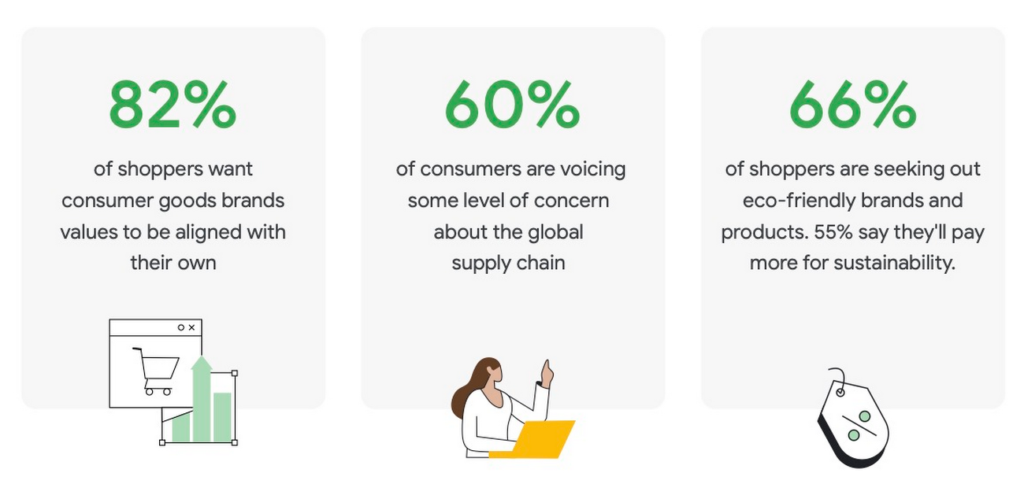
In fact, 66% of shoppers are now seeking out eco-friendly brands, with 55% saying they would pay more for more sustainable products. But these same shoppers are skeptical too: 72% think that companies and brands overstate their sustainability efforts. And they’re right to question brands’ practical application of their values. According to another Harris Poll survey recently commissioned by Google Cloud, 58% of executives polled across 16 countries admit that their organization has overstated its sustainability efforts.
Product availability is table stakes
A final point from the research: The global supply chain has stretched past its limits, and 60% of consumers are voicing some level of concern about it. At the end of the day, if a preferred brand isn’t actually on the shelves of a real or digital store, it doesn’t matter what the brand’s values or sustainability efforts are. A staggering 98% said they’d either buy from a different brand or search other stores or websites.
What’s a brand to do?
After more than 25 years working in the consumer goods industry in roles ranging from marketing and product development to business strategy and technology, at companies like Johnson & Johnson, Kimberly Clark, Carter’s, and now Google Cloud, I’ve seen successful brands do four things well when it comes to their values:
- Don’t be generic.
Your brand’s values need to be authentic, and they need to have teeth. But being too bold could run the risk of alienating some consumer segments. This is where technology can help. Personalizing your messages and outreach to specific shopper profiles is one way to ensure that your core values reach the right customers at the right time. - Make your values clear and consistent.
When focusing on which values to highlight with your consumers and the world, make sure they make sense for your brand and that you’ll stick to them over time. For example, it’s painfully obvious when a brand is being opportunistic and inserting itself into conversations around values like sustainability or social justice, when it doesn’t have a history of voicing those values. The key to clear and consistent messaging of values is balancing authenticity with relatability and the appropriate amount of promotion. - Develop sustainability practices and communicate their impact to everyday people.
How everyday people perceive a consumer goods brand’s sustainability initiatives is different from how an investor or general business audience does. Shoppers don’t read business sustainability plans or impact reports. To increase awareness of your brand’s sustainability efforts, consumers need to identify and interact with your brand and products directly. Some of my favorite examples are how I love that Google Maps gives me the choice of eco-friendly driving directions, and that I know I can buy low-waste, packaging-free cosmetics from a company like Lush. - Reward customer loyalty.
Shoppers have more choices than ever before, and supply chain woes are testing preferences even further. But when someone chooses a specific brand because they feel aligned with their values or like their eco-friendly products, that shopper doesn’t always get recognized or thanked. Implementing a rewards program or following-up with customers after their purchases is one way you can make loyal shoppers feel appreciated while creating a lasting relationship that extends as long as possible.
Cloud FinOps: Maximizing Business Value and Optimizing Cloud Spend

1184
Of your peers have already read this article.
6:30 Minutes
The most insightful time you'll spend today!
We’ve been saying it for years, the benefits and potential of the cloud abound.
And yet, more than 80% of respondents in a survey of 753 business leaders point to managing cloud spend as their top organizational challenge, and these same respondents estimate that nearly 1/3 of their cloud spend is inefficient or wasted (Flexera, 2023). Many organizations are new to optimizing cloud costs and ensuring resources are used efficiently.
As your organization digitally transforms you may be realizing what other organizations are realizing too: When it comes to business value, simply migrating to the cloud isn’t enough. Achieving the full benefits of cloud requires fundamental changes to both mindset and behaviors around existing financial-management practices. It requires changing the way your disparate teams work together.
Enter the Cloud FinOps Building Blocks
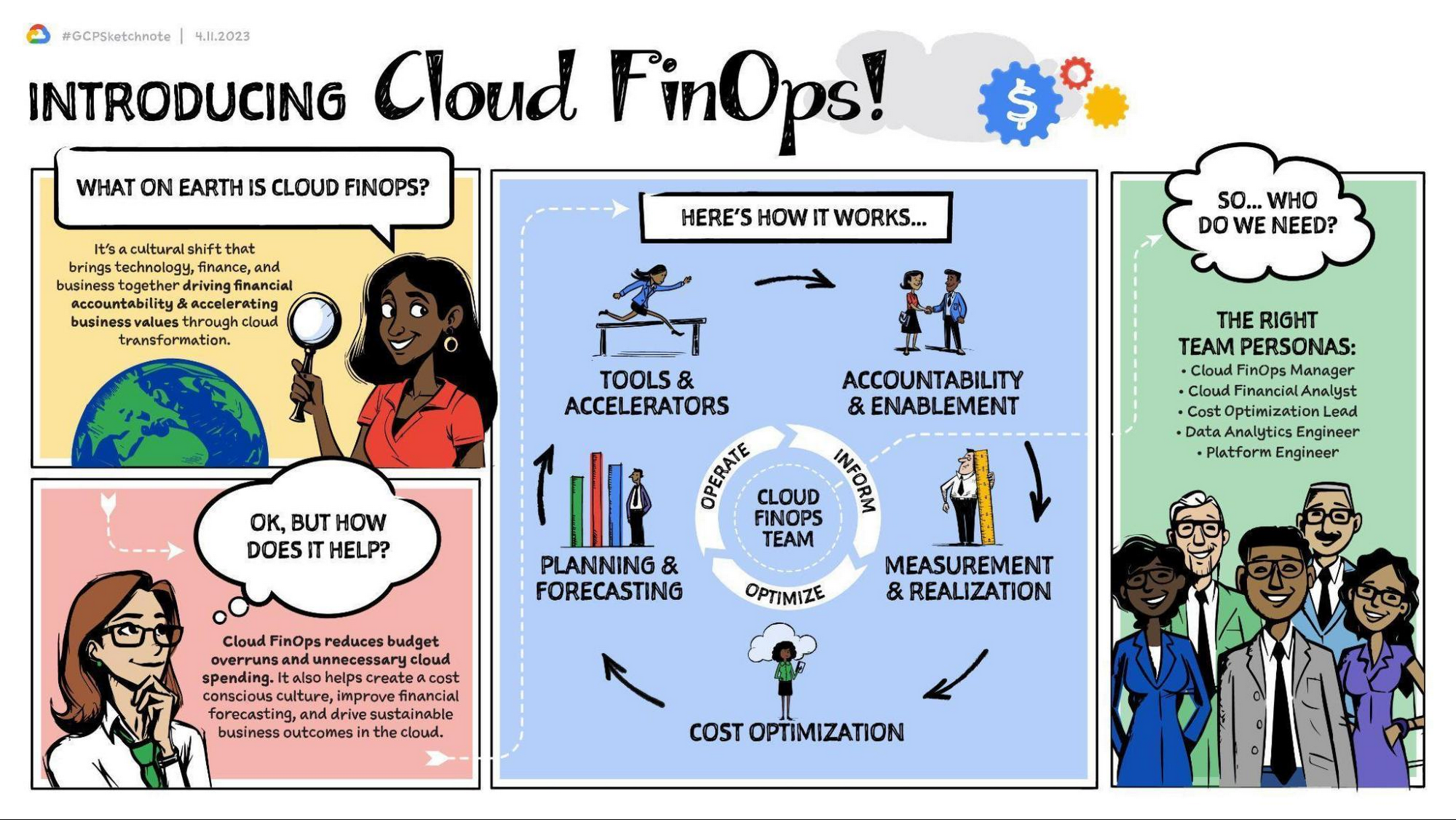
Cloud FinOps is a framework, discipline, and cultural shift combining people, processes, and technology to drive financial awareness and accountability. FinOps practices align engineering, finance, technology and business leaders and teams under a primary objective: to maximize business value from the cloud. With Cloud FinOps practices, every business stakeholder is charged not only to take responsibility for their spending and costs, but also to optimize them. These practices enable businesses to manage consumption and make sound, data-informed cloud-spend decisions. Cloud FinOps is comprised of five building blocks:
- Accountability and enablement
Establishing governance and policies to manage cloud spend and realize business value. - Measurement and realization
Driving financial accountability and value realization with a defined set of KPIs and success metrics. - Cost optimization
Providing financial visibility and recommendations of IT resource usage to optimize cloud spend. - Planning and forecasting
Modernizing budgeting, forecasting, and chargeback methods to allow for iterative, innovative and cost effective development practices. - Tools and accelerators
Deploying and integrating a set of cloud cost tooling to effectively manage and track cloud spend. Learn more here.
For a general overview of the Cloud FinOps framework and more on the five building blocks, check out these resources:
- Video | What is FinOps and 3 reasons why you should care about it.
This 5-minute video provides an overview of FinOps, the 5 building blocks, and how they can benefit your organization. - Podcast | FinOps with Joe Daly
In this podcast, Joe Daly of the FinOps Foundation shares about the key principles of FinOps, which he refers to as financial DevOps. Daly discusses how this framework is helping companies make better and more efficient financial decisions while taking advantage of the cloud. - Blog | Decoding Cloud FinOps to accelerate digital transformation
This blogpost discusses the critical role of FinOps in a successful digital transformation. It outlines key metrics to help measure and track business value and to increase visibility into the effects of digital transformation on top-line revenue. - Article | Cloud FinOps: The secret to unlocking the economic potential of public cloud
This Forbes article profiles OpenX, the first major advertising exchange platform to migrate entirely to the cloud. It details the 5 key pillars of the Cloud FinOps framework, which OpenX leveraged in their digital transformation strategy. In just 9 months, they reduced their per-unit costs by more than 60%.
Importantly, Cloud FinOps isn’t about saving money; it’s about making money. It’s about promoting a cost-conscious culture, financial accountability, and business agility in the cloud. Whatever stage of the cloud journey you’re at, cloud FinOps practices will help you get the most value out of Google Cloud. This framework can help to remove blockers, implement the building blocks, and empower your teams to make better business decisions.
The Cloud FinOps Journey
Implementing Cloud FinOps is neither a destination nor a box your organization will check then archive. Rather, Cloud FinOps is an ongoing journey and discipline. It’s inherently iterative. As such, growth and maturity across processes, capabilities, and domains requires action, repetition, and continuous learning.
Across the five FinOps building blocks, we’ve identified 50 subprocesses to best understand organizations’ FinOps proficiency, capabilities, practice domains, and blind spots. We scale them from 1 to 5 and categorize them in one of three phases of maturity: Crawl, Walk, or Run. Organizations in the Crawl phase tend to focus on technical problem solving and cloud-cost visibility. Organizations in the Walk phase emphasize strategic improvements such as employing cost visibility dashboards to realize better business value. And organizations in the Run phase are focused primarily on transformational change and strategic innovation, factoring cost considerations into both processes and cloud architecture.
Through this “crawl, walk, run” maturity model, we can evaluate proficiency, establish a benchmark, and recommend a targeted action plan for FinOps adoption. And whatever your level of maturity, your organization can take quick scalable action not only to foster improvement but also to evaluate outcomes and gain insights.
The key here is that regardless of your organization’s Cloud FinOps maturity level, you can take small steps now toward continuous improvement. Here are some common focus areas and several more resources organized by maturity level that you can access.
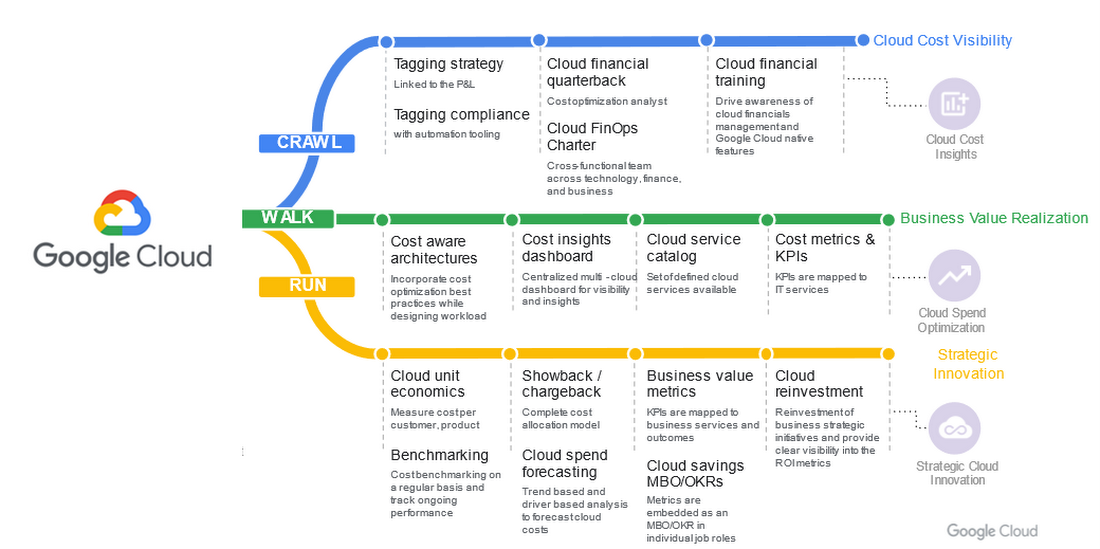
Crawl phase
Improve cloud-cost visibility.
- Whitepaper | Drive Cloud FinOps at scale with Google Cloud Tagging
Tags and labels can be useful and flexible tools to help your organization segment cloud spend and allocate costs. This whitepaper introduces Google Cloud Tags and best practices for implementing them. It differentiates tags, which offer reliable reporting and governance features, from labels, which can be prone to problems, including poor coverage and a lack of integrity in data labeling. - Whitepaper | Unlocking the value of Cloud FinOps with a new operating model
This white paper unpacks the details of the FinOps operating model, including roles, organizational alignment, and driving culture change. It details how to establish strong financial governance and a cost-conscious culture. - Whitepaper | Cloud FinOps: Shared services cost allocation
In this whitepaper, you’ll explore the elements of cost allocation as well as the complexities and challenges associated with shared-services cost allocation. While some of these concepts and models are interchangeable between legacy and cloud environments, this whitepaper focuses primarily on cloud computing and associated services.
Walk phase
Improve business-value realization.
- Blog | 5 key metrics to measure Cloud FinOps impact in your organization in 2022 and beyond
To drive business growth and topline revenue, business leaders must be able to connect cloud investments to business outcomes. As such, traditional IT metrics and KPIs must continue to evolve. In this blogpost, we’ll explore five key business-value metrics aligned to the five Cloud FinOps building blocks. - Whitepaper | Maximize business value with Cloud FinOps
The cloud introduces new complexity and challenges to traditional IT financial management. As such, it requires strategic financial governance, processes, and partnership across the organization. This whitepaper explains how Cloud FinOps helps enterprises that have invested in cloud to drive financial accountability and accelerate business value.
Run phase
Improve strategic cloud innovation.
- Whitepaper | Unit costing: The next frontier in cloud
In this whitepaper, you’ll explore the nature of and need for cloud unit costing, the standard by which FinOps practitioners obtain full business context for their cloud costs. It features examples from cloud-first organizations that have pioneered FinOps practices. Additionally, it examines several cloud forecasting and budgeting methods, ranging from least to most rigorous. - Blog | You get what you pay for: Principles for designing a chargeback process
Chargeback, a crucial Cloud FinOps capability, is the process of mapping cloud consumption to internal users within an organization. It provides transparency, facilitates accountability, enables recovery of cloud costs, and fosters a culture of fiscal responsibility. This blogpost will walk you through some best practices in designing an effective chargeback process in Google Cloud.
Success with Cloud FinOps
As global markets continue to face challenges, there’s never been a better time to increase the return on your cloud investments. Adopting and implementing FinOps practices will help. For some real-world examples of how organizations across a range of FinOps maturity levels have collectively saved millions of dollars on their overall cloud spend, check out these customers’ stories.
- Video | Next 2022: Top 10 ways to lower your costs on Google Cloud with General Mills
In this video, which highlights ten leading cloud cost optimization practices, hear how General Mills, which is on pace to increase their cloud footprint by 60%, has approached the discipline of cost savings and accelerated their adoption of Cloud FinOps to drive waste out of their cloud usage. - Video | How Nuro optimized their costs on Google Cloud
In this video, you’ll get an overview of the Google Cloud FinOps framework, a deep dive on cost-optimization best practices, and hear about how startup Nuro AI has adopted their own cost-savings discipline and Cloud FinOps practice. - Video | How OpenX reduce per unit costs by 60%
In this video, you’ll learn how to establish a cost center of excellence within your cloud practice, explore several cost-optimization recommendations, and hear from OpenX about how they reduced their costs on Google Cloud. - Case Study | How Sky saved millions with Google Cloud
In this case study, read how a few years into their cloud adoption journey, media and entertainment company, Sky Group discovered over $1.5 million in savings and optimized costs with BigQuery, Compute Engine, and Cloud Storage. - Case Study | Etsy: Doing more with less cost and infrastructure
In this case study, read how after migrating their data center and ecommerce platform to the cloud, Etsy realized more than 50% savings in compute energy and leveraged committed use discounts (CUDs) to reduce their compute costs by 42%.
It’s important to remember that FinOps success looks different for different organizations. It’s neither a one-time fix nor a destination reached by way of a single path. But for every organization, success requires small actions, refinement, and continuous improvement. As you leverage Google Cloud FinOps resources and tools, your organization can:
- Drive financial accountability and visibility.
- Optimize cloud usage and cost efficiency.
- Enable cross organizational trust and collaboration.
- Prevent cloud-spend sprawl.
- Break down departmental silos.
- Accelerate innovation.
Getting started with Cloud FinOps
At Google, we have a team of experts in leading FinOps practices dedicated to helping you create an actionable plan to optimize cloud spend and drive cost efficiency. We’ve created numerous resources to help you get started from any stage in the FinOps journey.
Whitepaper | Maximize Business Value with Cloud FinOps
This whitepaper outlines steps to help your organization implement FinOps. It details required teams and processes as well as the optimal behaviors, approaches, and outcomes to help maximize your investment on Google Cloud.
With Google Cloud FinOps, your organization can also accelerate business value in the cloud. To find out more, join us on the Google Cloud Twitter channel twice a month for open Twitter Spaces discussions or reach out to your Google Cloud Sales Representative for a 1:1 discussion.
Why Now Moving to Cloud is Great for Media and Broadcasting Companies

3251
Of your peers have already read this article.
1:30 Minutes
The most insightful time you'll spend today!
The broadcasting industry has gone through many evolutions since its inception. From linear over-the-air (OTA) to digital & personalized, to standard to ultra high definition, these evolutions were driven by increased demand from viewers who want more choices. The next evolution is happening now, driven by the emergence in cloud computing in a globally connected world. Broadcasters are understanding that the key for long-term success is embracing technical agility while they innovate their business models. Google Cloud technologies can provide a path for continual transformation, empowering broadcasters a multitude of ways to chart their own growth.
As broadcasters evolve their business models and operations for a digital future, evaluating both financial alongside operational benefits will lead to the best outcome. Legacy and siloed media supply chains restrict the ability to deliver content quickly across multiple consumption platforms. By understanding how cloud capabilities can provide cost savings, allow for more efficiency and scale, and open new revenue streams, broadcasters can harness flexible cloud technologies while achieving cost savings and increasing revenue.
Media workflows in the cloud
Over the last few years we have seen tremendous growth from media companies migrating their supply chains to the cloud. Today, there exists a whole ecosystem of media technologies that are built to take advantage of the cloud. “Does it work on the cloud?” is no longer driving the conversation. Rather, media companies now want to understand how Cloud can integrate with their business and drive better business outcomes.
Over the last years we have partnered with leading media companies including Grupo Globo, TelevisaUnivision and others to not only migrate their content supply chain to the cloud, but also leverage cloud capabilities to innovate their services to:
- Increase and streamline content production
- Distribute personalized content at planet scale
- Forge deep relationships with their audiences
- Identify new monetization opportunities
Impact of Cloud on Performance & Financials
M&E companies need to be able to provide more content at a quicker pace, with experiences that are seamless and exciting to viewers to retain their attention and dollars. Moving legacy systems and processes to the cloud is an organization-wide commitment, and the journey can pay off financially, while providing M&E companies valuable industry capabilities. With Google Cloud business value engagement framework, we partner to identify where there are opportunities in cost, output, and impact that IT can have.
Below are some examples of how we have worked with our customers to map organization optimizations to business drivers

Working Together – How can Google help
Our focus with customers is to help identify and understand the challenges that Media & Entertainment companies have in moving to the cloud, and coming up with the plan and solutions that Google can do to overcome them. Together we commit to understanding your business, both where you are right now in your IT capabilities as well as the progress you want to make to continue providing the best digital capabilities to clients and employees.
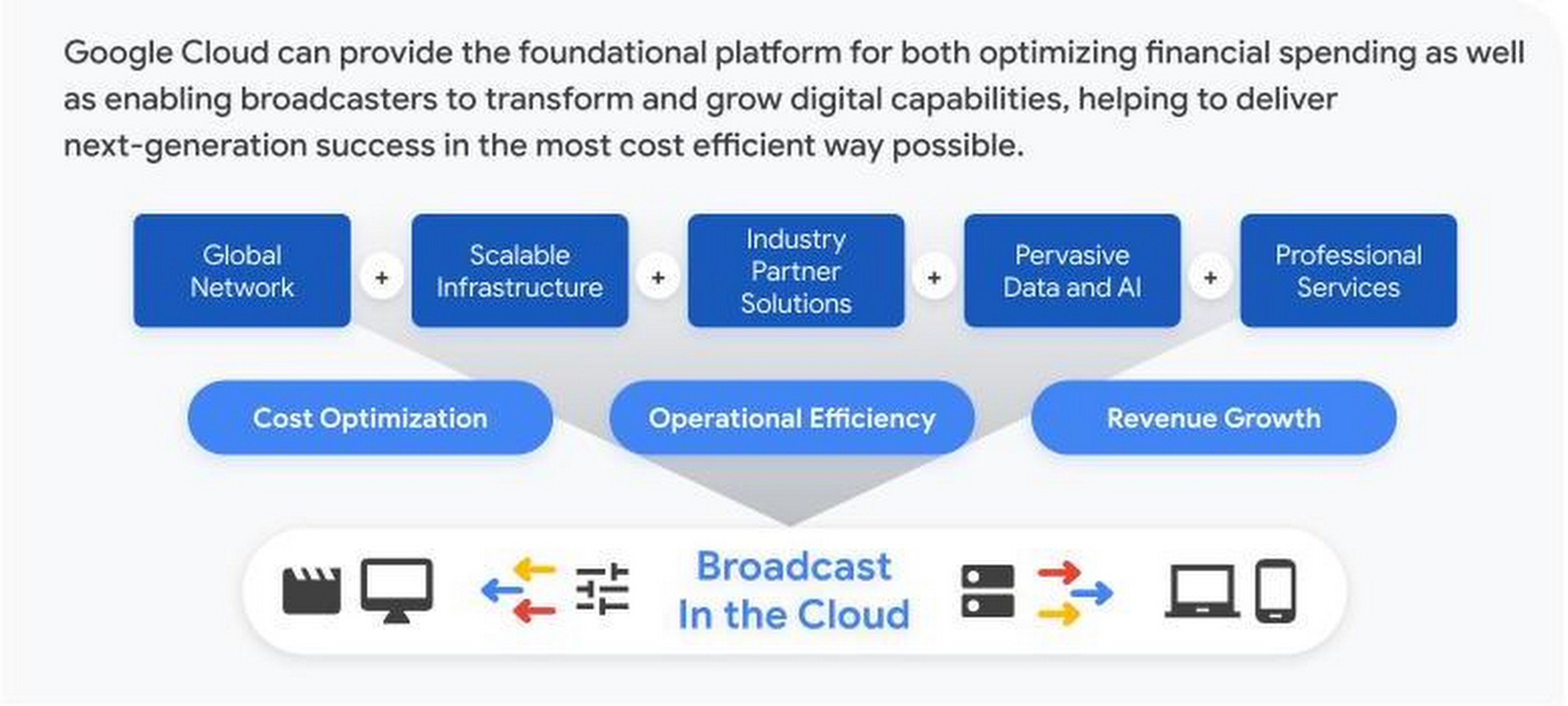
As broadcasters move more processes and solutions to the cloud, the exponential effect of harnessing data and AI power will provide incremental business value across all lines of business. Combined, these impacts to a broadcaster allow both operational excellence while optimizing costs as they continue to expand offerings to customers and regions around the world.
We recognize that every media company’s journey is different and so are expected business outcomes. Google Cloud works closely with customers – partnering every step of the way – to align technology, the media industry, and business outcomes.
Takeaways from the Google Cloud Public Sector Summit on Prioritizing Tech Investments

4772
Of your peers have already read this article.
3:00 Minutes
The most insightful time you'll spend today!
Editor’s note: Today’s post highlights five takeaways from our session at the first ever Google Cloud Public Sector Summit. To watch the full session, check out All the Right Moves: Prioritizing Investments in Technology.
Now more than ever, government agencies need to invest in digital services to fulfill their missions and better serve communities. Yet modernization isn’t a one-and-done approach; it’s a sustained effort, with multi-year implications, and requires careful consideration of how to integrate existing investments to optimize costs. Digital transformation requires coordination between different programs and agencies, including all of their many competing considerations. In short, maximizing technology investments requires careful planning, strategic thinking, and industry partners that can provide flexibility and security and meet agencies where they are.
I sat down with Suzette Kent, former U.S. federal chief information officer, and Dominic Sale, assistant commissioner for Technology Transformation Services at the General Services Administration (GSA) for a conversation to unpack this important topic and discuss industry best practices.
The panelists had five tips for government employees who are making technology purchasing decisions for their agency.
1. Put the agency’s mission first.Avoid getting distracted by exciting new trends and focus on long-term goals that can impact which procurement strategies or funds could be used. The discussion started with how government agencies could cut through the noise about technology and prioritize which technology is best for their needs. Sale and Kent agreed that an agency should focus on its core mission outcomes and let its technology needs flow from that. Sale also emphasized the importance of having technology design respond to humans’ needs, which has historically been a challenge for government agencies.
For agencies to stay focused on their mission, final decisions about technology need to be made by the program manager who best understands each program’s mission. The government CIO’s role is to be the enabler for the technology and leverage it at the enterprise level, particularly when it comes to sharing infrastructure. The takeaway: enable mission programs by empowering your teams and providing access to authorized, compliant, innovative data platforms that programs can move confidently and quickly with.
2. Invest in interoperability. Agency employees often struggle to balance the need for a positive return on investment (ROI) with requirements for meeting mission objectives. While the panelists agreed that the total cost of ownership was important, they also emphasized taking an expanded view of ROI, including future-proofing and investing in functionality that may not realize its return for many years based on the initiative. Saving money isn’t particularly valuable if the solution doesn’t meet an agency’s needs. When choosing a technology partner, government employees should understand its long-term vision to ensure that the partner fits agency priorities. Partners’ technologies should also integrate seamlessly with existing systems so agencies don’t duplicate investment costs.
For example, Google Anthos extends Google Cloud services and engineering practices into an organization’s existing environment, establishing operational consistency across apps and modernization. With Anthos, agencies can simply and securely build and deploy applications anywhere, integrating cloud services across platforms. This allows them to enjoy a consistent DevOps experience for hybrid and multi-cloud environments and enables new innovation. Most importantly, this enables an enterprise data platform, one of the largest catalysts for mission transformation and applied AI.
3. Take advantage of artificial intelligence (AI) benefits. Over the course of the pandemic, the rapid application of AI has improved government productivity, efficiency, and the ability to deliver critical new services to the public at scale. This has further cemented AI’s role as an essential government technology for the present and future. In fact, Nextgov reports that “46% of government IT specialists plan to use AI and machine learning (ML) for embedded systems in the near future.”
As we’ve seen over the course of the pandemic, government programs can start small with AI pilots before moving into broad deployment. This can help agencies understand AI’s potential before moving to full production. People always supervise AI technologies, and the possibilities are endless. Google Cloud’s Contact Center AI (CCAI) has helped government agencies improve the customer experience, by allowing citizens to schedule vaccine appointments via a platform of their choice with up to 28 languages and dialects, and manage vaccine deployment. The U.S. Navy spends billions annually to fight rust and corrosion on its ships. Inspections of ships, aircraft and vehicles are a time-consuming and critical part of keeping the U.S. Navy at top performance so Google Cloud and Simple Technology Solutions (STS) rapidly built an AI-based corrosion-detection and analysis system. The system detected and analyzed corrosion on vessels with 90% accuracy and will eventually be used to automate inspections of vessels, aircraft, and vehicles—saving billions of dollars. Document AI helps a variety of government agencies scale their document processing, reducing the time it typically takes to process enormous amounts of data and related citizen claims.
Successful adoption of AI also depends on the quality of the data. Ultimately, agencies need high-quality enterprise data pipes so that employees and the community trust the system and public sector agencies. Sale described a GSA project that used AI bots to read legal contracts and look for particular phrases that would indicate a specific use case. Previously, an employee would have had to read through the contracts and search for the information. In this way, AI is saving the government both money and time.
4. Creating better experiences for the public. Sale observed that, “trust is the government’s currency and profit motive.” And trust comes when the public can be served with the same modern tools and technology they’re used to – in real-time and with transparency in mind. For example, agencies can provide transparency in public-facing dashboards for programs and supply services that deliver information in real-time through solutions like CCAI.
Trust also requires that constituents feel that government agencies will keep their data safe and secure. The need for a globally secure infrastructure with systems that are up-to-date and designed with security at every level, underpinned by zero-trust enterprise-wide remains paramount – particularly after the series of recent cyberattacks targeting government IT infrastructure.
5. Finding the right technology partner. Government leaders need technology partners who provide a flexible and interoperable platform to integrate existing investments and maximize technical value. Historically, public sector agencies have largely been forced to adopt private clouds, which has reduced their access to richer features, and hindered their ability to adopt a full range of security and product capabilities. The right partner won’t require government leaders to compromise on functionality or service availability to achieve compliance. The right partner can harness the power of emerging technology to make it Government-ready and the true promise of cloud– the access and integration of open data– to make missions more powerful and impactful for the constituencies they serve.
More Relevant Stories for Your Company

How Companies can Improve Scalability, Flexibility, and Reliability While Reducing Costs: Tips from Route4Me
Google Cloud Results Improves application performance by 8x to 12x; customers can create increasingly complex optimized driving routes in single-digit secondsImproves customer satisfaction via increased reliability and greater application performanceFocuses on adding value to customers by improving software and algorithms, not infrastructure managementSaves 5x in infrastructure costs In 2009, Dan



Confused about Cloud? Here is a Primer to get all Your Doubts Answered
When you have decided on moving workloads to the cloud, the task of choosing the right cloud platform can be a tough one with many questions looming in your mind. From which specific product to choose from the plethora of options available to how and where to store your data

Strengthening Operational Resilience in Financial Services by Migrating to Google Cloud
Operational resilience continues to be a key focus for financial services firms. Regulators from around the world are refocusing supervisory approaches on operational resilience to support the soundness of financial firms and the stability of the financial ecosystem. Our new white paper discusses the continuing importance of operational resilience to the financial

2022 is a Big Year for the Gaming Industry!
Editor’s note: This post was originally published in TechPulse Belgium, where Jack Buser, Google Cloud’s Director of Game Industry Solutions, shared his trends for the industry this year. The year 2022 will hold many surprises (with a few already dropping!), but there's one near certainty: By this time next year there will
