





3299
Of your peers have already watched this video.
1:30 Minutes
The most insightful time you'll spend today!
Fitbit’s Zero-Downtime Migration to GCP
In 2019, Fitbit moved all of its production operations from managed hosting to Google Cloud Platform without any downtime. The Fitbit experience is provided by a monolithic application backed by 200+ data stores, making the task of moving service by service impossible.
So, Fitbit decided to run services in both hosting environments and move user by user. This is the story of Fitbit’s migration to GCP, which was tested and executed mostly in production, without any effects to the users.
The tale starts with a review of goals and requirements for the migration. What should the user experience be during this period? How would we know if we are meeting that benchmark and can push forward? How would we slow or reverse migration if things weren’t going well? Answering these questions led us to a migration plan that started with the movement of internal users, followed by the careful transplant of a small number of real customers, and concluded with a mass migration of the majority of our users.
This migration path required significant new additions to Fitbit’s architecture, including new testing, routing, and caching techniques. As the journey approached its conclusion, we recognized that these methods were not merely allowing us to migrate; they were allowing Fitbit to operate in multiple hosting environments simultaneously. The lessons from this migration have provided the foundation for a mutli-region architecture that will unlock the full potential of life in Google Cloud Platform.
Majority of Consumer Goods Shoppers in the U.S. will Not Compromise on Brand Principles: Google Commissioned Research

3087
Of your peers have already read this article.
1:30 Minutes
The most insightful time you'll spend today!
Editor’s note: This article first appeared in Consumer Goods Technology Magazine
Shifting work habits, more online shopping options, rising inflation, and stretched supply chains are just a few factors making it harder to discern what’s top-of-mind for shoppers today.
But we’re starting to get a clearer picture of what consumers say they value most right now. New Harris Poll research commissioned by Google Cloud reveals how U.S. shoppers are thinking about consumer goods brands in new ways—from apparel, electronics, and beauty products, to food and beverage.
While price unsurprisingly continues to be a major consideration in purchases, the average shopper is increasingly paying close attention to the values of consumer goods brands and how eco-friendly their products and practices are.
Shoppers want to buy from brands aligned with their values
COVID-19 drove people to reflect on their priorities, elevating concepts like community service, equity, and sustainability. A decade ago, most consumer goods companies would not have made these front-and-center, operational priorities. But today’s consumer not only wants savings and convenience, they also want that good feeling that comes from spending their money with a company that aligns with their values.
Our new research reveals that 82% of shoppers prefer a consumer brand’s values to align with their own, and they’ll vote with their wallet if they don’t feel a match. Three-quarters of shoppers reported parting ways with a brand over a conflict in values.
Even with their favorite consumer goods products, a majority of shoppers will not compromise on principles. If there’s a value mismatch, 39% of shoppers said they’d permanently boycott their favorite brand, and 24% would break ties at least temporarily. Most won’t be quiet about their concerns either: 28% of consumers that found their values at odds with a brand said they have shared their concerns with friends and family, and another 15% have shared their qualms on social media.
Consumer goods companies need to prioritize sustainability
A majority of today’s consumers (52%) are especially interested in supporting sustainable brands. They want to know how companies are managing their resources, specifically whether they are sourcing responsibly. These shoppers want to see meaningful, measurable efforts from CPG firms to save energy and reduce waste, like how Nuuly, URBN’s digital rental and resale business, has woven sustainability into its business operations, from its distribution centers to reusable packaging.
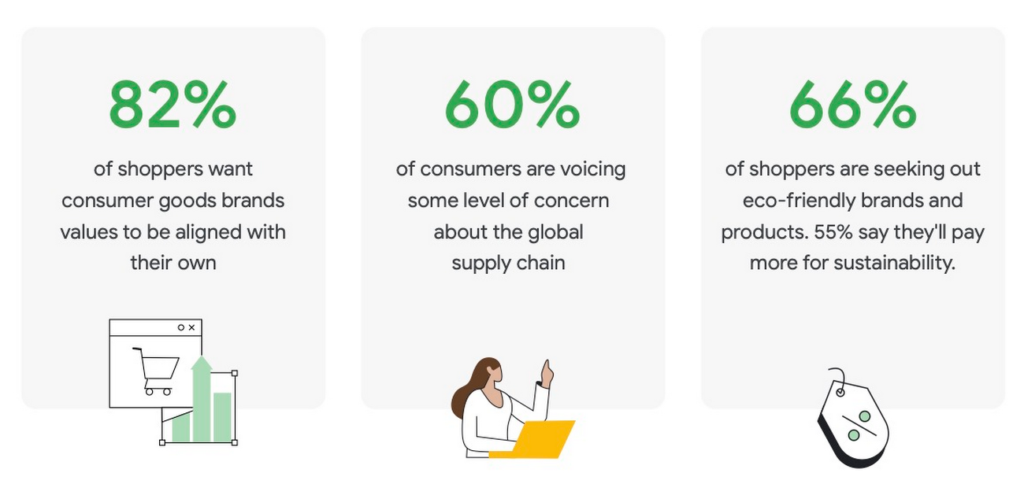
In fact, 66% of shoppers are now seeking out eco-friendly brands, with 55% saying they would pay more for more sustainable products. But these same shoppers are skeptical too: 72% think that companies and brands overstate their sustainability efforts. And they’re right to question brands’ practical application of their values. According to another Harris Poll survey recently commissioned by Google Cloud, 58% of executives polled across 16 countries admit that their organization has overstated its sustainability efforts.
Product availability is table stakes
A final point from the research: The global supply chain has stretched past its limits, and 60% of consumers are voicing some level of concern about it. At the end of the day, if a preferred brand isn’t actually on the shelves of a real or digital store, it doesn’t matter what the brand’s values or sustainability efforts are. A staggering 98% said they’d either buy from a different brand or search other stores or websites.
What’s a brand to do?
After more than 25 years working in the consumer goods industry in roles ranging from marketing and product development to business strategy and technology, at companies like Johnson & Johnson, Kimberly Clark, Carter’s, and now Google Cloud, I’ve seen successful brands do four things well when it comes to their values:
- Don’t be generic.
Your brand’s values need to be authentic, and they need to have teeth. But being too bold could run the risk of alienating some consumer segments. This is where technology can help. Personalizing your messages and outreach to specific shopper profiles is one way to ensure that your core values reach the right customers at the right time. - Make your values clear and consistent.
When focusing on which values to highlight with your consumers and the world, make sure they make sense for your brand and that you’ll stick to them over time. For example, it’s painfully obvious when a brand is being opportunistic and inserting itself into conversations around values like sustainability or social justice, when it doesn’t have a history of voicing those values. The key to clear and consistent messaging of values is balancing authenticity with relatability and the appropriate amount of promotion. - Develop sustainability practices and communicate their impact to everyday people.
How everyday people perceive a consumer goods brand’s sustainability initiatives is different from how an investor or general business audience does. Shoppers don’t read business sustainability plans or impact reports. To increase awareness of your brand’s sustainability efforts, consumers need to identify and interact with your brand and products directly. Some of my favorite examples are how I love that Google Maps gives me the choice of eco-friendly driving directions, and that I know I can buy low-waste, packaging-free cosmetics from a company like Lush. - Reward customer loyalty.
Shoppers have more choices than ever before, and supply chain woes are testing preferences even further. But when someone chooses a specific brand because they feel aligned with their values or like their eco-friendly products, that shopper doesn’t always get recognized or thanked. Implementing a rewards program or following-up with customers after their purchases is one way you can make loyal shoppers feel appreciated while creating a lasting relationship that extends as long as possible.
Google’s Research and Data Insights Solutions to Power Drug Development and Clinical Research

3709
Of your peers have already read this article.
1:30 Minutes
The most insightful time you'll spend today!
In order to be successful, research needs to be replicable, so scientists can build on past work and insights. However, an article in Nature warned that as much as 50% of published drug development research could not be reproduced in subsequent trials. As a result, promising drug candidates sometimes led to disappointment, as well as wasted time and money, when key findings could not be replicated.
The shift to cloud computing helps solve this problem because it allows researchers to use open-source tools that work across platforms. As demand for cloud computing rises, our customers have asked us for more ready-made solutions to assure reproducibility of results by their collaborators, regardless of the platform they are using. They asked for secure and effective collaboration tools as well as faster time-to-insight from any type of data.
We listened. Google’s new research and data insights solution includes three sets of functionalities to address these key challenges. Each can be activated on demand and may be eligible for subscription pricing. “HPC in a box” offers abstract complexity to run high performance computing (HPC) workloads by automatically managing your cluster in the most effective manner. It integrates seamlessly with some of the industry’s most-used schedulers like Slurm and PBS. It makes it easier than ever to answer bigger questions faster by accessing Google’s fast, powerful hardware like TPUs and GPUs, all for one predictable flat fee for eligible workloads. Healthcare Innovation Hub provides healthcare-specific functionality to help ingest, aggregate, and de-identify any type of healthcare data in its original format. It unlocks cross-modality analysis and collaboration and empowers researchers with harmonization tools to overcome healthcare interoperability issues. Google Cloud Real-World Insights (formerly FDA MyStudies) accelerates and streamlines drug development and clinical trials to address urgent medical challenges with reproducible results.
The solution enables researchers to ask new questions, get answers more quickly, and work more collaboratively–with no wait times or down times. Institutions can scale to more ambitious projects and generate actionable, real-time insights from any data source–all while staying within budget.
Many top research centers have already found it faster and more cost effective to shift from downloading and storing data on their own servers to storing and analyzing data on Google Cloud. Here are some of the real-world projects already yielding breakthroughs:
- Clemson analyzed 8,500 hours of traffic camera feeds with 2.1M vCPUs in three hours to improve evacuation routes for disaster planning.
- The Colorado Center for Personalized Medicine saved $2.9M by building their Compass data warehouse on Google Cloud rather than on on-prem.
- The Broad Institute slashed costs of genomic sequencing by 90% with Google Cloud.
Our partners, such as Atos, Burwood, Omnibond, Mavenwave, Quantiphi, and Deloitte, can help you first design and develop, then install and implement your own solution, including training. To assess your institution’s needs and develop a customized plan for your next-generation research solution with research and insights, contact our sales team.
Google Cloud Connector for SAP LaMa Helps Make Most of the Multi & Hybrid-cloud Strategies

3492
Of your peers have already read this article.
1:30 Minutes
The most insightful time you'll spend today!
As an SAP user, you may already be familiar with SAP Landscape Management (SAP LaMa) — a specialized product that supports centralized management of your SAP landscape. SAP LaMa is useful for a wide range of SAP customers and use cases, but it’s especially important to large enterprises that manage very large, diverse, and often geographically dispersed SAP landscapes.
Google Cloud recently released a free connector that our SAP customers can deploy on an existing or new SAP LaMa instance. It’s a potentially important contribution for enterprises that need to address the growing complexity associated with multi-cloud and hybrid-cloud application strategies.
Let’s take a look at how SAP LaMa works, how it fits into a customer’s SAP landscape, and what kinds of benefits they can expect. We’ll also run through some adjustments that SAP admins will need to make in order to launch the connector.
SAP LaMa: Bringing simplicity to SAP landscapes
The Google Cloud Connector for SAP LaMa is distributed as a Java archive — provided free of charge — that customers can deploy on a SAP LaMa system that already exists on premises, or on another cloud, or as part of a new SAP LaMa deployment on Google Cloud. SAP LaMa itself is a centralized SAP management tool designed to simplify, automate, and orchestrate a variety of management and administration tasks across your entire SAP landscape. Some examples of use cases for LaMa include:
- Getting a single, comprehensive overview of your organization’s full SAP landscape
- Automating day-to-day system administration tasks, like system refreshes
- Executing mass stop/start operations across your landscape
- Deploying custom operations and workflows within the SAP application environment
SAP admins can reclaim a significant amount of time by creating SAP context sensitive automation routines that can execute without human intervention, and by completing system maintenance tasks more quickly and consistently. SAP LaMa also elevates service quality by using automation to remove manual intervention (and thus human error) from the system admin process.
The Google Cloud Connector builds bridges for SAP customers
The Google Cloud connector functions as a trigger that extends LaMa functionality to SAP systems deployed on Google Cloud. The connector enables standard SAP LaMa execution scenarios, such as:
- Listing Google Cloud projects, zones, and VM instances within SAP LaMa’s landscape overview
- Mass stop/start of Google Compute Engine (GCE) instances, using either the SAP LaMa user interface or the scheduler
- System clone, copy, and DB refresh with Post Copy Automation
- Resizing of machine types
- Relocating SAP application instances to another VM instance
- SAP HANA failover to a replicated SAP HANA HA system via the SAP Host Agent
By supporting native SAP automation and orchestration, the Google Cloud connector contributes to the overall value customers get from using SAP LaMa. What may be just as important, however, is how the connector makes life easier for customers running Google Cloud as part of a hybrid cloud or multi-cloud SAP landscape. That’s an increasingly important advantage, given recent research revealing that 82% of enterprises are currently deploying hybrid clouds.1
Before getting started with the Google Cloud connector, it’s important to be aware that you’ll have to run it on SAP LaMa 3.0 (the current version), and that you will need to have an SAP Landscape Management – Enterprise Edition licence provided by SAP to support all functionality.
In addition, getting access to the full SAP LaMa feature set for your Google Cloud SAP environment will require you to deploy SAP systems using SAP’s adaptive design principles. These include:
- Using SID (SAP system ID) and instance-specific disk mount points
- Using alias IP for virtual host mapping and portability
- Configuring DNS to manage virtual hostname (aka. FQDN) for all VMs
- Using a local NFS host to manage shared files, as well as copying, migrating, and managing solutions like Filestore and NetApp separately
Because meeting these requirements may require altering your production systems, you’ll have to assess the pros and cons of doing so to take full advantage of the Google Cloud Connector.
Google Cloud is constantly looking for ways to support our SAP customers in running more efficiently and in making the most of their hybrid cloud and multi-cloud strategies. Releasing the Google Connector for SAP LaMa is one more reflection of our commitment to creating value for customers any way we can. Learn more about Google Cloud offerings for SAP customers.
Ulta Beauty: Managing Holiday Surges and Architecting Innovation

2736
Of your peers have already read this article.
3:30 Minutes
The most insightful time you'll spend today!
As we enter the holiday season, retailers are working behind the scenes to ensure they can provide the best experiences for customers, in store and online. Challenges in retail do not begin or end during the holiday season as sudden shifts in customer preferences, supply chain nuances, and overall demand ebbs and flows take place year round and retailers must be prepared to adapt swiftly.
Google Cloud’s retail customers globally, in total, saw more online traffic in the first six months of 2022 than all of 2019. This year, retailers can expect an early launch to holiday shopping activities, as 50% of consumers plan to start purchasing goods before the traditional Black Friday kick-off.
The very same improvements made to automate and improve retail infrastructure can prepare it for holiday surges and support year-round innovation. Let’s take a look at how Ulta Beauty, the largest beauty retailer in the U.S., is partnering with Google Cloud, MongoDB Atlas, commercetools, and HCLTech to cover these two areas and more.
Architecting for innovation
Creating personalized shopping experiences in stores and online is key to Ulta Beauty’s success. This commitment is best demonstrated through Ulta Beauty’s Virtual Beauty Advisor. Built on Google Cloud, this tool enhances shoppers’ experiences with personalized recommendations in addition to the ability to try on makeup virtually with GLAMLab.
As innovators in support of the best possible guest experience, Ulta Beauty needed to re-architect its infrastructure for greater agility and stability.
To start, Ulta Beauty chose to use Google Kubernetes Engine (GKE) as the backbone and orchestrator to build and deploy cloud-native applications. The Google Cloud deployments coincided with an organizational move from end-to-end application development to one that focuses on individual features, specific modules, and micro-applications.
This strategic change allowed Ulta Beauty to fix bugs, experiment with new offerings, and drive customer experiences faster and more efficiently. Thanks to the transformation and GKE, Ulta Beauty’s developer team now accelerates time to market for new products and services, and delivers new ways to engage with customers more quickly. These efforts all ladder to create ‘WOW’ experiences for the retailers’ guests who have emotional and personal connections to beauty and wellness. They can now discover and experience products that are served to them based on individual preferences.
Adapting to the new environment comes with its own set of challenges. “Microservices are not a silver bullet,” says Sethu Madhav Vure, IT Architect, Ulta Beauty. “For Ulta Beauty, the biggest challenge was how to break up a monolithic environment into multiple applications. We had to evolve our core systems—without impacting today’s services—and address what was needed for the future.”
Google Cloud partner HCLTech provided expert guidance throughout the re-architecting process, defining the solution blueprint and cloud-native deployment architecture through cross-functional workshops. HCLTech then assisted with the actual migration and platform setup, paving the way for fully automated, continuous integration and continuous delivery (CI/CD) pipelines to support faster rollouts and deployment architecture to drive higher availability and scalability.
Ulta Beauty took a domain-driven design approach to identify operations that could be grouped together to reduce complexity and improve scalability. Now, the applications are based on multiple domains, such as Commerce, Promotions, Catalog, Order, Customer, and Inventory. The new architecture prompted a fresh look at storage requirements to scale dynamically alongside its modernized applications.
For Ulta Beauty, MongoDB Atlas proved to be the best database solution for dynamic scaling, ease-of-use, and integrations with Google Cloud. The company also leveraged an entry-level plan to prove the value of MongoDB Atlas before investing in the technology.
“MongoDB Atlas offers a free tier that gave us an opportunity to quickly demonstrate tangible benefits of a proof of concept,” says Vure. “Once we proved the value of MongoDB Atlas, we benefited from the straightforward resource allocation supported by Google Cloud and MongoDB.”
Integrations between MongoDB Atlas and Google Cloud allow Ulta Beauty to take an iterative approach to new projects. The company creates new clusters in an existing project, then piggybacks them onto an existing Private Service Connect setup between a MongoDB project and Google Cloud project.
By removing complexities within infrastructure management, Ulta Beauty can manage its incredible amount of data, such as member preferences and purchases, that fuels its event-driven architecture. The much more agile infrastructure enables Ulta Beauty to deploy and scale offerings faster than ever.
“We recently had an unplanned traffic surge that impacted our domain services. It took less than an hour for MongoDB Atlas to scale up to the next level of the cluster and manage that traffic,” says Vure. “The on-demand, dynamic scaling, plus GKE, has saved the day more than once.”
Preparing for a happy holiday season
This holiday season, Ulta Beauty has a stronger technical foundation to manage demand surges and provide customers seamless shopping experiences. Previously, the company used 50 pods in a cluster, each with 6 GB of RAM without domain stores, to handle about 100 transactions each second. With domain stores, the same 6 GB of RAM with just 20 GKE pods was able to scale up to 2,400 transactions per second.
With Google Cloud as its technology foundation, Ulta Beauty partnered with Google Cloud partner commercetools to evolve its application APIs as products and properly separate interfaces and capabilities.
Ulta Beauty uses event-based integrations within commercetools to identify how best to leverage Cloud Pub/Sub middleware on top of MongoDB Atlas integrations. Patterns established here were extended into MongoDB change streams and in turn improved business processes.
“Working with the right technology partners has helped us to avoid analysis paralysis that can happen when developer teams spend a lot of time trying to understand and manage every detail,” says Vure. “Instead, we convert a proof of concept into a working solution, and quickly bring it to market. It’s been a major shift in our IT culture as we try out new things weekly and see incredible support from leadership.”
The improvements enable Ulta Beauty to maintain a high level of innovation, performance, and customer service year-round. Now, when the holiday shopping season begins, Ulta Beauty is prepared to handle surges in traffic through auto-scaling with Google Cloud and MongoDB Atlas. Customers get what they want, when they want, free from the frustrations of outages.
“With these changes, we are ready for a holiday season that everyone–even those of us in IT—gets to enjoy. We’re positioned to continuously focus on new, better ways to serve our guests,” says Vure.
Check out MongoDB and commercetools on Google Cloud Marketplace to learn more about what these partners can do for your business.

1095
Of your peers have already downloaded this article
4:30 Minutes
The most insightful time you'll spend today!
There is no one-size-fits-all solution to cloud migration. Every approach has unique considerations, so you need to understand the trade-offs of each to execute an effective migration plan.
We’ve outlined the key things to consider when crafting your migration journey, including:
- The benefits of having your applications in the cloud.
- Finding the right migration option for your business needs.
- Getting started with your migration.
More Relevant Stories for Your Company

Forrester Study Finds 72% ROI from Moving Expensive, Traditional OS and Software to Google Cloud!
Google Cloud commissioned Forrester Consulting to conduct a Total Economic Impact™ (TEI) study and examined the potential return on investment (ROI) for companies that have migrated to Google Cloud. The study evaluates the risks, benefits and costs associated with Google Cloud migration and the experiences of five customers with large,

Canadian Bank’s SAP Workload Moved to BigQuery Helps Unlock New Business Opportunities
When ATB Financial decided to migrate its vast SAP landscape to the cloud, the primary goal was to focus on things that matter to customers as opposed to IT infrastructure. Based in Alberta, Canada, ATB Financial serves over 800,000 customers through hundreds of branches as well as digital banking options. To

Explore Google Cloud SQL’s 3 Fault Tolerance Mechanism to Ease Data Pro
If you’re managing a crucial application that has to be fully fault-tolerant, you need your system to be able to handle every fault, no matter the type and scope of failure, with minimal downtime and data loss. Protecting against these faults means juggling numerous variables that can impact performance as

Transforming Canadian Healthcare and Medical Research with Google Cloud
Is Cloud an option for Canadian Healthcare healthcare and medical research organizations? Yes, Canadian healthcare and medical research organizations are moving to the cloud. The cloud market is expected to grow in Canada significantly through 2027. There are several reasons why Canadian healthcare and medical research organizations are moving to
