





IndiaMART: Delivering a Compelling Experience for B2B Buyers and Suppliers with Google Cloud

3892
Of your peers have already read this article.
3:30 Minutes
The most insightful time you'll spend today!
B2B marketplace IndiaMART aims to help businesses escape the restrictions of traditional supply chains. By providing access to a digital platform optimized for access from desktops and mobile devices, businesses can improve their operations and generate more revenue. IndiaMART’s suite of services includes web storefront, enquiry support, priority listings, premium number services, a lead management system, and payment facilitation.
IndiaMART also provides “behavior-based matchmaking” that identifies the supplier best equipped to meet buyer needs by product or service, category and location. IndiaMART then matches the designated suppliers with the buyers. Finally, IndiaMART operates as a “horizontal marketplace”—enabling suppliers to market to a large number of potential buyers—presenting a compelling offering for both groups.
Amarinder S. Dhaliwal, Chief Product Officer of IndiaMART, says once IndiaMART grew to a certain size, it benefited from a network effect—as more buyers used the marketplace, more suppliers came on board, prompting yet more buyers to access the service and so on. Suppliers becoming buyers and using IndiaMART to purchase products is another growth driver. “There is not just a network effect, but a community effect as well, as a supplier becomes a buyer,” says Dhaliwal. “This increases affinity, and supplier and buyer ‘lock-in’ to the marketplace increases multifold.”
Positioned to address challenges
IndiaMART’s proactive approach positioned the business well to address the challenges presented by new trends and market conditions. Traffic from mobile devices to its business-to-business marketplace has grown from about 30% to 75% over the last four years.
“Mobile traffic has grown at a compound annual growth rate of almost 100% over the same period,” says Dhaliwal. “The proliferation of smartphones and other mobile devices has brought a considerable number of new users onto the internet and these users look for value—the right price from the right supplier,” he adds. “Furthermore, they can connect at any time and from any location they can access a network.”
The mobility revolution also challenged IndiaMART to provide a user interface and experience optimized for devices of various types and sizes—and that incorporated screens much smaller than the screens incorporated in desktops. The organization also had to help users overcome issues such as inconsistent network coverage and quality—particularly in remote areas.
Becoming a mobile-first organization
IndiaMART is responding by becoming, for buyers, a “mobile-first” organization that meets the group’s technical and user experience requirements.
IndiaMART is also adapting its marketplace to support two key trends:
• Buyers using long, conversational sentences to conduct online searches rather than simply typing in keywords
• Non English-users—the vast majority of people in India—stepping up their use of the marketplace
“We expect that, within a few years, we will have more non-English users than English users on IndiaMART,” says Dhaliwal.
IndiaMART is also benefiting from Indian government measures to reform taxation and stimulate the digital economy. “There has been a huge focus on areas such as digital payments and the digitization of identity,” says Dhaliwal. “We have embraced elements of this agenda by implementing a digital payment platform and are continuing to look at ways of providing new digital services to suppliers.
“Meanwhile, the Indian government’s recent implementation of GST allows us to validate suppliers’ businesses and bring more qualified, more verified suppliers on our platform—improving the experience for buyers and suppliers.”
Speed and reliability an issue
IndiaMART had started operations with servers, storage, networking, and associated systems co-located in a data center in the United States. However, as buyers and suppliers increasingly used mobile devices—over occasionally unreliable networks—to access the marketplace, access speeds and reliability became an issue. With most requests traveling between India and the United States, network latency was unacceptably high. Furthermore, business growth meant IndiaMART needed an environment that could scale to meet demand for the next five to 10 years.
IndiaMART opted for a multi-cloud architecture and established criteria for cloud providers to win its business. “We required an infrastructure that could scale and meet our demand for fast response time without putting our business at risk,” says Dhaliwal. “This meant taking a phased rather than one-shot approach to the migration. We also needed to minimize any wasteful duplication of infrastructure and reduce latency. In addition, as we scaled, we needed to protect our systems, transactions and information, including the details of buyers and suppliers.”
Google Cloud team’s high-quality support
The organization performed proof of concept with the three largest multinational cloud services providers and found Google Cloud was best positioned to act as the cornerstone of its multi-cloud architecture. “The Google Cloud team gave us considerable support in helping us run a proof of concept of its services,” says Dhaliwal.
“The proof of concept also illustrated that Google Cloud was superior to the other cloud services we looked at.
“We could run our marketplace across multiple geo-locations under a single IP address, avoiding duplication, and users in India could connect to Google Cloud via the closest access point, with their traffic passing quickly across the Google network.
“In addition, Google Cloud’s load balancing service would enable encryption between load balancing layers and back ends to ensure security, while all communication would move across Google’s own protected network.”
Being one of India’s early users of G Suite, the organization was also familiar with Google Cloud applications and services.
IndiaMART then opted to work with the Google Cloud team and a certified partner on a step-by-step implementation that minimized any risk of disruption.
Deep engagement from Google
“We engaged very deeply with both Google and the partner to complete this migration,” says Dhaliwal. “The Google team worked very hard to understand our requirements and provide a solution that catered to our needs and could be deployed in a phased manner.” The team ran workshops and technical sessions with IndiaMART and, at a Google Summit, connected the marketplace provider to Google experts in databases and infrastructure.
“These discussions really helped us formulate a strategy moving forward,” says Dhaliwal.
Based on input from Google and its own evaluation, IndiaMART developed an architecture comprising virtual machine instances delivered through Compute Engine, Google Cloud’s infrastructure-as-a-service offering; Cloud Load Balancing to support cloud resources distributed across multiple locations; Cloud Pub/Sub to provide enterprise messaging; and Cloud Dataflow to transform and enrich data.
Cloud Armor works with Cloud Load Balancing to defend against distributed denial of service (DDoS) attacks; and Geocoding API helps the organization convert geographic coordinates into readable addresses and vice versa. Cloud AutoML allows IndiaMART to train machine learning models to meet its requirements. With Geocoding API, IndiaMART can matchmake buyers and suppliers based on location—providing a high quality experience for both parties. Finally, AutoML Translation allows the organization to create a custom machine learning model that converts product names from English into Hindi and other languages, effectively opening up new markets for buyers and suppliers.
Phase one complete
IndiaMART has completed phase one of the migration that involved moving its web properties across to Google Cloud. The organization is now experimenting with moving its APIs and databases to the service and anticipates completing the exercise over the coming year.
Average page load time down
The initial phase of the project has already delivered considerable benefits to IndiaMART. The organization has cut average page loading time from five seconds to three seconds, and Dhaliwal attributes close to one second of that reduction to the move to Google Cloud. “With Google Cloud, buyers and suppliers can access our marketplace much faster than previously,” says Dhaliwal. “This impacts positively on engagement, time spent on our marketplace, and the user’s entire journey with us.”
DDoS attack repelled
Google Cloud’s security features have already passed their first test. As IndiaMART undertook stage one of the migration, the business experienced a DDoS attack that generated request loads more than 400 times greater than normal. “Because we were on Google Cloud infrastructure, we could develop a solution to combat this severe DDoS attack,” says Sunil Parolia, Sr. VP at IndiaMART. “From a security perspective, this really justified our decision to go with Google Cloud.”
Google Cloud is also helping deliver the availability required by IndiaMART and the scalability to support growing demand. “As the number of people in India who access the internet grows from about 500 million to 700-800 million over the next couple of years, we will continue to build our traffic and be the dominant business-to-business platform,” says Dhaliwal. “On the supplier side, we expect to see more and more businesses come onto our marketplace—ranging from small-to-medium businesses up to larger brands. Google Cloud will enable us to accommodate this traffic without compromising the experience we provide.”
Google Cloud is Every Retailer’s Most Trusted Cloud

6608
Of your peers have already read this article.
3:00 Minutes
The most insightful time you'll spend today!
Whether they were ready for it or not, the COVID-19 pandemic transformed many retailers into digital businesses. Retailers made huge investments into commerce technologies, customer experience tools, sales and fulfillment technology, and improving digital experiences to continue providing their goods and services to their customers. Now, more than a year into the COVID-19 pandemic, digital retail is the new normal. In fact, many retailers are planning on expanding their digital investments. However, as their digital footprint expands, so do their threats and security concerns.
As a digital-focused retailer, your website is the most visible part of your attack surface. Your website is where your customers search for goods or services, make payments, or learn more about your brand. However, your website does not operate in isolation. There is an underlying infrastructure as well as the services that run on top of it that need protection from a wide array of attacks that may seek to compromise your data, internal employees, business, and customers. During this week’s Google Cloud Retail Summit, we’ve shared why Google Cloud is built to be the most trusted cloud for retailers. From providing you with control over your data as you move from your own data centers to the public cloud to giving you built-in technology to protect your applications all the way to your end users, Google Cloud helps you safely migrate to and operate in our Trusted Cloud.
Trusted Cloud Gives You Control, Transparency, and Sovereignty
- Access Transparency: We offer the ability to monitor and approve access to your data or configurations by Google Cloud support and engineering based on specific justifications and context, so you have visibility and control over insider access.
- Certificate Authority Service (CAS): CAS is a highly scalable and available service that simplifies and automates the management and deployment of private CAs while meeting the needs of modern developers and applications. With CAS, you can offload to the cloud time-consuming tasks associated with operating a private CA, like hardware provisioning, infrastructure security, software deployment, high-availability configuration, disaster recovery, backups, and more, allowing you to stand up a private CA in minutes, rather than the months it might normally take to deploy.
- Confidential Computing: We already encrypt data at-rest and in-transit, but customer data needs to be decrypted for processing. Confidential Computing is a breakthrough technology which encrypts data in-use—while it’s being processed. Confidential VMs take this technology to the next level by offering memory encryption so that you can further isolate your workloads in the cloud. With the beta launch of Confidential VMs, we’re the first major cloud provider to offer this level of security and isolation while giving you a simple, easy-to-use option for your newly built and “lift and shift” applications.
- Cloud Key Management: We allow you to configure the locations where your data is stored, where your encryption keys are stored, and where your data can be accessed from. We give you the ability to manage your own encryption keys, even storing them outside Google’s infrastructure. Using our External Key Management service, you have the ability to deny any request by Google to access encryption keys necessary to decrypt customer data at rest for any reason.
Trusted cloud Helps You Prevent, Detect, and Respond to Threats
- BeyondCorp Enterprise is Google’s comprehensive zero trust product offering. Google has over a decade of experience managing and securing cloud applications at a global scale, and this offering was developed based on learnings from our experience managing our own enterprise, feedback from customers and partners, as well as informed by leading engineering and security research. We understand that most customers host resources across different cloud providers. With this in mind, BeyondCorp Enterprise was purpose-built as a multicloud solution, enabling customers to securely access resources hosted not only on Google Cloud or on-premises, but also across other clouds such as Azure and Amazon Web Services (AWS).
- Cloud Armor: We’re simplifying how you can use Cloud Armor to help protect your websites and applications from exploit attempts, as well as Distributed Denial of Service (DDoS) attacks. With Cloud Armor Managed Protection Plus, you will get access to DDoS and WAF services, curated rule sets, and other services for a predictable monthly price.
- Chronicle: Chronicle is a threat detection solution that identifies threats, including ransomware, at unparalleled speed and scale. Google Cloud Threat Intelligence for Chronicle surfaces highly actionable threats based on Google’s collective insight and research into Internet-based threats. Threat Intel for Chronicle allows you to focus on real threats in the environment and accelerate your response time.
- Google Workspace Security: Used by more than five million organizations worldwide, from large banks and retailers with hundreds of thousands of people to fast-growing startups, Google Workspace and Google Workspace for Education include the collaboration and productivity tools found here. Google Workspace and Google Workspace for Education are designed to help teams work together securely in new, more efficient ways, no matter where members are located or what device they use. For instance, Gmail scans over 300 billion attachments for malware every week and prevents more than 99.9% of spam, phishing, and malware from reaching users. We’re committed to protecting against security 1 threats of all kinds, innovating new security tools for users and admins, and providing our customers with a secure cloud service.
- Identity & Access Management IAM: Identity and Access Management (IAM) lets administrators authorize who can take action on specific resources, giving you full control and visibility to manage Google Cloud resources centrally. For enterprises with complex organizational structures, hundreds of workgroups, and many projects, IAM provides a unified view into security policy across your entire organization, with built-in auditing to ease compliance processes.
- reCAPTCHA Enterprise: reCAPTCHA has over a decade of experience defending the internet and data for its network of more than 5 million sites. reCAPTCHA Enterprise builds on this technology with capabilities, such as two-factor authentication and mobile application support, designed specifically for enterprise security concerns. With reCAPTCHA Enterprise, you can defend your website against common web-based attacks like credential stuffing, account takeovers, and scraping and help prevent costly exploits from malicious human and automated actors. And, just like reCAPTCHA v3, reCAPTCHA Enterprise will never interrupt your users with a challenge, so you can run it on all webpages where your customers interact with your services.
- Security Command Center: With Security Command Center (SCC), our native posture management platform, you can prevent and detect abuse of your cloud resources, centralize security findings from Google Cloud services and partner products, and detect common misconfigurations, all in one easy-to-use platform. We have Premium tier for Security Command Center to provide even more tools to protect your cloud resources. It adds new capabilities that let you spot threats using Google intelligence for events in Google Cloud Platform (GCP) logs and containers, surface large sets of misconfigurations, perform automated compliance scanning and reporting. These features help you understand your risks on Google Cloud, verify that you’ve configured your resources properly and safely, and document it for anyone who asks.
- VirusTotal: VirusTotal inspects items with over 70 antivirus scanners and URL/domain blocklisting services, in addition to a myriad of tools to extract signals from the studied content. Any user can select a file from their computer using their browser and send it to VirusTotal.
- Web Risk API: With Web Risk, you can quickly identify known bad sites, warn users before they click infected links, and prevent users from posting links to known infected pages from your site. Web Risk includes data on more than a million unsafe URLs and stays up to date by examining billions of URLs each day.
Trusted cloud Plays an Active Role in Our Shared Fate
Our trusted cloud provides a shared-fate model for risk management. We stand with retailers from day one, helping them implement best practices for safely migrating to and operating in our trusted cloud.
We hope you enjoy the sessions we’ve created for you with Google Cloud Retail Summit and that they help you understand the ways our trusted cloud can help secure retailers all over the world.
AWS to Google Cloud Translator: Which AWS Database Service Is Equal to Google Cloud Database?

6308
Of your peers have already read this article.
2:30 Minutes
The most insightful time you'll spend today!
There are multiple reasons a growing number of database administrators, enterprise architects, application developers and other technology practitioners are moving to Google Cloud’s various database services.
Some are being driven by missing features in offering from other providers such as AWS. In Gartner’s Magic Quadrant for Operational Database Management Systems, the research and advisory firm points out that, “AWS’s surveyed reference customers scored its overall product capabilities one standard deviation (STD) below the mean. Their responses identified missing features such as multiregion writes and autosharding.”
Others are moving to database services on Google Cloud Platform driven by a few benefits. According to Gartner, “Reference customers repeatedly commented on Google’s ease of use and implementation, reliability and integration (with other services and other systems). Reference customers scored Google a full STD above the mean for satisfaction with GCP’s pricing; it received the second-highest satisfaction score of any vendor in this Magic Quadrant.
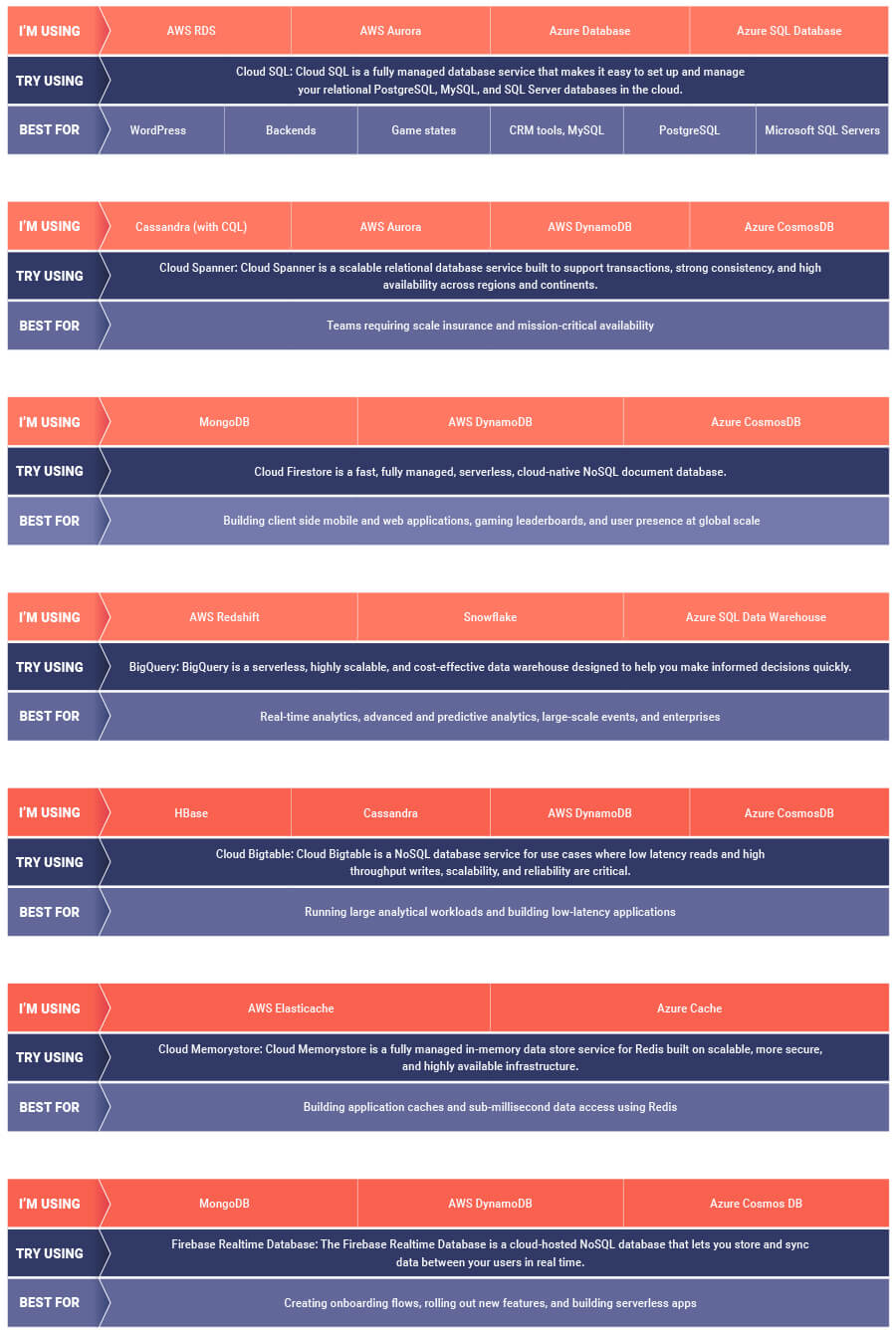
If you are looking to leverage the power of Google Cloud database offerings—but were unsure of which database services comes closest to the service you are currently using, here’s a handy map to find your way.
Bushel: Empowering Agribusinesses One Step at a Time with Google Cloud

3115
Of your peers have already read this article.
3:00 Minutes
The most insightful time you'll spend today!
Working to put food on all of our tables, today’s farmers are facing a higher amount of instability from input supply chain issues to weather patterns. Adding to this challenge are problems farmers face when trying to correctly time grain purchases, sales and transport. Farmers have always been stewards of the land, but now the demand for sustainable products has them needing to better prove their regenerative practices.
At Bushel, we understand these problems can’t be solved overnight or by a single company. We focus on empowering agribusinesses and farmers to work even more closely together to build a more sustainable agricultural supply chain by rapidly responding to market changes. With Bushel, farmers can track market prices in real time, instantly buy and sell grain, analyze inventory and transactions, and securely share verified information with grain operators and other producers. We provide the digital tools to streamline how farmers buy and sell commodities throughout the agricultural industry’s supply chain to help address market inefficiencies that can lead to waste, and have the information and resources to help them flex and adapt as complexity increases in farming operations.
Approximately 40% to 50% of all U.S. grain transactions now pass through the Bushel platform. As we continue to grow, Bushel continues to focus on what digital tEmpowering Farmers: Bushel Drives 40-50% of US Grain Transactions, Fueling Sustainable Agricultureools can support each point in the supply chain. Many focus on the first mile at the farm or last mile at the store. But Bushel is focused on modernizing the middle where grain purchasing and processing sit. We aim to help local grain industries and stabilize regional agricultural supply chains.
Starting with a simple mobile app; now scaling into an agricultural ecosystem
Bushel began its journey in 2017 as a small-scale platform for farmers that delivered grain contracts, cash bids, and receipts. As Bushel evolved into a comprehensive agricultural ecosystem, we realized we needed knowledgeable technology partners to help us rapidly scale while saving time and administrative costs. That’s why we started partnering with the Google for Startups Cloud Program to get support from Google and work with Google Cloud Managed Services partner, DoiT International to help support our use of GKE and create a multi-regional deployment as well as migrate our CUDs to new Compute Engine families and continue to optimize our footprint. We’ll also use DoiT’s Flexsave technology to reduce the management overhead of CUDs in the future.
In just one year, we expanded to over 1,200 live grain receiving locations and quickly grew our services portfolio with electronic signature capabilities, commodity balances, and web development. Because that relationship between farmer and agribusiness is so important, we provide more than 200 grain companies with white-labled digital experiences so each farmer sees their local grain facility they do business with on both desktop and mobile. To further our extension into the digital infrastructure of agriculture, we subsequently acquired GrainBridge and FarmLogs to help farmers handle specific jobs and tasks, and provide the needed insights to improve their business operations. Over 2,000 grain receiving locations across the United States and Canada now use Bushel products. We accomplished all this on Google Cloud.
We leverage the secure-by-design infrastructure to protect millions of financial transactions and keep sensitive customer data safe. Our data is processed and stored in Google’s secure data centers, which maintain adherence to a number of compliance frameworks. We utilize Google Kubernetes Engine extensively as it reduces operational overhead and offers auto scaling up to 15,000 nodes.
Database provisioning, storage capacity management, and other time-consuming tasks are automated with our Cloud SQL usage. Query Insights for Cloud SQL streamlines database observability and seamlessly integrates with existing apps and Google Cloud services such as GKE and BigQuery.
Empowering farmers and agribusinesses in North America
The Google Cloud Account Team had been instrumental in helping Bushel build an expansive agricultural platform that powers APIs, apps, websites, and digital solutions. Google’s startup experts are incredibly responsive, with deep technical knowledge that can’t be found elsewhere. Google Cloud also has provided us credits to explore new ways of analyzing the vast amounts of data we generate, verify, and transfer with solutions such as BigQuery and Pub/Sub.
With BigQuery, we can run analytics at scale with 26%–34% lower three-year TCO than cloud data warehouse alternatives. BigQuery delivers actionable insights on a highly secure and scalable platform, includes built-in machine learning capabilities, and integrates with Pub/Sub to ingest and stream analytic events via Dataflow.
With Bushel, farmers across North America are rapidly responding to sudden market changes by tracking grain prices in real time and instantly buying and selling crops. We see a future where this business information becomes insights – where a farmer can not just know where to sell their grain, but when to sell. The burden right now to engage with carbon markets is high, full of paper-based binders and verification forms. We see a world where farming practices recorded digitally can be permissioned along the supply chain for a better picture of how our food is grown.
With the Bushel platform, millions of farmers around the world will have the digital tools to modernize local grain industries, build more sustainable agricultural supply chains, and help to address global food inequity.
If you want to learn more about how Google Cloud can help your startup, visit our page here to get more information about our program, and sign up for our communications to get a look at our community activities, digital events, special offers, and more.
A New Milestone: Istio Comes Closer to Cloud-native Ecosystem

3446
Of your peers have already read this article.
2:00 Minutes
The most insightful time you'll spend today!
Today we are excited to announce that Google and the Istio Steering Committee have submitted the Istio project for consideration as an incubating project within the Cloud Native Computing Foundation (CNCF). This is a significant milestone for Istio and its community, and we are thrilled to reach this next step in the evolution of the project.
Google and Istio
Google originated the Istio project, which alongside Kubernetes and Knative, is a critical part of cloud-native infrastructure. The Istio project has found success and maturity in its current model — being adopted by hundreds of organizations and bringing in over 4,000 developers for IstioCon.
For over 20 years, Google has helped shape the future of computing with its open source contributions and has invested deeply to unlock innovation for our customers. Istio extends Kubernetes to establish a programmable, application-aware network using the Envoy service proxy. Istio works with both Kubernetes-based and traditional workloads, and brings standard, universal traffic management, telemetry, and security to complex deployments. Finding a home in the CNCF brings Istio closer to the cloud-native ecosystem and will foster continuing open innovation.
The Istio journey
We started to develop Istio in partnership with teams at IBM and Lyft in 2016 based on patterns that were being used to connect Google production applications. Google’s security focus complemented the traffic management focus of an open-source project published by IBM, and those two teams decided to collaborate on Istio directly. Istio was launched “fully formed” in May 2017, with the v0.1 release featuring sidecar-powered traffic control, observability and policy features — the things that today define a service mesh. Istio has been open source from the beginning, and has a governance structure that promotes continuous contribution and project engagement.
By the release of v0.3 a few months later there were users trusting it in production, seeing immediate benefits from its powerful features. The project reached v1.0 in July 2018, and was being used at scale by eBay and The Weather Company. Google led a major re-architecture with the release of v1.5, unifying the control plane into a single service. This change, based on user feedback, reduced administrative overhead, as was later written about in the IEEE Software journal. We also greatly simplified extensibility of the mesh by building support for WebAssembly plugins into Envoy.
Istio is now offered as a managed or hosted service by over 20 providers, including Anthos Service Mesh, a suite of tools that helps you monitor and manage a reliable service mesh on-premises or on Google Cloud.
The future of Istio as a project in the CNCF
At Google, we believe that using open source comes with a responsibility to contribute, sustain, and improve the ecosystem, and we are committed to improving critical cloud-native projects on behalf of our customers and the community at large. Google has made over half of all contributions to Istio and two-thirds of the commits, as measured by the CNCF DevStats.1 After deciding to adopt Envoy for Istio, Google rose to be Envoy’s number-one contributor.2
Istio is the last major component of organizations’ Kubernetes ecosystem to sit outside of the CNCF, and its APIs are well-aligned to Kubernetes. On the heels of our recent donation of Knative to the CNCF, acceptance of Istio will complete our cloud-native stack under the auspices of the foundation, and bring Istio closer to the Kubernetes project. Joining the CNCF also makes it easier for contributors and customers to demonstrate support and governance in line with the standards of other critical cloud-native projects, and we are excited to help support the growth and adoption of the project as a result.
Istio is key to the future of Google Cloud and if the project is accepted, Google will continue to strategically invest in Istio as a key maintainer and through ongoing investment in engineering for upstream contributions.
1. https://istio.teststats.cncf.io/d/5/companies-table?orgId=1
2. https://envoy.devstats.cncf.io/d/5/companies-table?orgId=1
How Google Cloud and SAP Address Global Supply Chain Initiatives

3510
Of your peers have already read this article.
1:30 Minutes
The most insightful time you'll spend today!
With SAP Sapphire kicking off today in Orlando, we’re looking forward to seeing our customers and discussing how they can make core processes more efficient and improve how they serve their customers.
One thing is certain to be top of mind – the global supply chain challenges facing the world today. It’s affecting every business across every industry, from common household items that once filled store shelves and are now on backorder, to essential goods and services like food and medical treatments, which are at risk. Even cloud-native companies are making changes to ensure they have the insights, equipment, and other assets they need to continue serving customers.
We are proud to work with SAP on many initiatives that are driving results for our customers and helping them run more intelligent and sustainable companies. I’d like to highlight three of these important initiatives and how they are helping address global supply chain challenges.
Enabling more efficient migrations of critical workloads
We know a key barrier to entry in the cloud is the ability to easily migrate from on-premises environments. Our cloud provides a safe path to help companies including Johnson Controls, PayPal, and Kaeser Compressor to digitize and solve large, complex business problems, reduce costs, scale without cycles of investment, and gain access to key services and capabilities that can unlock value and enable growth.
Singapore-based shipping company Ocean Network Express (ONE) has become more agile by running their mission-critical SAP workloads on Google Cloud and using our data analytics to improve operational efficiency and make faster decisions. They have gone from an on-premises data warehouse solution that would take a full day loading data from SAP S/4HANA, to using our BigQuery solution that delivers business insights in minutes.
Since The Home Depot moved its critical SAP workloads to Google Cloud, the company has been able to shorten the time it takes to prepare a supply chain use case from 8 hours to 5 minutes by using BigQuery to analyze large volumes of internal and external data. This helps improve forecast accuracy and more effectively replenish inventory by being able to create a new plan when circumstances change unexpectedly with demand or a supplier.
Accelerating cloud benefits through RISE and LiveMigration
At Google Cloud, we have dedicated programs to help migrate SAP and other mission-critical workloads to our cloud with our Cloud Acceleration Program for SAP.
For SAP customers moving to Google Cloud, we provide LiveMigration to provide superior uptime and business continuity. LiveMigration eliminates downtime required for planned infrastructure maintenance. This means that your SAP system continues running even when Google Cloud is performing planned infrastructure maintenance upgrades thus ensuring superior business continuity for your mission critical workloads.
We are also proud to be a strategic partner with the RISE with SAP program, which helps accelerate cloud migration for SAP’s global customer base while minimizing risks along the migration journey. This program provides solutions and expertise from SAP and technology ecosystem partners to help companies transform through process consulting, workload migration services, cloud infrastructure, and ongoing training and support. To secure your mission critical workloads, SAP and Google Cloud can provide a 99.9% uptime SLA as part of the RISE with SAP program.
Many large manufacturers have taken advantage of RISE with SAP to forge a secure, proven path to our cloud, including Energizer Holdings Inc., a leading manufacturer and distributor of primary batteries, portable lights, and auto care products. Energizer has turned to RISE with SAP on Google Cloud to power its move to SAP S/4HANA. The company wants to automate essential business processes, improve customer service, and boost innovation. It had been using a private cloud solution but needed to gain flexibility while better containing costs.
“SAP S/4HANA for central finance will help us automate essential business processes, improve customer service, and fuel innovation that grows our company’s leadership position globally. We selected RISE with SAP to begin our journey to SAP S/4HANA and maintain the freedom and flexibility to move at our own pace,” said Energizer Chief Information Officer Dan McCarthy.
Another example is global automotive distributor Inchcape, which moved its mission-critical sales, marketing, finance, and operations systems and data to Google Cloud. With its diverse data sets now in a single, secure cloud platform, Inchcape is applying Google Cloud AI and ML capabilities to manage and analyze its data, automate operations, and ultimately transform the car ownership experience for millions.
“Google Cloud’s close relationship with SAP and its strong technical expertise in this space were a big pull for us,” said Mark Dearnley, Chief Digital Officer at Inchcape. “Ultimately, we wanted a headache-free RISE with SAP implementation and to unlock value for auto makers and consumers in all our regions, while continuing to have the choice and flexibility to modernize our 150-year old business in a way that works for us.”
A new intelligence layer for all SAP Google Cloud customers
When moving mission-critical workloads to the cloud, companies not only need to migrate safely, they also need to quickly realize value, which we enable with Google Cloud Cortex Framework — a layer of intelligence that integrates with SAP Business Technology Platform (SAP BTP). Google Cloud Cortex Framework provides reference architectures, deployment accelerators, and integration services for analytics scenarios.
Like many large e-commerce companies, Mercado Libre experienced skyrocketing transactions that more than doubled in 2020 as people sheltered at home during the pandemic, and they are anticipating more growth. The Google Cloud Cortex Framework is enabling Mercado Libre to respond, run more efficiently, and make faster, data-driven decisions.
Continued partnership to support organizations around the world
Our longstanding partnership with SAP continues to yield exciting innovations for our customers, and we’re honored to work with them to help customers address the ongoing impact of global supply chain challenges. We’re looking forward to sharing new insights and innovations at SAP Sapphire this week, and to listening and learning from you about your plans and challenges, and how we can best support your transformation to the cloud.
More Relevant Stories for Your Company
30 Guides to Ease Your Cloud Migration Journey
Getting started with your migration One of the challenges with cloud migration is that you’re solving a puzzle with multiple pieces. In addition to a number of workloads you could migrate, you’re also solving for challenges you’re facing, the use cases driving you to migrate, and the benefits you’re looking to gain.

Google Cloud Garners Highest Score in Forrester New Wave for Computer Vision Platforms
In Forrester's evaluation of the emerging market for computer vision platforms, it identified the 11 most significant providers in the category — Amazon Web Services, Chooch AI, Clarifai, Deepomatic, EdgeVerve, Google, Hive, IBM, Microsoft, Neurala, and SAS — and evaluated them. Its report details its findings about how well each




Skincare Firm Scales 4X in Minutes with SAP on Google Cloud
As the number one skincare brand in the United States, Rodan + Fields must support its team of over 300,000 of independent contractors as well as work to ensure a really personalized experience for customers. To keep pace with the company’s growth, Rodan + Fields realized it needed a more

How to Pick a Database that is Suitable for Your Application
Picking the right database for your application is not easy. The choice depends heavily on your use case—transactional processing, analytical processing, in-memory database, and so on—but it also depends on other factors. This post covers the different database options available within Google Cloud across relational (SQL) and non-relational (NoSQL) databases
