





Your Cloud Defense Enhanced: Google Introduces End-to-End TDIR in Chronicle Security Operations

1164
Of your peers have already read this article.
4:30 Minutes
The most insightful time you'll spend today!
As cloud adoption continues to grow, so too does the number of cloud-born security threats. However, cloud environments can present significant opportunities to improve security with the right tools and processes in place.
When it comes to effective threat detection, investigation and response (TDIR) in the cloud, modern solutions must ensure that the entire security operations workflow — from data analysis through detection to response — are working in tandem to deliver the insights, context, and processes needed for cyber defenders to respond to threats with speed and precision.
At Google Cloud, we believe that modern security operations should rely less on customer engineering and more on packaged outcomes delivered by solution providers. With this in mind, we are excited to announce today at our annual Security Summit that Chronicle Security Operations now provides turnkey TDIR for Google Cloud. By integrating with our cloud-focused Security Command Center Premium (SCC) and Google Cloud telemetry, Chronicle can collect and analyze data from Google Cloud, detect and investigate threats, and automate responses to mitigate risks.
In our recent State of Cloud Threat Detection and Response Survey, 71% of respondents said that “entire classes of threats are eliminated by migrating to the cloud,” and 82% stated that “the cloud affords the ability to process more data, including on-prem data, which can improve detection across the board.”
To take advantage of all that the cloud can do for security, organizations should to do more than “lift and shift” their existing security tools and processes to the cloud. The cloud presents a different attack surface, often across several cloud services and data repositories, and each can have different attack tactics, potential misconfigurations, and context.
This update to Chronicle helps enable teams to:
- Detect with confidence. Out-of-the-box detection rule sets developed by Google threat researchers surface cloud attack vectors and provide high fidelity, contextualized alerts that quickly give insight into potential threats in your Google Cloud environment.
- Investigate with full context. Visualize threat storylines, complete with cloud-specific context that is correlated with additional data and context from across your environment for fast and efficient investigations.
- Respond with speed and precision. Streamline workflows and automate response actions with prebuilt playbooks and best practices designed specifically for Google Cloud. Chronicle SOAR’s case management and team collaboration help ensure fast and timely response.
- Simplify data ingestion. Chronicle automatically ingests, normalizes and contextualizes cloud telemetry from a variety of Google Cloud services (such as Cloud Asset Inventory, Google Kubernetes Engine, Google Compute Engine, cloud audit logs, and Cloud DLP), reducing the need for complex and time-consuming engineering.
Putting Google Cloud TDIR to work
Let’s take a closer look at how our end-to-end cloud TDIR workflow manages a potential Google Cloud attack.
Setting up cloud TDIR in Chronicle only takes a few clicks. Security Command Center’s built-in threat detection identifies attacks against Google Cloud resources. These findings, as well as audit, NAT, DNS, and firewall logs, are ingested into Chronicle to provide additional insight and context into Google Cloud threats.
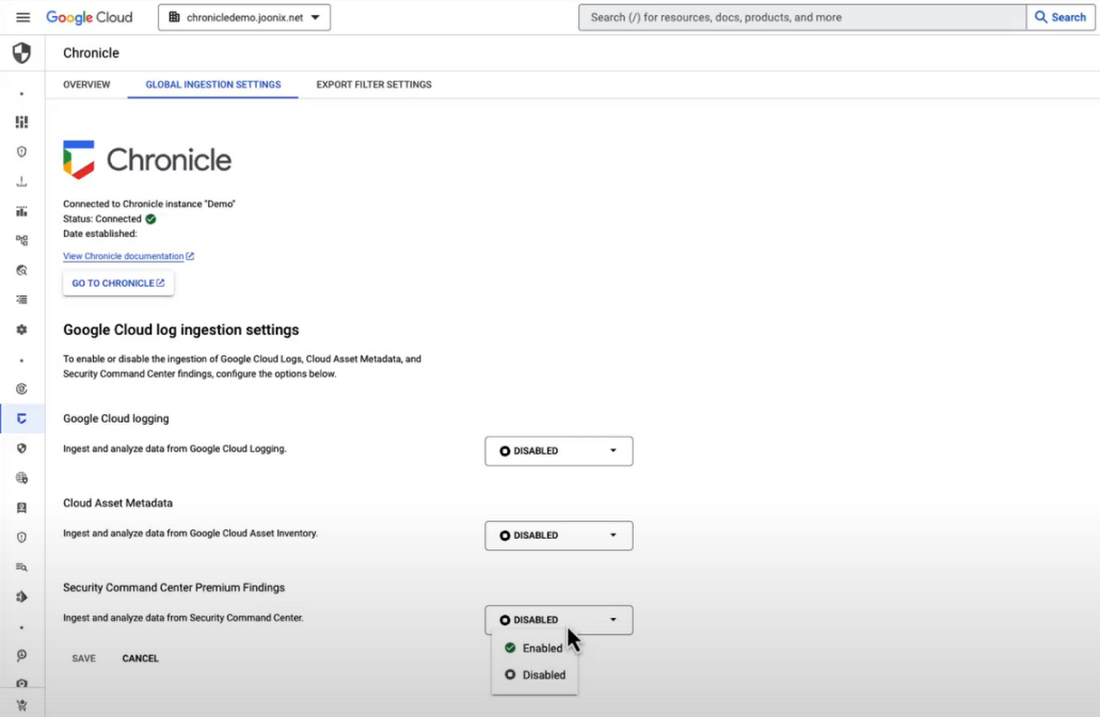
Chronicle now provides detection rules for Google Cloud threats. These rules correlate SCC findings with Chronicle’s advanced detection engine to reveal the broad scope of malicious activity, giving you visibility and more contextual information into what’s going on in your environment. In our example, Chronicle alerts on suspicious activity that can indicate an attempt to exfiltrate data from BigQuery.
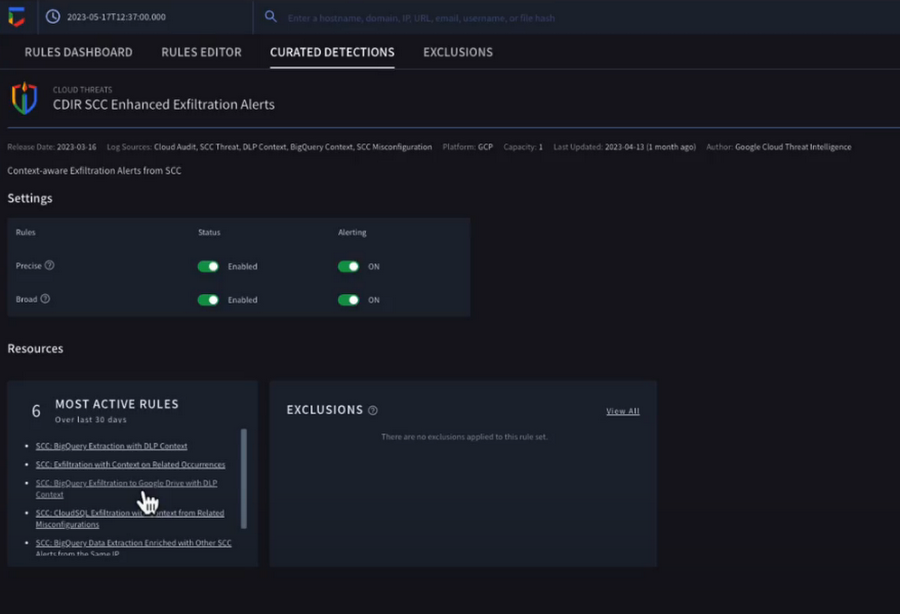
The new Chronicle Alert Graph surfaces key details of primary alerts you’re investigating in seconds. Combining cloud alerts and telemetry and correlating that with vital context from other sources (such as user data, endpoint data, and threat intelligence,) you can explore the visual representation of an alert’s relationship to other alerts and entities, dig into the potential attack paths, get quick summaries of implicated security artifacts, and pivot into your Google Cloud Console to do a deeper dive into potentially-impacted resources.
In our example, we can see a BigQuery exfiltration event associated with a customer and that it’s associated with a particular service account tied to a Google Cloud org. Alert context below tells us more about what’s been impacted. It shows us that cloud credentials in the form of encryption keys and email addresses were associated with the event.
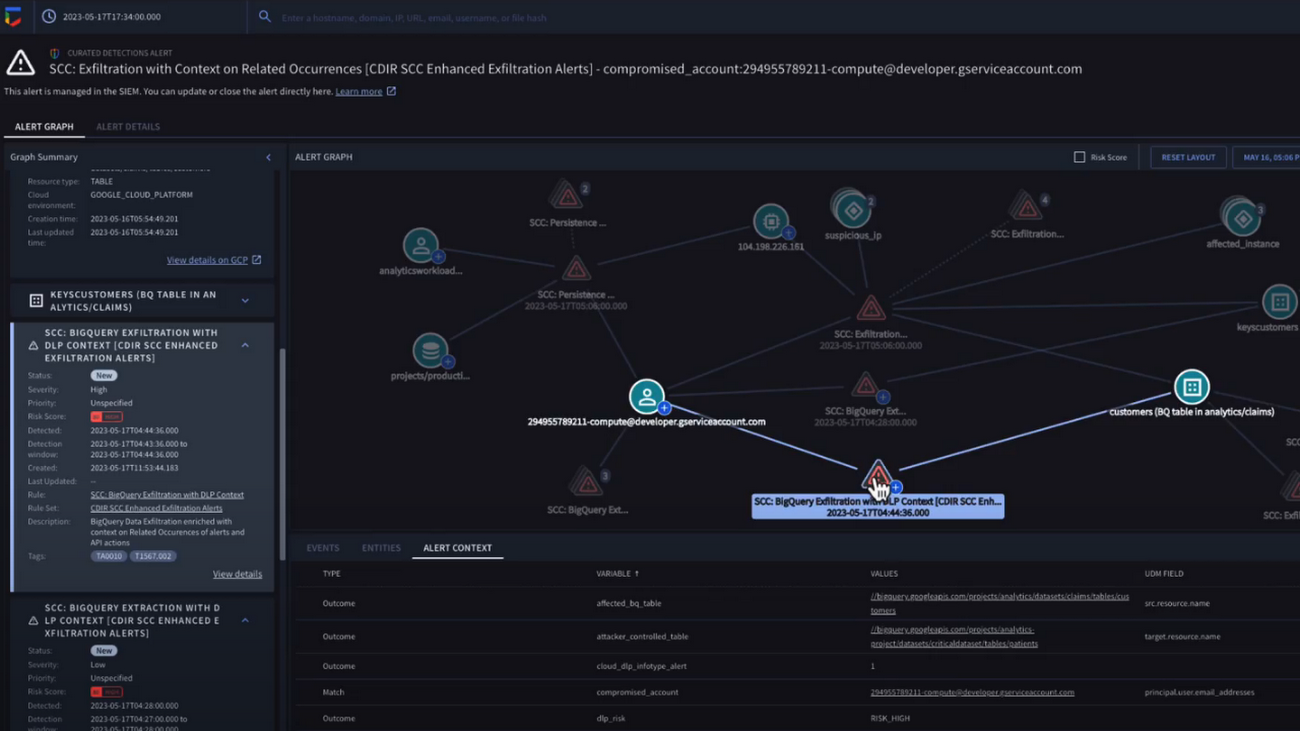
Chronicle case management automatically groups any related alerts into threat-centric cases, uniting the information that matters and making it simple for you to see and understand the scope of the event.
In our example, Chronicle groups these alerts together based on common source address and username, and the case wall provides the summary of the alerts and actions that are taking place across the entire case.
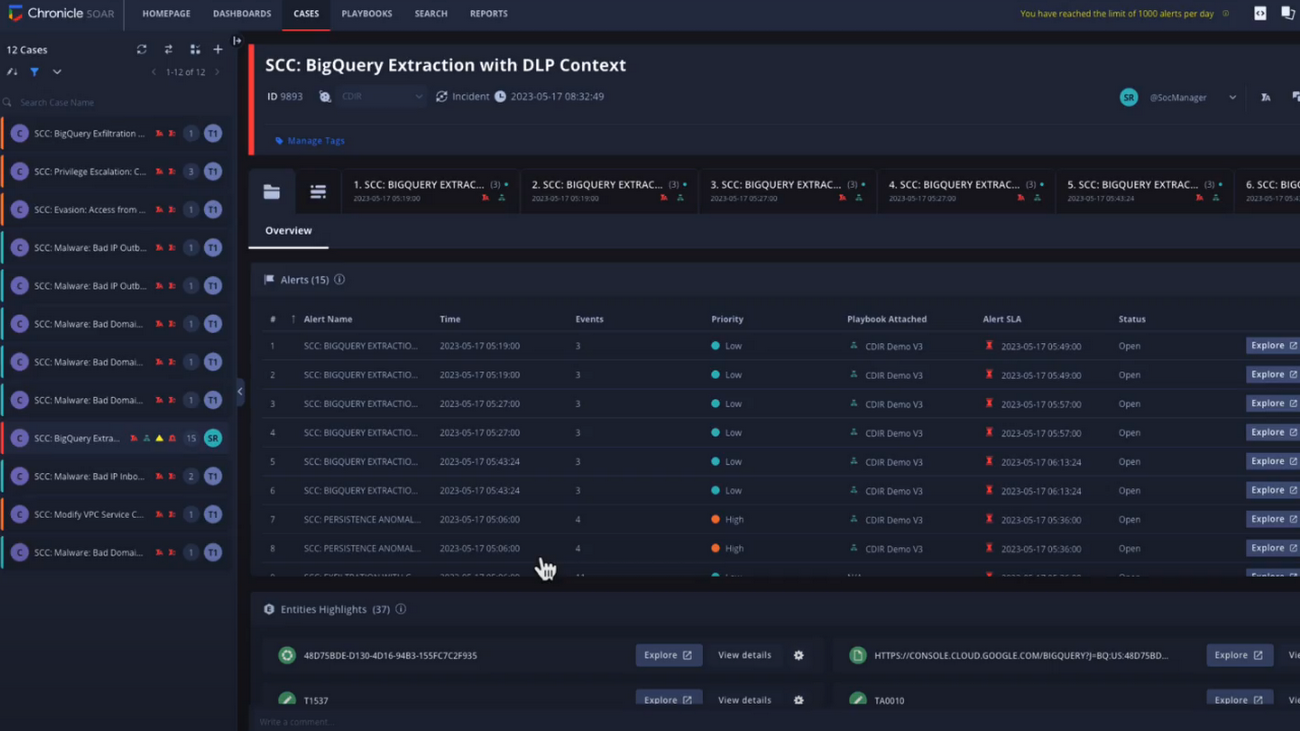
Chronicle playbooks, designed specifically for Google Cloud, automate your desired response processes. In our example, when an alert was generated a playbook automatically ran through predefined steps that gathered data, enrichment, and took automated remediation steps to prevent this service account and instance from continuing.
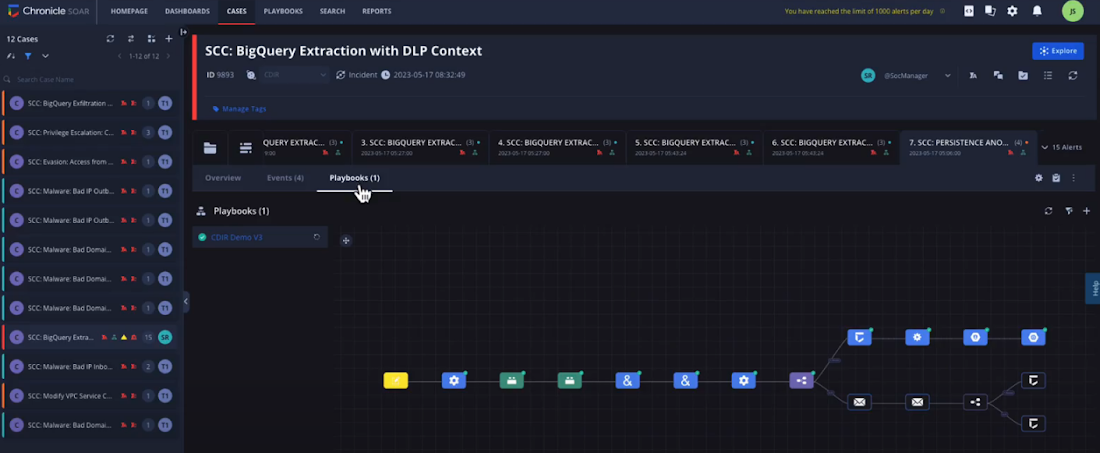
Ready to detect with confidence, investigate with broad context, respond with speed and precision, and simplify data ingestion? Chronicle Security Operations is your go-to for turnkey, end-to-end threat detection, investigation, and response on Google Cloud.
Tune in to our Security Summit session to learn more and see a demo of the new Google Cloud TDIR capabilities.
Defining cloud’s future: How autonomic data security can help

2555
Of your peers have already read this article.
1:30 Minutes
The most insightful time you'll spend today!
“Ninety percent of all data today was created in the last two years—that’s 2.5 quintillion bytes of data per day,” according to business data analytics company Domo. That would be a mind-bending statistic, except that it’s already five years old.
As data usage has undergone drastic expansion and changes in the past five years, so have your business needs for data. Technology such as cloud computing and AI have changed how we use data, derive value from data, and glean insights from data. Your organization is no longer just crunching and re-crunching the same data sets. Data moves, shifts, and replicates, as you mingle data sets and gain new value in the process, as we say in our Data Cloud story. All the while, your data resides in—and is being created in—new places.
Data lives in a myriad of locations now and requires access from different locations and mediums, yet many of today’s security models are not geared towards this. In short, your data has fallen out of love with your security model, but attackers have not. So, how do we realign data and security so they are once again in a healthy relationship?
Google Cloud, as a leader in cloud data management and cloud security, is positioned uniquely to define and lead this effort. We’ve identified some challenges around the classic approach to data security and the changes triggered by the near-ubiquity of the cloud. The case is compelling for adopting a modern approach to data security. We contend that the optimal way forward is with autonomic data security.
A relatively new concept, autonomic data security is security that’s been integrated with data throughout its lifecycle. It can make things easier on users by freeing them from defining and redefining myriad rules about who can do what, when, where. It’s an approach that keeps pace with constantly evolving cyberthreats and business changes.
Autonomic data security can help you keep your IT assets more secure and can make your business and IT processes speedier. For example, data sharing with partners and data access decisions simultaneously becomes faster and more secure. This may sound like magic, but in fact relies on a constant willingness to change and adapt to both business changes and threat evolution.

Taking the precepts, concepts, and forward-looking solutions presented in this paper into consideration, we strongly believe that now is the right time to assess where you and your business are when it comes to data security. Cloud also brings an incredible scale of computing. Where gigabytes once roamed, petabytes are now common. This means that many data security approaches, especially the manual ones, are no longer practical.
To prepare for the future of data security, we recommend you challenge your current model and assumptions and ask critical questions, evaluate where you are, and then start to put a plan in place of how you could start incorporating the autonomic data security pillars into your data security model.
There are two sets of questions organizations need to discover the answers to as they start this journey. The first set of questions will help you identify the nature and status of your data, and inform the answers to the second set.
- What data do I have?
- Who owns it?
- Is it sensitive?
- How is it used?
- What is the value in storing the data?
The second set focuses on higher-level problems:
- What is my current approach to data security?
- Where does it fail to support the business and counter the threats?
- Does it support my business?
- Should I consider making a change? And if yes, in what direction?
The path to improved data security starts by asking the right questions. You can read the full Autonomic Data Security paper for a more in-depth exploration here and learn more about the idea in this podcast episode.
The {$persona} Survival Guide: A Roadmap for Successful Transformation

2452
Of your peers have already read this article.
1:30 Minutes
The most insightful time you'll spend today!
Part of being a security leader whose organization is taking on a digital transformation is preparing for hard questions – and complex answers – on how to implement a transformation strategy.
In our previous CISO Survival Guide blog, we discussed how financial services organizations can more securely move to the cloud. We examined how to organize and think about the digital transformation challenges facing the highly-regulated financial services industry, including the benefits of the Organization, Operation, and Technology (OOT) approach, as well as embracing new processes like continuous delivery and required cultural shifts.
As part of Google Cloud’s commitment to shared fate, today we offer tips on how to ask the right questions that can help create the conversations that lead to better transformation outcomes for your organization. While there often is more than one right answer, a thoughtful, methodical approach to asking targeted questions and maintaining an open mind about the answers you hear back can help achieve your desired result. These questions are designed to help you figure out where to start and where to end your organization’s security transformation. By asking the following questions, CISOs and business leaders can develop a constructive, focused dialogue which can help determine the proper balance between implementing security controls and fine-tuning the risk tolerance set by the executive management and the board of directors.
To start the conversation, begin by asking:
- What defines our organization’s culture?
- How can we best integrate the culture with our security goals?
CISOs should ask business leaders:
- What makes a successful transformation?
- What are the key goals of the transformation?
- What data is (most) valuable?
- What data can be retired, reclassified, or migrated?
- What losses can we afford to take and still function?
- What is the real risk that the organization is willing to accept?
Business leaders should ask CISOs and the security team:
- What are the best practices for protecting our valuable data?
- What is the business impact of implementing those controls?
- What are the top threats that we need to address?
CISOs and business leaders should ask:
- Which threats are no longer as important?
- Where could we potentially use spending for more cost-effective controls such as firewalls and antivirus software?
- What benefits do we get from refactoring our applications?
- Are we really transforming, or lifting and shifting?
- How should we perform identity and access management to meet our business objectives?
- What are the core controls needed to ensure enterprise-level performance for the first workloads?
CISOs and risk teams should ask:
- How can we use the restructuring of an existing body of code to streamline security functions?
- How should we monitor our security posture to ensure we are aligned with our risk appetite?
Business and technical teams should ask:
- What’s our backup plan?
- What do we do if that fails?
Practical advice and the realities of operational transformation
Some organizations have been working in the cloud for more than a decade and have already addressed many operational procedures, sometimes with painful lessons learned along the way. If you’ve been operating in the cloud securely for that long, we recognize that there’s a lot to be gained from understanding your approaches to culture, operational expertise, and technology.
However, there are still many organizations that have not thought through how they will operate in a cloud environment until it’s almost ready – and at that point, it might be too late. If you can’t detail how a cloud environment will operate before its launch, how will you know who should be responsible for maintaining it?
Who are the critical stakeholders, along with those responsible for engineering and maintaining specific systems, who should be identified at the start of the transformation? There are likely several groups of stakeholders, such as those aligned with operations for transformation, and those focused on control design for cloud aligned with operations.
If you don’t have the operators involved in the design phase, you’re destined to create clever security controls with very little practical value because those tasked with day-to-day maintenance most likely won’t have the expertise or training to effectively operate these controls.
This is complicated by the fact that many organizations are struggling to recruit and retain resources with the right skills to operate in the cloud. We believe that training current employees to learn new cloud skills, and giving them the time away from other responsibilities, can help build skilled, diverse cloud security teams.
If your organization continually experiences high turnover in security leadership and skilled staff, it’s up to you to navigate your culture to ensure greater consistency. You can, of course, choose to supplement internal knowledge with trusted partners – however, that’s an expensive strategy for ongoing operational cost.
We met recently with a security organization that turns over skilled staff and leadership every two to three years. This rate of churn results in a continual resetting of security goals. This particular team joked that it’s like “Groundhog Day” as they constantly re-evaluate their best security approaches yet make no meaningful progress. This is not a model to emulate.
Many security controls fail not because they are improperly engineered, but because the people who use them – your security team – are improperly trained and insufficiently motivated. This is especially true for teams with high turnover rates and other organizational misalignments. A security control that blocks 100% of attacks might be engineered correctly, but if you can’t efficiently operate it, the effectiveness of the control will plummet to zero over time. Worse, it then becomes a liability because you incorrectly assume you have a functioning control.
In our next blog, we will highlight several proven approaches that we believe can help guide your security team through your organization’s digital transformation.
To learn more now, check out:
Highmark & Google’s Secure-by-design Technique to Bring the Living Health Solution to Life

6531
Of your peers have already read this article.
3:30 Minutes
The most insightful time you'll spend today!
In an industry as highly regulated as healthcare, building a single secure and compliant application that tracks patient care and appointments at a clinic requires a great deal of planning from development and security teams. So, imagine what it would be like to build a solution that includes almost everything related to a patient’s healthcare, including insurance and billing. That’s what Highmark Health (Highmark)—a U.S. health and wellness organization that provides millions of customers with health insurance plans, a physician and hospital network, and a diverse portfolio of businesses–decided to do.
Highmark is developing a solution called Living Health to re-imagine healthcare delivery, and it is using Google Cloud and the Google Cloud Professional Services Organization (PSO) to build and maintain the innovation platform supporting this forward thinking experience. Considering all the personal information that different parties like insurers, specialists, billers and coders, clinics, and hospitals share, Highmark must build security and compliance into every part of the solution.
In this blog, we look at how Highmark Health and Google are using a technique called “secure-by-design” to address the security, privacy, and compliance aspects of bringing Living Health to life.
Secure-by-design: Preventive care for development
In healthcare, preventing an illness or condition is the ideal outcome. Preventive care often involves early intervention—a course of ideas and actions to ward off illness, permanent injury, and so on. Interestingly, when developing a groundbreaking delivery model like Living Health, it’s a good idea to take the same approach to security, privacy, and compliance.
That’s why Highmark’s security and technology teams worked with their Google Cloud PSO team to implement secure-by-design for every step of design, development, and operations. Security is built into the entire development process rather than waiting until after implementation to reactively secure the platform or remediate security gaps.
It’s analogous to choosing the right brakes for a car before it rolls off the assembly line instead of having an inspector shut down production because the car failed its safety tests. The key aspect of secure-by-design is an underlying application architecture created from foundational building blocks that sit on top of a secure cloud infrastructure. Secure-by-design works to ensure that these building blocks are secure and compliant before moving on to development.
The entire approach requires security, development, and cloud teams to work together with other stakeholders. Most importantly, it requires a cloud partner, cloud services, and a cloud infrastructure that can support it.
Finding the right cloud and services for secure-by-design
Highmark chose Google Cloud because of its leadership in analytics, infrastructure services, and platform as a service. In addition, Google Cloud has made strategic investments in healthcare interoperability and innovation, which was another key reason Highmark decided to work with Google. As a result, Highmark felt that Google Cloud and the Google Cloud PSO were best suited for delivering on the vision of Living Health—its security and its outcomes.
“Google takes security more seriously than the other providers we considered, which is very important to an organization like us. Cloud applications and infrastructure for healthcare must be secure and compliant,” explains Highmark Vice President and Chief Information Security Officer, Omar Khawaja.
Forming a foundation for security and compliance
How does security-by-design with services work? It starts with the creation and securing of the foundational platform, allowing teams to harden and enforce specified security controls. It’s a collaborative process that starts with input from cross-functional teams—not just technology teams—using terms they understand, so that everyone has a stake in the design.
A strong data governance and protection program classifies and segments workloads based on risk and sensitivity. Teams build multiple layers of defense into the foundational layers to mitigate against key industry risks. Google managed services such as VPC Service Controls help prevent unauthorized access. Automated controls such as those in Data Loss Prevention help teams quickly classify data and identify and respond to potential sources of data risk. Automation capabilities help ensure that security policies are enforced.
After the foundational work is done, it’s time to assess and apply security controls to the different building blocks, which are Google Cloud services such as Google Kubernetes Engine, Google Compute Engine, and Google Cloud Storage. The goal is to make sure that these and similar building blocks, or any combination of them, do not introduce additional risks and to ensure any identified risks are remediated or mitigated.
Enabling use cases, step by step
After the foundational security is established, the security-by-design program enables the Google Cloud services that developers then use to build use cases that form Living Health. The service enablement approach allows Highmark to address complexity by providing the controls most relevant for each individual service.
For each service, the teams begin by determining the risks and the controls that can reduce them. The next step is enforcing preventive and detective controls across various tools. After validation, technical teams can be granted an authorization to operate, also called an ATO. An ATO authorizes the service for development in a use case.
For use cases with greater data sensitivity, the Highmark teams validate the recommended security controls with an external trust assessor, who uses the HITRUST Common Security Framework, which maps to certifications and compliance such as HIPAA, NIST, GDPR, and more. A certification process follows that can take anywhere from a few weeks to a few months. In addition to certification, there is ongoing monitoring of the environment for events, behavior, control effectiveness, and control lapses or any deviation from the controls.
The approach simplifies compliance for developers by abstracting compliance requirements away. The process provides developers a set of security requirements written in the language of the cloud, rather than in the language of compliance, providing more prescriptive guidance as they build solutions. Through the secure-by-design program, the Highmark technology and security teams, Google, the business, and the third-party trust assessor all contribute to a secure foundation for any architectural design with enabled Google Cloud services as building blocks.
Beating the learning curve
Thanks to the Living Health project, the Highmark technology and security teams are trying new methods. They are exploring new tools for building secure applications in the cloud. They are paying close attention to processes and the use case steps and, when necessary, aligning different teams to execute. Because everyone is working together collaboratively toward a shared goal, teams are delivering more things on time and with predictability, which has reduced volatility and surprises.
The secrets to success: Bringing everyone to the table early and with humility
Together, Highmark and Google Cloud PSO have created over 24 secure-by-design building blocks by bringing everyone to the table early and relying on thoughtful, honest communication. Input for the architecture design produced for Highmark came from privacy teams, legal teams, security teams, and the teams that are building the applications. And that degree of collaboration ultimately leads to a much better product because everyone has a shared sense of responsibility and ownership of what was built.
Delivering a highly complex solution like Living Health takes significant, more purposeful communication and execution. It is also important to be honest and humble. The security, technology, and Google teams have learned to admit when something isn’t working and to ask for help or ideas for a solution. The teams are also able to accept that they don’t have all the answers, and that they need to figure out solutions by experimenting. Khawaja puts it simply, “That level of humility has been really important and enabled us to have the successes that we’ve had. And hopefully that’ll be something that we continue to retain in our DNA.”
New Study Suggests Public Sector Firms Must Move Over Legacy Productivity Tools

5004
Of your peers have already read this article.
6:00 Minutes
The most insightful time you'll spend today!
Prior to joining Google Cloud, I spent 20 years in the public sector serving in various security roles, most recently as the head of the cybersecurity division at the newly established Cybersecurity and Infrastructure Security Agency (CISA). I was responsible for delivering services and capabilities to about 100 civilian agencies, as well as our critical infrastructure for state and local partners across the country.
Throughout my time serving in the U.S. government, I spent a great deal of energy working to keep bad actors out of our systems. What I eventually realized was that we were at a disadvantage. We didn’t just have legacy systems to deal with; we also had a legacy mindset. Our policies and capabilities were overly reliant on a perimeter-based approach to defense and introduced layers of friction with tools like VPNs, which inhibited productivity and increased frustration.
I spent the last few years of my time in the government doing my best to modernize this approach to security and supporting the many people who shared this vision. While most of them are still there, doing excellent work, repeated cybersecurity breaches of U.S. government systems have interrupted vital work and cost taxpayers billions of dollars. The SolarWinds breach in 2020, for example, may have cost governments and businesses more than $100 billion and the loss of vital national security information. Yet many government agencies continue to rely on the same legacy productivity software.
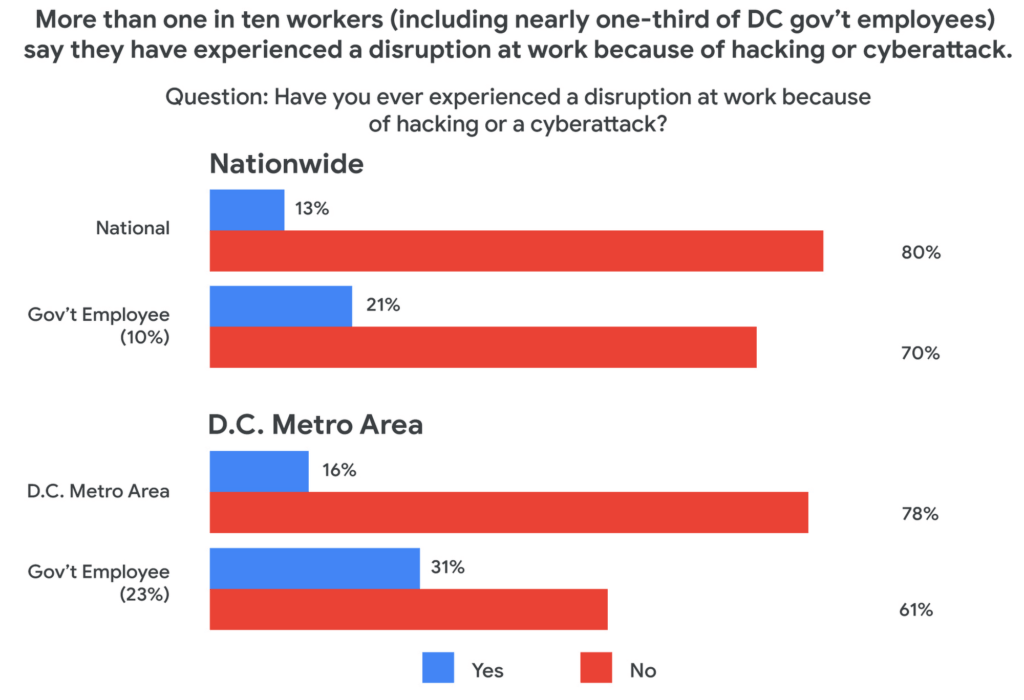
Today, a new survey conducted by Public Opinion Strategies and commissioned by Google Cloud shows that many government workers echo these concerns. The survey—which polled 2,600 working Americans, includes 600 workers from the D.C. metro area and 338 workers employed by federal, state, or local governments across the country—found that the majority of government employees surveyed reported being “very” concerned about cyberattacks striking their employers in the coming years. And nearly one-third of surveyed government employees in the D.C. metro area say they have experienced a disruption at work because of a cyberattack.
Results from the survey also showed a lack of satisfaction with legacy software, with more than 50% of government workers nationally responding that there are other products and services that could help them do their jobs better.
These new findings not only speak to the challenges our government employees face, but also outline an opportunity for improved innovation and security that can help government employees better achieve their missions.
Concerns about cybersecurity
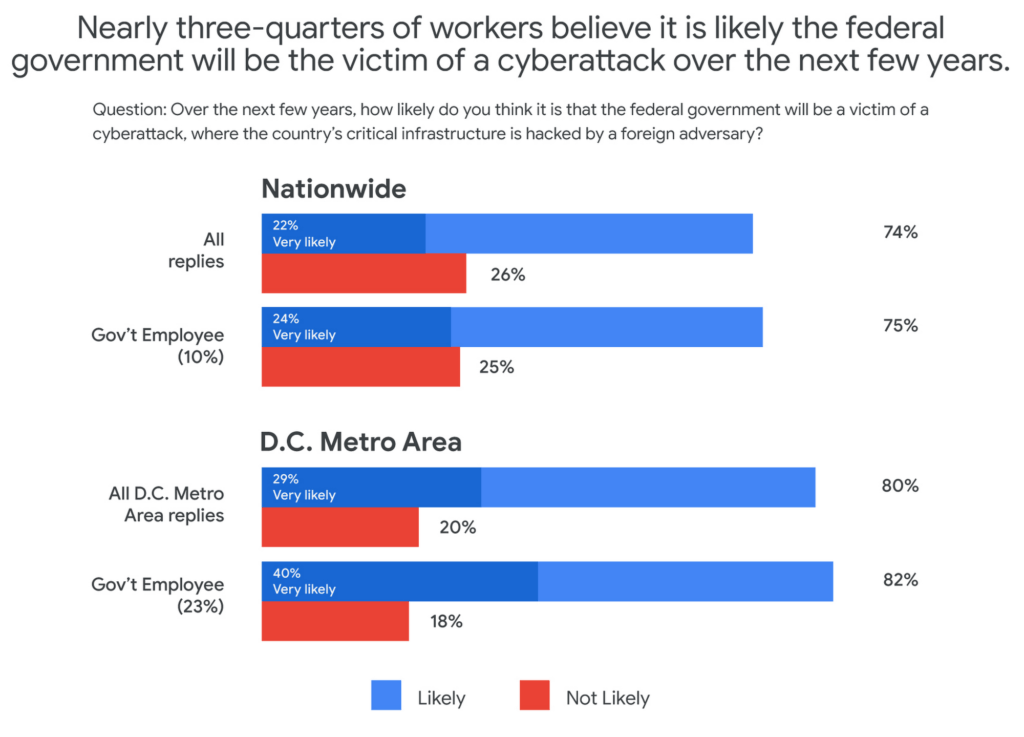
The majority of respondents said they believed it was likely that the federal government would be the victim of a cyberattack in the next few years. This percentage was even higher in the D.C. metro area and among government employees, with 40% of government workers living in metro D.C. saying it was “very likely.”
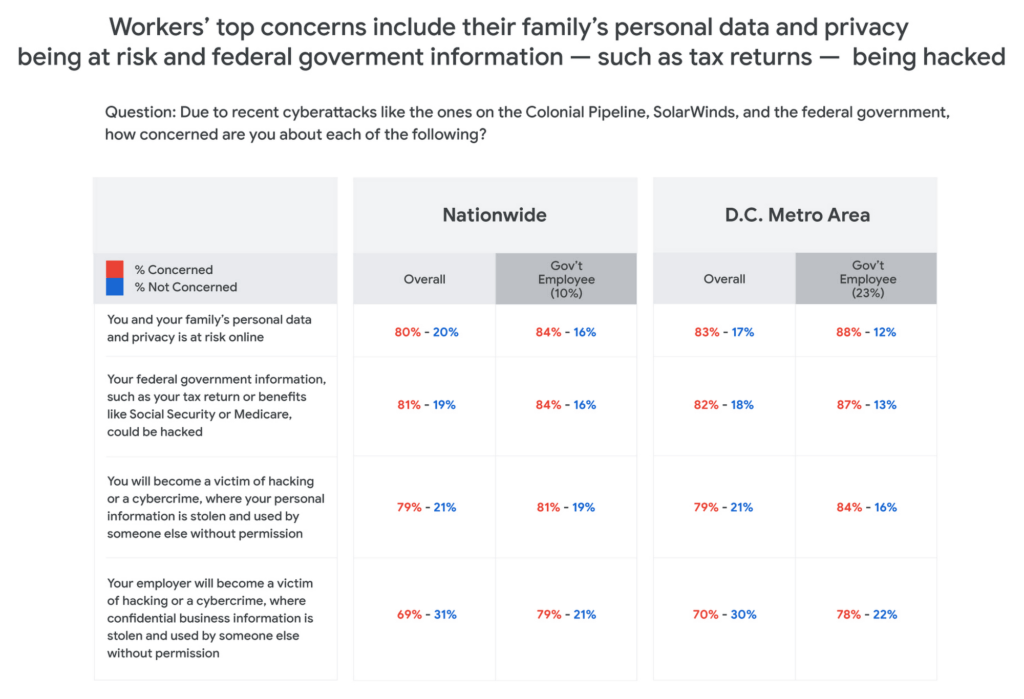
Respondents in all groups—national, D.C. metro, and government employees—were more likely to be concerned about cyberattacks as the perceived threat moved closer to home. For example, 80% of those surveyed said that recent attacks have them concerned about their personal data and privacy, and that of their family members. And for those in the D.C. area or in government jobs, the numbers were consistently higher than the national average.
One likely reason for such broad concern about cyberattacks is that many respondents reported experiencing a cyberattack at work. And while more than one-in-ten workers nationally have experienced disruptions from a cyberattack, the number increased to nearly one-in-three for D.C.-based government employees—nearly three times higher than the national average.
The problem with IT ‘monoculture’
According to survey respondents, 84% of D.C. metro government employees primarily use Microsoft products at work, including Word, Outlook, Teams, and OneDrive. This is confirmed by another recent study by Omdia that found 85% of government employees use Microsoft productivity software, far and away the largest IT productivity vendor by market share.
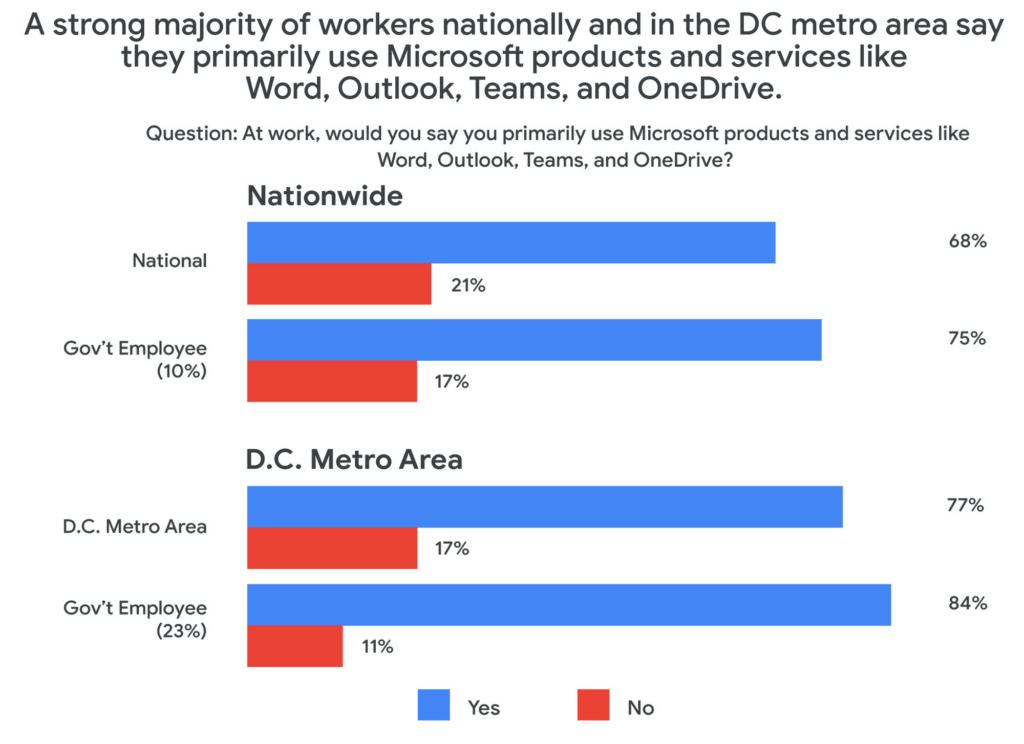
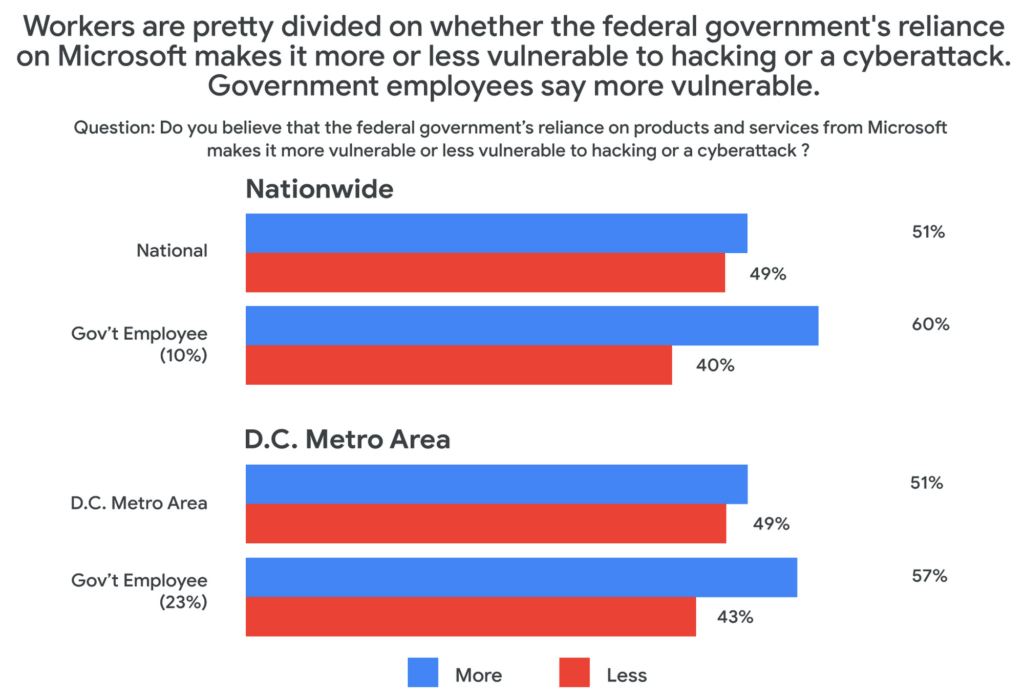
This reliance on a single software suite might suggest that these products are safe and secure, but the Public Opinion Strategies survey found that more than half of all respondents said that the government’s reliance on these Microsoft products actually made the federal government more vulnerable to hacking or cyberattacks.
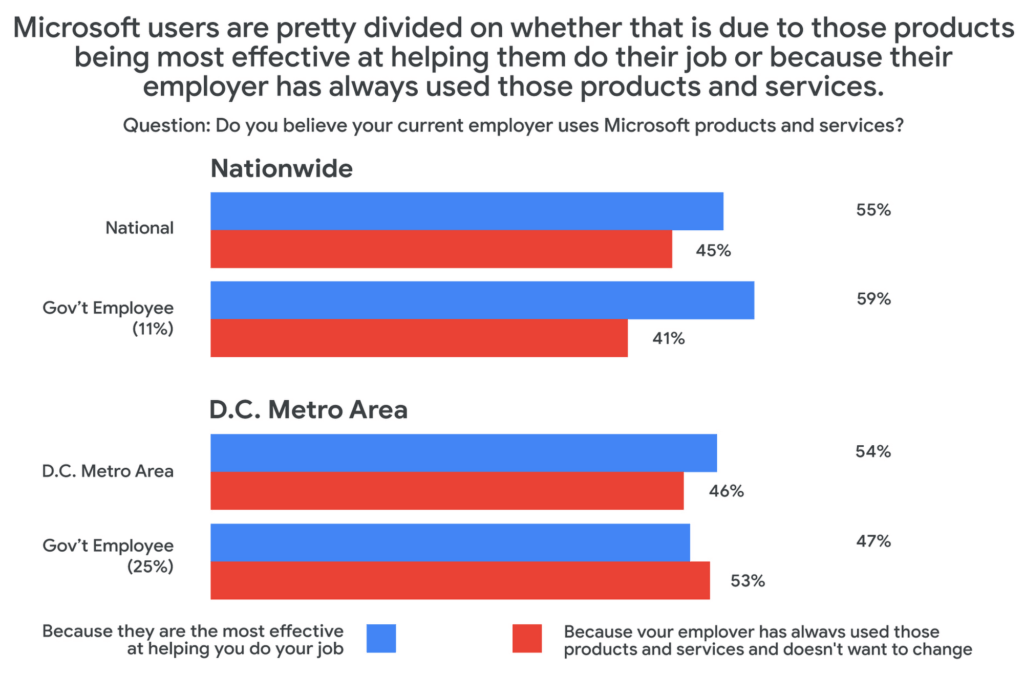
Given these vulnerabilities, why does government IT continue to rely on the same set of productivity tools in the workplace? The reason, according to survey respondents, has more to do with inertia than innovation. When asked why their employers used Microsoft services, around half said that the reason their employer continues to choose legacy, incumbent vendors was more about not wanting to change than wanting the most effective tool for the job.
Choice and shadow IT
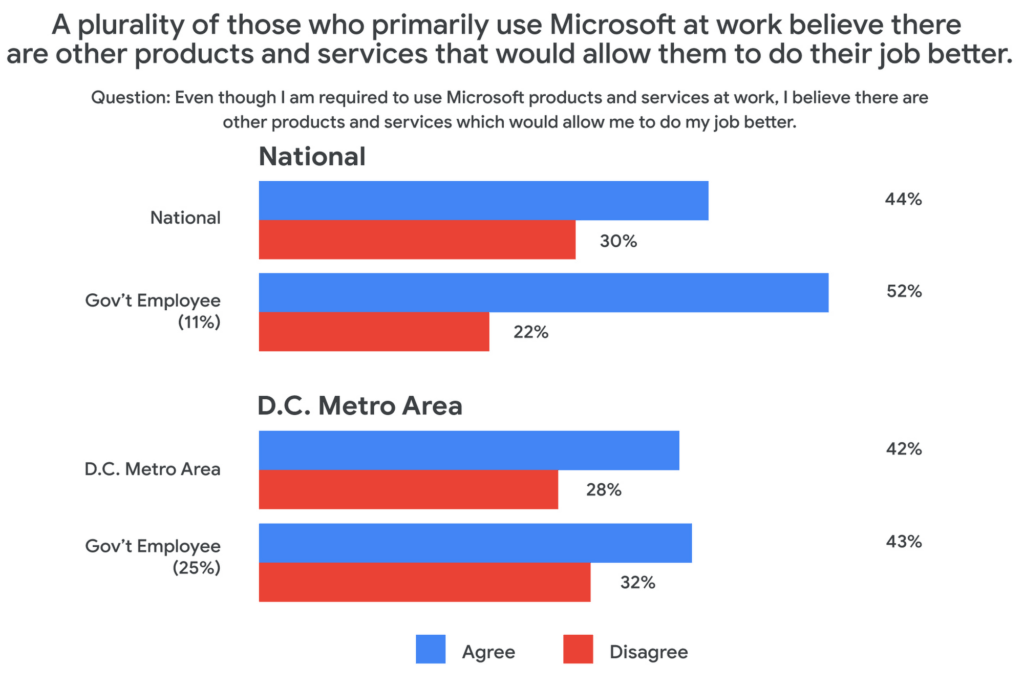
Coupled with these concerns about vulnerabilities comes a noted sentiment among those surveyed that their current IT solutions are not best for their needs. About half of those surveyed who primarily use Microsoft at work said that they would prefer to have a choice to use products and services from other companies. And among those who use Microsoft at work, 43% believe there are other products and services that would allow them to do their job better.
This may be leading workers to adopt “shadow IT,” or using products and services that are not officially approved or endorsed by their IT departments. In fact, the Public Opinion Strategies survey found that 35% of D.C. metro government workers have used shadow IT to get their jobs done. And among workers aged 20 to 34, that number jumps to 41%.
Rethinking IT purchasing priorities
With so many survey respondents reporting that they are dissatisfied with their legacy IT solutions, it may be time for the government to rethink its approach to procurement. In a separate research survey from Omdia in December 2021, 250 people responsible for technology purchasing decisions in the U.S. federal, state, and local governments said that government technology and procurement practices often are more about making things easier for IT vs. choosing what employees feel would be the best solution. In fact, only 27% of officials surveyed in that research cited “user demand” as a factor affecting their purchasing decisions.
As governments work to meet the demands and preferences of their constituents—and their employees—it’s clear that there’s an overreliance on legacy solutions, despite a track record of cybersecurity vulnerabilities and poor user perception.
At Google Cloud, we believe it’s time for more diversity and choice in the tools available for our civil servants across the nation—70% of whom use Gmail outside of work, according to our survey. Government workers have the right to benefit from the same flexible, secure-by-design tools at the office that they use in their personal lives. You can learn more about Google Workspace for Government here.
5217
Of your peers have already watched this video.
17:00 Minutes
The most insightful time you'll spend today!
AppSheet: Reduce Shadow IT and Accelerate Development of Enterprise-grade Apps
Google Cloud findings suggest that nearly 40 percent of organizations’ investments are consumed by shadow IT and can be a detractor to the adoption of cutting-edge tools and solutions. Also, about 51 percent of the surveyed executives are of the opinion that the inability to adapt to digital transformation trends and practices are at the risk of going out of business in the next 3-4 years. However, enterprises need not be blindsided by the mounting expenses involved with the implementation and optimization of solutions and tools meant for empowering employees. AppSheet, Google Cloud’s no-code application development and automation platform is at the helm of empowering organizations to custom build apps for employees without relying on third-party services.
Watch the video from the Google Workspace sessions of Next ’21 to hear experts’ insights on AppSheet to effectively govern workforce and ward off security threats to helps employees build enterprise-grade applications!
More Relevant Stories for Your Company

The SolarWinds Attack: A Case Study in Supply Chain Threats
Our quarterly Security Talks series brings together experts from Google Cloud Security teams and the industry to share information on our latest security products, innovations and best practices. Below is an introduction to Mandiant’s Security Talks presentation on Dec. 7, Mandiant Tales from the Front Lines: Activate Cyber Defenses Against

What’s in Line for Google Cloud’s Europe Customers in Regards to the E.U.-U.S. Data Transfer Framework
Last week, the European Commission and U.S. Government agreed on a new E.U.-U.S. data transfer framework. Earlier today, Google shared that it welcomes these efforts by the U.S. government to enhance privacy protections for E.U. data and facilitate trusted transatlantic data flows. For our Google Cloud customers, we intend to

Google Products Helps HMH’s Healthcare Staff Work from Anywhere Efficiently and Securely!
Hackensack Meridian Health (HMH) executive Mark Eimer explains how an ambitiously-timed rollout of a comprehensive suite of Google products helped the entire organization—from doctors to IT staff—achieve better security, cultivate a more equitable work environment, and ultimately, improve patient outcomes. How does a recently merged, 17-hospital healthcare system fast-track a platform migration



Journey to Transformation and Modernization with Google’s Distributed Cloud
Google Cloud has been leading the way of helping businesses make most from their cloud investments to drive digital transformation through modern application platforms that cater to today's customer needs. Watch the video from the Next '21 to explore three areas where companies are supported by Google Cloud throughout their
