





Transport Platform’s Richly-detailed Geospatial Data Allows Commuters to Track Buses in Real-time!

5639
Of your peers have already read this article.
3:00 Minutes
The most insightful time you'll spend today!
Vinayak Bhavnani, Co-Founder and CTO of India-based bus transport technology company Chalo, shares how Google Maps Platform is used to improve visibility for commuters and bus operators across India by visualizing geospatial data.
Effective public transport networks contribute to the local economy and help make cities safe, pleasant, and sustainable. In India, buses make up around 90% of the public transport offering, but when you talk to the people who ride them every day, you find that there’s a lot of room for improvement. Heavy traffic means there are rarely any fixed schedules and it’s impossible to know exactly when your bus is coming. We’ve found that people tend to wait at a bus stop for up to 30 minutes a day, which creates a lot of frustration and wasted time.
When we founded Chalo, our aim was to make the daily city commute a more positive experience. Reliability is synonymous with visibility: when you know exactly when the bus is coming, you can plan your day better. If you’re in your office, for example, and see the next bus is in 10 minutes, you can be at the stop at the exact time it arrives, instead of waiting around. To enable this, we base our solutions on richly-detailed geospatial data provided by Google Maps Platform.
Eliminating wait times and increasing revenue with geospatial data
In India, bus passengers tend to have fewer resources. The Chalo App, which can be downloaded for free, allows them to see exactly where their bus is on its route and when it will arrive at their nearest stop. They also tend to be late adopters of mobile technology, meaning we had to create an interface that was user-friendly, reassuring and adapted to all age groups and backgrounds. One of the main reasons we opted for Google Maps Platform is that it’s very present in India and other emerging markets and is familiar to our users, which inspires trust. At the same time, we like the fact that Google Maps Platform provides rich geospatial data while being simple to implement and work with. We use the Geocoding API, Reverse Geocoding, and the Directions API to enable location search and provide directions.
We also worked with MediaAgility to identify the Google Maps Platform products most suited to our needs and the best practices to be followed. This helped to ensure that our business objectives could be met efficiently.
The Chalo App also enables digital ticketing, alongside the Chalo Card, a payment card for those who don’t own a smartphone. India, like the rest of the world, is gradually moving away from cash payments, but the public transport system is proving slow to catch up, meaning people still must have cash in hand when they board the bus. Digital ticketing not only makes commuting more convenient, it also helps protect passengers, drivers and conductors during the COVID-19 health crisis by limiting physical contact.
Chalo also offers solutions aimed at bus operators that help them improve their services and their bottom line. In major Indian cities, buses are run by a combination of public and private agencies and small private individual bus operators, with the majority of the latter only operating one or two buses. The market is very fragmented and there’s not much incentive for bus operators to invest in infrastructure or customer experience – especially when they have little to no visibility on where their fleet is at a given time, how many kilometers it travels in a day, or how much money it takes.
The Chalo dashboard provides operators with a map-based real-time overview of bus locations, alongside scheduling features and route, ticketing, and passenger statistics. Geospatial intelligence and insight into passenger demand enable operators to explore new avenues of revenue and adapt routes and services to passenger needs. Operators who’ve partnered with Chalo report an average improvement of 10% to 30% of their bus fleet operations.
Chalo is currently powering about 100 million rides a month on 15,000 buses in 37 cities. We’d like to see the number of rides increase tenfold over the next few years. To do that, we’re looking to broaden our offer and expand to other parts of the country and across international borders. A pilot is underway in Bangkok, and we’re considering expansion into South-East Asia, Africa, and the Middle East. Having access to detailed geospatial data anywhere in the world via Google Maps Platform, without having to make any major investments or changes to our technology stack, will make this considerably easier.
At the same time, we’re exploring artificial intelligence and machine learning to improve the accuracy of our scheduling features and we’re introducing video-based solutions for people-counting on buses. Our aim is to continually improve our offering and optimize our services. We’re looking forward to working closely with Google to make that happen.
For more information on Google Maps Platform, visit our website.
Canva: Democratizing design and collaborating closely with Google Workspace

4003
Of your peers have already read this article.
3:30 Minutes
The most insightful time you'll spend today!
Launched in 2013, Canva is a free online design platform with a mission to empower everyone in the world to design. Featuring a simple drag-and-drop user interface and a vast range of templates ranging from presentations, social media graphics, posters, apparel to videos, plus a huge library of fonts, stock photography, illustrations, video footage and audio clips, anyone can take an idea and create something beautiful. The Canva team is located across the globe with offices in the United States, China, the Philippines and Australia.
A long-term user
“To empower our team to undertake deep work, we have a recurring weekly Calendar invitation that keeps an entire day free of meetings across the business.” – Jeff Lai, Internal Infrastructure Specialist, Canva
A business that enables collaboration, innovation, and creativity is a natural fit for Google Workspace, an integrated suite of secure, cloud-native collaboration and productivity applications. Canva is a long-term user of the application suite and Jeff Lai, Internal Infrastructure Specialist, says “being a global business from day one, the company wanted to ensure any technology we used would be able to grow and scale with us.
“Google Workspace certainly met the brief. For example, creating new Google Workspace instances is very easy, you simply connect them to your domain and away you go.”
Canva has 1,850 Google Workspace licenses to cover its approximately 1,200-strong workforce, plus service accounts and shared accounts. The application suite covers the organization’s communication, connectivity and productivity needs, with enough storage to enable the business not to have to pay for supplementary storage services or deploy storage in-house. Canva’s team of designers, developers, marketers, investors and advisers uses Google Workspace for tasks such as scheduling meetings, emailing and chatting to internal and external parties, storing files and tracking activity on spreadsheets.
“Google Workspace is like air and water to us,” says Jeff. “it is part of the natural environment of our workplace.”
Reviewing licensing
With Google Workspace enabling Canva’s global workforce model, the business is exploring ways of further leveraging the features available through the application suite; Jeff reveals Canva is exploring the use of enterprise-class licenses that provide additional reporting and auditing capabilities.
Near-100% availability
“We expect Google Workspace to continue to play a key role in our operations and in supporting an increasingly international workforce.” – Jeff Lai, Internal Infrastructure Specialist, Canva
Supporting a distributed model with an increasing number of employees based outside Australia also requires Canva to use collaboration and productivity tools available 24 hours a day, seven days a week.
Google Workspace applications help the business drive continuous improvement from the bottom up, as well as the top down. Canva uses Forms to capture — in what Jeff describes as ‘no-judgement’ fashion — new ideas, callouts of broken processes, or areas of improvement. These comments and suggestions go directly to founders and senior management for action.
Furthermore, Google Workspace enables Canva to run a continuously productive working environment. “To empower our team to undertake deep work, we have a recurring weekly Calendar invitation that keeps an entire day free of meetings across the business,” says Jeff.
Growth example of ‘new normal’
Canva’s team believes the organization’s accelerated growth is indicative of the ‘new normal’, as more teams realize the need for a more scalable, more collaborative, more affordable and more user-friendly design platform.
Organizations of all sizes are doubling down on building a reliable remote workplace, and are turning to modern productivity and collaboration platforms like Canva to ensure they remain flexible and scalable.
Google Workspace and other Google Cloud products and services also enable Canva to increase the value of its own platform. The business uses Translation API to translate non-English searches into English, allowing it to display appropriate images and other elements.
Furthermore, the Canva editing tool enables users to pull files from Drive to be refined, while the platform also integrates with Google Maps and YouTube to give end users the ability to easily create items such as online brochures with these products integrated into them. Finally, Canva for Education — a tailored product to support student learning — integrates with Google Classroom, helping educators efficiently manage progress and connect with students at school, from home or on the go.
With Google Workspace, Canva is ideally positioned to continue growing its user base and build on the success of a platform that has thousands of templates and fonts, and millions of stock photos, icons and illustrations. Jeff says the business remains focused on the same goal as its founders had right at the start — making design accessible to everyone. “We expect Google Workspace to continue to play a key role in our operations and in supporting an increasingly international workforce,” he says.
Fortune 500 Electronics Manufacturer Makes Collaboration a Competitive Advantage…and Saves $2 Million A Year

4656
Of your peers have already read this article.
4:30 Minutes
The most insightful time you'll spend today!
When electronics manufacturer Sanmina adopted G Suite several years ago, its goals were clear: reduce licensing costs, simplify management—particularly of its messaging tools—and cut hardware expenditures.
Fast forward several years and the Fortune 500 company has achieved those goals and more. By moving to Gmail, Sanmina reduced more than 110 email servers by over 90%, freed up its IT support function from basic administration to focus on more valuable tasks, and saved $2 million a year on total cost of ownership (including over $1.5 million a year on IT licensing).
A long-term plan: cloud collaboration
For Sanmina CIO Manesh Patel, the impressive returns are part of a bigger plan. From the beginning, Manesh recognized the potential of moving to the cloud to facilitate collaboration across Sanmina’s global operations. With more than 45,000 employees across 26 countries delivering different elements of a global value chain from design to delivery, the benefits of improving collaboration were clear. It could open up innovation by drawing on ideas from different locations and teams and enhance quality control throughout the manufacturing process.
As the first step towards this compelling vision, Manesh focused on rolling out Gmail and Calendar. Both applications were already familiar to many employees and offered a straightforward route to embrace cloud services. With cost savings quickly following, colleagues across Sanmina could see clear benefits from the shift to the cloud.
At the same time, Sanmina made the full suite of tools available and allowed adoption to occur organically across the organization.
Driving adoption
As interest in cloud computing grew, G Suite provided an ideal platform for employees to explore new ways of working together—with some parts of the business swift to develop effective uses for the collaborative tools. Building on the work of these leaders, Manesh has promoted adoption of the suite on several fronts over the past 18 months. Manufacturing, Quality, Engineering, and Supply Chain are a few examples of early adopters that benefit from the improved collaboration in G Suite.
The company also looked to build greater awareness of new G Suite features and functions. It engaged with Google partner Maven Wave. “Maven Wave has been a terrific and responsive partner,” he says. “They’re open and adapted their approach to our needs, while bringing a core competency on G Suite.” Maven Wave brought the experience of working with other global companies on similar initiatives, and an effective change management methodology that was tailored to fit Sanmina’s culture.
“Hangouts Meet fundamentally changes how people interact; you can put a face to a name and really engage with your team. It’s as close as you can get to meeting in person.”
– Manesh Patel, CIO, Sanmina
The messaging tools were not being used to full effect either. When Gmail was first introduced, training was optional; some of the teams were therefore not familiar with features such as attaching documents from Google Drive or archiving content. To help ensure the whole business was using Gmail to its full potential, there has been strong internal promotion of Google’s easy-to-use, online G Suite Training tools. “It’s very easy to consume and very effective,” says Manesh.
Embracing collaboration
Today, Sanmina employees rely daily on several G Suite tools, including Docs, Sheets, Slides, and most recently Hangouts Meet.
“More and more of our employees use Hangouts Meet. Our employees often work as part of teams that are dispersed around the world, so they don’t have the chance to actually meet their colleagues,” Manesh explains. “Hangouts Meet fundamentally changes how people interact; you can put a face to a name and really engage with your team. It’s as close as you can get to meeting in person.”
Manesh acknowledges that this is not simply a result of technological change, but a cultural shift as people grow more comfortable with video calls in their personal lives. Hangouts Meet brings that same ease of use to professional settings—and even well-traveled executives are adopting Hangouts Meet, appreciating its versatility across multiple platforms.
To encourage further use, the IT team has committed to equipping at least one room in every Sanmina facility around the world with Hangouts Meet hardware. “We definitely expect to save time and reduce travel costs with Hangouts Meet,” Manesh confirms. “But the bigger benefit for us is definitely the way it brings people together.”
Collaborating across teams and communities
With that goal in mind, Manesh has also promoted several other collaboration tools—in particular Hangouts Chat, Reveal, and Team Drives.
“More and more of our communications take place via Chat, whether in a team environment or one-to-one setting,” he says. “It’s the asynchronous tool that works alongside Hangouts Meet, for synchronous collaboration.”
Similarly, the use of Reveal—a corporate video sharing platform developed by Maven Wave and Google—is growing. “We’ve just started using Reveal to distribute regular video messages from the CEO to our employees and we also expect it to be a big part of our internal communications,” Manesh says. These videos help keep Sanmina employees aligned with company goals and increase a sense of connectedness across the global organization.
Sharing files between dispersed teams
The move to increase use of Team Drives, meanwhile, is one of Manesh’s priorities. “In every one of our factories worldwide, we have a shared drive on a shared server. We’re in the process of moving those to Team Drives, which will provide a big benefit in terms of infrastructure and in terms of how we work.”
“G Suite enables us to collaborate efficiently and create complex process documents that help us adhere to strict quality control requirements.”
– Manesh Patel, CIO, Sanmina
Manesh and his team have spent a lot of time and effort improving capacity, redundancy, and failover capabilities in preparation for the change. Team Drives should reduce storage requirements and remove challenges and costs tied to back-up and maintenance.
More importantly, the use of Team Drives will mean that files can be shared across multiple sites to further improve collaboration across teams.
Bringing collaboration to the factory floor
The power of G Suite is evident across the organization—from its corporate offices to its factories worldwide. “We’ve had employees creating a Google Sheet, sharing it with five team members, and then displaying it on a big screen on the manufacturing floor so everyone can see the project status,” he explains.
Another key process that is being transformed is quality reporting. The quality team has identified that moving large quantities of required documentation from legacy technologies to G Suite can assist with transparency and version control, routing, and approvals. “G Suite enables us to collaborate efficiently and create complex process documents that help us adhere to strict quality control requirements,” Manesh says.
“We need to empower employees to get the information they need, when they need it, on any device. G Suite makes that happen.”
– Manesh Patel, CIO, Sanmina
Gaining a competitive edge
Sanmina continues to achieve solid year-over-year returns on its investment in G Suite, and those returns will grow with increased adoption. “G Suite really is at the heart of our efforts to get people to work in ways that are more efficient and effective,” Manesh says.
For a company with a rich history of innovation and service, the expanded use of G Suite is another way that Sanmina stands out from competitors. “We need employees to be empowered to get the information they need, when they need it, and on any device. G Suite makes that happen.”
5350
Of your peers have already watched this video.
26:00 Minutes
The most insightful time you'll spend today!
On-Demand Webinar: 3 Ways Collaboration Transforms How Your Company Works
A majority of your employees and teams spend 38% of their time unsuccessfully searching and recreating content, according to IDC.
They also spend 20% of their time looking for information, according to McKinsey. That’s 58% of time lost in unproductive tasks that could have been spent coming up with the next big innovative idea that actually impacts business.
Now you know why there are no new ideas, no new innovations, no room for business to grow. Savvy organizations like Nielsen, Whirlpool, and Colgate-Palmolive have had enough of that and are embracing the cloud to collaborate in real-time and transform how their companies work.
The only way to achieve business growth and beat competition is to invest less time in unproductive tasks—like looking for information—and more time innovating with intelligent systems that provide your teams with information they need without even having to look for it: The ability to search smart, find fast, collaborate in real-time, and build new ideas quickly. Embracing Artificial Intelligence enabled-cloud collaboration platforms is one way to get there.
In this webinar, Allen Yang, Product Manager, Google Cloud, talks about how big corporations are turning to the power of the cloud to enable real-time collaboration, faster decision making, smarter and more productive employees and teams, and embracing a new way of working.
If You Run Your Country’s Largest Retail Franchise, How Do You Pull Together, in Sync?

6316
Of your peers have already read this article.
9:30 Minutes
The most insightful time you'll spend today!
In 1984, Mario Maio set up a small business manufacturing electrical transformers in his Johannesburg garage. Over the next two decades, the ACDC Dynamics company he created came to dominate manufacturing, import, and distribution in South Africa’s electrical goods sector. Then, in 2007, Mario’s son, Ricardo Maio, founded a retail arm to the business, ACDC Express. Today ACDC Express is South Africa’s largest electrical retail franchise, with 29 franchise stores across the country. Eight of those franchises joined in 2017 alone, and ACDC Express is experiencing quarter-on-quarter growth of 28% per year.
Rapid expansion increases the demands on the ACDC Express central administration, which provides each franchise with IT support and a full suite of marketing, operational, and bookkeeping functions. So when email server downtime became a frequent problem, Ricardo and his team chose G Suite to transform the way the franchise worked.
“We lost revenue when our email servers went down. When I researched Google’s SLA of 99.9% uptime and experimented with G Suite on my private Gmail account, I could see the difference this technology could create.”
Ricardo Maio, CEO, ACDC Express
“On consecutive occasions, our entire email server went down,” says Ricardo Maio, CEO at ACDC Express. “It would take more than one or two days to bring it back up. We had already highlighted software cost overhead as a potential thing to reduce, so when that happened several times within a short period, we knew it was time to make a change.”
Building a better franchise
Franchise businesses undergoing rapid expansion must respond quickly to the demands of new stores. At ACDC Express, 33 staff run the national franchise, delivering core services and support to 29 franchises across the country. Key tasks, such as updating the operations manual, were hampered by a reliance on paper forms and mail services, while email servers experienced repeat failures, which compromised communication. By implementing new, cloud-based productivity tools, ACDC Express looked to cut down on slow and expensive practises, and deliver an agile, reliable online communications platform.
To do that, ACDC Express migrated its franchise to G Suite with Opennetworks. “We lost revenue when our email servers went down,” says Ricardo. “When I researched Google’s SLA of 99.9% uptime and experimented with G Suite on my private Gmail account, I could see the difference this technology could create.”
Since moving to Gmail, ACDC Express reports that the problem of email server downtime “is no longer existent for us,” while with Google Drive, versioning problems have been resolved. Using surveys on Google Forms, ACDC Express quickly and easily collects data from stores and customers—whether they are in stores or on the road—and populates Google Sheets with the information.
“Our operations manual is a binding document, and it’s a living document that gets regularly updated. In the past, we would struggle to track which franchise had which version. With Google Drive, we can be sure that everyone is looking at the right one.”
Ricardo Maio, CEO, ACDC Express
With Google Data Studio, the managing team then consolidates that data on dashboards, creating snapshots of performance, complete with averages and simple comparisons, which make it easy to spot issues and outliers in need of attention. Individual businesses that do require help are then contacted over Google Hangouts Meet to assess what they need, part of a culture of sharing expertise, which Ricardo sees as key to the franchise mode.
“As a franchise, sharing knowledge is as important as maintaining control,” he says. “If there’s a new procedure or system that worked in one store, we can immediately update our manuals and documentation so that everyone has access to it. That’s been fantastic.”
“Our operations manual is a binding document, and it’s a living document, which gets regularly updated,” says Ricardo. “In the past, we would struggle to track which franchise had which version, and every time we had to make a change we would print out a version and send it to stores through an unreliable postal service. With Google Drive, we can be sure that everyone is looking at the right one.”
Remote training, rapid migration
Rolling out new IT tools across a franchise is often expensive, demanding extensive travel and numerous training sessions, which often repeat the same material. Instead, ACDC Express set up training on Google Hangouts that staff could drop into at their convenience, creating a cost-effective training schedule, which meant individual stores could plan their own learning process.
“When we moved to G Suite, we did it all at once, with every employee changing at the same time. We took a band-aid approach, switching to the new tools as rapidly as possible. After six months of training, there have been no reported problems with G Suite at all.”
Ricardo Maio, CEO, ACDC Express
“The whole benefit of franchising is that you can learn from your peers,” says Ricardo. “When we moved to G Suite, we did it all at once, with every employee changing at the same time. We took a band-aid approach, switching to the new tools as rapidly as possible. After six months of training, there have been no reported problems with G Suite at all.”
More mobile, more reliable
Today, ACDC Express operates 240 Google accounts, and information from the franchises’ marketing systems, research, operations, and accounting is fed back automatically to Google Sheets and Google Dashboard at the headquarters in Edenvale, Gauteng. By Ricardo’s estimation, the administrative team is now so effective with G Suite tools, it can achieve twice as much as it could without them.
Now, ACDC Express is looking to use Google Chromebooks in a new web-based point-of-sale system, and considering moving its ERP onto Google Cloud Platform for greater stability, in another project with Opennetworks.
“We’ve developed an in-house point of sale system that’s web-based and can use a functional touchscreen,” adds Ricardo. “We’re looking at rolling that out with Google Chromebooks. We really like how straightforward and simple the Google Chrome devices are, and because we’ve taken a lot of infrastructure into the cloud, we no longer actually need physical machines on our counters. We can work anywhere. That’s something that applies from our head office right down to our smallest franchise store.”
Taking Maps Further: New Website Experience for Product Discovery, Budgeting and Access to Dev Documentation

6655
Of your peers have already read this article.
1:30 Minutes
The most insightful time you'll spend today!
For more than 15 years, developers have used Google Maps Platform to deliver location-based experiences to their end users and used location intelligence to optimize their businesses. Along this journey, we’ve made a variety of changes to better support our community as needs have changed and new industries and technologies have emerged. We started rolling out a new website experience, at https://mapsplatform.google.com, to help you better understand the products and solutions best suited to address your objectives. Plus, now you can directly connect to the developer documentation for each product to get started quickly, and you can visualize usage and associated costs to have a better idea of what to expect before getting started.
Getting to your solution faster
Maps, Routes, Places are building blocks that let you develop implementations for any use case. Building for specific use cases, however, typically requires using a combination of APIs and SDKs. To help you quickly understand what’s possible and what you need to build for your use case, you can now visit the solutions tab to select from a list of popular use cases or industries. Once you’ve selected a use case or industry, you’re taken to a page where you can explore relevant products, read helpful blog posts, see how other customers have deployed for similar use cases, and more.
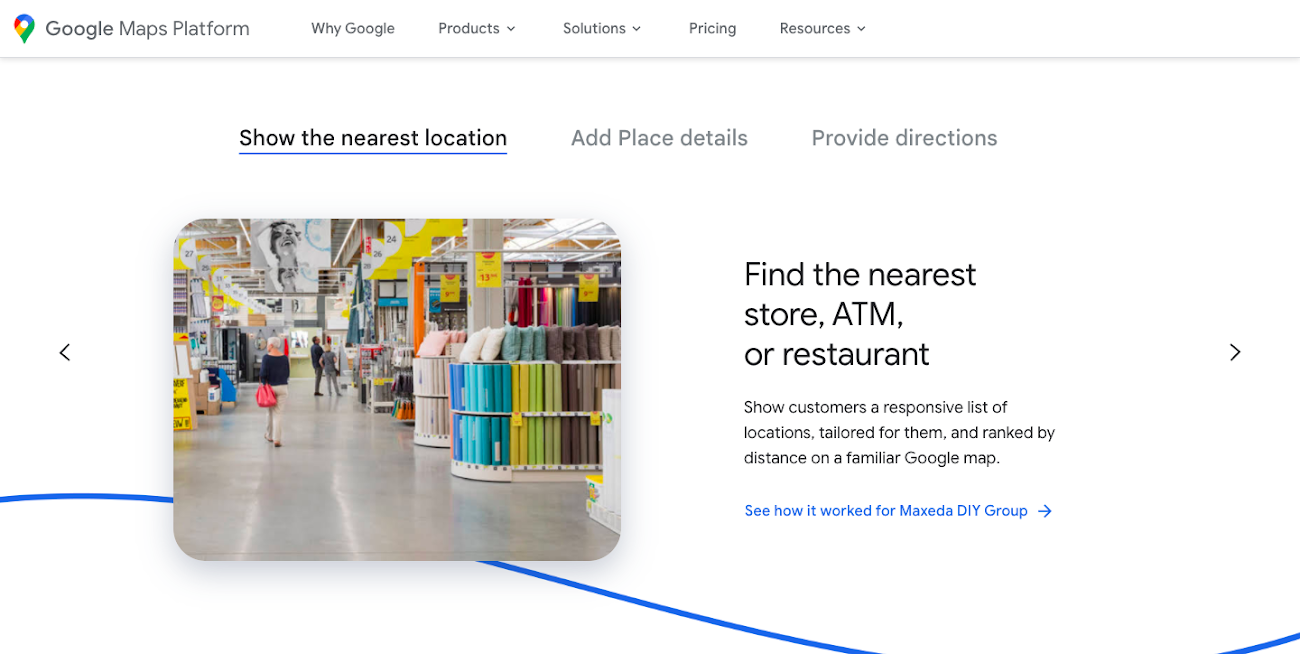
Direct access to developer documentation
Did you know there are more than a thousand pages of developer documentation created to help you get started, unblock you when you’re stuck, and share best practices? Now when you explore a product or solution from the Google Maps Platform website, you can easily navigate back and forth between our website and documentation. Just tap on JS, iOS, Android or API under the product name to get to the documentation you need.
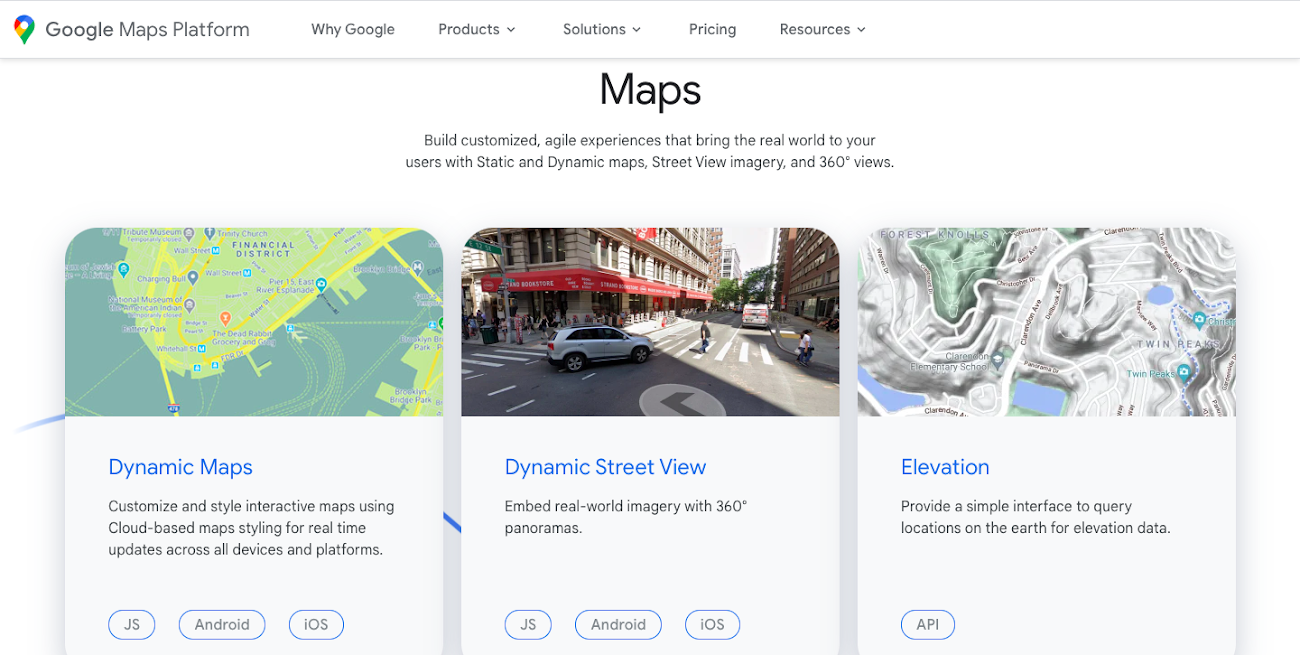
Budgeting for your project
To help you calculate pricing for your project, we’ve introduced a new pricing calculator. Once you find the product and API or SDK you plan to use, pull the slider to reflect your estimated number of monthly requests. This will automatically update the “monthly cost” column for each product and API or SDK you plan to use. If your estimated monthly requests exceed the slider limit, contact our sales team to learn about volume discounts that start at 20% off.
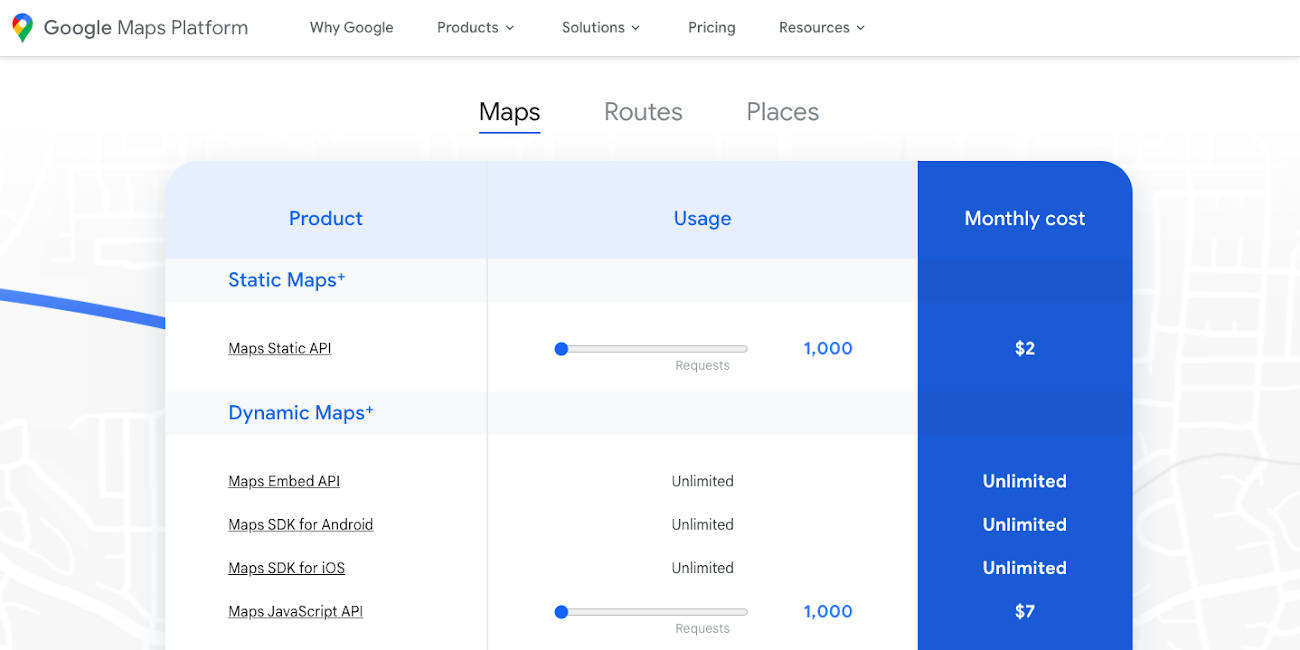
We hope our new website makes it easier to discover our products and solutions, estimate your budget, and start building with our documentation so you can deliver helpful experiences to your users and optimize your business.
For more information on Google Maps Platform, visit https://mapsplatform.google.com.
More Relevant Stories for Your Company

How Do You Cut Costs and Improve Staff Productivity, and Business Visibility? Ascend Money Has an Answer
Hundreds of millions of residents of South East Asia have only limited access to banking and finance services. However, help is at hand. One of South East Asia's largest fintech businesses, Ascend Money is using digital technologies to realize its mission of enabling as many people as possible to access

16 Popular Chrome Insider Posts to Help You Simplify Browser Deployments
We launched the Chrome Insider blog in 2019 to share tips and best practices with IT admins so they could better deploy, manage, and secure Chrome browser. Since then, the series has covered everything from supporting legacy browsers to protecting enterprise credentials to simplifying deployments. To make it even easier

Safeguarding time and attention with Google Workspace and Gmail
As the pandemic forced millions of people to work from home, many of us found ourselves spending more time in video meetings and in our inboxes as a way to bridge the distance from our colleagues. When the workplace became the living room or the makeshift home office, and as

Dr. Agarwal’s Eye Hospital Cuts IT Support Tickets By 80% With Google
Founded by the late Dr. J. Agarwal, Dr. Agarwal’s Eye Hospital, headquartered in Chennai, India, operates 62 hospitals in cities across India and 14 hospitals in 8 countries in Africa, including Zambia, Nigeria, and Ghana. According to Dilip Ramadasan, GM-IT, Dr. Agarwal’s Eye Hospital, the business is the second-largest network
