





A French News Company’s Web Modernization Journey with Cloud Run

3498
Of your peers have already read this article.
1:30 Minutes
The most insightful time you'll spend today!
Editor’s note: Today’s post documents the solution to a problem of how to scale website infrastructure as it moves from on-prem to the cloud. It is the result of collaboration between technical teams of Les Echos Le Parisien Annonces (a division of Groupe Les Echos, subsidiary company of LVMH) and Google in the spirit of finding the best tool for the job together.
All technology starts aging from the first day you set it up, and over time becomes in need of some renewal. At Les Echos Le Parisien Annonces (a division of Groupe Les Echos, subsidiary company of LVMH), we complement the main site (“publication annonce légale”) with a number of local market sites for different regions within metropolitan France, as well as French readers in territories across the world. Each local market site offers a variety of services and content, which are served by a set of CMS-driven sites.
Historically these sites were served from dedicated on-prem infrastructure. As the number of sites grew, vertical scaling was used to increase the capacity of the machine. Over time, this approach presented challenges. First, each new site involved modifying multiple shared configurations, and modifying several monolithic parts of the architecture. Because all the sites shared parts of the serving stack, an issue that developed for one site could take down all of the sites. The reliability of the serving path was not able to reach the availability we and our customers expected. Les Echos and Google put their heads together to solve this with a new serverless deployment pattern where each new site can be quickly and independently launched.
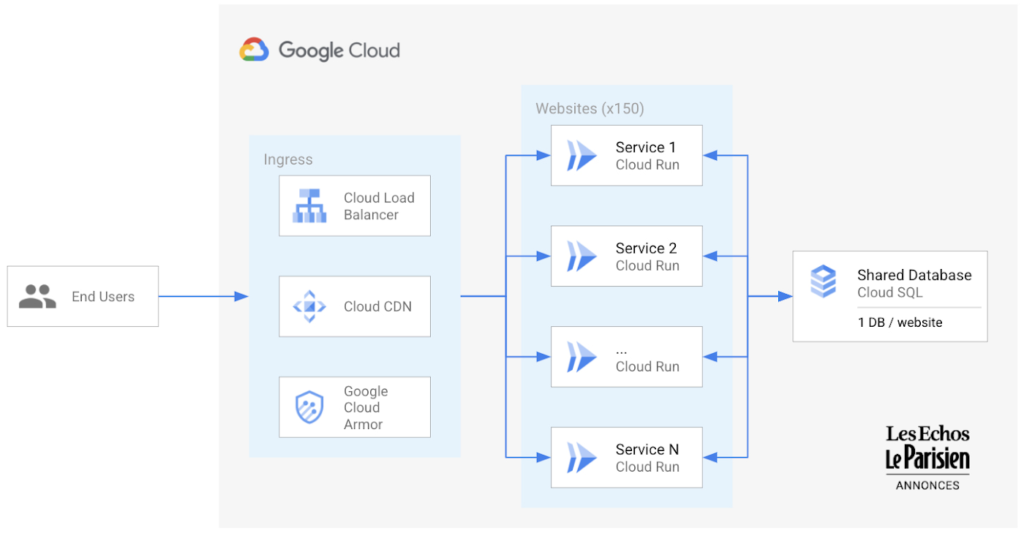
Each site, running a conventional PHP CMS solution, is now containerized and deployed as its own Cloud Run service with an independent configuration and database. This means each site scales vertically, including down to zero at times of day when that locale is quiet. Because Cloud Run is available across GCP regions, we can deploy sites closest to the market we want to reach. To further enhance our customer experience, each of these sites is run behind Cloud Global Load Balancing with Cloud Armor and Cloud CDN, providing extra security and performance. The initial pilot of 30 sites has performed well, and the remainder of the 150 current sites are now being migrated. Adding new sites has gone from taking hours to minutes. This allows Les Echos to quickly explore new opportunities in markets that previously would have taken much longer to assess and qualify for investing in a new site.
Adopting this serverless approach has been a successful step in the modernization journey to Google Cloud, allowing us to use containers to take existing software and both re-architect and re-platform to support growth while reducing toil.
Rapido: Finding the Quickest Route to Success with Google Maps Platform

3886
Of your peers have already read this article.
3:30 Minutes
The most insightful time you'll spend today!
Founded in 2015, Rapido operates a mobile app-based two-wheeler taxi service across more than 40 cities in India. More than 100,000 drivers provide Rapido two-wheeler taxi services, while more than 400,000 current or prospective drivers have downloaded the company’s app. Consumers have downloaded the app more than 5 million times, and the business receives about 5 million orders per month for taxi services.
“If a consumer wants to travel from point A to point B, they simply open up the app on their smartphone, select pickup and dropoff locations, and tap ‘request,'” explains Rishikesh SR, Co-Founder, Rapido. “We can track that request to the nearest available two-wheeler taxi and allocate the job to the right driver.”
Google a compelling opportunity
The business started operations on a cloud service. However, Google presented a compelling opportunity to Rapido to improve its location-based intelligence through a wide range of cloud-based map APIs, infrastructure, and mobile app development services. “Google Maps Platform was particularly interesting to our business and we saw enormous potential to use it to improve our service and gain a competitive edge,” says Rishikesh.
Rapido elected to use Geocoding API to enable its app to convert addresses to geographic coordinates, and the reverse, allowing consumers to identify point A and point B on their journey. The company also uses Directions API to identify the fastest route between pickup and dropoff locations, which enables Rapido to provide users with approximate prices for trips. Distance Matrix API is used to calculate the travel times and distances between locations, and Maps SDKs for Android and iOS to add interactive maps to the app.
Google Cloud Results
- Enables the business to optimize use of Maps Platform APIs
- Takes 5 million orders per month
- Establishes a robust platform for expansion
“Google Maps Platform is particularly useful for us as it identifies optimum routes for two-wheel services,” says Rishikesh. “This saves us time and money, while helping us deliver a better consumer experience.”
In addition, Rapido uses the Snap to Roads service to deliver best-fit geometry for sets of GPS coordinates within the Roads API, which identifies and provides metadata about the roads on which drivers travel. “Snap to Roads in Roads API allows us to optimize the path drivers take and helps ensure the fare charged is accurate,” says Rishikesh.
Improving user experiences
As Rapido matured, Rishikesh considered how to improve the user experience of the app while reducing the business’ costs. In 2017, Rapido asked Google Cloud Premier Partner and Google Maps Platform Partner Searce to help meet these objectives. Searce provided the technical and business advice that prompted Rapido to take advantage of the unlimited API calls, 24-hours-a-day, 7-days-a-week support, and strict SLAs available through the Google Maps APIs Premium Plan for Asset Tracking.
Searce also helped Rapido optimize its API calls and integrate directions and distance calls with the Roads API to smooth out variations in GPS readings received from the handsets of two-wheeler taxi owners. Finally, Searce helped Rapido deploy the Firebase mobile and web development platform to automate the mode configuration of the API keys, rather than maintain a time-consuming manual process. This move also minimized the likelihood of any issues arising if Rapido decided to start multiple projects or add more licenses, or combine Google Maps APIs Premium Plan for Asset Tracking with an external license.
Technical skill and experience
Searce finalized its initial engagement with Rapido last year and provides ongoing support and advice. “Searce’s technical skill with Google Maps Platform put us on the right path to provide a better, more relevant user experience,” says Rishikesh.
Rapido also now uses a range of Firebase services for app development, testing, and modification. The business employs Google Analytics for Firebase to measure customer use of and engagement with its app, enabling the business to make informed decisions about where to direct its resources. In addition, the business is using the Firebase Test Lab app-testing infrastructure to test its Android and iOS apps across a range of device configurations, view the outcomes, and make changes as needed.
Rapido uses Firebase Remote Config to change the app’s behavior and appearance on the fly in response to the results of A/B testing across sections of its user base. Furthermore, Rapido uses Firebase Crashlytics to provide app crash reports to its Firebase console.
Firebase Dynamic Links allows Rapido to direct users to linked content in the iOS or Android version of the app, while Firebase Cloud Messaging enables Rapido to deliver notifications and other messages to users. Cloud Firestore provides a NoSQL cloud database to store and sync data for the Rapido app.
Rapido has also started using the Firebase Realtime Database to store and sync information about customers that can be used to provide a more informed, personalized service.
At the same time, Rapido uses a BigQuery data warehouse to process about 10TB of data every month for analysis and reporting that supports decision-making across the business. The organization is also using application containerization through Google Kubernetes Engine on Google Cloud Platform.
“We are moving our apps from dedicated virtual machines to a scalable containerized environment that consumes fewer resources,” says Rishikesh. “It makes sense to work with Google – the business that designed the Kubernetes container-orchestration system.”
Rapido has also started using the Cloud Functions event-driven serverless compute platform to process smaller jobs. “This is ideal for small use cases in particular as we do not have to spin up virtual machine instances,” says Rishikesh.
Finally, Rapido is using image classification through the Vision AI service to analyze riders’ documentation, such as driving licenses. This allows the business to verify details such as names, addresses, and expiry dates with more than 90 percent accuracy – a high rate in a country where each state has its own license template.
Expanding rapidly to new cities
The Rapido app enables drivers to pick up customers quickly – in most cases, between 2 and 5 minutes.
Overall, the high-quality experience for consumers and drivers delivered by Google Maps Platform, combined with Firebase, has helped power Rapido to robust growth. The business now takes more than 5 million orders per month.
“With Google, we are delivering the right experience to users through Google Maps Platform, Firebase, and Google Cloud Platform services,” concludes Rishikesh. “We have realized our vision faster and now have a robust platform to grow in the future.”
Scaling with Breaking News: BBC’s Serverless Infrastructure on Google Cloud

1280
Of your peers have already read this article.
3:30 Minutes
The most insightful time you'll spend today!
Editors note: Today’s post is from Neil Craig at the British Broadcasting Corporation (BBC), the national broadcaster of the United Kingdom. Neil is part of the BBC’s Digital Distribution team which is responsible for building the services such as the public-facing www bbc.co.uk and .com websites and ensuring they are able to scale and operate reliably.
The BBC’s public-facing websites inform, educate, and entertain over 498 million adults per week across the world. Because breaking news is so unpredictable, we need a core content delivery platform that can easily scale in response to surges in traffic, which can be quite unpredictable.
To this end, we recently rebuilt our log-processing infrastructure on a Google Cloud serverless platform. We’ve found that the new system, based on Cloud Storage, Eventarc, Cloud Run and BigQuery, enables us to provide a reliable and stable service without us having to worry about scaling up during busy times. We’re also able to save license fee payers money by operating the service more cost effectively than our previous architecture. Not having to manually manage the scale of major components of the stack has freed up our time, allowing us to spend it on using, rather than creating the data.
A log in time
To operate the site and ensure our services run smoothly we continually monitor Traffic Manager and CDN access logs. Our websites generate more than 3B log lines per day, and handle large data bursts during major news events; on a busy day our system supports over 26B log lines in a single day.
As initially designed, we stored log data in a Cloud Storage bucket. But every time we needed to access that data, we had to download terabytes of logs down to a virtual machine (VM) with a large amount of attached storage, and use the ‘grep’ tool to search and analyze them. From beginning to end, this took us several hours. On heavy news days, the time lag made it difficult for the engineering team to do their jobs.
We needed a more efficient way to make this log data available, so we designed and deployed a new system that deals with logs and reacts to spikes more efficiently as they arrive, improving the timeliness of critical information significantly.
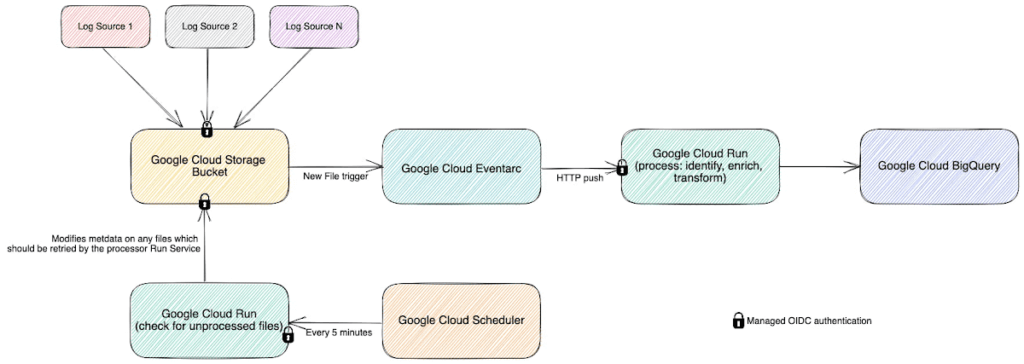
In this new system, we still leverage Cloud Storage buckets, but on arrival, each log generates an event using EventArc. That event triggers Cloud Run to validate, transform and enrich various pieces of information about the log file such as filename, prefix, and type, then processes it and outputs the processed data as a stream into BigQuery. This event-driven design allows us to process files quickly and frequently — processing a single log file typically takes less than a second. Most of the files that we feed into the system are small, fewer than 100 Megabytes, but for larger files, we automatically split those into multiple files and Cloud Run automatically creates additional parallel instances very quickly, helping the system scale almost instantly.
The nature of running a global website which provides news coverage means we see frequent, unpredictable large spikes of traffic. We learn from these and optimize our systems where necessary so we’re confident in the system’s ability to handle significant traffic. For example, around the time of the announcement of the Queen’s passing in September, we saw some huge traffic spikes. During the largest, within one minute, we went from running 150 – 200 container instances to over 1000…. and the infrastructure just worked. Because we engineered the log processing system to rely on the elasticity of a serverless architecture, we knew from the get-go that it would be able to handle this type of scaling.
Around the time of the announcement of the Queen’s passing in September, we saw some huge traffic spikes. During the largest, within one minute, we went from running 150 – 200 container instances to over 1000…. and the infrastructure just worked

Our initial concern about choosing serverless was cost. It turns out that using Cloud Run is significantly more cost-effective than running the number of VMs we would need for a system that could survive reasonable traffic spikes with a similar level of confidence.
Switching to Cloud Run also allows us to use our time more efficiently, as we no longer need to spend time managing and monitoring VM scaling or resource usage. We picked Cloud Run intentionally because we wanted a system that could scale well without manual intervention. As the digital distribution team, our job is not to do ops work on the underlying components of this system — we leave that to the specialist ops teams at Google.
Another conscious choice we made whilst rebuilding the system was to use the built-in service-to-service authentication in Google Cloud. Rather than implementing and maintaining the authentication mechanism ourselves, we add some simple configuration which instructs the client side to create and send a OIDC token for a service account we define and the server side to authenticate and authorize the client. Another example is pushing events into Cloud Run, where we can configure Cloud Run authorization to only accept events from specific EventArc triggers, so it is fully private.
Going forward, the new system has allowed us to make better use of our data safely. For example, BigQuery’s per-column permissions allow us to open up access to our logs to other engineering teams around the organization, without having to worry about sharing PII that’s restricted to approved users.
The goal of our team is to empower all teams within the BBC to get the content they want on the web when they want it, make it reliable, secure, and make sure it can scale. Google Cloud serverless products helped us to achieve these goals with relatively little effort and require significantly less management than previous generations of technology.
3621
Of your peers have already watched this video.
6:20 Minutes
The most insightful time you'll spend today!
Why Apigee: Customers Explain How this API Platform Boosts their Business
Apigee customers Expedia, Equinix, Morningstar, Swisscom, Vantiv, Telstra, Fox Broadcasting company, Laterooms.com and partners, SAP and Accenture share why they joined forces with the intelligent API management platform company.
Apigee is helping customers execute businesses commerce with other partners, securely expose assets to external developer communities, secure APIs throughout the digital value chains, open up new revenue streams and do much more.
Here is A Quick Glance at Who Said What
“Through our partnership with Apigee we have been able to create some really amazing implementations using our APIs to commerce with other partners and other types of content interactions in the marketplace and so far, the response in the market has been outstanding,” says Brad Jaehn, VP, Product GoGo.
“Businesses cannot afford to be on an island. It really is all about the interconnections among businesses. And when you are talking about sharing digital assets, you really are talking about APIs. Apigee is essential to provide a way for sharing of APIs, sharing of those assets between those companies,” says Garrett Vargas, Senior Director of Technology, Expedia.
“We mainly choose Apigee for three reasons. One is their experience in the enterprise market. They could really handle big data amounts for big enterprise customers. Second, their experience in telecom and third they really helped us to securely expose our telecom assets to the external developer community,” Heinz Herren, Head of IT.
“One of the primary reasons we selected Apigee was because it could secure APIs throughout the digital value chain. It offered us access control, authentication control, even versioning of APIs so that our customers are selecting the right APIs. It protects them and their assets as well as our assets, backend systems, and processes. Apigee allowed us to do this not only securely but very quickly. So, we are excited to partner with Apigee on the Equinix cloud exchange,” says Brian Lillie, CIO, Equinix.
“We all talk about user experience. It’s the end thing in Silicon Valley. But what about DevX. Vantiv wants to provide clean, open and standard APIs. To the Apigee powered Vantiv platform, enables our community of developers to innovate much faster. rather than having them discover capabilities by various other providers of commerce services, this one-stop shop Vantiv platform powered by Apigee give a clean, open and standard API layer for all commerce services to our developers,” says Navneet Singh, Senior VP, Product, Vantiv.
Watch this short video to know what else Apigee customers and partners are saying about the platform.
Contact Center AI (CCAI) with Agent Assist can Lower Opex and Handle 28% More Chats

4830
Of your peers have already read this article.
1:30 Minutes
The most insightful time you'll spend today!
Contact Center AI (CCAI) brings Google’s innovation in conversational AI to solve the most challenging customer service needs while lowering operational costs. More than a thousand customers have deployed CCAI and are steadily turning it on to power their production contact centers.
Today, we’re excited to announce that we’ve made CCAI even stronger with Agent Assist for Chat, now in public preview.
Agent Assist provides your human agents with continuous support during their calls and now chats by identifying the customers’ intent and providing them with real-time recommendations such as articles and FAQs as well as responses to customer messages to more effectively resolve the conversation.
Customers using Agent Assist for Chat have been able to manage up to 28% more conversations concurrently, while also driving up customer satisfaction by 10%. Additionally, we’ve seen them respond up to 15% faster to chats, reducing chat abandonment rates and solving more customer problems.
Agent Assist provides two key components to help agents manage conversations better:
- Smart Reply provides response suggestions to agents so they can quickly and appropriately respond to customer messages. These suggestions can be taken from your top performing agents as well as modified even further to ensure suggestions properly reflect the tone and voice of your brand. Agent Assist learns when and what recommendations to make by building a custom model that’s trained on your (and only your) data.
- Knowledge Assist unlocks the power of your knowledge base to provide articles and FAQ suggestions to agents in real-time as the conversation progresses. When using Knowledge Assist, agents no longer need to make the customer wait while they navigate multiple applications and data to find the resolution to the customer’s issue — the answer is delivered right to them.
“We’ve been very impressed by the chat capabilities of Agent Assist,” said Chris Smith, Vice President of Digital Service at Optus, one of the largest telecommunications companies in Australia
Optus has been using CCAI Dialogflow CX to send queries to virtual agents and sees great potential to use Agent Assist to provide recommendations to their customer support representatives. They expect Agent Assist to help minimize repetitive tasks by providing response and typeahead suggestions, helping improve the efficiency of their agents and the quality and consistency of service they provide.
Another customer, LoveHolidays, is using Agent Assist to support their agents and customers in the travel industry.
“Agent Assist has been a beneficial aid to agents and our customers alike… It gives us the power to flex our contact center staff levels in hours not weeks,” said Eugene Neale, Director of CX Engineering & Business IT at LoveHolidays
Analysts say online chat is becoming one of the most popular ways to reach out to businesses for customer support. IDC research finds that single-function contact centers worldwide are increasingly rare — in 2020, although phone/voice is still responsible for most interactions (at around 18%); email is responsible for around 13% of interactions, and live chat (without automation) is responsible for around 8% of interactions, according to IDC, Toward the AI-Powered Contact Center, Doc # EUR147017320, December 2020.
Deploying CCAI with Agent Assist for Chat
As part of Google’s Contact Center AI suite, Agent Assist provides a seamless handoff from chats managed by your Dialogflow CX virtual agents. If a conversation or customer requires a live agent, Agent Assist will help your team pick it up quickly and drive it to a satisfying resolution.
Historically, when managers saw contact center volumes increase they had two choices: allow customers to wait longer to speak to someone (lowering customer satisfaction) or bring on more agents (increasing cost to serve). Deploying CCAI provides contact center leaders with a third choice: equip agents with tools like, Agent Assist for Chat, to efficiently manage customer interactions while maintaining high quality service.
Global CCAI partners support Agent Assist for Chat
Agent Assist for Chat is a set of public APIs that your engineering team can integrate directly into an agent desktop to control the agent experience from end-to-end. For a more out-of-the-box solution, we have partnered with LivePerson and 247.ai to build Agent Assist directly into their agent desktops.
“Integrating our Conversational Cloud directly with Agent Assist means agents can leverage cutting-edge productivity AI to build even further on the massive ROI of conversational commerce, from reduced agent effort and time-to-respond to increased customer satisfaction and revenue,” said Alex Spinelli, CTO of LivePerson.
More Agent Assist resources
To learn more, check out the Agent Assist webpage. Give Agent Assist a try by training a model and then testing it using the Agent Assist simulator.
Headless e-Commerce is the Next Big Thing in Retail

5011
Of your peers have already read this article.
2:00 Minutes
The most insightful time you'll spend today!
Headless Ecommerce
In the last couple of years there has been a shift in the way retailers approach ecommerce: where in the past development efforts were prioritized around building a solid foundation for backend transactions and operations now it is clear that companies in this space are focusing on differentiating themselves by creating unique shopping experiences that increase engagement and reduce friction.
But how can development teams spend the necessary time designing and writing code for this kind of interactions while also having to seamlessly maintain ecommerce vital components like online catalogs, shopping carts and checkout payment processes? Enter headless commerce.
Headless commerce (HC) helps companies of all sizes to innovate, develop and launch in less time and using fewer resources by decoupling backend and frontend. Headless solution providers empower online retailers by offering a balance between flexibility and optimization through pre-built api-accessible modules and components that can be easily plugged into their frontend architecture. This translates into rapid development while keeping desired levels of security, compliance, integration and responsiveness.
This composable approach enables dev teams not only to create new features but also connect other ecommerce components with less effort which is critical when responding to business trends. But above all, the main benefit retailers receive from HC, is owning and controlling the frontend for an engaging customer journey as well as quickly launching new experiences.
Google Cloud + commercetools
commercetools, a leader in the headless commerce space, has partnered with Google Cloud to make their cloud-native SaaS platform available in the Google Cloud Marketplace. With a flexible API system (REST API and GraphQL), commercetools’ architecture has been designed to meet the needs of demanding omnichannel ecommerce projects while offering real flexibility to modify or extend its features. It supports a variety of storefront providers like Vue Storefront, offers a large set of integrations and supports microservice-based architectures. All this while providing access to multiple programming languages (PHP, JS, Java) via its SDK tools.
commercetools and Google Cloud provide development teams with all the tools to build high-quality digital commerce systems. Google Cloud’s scalability, AI/ML components, API management capabilities and CI/CD tools are a perfect fit to build frontend shopping experiences that easily integrate with the commercetools stack. Developers can take advantage of this compatibility by:
- Integrating systems with Google’s Retail Search, Recommendations AI and Vision Product Search
- Injecting serverless functions into commercetools using Google Cloud Functions
- Extending and integrating commercetools via Events handled by Pub/Sub
- Managing 3rd party, legacy, microservices and commercetools APIs with Apigee
- Selecting the Google Cloud region commercetools uses for zero latency for custom apps
- Expanding their microservice ecosystem with components like Cloud Storage, Cloud SQL, Firestore and BigQuery
Additionally, commercetools allows ecommerce solutions to tap into the wider Google Ecosystem by providing authoritative data via Merchant Center, advertising via product listing ads and selling via Google Shopping.
Architecture Overview
As mentioned previously, headless commerce is increasingly preferred by retailers who want to own and control the ‘front-end’ for providing and enabling an engaging and differentiated user and shopping experiences.
The approach involves a loosely coupled architecture that separates ‘front end’ from the ‘back end’ of a digital commerce application. The front end is typically built and managed by the retailer. They want to leverage an independent software vendor (ISV) offered, ready-to-use ‘back-end’ commerce building blocks for capabilities, such as product catalog, pricing, promotions, cart, shipping, account and others.

Most retailers want to invest their time and resources in building a front end that requires an agile development model to introduce new and tweaking existing user experiences to acquire and retain customers. A few retailers that do not have an in-house web development team may choose an ISV that offers ready to use front end. The front end is a web app and designed as a progressive web application (PWA) on Google Cloud. The backend is a headless commerce offered by an ISV, such as commercetools. The backend commerce capabilities are built as a set of microservices, exposed as APIs, run cloud-native and implemented as headless. It is commonly referred to as the “MACH” solution. The API-first approach of the architecture allows easily integrating ‘best of breed’ capabilities built internally and/or offered by 3rd party ISVs.
Leveraging Google Cloud Components
The architecture of the front end will be implemented on Google Cloud and will integrate with the ISV’s headless commerce back end that runs natively in Google Cloud.
The front end will be designed using cloud-native services for
- PWA web app development (Google Kubernetes Engine, CI/CD services),
- Google Product Discovery solution that includes Retail Search and Vision API Product Search for serving product search (text and image) and Recommendations AI for serving recommendations.
- Storage (Cloud Storage), Database (Cloud SQL, Cloud Firestore), and edge caching for content delivery (Cloud CDN)
- Networking (Cloud DNS, Global Load Balancing), and
- Security (Cloud Armor for DDoS, API Defense for API protection)
Additionally, API management (Apigee on Google Cloud) can be used to orchestrate interactions of the front end with the APIs of the backend commerce services. The API management’s capability will be used for accessing the services of on-premises systems, such as ERP, order management system (OMS), warehouse management system (WMS) as needed to support the functioning of digital commerce application. Alternatively, depending on the frontend capabilities, developers can use middleware to build custom services and route requests.
What’s next?
A considerable number of retailers have adopted headless commerce and are now focusing on adopting best practices and leveraging the agility that comes with this approach. Just like commercetools offers robust components that meet the retailer’s backend operational needs (Product Catalog, Order Management, Carts, Payments, etc), Google Cloud’s Compute, Networking, Severless and AI/ML services provide the agility and flexibility required by development teams to quickly and easily extend their frontend capabilities.
commercetools and Google Cloud work seamlessly together because they both prioritize ease of integration, scalability, security and iterability while providing ready-to-use building blocks. It also helps that commercetools backend runs on Google Cloud. Once an initial foundation of Google Cloud and commercetools has been established, adding new commerce modules and extending functionally of the current ones becomes a straightforward process that allows to route efforts to innovation initiatives. In the end, the main beneficiaries of this technical synergy are the shoppers that enjoy experiences which increase engagement and minimize friction.
Alternatively, retailers can also save time and resources by relying on frontend integrations. commercetools offers a variety of third-party solutions that can effortlessly be added to a headless commerce architecture. These integrations as well as other important headless commerce extensions will be explored in future blog entries. In the meantime, all the necessary tools to leverage headless commerce can be found in just one place:
Get started with commercetools on the Google Cloud Marketplace today!
More Relevant Stories for Your Company

Chrome OS’s Hybrid Work Model Powers Google’s Return to Work Strategy
The pandemic continues to deeply affect our lives around the globe. In some places, new cases are surging and returning to work is the last thing on people’s minds. In other areas, conditions are improving and companies are starting to think about transitioning their workforce back to the office. Exactly

How PLAID’S Multi-cloud Approach with Anthos Clusters on AWS Drives Higher Business Growth
Editor’s note: Today’s post comes from Naohiko Takemura, Head of Engineering, and Kosukex Oya, Engineer, both from Japanese customer experience platform PLAID. The company runs its platform in a multicloud environment through Anthos clusters on AWS and shares more on its experiences and best practices. At PLAID, our mission is to maximize the value

Quick Recap on Google Cloud: Latest News, Launches, Updates, Events and More
Want to know the latest from Google Cloud? Find it here in one handy location. Check back regularly for our newest updates, announcements, resources, events, learning opportunities, and more. Tip: Not sure where to find what you’re looking for on the Google Cloud blog? Start here: Google Cloud blog 101: Full list

New to Cloud Functions? Here’s What You Need to Learn
Cloud Functions is a fully managed event-driven serverless function-as-a-service (FaaS). It is a small piece of code that runs in response to an event. Because it is fully managed, developers can just write the code and deploy it without worrying about managing the servers or scaling up/down with traffic spikes.
